
Muga G. Time in Quantum Mechanics - Vol. 2
Подождите немного. Документ загружается.

398 R. Wynands
Sooner or later all of the atomic population will have been optically pumped
into state |F = 2, and the main cell becomes transparent for the light beam: one
observes maximum signal on the photodetector. When now a 6.8-GHz microwave is
present it can induce transitions from |F = 2 to |F = 1. This restores some popu-
lation to the light-absorbing state, so that the transmission signal decreases. A servo
loop adjusts the microwave frequency such that the detector signal is minimized. In
the absence of frequency-shifting effects the microwave frequency then is 6, 834,
682, 610. 904, 324 Hz.
However, in order to get a reasonably narrow linewidth one needs to prolong the
period of time the atoms spend inside the volume illuminated by the laser beam.
One way is to use a chemically inert buffer gas chosen such that the ground state
coherence is not destroyed by collisions of buffer gas atoms with the alkali atoms
[123]. Typical gases are the noble gases or nitrogen. Alternatively, one can coat the
walls of the cell with paraffin, siloxanes or similar substances that exhibit a very low
sticking coefficient for alkali atoms and that isolate them from paramagnetic impu-
rities inside the wall material. In this way, the ground state coherence can survive
hundreds or even thousands of wall collisions, allowing a coherence lifetime of the
order of a second and a correspondingly narrow resonance line.
Over the years a number of commercial designs have been developed for a wide
range of applications including space-qualified versions. Typical specifications are
a relative short-term instability of 3 ×10
−11
and 2 ×10
−11
at 1 second and at 1 day,
respectively. Long-term drift rates can be as low as a few parts in 10
14
per day after
an initial burn-in phase [124]. At least some of this drift is due to chemical reactions
between the alkali atoms and the walls of the cells, with additional contributions due
to a changing light spectrum coming out of the
87
Rb lamp as it ages.
Easy as it looks to replace the spectral lamp by a laser, there are several problems
with this approach [125]. For one thing, the laser frequency noise gets converted by
the absorption profile of the vapour cell into amplitude noise [126], thus reducing the
short-term stability of the clock, unless special measures are taken to stabilize the
laser parameters and to narrow the linewidth. Another issue is the question of long-
term stability of the laser characteristics, where until very recently no commercially
viable solution of the aging problem could be found.
13.8.1.2 Purely Optical Vapour-Cell Clocks
Small as these clocks are, a further miniaturization is desirable, maybe down to
chip-scale. More important would be to find a way to curb the (relatively) large
power requirements of optical-pumping clocks, ideally down to a few 10 mW so
that it could run off a reasonable-sized battery for an extended period of time. Such
small, low-power atomic clocks could find their way into GPS receivers, cell phones
or even wrist watches.
The microwave excitation sets a natural size limit to any miniaturization effort,
given by the microwave wavelength or some large fraction thereof. This limita-
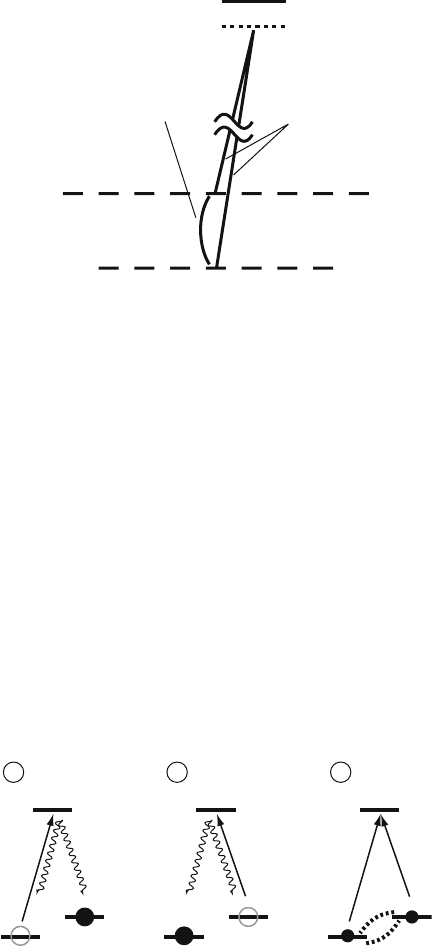
tion can be overcome by switching to an all-optical excitation scheme (Fig. 13.18).
Basically, one uses the same clock transition |F, m
F
= 0→|F + 1, m
F
= 0 but
13 Atomic Clocks 399
excited state
two laser
frequencies
one microwave
frequency
Fig. 13.18 Principle of operation of the dark-state clock. Instead of coupling the levels involved
in the “clock transition” with a microwave one uses two phase-stable laser fields with a frequency
difference precisely matching the level splitting on the clock transition
instead of coupling those levels with a microwave one uses two phase-stable laser
fields with a frequency difference precisely matching the level splitting on the clock
transition.
The phenomenon one makes use of here is called coherent population trapping
(CPT) [127]. CPT in a Λ system (Fig. 13.19) shows interesting properties suitable
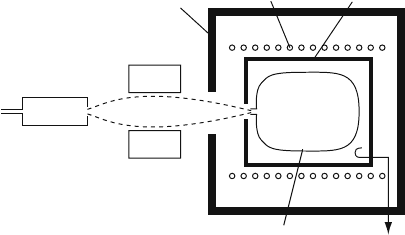
for a compact atomic clock. Consider first the situation of Fig. 13.19a. A resonant
laser field of frequency ω
1
interacts with the transition from state |1 to the excited
state |e. Excited atoms can decay back in to either |1 or |2. Since the laser is not
resonant with the transition |2→|e, any atom reaching state |2can no longer be
excited by the laser frequency ω
1
. State |2 therefore is a dark state because after
several absorption–emission cycles all population will have accumulated in it; no
more absorption can take place, therefore no more spontaneous emission light is
given off by the sample.
|1 〉
|
e 〉
|2 〉
ω
2
b
|1 〉
ω
1
ω
2
| e 〉
|2
〉
c
|1 〉
| e
〉
|2
〉
ω
1
a
Fig. 13.19 The three-level Λ system. (a) A laser resonant with the |1→|e transition cannot
interact with any population in the |2 state, so this state becomes a dark state. (b)Likewise,fora
laser resonant only with the |2→|e transition state |1 becomes a dark state. (c) For a coherent
superposition of the two laser fields the dark state is a coherent superposition of |1 and |2

400 R. Wynands
On the other hand, if the radiation is applied on the other optical transition
(Fig. 13.19b) the state |1becomes a dark state. Surprisingly (or maybe not), when a
coherent superposition of the two laser fields is applied, a new dark state consists of
a coherent superposition of the two atomic ground states, where the weights of the
two components are inversely proportional to the Rabi frequencies Ω
i
on the two
optical transitions (Fig. 13.19c):
|dark=
Ω
2
|1−Ω
1
|2
Ω
2
1
+Ω
2
2
. (13.11)
Note that this equation smoothly transforms into the two limiting cases (a) and (b)
of Fig. 13.19.
Closer inspection of the mathematics shows that atoms can reach this coherent
dark state, the quantum-mechanical superposition of two ground states, only if the
laser difference frequency closely matches the frequency splitting between the two
ground states. In that case a ground state coherence is generated that prevents any
further excitation into the excited state. For a well-designed experimental set-up,
where the two laser frequency components are derived from two phase-locked lasers
[128] or from two modulation sidebands of a single laser [129], the width of the
resonance is only limited by the lifetime of the ground state coherence, for instance
by the inverse of the observation time. It is straight-forward to obtain linewidths of
just a few 10 Hz as a function of the difference frequency of the two lasers [130]
when a buffer gas is used to prevent the atoms in a thermal vapour from leaving the
volume illuminated by the laser beams. A servo loop can lock the laser difference
frequency to the ground state hyperfine splitting frequency, i.e. 9.2 GHz for caesium
vapour or 6.8 GHz for
87
Rb vapour.
Note a difference here to the case of a microwave-induced transition in the
beam, fountain, or vapour-cell clocks described before. There the signal was con-
nected to the net transfer of population from one clock state to the other, which
can only happen when the two levels start with different populations. In con-
trast, the CPT clock relies on the generation of a ground state coherence, i.e. an
off-diagonal element in the density matrix becomes nonzero; this coherence can
be induced by the two laser beams even when the populations in the two cou-
pled ground state levels are equal. A state-selection mechanism therefore is not
required.
The first use of the CPT effect for an atomic frequency standard was in a sodium
atomic-beam experiment [131]. Later a series of papers was published that exam-
ined the use of the CPT resonance for sensitive magnetometry and for the con-
struction of vapour-cell clocks as described here (see [132] for a compilation of the
pioneering work and [133] for a more recent review). In a US–German collaboration
a first prototype of a miniaturized CPT clock could be demonstrated [134]. Shortly
thereafter, a truly chip-sized physics package for a CPT clock was constructed and
tested [135]. A recent review sums up the current state of the art [136]. A major
technological problem there is how to build and fill a millimetre-sized cell with
an alkali vapour and a buffer gas at just the right pressure. A first commercial
13 Atomic Clocks 401
device, although overall not quite at chip-scale yet, will enter the market soon. It will
probably offer an instability of 1.6×10
−11
at 1 second and of below 10
−12
at several
hours, in a package smaller than 50 cm
3
[137].
A related device is the CPT maser [138], where the radiation emitted by the oscil-
lating magnetic dipole moment (the ground state coherence) is used. The advantages
and disadvantages of this principle are discussed in [138].
13.8.2 The Hydrogen Maser
Another invention by Ramsey, and another reason for why he got the Nobel Prize,
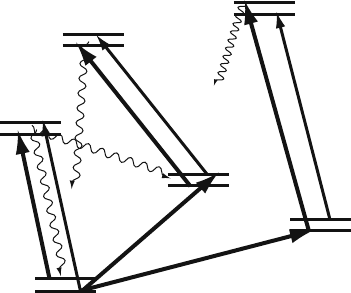
is the hydrogen maser (Fig. 13.20) [139, 140, 2]. From a beam of atomic hydrogen,
generated from H
2
gas in a radiofrequency discharge, the atoms in the upper ground
states |F = 1, m
F
= 0 and |F = 1, m
F
= 1 are focussed by a polarizer magnet
into a storage bulb inside a microwave cavity resonant with the 1.4-GHz frequency
of the |F = 1, m
F
= 0→|F = 0, m
F
= 0 hyperfine transition; atoms in the
other ground states (|F = 1, m
F
=−1 and |F = 0, m
F
= 0) are defocused
and do not reach the storage bulb. Therefore, a population inversion exists in the
hydrogen atom sample moving around inside the bulb with an average velocity close
to 0. When the flux of incoming spin-polarized atoms and their storage time in the
bulb is high enough, a self-sustained maser oscillation is possible. A small antenna
in the cavity picks up this oscillation, from which the output signal of the frequency
standard is derived.
This is the principle of operation of an active hydrogen maser, with some vari-
ation of course in the individual embodiments. The passive hydrogen maser is
H
2
source
H
source
(rf discharge)
focussing
magnet(s)
thermal
shield
bias field
coil
microwave
cavity
H storage bulb
microwave
pickup loop
and to electronics
Fig. 13.20 Principle of operation of the hydrogen maser. Molecular hydrogen gas is dissociated in
a radiofrequency discharge. Hydrogen atoms in a low-field seeking state are magnetically focussed
into a storage bulb where they can emit a microwave photon into the cavity. A pickup loop registers
the resulting cavity field and passes it on to the electronics, which in turn generates the maser output
signal from it

402 R. Wynands
constructed similarly, except that a 1.4-GHz microwave signal is sent into the cav-
ity and its amplification by the hydrogen atoms inside is monitored. The passive
maser in general has a smaller form factor at the expense of larger short-term
instability.
A key component is the storage bulb, which is coated with Teflon or similar
materials so that an |F = 1 hydrogen atom survives thousands of wall collisions
before a spin-depolarization event occurs. Storage times of several seconds are thus
possible for the hydrogen atoms.
The main advantage of a hydrogen maser is its low relative short-term instability
on the order of < 10
−14
at 1 s of averaging time. However, its long-term stabil-
ity suffers from drifts in the parameters of the set-up, in particular the geometrical
dimensions of the storage bulb (which can be, for instance, air pressure dependent
in simple designs) and chemical changes and againg of its wall coating, which in
turn change the frequency shift due to the wall collisions.
The hydrogen maser finds application wherever one needs a stable timescale, for
instance in astronomical observatories for pulsar timing or for radio interferometry
and, of course, in timing laboratories all over the world.
13.9 Optical Clocks
Perhaps the most dynamic area in the field of atomic clocks is that of optical clocks,
where great advances occurred in the last few years. So whatever I write here will be
outdated by the time this book appears in print. Therefore, here I will restrict myself
to giving only the general ideas and to focussing on some of the recent advances. A
fairly recent review covers the state of the art as of early 2005 [141].
A look at Eq. (13.7) immediately shows why an optical rather than a microwave
frequency standard might be an attractive option. The frequency ν
0
of the oscillator
appears in the denominator of the equation for the instability. Since ν
0
is five to six
orders of magnitude larger for an optical transition than for one in the microwave
regime one can expect an enormous gain in short-term stability (Table 13.1). Of
course, many other fundamental and technical problems need to be addressed before
such low instabilities can be reached. All in all, however, one can hope to reach
a clock uncertainty of around 10
−18
, after a number of expected and unexpected
technical and fundamental challenges have been met.
Table 13.1 Extrapolated short-term instabilities of some proposed optical frequency standards
calculated using Eq. (13.7) with T
cycle
= 1 s for simplicity
Atom / ion Number of atoms Transition frequency Linewidth (Hz) σ
y
(τ = 1s)
133
Cs 6 × 10
5
9.2 GHz 0.9 4 ×10
−14
171
Yb
+
1 688 THz 3.1 2 ×10
−15
40
Ca 10
7
456 THz 400 9 ×10
−17
87
Sr 10
6
430 THz 5 4 ×10
−18
13 Atomic Clocks 403
13.9.1 How an Optical Clock Works
The operating principle of an optical clock is once again covered by Fig. 13.4. Here
the oscillator is a narrow-band laser source, the spectroscopy is performed either on
a single trapped ion or on a cloud of cold atoms (free falling or held in an optical
trap). The detection is done by observing the fluorescence light coming from the
ion or atoms. One modification, however, needs to be applied to the principle of
Fig. 13.4. It is impractical to have an optical signal as the clock output. Instead, one
would rather have a microwave signal, which can then be processed by standard
electronic techniques. This task, the optical-to-microwave clockwork function, is
taken up by a femtosecond laser frequency comb.
The first role of the lasers in an optical clock is to cool the sample. In principle
the same cooling techniques are applied as described above for the case of caesium
fountain clocks. In the case of a trapped ion clock additional cooling, for instance
sideband cooling [142], can be applied to cool the motion of the atom down to its
motional ground state. The exact details, like the question of whether and how to
apply repumping light, depend on the actual atom/ion in question. As an example,
we will consider here the case of a single-ion
171
Yb trap (Fig. 13.21) [143]. Two
clock transitions are being investigated: the quadrupole transition S
1/2
→D
3/2
at
435 nm wavelength and the octupole transition S
1/2
→F
7/2
at 467 nm wavelength,
with natural linewidths of 3 Hz and some nanohertz, respectively.
The main laser cooling is done on the 369-nm transition, with some repumping
light applied on the other hyperfine transition (Fig. 13.21); a relatively strong mag-
netic field applied during the cooling phase prevents the population of dark states in
the ground state by inducing Larmor precession. In order to excite one of the clock
transitions one needs a laser with a linewidth of less than a Hertz, in order to obtain
a suitably narrow resonance line. This is achieved by locking the laser to a Fabry–
Perot resonance in a high-finesse (finesse > 100, 000 is possible) optical resonator
F = 0
F = 1
2
S
1/2
F = 0
F = 1
2
P
1/2
369 nm
(E1)
435 nm
(E2)
467 nm
(E3)
935 nm
(E1)
638 nm
(M1)
F = 1
F = 0
3
D[3/2]
1/2
F = 1
F = 2
2
D
3/2
F = 3
F = 4
2
F
7/2
F = 3
F = 2
1
D[5/2]
5/2
Fig. 13.21 Relevant levels for the
171
Yb single ion optical frequency standard, using either the
electric-quadrupole resonance line at 435 nm wavelength or the octupole line at 467 nm
404 R. Wynands
with a low-thermal expansion spacer material between the mirrors, typically glass
ceramics. This resonator must be well isolated from external perturbations, so it is
fixed on a vibration-isolated mount [144]. Impressively small linewidths of about
0.1 Hz are possible in this way [145].
After the ion has been cooled one can switch off the repumping light on the
cooling transition, and a little while later the cooling light itself. The atom is then
in the lower clock state
2
S
1/2
, F = 0. Next the probing light (either 435 or 467 nm)
is applied for some time (tenths of seconds typically). When the cooling light is
switched on again, the amount of fluorescence light observed on the cooling tran-
sition immediately after turn-on is an indication of whether the atom has made the
transition to the long-lived upper clock state or not: if there still is fluorescence light,
it has not! The absence of fluorescence light, in contrast, means that the atom is now
in the upper state of the clock transition.
The other laser frequencies are needed to prevent the atom falling into other
metastable levels. From the upper level of the cooling transition the atoms can
decay spontaneously into both hyperfine levels of the upper clock state
2
D
3/2
.The
935-nm light resonantly excites atoms in F = 1tothe
3
D[3/2]
1/2
state which decays
spontaneously into the ground state. This light beam also nonresonantly excites
the transition from the upper clock level, F = 2. This weak excitation rate must
be taken into account when considering the characteristics of the clock transition
but it has the essential and beneficial effect of depopulating the upper clock state
much faster than its very long spontaneous lifetime would prescribe. In this way
one need not wait for the atom to decay spontaneously via the forbidden clock
transition, which could take a very long time indeed! The 638-nm light prevents
shelving of the atom in the
2
F
7/2
state, which can happen by spontaneous decay
from states omitted from Fig. 13.21 that are populated by collisions with residual gas
atoms.
By repeating this cooling and probing cycle for the same detuning one can deter-
mine the transition probability for a given detuning of the interrogation laser, and by
scanning this laser one can build up a line profile of the clock transition. Its width is
Fourier-limited by the duration of the interrogation light pulse when the linewidth
of the interrogation laser is sufficiently narrow.
When the servo loop of the optical clock is closed the frequency of the narrow-
band interrogation laser is locked to the clock transition. Careful consideration has to
be given to the sampling and locking parameters in order to obtain the best stability,
as detailed in [146]. A stringent test of the quality of the optical frequency standard
realized in this way is to actually build two of them and to compare them. The PTB
group has done this for two independent
171
Yb
+
ion standards and found a frequency
difference of only 3.6 ± 6.1 ×10
−16
, i.e. no difference within the total uncertainty
[143].
We will not go into the details of systematic frequency biases of optical clocks
here – we have already done that for the example of a fountain clock above. There is
once again a long and in principle rather similar list of effects that need to be investi-
gated and controlled, with differences in detail, of course. Of particular importance
are questions related to the trapping of the atoms: offsets and motion of an ion due
13 Atomic Clocks 405
f
0
f
S( f )
f
0
f
r
f
n
= f
0
+ nf
r
f
2n
= f
0
+ 2nf
r
× 2 −
n
n+1
n−1
2n
2n+1
2n−1
m
o
d
e
o
r
d
e
r
spectral profile of
the light pulse
unknown laser
frequency
Δf
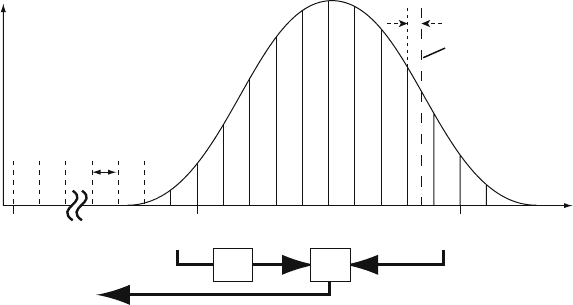
Fig. 13.22 How to measure optical frequencies with a femtosecond laser, or how to transfer an
optical frequency into the microwave regime when f
r
and f
0
are known and Δf is measured
to static or dynamically generated electrical charges on the materials in the vicinity
of the ion, or light shifts (discussed below) in an optical trap for neutral atoms.
13.9.2 Obtaining Time from an Optical Clock
The optical frequency needs to be transferred into the microwave domain so that
a time signal can be derived from it. This optical-microwave transfer can be done
with the help of a laser frequency comb [147, 148]. The principle, originally devised
for the measurement of an unknown optical frequency, is shown in Fig. 13.22.
It makes use of the fact that a periodic train of short light pulses with repetition
rate f
r
, as it comes out of a mode-locked laser, consists of a sequence of equidistant
light frequency components separated by f
r
in frequency space. Except for a small
frequency offset the absolute frequency of one of these modes is a large integer
multiple of f
r
. The small offset frequency f
0
reflects the phase slip between carrier
and envelope of the short pulses as a result of the difference between group and
phase velocity in the medium traversed by the pulses. The frequency of an optical
lightwave can be determined by measuring its offset (in the radiofrequency range)
from the closest mode of the comb.
Using the strong optical nonlinearity of special types of optical fibre one can
broaden the frequency spectrum of the pulsed laser beam so much that it spans
more than one octave. This allows one to frequency-double one of the low-frequency
modes and compare the second harmonic to the closest one of the high-frequency
modes. As indicated in Fig. 13.22 this can be used to determine f
0
, or even to lock it
to some desired value. When the system is run “in reverse”, it allows one to transfer
the optical frequency of an optical clock into the microwave domain.
Systems like that have been used to determine the frequencies of a number
of optical transitions by now, relative to the SI second reproduced by a caesium
406 R. Wynands
fountain clock, by locking f
r
to the caesium clock output. Even more precise are
frequency comparisons between optical transition lines directly, without the detour
through the caesium-based SI second: relative uncertainties of the frequency ratio
of about 10
−17
have been demonstrated [149].
13.9.3 Which System Would Make the “Best” Optical Clock?
What would be the best ion or atom to use in an optical clock? This question is
hard to decide because so many different and competing aspects enter, like the
sensitivity of the clock transition frequency to the Zeeman effect or to blackbody
radiation, or the influence of nuclear quadrupole moments. On top of that, the ion’s
or atom’s level structure must allow laser cooling with reasonable effort, including
the provision of the required laser wavelengths. It is an interesting idea, therefore, to
separate the two functions, that of being laser coolable and that of having a suitable
clock transition, into two ions of different chemical species [150]. When the two
ions are trapped inside a linear ion trap, for instance, their joint normal modes of
motion can be cooled by laser-cooling one ion. The clock transition can be excited
and read out by entangling internal states of the ion with the motional states in the
trap – the quantum logic clock. This has been demonstrated with a combination of
9
Be
+
for cooling and
27
Al
+
as the clock ion [151].
Whether a single ion or a cloud of cold atoms is the better optical clock depends
on whether one is more interested in low instability or in low uncertainty. Certainly,
with many atoms one obtains a much higher signal, but on the other hand those
atoms could potentially interact with each other. Also, for a single ion the question
of inhomogeneity of external magnetic or laser light fields is not an issue. Until
recently, the observation time for a cold atom cloud in a clock was limited to the
free-fall time in Earth’s gravity. In principle, one could trap atoms using the periodic
light shift potential they experience in a 1D, 2D, or 3D standing wave. However, in
general the trapping light would also shift one of the clock states, thus giving a
frequency bias that would be extremely hard to control. Fortunately, it was then
pointed out that for strontium, for instance, a specific, “magic” wavelength for the
trapping light would cause the same light shift for both trapping states, so that no
frequency bias would be caused by the trapping lasers [152]. Similarly, Yb and Ca
could be trapped with their respective “magic” wavelengths.
This has certainly helped to push ahead the work on neutral atom clocks, with
several groups now working on Sr optical clocks. Measurements of the frequency
of the
1
S
0
→
3
P
0
transition in
87
Sr by three groups agree within 1 × 10
−15
with
each other [153], making this transition a potential candidate for the redefinition
of the second. It is an open question whether a Bose–Einstein condensate of atoms
could be useful for an atomic clock; after all, in this dense sample the question of
interactions becomes of critical importance.
Today the optical clocks with the lowest estimated frequency bias are ion clocks,
in particular the clock transitions
1
S
0
→
3
P
0
in
27
Al
+
and
2
S
1/2
→
2
D
5/2
in
199
Hg
+
.
13 Atomic Clocks 407
Their current relative systematic uncertainties stand at 2.3 ×10
−17
and 1.9 ×10
−17
,
respectively [149]. This is more than an order of magnitude better than the uncer-
tainty within which the best fountain clocks can reproduce the SI second as it is
currently defined.
In 2006 the Meter Convention recommended one microwave and four optical
transitions as secondary representations of the second [154]; they are listed in
Table 13.2. The elements and transitions in the table are, of course, not the only
candidates for a future redefinition of the second – the race is wide open and will
still take some time to decide. After all, when the definition of the second is changed
one wants to be sure that one really has made the best choice. That is why in all
probability at its next official meeting in 2011 the Meter Convention will leave the
caesium-based definition of the second untouched for now even though one or more
other base units might be redefined [155]. However, at that time we can expect to
see recommendations for other secondary representations of the second, as well as
reductions in the assigned uncertainties of those in Table 13.2.
Table 13.2 Transitions recommended in 2007 as secondary representations of the second
Atom / ion Transition Frequency (Hz) Relative uncertainty Group
87
Rb S
1/2
→ S
1/2
6,834,682,610. 904,324 3 ×10
−15
SYRTE
199
Hg
+
S
1/2
→ D
5/2
1,064,721,609,899,145 3 ×10
−15
NIST
171
Yb
+
S
1/2
→ D
3/2
688,358,979,309,308 9 ×10
−15
PTB
88
Sr
+
S
1/2
→ D
5/2
484,779,044,095,484 7 ×10
−15
NPL
87
Sr
1
S
0
→
3
P
0
429,228,004,229,877 1.5 ×10
−14
U. Tokyo, SYRTE, NIST
13.10 The Future (Maybe)
If we look at clock-making in general, we find a recurring theme. It is always a
quest for an oscillating system that is ever better isolated from its surroundings.
In that sense a vibrating quartz crystal is better than a mechanical pendulum and
an oscillating magnetic transition dipole moment in an atom much better than a
macroscopic crystal. If we carry this thought further, one might think about a system
even more isolated than an electron in an atom: an oscillation of a nucleus [156].
Certainly, at some point a few years ahead the caesium-based definition of the
length of the SI second will be replaced by one based on a transition in the optical
frequency range. Until then, caesium fountain clocks will remain the most precise
(and still improving) standards of time.
13.10.1 A Nuclear Clock?
Typically, excitations of an atomic nucleus lie in the MeV energy range, but in the
case of the thorium isotope
229
Th a low-lying energy state a mere 7.6 eV above the
ground state has been deduced from the analysis of high-energy decay spectra [157].