
Neubauer A., Freudenberger J., Kuhn V. Coding theory: algorithms, architectures and applications
Подождите немного. Документ загружается.

226 SPACE–TIME CODES
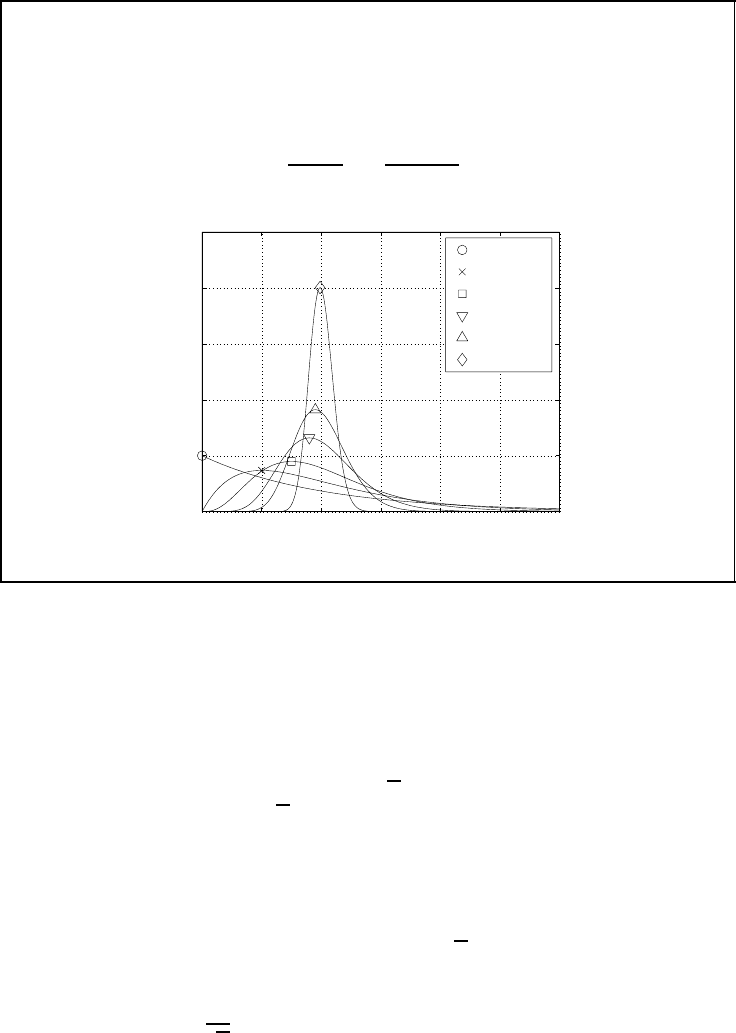
SNR distribution for diversity reception
■ Probability density function of SNR normalised to unit mean
p(ξ) =
!
D
E
s
/N
0
"
D
·
ξ
D−1
(D − 1)!
· e
−ξD/(E
s
/N
0
)
(5.18)
0 0.5 1 1.5 2 2.5 3
0
1
2
3
4
5
ξ →
p(ξ) →
D = 1
D = 2
D = 4
D = 10
D = 20
D = 100
Figure 5.9: Probability density function of SNR for D-fold diversity, Rayleigh
distributed coefficients and Maximum Ratio Combining (MRC). Reproduced by
permission of John Wiley & Sons, Ltd
the expectation with respect to the chi-square distribution with 2D degrees of freedom
has to be determined. For BPSK and i.i.d. diversity branches, an exact solution is given in
Equation (5.21) (Proakis, 2001). The parameter
γ denotes the average SNR in each branch.
A well-known approximation for
γ 1 provides a better illustration of the result. In this
case, (1 + α)/2 ≈ 1 holds and the sum in Equation (5.21) becomes
D−1
=0
D − 1 +
=
2D − 1
D
(5.19)
Furthermore, the Taylor series yields (1 − α)/2 ≈ 1/(4
γ). With these results, the symbol
error rate can be approximated for large signal-to-noise ratios by
P
s
≈
1
4γ
D
·
2D − 1
D
=
(
4E
s
/N
0
)
−D
·
2D − 1
D
(5.20)
Obviously, P
s
is proportional to the Dth power of the reciprocal signal-to-noise ratio. Since
error rate curves are scaled logarithmically, their slope will be dominated by the diversity
SPACE–TIME CODES 227
Error rate performance for diversity reception
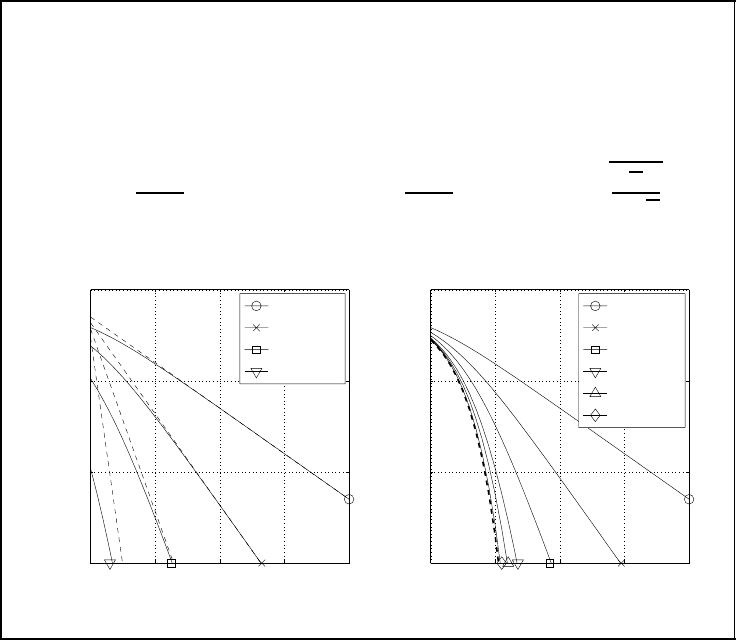
■ Error probability for Binary Phase Shift Keying (BPSK), Rayleigh density
and D-fold diversity
P
s
=
1 − α
2
D
·
D−1
=0
D − 1 +
·
1 + α
2
with α =
γ
1 + γ
(5.21)
0 10 20 30 40
10
Ŧ6
10
Ŧ4
10
Ŧ2
10
0
0 10 20 30 40
10
Ŧ6
10
Ŧ4
10
Ŧ2
10
0
E
b
/N
0
in dB →
P
s
→
P
s
→
D = 1D = 1
D = 2D = 2
D = 4
D = 4
D = 10
D = 10
D = 20
D = 100
(a) SNR per antenna
(b) SNR per symbol
DE
b
/N
0
in dB →
Figure 5.10: Error probability for D-fold diversity, BPSK, Rayleigh distributed
coefficients and MRC: (a) SNR measured per receive antenna (dashed lines =
approximation from expression (5.20)), (b) SNR per combined symbol (bold dashed line
= AWGN reference)
degree D at high SNRs. This is confirmed by the results depicted in Figure 5.10. In diagram
(a) the symbol error probability is plotted versus the signal-to-noise ratio E
s
/N
0
per receive
antenna. Hence, we observe the array gain as well as the diversity gain. The array gain
amounts to 3 dB if D is doubled, e.g. from D = 1toD = 2. The additional gap is caused
by the diversity gain. It can be illuminated by the curves’ slopes at high SNRs, as indicated
by the dashed lines.
In diagram (b), the same error probabilities are plotted versus the SNR after the com-
biner. Therefore, the array gain is invisible and only the diversity gain can be observed.
The gains are largest at high signal-to-noise ratios and if the diversity degree increases
from a low level. Asymptotically for D →∞, the AWGN performance without any fading
is reached.
228 SPACE–TIME CODES
Outage probability
For slowly fading channels, the average error probability is often of minor interest. Instead,
operators are particularly interested in the probability that the system will not be able to
guarantee a specified target error rate. This probability is called the outage probability P
out
.
Since the instantaneous error probability P
s
(γ []) depends directly on the actual signal-to-
noise ratio γ [], the probability of an outage event when maximum ratio combining i.i.d.
diversity paths is obtained by integrating the distribution in Equation (5.17)
P
out
= Pr{P
s
(γ [])>P
t
}=
γ
t
-
0
p(ξ) dξ (5.22)
The target SNR γ
t
corresponds to the desired error probability P
t
= P
s
(γ
t
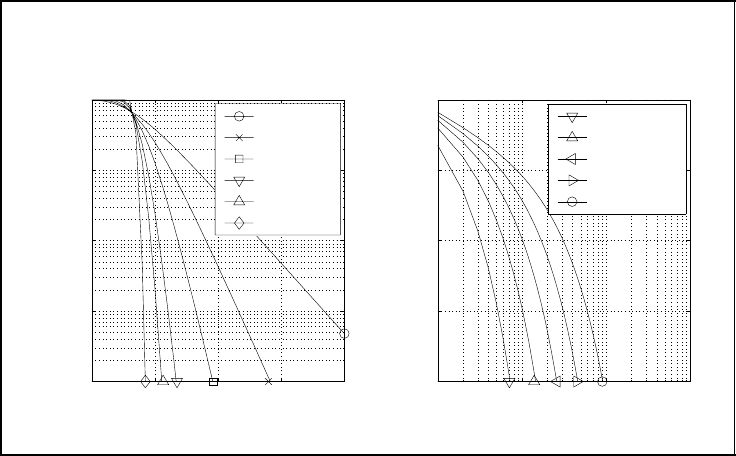
). Figure 5.11
shows numerical results for BPSK. The left-hand diagram shows P
out
versus E
b
/N
0
for a
fixed target error rate of P
t
= 10
−3
. Obviously, P
out
decreases with growing signal-to-noise
ratio as well as with increasing diversity degree D. At very small values of E
s
/N
0
,we
observe the astonishing effect that high diversity degrees provide a worse performance.
This can be explained by the fact that the variations in γ [] become very small for large
D. As a consequence, instantaneous signal-to-noise ratios lying above the average E
s
/N
0
occur less frequently than for low D, resulting in the described effect. Diagram (b) shows
Outage probabilities for diversity reception
0 10 20 30 40
10
Ŧ4
10
Ŧ3
10
Ŧ2
10
Ŧ1
10
0
10
0
10
1
10
2
10
3
10
Ŧ8
10
Ŧ6
10
Ŧ4
10
Ŧ2
10
0
E
b
/N
0
in dB →
P
out
→
P
out
→
D →
D = 1
D = 2
D = 4
D = 10
D = 20
D = 100
P
t
= 10
−1
P
t
= 10
−2
P
t
= 10
−3
P
t
= 10
−4
P
t
= 10
−5
(a) P
t
= 10
−3
(b) 10 log
10
(E
b
/N
0
) = 12 dB
Figure 5.11: Outage probabilities for BPSK and i.i.d. Rayleigh fading channels:
(a) a target error rate of P
t
= 10
−3
and (b) 10 log
10
(E
b
/N
0
) = 12 dB. Reproduced by
permission of John Wiley & Sons, Ltd
SPACE–TIME CODES 229
the results for a fixed value 10 log
10
(E
b
/N
0
) = 12 dB. Obviously, diversity can reduce the
outage probability remarkably.
5.2 Spatial Channels
5.2.1 Basic Description
Contrary to scalar channels with a single input and a single output introduced in Chapter 1,
spatial channels resulting from the deployment of multiple transmit and receive antennas
are vector channels with an additional degree of freedom, namely the spatial dimension.
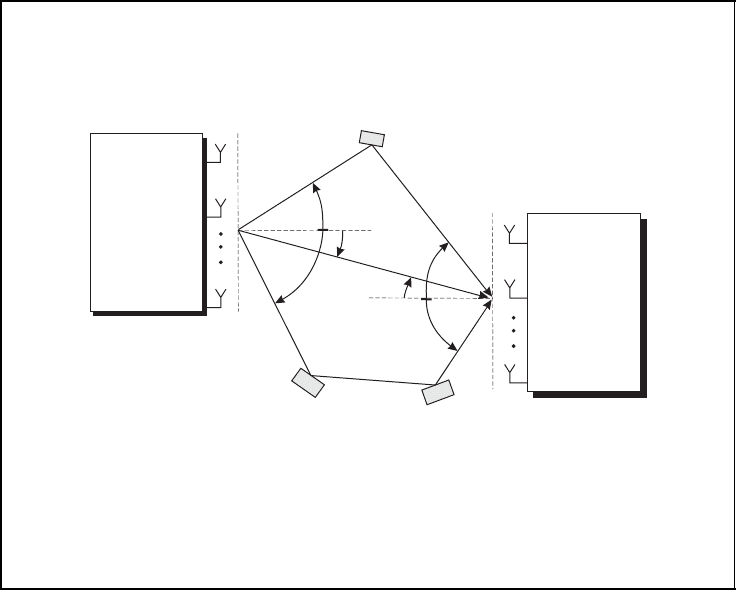
A general scenario is depicted in Figure 5.12. It illustrates a two-dimensional view that
considers only the azimuth but not the elevation. For the scope of this chapter, this two-
dimensional approach is sufficient and will be used in the subsequent description. An
extension to a truly three-dimensional spatial model is straightforward and differs only by
an additional parameter, the elevation angle.
As shown in Figure 5.12, the azimuth angle θ
R
denotes the DoA of an impinging
waveform with respect to the orientation of the antenna array. Equivalently, θ
T
represents
Channel with multiple transmit and receive antennas
Simple model with discrete DoAs and DoDs:
transmitter
receiver
scatterer
scatterers
θ
T,1
θ
T,2
θ
T,LoS
θ
R,1
θ
R,2
θ
R,LoS
■ Multiple direction of arrivals (DoAs) θ
R,µ
at receiver.
■ Direction of departure (DoD) θ
T,µ
at transmitter depends on Direction of
Arrival (DoA) θ
R,µ
.
⇒ Channel impulse response h(t,τ,θR) is a three-dimensional function.
Figure 5.12: Channel with multiple transmit and receive antennas

230 SPACE–TIME CODES
the DoD of a waveform leaving the transmitting antenna array. Obviously, both angles
depend on the orientation of the antenna arrays at transmitter and receiver as well as on the
location of the scatterers. For the purpose of this book it is sufficient to presuppose a one-
to-one correspondence between θ
R
and θ
T
. In this case, the DoD is a function of the DoA
and the channel impulse response has to be parameterised by only one additional param-
eter, the azimuth angle θ
R
. Hence, the generally time-varying channel impulse response
h(t, τ ) known from Chapter 1 is extended by a third parameter, the direction of arrival θ
R
.
1
Therefore, the augmented channel impulse response h(t,τ,θ
R
) bears information about the
angular power distribution.
Principally, Line of Sight (LoS) and non-line of sight (NLoS) scenarios are distin-
guished. In Figure 5.12, an LoS path with azimuth angles θ
T,LoS
and θ
R,LoS
exists. Those
paths are mainly modelled by a Ricean fading process and occur for rural outdoor areas.
NLoS scenarios typically occur in indoor environments and urban areas with rich scatter-
ing, and the corresponding channel coefficients are generally modelled as Rayleigh fading
processes.
Statistical Characterisation
As the spatial channel represents a stochastic process, we can follow the derivation in
Chapter 1 and describe it by statistical means. According to Figure 5.13, we start with the
autocorrelation function φ
HH
(t,τ,θ
R
) of h(t,τ,θ
R
) which depends on three parameters,
the temporal shift t, the delay τ and the DoA θ
R
. Performing a Fourier transformation with
respect to t delivers the three-dimensional Doppler delay-angle scattering function defined
in Equation (5.24) (Paulraj et al., 2003). It describes the power distribution with respect
to its three parameters. If
HH
(f
d
,τ,θ
R
) is narrow, the angular spread is small, while a
broad function with significant contributions over the whole range −π<θ
R
≤ π indicates
a rather diffuse scattering environment. Hence, we can distinguish between space-selective
and non-selective environments.
Similarly to scalar channels, integrations over undesired variables deliver marginal
spectra. As an example, the delay-angle scattering function is shown in Equation (5.25).
Similarly, we obtain the power Doppler spectrum
HH
(f
d
) =
π
-
−π
∞
-
0
HH
(f
d
,τ,θ
R
)dτ dθ
R
,
the power delay profile
HH
(τ ) =
π
-
−π
HH
(τ, θ
R
)dθ
R
or the power azimuth spectrum
HH
(θ) =
∞
-
0
HH
(τ, θ) dτ .
1
In order to simplify notation, we will use in this subsection a channel representation assuming that all
parameters are continuously distributed.

SPACE–TIME CODES 231
Statistical description of spatial channels
■ Extended channel impulse response h(t,τ,θ
R
).
■ Autocorrelation function of h(t,τ,θ
R
)
φ
HH
(t,τ,θ
R
) =
-
∞
−∞
h(t,τ,θ
R
) · h
∗
(t +t,τ,θ
R
)dt (5.23)
■ Doppler delay-angle scattering function
HH
(f
d
,τ,θ
R
) =
-
∞
−∞
φ
HH
(ξ,τ,θ
R
) · e
−j2πf
d
ξ
dξ (5.24)
■ Delay-angle scattering function
HH
(τ, θ
R
) =
f
d max
-
−f
d max
HH
(f
d
,τ,θ
R
)df
d
(5.25)
Figure 5.13: Statistical description of spatial channels
Typical Scenarios
Looking for typical propagation conditions, some classifications can be made. First, outdoor
and indoor environments have to be distinguished. While indoor channels are often affected
by rich scattering environments with low mobility, the outdoor case shows a larger variety
of different propagation conditions. Here, macro-, micro- and picocells in cellular networks
show a significantly different behaviour. Besides different cell sizes, these cases also differ
as regards the number and spatial distribution of scatterers, mobile users and the position of
the base station or access point. At this point, we will not give a comprehensive overview of
all possible scenarios but confine ourselves to the description of an exemplary environment
and some settings used for standardisation.
A typical scenario of a macrocell environment is depicted in Figure 5.14. Since the
uplink is being considered, θ
R
denotes the DoA at the base station while θ
T
denotes
the DoD at the mobile unit. The latter is often assumed to be uniformly surrounded
by local scatterers, resulting in a diffuse field of impinging waveforms arriving from
nearly all directions. Hence, the angular spread θ
T
that defines the azimuthal range
within which signal paths depart amounts to θ
T
= 2π . By contrast, the base station
is generally elevated above rooftops. Scatterers are not as close to the base station as
for the mobile device and are likely to occur in clusters located at discrete azimuth
angles θ
R
. Depending on the size and the structure of a cluster, a certain angular spread
θ
R
! 2π is associated with it. Moreover, the propagation delay τ
i
corresponding to
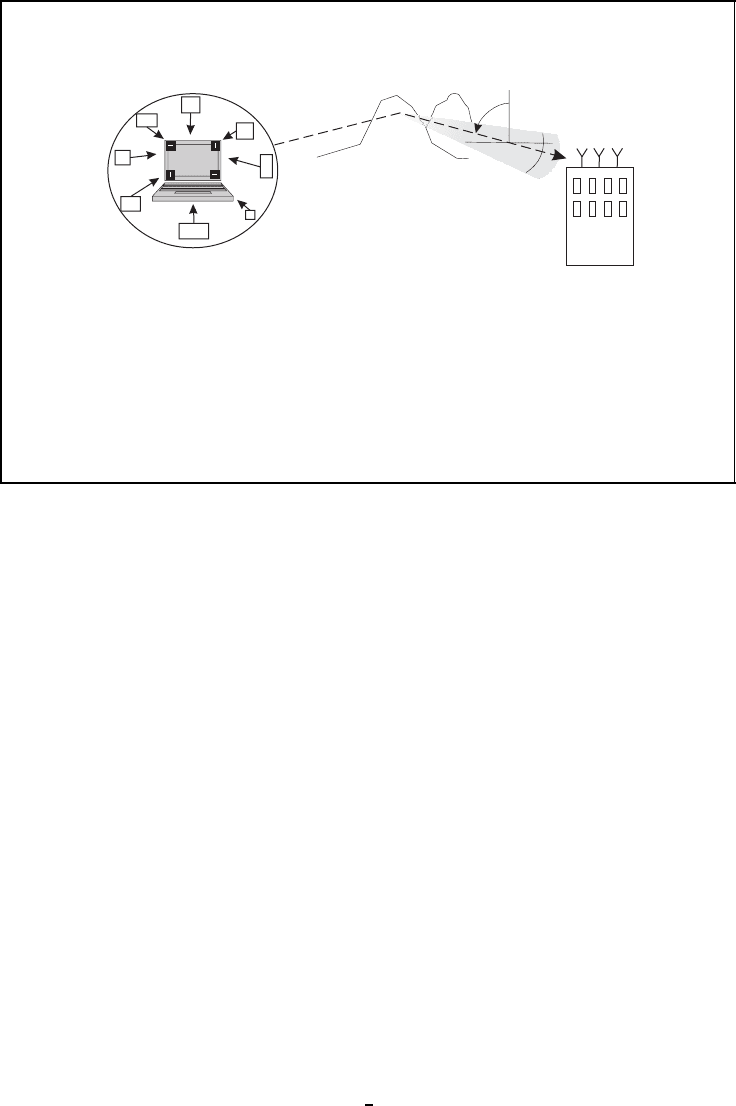
232 SPACE–TIME CODES
Spatial channel properties in a typical macrocell environment
mobile unit
base
station
θ
R
θ
R
■ Example for uplink transmission from mobile to base station.
■ More or less uniform distributed scatterers local to mobile unit.
■ Distinct preferred directions of arrival and departure at base station.
■ Cluster of scatterers leads to preferred direction θ
R
with certain angular
spread θ
R
.
Figure 5.14: Spatial channel properties in a typical macrocell environment
cluster i depends on the length of the path from transmitter over the scatterer towards the
receiver.
In order to evaluate competing architectures, multiple access strategies, etc., of future
telecommunication systems, their standardisation requires the definition of certain test cases.
These cases include a set of channel profiles under which the techniques under consider-
ation have to be evaluated. Figure 5.15 shows a set of channel profiles defined by the
third-Generation Partnership Project 3GPP (3GPP, 2003). The Third-Generation Partner-
ship Project (3GPP) is a collaboration agreement between the following telecommunications
standards bodies and supports the standardisation process by elaborating agreements on
technical proposals:
– ARIB: Association of Radio Industries and Business,
http://www.arib.or.jp/english/index.html
– CCSA: China Communications Standards Association,
http://www.ccsa.org.cn/english
– ETSI: European Telecommunications Standards Institute,
http://www.etsi.org
– ATIS: Alliance for Telecommunications Industry Solutions,
http://www.atis.org
– TTA: Telecommunications Technology Association,
http://www.tta.or.kr/e
index.htm

SPACE–TIME CODES 233
– TTC: Telecommunications Technology Committee,
http://www.ttc.or.jp/e/index.html
In Figure 5.15, d represents the antenna spacing in multiples of the wavelength λ. For the
mobile unit, two antennas are generally assumed, while the base station can deploy more
antennas. Regarding the mobile, NLoS and LoS scenarios are distinguished for the modified
pedestrian A power delay profile. With a line-of-sight (LoS) component, the scattered paths
are uniformly distributed in the range [−π, π] and have a large angular spread. Only the
LoS component arrives and departs from a preferred direction. In the absence of an LoS
component and for all other power delay profiles, the power azimuth spectrum is assumed
to be Laplacian distributed
p
(θ) = K ·e
−
√
2|θ−
¯
|
σ
· G(θ )
with mean
¯
and root mean square σ
. The array gain G(θ ) certainly depends on the angle
θ, and K is a normalisation constant ensuring that the integral over p
(θ) equals unity.
Here, the base station array, generally mounted above rooftops, is characterised by small
angular spreads and distinct DoDs and DoAs. In the next subsection, it will be shown how
to classify and model spatial channels.
3GPP SCM link level parameters (3GPP, 2003)
Model Case 1 Case 2 Case 3
power delay profile mod. pedestrian
A
vehicular A pedestrian B
d 0.5λ 0.5λ 0.5λ
Mobile
θ
R
, θ
T
1) LoS on:
LoS path 22.5
◦
,
rest uniform
67.5
◦
Odd paths: 22.5
◦
,
Even paths:
−67.5
◦
station 2) LoS off: 67.5
◦
,
(Laplacian)
σ
θ
R
1) LoS on:
uniform for
NLoS paths
35
◦
(Laplacian)
or
uniform
35
◦
(Laplacian)
2) LoS off: 35
◦
d Uniform linear array with 0.5λ, 4λ or 10λ
Base θ
T
50
◦
station θ
R
20
◦
σ
θ
T,R
2
◦
for DoD , 5
◦
for DoA
Figure 5.15: 3GPP SCM link level parameters (3GPP, 2003)
234 SPACE–TIME CODES
5.2.2 Spatial Channel Models
General Classification
In Chapter 1, channels with a single input and a single output have been introduced. For a
frequency-selective channel with L
h
taps, their output was described by
r[k] =
L
h
−1
κ=0
h[k, κ] ·x[k − κ] + n[k] .
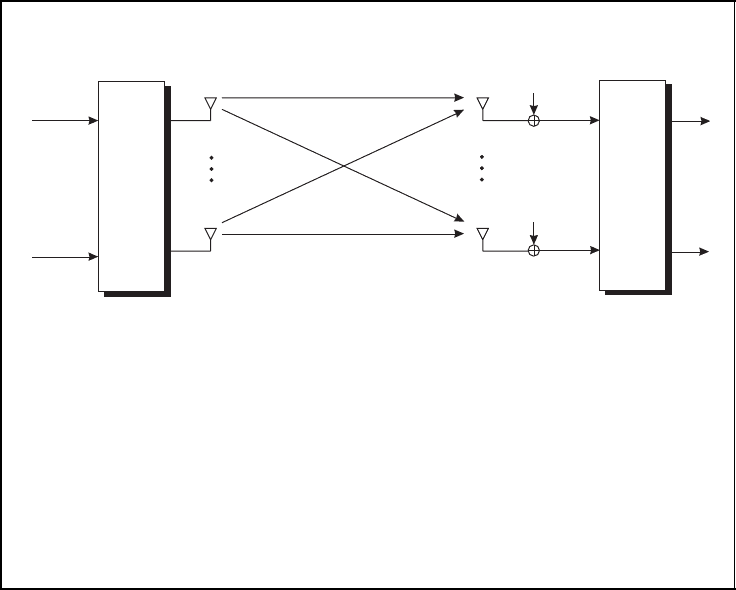
In this chapter, we extend the scenario to multiple-input and multiple-output (MIMO)
systems as depicted in Figure 5.16. The MIMO channel has N
T
inputs represented by the
signal vector
x[k] =
x
1
[k] ··· x
N
T
[k]
T
and N
R
outputs denoted by
r[k] =
r
1
[k] ··· r
N
R
[k]
T
.
General structure of a frequency-selective MIMO channel
Rx
Tx
x
1
[k]
x
N
T
[k]
r
1
[k]
r
N
R
[k]
h
1,1
[k, κ]
h
N
R
,1
[k, κ]
h
1,N
T
[k, κ]
h
N
R
,N
T
[k, κ]
n
1
[k]
n
N
R
[k]
■ Received signal at antenna µ
r
µ
[k] =
N
T
ν=1
L
h
−1
κ=0
h
µ,ν
[k, κ] ·x
ν
[k − κ] +n
µ
[k] (5.26)
■ Entire received signal vector
r[k] =
L
h
−1
κ=0
H[k, κ] ·x[k − κ] +n[k] = H[k] · x
L
h
[k] + n[k] (5.27)
Figure 5.16: General structure of a frequency-selective MIMO channel

SPACE–TIME CODES 235
Each pair (ν, µ) of transmit and receive antennas is connected by a generally frequency-
selective single-input single-output channel h
µ,ν
[k, κ], the properties of which have already
been described in Chapter 1. At each receive antenna, the N
T
transmit signals and additive
noise superpose, so that the νth output at time instant k can be expressed as in Equation
(5.26) in Figure 5.16. The parameter L
h
represents the largest number of taps among all
contributing channels.
A more compact description is obtained by using vector notations. According to
Equation (5.27), the output vector
r[k] =
r
1
[k] ··· r
N
R
[k]
T
can be described by the convolution of a sequence of channel matrices
H[k, κ] =
h
1,1
[k, κ] ··· h
1,N
T
[k, κ]
.
.
.
.
.
.
.
.
.
h
N
R
,1
[k, κ] ··· h
N
R
,N
T
[k, κ]
with 0 ≤ κ<L
h
and the input vector x[k] plus the N
R
dimensional noise vector n[k].
Each row of the channel matrix H[k, κ] contains the coefficients corresponding to a specific
receive antenna, and each column comprises the coefficients of a specific transmit antenna,
all for a certain delay κ at time instant k. Arranging all matrices H[k, κ] side by side to an
overall channel matrix
H[k] =
H[k, 0] ··· H[k, L
h
− 1]
and stacking all input vectors x[k − κ] on top of each other
x
L
h
[k] =
x[k]
T
··· x[k − L
h
− 1]
T
T
leads to the expression on the right-handside of Equation (5.27) in Figure 5.16.
The general MIMO scenario of Figure 5.16 contains some special cases. For the
frequency-non-selective MIMO case, H[k, κ] = 0
N
R
×N
T
holds for κ>0 and the model
simplifies to
r[k] = H[k] ·x[k] + n[k]
with H[k] = H[k, 0]. Many space–time coding concepts have been originally designed
especially for this flat fading case where the channel does not provide frequency diversity. In
Orthogonal Frequency Division Multiplexing (OFDM) systems with multiple transmit and
receive antennas, the data symbols are spread over different subcarriers each experiencing
a flat fading MIMO channel. Two further cases depicted in Figure 5.17 are obtained if
the transmitter or the receiver deploys only a single antenna. The channel matrix of these
Single-input Multiple-Output (SIMO) systems reduces in this case to a column vector
h[k, κ] =
h
1,1
[k, κ] ··· h
N
R
,1
[k, κ]
T
.
By Contrast, the Multiple-Input Single-Output (MISO) system has multiple inputs but only
a single receive antenna and is specified by the row vector
h
[k, κ] =
h
1,1
[k, κ] ··· h
N
R
,1
[k, κ]
.
In order to distinguish between column and row vectors, the latter is underlined. Appro-
priate transmission strategies for MIMO, SIMO and MISO scenarios are discussed in later
sections.