
Neubauer A., Freudenberger J., Kuhn V. Coding theory: algorithms, architectures and applications
Подождите немного. Документ загружается.

246 SPACE–TIME CODES
for a specific channel H is similarly defined as the mutual information of the scalar case
(Figure 5.21). With the differential entropies
I
diff
(R | H) = log
2
det(πe
RR
)
and
I
diff
(N ) = log
2
det(πe
NN
)
,
we obtain the right-handside of Equation (5.47). With the relation r = Hx + n, the covari-
ance matrix
RR
of the channel output r becomes
RR
= E{rr
H
}=H
XX
H
H
+
NN
.
Moreover, mutually independent noise contributions at the N
R
receive antennas are often
assumed, resulting in the noise covariance matrix
NN
= σ
2
N
· I
N
R
.
Inserting these covariance matrices into Equation (5.47) and exploiting the singular value
decomposition of the channel matrix H = U
H
H
V
H
H
delivers the result in Equation (5.48).
It has to be mentioned that the singular values σ
H,i
of H are related to the eigenvalues
λ
H,i
of HH
H
by λ
H,i
= σ
2
H,i
.
Next, we distinguish two cases with respect to the available channel knowledge. If only
the receiver has perfect channel knowledge, the best strategy is to transmit independent
data streams over the antenna elements, all with average power σ
2
X
. This corresponds to
the transmit covariance matrix
XX
= σ
2
X
· I
N
T
and leads to the result in Equation (5.49).
Since the matrix in Equation (5.49) is diagonal, the whole argument of the determinant is
a diagonal matrix. Hence, the determinant equals the product of all diagonal elements which
is transformed by the logarithm into the sum of the individual logarithms. We recognize
from the right-handside of Equation(5.49) that the MIMO channel has been decomposed
into a set of parallel (independent) scalar channels with individual signal-to-noise ratios
σ
2
H,i
σ
2
X
/σ
2
N
. Therefore, the total capacity is simply the sum of the individual capacities of
the contributing parallel scalar channels.
If the transmitter knows the channel matrix perfectly, it can exploit the eigenmodes
of the channel and, therefore, achieve a higher throughput. In order to accomplish this
advantage, the transmitter covariance matrix has to be chosen as
XX
= V
H
·
X
· V
H
H
,
i.e. the eigenvectors have to equal those of H. Inserting the last equation into Equation
(5.48), we see that the eigenvector matrices V
H
eliminate themselves, leading to Equation
(5.50). Again, all matrices are diagonal matrices, and we obtain the right-handside of
Equation (5.50). The question that still has to be answered is how to choose the eigenvalues
λ
H,i
= σ
2
H,i
of
XX
, i.e. how to distribute the transmit power over the parallel data streams.
Following the procedure described elsewhere (Cover and Thomas, 1991; K
¨
uhn, 2006)
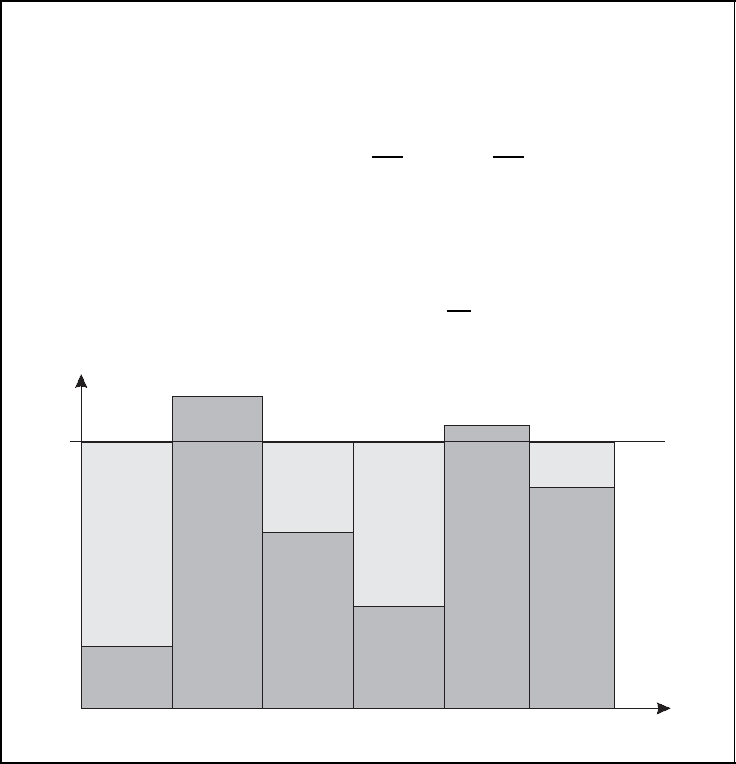
using Lagrangian multipliers, the famous waterfilling solution is obtained. It is illustrated in
Figure 5.25, where each bin represents one of the scalar channels. We have to imagine the
SPACE–TIME CODES 247
Waterfilling solution
■ Waterfilling solution
σ
2
X ,i
=
θ −
σ
2
N
σ
2
H,i
for θ>
σ
2
N
σ
2
H,i
0 else
(5.51)
■ Total transmit power constraint
N
T
i=1
σ
2
X ,i
!
= N
T
·
E
s
N
0
(5.52)
θ
channel ν
σ
2
N
/σ
2
H,1
σ
2
N
/σ
2
H,2
σ
2
N
/σ
2
H,3
σ
2
N
/σ
2
H,4
σ
2
N
/σ
2
H,5
σ
2
N
/σ
2
H,6
σ
2
X ,1
σ
2
X ,2
= 0
σ
2
X ,3
σ
2
X ,4
σ
2
X ,5
= 0
σ
2
X ,6
Figure 5.25: Waterfilling solution. Reproduced by permission of John Wiley & Sons, Ltd
diagram as a vessel with a bumpy ground where the height of the ground is proportional
to the ratio σ
2
N
/σ
2
H,i
. Pouring water into the vessel is equivalent to distributing transmit
power onto the parallel scalar channels. The process is stopped when the totally available
transmit power is consumed. Obviously, good channels with a low σ
2
N
/σ
2
H,i
obtain more
transmit power than weak channels. The worst channels whose bins are not covered by
the water level θ do not obtain any power, which can also be seen from Equation (5.51).
Therefore, we can conclude that much power is spent on good channels transmitting high
data rates, while little power is given to bad channels transmitting only very low data rates.
This strategy leads to the highest possible data rate.
248 SPACE–TIME CODES
Channel capacity and receive diversity
0 5 10 15 20
0
2
4
6
8
10
12
0 5 10 15 20
0
2
4
6
8
10
12
E
s
/N
0
in dB →
¯
C →
¯
C →
N
R
= 1N
R
= 1
N
R
= 2N
R
= 2
N
R
= 3N
R
= 3
N
R
= 4N
R
= 4
E
s
/N
0
in dB per receive antenna
(a) SNR per receive antenna
(b) SNR after combining
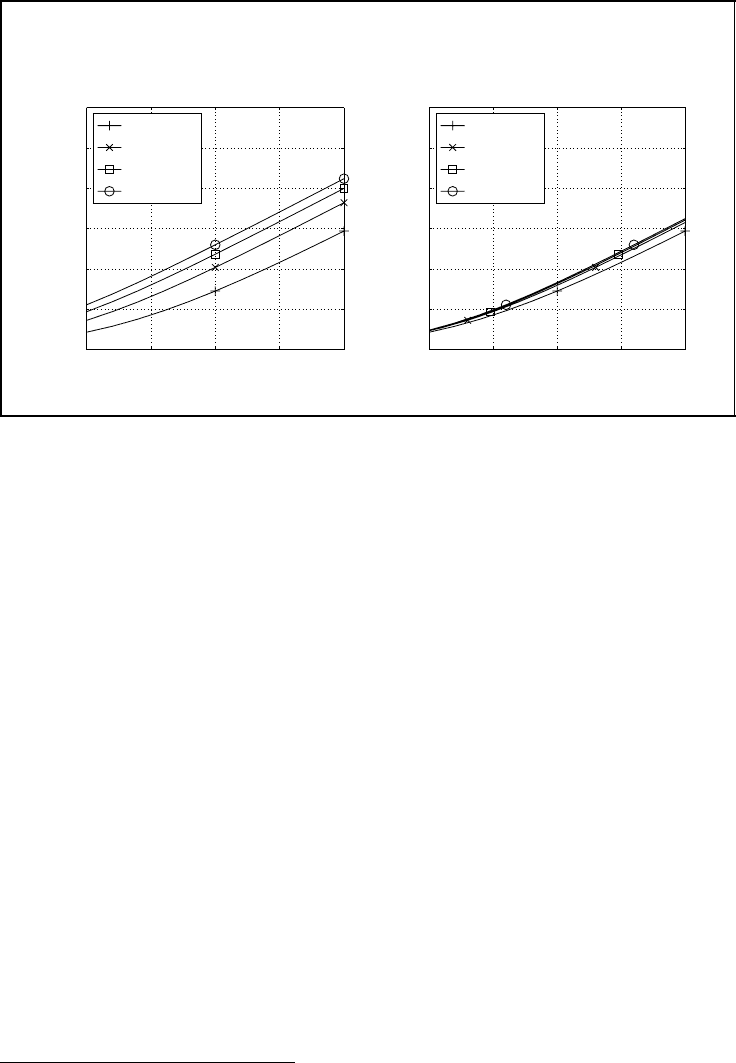
Figure 5.26: Channel capacity and receive diversity. Reproduced by permission of John
Wiley & Sons, Ltd
Figure 5.26 illuminates array and diversity gains for a system with a single transmit and
several receive antennas. In the left-hand diagram, the ergodic capacity is plotted versus
the signal-to-noise ratio at each receive antenna. The more receive antennas employed, the
more signal energy can be collected. Hence, doubling the number of receive antennas also
doubles the SNR after maximum ratio combining, resulting in a 3 dB gain. This gain is
denoted as array gain.
4
Additionally, a diversity gain can be observed, stemming from the
fact that variations in the SNR owing to fading are reduced by combining independent
diversity paths. Both effects lead to a gain of approximately 6.5 dB by increasing the
number of receive antennas from N
R
= 1toN
R
= 2. This gain reduces to 3.6 dB by going
from N
R
= 2toN
R
= 4. The array gain still amounts to 3 dB, but the diversity gain is
getting smaller if the number of diversity paths is already high.
The pure diversity gains become visible in the right-hand diagram plotting the ergodic
capacities versus the SNR after maximum ratio combining. This normalisation removes
the array gain, and only the diversity gain remains. We observe that the ergodic capacity
increases only marginally owing to a higher diversity degree.
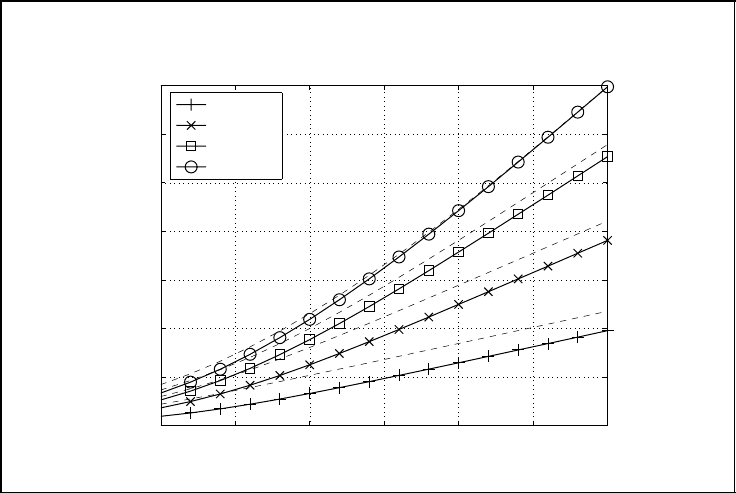
Figure 5.27 shows the ergodic capacities for a system with N
T
= 4 transmit antennas
versus the signal-to-noise ratio E
s
/N
0
. The MIMO channel matrix consists of i.i.d. com-
plex circular Gaussian distributed coefficients. Solid lines represent the results with perfect
channel knowledge only at the receiver, while dashed lines correspond to the waterfilling
solution with ideal CSI at transmitter and receiver. Asymptotically for large signal-to-noise
ratios, we observe that the capacities increase linearly with the SNR. The slope amounts
4
Certainly, the receiver cannot collect a higher signal power than has been transmitted. However, the channels’
path loss has been omitted here so that the average channel gains are normalised to unity.
SPACE–TIME CODES 249
Ergodic capacity of MIMO systems
0 5 10 15 20 25 30
0
5
10
15
20
25
30
35
E
s
/N
0
in dB →
C →
N
R
= 1
N
R
= 2
N
R
= 3
N
R
= 4
Figure 5.27: Ergodic capacity of MIMO systems with N
T
= 4 transmit antennas and
varying N
R
(solid lines: CSI only at receiver; dashed lines: waterfilling solution with
perfect CSI at transmitter and receiver)
to 1 bit/s/Hz for N
R
= 1, 2 bit/s/Hz for N
R
= 2, 3 bit/s/Hz for N
R
= 3 and 4 bit/s/Hz for
N
R
= 4, and therefore depends on the rank r of H. For fixed N
T
= 4, the number of non-
zero eigenmodes r grows with the number of receive antennas up to r
max
= rank(H) = 4.
These data rate enhancements are called multiplexing gains because we can transmit up to
r
max
parallel data streams over the MIMO channel. This confirms our theoretical results
that the capacity increases linearly with the rank of H while it grows only logarithmically
with the SNR.
Moreover, we observe that perfect CSI at the transmitter leads to remarkable improve-
ments for N
R
<N
T
. For these configurations, the rank of our system is limited by the
number of receive antennas. Exploiting the non-zero eigenmodes requires some kind of
beamforming which is only possible with appropriate channel knowledge at the transmit-
ter. For N
R
= 1, only one non-zero eigenmode exists. With transmitter CSI, we obtain
an array gain of 10 log
10
(4) ≈ 6 dB which is not achievable without channel knowledge.
For N
R
= N
T
= 4, the additional gain due to channel knowledge at the transmitter is vis-
ible only at low SNR where the waterfilling solution drops the weakest eigenmodes and
concentrates the transmit power only on the strongest modes, whereas this is impossible
without transmitter CSI. At high SNR, the water level in Figure 5.25 is so high that all
eigenmodes are active and a slightly different distribution of the transmit power has only
a minor impact on the ergodic capacity.
250 SPACE–TIME CODES
5.3.2 Outage Probability and Outage Capacity
As we have seen from Figure 5.22, the channel capacity of fading channels is a random
variable itself. The average capacity is called the ergodic capacity and makes sense if the
channel varies fast enough so that one coded frame experiences the full channel statistics.
Theoretically, this assumes infinite long sequences due to the channel coding theorem. For
delay-limited applications with short sequences and slowly fading channels, the ergodic
capacity is often not meaningful because a coded frame is affected by an incomplete part
of the channel statistics. In these cases, the ‘short-term capacity’ may vary from frame to
frame, and network operators are interested in the probability that a system cannot support
a desired throughput R. This parameter is termed the outage probability P
out
and is defined
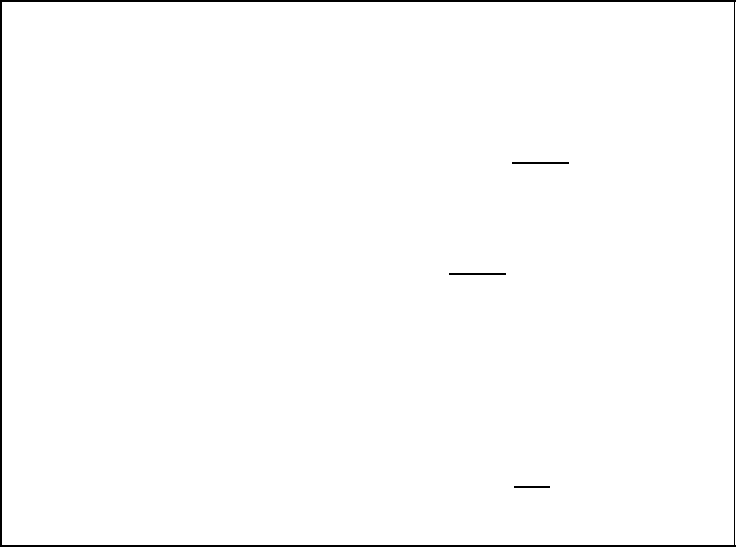
in Equation (5.53) in Figure 5.28.
Equivalently, the outage capacity C
p
describes the capacity that cannot be achieved in
p percent of all fading states. For the case of a Rayleigh fading channel, outage probability
and capacity are also presented in Figure 5.28. The outage capacity C
out
is obtained by
resolving the equation for P
out
with respect to R = C
out
. For MIMO channels, we sim-
ply have to replace the expression of the scalar capacity with that for the multiple-input
multiple-output case.
Outage probability of fading channels
■ Outage probability of a scalar channel
P
out
= Pr{C[k] <R}=Pr{|h[k]|
2
<
2
R
− 1
E
s
/N
0
} (5.53)
– Outage probability for scalar Rayleigh fading channels (K
¨
uhn, 2006)
P
out
= 1 −exp
1 − 2
R
E
s
/N
0
– Outage capacity for scalar Rayleigh fading channel
C
out
= log
2
1 − E
s
/N
0
· log(1 −P
out
)
.
■ Outage probability for MIMO channel with singular values σ
H,i
P
out
= Pr{C[k] <R}=Pr{
r
µ=1
log
2
7
1 + σ
2
H,i
·
σ
2
X ,i
σ
2
N
8
<R} (5.54)
Figure 5.28: Outage probability of fading channels
SPACE–TIME CODES 251
Capacity and outage probability of Rayleigh fading channels
Ŧ10 0 10 20 30 40
0
2
4
6
8
10
12
0 2 4 6 8 10
0
0.2
0.4
0.6
0.8
1
E
s
/N
0
in dB →
(a)
C →
AWGN
¯
C
C
1
C
5
C
10
C
20
C
50
(b)
P
out
→
R →
0dB
5dB
10dB
15dB20dB
25dB30dB
Figure 5.29: Capacity and outage probability of Rayleigh fading channels
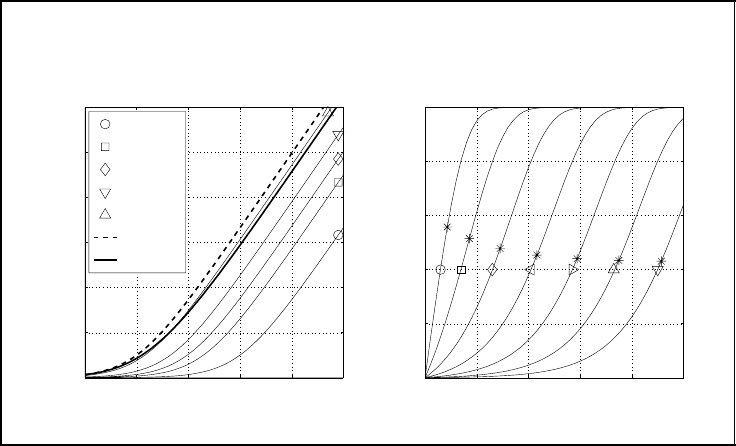
The left-hand diagram in Figure 5.29 shows a comparison between the ergodic capac-
ities of AWGN and flat Rayleigh fading channels (bold lines). For sufficiently large SNR,
the curves are parallel and we can observe a loss due to fading of roughly 2.5 dB. Com-
pared with the loss of approximately 17 dB at a bit error rate (BER) of P
b
= 10
−3
in the uncoded case, the observed difference is rather small. This discrepancy can be
explained by the fact that the channel coding theorem presupposes infinite long code words
allowing the decoder to exploit a high diversity gain. Therefore, the loss in capacity com-
pared with the AWGN channel is relatively small. Astonishingly, the ultimate limit of
10 log
10
(E
b
/N
0
) =−1.59 dB is the same for AWGN and Rayleigh fading channels.
Additionally, the left-hand diagram shows the outage capacities for different values of
P
out
. For example, the capacity C
50
can be ensured with a probability of 50% and is close
to the ergodic capacity
¯
C. The outage capacities C
p
decrease dramatically for smaller P
out
,
i.e. the higher the requirements, the higher is the risk of an outage event. At a spectral
efficiency of 6 bit/s/Hz, the loss compared with the AWGN channel in terms of E
b
/N
0
amounts to nearly 8 dB for P
out
= 0.1 and roughly 18 dB for P
out
= 0.01.
The right-hand diagram depicts the outage probability versus the target throughput R
for different values of E
s
/N
0
. As expected for large signal-to-noise ratios, high data rates
can be guaranteed with very low outage probabilities. However, P
out
grows rapidly with
decreasing E
s
/N
0
. The asterisks denote the outage probability of the ergodic capacity
R =
¯
C. As could already be observed in the left-hand diagram, it is close to a probability
of 0.5.
Finally, Figure 5.30 shows the outage probabilities for 1 × N
R
and 4 ×N
R
MIMO
systems at an average signal-to-noise ratio of 10 dB. From figure (a) it becomes obvious
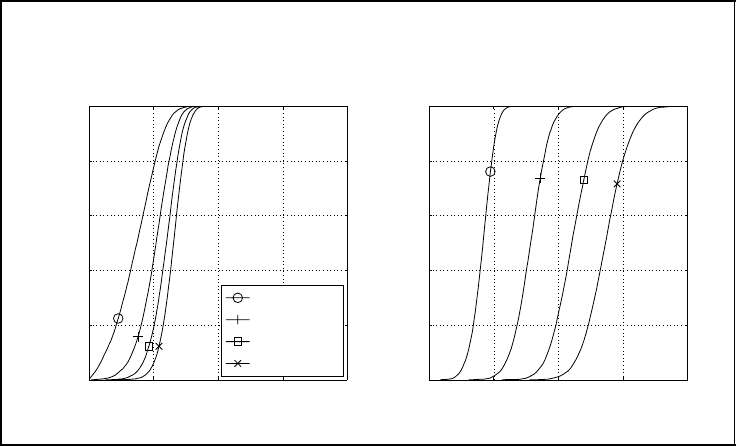
252 SPACE–TIME CODES
Outage probability of MIMO fading channels
0 4 8 12 16
0
0.2
0.4
0.6
0.8
1
0 4 8 12 16
0
0.2
0.4
0.6
0.8
1
P
out
→
P
out
→
R →R →
(a) N
T
= 1
(b) N
T
= 4
N
R
= 1
N
R
= 2
N
R
= 3
N
R
= 4
Figure 5.30: Outage probability of MIMO fading channels
that an increasing number of receive antennas enlarges the diversity degree and, hence,
minimises the risk of an outage event. However, there is no multiplexing gain with only a
single transmit antenna, and the gains for additional receive antennas become smaller if the
number of receiving elements is already large. This is a well-known effect from diversity,
assuming an appropriate scaling of the signal-to-noise ratio. In figure (b), the system with
N
T
= 4 transmit antennas is considered. Here, we observe larger gains with each additional
receive antenna, since the number of eigenmodes increases so that we obtain a multiplexing
gain besides diversity enhancements.
5.3.3 Ergodic Error Probability
Having analysed MIMO systems on an information theory basis, we will now have a look at
the error probabilities. The following derivation was first introduced for space–time codes
(Tarokh et al., 1998). However, it can be applied to general MIMO systems. It assumes
an optimal maximum likelihood detection and perfect channel knowledge at the receiver
and a block-wise transmission, i.e. L consecutive vectors x[k] are written into the N
T
× L
transmit matrix
X =
.
x[0] x[1] ···x[L − 1]
/
=
x
1
[0] x
1
[1] ··· x
1
[L − 1]
x
2
[0] x
2
[1] ··· x
2
[L − 1]
.
.
.
.
.
.
.
.
.
x
N
T
[0] x
N
T
[1] ··· x
N
T
[L − 1]
.

SPACE–TIME CODES 253
The MIMO channel is assumed to be constant during L time instants so that we receive
an N
R
× L matrix R
R =
.
r[0] r[1] ···r[L − 1]
/
=
r
1
[0] r
1
[1] ··· r
1
[L − 1]
r
2
[0] r
2
[1] ··· r
2
[L − 1]
.
.
.
.
.
.
.
.
.
r
N
R
[0] r
N
R
[1] ··· r
N
R
[L − 1]
= H · X + N ,
where N contains the noise vectors n[k] within the considered block. The set of all possible
matrices X is termed X. In the case of a space–time block code, certain constraints apply
to X, limiting the size of X (see Section 5.4). By contrast, for the well-known Bell Labs
Layered Space–Time (BLAST) transmission, there are no constraints on X, leading to a
size |X|=M
N
T
L
, where M is the size of the modulation alphabet.
Calculating the average error probability generally starts with the determination of the
pairwise error probability Pr{B →
˜
B | H}. Equivalently to the explanation in Chapter 3, it
denotes the probability that the detector decides in favour of a code matrix
˜
X although X
was transmitted. Assuming uncorrelated noise contributions at each receive antenna, the
optimum detector performs a maximum likelihood estimation, i.e. it determines that code
matrix
˜
X which minimises the squared Frobenius distance R − H
˜
X
2
F
(see Appendix B
on page 312). Hence, we have to consider not the difference X −
˜
X
2
F
, but the difference
in the noiseless received signals HX − H
˜
X
2
F
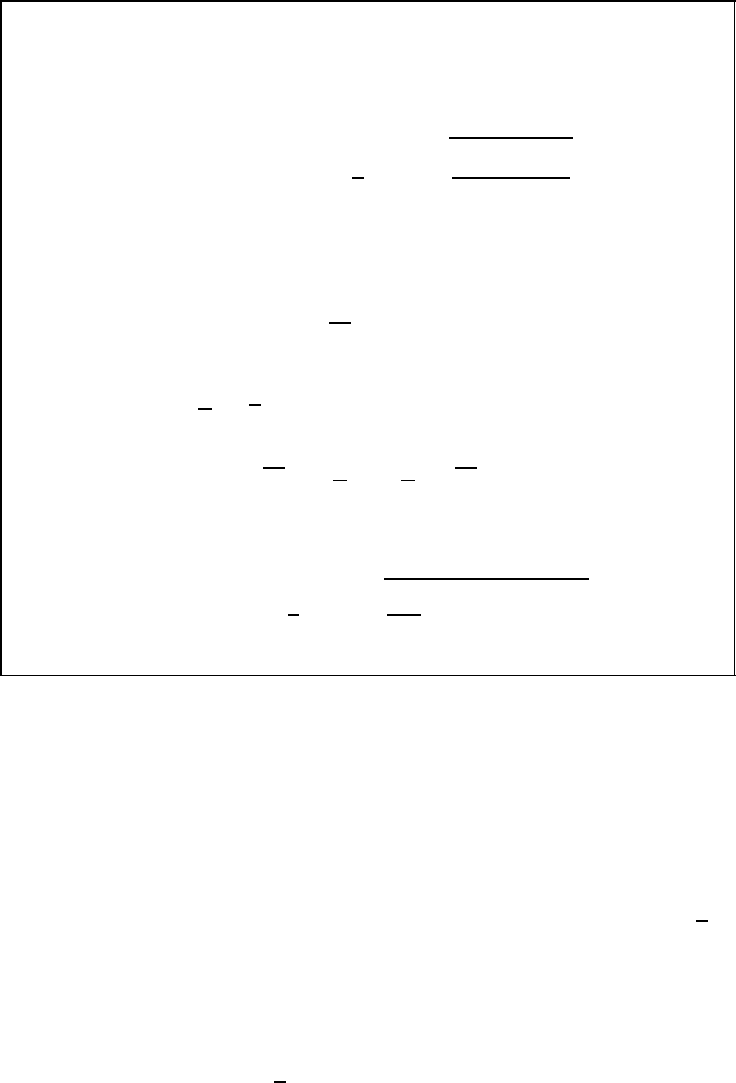
, as done in Equation (5.55) in Figure 5.31.
In order to make the squared Frobenius norm independent of the average power E
s
of
a symbol, we normalise the space–time code words by the average power per symbol to
B =
X
√
E
s
/T
s
and
˜
B =
˜
X
√
E
s
/T
s
.
If the µth row of H is denoted by h
µ
, the squared Frobenius norm can be written as
4
4
H(B −
˜
B)
4
4
2
F
=
4
4
h
µ
(B −
˜
B)
4
4
2
=
N
R
µ=1
h
µ
(B −
˜
B)(B −
˜
B)
H
h
H
µ
.
This rewriting and the normalisation lead to the form given in Equation (5.56). We now
apply the eigenvalue decomposition on the Hermitian matrix
(B −
˜
B)(B −
˜
B)
H
= UU
H
.
The matrix is diagonal and contains the eigenvalues λ
ν
of (B −
˜
B)(B −
˜
B)
H
, while U is
unitary and consists of the corresponding eigenvectors. Inserting the eigenvalue decompo-
sition into Equation (5.56) yields
4
4
H(B −
˜
B)
4
4
2
F
=
N
R
µ=1
h
µ
U · · U
H
h
H
µ
=
N
R
µ=1
β
µ
β
H
µ
with β
µ
= [β
µ,1
, ... , β
µ,L
]. Since is diagonal, its multiplication with β
µ
and β
H
µ
from
the left- and the right-handside respectively reduces to
4
4
H(B −
˜
B)
4
4
2
F
=
N
R
µ=1
L
ν=1
|β
µ,ν
|
2
· λ
ν
=
N
R
µ=1
r
ν=1
|β
µ,ν
|
2
· λ
ν
.
254 SPACE–TIME CODES
Pairwise error probability
■ Pairwise error probability for code matrices X and
˜
X
Pr{X →
˜
X | H}=
1
2
· erfc
(
)
)
*
4
4
HX − H
˜
X
4
4
2
F
4σ
2
N
(5.55)
■ Normalisation to unit average power per symbol
4
4
H · (X −
˜
X)
4
4
2
F
=
E
s
T
s
·
N
R
µ=1
h
µ
· (B −
˜
B)(B −
˜
B)
H
· h
H
µ
(5.56)
■ Substitution of β
µ
= h
µ
U
4
4
H · (X −
˜
X)
4
4
2
F
=
E
s
T
s
·
N
R
µ=1
β
µ
· · β
H
µ
=
E
s
T
s
·
N
R
µ=1
r
ν=1
|β
µ
|
2
· λ
µ
(5.57)
■ With σ
2
N
= N
0
/T
s
, pairwise error probability becomes
Pr{X →
˜
X | H}=
1
2
· erfc
(
)
)
*
E
s
4N
0
·
N
R
µ=1
r
ν=1
|β
µ,ν
|
2
· λ
ν
(5.58)
Figure 5.31: Pairwise error probability for space–time code words
Assuming that the rank of equals rank{}=r ≤ L, i.e. r eigenvalues λ
µ
are non-zero,
the inner sum can be restricted to run from ν = 1 only to ν = r because λ
ν>r
= 0 holds.
The last equality is obtained because is diagonal. Inserting the new expression for the
squared Frobenius norm into the pairwise error probability of Equation (5.55) delivers the
result in Equation (5.58).
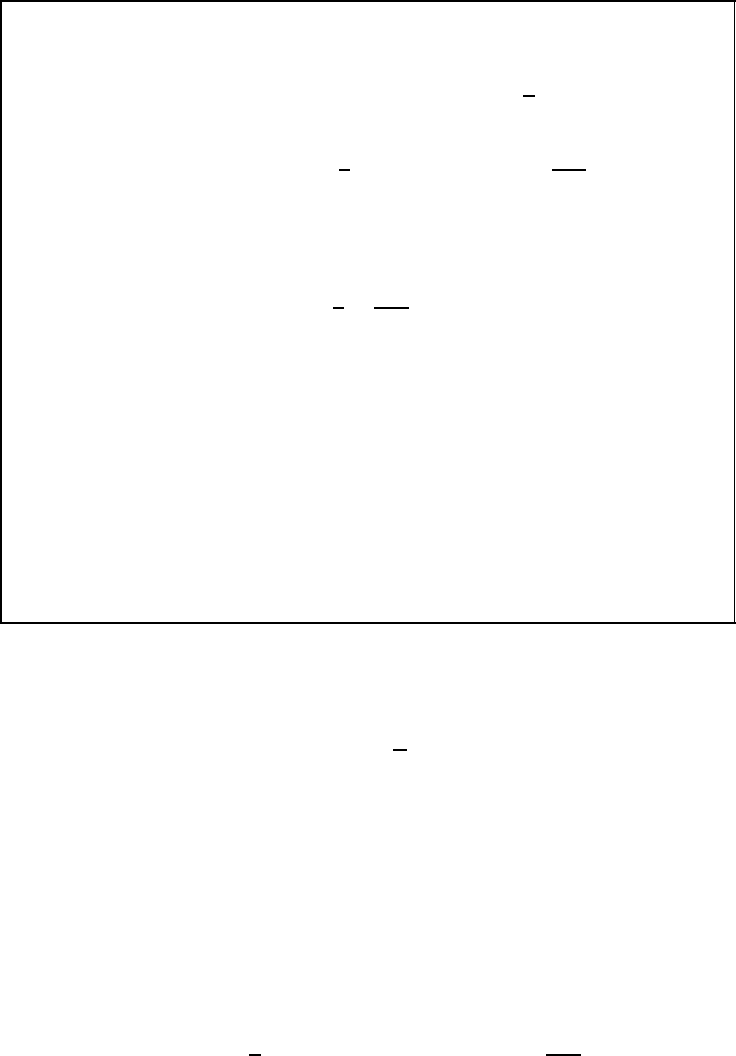
The last step in our derivation starts with the application of the upper bound erfc(
√
x) <
e
−x
on the complementary error function. Rewriting the double sum in the exponent into the
product of exponential functions leads to the result in inequality (5.59) in Figure 5.32. In
order to obtain a pairwise error probability averaged over all possible channel observations,
the expectation of Equation (5.58) with respect to H has to be determined. This expectation
is calculated over all channel coefficients h
µ,ν
of H. At this point it has to be mentioned
that the multiplication of a vector h
µ
with U performs just a rotation in the N
T
-dimensional
SPACE–TIME CODES 255
Determinant and rank criteria
■ Upper bound on pairwise error probability by erfc(
√
x) < e
−x
Pr{B →
˜
B | H}≤
1
2
·
N
R
µ=1
r
ν=1
exp
!
−|β
µ
|
2
λ
µ
E
s
4N
0
"
(5.59)
■ Expectation with respect to H yields
Pr{B →
˜
B}≤
1
2
·
7
E
s
4N
0
·
r
ν=1
λ
ν
1/r
8
−rN
R
(5.60)
■ Rank criterion: maximise the minimum rank of
B −
˜
B
g
d
= N
R
· min
(B,
˜
B)
rank
B −
˜
B
(5.61)
■ Determinant criterion: maximise the minimum of (
$
r
ν=1
λ
ν
)
1/r
g
c
= min
(B,
˜
B)
r
ν=1
λ
ν
1/r
(5.62)
Figure 5.32: Determinant and rank criteria
space. Hence the coefficients β
µ,ν
of the vector β
µ
have the same statistics as the channel
coefficients h
µ,ν
(Naguib et al., 1997).
Assuming the frequently used case of independent Rayleigh fading, the coefficients
h
µ,ν
, and, consequently also β
µ,ν
, are complex rotationally invariant Gaussian distributed
random variables with unit power σ
2
H
= 1. Hence, their squared magnitudes are chi-squared
distributed with two degrees of freedom, i.e.
p
β
µ,ν
(ξ) = e
−ξ
holds. The expectation of inequality (5.59) now results in
Pr{B →
˜
B}=E
H
Pr{B →
˜
B | H}
≤
1
2
·
N
R
µ=1
r
ν=1
E
β
%
exp
5
− λ
ν
·|β
µ,ν
|
2
·
E
s
4N
0
6
&