
Norman D.A. Emotional Design: Why We Love (Or Hate) Everyday Things
Подождите немного. Документ загружается.

1
70
Emotional
Design
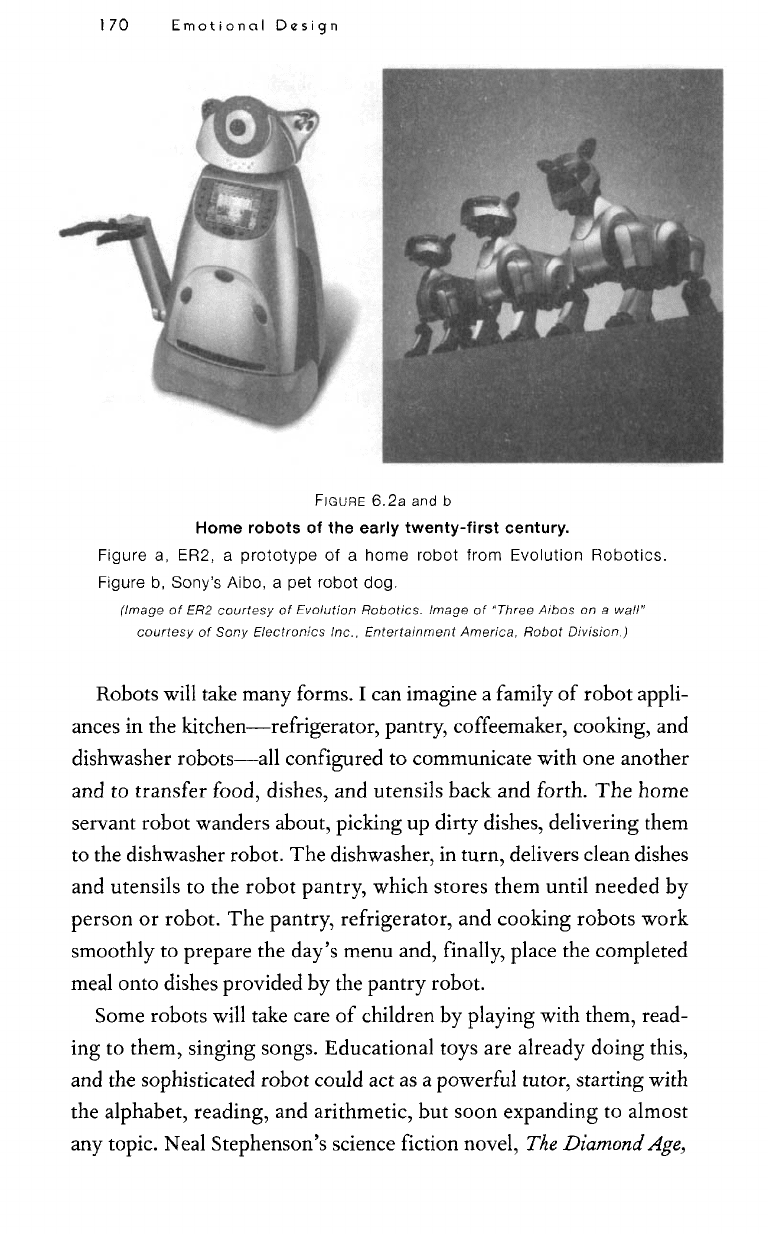
FIGURE
6.2a
and b
Home
robots
of the
early twenty-first century.
Figure
a,
ER2,
a
prototype
of a
home robot from
Evolution
Robotics.
Figure
b,
Sony's Aibo,
a pet
robot
dog.
(Image
of ER2
courtesy
of
Evolution
Robotics.
Image
of
"Three Aibos
on a
wall"
courtesy
of
Sony
Electronics
Inc.,
Entertainment
America,
Robot
Division.)
Robots will take many forms.
I can
imagine
a
family
of
robot appli-
ances
in the
kitchen—refrigerator, pantry, coffeemaker, cooking,
and
dishwasher robots—all configured
to
communicate with
one
another
and
to
transfer food, dishes,
and
utensils back
and
forth.
The
home
servant robot wanders about, picking
up
dirty dishes, delivering them
to the
dishwasher robot.
The
dishwasher,
in
turn, delivers clean dishes
and
utensils
to the
robot pantry, which stores them until needed
by
person
or
robot.
The
pantry, refrigerator,
and
cooking
robots
work
smoothly
to
prepare
the
day's menu
and,
finally,
place
the
completed
meal
onto dishes provided
by the
pantry robot.
Some robots will take care
of
children
by
playing with them, read-
ing to
them, singing songs. Educational toys
are
already doing this,
and
the
sophisticated
robot
could
act as a
powerful tutor, starting with
the
alphabet, reading,
and
arithmetic,
but
soon expanding
to
almost
any
topic. Neal Stephenson's science
fiction
novel,
The
Diamond Age,
TLFeBOOK
Six:
Emotional
Machines
171
does
a
superb
job of
showing
how an
interactive
book,
The
Young
Lady's
Illustrated
Primer.,
can
take over
the
entire education
of
young
girls
from
age
four
through adulthood.
The
illustrated primer
is
still
some time
in the
future,
but
more limited tutors
are
already
in
exis-
tence.
In
addition
to
education, some robots will
do
household chores:
vacuuming, dusting,
and
cleaning
up.
Eventually their range
of
abili-
ties will expand. Some
may end up
being built into homes
or
furniture.
Some
will
be
mobile, capable
of
wandering about
on
their own.
These
developments will require
a
coevolutionary process
of
adap-
tation
for
both people
and
devices.
This
is
common with
our
technolo-
gies:
we
reconfigure
the way we
live
and
work
to
make things possible
for
our
machines
to
function.
The
most dramatic coevolution
is the
automobile system,
for
which
we
have altered
our
homes
to
include
garages
and
driveways sized
and
equipped
for the
automobile,
and
built
a
massive worldwide highway system,
traffic
signaling systems,
pedestrian
passageways,
and
huge parking
lots.
Homes, too, have been
transformed
to
accommodate
the
multiple wires
and
pipes
of the
ever-
increasing infrastructure
of
modern
life:
hot and
cold water, waste
return,
air
vents
to the
roof, heating
and
cooling
ducts, electricity, tele-
phone, television, internet
and
home computer
and
entertainment net-
works.
Doors
have
to be
wide enough
for our
furniture,
and
many
homes have
to
accommodate wheelchairs
and
people using walkers.
Just
as we
have accommodated
the
home
for all
these changes,
I
expect
modification
to
accommodate
robots.
Slow modification,
to be
sure,
but as
robots
increase
in
usefulness,
we
will
ensure their success
by
minimizing
obstacles and, eventually, building charging stations,
cleaning
and
maintenance places,
and so on.
After
all,
the
vacuum
cleaner
robot will need
a
place
to
empty
its
dirt,
and the
garbage robot
will
need
to be
able
to
carry
the
garbage
outside
the
home.
I
wouldn't
be
surprised
to see
robot quarters
in
homes, that
is,
specially built nich-
es
where
the
robots
can
reside,
out of the
way, when they
are not
active. We
have closets
and
pantries
for
today's appliances,
so why not
ones especially equipped
for
robots, with doors that
can be
controlled
by the
robot,
electrical
outlets,
interior
lights
so
robots
can see to
clean
TLFeBOOK
172
Emotional Design
themselves (and plug themselves
into
the
outlets),
and
waste
recepta-
cles
where appropriate.
Robots, especially
at
first, will probably require smooth floors,
without obstacles.
Door
thresholds might have
to be
eliminated
or
minimized.
Some locations—especially stairways—might have
to be
especially
marked, perhaps with lights,
infrared
transmitters,
or
sim-
ply
special
reflective
tape. Barcodes
or
distinctive markers posted here
and
there
in the
home would enormously
simplify
the
robot's
ability
to
recognize
its
location.
Consider
how a
servant robot might bring
a
drink
to its
owner.
Ask
for a can of
soda,
and off
goes
the
robot, obediently making
its
way to the
kitchen
and the
refrigerator, which
is
where
the
soda
is
kept. Understanding
the
command
and
navigating
to the
refrigerator
are
relatively simple. Figuring
out how to
open
the
door,
find
the
can,
and
extract
it is not so
simple. Giving
the
servant robot
the
dexterity,
the
strength,
and the
non-slip wheels that would allow
it to
pull open
the
refrigerator
door
is
quite
a
feat.
Providing
the
vision system that
can
find
the
soda, especially
if it is
completely hidden behind other
food
items,
is
difficult,
and
then figuring
out how to
extract
the can
without destroying
objects
in the way is
beyond today's capabilities
in
robot arms.
How
much simpler
it
would
be if
there were
a
drink dispenser
robot tailored
to the
needs
of the
servant robot. Imagine
a
drink-dis-
pensing robot appliance capable
of
holding
six or
twelve cans, refrig-
erated, with
an
automatic door
and a
push-arm.
The
servant robot
could
go to the
drink robot, announce
its
presence
and its
request
(probably
by an
infrared
or
radio signal),
and
place
its
tray
in
front
of
the
dispenser.
The
drink robot would slide open
its
door, push
out a
can,
and
close
the
door again:
no
complex vision,
no
dexterous arm,
no
forceful
opening
of the
door.
The
servant robot would receive
the
can
on its
tray,
and
then
go
back
to its
owner.
In a
similar way,
we
might
modify
the
dishwasher
to
make
it
easier
for
a
home robot
to
load
it
with dirty dishes, perhaps give
it
special
trays with designated slots
for
different
dishes.
But as
long
as we are
TLFeBOOK
Six:
Emotional
Machines
173
doing that,
why not
make
the
pantry
a
specialized robot,
one
capable
of
removing
the
clean dishes
from
the
dishwasher
and
storing them
for
later use?
The
special trays would help
the
pantry
as
well. Perhaps
the
pantry could automatically deliver cups
to the
coffeemaker
and
plates
to the
home cooking
robot,
which
is, of
course, connected
to
refrigerator, sink,
and
trash.
Does
this sound
far-fetched?
Perhaps,
but,
in
fact,
our
household appliances
are
already complex, many
of
them with multiple connections
to
services.
The
refrigerator
has
con-
nections
to
electric power
and
water. Some
are
already connected
to
the
internet.
The
dishwasher
and
clothes washer have electricity,
water
and
sewer connections. Integrating these units
so
that they
can
work smoothly with
one
another does
not
seem
all
that
difficult.
I
imagine that
the
home will contain
a
number
of
specialized
robots:
the
servant
is
perhaps
the
most general purpose,
but it
would
work together with
a
cleaning
robot,
the
drink dispensing
robot,
per-
haps
some outside gardening robots,
and a
family
of
kitchen robots,
such
as
dishwasher, coffee-making,
and
pantry robots.
As
these
robots
are
developed,
we
will probably also design specialized objects
in
the
home that
simplify
the
tasks
for the
robots,
coevolving robot
and
home
to
work smoothly together. Note that
the end
result will
be
better
for
people
as
well.
Thus,
the
drink dispenser robot would allow
anyone
to
walk
up to it and ask for a
can, except that
you
wouldn't
use
infrared
or
radio,
you
might push
a
button
or
perhaps
just
ask.
I am not
alone
in
imagining this coevolution
of
robots
and
homes.
Rodney Brooks,
one of the
world's leading roboticists, head
of the
MIT
Artificial
Intelligence Laboratory
and
founder
of a
company that
builds home
and
commercial robots, imagines
a
rich ecology
of
envi-
ronments
and
robots, with specialized ones living
on
devices, each
responsible
to
keep
its
domain clean:
one
does
the
bathtub, another
the
toilet;
one
does windows, another manipulates mirrors. Brooks even
contemplates
a
robot
dining room table, with storage area
and
dish-
washer
built into
its
base
so
that "when
we
want
to set the
table,
small
robotic
arms,
not
unlike
the
ones
in a
jukebox, will bring
the
required
dishes
and
cutlery
out
onto
the
place settings.
As
each course
is
fin-
TLFeBOOK
174
Emotional Design
ished,
the
table
and its
little robot arms would grab
the
plates
and
devour them into
the
large internal volume underneath."
What should
a
robot
look
like? Robots
in the
movies
often
look like
people, with
two
legs,
two
arms,
and a
head.
But
why? Form should
follow
function.
The
fact
that
we
have legs allows
us to
navigate irreg-
ular
terrain, something
an
animal
on
wheels could
not do. The
fact
that
we
have
two
hands allows
us to
lift
and
manipulate, with
one
hand
helping
the
other.
The
humanoid shape
has
evolved over eons
of
interaction with
the
world
to
cope
efficiently
and
effectively
with
it.
So,
where
the
demands upon
a
robot
are
similar
to
those upon
people,
having
a
similar shape might
be
sensible.
If
robots don't have
to
move—such
as
drink, dishwasher,
or
pantry
robots—they need
not
have
any
means
of
locomotion, neither legs
nor
wheels.
If the
robot
is a
coffeemaker,
it
should look like
a
cof-
feemaker,
modified
to
allow
it to
connect
to the
dishwasher
and
pantry.
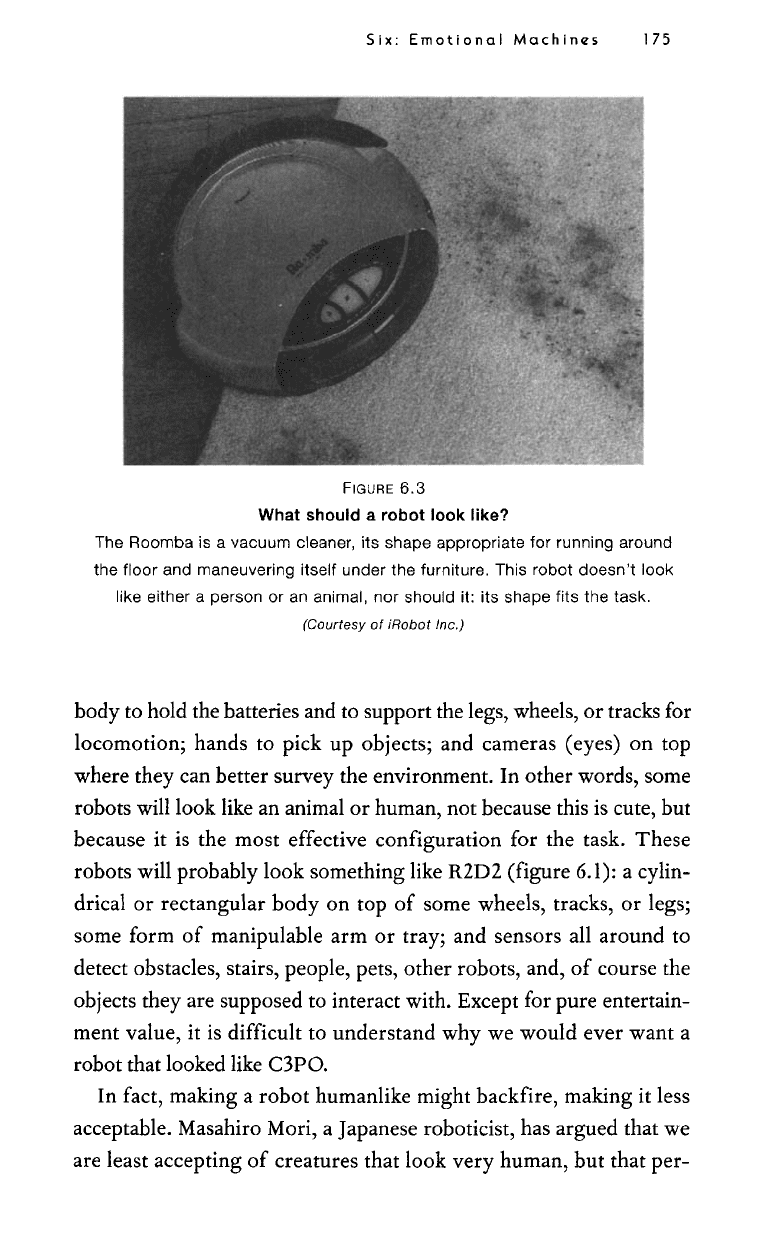
Robot
vacuum cleaners
and
lawn mowers already
exist,
and
their appearance
is
perfectly suited
to
their
tasks:
small, squat
devices,
with
wheels
(see
figure
6.3).
A
robot
car
should look like
a
car.
It is
only
the
general-purpose home servant robots that
are apt to
look like
animals
or
humans.
The
robot dining room table envisioned
by
Brooks would
be
especially bizarre, with
a
large central column
to
house
the
dishes
and
dishwashing equipment (complete with electric
power, water
and
sewer
connections).
The top of the
table would have
places
for the
robot arms
to
manipulate
the
dishes
and
probably some
stalk
to
hold
the
cameras that
let the
arms know where
to
place
and
retrieve
the
dishes
and
cutlery.
Should
a
robot have legs?
Not if it
only
has to
maneuver about
on
smooth surfaces—wheels will
do for
this;
but if it has to
navigate
irregular terrain
or
stairs,
legs
would
be
useful.
In
this
case,
we can
expect
the
first legged
robots
to
have
four
or six
legs:
balancing
is far
simpler
for
four-
and
six-legged creatures than
for
those with only
two
legs.
If
the
robot
is to
wander about
a
home
and
pick
up
after
the
occu-
pants,
it
probably will look something like
an
animal
or a
person:
a
TLFeBOOK
Six:
Emotional Machines
175
FIGURE
6.3
What should
a
robot look
like?
The
Roomba
is a
vacuum cleaner,
its
shape appropriate
for
running around
the
floor
and
maneuvering itself under
the
furniture. This robot doesn't look
like
either
a
person
or an
animal,
nor
should
it: its
shape
fits
the
task.
(Courtesy
of
iRobot
Inc.)
body
to
hold
the
batteries
and to
support
the
legs,
wheels,
or
tracks
for
locomotion; hands
to
pick
up
objects;
and
cameras (eyes)
on top
where they
can
better survey
the
environment.
In
other words, some
robots will look like
an
animal
or
human,
not
because this
is
cute,
but
because
it is the
most
effective
configuration
for the
task.
These
robots will probably look something like R2D2 (figure
6.1):
a
cylin-
drical
or
rectangular body
on top of
some wheels, tracks,
or
legs;
some
form
of
manipulable
arm or
tray;
and
sensors
all
around
to
detect obstacles, stairs, people, pets, other robots,
and,
of
course
the
objects
they
are
supposed
to
interact with. Except
for
pure entertain-
ment
value,
it is
difficult
to
understand
why we
would ever want
a
robot that looked like
C3PO.
In
fact, making
a
robot
humanlike might backfire, making
it
less
acceptable. Masahiro Mori,
a
Japanese roboticist,
has
argued that
we
are
least accepting
of
creatures that look very human,
but
that
per-
TLFeBOOK
176
Emotional Design
form
badly,
a
concept demonstrated
in
film
and
theater
by the
terrify-
ing
nature
of
zombies
and
monsters (think
of
Frankenstein's
monster)
that take
on
human form,
but
with inhuman movement
and
ghastly
appearance.
We are not
nearly
so
dismayed—or frightened—by non-
human shapes
and
forms. Even perfect
replicas
of
humans might
be
problematic,
for
even
if the
robot could
not be
distinguished
from
humans,
this very lack
of
distinction
can
lead
to
emotional angst
(a
theme explored
in
many
a
science fiction novel, especially Philip
K.
Dick's
Do
Androids
Dream
of
Electric
Sheep?
and,
in
movie version,
Blade
Runner). According
to
this line
of
argument, C3PO gets away
with
its
humanoid
form
because
it is so
clumsy, both
in
manner
and
behavior, that
it
appears more cute
or
even irritating than threatening.
Robots that serve human needs—for example, robots
as
pets—
should probably look like living creatures,
if
only
to tap
into
our
vis-
ceral
system, which
is
prewired
to
interpret human
and
animal body
language
and
facial
expressions.
Thus,
an
animal
or a
childlike shape
together with appropriate body actions,
facial
expressions,
and
sounds will
be
most
effective
if the
robot
is to
interact successfully
with
people.
Affect
and
Emotion
in
Robots
What emotions will
a
robot need
to
have?
The
answer depends upon
the
sort
of
robot
we are
thinking about,
the
tasks
it is to
perform,
the
nature
of the
environment,
and
what
its
social
life
is
like. Does
it
inter-
act
with other robots, animals, machines,
or
people?
If so, it
will need
to
express
its own
emotional state
as
well
as to
assess
the
emotions
of
the
people
and
animals
it
interacts with.
Think
about
the
average, everyday home
robot.
These
don't
yet
exist,
but
some
day the
house will become populated with robots.
Some home robots will
be
fixed
in
place, specialized, such
as
kitchen
robots:
for
example,
the
pantry, dishwasher, drink dispenser, food
dis-
penser,
coffeemaker,
or
cooking unit robots. And,
of
course, clothes
TLFeBOOK
Six:
Emotional
Machines
177
washer, drier, iron,
and
clothes-folding robots, perhaps coupled
to
wardrobe robots. Some will
be
mobile,
but
also specialized, such
as
the
robots that vacuum
the
floors
and mow the
lawn.
But
probably
we
will
also have
at
least
one
general-purpose
robot:
the
home servant
robot,
that brings
us
coffee,
cleans
up,
does simple errands,
and
looks
after
and
supervises
the
other
robots.
It is the
home robot that
is of
most interest, because
it
will have
to be the
most
flexible
and
advanced.
Servant robots will need
to
interact with
us and
with
the
other
robots
of the
house.
For the
other robots, they could
use
wireless
communication.
They
could discuss
the
jobs they were
doing,
whether
or not
they
were
overloaded
or
idle.
They
could also state
when they were running
low on
supplies
and
when they sensed
diffi-
culties, problems,
or
errors
and
call upon
one
another
for
help.
But
what about when
robots
interact with people?
How
will this happen?
Servant robots need
to be
able
to
communicate with their owners.
Some
way of
issuing commands
is
needed, some
way of
clarifying
the
ambiguities, changing
a
command
in
midstream
("Forget
the
coffee,
bring
me a
glass
of
water instead"),
and
dealing with
all of the
com-
plexities
of
human language. Today,
we
can't
do
that,
so
robots that
are
built
now
will have
to
rely upon very simple commands
or
even
some sort
of
remote controller, where
a
person pushes
the
appropriate
buttons, generates
a
well-structured command,
or
selects actions
from
a
menu.
But the
time will come when
we can
interact
in
speech, with
the
robots understanding
not
just
the
words
but the
meanings behind
them.
When should
a
robot volunteer
to
help
its
owners? Here, robots will
need
to be
able
to
assess
the
emotional state
of
people.
Is
someone
struggling
to do a
task?
The
robot might want
to
volunteer
to
help.
Are
the
people
in the
house arguing?
The
robot might wish
to go to
some
other
room,
out of the
way.
Did
something
bring
pleasure?
The
robot
might wish
to
remember that,
so it
could
do it
again when appropriate.
Was
an
action poorly done,
so the
person showed disappointment?
Perhaps
the
action could
be
improved,
so
that next time
the
robot
TLFeBOOK
178
Emotional Design
would produce better
results.
For all
these
reasons,
and
more,
the
robot
will
need
to be
designed with
the
ability
to
read
the
emotional state
of
its
owners.
A
robot will need
to
have eyes
and
ears (cameras
and
microphones)
to
read
facial
expressions, body language,
and the
emotional compo-
nents
of
speech.
It
will have
to be
sensitive
to
tones
of
voice,
the
tempo
of
speech,
and its
amplitude,
so
that
it can
recognize anger,
delight, frustration,
or
joy.
It
needs
to be
able
to
recognize scolding
voices
from
praising ones. Note that
all of
these states
can be
recog-
nized just
by
their sound quality without
the
need
to
recognize
the
words
or
language. Notice that
you can
determine other people's
emotional states just
by the
tone
of
voice
alone.
Try it:
Make
believe
you are in any one of
those states—angry, happy, scolding,
or
prais-
ing—and express yourself while keeping your lips
firmly
sealed.
You
can
do it
entirely with
the
sounds, without speaking
a
word.
These
are
universal
sound patterns.
Similarly,
the
robot should display
its
emotional state, much
as a
person does (or, perhaps more appropriately,
as a pet dog or
child
does),
so
that
the
people with whom
it is
interacting
can
tell when
a
request
is
understood, when
it is
something easy
to do,
difficult
to do,
or
perhaps even when
the
robot
judges
it to be
inappropriate.
Similarly,
the
robot should show pleasure
and
displeasure,
an
ener-
getic appearance
or
exhaustion, confidence
or
anxiety when appropri-
ate.
If it is
stuck, unable
to
complete
a
task,
it
should show
its
frustration.
It
will
be as
valuable
for the
robot
to
display
its
emotional
state
as it is for
people
to do so. The
expressions
of the
robot will
allow
us
humans
to
understand
the
state
of the
robot,
thereby learning
which tasks
are
appropriate
for it,
which
are
not.
As a
result,
we can
clarify
instructions
or
even
offer
help, eventually learning
to
take bet-
ter
advantage
of the
robot's
capabilities.
Many
people
in the
robotics
and
computer research community
believe that
the way to
display emotions-is
to
have
a
robot decide
whether
it is
happy
or
sad, angry
or
upset,
and
then display
the
appro-
priate
face,
usually
an
exaggerated parody
of a
person
in
those states.
I
TLFeBOOK
Six:
Emotional
Machines
179
argue strongly against this approach.
It is
fake, and, moreover,
it
looks
fake.
This
is not how
people operate.
We
don't
decide that
we are
happy,
and
then
put on a
happy face,
at
least
not
normally.
This
is
what
we do
when
we are
trying
to
fool
someone.
But
think about
all
those professionals
who are
forced
to
smile
no
matter what
the
cir-
cumstance:
they
fool
no
one—they look
just
like they
are
forcing
a
smile,
as
indeed they are.
The way
humans show
facial
expression
is by
automatic innerva-
tion
of the
large number
of
muscles involved
in
controlling
the
face
and
body.
Positive
affect
leads
to
relaxation
of
some muscle groups,
automatic pulling
up of
many
facial
muscles (hence
the
smile, raised
eyebrows
and
cheeks,
etc.),
and a
tendency
to
open
up and
draw
clos-
er to the
positive event
or
thing. Negative
affect
has the
opposite
impact, causing withdrawal,
to
push away. Some muscles
are
tensed,
and
some
of the
facial
muscles
pull
downward (hence
the
frown).
Most
affective
states
are
complex mixtures
of
positive
and
negative
valence,
at
differing
levels
of
arousal, with some residue
of the
imme-
diately
previous states.
The
resulting expressions
are
rich
and
inform-
ative.
And
real.
Fake emotions look fake:
we are
very
good
at
detecting
false
attempts
to
manipulate
us.
Thus,
many
of the
computer systems
we
interact
with—the
ones with cute, smiling helpers
and
artificially
sweet voices
and
expressions—tend
to be
more irritating than
useful.
"How
do I
turn this
off?"
is a
question
often
asked
of me, and I
have
become adept
at
disabling them, both
in my own
computers
or
those
of
others
who
seek
to be
released
from
the
irritation.
I
have argued that machines should indeed both have
and
display
emotions,
the
better
for us to
interact with them.
This
is
precisely
why
the
emotions need
to
appear
as
natural
and
ordinary
as
human emo-
tions.
They
must
be
real,
a
direct reflection
of the
internal states
and
processing
of a
robot.
We
need
to
know when
a
robot
is
confident
or
confused, secure
or
worried,
understanding
our
queries
or
not,
work-
ing on our
request
or
ignoring
us. If the
facial
and
body expressions
reflect
the
underlying processing, then
the
emotional displays
will
TLFeBOOK