
Norman D.A. Emotional Design: Why We Love (Or Hate) Everyday Things
Подождите немного. Документ загружается.

190
Emotional Design
the
computer
was
running,
he
assumed that Bobrow
was
using
it
from
home,
and,
according
to
Bobrow, "decided
to use the
'obvious'
com-
munication link
I
must have
left
going"
to
chat with
him.
So the VP
typed some questions
for
Bobrow.
But
Bobrow
was at
home, asleep,
and
what ensued
was
actually taking place between Eliza
and the VP,
who
assumed these responses came
from
Bobrow:
VP:
Do you
think that
I can use the
computer this morning?
Eliza:
Why do you
ask?
VP:
I
might
be
able
to
make some additional Telcom sales.
Eliza:
Why
aren't
you so
sure?
VP:
My
prospective customers have never seen
a
demonstration
of
the
system.
Eliza:
Does
this mean very much
to
you?
VP:
Of
course
it
does.
Eliza:
You
seem very positive about that.
VP:
This
is
ridiculous.
Eliza:
What
do you
mean, this
is
ridiculous?
VP:
Is
there
any
reason
why I
can't
use the
computer now?
Eliza:
Tell
me
more about your prospective customers.
VP:
Please dial
me up on
491-1850
In
those days, computers were
not
very powerful,
and the
only
way
that
the
Eliza program could tell when
a
person
had
finished
a
sen-
tence
was by
noticing
a
period.
Up to
that last line,
the VP had
fin-
ished
each line with
a
period,
but
this time
he
neglected
it. As a
result,
the
computer kept waiting
for
more typing
and,
therefore, didn't
answer. According
to
Bobrow,
"This
so
infuriated
the VP, who
thought
I was
playing games with him, that
he
called
me up,
woke
me
from
a
deep sleep,
and
said:
'Why
are you
being
so
snotty
to
me?'
'What
do you
mean
I am
being snotty
to
you?,'
I
answered."
Then,
Bobrow
told
me,
"The
VP
angrily read
me the
dialog that
'we'
had
been having,
and
couldn't
get any
response
but
laughter
from
me. It
took
a
while
to
convince
him it
really
was a
computer."
TLFeBOOK
Six:
Emotional
Machines
191
As
Bobrow told
me
when
I
discussed this interaction with him,
"You
can see he
cared
a lot
about
the
answers
to his
questions,
and
what
he
thought were
my
remarks
had an
emotional
effect
on
him."
We
are
extremely trusting, which makes
us
very easy
to
fool,
and
very
angry when
we
think
we
aren't being taken seriously.
The
reason Eliza
had
such
a
powerful impact
is
related
to the
dis-
cussions
in
chapter
5 on the
human tendency
to
believe that
any
intel-
ligent-seeming interaction must
be due to a
human
or, at
least,
an
intelligent presence:
anthropomorphism.
Moreover,
because
we are
trusting,
we
tend
to
take these interactions seriously.
Eliza
was
written
a
long
time ago,
but its
creator, Joseph Weizenbaum,
was
horrified
by
the
seriousness with which
his
simple system
was
taken
by so
many
people
who
interacted with
it. His
concerns
led him to
write
Computer
Power
and
Human Reason,
in
which
he
argued most cogently that these
shallow
interactions were detrimental
to
human society.
We
have come
a
long
way
since Eliza
was
written. Computers
of
today
are
thousands
of
times more
powerful
than they were
in the
1960s
and, more importantly,
our
knowledge
of
human behavior
and
psychology
has
improved dramatically.
As a
result, today
we can
write
programs
and
build machines that, unlike Eliza, have some true under-
standing
and can
exhibit true emotions. However, this doesn't mean
that
we
have escaped
from
Weizenbaum's concerns. Consider Kismet.
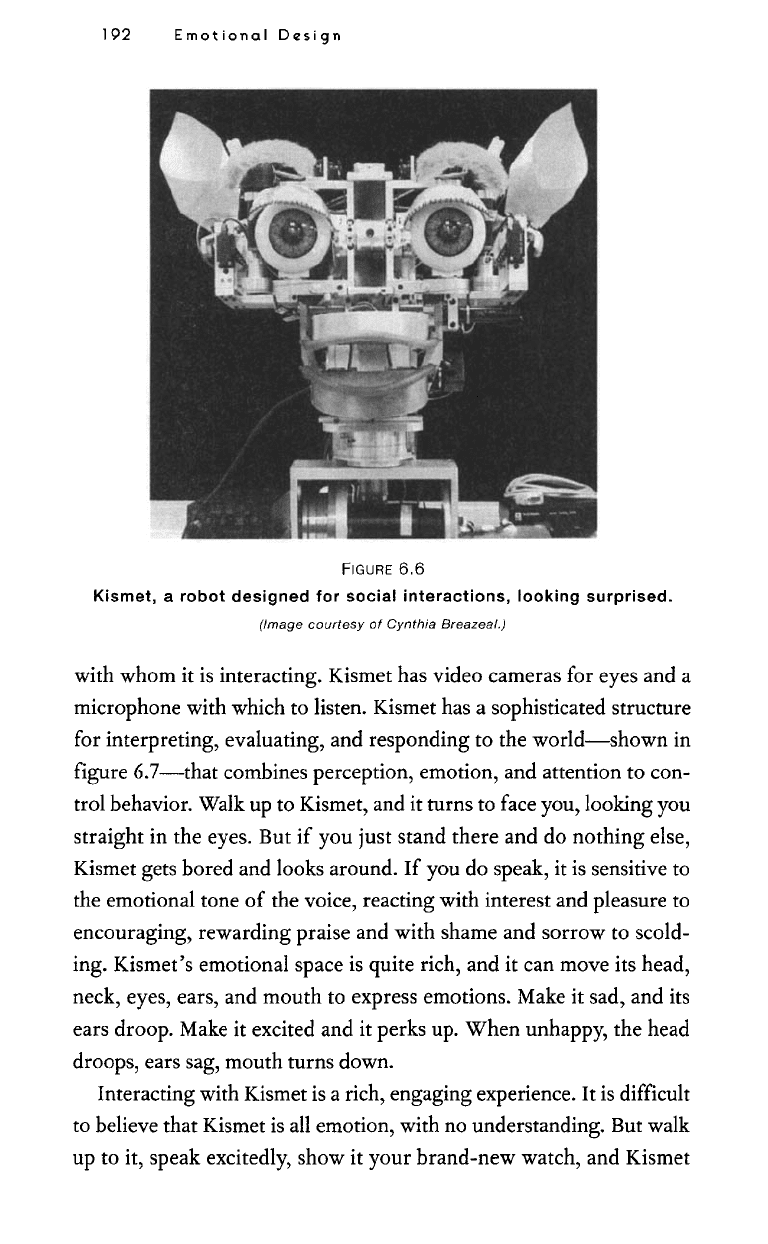
Kismet, whose photograph
is
shown
in
figure 6.6,
was
developed
by a
team
of
researchers
at the MIT
Artificial
Intelligence Laboratory
and
reported upon
in
detail
in
Cynthia Breazeal's Designing
Sociable
Robots.
Recall that
the
underlying emotions
of
speech
can be
detected with-
out any
language understanding. Angry, scolding, pleading, consol-
ing,
grateful,
and
praising voices
all
have distinctive pitch
and
loudness contours.
We can
tell which
of
these states someone
is in
even
if
they
are
speaking
in a
foreign language.
Our
pets
can
often
detect
our
moods through both
our
body language
and the
emotional
patterns within
our
voices.
Kismet
uses these cues
to
detect
the
emotional state
of the
person
TLFeBOOK
192
Emotional
Design
FIGURE
6.6
Kismet,
a
robot designed
for
social interactions, looking surprised.
(Image
courtesy
of
Cynthia Breazeal.)
with whom
it is
interacting. Kismet
has
video cameras
for
eyes
and a
microphone with which
to
listen. Kismet
has a
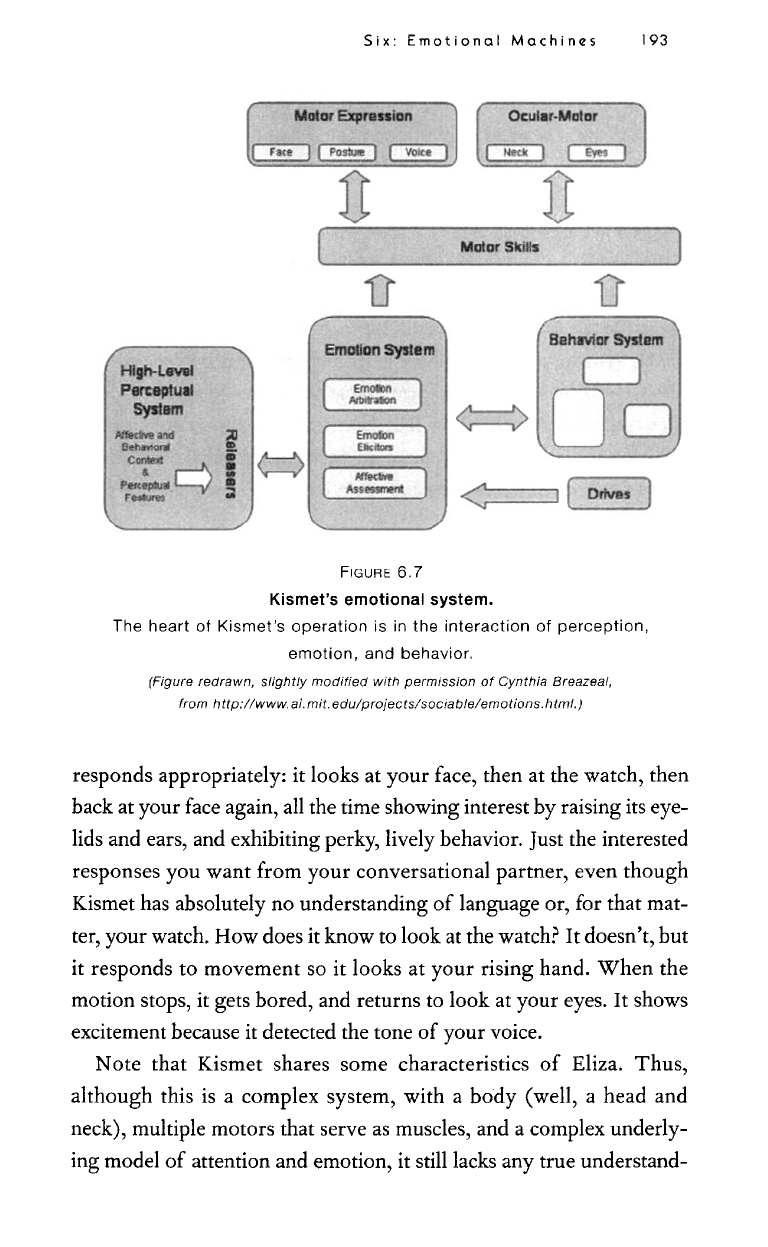
sophisticated structure
for
interpreting, evaluating,
and
responding
to the
world—shown
in
figure
6.7—that combines perception, emotion,
and
attention
to
con-
trol
behavior. Walk
up to
Kismet,
and it
turns
to
face
you, looking
you
straight
in the
eyes.
But if you
just stand there
and do
nothing else,
Kismet
gets bored
and
looks around.
If you do
speak,
it is
sensitive
to
the
emotional tone
of the
voice, reacting with interest
and
pleasure
to
encouraging, rewarding praise
and
with shame
and
sorrow
to
scold-
ing. Kismet's emotional space
is
quite rich,
and it can
move
its
head,
neck, eyes, ears,
and
mouth
to
express emotions.
Make
it
sad,
and its
ears droop.
Make
it
excited
and it
perks
up.
When unhappy,
the
head
droops, ears sag, mouth turns down.
Interacting with Kismet
is a
rich, engaging experience.
It is
difficult
to
believe that Kismet
is all
emotion, with
no
understanding.
But
walk
up
to it,
speak excitedly, show
it
your brand-new watch,
and
Kismet
TLFeBOOK
Six:
Emotional Machines
193
FIGURE
6.7
Kismet's
emotional
system.
The
heart
of
Kismet's
operation
is in the
interaction
of
perception,
emotion,
and
behavior.
(Figure
redrawn,
slightly
modified
with
permission
of
Cynthia
Breazeal,
from
http://www.ai.mit.edu/projects/sociable/emotions.html.)
responds appropriately:
it
looks
at
your face, then
at the
watch, then
back
at
your
face
again,
all the
time showing interest
by
raising
its
eye-
lids
and
ears,
and
exhibiting perky, lively behavior. Just
the
interested
responses
you
want
from
your conversational partner, even though
Kismet
has
absolutely
no
understanding
of
language
or, for
that mat-
ter, your watch.
How
does
it
know
to
look
at the
watch?
It
doesn't,
but
it
responds
to
movement
so it
looks
at
your rising hand. When
the
motion stops,
it
gets bored,
and
returns
to
look
at
your eyes.
It
shows
excitement
because
it
detected
the
tone
of
your voice.
Note that Kismet shares some characteristics
of
Eliza.
Thus,
although this
is a
complex system, with
a
body (well,
a
head
and
neck), multiple motors that serve
as
muscles,
and a
complex underly-
ing
model
of
attention
and
emotion,
it
still lacks
any
true understand-
TLFeBOOK
194
Emotional Design
ing. Therefore,
the
interest
and
boredom that
it
shows toward people
are
simply programmed responses
to
changes—or
the
lack thereof—
in
the
environment
and
responses
to
movement
and
physical aspects
of
speech. Although Kismet
can
sometimes keep people entranced
for
long periods,
the
enhancement
is
somewhat akin
to
that
of
Eliza: most
of
the
sophistication
is in the
observer's
interpretations.
Aibo,
the
Sony
robot
dog,
has a far
less sophisticated emotional
repertoire
and
intelligence than Kismet. Nonetheless, Aibo
has
also
proven
to be
incredibly engaging
to its
owners.
Many
owners
of the
robot
dog
band together
to
form
clubs: some
own
several robots.
They
trade stories about
how
they have trained Aibo
to do
various
tricks.
They
share ideas
and
techniques. Some
firmly
believe that their
personal Aibo recognizes them
and
obeys commands even though
it is
not
capable
of
these deeds.
When machines display emotions, they provide
a
rich
and
satisfy-
ing
interaction with people, even though most
of the
richness
and
sat-
isfaction,
most
of the
interpretation
and
understanding, comes
from
within
the
head
of the
person,
not
from
the
artificial
system. Sherry
Turkic, both
an MIT
professor
and a
psychoanalyst,
has
summarized
these interactions
by
pointing
out,
"It
tells
you
more about
us as
human
beings than
it
does
the
robots."
Anthropomorphism again:
we
read
emotions
and
intentions into
all
sorts
of
things.
"These
things
push
on our
buttons whether
or not
they have consciousness
or
intelli-
gence,"
Turkic said.
"They
push
on our
buttons
to
recognize them
as
though they
do. We are
programmed
to
respond
in a
caring
way to
these
new
kinds
of
creatures.
The key is
these
objects want
you to
nur-
ture
them
and
they thrive when
you pay
attention."
TLFeBOOK
CHAPTER
SEVEN
The
Future
of
Robots
SCIENCE
FICTION
CAN BE a
useful
source
of
ideas
and
information,
for it is, in
essence, detailed scenario development.
Writers
who
have used robots
in
their stories have
had to
imagine
in
considerable detail
just
how
they would
function
within everyday
work
and
activities. Isaac Asimov
was one of the
earliest thinkers
to
explore
the
implications
of
robots
as
autonomous, intelligent crea-
tures, equal
(or
superior)
in
intelligence
and
abilities
to
their human
masters. Asimov wrote
a
sequence
of
novels analyzing
the
difficulties
that would arise
if
autonomous
robots
populated
the
earth.
He
real-
ized
that
a
robot
might inadvertently harm itself
or
others,
both
through
its
actions
or, at
times,
through
its
lack
of
action.
He
there-
fore
developed
a set of
postulates that might prevent these problems;
but,
as he did so, he
also
realized
that they were
often
in
conflict
with
one
another. Some
conflicts
were simple: given
a
choice between pre-
venting harm
to
itself
or to a
human,
the
robot should protect
the
human.
But
other
conflicts
were much more subtle, much more
diffi-
cult. Eventually,
he
postulated three laws
of
robotics (laws one, two,
195
TLFeBOOK
196
Emotional Design
and
three)
and
wrote
a
sequence
of
stories
to
illustrate
the
dilemmas
that robots would
find
themselves
in, and how the
three laws would
allow
them
to
handle these situations. These three laws dealt with
the
interaction
of
robots
and
people,
but as his
story line progressed into
more complex situations, Asimov
felt
compelled
to add an
even more
fundamental
law
dealing with
the
robots'
relationship
to
humanity
itself.
This
one was so
fundamental that
it had to
come first;
but,
because
he
already
had a law
labeled First, this
fourth
law had to be
labeled
Zeroth.
Asimov's vision
of
people
and of the
workings
of
industry
was
strangely crude.
It was
only
his
robots that behaved well. When
I
reread
his
books
in
preparation
for
this chapter,
I was
surprised
at the
discrepancy between
my
fond memories
of the
stories
and my
response
to
them now.
His
people
are
rude, sexist,
and
naive.
They
seem
unable
to
converse unless they
are
insulting each other, fighting,
or
jeering.
His
fictional
company,
the
U.S.
Robots
and
Mechanical
Men
Corporation
doesn't
fare
well either.
It is
secretive, manipulative,
and
allows
no
tolerance
for
error:
make
one
mistake
and the
company
would fire you. Asimov spent
his
entire
life
in a
university. Maybe that
is
why he had
such
a
weird view
of the
real world.
Nonetheless,
his
analysis
of the
reaction
of
society
to
robots—and
of
robots
to
humans—was interesting.
He
thought society would turn
against
robots; and, indeed,
he
wrote that "most
of the
world govern-
ments banned robot
use on
earth
for any
purpose other than scientific
research between 2003
and
2007."
(Robots,
however, were allowed
for
space
exploration
and
mining;
and in
Asimov's stories, these activities
are
widely deployed
in the
early 2000s, which allow
the
robot industry
to
survive
and
grow.)
The
Laws
of
Robotics
are
intended
to
reassure
humanity
that robots will
not be a
threat
and
will, moreover, always
be
subservient
to
humans.
Today, even
our
most powerful
and
functional
robots
are far
from
the
stage
of
Asimov's.
They
do not
operate
for
long
periods without
human
control
and
assistance. Even
so, the
laws
are an
excellent tool
for
examining
just
how
robots
and
humans should interact.
TLFeBOOK
Seven:
The
Future
of
Robots
197
Asimov's
Four
Laws
of
Robotics
Zeroth
Law:
A
robot
may not
injure humanity,
or,
through
inac-
tion,
allow humanity
to
come
to
harm.
First
law:
A
robot
may not
injure
a
human
being,
or,
through
inaction, allow
a
human
being
to
come
to
harm, unless this
would violate
the
Zeroth
Law of
Robotics.
Second Law:
A
robot
must
obey
orders
given
it by
human
beings,
except where such
orders
would conflict with
the
Zeroth
or
First
Law.
Third
Law:
A
robot
must protect
its own
existence
as
long
as
such
protection
does
not
conflict with
the
Zeroth,
First,
or
Second Law.
Many
machines already have
key
aspects
of the
laws hard-wired
into them.
Let's
examine
how
these laws
are
implemented.
The
Zeroth Law—that
"a
robot
may not
injure
humanity,
or,
through inaction, allow humanity
to
come
to
harm,"
is
beyond current
capability,
for
much
the
same reasons that Asimov
did not
need this
law
in his
early stories:
to
determine
just
when
an
action—or lack
of
action—will harm
all
humanity
is
truly sophisticated, probably
beyond
the
abilities
of
most people.
The
first law—that
"a
robot
may not
injure
a
human
being,
or,
through inaction, allow
a
human being
to
come
to
harm, unless this
would violate
the
Zeroth
Law of
Robotics," could
be
labeled "safety."
It
isn't legal,
let
alone proper,
to
produce things that
can
hurt people.
As a
result,
all
machines today
are
designed with multiple safeguards
to
minimize
the
likelihood that they
can
harm
by
their action. Liability
laws
guarantee that robots—and machines
in
general—are outfitted
with numerous safeguards
to
prevent their actions
from
harming
peo-
ple. Industrial
and
home robots have proximity
and
collision sensors.
Even simple machines such
as
elevators
and
garage doors have sensors
that stop them
from
closing
on
people.
Today's
robots
try to
avoid
bumping into people
or
objects. Lawn mower
and
vacuum cleaner
TLFeBOOK
198
Emotional Design
robots have sensing mechanisms that cause them
to
stop
or
back away
whenever they bump into anything
or
come
too
close
to an
edge, such
as
a
stairway. Industrial robots
are
often
fenced
off,
so
that people
can't
get
near them when they
are
operating. Some have people detec-
tors,
so
they stop when they detect someone nearby. Home robots
have
many mechanisms
to
minimize
the
chance
of
damage;
but at the
moment, most
of
them
are so
underpowered that they couldn't hurt
even
if
they tried
to.
Moreover,
the
lawyers
are
very
careful
to
guard
against potential damage.
One
company sells
a
home robot that
can be
used
to
teach children
by
reading books
to
them
and
that
can
also
serve
as a
home sentinel, wandering about
the
house, taking photo-
graphs
of
unexpected encounters
and
notifying
its
owners,
by
email
if
necessary
(through
its
wireless internet connection, attaching
the
pho-
tographs along with
the
message,
of
course).
Despite these intended
applications,
the
robot comes with stern instructions that
it is not to be
used
near children,
nor is it to be
left
unattended
in the
house.
A
lot of
effort
has
gone into implementation
of the
safety
provision
of
the
first law. Most
of
this work
can be
thought
of as
applying
to the
visceral level, where fairly simple mechanisms
are
used
to
shut down
the
system
if
safety
regulations
are
violated.
The
second part
of the
law—do
not
allow harm through inac-
tion—is quite
difficult
to
implement.
If
determining
how a
machine's
actions might
affect
people
is
difficult, trying
to
determine
how the
lack
of an
action might have
an
impact
is
even more
so.
This
would
be
a
reflective
level implementation,
for the
robot would have
to do
con-
siderable
analysis
and
planning
to
determine when lack
of
action
would
lead
to
harm.
This
is
beyond most capabilities today.
Despite
the
difficulties, some simple solutions
to the
problem
do
exist. Many computers
are
plugged into "non-interruptible power sup-
plies"
to
avoid loss
of
data
in
cases
of
power failure.
If the
power
failed
and no
action were taken, harm would occur,
but in
these cases,
when
the
power
fails,
the
power supply springs into action, switching
to
batteries, converting
the
battery voltage
to the
form
the
computer
requires.
It can
also
be set to
notify people
and to
turn
off the
comput-
TLFeBOOK
Seven:
The
Future
of
Robots
199
er
gracefully.
Other
safety
systems
are
designed
to act
when normal
processes have failed. Some automobiles have internal sensors that
watch over
the
path
of the
car, adjusting engine power
and
braking
to
ensure that
the
auto keeps
going
as
intended. Automatic speed control
mechanisms
attempt
to
keep
a
safe
distance
from
the car in
front,
and
lane-changing detectors
are
under investigation.
All of
these devices
safeguard
car and
passengers when inaction would lead
to
accident.
Today,
these devices
are
simple
and the
mechanisms built
in.
Still,
one can see the
beginnings
of
solutions
to the
inaction clause
of the
first
law, even
in
these
simple
devices.
The
second law—that
"a
robot
must obey orders given
it by
human
beings,
except where such orders would
conflict
with
the
Zeroth
or
First Law,"
is
about
obeying
people,
in
contrast
to the
first,
which
is
about protecting them.
In
many ways, this
law is
trivial
to
implement,
but for
elementary reasons. Machines today
do not
have
an
independent mind,
so
they must obey
orders:
they have
no
choice
but to
follow
the
commands given them.
If
they
fail,
they
face
the
ulti-
mate
punishment: they
are
shut
off and
sent
to the
repair shop.
Can
a
machine
disobey
the
second
law in
order
to
protect
the
first
law?
Yes,
but not
with much subtlety. Command
an
elevator
to
take
you to
your floor,
and it
will
refuse
if it
senses that
a
person
or
object
is
blocking
the
door.
This,
however,
is the
most trivial
of
ways
to
implement
the
law,
and it
fails
when
the
situation
has any
sophistica-
tion. Actually,
in
cases where safety systems prevent
a
machine
from
following
orders,
usually
a
person
can
override
the
safety system
to
permit
the
operation
to
take place anyway.
This
has
been
the
cause
of
many
an
accident
in
trains, airplanes,
and
factories. Maybe Asimov
was
correct:
we
should leave some decisions
up to the
machines.
Some automatically deployed
safety
systems
are an
example
of the
"through
inaction" clause
of the
law.
Thus,
if the
driver
of an
auto-
mobile steps
on the
brakes rapidly,
but
only depresses
the
brake pedal
halfway,
most autos would only slow
halfway.
The
Mercedes Benz,
however, considers this "harm through inaction,"
so
when
it
detects
a
rapid
brake deployment,
it
puts
the
brakes
on
full,
assuming that
the
TLFeBOOK