
Norman D.A. Emotional Design: Why We Love (Or Hate) Everyday Things
Подождите немного. Документ загружается.


This page intentionally left blank
TLFeBOOK
CHAPTER
Six
Emotional
Machines
Dave,
stop
. . .
Stop, will
you . . .
Stop,
Dave
. . .
Will
you
stop,
Dave
. . .
Stop,
Dave
. . . I'm
afraid.
I'm
afraid
... I'm
afraid,
Dave
. . .
Dave
... My
mind
is
going
... I can
feel
it ... I can
feel
it ... My
mind
is
going
. . .
There
is no
question about
it ... I can
feel
it
... I can
feel
it ... I'm a. ..
fraid.
—HAL,
the
all-powerful computer,
in
the
movie 2001
HAL IS
CORRECT
TO BE
AFRAID:
Dave
is
about
to
shut
him
down
by
dismantling
his
parts.
Of
course, Dave
is
afraid, too:
HAL has
killed
all the
other crew
of the
spacecraft
and
made
an
unsuccessful
attempt
on
Dave's
life.
But
why and how
does
HAL
have
fear?
Is it
real
fear?
I
suspect not.
HAL
correctly diagnoses
Dave's
intent: Dave wants
to
kill him.
So
fear—being afraid—is
a
logical response
to the
situation.
But
human
emotions have more than
a
logical, rational component; they
are
tight-
ly
coupled
to
behavior
and
feelings. Were
HAL a
human,
he
would
fight
hard
to
prevent
his
death, slam some
doors,
do
something
to
sur-
l6l
TLFeBOOK
162
Emotional Design
vive.
He
could
threaten,
"Kill
me and you
will
die, too,
as
soon
as the
air
in
your backpack runs
out."
But HAL
doesn't
do any of
this;
he
simply
states,
as a
fact,
"I'm
afraid."
HAL has an
intellectual knowl-
edge
of
what
it
means
to be
afraid,
but it
isn't coupled
to
feelings
or to
action:
it
isn't
real emotion.
But
why
would
HAL
need real emotions
to
function?
Our
machines
today
don't
need emotions.
Yes,
they have
a
reasonable
amount
of
intelligence.
But
emotions? Nope.
But
future
machines will
need
emotions
for the
same reasons people
do: The
human emotional
system
plays
an
essential role
in
survival, social interaction
and
coop-
eration,
and
learning.
Machines
will need
a
form
of
emotion—
machine
emotion—when they
face
the
same conditions, when they
must
operate continuously without
any
assistance
from
people
in the
complex, ever-changing world where
new
situations continually arise.
As
machines become more
and
more capable, taking
on
many
of our
roles, designers
face
the
complex task
of
deciding
just
how
they shall
be
constructed,
just
how
they will interact with
one
another
and
with
people.
Thus,
for the
same reason that animals
and
people have
emo-
tions,
I
believe that machines will also need them.
They
won't
be
human
emotions, mind
you,
but
rather emotions that
fit the
needs
of
the
machines themselves.
Robots already exist. Most
are
fairly
simple automated arms
and
tools
in
factories,
but
they
are
increasing
in
power
and
capabilities,
branching
out to a
much wider array
of
activities
and
places. Some
do
useful
jobs,
as do the
lawn-mowing
and
vacuum-cleaning
robots
that
already exist. Some, such
as the
surrogate pets,
are
playful.
Some
sim-
ple
robots
are
being used
for
dangerous jobs, such
as
fire
fighting,
search-and-rescue missions,
or for
military purposes. Some
robots
even deliver mail, dispense medicine,
and
take
on
other relatively
sim-
ple
tasks.
As
robots
become more advanced, they will need only
the
simplest
of
emotions, starting with such practical ones
as
visceral-like
fear
of
heights
or
concern about bumping into
things.
Robot pets will
have
playful,
engaging personalities. With time,
as
these robots gain
in
capability, they will come
to
possess
full-fledged
emotions:
fear
and
TLFeBOOK
Six:
Emotional
Machines
163
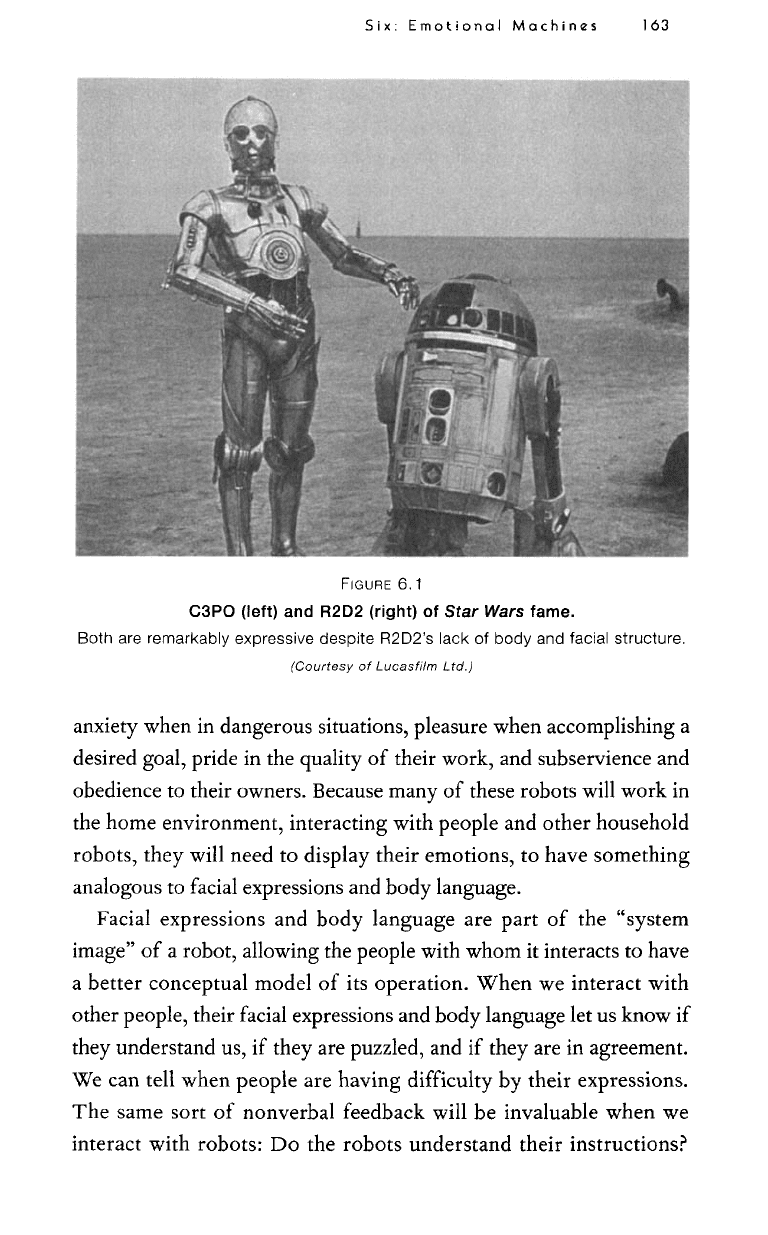
FIGURE
6.1
C3PO
(left)
and
R2D2 (right)
of
Star
Wars
fame.
Both
are
remarkably expressive
despite
R2D2's lack
of
body
and
facial structure.
(Courtesy
of
Lucasfilm Ltd.)
anxiety
when
in
dangerous situations, pleasure when accomplishing
a
desired goal, pride
in the
quality
of
their work,
and
subservience
and
obedience
to
their owners. Because many
of
these robots will work
in
the
home environment, interacting with people
and
other household
robots, they will need
to
display their emotions,
to
have something
analogous
to
facial
expressions
and
body language.
Facial
expressions
and
body language
are
part
of the
"system
image"
of a
robot, allowing
the
people with whom
it
interacts
to
have
a
better conceptual model
of its
operation. When
we
interact with
other people, their
facial
expressions
and
body language
let us
know
if
they understand
us, if
they
are
puzzled,
and if
they
are in
agreement.
We
can
tell when people
are
having difficulty
by
their expressions.
The
same sort
of
nonverbal feedback will
be
invaluable when
we
interact
with robots:
Do the
robots understand their instructions?
TLFeBOOK
164
Emotional Design
When
are
they
working
hard
at the
task?
When
are
they
being
suc-
cessful?
When
are
they
having
difficulties?
Emotional expressions
will
let us
know their motivations
and
desires, their accomplishments
and
frustrations,
and
thus will increase
our
satisfaction
and
under-
standing
of the
robots:
we
will
be
able
to
tell what they
are
capable
of
and
what they
aren't.
Finding
the
right
mix of
emotions
and
intelligence
is not
easy.
The
two
robots
from
the
Star
Wars
films, R2D2
and
C3PO,
act
like
machines
we
might
enjoy
having around
the
house.
I
suspect that part
of
their charm
is in the way
they display their limitations.
C3PO
is a
clumsy,
well-meaning
oaf,
pretty incompetent
at all
tasks except
the
one for
which
he is a
specialist: translating languages
and
machine
communication. R2D2
is
designed
for
interacting with other machines
and
has
limited physical capabilities.
It has to
rely upon C3PO
to
talk
with
people.
R2D2
and
C3PO show their emotions well, letting
the
screen char-
acters—and
the
movie audience—understand, empathize with, and,
at
times,
get
annoyed with them.
C3PO
has a
humanlike form,
so he can
show
facial
expressions
and
body motions:
he
does
a lot of
hand wring-
ing and
body swaying. R2D2
is
more limited,
but
nonetheless very
expressive, showing
how
able
we are to
impute emotions when
all we
can
see is a
head shaking,
the
body moving back
and
forth,
and
some
cute
but
unintelligible sounds.
Through
the
skills
of the
moviemakers,
the
conceptual models underlying R2D2
and
C3PO
are
quite visible.
Thus,
people always have pretty accurate understanding
of
their
strengths
and
weaknesses, which make them enjoyable
and
effective.
Movie
robots haven't always
fared
well. Notice what happened
to
two
movie
robots:
HAL,
of the
movie 2001
and
David,
of the
movie
Al
(Artificial
Intelligence}.
HAL is
afraid,
as the
opening
quotation
of
this
chapter illustrates,
and
properly
so. He is
being taken apart—basi-
cally,
being murdered.
David
is a
robot built
to be a
surrogate child, taking
the
place
of a
real
child
in a
household. David
is
sophisticated,
but a
little
too
per-
fect.
According
to the
story, David
is the
very
first
robot
to
have
TLFeBOOK
Six:
Emotional
Machines
165
"unconditional
love."
But
this
is not a
true love. Perhaps because
it is
"unconditional,"
it
seems artificial, overly
strong,
and
unaccompanied
by the
normal human array
of
emotional states. Normal children
may
love their parents,
but
they also
go
through stages
of
dislike, anger,
envy,
disgust,
and
just
plain
indifference
toward them. David does
not
exhibit
any of
these feelings. David's pure love means
a
happy devoted
child,
following
his
mother's footsteps, quite literally, every second
of
the
day. This behavior
is so
irritating that
he is
finally
abandoned
by
his
foster
mother,
left
in the
wilderness,
and
told
not to
come back.
The
role
of
emotion
in
advanced intelligence
is a
standard theme
of
science fiction.
Thus,
two of the
characters
from
the
Star
Trek
televi-
sion
shows
and
films
wrestle with
the
role
of
emotion
and
intelligence.
The
first,
Spock, whose mother
is
human
but
whose
father
is
Vulcan,
has
essentially
no
emotions, giving
the
story writers wonderful oppor-
tunities
to pit
Spock's
pure reason
against
Captain Kirk's human emo-
tions. Similarly,
in the
later series, Lieutenant Commander Data
is
pure android, completely artificial,
and his
lack
of
emotion provides
similar
fodder
for the
writers, although several episodes tinker with
the
possibility
of
adding
an
"emotion chip" into Data,
as if
emotion
were
a
separate section
of the
brain that could
be
added
or
subtracted
at
will.
But
although
the
series
is
fiction,
the
writers
did
their home-
work well: their portrayal
of the
role
of
emotion
in
decision making
and
social interaction
is
reasonable enough that
the
psychologists
Robert Sekuler
and
Randolph Blake
found
them excellent examples
of
the
phenomena, appropriate
for
teaching introductory psychology.
In
their
book,
Star
Trek
on the
Brain, they used numerous examples
from
the
Star
Trek
series
to
illustrate
the
role
of
emotion
in
behavior
(among other topics).
Emotional
Things
How
will
my
toaster ever
get
better, making toast
the way I
prefer,
unless
it has
some pride? Machines will
not be
smart
and
sensible until
TLFeBOOK
166
Emotional Design
they have both intelligence
and
emotions. Emotions enable
us to
translate
intelligence
into
action.
Without pride
in the
quality
of our
actions,
why
would
we
endeavor
to do
better?
The
positive emotions
are of
critical importance
to
learning,
to
maintaining
our
curiosity about
the
world. Negative emo-
tions
may
keep
us
from
danger,
but it is
positive emotions that make
living worthwhile, that guide
us to the
good things
in
life,
that reward
our
successes,
and
that
make
us
strive
to be
better.
Pure reason
doesn't
always
suffice.
What happens when there isn't
enough information?
How do we
decide which course
of
action
to
take when there
is
risk,
so
that
the
possibility
of
harm
has to be
bal-
anced against
the
emotional gain
of
success?
This
is
where emotions
play
a
critical role
and
where humans
who
have
had
neurological dam-
age to
their emotional systems
falter.
In the
movie 2001,
the
astronaut
Dave risks
his
life
in
order
to
recover
the
dead body
of his
fellow
astronaut. Logically this doesn't make much sense,
but in
terms
of a
long
history
of
human society,
it is of
great
importance.
Indeed,
this
tendency
of
people
to
risk many lives
in the
effort
to
rescue
a
few—or
even
to
retrieve
the
dead—is
a
constant theme
in
both
our
real lives
and
our
fictional ones,
in
literature, theater,
and
film.
Robots will need something akin
to
emotion
in
order
to
make these
complex
decisions. Will that walkway hold
the
robot's
weight?
Is
there some danger lurking behind
the
post?
These
decisions require
going
beyond perceptual information
to use
experience
and
general
knowledge
to
make
inferences
about
the
world
and
then
to use the
emotional system
to
help assess
the
situation
and
move toward action.
With
just
pure
logic,
we
could spend
all day
frozen
in
place, unable
to
move
as we
think through
all the
possible things that could
go
wrong—as
happens
to
some emotionally impaired people.
To
make
these decisions
we
need emotions: robots will,
too.
Rich,
layered systems
of
affect
akin
to
that
of
people
are not yet a
part
of our
machines,
but
some
day
they will
be.
Mind
you,
the
affect
required
is not
necessarily
a
copy
of
humans'. Instead, what
is
needed
is
an
affective
system tuned
to the
needs
of the
system. Robots should
TLFeBOOK
Six:
Emotional Machines
167
be
concerned
about
dangers
that
might
befall
them,
many
of
which
are
common
to
people
and
animals,
and
some
of
which
are
unique
to
robots.
They
need
to
avoid falling down stairs
or off of
other edges,
so
they should have
fear
of
heights.
They
should
get
fatigued,
so
they
do
not
wear themselves
out and
become
low on
energy (hungry?)
before
recharging their battery.
They
don't
have
to eat or use a
toilet,
but
they
do
need
to be
serviced periodically:
oil
their joints, replace
worn parts,
and so on.
They
don't
have
to
worry about cleanliness
and
sanitation,
but
they
do
need
to pay
attention
to
dirt that might
get
into
their moving parts, dust
and
dirt
on
their television lenses,
and
com-
puter viruses that might interfere with their functioning.
The
affect
that
robots require will
be
both similar
to and
very
different
from
that
of
people.
Even though machine designers
may
have never considered that
they were building
affect
or
emotion into their machines, they have
built
in
safety
and
survival systems. Some
of
these
are
like
the
visceral
level
of
people: simple, fast-acting circuits that detect possible danger
and
react accordingly.
In
other words, survival
has
already been
a
part
of
most machine design.
Many
devices have
fuses,
so
that
if
they
sud-
denly draw more electric current than normal,
the
fuse
or
circuit
breaker opens
the
electrical circuit, preventing
the
machine
from
dam-
aging itself
(and,
along
the
way,
preventing
it
from
damaging
us or
the
environment). Similarly, some computers have non-interruptible
power supplies,
so
that
if the
electric power
fails,
they quickly
and
immediately
switch
to
battery power.
The
battery gives them time
to
shut
down
in an
orderly
and
graceful
fashion, saving
all
their data
and
sending notices
to
human operators. Some equipment
has
temperature
or
water-level sensors. Some detect
the
presence
of
people
and
refuse
to
operate
whenever
someone
is in a
proscribed
zone.
Existing
robots
and
other mobile systems already have sensors
and
visual systems that
prevent them
from
hitting people
and
other objects
or
falling down
stairs.
So
simple
safety
and
survival
is
already
a
part
of
many designs.
In
people
and
animals,
the
impact
of the
visceral system doesn't
cease with
an
initial response.
The
visceral level signals higher levels
TLFeBOOK
168
Emotional Design
of
processing
to try to
determine
the
causes
of the
problem
and to
determine
an
effective
response. Machines should
do the
same.
Any
system that
is
autonomous—that
is
intended
to
exist
by
itself,
without
a
caretaker always guiding it—continually
has to
decide
which
of
many possible activities
to do. In
technical terms,
it
needs
a
scheduling system. Even people have
difficulty
with this task.
If we
are
working hard
to
finish
an
important task, when should
we
take
a
break
to
eat,
sleep,
or to do
some other activity that
is
perhaps
required
of us but not
nearly
so
urgent?
How do we fit the
many
activities that have
to be
done into
the
limited hours
of the
day, know-
ing
when
to put one
aside, when
not to?
Which
is
more important:
The
critical proposal
due
tomorrow morning
or
planning
a
family
birthday celebration?
These
are
difficult
problems that
no
machine
today
can
even contemplate
but
that people
face
every
day.
These
are
precisely
the
sorts
of
decision-making
and
control problems
for
which
the
emotional system
is so
helpful.
Many
machines
are
designed
to
work even though individual com-
ponents
may
fail.
This
behavior
is
critical
in
safety-related systems,
such
as
airplanes
and
nuclear power reactors,
and
very valuable
in
systems that
are
performing critical operations, such
as
some comput-
er
systems, hospitals,
and
anything dealing with
the
vital infrastruc-
ture
of
society.
But
what happens when
a
component
fails
and the
automatic backups take over? Here
is
where
the
affective
system
would
be
useful.
The
component
failure
should
be
detected
at the
visceral level
and
used
to
trigger
an
alert:
in
essence,
the
system would become
"anx-
ious."
The
result
of
this increased anxiety should
be to
cause
the
machine
to act
more conservatively, perhaps slowing down
or
post-
poning non-critical jobs.
In
other words,
why
shouldn't machines
behave like people
who
have become anxious?
They
would
be
cau-
tious even while attempting
to
remove
the
cause
of
anxiety. With
peo-
ple,
behavior
becomes more focused until
the
cause
and an
appropriate
response
are
determined. Whatever
the
response
for
machine systems, some change
in
normal behavior
is
required.
TLFeBOOK
Six:
Emotional
Machines
169
Animals
and
humans have developed sophisticated mechanisms
for
surviving
in an
unpredictable, dynamic world, coupling
the
appraisals
and
evaluations
of
affect
to
methods
for
modulating
the
overall sys-
tem.
The
result
is
increased robustness
and
error tolerance.
Our
artifi-
cial
systems would
do
well
to
learn
from
their example.
Emotional
Robots
The
1980s
was the
decade
of the PC,
the 90s of the
Internet,
but I
believe
the
decade
just starting will
be the
decade
of
the
robot.
—Sony
Corporation Executive
Suppose
we
wish
to
build
a
robot
capable
of
living
in the
home, wan-
dering about, fitting comfortably into
the
family—what would
it do?
When asked this question, most people first think
of
handing over
their
daily chores.
The
robot should
be a
servant, cleaning
the
house,
taking care
of the
chores. Everyone seems
to
want
a
robot
that will
do
the
dishes
or the
laundry. Actually, today's dishwashers
and
clothes
washers
and
dryers could
be
considered
to be
very simple, special-
purpose
robots,
but
what people really have
in
mind
is
something that
will
go
around
the
house
and
collect
the
dirty dishes
and
clothes, sort
and
wash them,
and
then
put
them back
to
their proper places—after,
of
course, pressing
and
folding
the
clean clothes.
All of
these tasks
are
quite
difficult,
beyond
the
capabilities
of the
first
few
generations
of
robots.
Today,
robots
are not yet
household objects.
They
show
up in
sci-
ence
fairs
and
factory floors, search-and-rescue missions,
and
other
specialized
events.
But
this will change. Sony
has
announced this
to be
the
decade
of the
robot,
and
even
if
Sony
is too
optimistic,
I do
pre-
dict
that
robots
will blossom
forth
during
the
first
half
of the
twenty-
first
century.
TLFeBOOK