
Quinn J.J., Yi K.-S. Solid State Physics: Principles and Modern Applications
Подождите немного. Документ загружается.

Uncorrected Proof
BookID 160928 ChapID 02 Proof# 1 - 29/07/09
78 2 Lattice Vibrations
In the three-dimensional case, the Hamiltonian is given by 899
H =
kλ
¯hω
kλ
a
†
kλ
a
kλ
+
1
2
.
The allowed values of k are given by k =2π
n
1
N
1
b
1
+
n
2
N
2
b
2
+
n
3
N
3
b
3
. The
900
displacement u
n
and momentum P
n
of the nth atom are written, respectively, 901
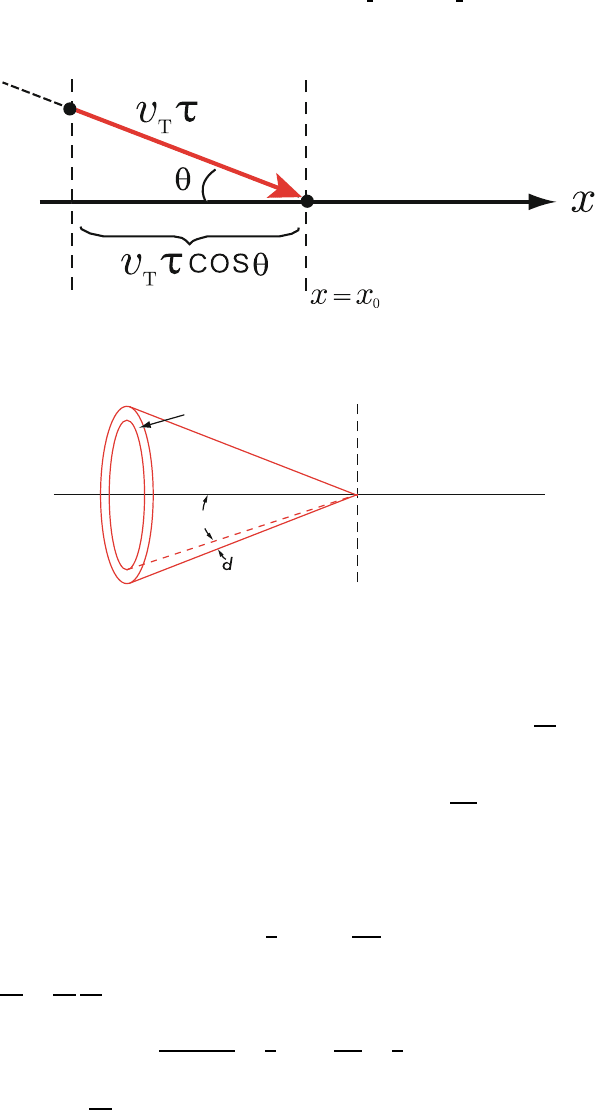
as 902
u
n
=
kλ
¯h
2MNω
kλ
1/2
ˆε
kλ
e
ik·R
0
n
a
kλ
− a
†
−kλ
903
P
n
=
kλ
i
¯hM ω
kλ
2N
1/2
ˆε
kλ
e
−ik·R
0
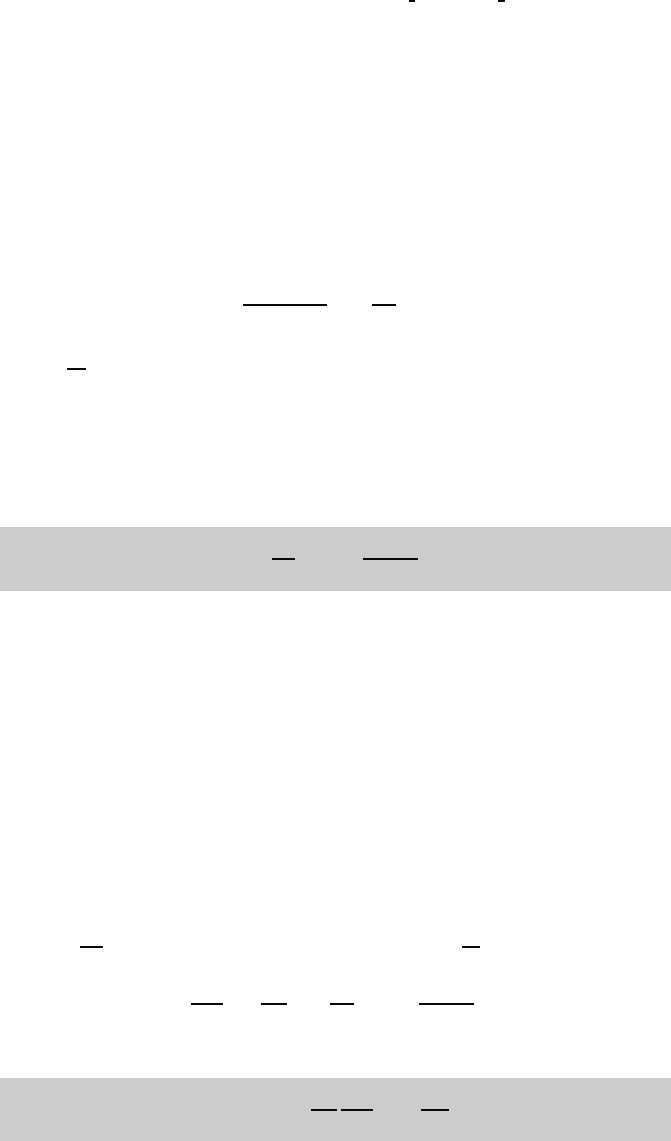
n
a
†
kλ
+ a
−kλ
.
The energy of the crystal is given by U =
qλ
¯n
qλ
+
1
2
¯hω
qλ
, where ¯n
qλ
904
is given by ¯n
qλ
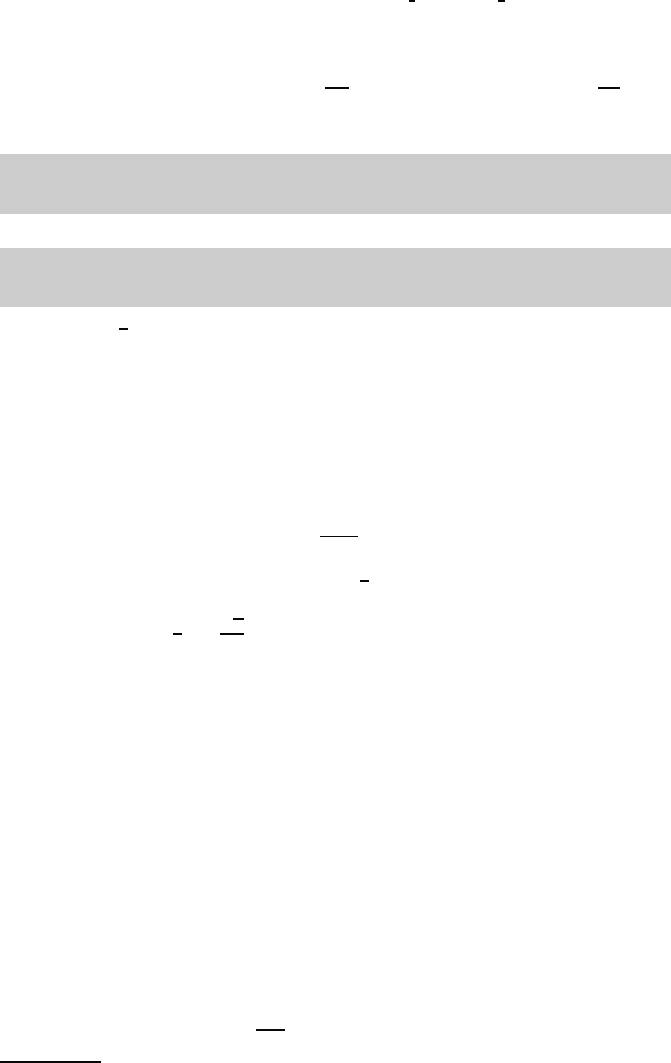
=
1
e
¯hω
qλ
/k
B
T
−1
. The lattice heat capacity is written as 905
C
v
=
∂U
∂T
v
= k
B
qλ
¯hω
qλ
k
B
T
2
e
¯hω
qλ
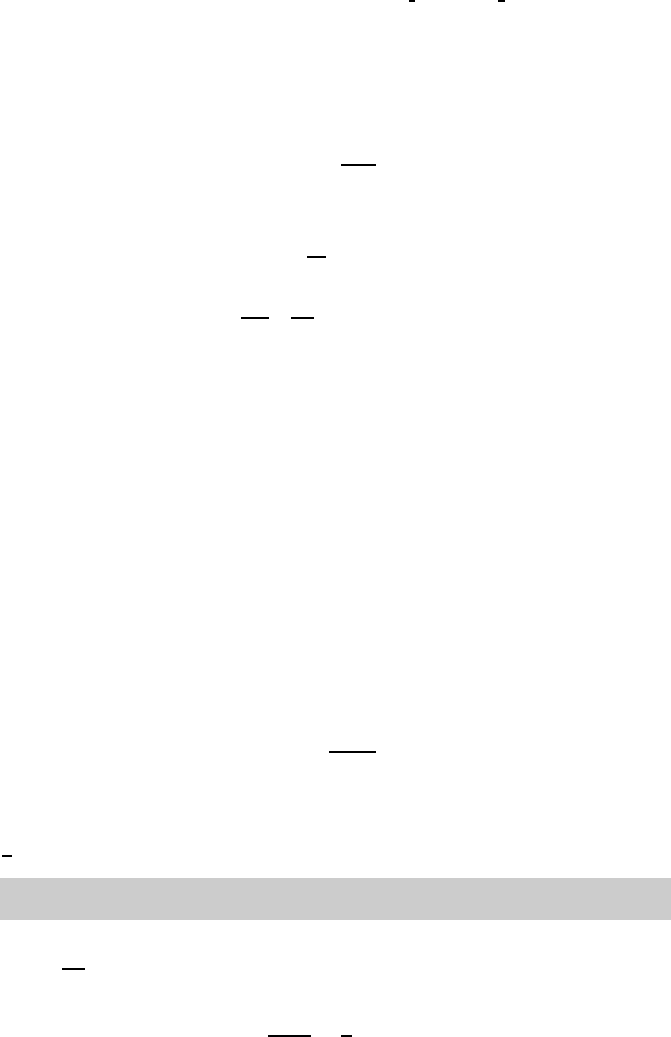
k
B
T
− 1
−1
1 − e
−
¯hω
qλ
k
B
T
−1
.
The density of states g(ω) defined by
906
g(ω)dω =
#
The number of normal modes per unit volume
Whose frequency ω
qλ
satisfies ω<ω
qλ
<ω+dω.
Then we have g(ω)=
1
(2π)
3
λ
"
dS
λ
(ω)
|∇
q
ω
qλ
|
ω
. Here, |rmdS
λ
(ω) is an infinites- 907
imal element of the surface of constant frequency in three-dimensional wave 908
vector space on which ω
qλ
has the value ω. Near a critical point q
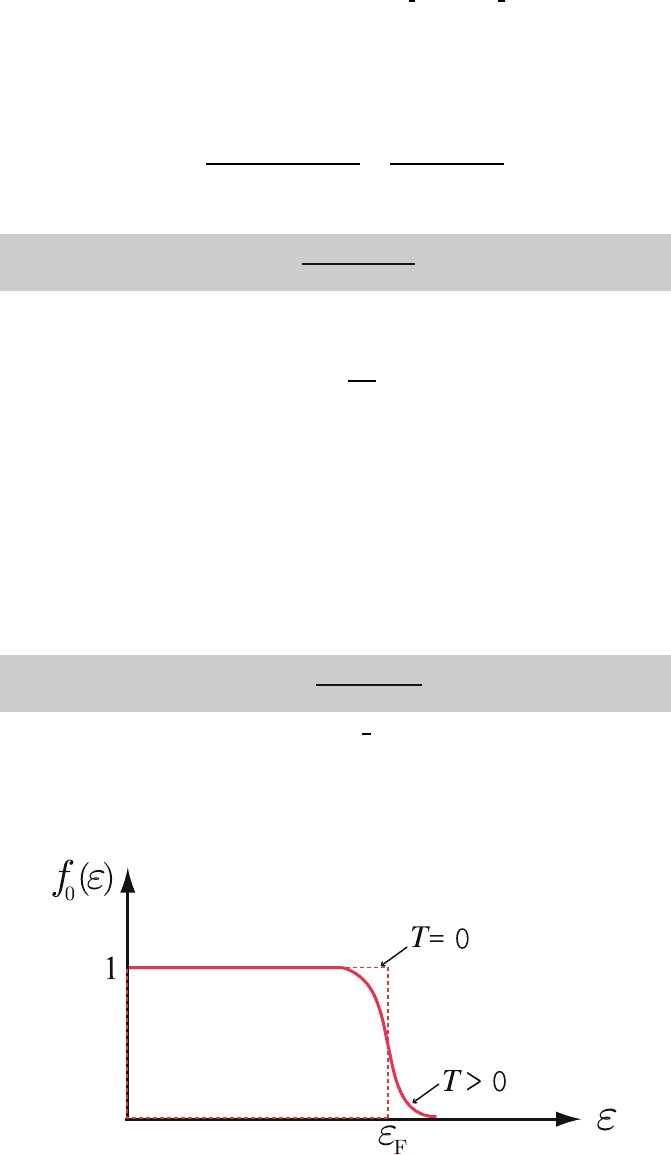
c
,atwhich 909
∇
q
ω
qλ
= 0, in the phonon spectrum, we can write 910
ω
q
= ω
c
+ α
1
ξ
2
1
+ α
2
ξ
2
2
+ α
3
ξ
2
3
,
where ξ
i
are the components of ξ = q − q
c
,andω
c
= ω(q
c
). In three 911
dimensions, there are four kinds of critical points: 912
1. Maxima: points at which all three α
i
are negative. 913
2. Minima: points at which all three α
i
are positive. 914
3. Saddle Points of the First Kind:Pointsatwhichtwoα
i
’s are positive and 915
one is negative. 916
4. Saddle Points of the Second Kind: Points at which one α
i
is positive and 917
the other two are negative. 918
The density of states for the Debye model is expressed as 919
g(ω)=
ω
2
2π
2
θ(s
l
k
D
− ω)
s
3
l
+
2 θ(s
t
k
D
− ω)
s
3
t
.
Here, s
l
and s
t
are the speed of a longitudinal and of a transverse sound wave. 920

Uncorrected Proof
BookID 160928 ChapID 03 Proof# 1 - 29/07/09
3 1
Free Electron Theory of Metals 2
3.1 Drude Model 3
The most important characteristic of a metal is its high electrical conductivity. 4
Around 1900, shortly after J.J. Thompson’s discovery of the electron, people 5
became interested in understanding more about the mechanism of metallic 6
conduction. The first work by E. Riecke in 1898 was quickly superseded by 7
that of Drude in 1900. Drude
1
proposed an exceedingly simple model that 8
explained a well-known empirical law, the Wiedermann–Franz law (1853). 9
This law states that at a given temperature the ratio of the thermal conduc- 10
tivity to the electrical conductivity is the same for all metals. The assumptions 11
of the Drude model are: 12
1. A metal contains free electrons which form an electron gas. 13
2. the electrons have some average thermal energy
1
2
mv
2
T
, but they pursue
14
random motions through the metal so that v
T
= 0 even though
v
2
T
=0.
15
The random motions result from collisions with the ions. 16
3. Because the ions have a very large mass, they are essentially immovable. 17
3.2 Electrical Conductivity 18
In the presence of an electric field E, the electrons acquire a drift velocity 19
v
D
which is superimposed on the thermal motion. Drude assumed that the 20
probability that an electron collides with an ion during a time interval dt is 21
simply proportional to
dt
τ
,whereτ is called the collision time or relaxation 22
time. Then Newton’s law gives 23
m
dv
D
dt
+
v
D
τ
= −eE, (3.1)
24
1
P. Drude, Annalen der Physik 1, 566 (1900); ibid., 3, 369 (1900); ibid., 7, 687
(1902).
Uncorrected Proof
BookID 160928 ChapID 03 Proof# 1 - 29/07/09
80 3 Free Electron Theory of Metals
where −e is the charge on an electron. Some appreciation of the term of relax- 25
ation time
dt
τ
can be obtained by assuming that the system acquires a drift 26
velocity v
D
inthepresenceofanelectricfieldE,andthen,attimet =0,the 27
electric field is turned off. The behavior of v
D
(t) as a function of time is given 28
by 29
v
D
(t)=v
D
(0)e
−t/τ
, (3.2)
showing that v
D
relaxes from v
D
(0) toward zero with a relaxation time τ. 30
In the steady-state (where
˙
v
D
=0),v
D
is given by 31
v
D
= −
eEτ
m
. (3.3)
The quantity
eτ
m
, the drift velocity per unit electric field, is called μ,the 32
drift mobility. The velocity of an electron including both thermal and drift 33
components is 34
v = v
T
−
eτE
m
. (3.4)
The current density caused by the electric field E is simply
35
j = V
−1
all
electrons
(−e)v. (3.5)
But
all
electrons
v
T
=0,sothat 36
j = V
−1
N(−e)
−
eτE
m
= σE. (3.6)
Here σ,theelectrical conductivity,isequalto
n
0
e
2
τ
m
where n
0
=
N
V
is the 37
electron concentration. 38
3.3 Thermal Conductivity 39
The thermal conductivity is the ratio of the thermal current (i.e., the energy 40
current) to the magnitude of the temperature gradient. In the presence of a 41
temperature gradient
∂T
∂x
, the average thermal energy
1
2
mv
2
T
will depend
42
on the local temperature T (x). The electrons sense the local temperature 43
through collisions with the lattice. Thus, the thermal energy of a given elec- 44
tron will depend on where it made its last collision. If we choose an electron 45
at random, the mean time back to its last collision is τ. Therefore, an electron 46
crossing the plane x = x
0
at an angle θ to the x-axis had its last colli- 47
sion at x = x
0
− v
T
τ cos θ. (See Fig. 3.1.) The energy of such an electron is 48
E(x)=E (x
0
− v
T
τ cos θ). The number of electrons per unit volume whose 49
direction of motion is in the solid angle dΩ is simply n
0
dΩ
4π
. (See Fig. 3.2.) 50
Uncorrected Proof
BookID 160928 ChapID 03 Proof# 1 - 29/07/09
3.3 Thermal Conductivity 81
Fig. 3.1. An electron crossing the plane x = x
0
at an angle θ to the x-axis
θ
θ
2sinddΩ= π θ θ
Fig. 3.2. Solid angle dΩ in which electrons moving to cross the plane x = x
0
at an
angle θ to the x-axis
The number of such electrons crossing a unit area at x
0
is n
0
dΩ
4π
v
T
cos θ, 51
giving for the energy flux through a unit area at x
0
52
w(x
0
)=
E (x
0
− v
T
τ cos θ) n
0
v
T
cos θ
dΩ
4π
. (3.7)
Just as we did for the thermal conductivity due to phonons we expand E(x
0
− 53
v
T
τ cos θ) and perform the integral over θ from 0 to π.Thisgives 54
w(x)=−
1
3
n
0
v
2
T
τ
∂E
∂x
. (3.8)
But
∂E
∂x
=
∂E
∂T
∂T
∂x
, so the thermal conductivity κ is given by 55
κ =
w
−∂T/∂x
=
1
3
n
0
v
2
T
τ
dE
dT
=
1
3
v
2
T
τC
v
, (3.9)
where C
v
= n
0
dE
dT
is the heat capacity per unit volume (or the specific heat). 56
Uncorrected Proof
BookID 160928 ChapID 03 Proof# 1 - 29/07/09
82 3 Free Electron Theory of Metals
3.4 Wiedemann–Franz Law 57
The ratio of κ to σ is given by 58
κ
σ
=
1
3
v
2
T
τC
v
n
0
e
2
τ
m
. (3.10)
Now Drude applied the classical gas laws to evaluation of v
2
T
and C
v
, viz., 59
1
2
mv
2
T
=
3
2
k
B
T and C
v
= n
0
3
2
k
B
.Thisgave 60
κ
σ
=
3
2
k
B
e
2
T. (3.11)
61
In addition to agreeing with the Wiedemann–Franz law, the ratio L =
κ
σT
62
had the value
3
2
k
B
e
2
which was equal to 1.24 ×10
−13
esu. The observed val- 63
ues for L, called the Lorenz number
2
, averaged to roughly 2.72 × 10
−13
esu. 64
Drude made an error of a factor of 2 in his original paper and found that 65
L∼2.48 × 10
−13
esu, remarkably close to the experimental value. 66
3.5 Criticisms of Drude Model 67
1. If
1
2
mv
2
T
=
3
2
k
B
T , then the electronic contribution to C
v
had to be C
v
= 68
3
2
Nk
B
=
3
2
R. This is half as big as the lattice contribution and was simply 69
not observed. 70
2. Experimentally σ varies as T
−1
. This implies that n
0
τ ∝ T
−1
since e
2
71
and m are constants. In Drude’s picture, the mean free path l v
T
τ was 72
thought to be of the order of the atomic spacing and therefore independent 73
of T .Sincev
T
∝ T
1/2
this would imply that τ ∝ T
−1/2
and, to satisfy 74
n
0
τ ∝ T
−1
,thatn
0
∝ T
−1/2
. This did not make any sense. 75
3.6 Lorentz Theory 76
Since Drude’s simple model gave some results that agree fairly well with 77
experiment, Lorentz
3
decided to use the full apparatus of kinetic theory to 78
investigate the model more carefully. He did not succeed in improving on 79
Drude’s model, but he did make use of the Boltzmann distribution function 80
and Boltzmann equation which we would like to describe. 81
2
Ludvig Valentin Lorenz (1829–1891).
3
Hendrik Antoon Lorentz (1853–1928).
Uncorrected Proof
BookID 160928 ChapID 03 Proof# 1 - 29/07/09
3.6 Lorentz Theory 83
3.6.1 Boltzmann Distribution Function 82
The Boltzmann distribution function f (v, r,t) is defined by 83
f(v, r,t)d
3
rd
3
v = the number of electrons in the volume element d
3
r centered 84
at r whose velocity is between v and v +dv at time t. 85
Boltzmann’s equation says that the total time rate of change of f (v, r,t)must 86
be balanced by its time rate of change due to collisions, i.e., 87
df (v, r,t)
dt
=
∂f
∂t
c
. (3.12)
Here,
∂f
∂t
c
d
3
r d
3
v dt is the net number of electrons forced into the volume 88
element d
3
rd
3
v (in phase space) by collisions in the time interval dt. 89
3.6.2 Relaxation Time Approximation 90
The simplest form of the collision term is 91
∂f
∂t
c
= −
f − f
0
τ
, (3.13)
92
where f
0
is the thermal equilibrium distribution function, f the actual nonequi- 93
librium distribution function (which differs from f
0
due to some external 94
disturbance), and τ is a relaxation time. Once again if f − f
0
is nonzero due 95
to some external disturbance, and if at time t = 0 the disturbance is turned 96
off, one can simply write 97
(f −f
0
)
t
=(f − f
0
)
t=0
e
−t/τ
. (3.14)
3.6.3 Solution of Boltzmann Equation
98
We are frequently interested in small perturbations away from equilibrium 99
and can linearize the Boltzmann equation. For example, suppose the external 100
perturbation is a small electric field E in the x-direction, and a temperature 101
gradient
∂T
∂x
. The steady-state Boltzmann equation (
∂f
∂t
=0)is 102
∂f
∂v
x
−
eE
m
+
∂f
∂x
v
x
= −
f − f
0
τ
. (3.15)
If f − f
0
is small we can approximate f on the left-hand side by f
0
and obtain 103
f f
0
+ τ
eE
m
∂f
0
∂v
x
− v
x
∂f
0
∂x
. (3.16)
104
Uncorrected Proof
BookID 160928 ChapID 03 Proof# 1 - 29/07/09
84 3 Free Electron Theory of Metals
This is linear response since E and
∂f
0
∂x
are already linear in E or
∂T
∂x
.The 105
electrical current density and thermal current density are given, respectively, 106
by 107
j(r,t)=
(−e)v f (r, v,t)d
3
v, (3.17)
108
and 109
w(r,t)=
εv f (r, v,t)d
3
v. (3.18)
110
In (3.18) ε =
1
2
mv
2
is the kinetic energy of the electron of velocity v. We sub- 111
stitute the solution for f given by (3.16) into (3.17) and (3.18) to calculate j 112
and w. 113
3.6.4 Maxwell–Boltzmann Distribution 114
To evaluate j and w it is necessary to know f
0
(v). Lorentz used the following 115
expression: 116
f
0
(v)=n
0
m
2πΘ
3/2
e
−ε/Θ
. (3.19)
Here n
0
= N/V ,Θ=k
B
T ,andε =
1
2
mv
2
. The normalization constant 117
has been chosen so that
"
f
0
(v)d
3
v = n
0
. The reader should check this. (Use 118
"
∞
0
x
1/2
e
−x
dx =Γ(
3
2
)=
√
π
2
.) 119
The use of classical statistical mechanics and the Maxwell–Boltzmann 120
distribution function is the source of the difficulty with the Lorentz the- 121
ory. In 1925 Pauli
4
proposed the exclusion principle; in 1926 Fermi and 122
Dirac
5
proposed the Fermi–Dirac statistics, and in 1928 Sommerfeld pub- 123
lished the Sommerfeld Theory of Metals. The Sommerfeld theory was simply 124
the Lorentz theory with the Fermi–Dirac distribution function replacing the 125
Boltzmann–Maxwell distribution function. 126
3.7 Sommerfeld Theory of Metals 127
Sommerfeld
6
treated the Drude electron gas quantum mechanically. We can 128
assume that the electron gas is contained in a cubic box of edge L,andthat 129
the potential inside the box is constant. The Schr¨odinger equation is 130
−
¯h
2
2m
∇
2
Ψ(r)=EΨ(r), (3.20)
4
W. Pauli, Z. Physik 31, 765 (1925).
5
E. Fermi, Z. Physik 36, 902 (1926); P.A.M. Dirac, Proc. Roy. Soc. London, A
112, 661 (1926).
6
A. Sommerfeld, Zeits. fur Physik 47, 1 (1928).
Uncorrected Proof
BookID 160928 ChapID 03 Proof# 1 - 29/07/09
3.7 Sommerfeld Theory of Metals 85
and its solution is 131
Ψ
k
(r)=V
−1/2
e
ik·r
(3.21)
E
k
=
¯h
2
k
2
2m
.
To avoid difficulties with boundaries, we can assume periodic boundary con-
132
ditions so that x =0andx = L are the same point. Then the allowed values 133
of k
x
(and k
y
and k
z
)satisfyk
x
=
2π
L
n
x
,wheren
x
=0, ±1, ±2,...,and 134
E
k
=
¯h
2
2m
2π
L
2
n
2
x
+ n
2
y
+ n
2
z
. (3.22)
The functions |k form a complete orthonormal set with
135
k|k
=
d
3
rΨ
∗
k
(r)Ψ
k
(r)=δ
kk
. (3.23)
k
|kk| =1or
k
Ψ
∗
k
(r
)Ψ
k
(r)=δ(r
− r). (3.24)
Fermi Energy
136
The Pauli principle states that only one electron can occupy a given quantum 137
state. In the Sommerfeld model, states are labeled by {k,σ} =(k
x
,k
y
,k
z
) 138
and σ,whereσ is a spin index which takes on the two values ↑ or ↓.At 139
T = 0, only the lowest N energy states will be occupied by the N electrons in 140
the system. Define k
F
as the value of k for the highest energy occupied state. 141
Then the number of particles is given by 142
N =
k<k
F
σ
1=
V
(2π)
3
2
k<k
F
d
3
k. (3.25)
The factor of 2 comes from summing over spin. The integration simply gives
143
4
3
πk
3
F
, resulting in the relation 144
k
3
F
=3π
2
n
0
. (3.26)
145
The Fermi energy ε
F
(≡Θ
F
), Fermi velocity v
F
,andFermi temperature 146
T
F
=
Θ
F
k
B
are defined, respectively, by
147
ε
F
=
¯h
2
k
2
F
2m
=
1
2
mv
2
F
=Θ
F
. (3.27)
For a typical metal, we have n
0
=10
23
cm
−3
giving ε
F
5eV,v
F
10
8
cm/s, 148
and T
F
10
5
K. 149

Uncorrected Proof
BookID 160928 ChapID 03 Proof# 1 - 29/07/09
86 3 Free Electron Theory of Metals
3.8 Review of Elementary Statistical Mechanics 150
Suppose that the states of an ideal Fermi gas are labeled φ
1
, φ
2
, ..., φ
i
,... 151
and that they have energies ε
1
,ε
2
,...,ε
i
,.... Then, if N is the total number 152
of Fermions 153
i
n
i
= N, (3.28)
where n
i
= 1 if the state φ
i
is occupied and n
i
= 0 if it is not. The partition 154
function Z
N
for this N particle system is defined by 155
Z
N
=
{n
i
}
e
−β
i
n
i
ε
i
. (3.29)
In (3.29) β =(k
B
T )
−1
and the symbol
{n
i
}
means a summation over all sets 156
of values {n
i
} = {n
1
,n
2
,...,n
i
,...} which satisfy the condition
i
n
i
= N. 157
This restriction makes performing the sum to obtain Z
N
difficult. One can 158
avoid this difficulty by using the grand canonical ensemble instead of the 159
canonical ensemble.Thegrand partition function Q is defined by 160
Q =
∞
N=0
e
βζN
Z
N
. (3.30)
The symbol ζ is is called the chemical potential. When we substitute (3.29) into
161
(3.30), the summation over N removes the restriction on the sets of values {n
i
} 162
included in the sum appearing in (3.29). We can rewrite the grand partition 163
function as follows: 164
Q =
∞
N=0
{n
i
}
e
−β
i
n
i
(ε
i
−ζ)
(3.31)
=
1
n
1
=0
1
n
2
=0
···
1
n
i
=0
···e
−β(ε
1
−ζ)n
1
e
−β(ε
2
−ζ)n
2
···e
−β(ε
i
−ζ)n
i
··· .
It is easy to see that
165
1
n
i
=0
e
−β(ε
i
−ζ)n
i
=1+e
−β(ε
i
−ζ)
so that 166
Q =
i
1+e
−β(ε
i
−ζ)
. (3.32)
The average occupancy of some quantum state l is given by
167
¯n
l
= Q
−1
{n
i
}
n
l
e
−β
i
n
i
(ε
i
−ζ)
. (3.33)
Uncorrected Proof
BookID 160928 ChapID 03 Proof# 1 - 29/07/09
3.8 Review of Elementary Statistical Mechanics 87
For all i = l, the factor involving i in the numerator is exactly cancelled by 168
the same factor in Q
−1
leaving us 169
¯n
l
=
n
l
n
l
e
−β(ε
l
−ζ)n
l
n
l
e
−β(ε
l
−ζ)n
l
=
e
−β(ε
l
−ζ)
1+e
−β(ε
l
−ζ)
. (3.34)
Thus we find the Fermi–Dirac distribution function of
170
¯n
l
=
1
e
(ε
l
−ζ)/Θ
+1
. (3.35)
171
At Θ = 0 all states whose energy is smaller than ε
F
are occupied; all states of 172
higher energy empty. Notice that (3.33) can be written 173
¯n
l
= −k
B
T
∂
∂ε
l
ln Q, (3.36)
a form that is sometimes useful.
174
3.8.1 Fermi–Dirac Distribution Function 175
At zero temperature the Fermi–Dirac distribution function can be written, as 176
a function of energy ε,as 177
f
0
(ε)=
#
1ifε<ε
F
,
0ifε>ε
F
.
(3.37)
At a finite temperature
178
f
0
(ε)=
1
e
(ε−ζ)/Θ
+1
. (3.38)
179
Clearly at ε = ζ, f
0
(ε = ζ)isequalto
1
2
. (See Fig. 3.3.) The value of ζ is 180
determined (as a function of T ) by the condition 181
kσ
f
0
(ε
kσ
)=N. (3.39)
Fig. 3.3. Fermi–Dirac distribution function f
0
(ε)fortwodifferenttemperatures