
Quinn J.J., Yi K.-S. Solid State Physics: Principles and Modern Applications
Подождите немного. Документ загружается.

Uncorrected Proof
BookID 160928 ChapID 03 Proof# 1 - 29/07/09
88 3 Free Electron Theory of Metals
3.8.2 Density of States 182
It is easy to determine G(ε), the total number of states per unit volume whose 183
energy is less than ε, and then obtain g(ε)fromit. 184
G(ε +dε) − G(ε)=
dG
dε
dε = g(ε)dε. (3.40)
For free electrons we have
185
G(ε)=V
−1
kσ
ε
kσ
≤ ε
1=
2
(2π)
3
4π
3
k
3
, (3.41)
where
¯h
2
k
2
2m
= ε. It is easy to see that 186
G(ε)=n
0
k
k
F
3
= n
0
ε
ε
F
3/2
. (3.42)
Thus, from (3.40) we find
187
g(ε)=
3
2
n
0
ε
F
ε
ε
F
1/2
=
1
2π
2
2m
¯h
2
3/2
ε
1/2
. (3.43)
188
For electrons moving in a periodic potential, g(ε) does not have such a simple 189
form. 190
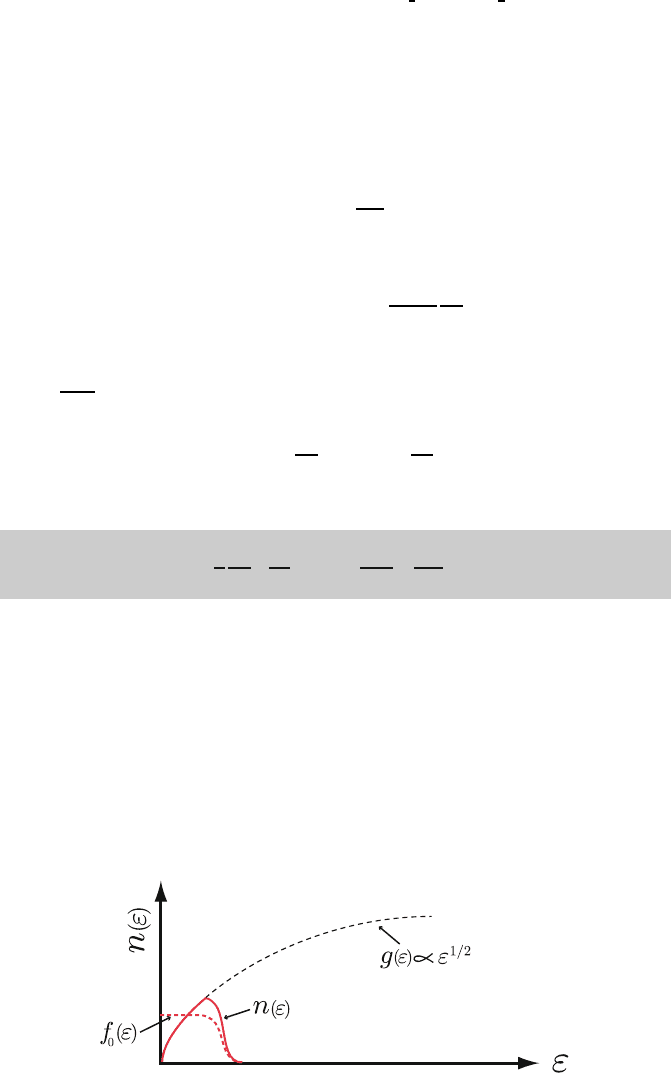
At a finite temperature Θ, the number of electrons per unit volume having 191
energies between ε and ε +dε is simply the product of g(ε)dε and f
0
(ε): 192
n(ε)dε = g(ε)f
0
(ε)dε. (See Fig. 3.4.) The chemical potential ζ is determined 193
from 194
N = V
∞
0
g(ε)f
0
(ε)dε. (3.44)
Fig. 3.4. Particle density n(ε) and the density of states g(ε)
195

Uncorrected Proof
BookID 160928 ChapID 03 Proof# 1 - 29/07/09
3.8 Review of Elementary Statistical Mechanics 89
3.8.3 Thermodynamic Potential 196
The thermodynamic potential Ω is defined by 197
Ω=−ΘlnQ = −Θ
i
ln
1+e
(ζ−ε
i
)/Θ
. (3.45)
Functions that are commonly used in statistical mechanics are:
198
Internal energy U,
Helmholtz free energy F = U −TS,
Thermodynamic potential Ω=U − TS − ζN = −PV, (3.46)
enthalpy H = U + PV = TS + ζN,
Gibbs free energy G = U −TS + PV = ζN.
These definitions together with Euler’s relation
199
U = TS− PV + ζN (3.47)
and the second law of thermodynamics
200
dU = T dS − P dV + ζdN (3.48)
are very useful to remember. By using (3.47) and (3.48) and Ω = −PV,one
201
can obtain 202
dΩ = −SdT − P dV − N dζ. (3.49)
From (3.49) one can see that the entropy S, pressure P , and particle number
203
N can be obtained from the thermodynamic potential Ω 204
S = −
∂Ω
∂T
V,ζ
,
P = −
∂Ω
∂V
T,ζ
, (3.50)
N = −
∂Ω
∂ζ
V,T
.
3.8.4 Entropy
205
We know that 206
Ω=−Θ
i
ln
1+e
(ζ−ε
i
)/Θ
. (3.51)
But we can write
207
1 − ¯n
i
=1−
1
e
(ε
i
−ζ)/Θ
+1
=
1
e
(ζ−ε
i
)/Θ
+1
, (3.52)
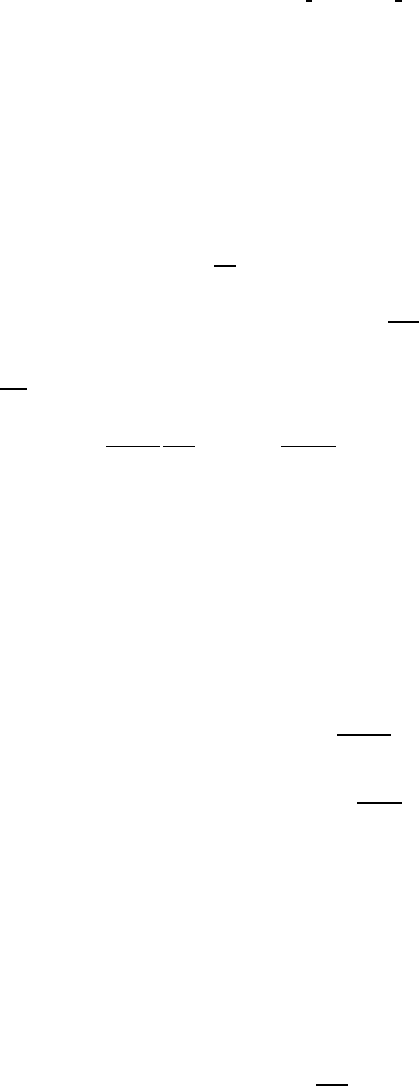
Uncorrected Proof
BookID 160928 ChapID 03 Proof# 1 - 29/07/09
90 3 Free Electron Theory of Metals
so that 208
ln (1 − ¯n
i
)=−ln
1+e
(ζ−ε
i
)/Θ
. (3.53)
We can express (3.51) as
209
Ω=Θ
i
ln (1 − ¯n
i
) . (3.54)
Since the entropy is given by S = −
∂Ω
∂Θ
, we can obtain 210
S = −
i
ln (1 − ¯n
i
)+Θ
i
(1 − ¯n
i
)
−1
∂¯n
i
∂Θ
. (3.55)
Evaluating
∂ ¯n
i
∂Θ
and multiplying by Θ (1 − ¯n
i
)
−1
gives 211
Θ
1 − ¯n
i
∂¯n
i
∂Θ
=¯n
i
ln
1 − ¯n
i
¯n
i
. (3.56)
Sustituting this result into (3.55) gives
212
S = −k
B
i
[(1 − ¯n
i
)ln(1− ¯n
i
)+¯n
i
ln ¯n
i
] . (3.57)
We have inserted the factor k
B
into (3.57); in the derivation we had essentially 213
set it equal to unity. Notice that the expression for S goes to zero as T goes 214
to zero because ¯n
i
takes on the values 0 or 1 in this limit. In addition, we can 215
write that 216
ΘS = −Θ
i
ln (1 − ¯n
i
)+¯n
i
ln
¯n
i
1 − ¯n
i
,
= −Θ
i
ln (1 − ¯n
i
) − Θ
i
¯n
i
ζ − ε
Θ
,
= −Θ
i
ln (1 − ¯n
i
) − ζ
i
¯n
i
+
i
¯n
i
ε
i
, (3.58)
= −Θ
i
ln (1 − ¯n
i
) − ζN + U.
If we write F = U − TS we have
217
F = Nζ +Θ
i
ln (1 − ¯n
i
) , (3.59)
= Nζ − Θ
i
ln
1+e
ζ−ε
i
Θ
.

Uncorrected Proof
BookID 160928 ChapID 03 Proof# 1 - 29/07/09
3.9 Fermi Function Integration Formula 91
If we hold V and T constant, the energy levels ε
i
are unchanged and 218
∂F
∂N
T,V
= ζ + N
∂ζ
∂N
T,V
− Θ
∂
∂N
i
ln
1+e
ζ−ε
i
Θ
. (3.60)
It is not difficult to show that (since ln
1+e
ζ−ε
i
Θ
depends on N through ζ)
219
the last two terms cancel and hence 220
∂F
∂N
T,V
= ζ. (3.61)
3.9 Fermi Function Integration Formula 221
To study how the chemical potential ζ and internal energy U vary with tem- 222
perature, we must evaluate the integrals 223
N
V
= n
0
=
∞
0
dεg(ε)f
0
(ε) (3.62)
224
and 225
U
V
= u =
∞
0
dεεg(ε)f
0
(ε). (3.63)
226
In evaluating integrals of this type there is a very useful integration formula 227
which we will now derive. Let us define an integral I as follows: 228
I =
∞
0
dε f
0
(ε)
dF (ε)
dε
. (3.64)
Integrating by parts gives
229
I =[f
0
(ε)F (ε)]
∞
0
−
∞
0
dε
∂f
0
∂ε
F (ε). (3.65)
For many functions F (ε), F (0) = 0 and lim
ε→∞
f
0
(ε)F (ε) → 0. For such 230
functions we can write (3.65) simply as 231
I = −
∞
0
dε
∂f
0
∂ε
F (ε). (3.66)
The functions f
0
changes rather quickly in an interval of width of the order of 232
k
B
T about ε = ζ.Itisobviousthat 233
∞
0
−
∂f
0
∂ε
dε =1.
If the function F (ε) is slowly varying compared to
∂f
0
∂ε
in the region ε ζ,we 234
can expand F(ε) in Taylor series as follows: 235

Uncorrected Proof
BookID 160928 ChapID 03 Proof# 1 - 29/07/09
92 3 Free Electron Theory of Metals
F (ε)=F (ζ)+(ε − ζ)F
(ζ)+
1
2!
(ε − ζ)
2
F
(ζ)+··· . (3.67)
Then, we can write I as
236
I = F (ζ)
∞
0
dε
−
∂f
0
∂ε
+ F
(ζ)
∞
0
dε (ε − ζ)
−
∂f
0
∂ε
+
1
2!
F
(ζ)
∞
0
dε (ε − ζ)
2
−
∂f
0
∂ε
+ ··· .
But we note that
237
−
∂f
0
∂ε
= β
e
β(ε−ζ)
e
β(ε−ζ)
+1
2
.
Introduce the parameter z = β(ε − ζ) and note that
238
∞
0
dε (ε − ζ)
n
−
∂f
0
∂ε
=Θ
n
∞
−ζ/Θ
dz
z
n
(e
z
+1)(e
−z
+1)
.
If ζ is much larger than Θ (this is certainly true in metals) the lower limit
239
on the integral over z can be replaced by −∞.Since
z
n
(e
z
+1)(e
−z
+1)
is an odd 240
function of z for n odd, we obtain 241
I F (ζ)+
1
2!
Θ
2
F
(ζ)
∞
−∞
dz
z
2
(e
z
+1)(e
−z
+1)
+ ···
+
1
(2n)!
Θ
2n
F
(2n)
(ζ)
∞
−∞
dz
z
2n
(e
z
+1)(e
−z
+1)
. (3.68)
The first few integrals are
242
∞
−∞
dz
z
2
(e
z
+1)(e
−z
+1)
=
π
2
3
,
243
∞
−∞
dz
z
4
(e
z
+1)(e
−z
+1)
=
7π
4
15
.
To order Θ
2
we have 244
I = F (ζ)+
π
2
6
Θ
2
F
(ζ). (3.69)
245
To evaluate the integral given in (3.62), we note that F (ζ)isjustG(ε), the 246
total number of states per unit volume whose energy is less than ε. Then using 247
(3.69) gives us 248
n
0
= G(ζ)+
π
2
6
Θ
2
G
(ζ). (3.70)
Define ζ
0
as the chemical potential at T =0.Thenn
0
= G(ζ
0
)and 249
G(ζ)=G(ζ
0
) −
π
2
6
Θ
2
g
(ζ). (3.71)

Uncorrected Proof
BookID 160928 ChapID 03 Proof# 1 - 29/07/09
3.10 Heat Capacity of a Fermi Gas 93
Here, we have used G
(ε)=g(ε)andsetn
0
= G(ζ
0
). Write G(ζ)asG(ζ
0
)+ 250
g(ζ
0
)(ζ −ζ
0
) and substitute into (3.71) to obtain 251
ζ = ζ
0
−
π
2
6
Θ
2
g
(ζ
0
)
g(ζ
0
)
.
But for free electrons g(ζ)=
3
2
n
0
ζ
0
ε
ζ
0
1/2
so that 252
ζ = ζ
0
1 −
π
2
12
Θ
ζ
0
2
+ ···
. (3.72)
253
Applying the integration formula to the integral for
U
V
, F (ε)issimply254
"
ε
0
ε
g(ε
)dε
; therefore we have 255
U
V
=
ζ
0
εg(ε)dε +
π
2
6
Θ
2
d
dε
(εg(ε))
ε=ζ
. (3.73)
Define U
0
= V
"
ζ
0
0
εg(ε)dε and use the expression for g(ε) given above for 256
free electrons. One can find that 257
U
V
=
U
0
V
+
π
2
6
Θ
2
g(ζ
0
). (3.74)
3.10 Heat Capacity of a Fermi Gas 258
The heat capacity C
v
=
∂U
∂T
V
is given, using (3.74), by 259
C
v
= V
π
2
3
k
2
B
g(ζ
0
)T = γT. (3.75)
For free electrons we have γ =
π
2
k
2
B
2ζ
0
N. It is interesting to compare the quan- 260
tum mechanical Sommerfeld result C
QM
v
= γT with the classical Drude result 261
C
CM
v
=
3
2
Nk
B
: 262
C
QM
v
C
CM
v
=
π
2
3
T
T
F
. (3.76)
For a typical metal, T
F
10
5
K, while at room temperature T 300 K. This 263
solves the problem that perplexed Drude concerning why the classical specific 264
heat C
CM
v
was not observed. The correct quantum mechanical specific heat 265
is so small (because
T
T
F
1) that it is difficult to observe even at room 266
temperature. 267
One can obtain a rough estimate of the specific heat by saying that only 268
quantum states within k
B
T of the Fermi energy contribute to the classical 269
estimate of the specific heat. This means that 270

Uncorrected Proof
BookID 160928 ChapID 03 Proof# 1 - 29/07/09
94 3 Free Electron Theory of Metals
N
eff
= V [G(ε
F
) − G(ε
F
− k
B
T )] .
This gives
271
U ≈
3
2
k
B
T
N
eff
=
3
2
k
B
T
[Vg(ε
F
)k
B
T ], (3.77)
and hence
272
C
v
=
∂U
∂T
≈ V 3k
2
B
g(ε
F
)T. (3.78)
273
3.11 Equation of State of a Fermi Gas 274
The equation of state relates the variables P , V ,andT . For the Fermi gas we 275
know that 276
P = −
∂Ω
∂V
T,ζ
. (3.79)
But Ω = −Θ
i
ln
1+e
(ζ−ε
i
)/Θ
. At constant values of Θ = k
B
T and ζ,Ω 277
depends on V through ε
i
: 278
ε
i
=
¯h
2
2m
2π
L
2
n
2
ix
+ n
2
iy
+ n
2
iz
. (3.80)
We can write
∂ε
i
∂V
=
∂ε
i
∂L
∂V
∂L
−1
.Sinceε
i
∝ L
−2
and V ∝ L
3
this gives 279
∂ε
i
∂V
= −
2
3
ε
i
V
. Using this result in (3.79) gives 280
P =Θ
i
e
(ζ−ε
i
)/Θ
1+e
(ζ−ε
i
)/Θ
−Θ
−1
∂ε
i
∂V
. (3.81)
From this we find (since G(ε)=
2
3
εg(ε) for a free Fermi gas) that 281
P =
2
3
U
V
=
∞
0
dεG(ε)f
0
(ε). (3.82)
If we keep terms to order Θ
2
we obtain 282
P = P
0
+
π
2
6
Θ
2
#
g(ε
F
) −
g
(ε
F
)
g(ε
F
)
G(ε
F
)
$
. (3.83)
283
3.12 Compressibility 284
The compressibility κ
T
is defined by 285
κ
−1
T
= −V
∂P
∂V
T,ζ
(3.84)
= −V
∂
∂V
∞
0
G(ε)f
0
(ε)dε.

Uncorrected Proof
BookID 160928 ChapID 03 Proof# 1 - 29/07/09
3.13 Electrical and Thermal Conductivities 95
If we define H(ε)=
"
ε
0
G(ε)dε, then the integral can be evaluated by 286
integrating by parts to get (at T =0) 287
∞
0
G(ε)f
0
(ε)dε = H (ε
F
) .
But we know that G(ε)=Aε
3/2
, therefore H(ε)=
2
5
Aε
5/2
=
2
5
εG(ε)tohave 288
κ
−1
T
= −V
∂
∂V
2
5
ε
F
n
0
,
since G(ε
F
)=n
0
. ε
F
is proportional to L
−2
,andn
0
is proportional to L
−3
so 289
ε
F
n
0
is proportional to L
−5
= V
−5/3
.Thisgives 290
κ
−1
T
= −V
2
5
−
5
3
n
0
ε
F
V
=
2
3
n
0
ε
F
.
Using g(ε
F
)=
3
2
n
0
ε
F
allows us to write 291
κ
−1
T
=
n
2
0
g(ε
F
)
. (3.85)
292
For free electrons g(ζ
0
)=
3n
0
2ε
F
and κ
T
=
3
2n
0
ζ
0
. The velocity of sound in a solid 293
is given by 294
s =(κ
T
ρ)
−1/2
(3.86)
where ρ is the mass density. κ
T
is the compressibility of the material in (3.86), 295
and it includes the ion core repulsion as well as the pressure due to compressing 296
the electron gas. The ionic contribution is small in simple metals like the alkali 297
metals. If we neglect it and put ρ =
n
0
M
z
,whereM is the ionic mass and z 298
the number of electrons per atom, we find 299
s =
zm
3M
1/2
v
F
. (3.87)
This result was first obtained by Bohm and Staver in a somewhat different
300
way. 301
3.13 Electrical and Thermal Conductivities 302
Assume that there is an electric field E = Eˆx and a temperature gradient 303
∇T =
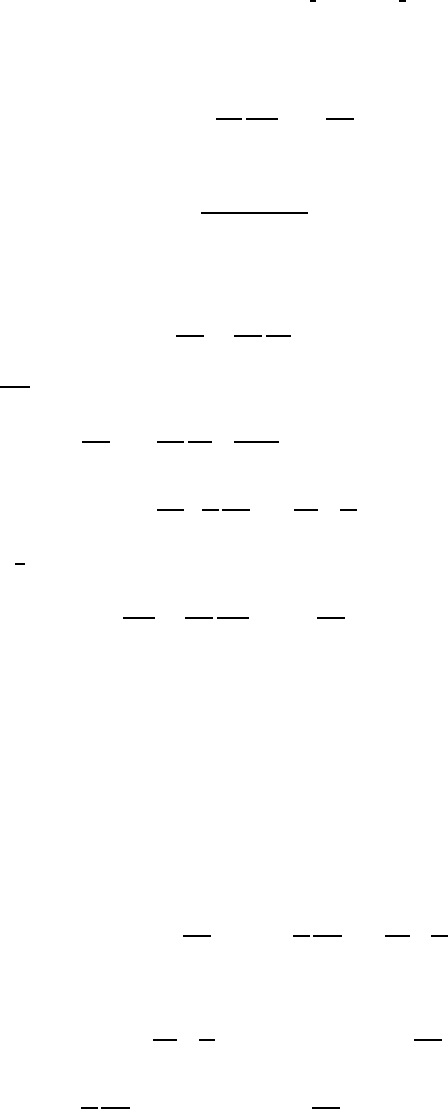
∂T
∂x
ˆx. In discussing the Lorentz model, we wrote down the solution to 304
the linearized Boltzmann equation 305
∂f
∂t
+ v ·∇
r
f +
˙
v ·∇
v
f = −
f − f
0
τ
(3.88)
Uncorrected Proof
BookID 160928 ChapID 03 Proof# 1 - 29/07/09
96 3 Free Electron Theory of Metals
in the form 306
f = f
0
− τ
−
eE
m
∂f
0
∂v
x
+ v
x
∂f
0
∂x
. (3.89)
The equilibrium distribution function is the Fermi–Dirac distribution function
307
f
0
=
1
1+e
(ε−ζ)/Θ
. (3.90)
Because of the temperature gradient, both T and ζ depend on the coordinate 308
x, but the energy ε does not. We can write 309
∂f
0
∂x
=
∂f
0
∂α
∂α
∂x
, (3.91)
where α =
ε−ζ
Θ
. This can be rewritten 310
∂f
0
∂x
=Θ
∂f
0
∂ε
∂
∂x
ε − ζ
Θ
(3.92)
= −
∂f
0
∂ε
ε
Θ
∂Θ
∂x
+Θ
∂
∂x
ζ
Θ
.
Because ε =
1
2
mv
2
we can write 311
∂f
0
∂v
x
=
∂f
0
∂ε
∂ε
∂v
x
= mv
x
∂f
0
∂ε
. (3.93)
We now substitute (3.90), (3.92), and (3.93) into (3.89) and use the resulting
312
expression for f (ε) in the equations for the electrical current density j
x
and 313
the thermal current density w
x
: 314
j
x
=
∞
0
dε (−ev
x
)g(ε)f (ε), (3.94)
w
x
=
∞
0
dε (εv
x
)g(ε)f (ε). (3.95)
For the electrical current density we obtain
315
j
x
= e
∞
0
dεv
x
g(ε)τv
x
−
∂f
0
∂ε
eE +
ε
Θ
∂Θ
∂x
+Θ
∂
∂x
ζ
Θ
. (3.96)
Factoring all quantities that are independent of ε out of the integral gives
316
j
x
=
e
2
E + eΘ
∂
∂x
ζ
Θ
∞
0
dεv
2
x
g(ε)τ
−
∂f
0
∂ε
(3.97)
+
e
Θ
∂Θ
∂x
∞
0
dεv
2
x
εg(ε)τ
−
∂f
0
∂ε
.

Uncorrected Proof
BookID 160928 ChapID 03 Proof# 1 - 29/07/09
3.13 Electrical and Thermal Conductivities 97
Now substitute v
2
x
=
2
3
ε
m
and g(ε)=
3
2
n
0
ζ
3/2
0
ε
1/2
into (3.97) to have 317
j
x
=
e
2
E + eΘ
∂
∂x
ζ
Θ
K
1
+
e
Θ
∂Θ
∂x
K
2
, (3.98)
318
wherewehaveintroducedthesymbolK
n
defined by 319
K
n
=
n
0
mζ
3/2
0
∞
0
dε
−
∂f
0
∂ε
ε
n+1/2
τ. (3.99)
In the calculation of w
x
, a factor of ε replaces (−e); this gives 320
w
x
= −
eE +Θ
∂
∂x
ζ
Θ
K
2
−
1
Θ
∂Θ
∂x
K
3
. (3.100)
321
The function K
n
can be evaluated using the integration formula (3.69). We 322
obtain 323
K
n
=
n
0
mζ
3/2
0
ζ
n+1/2
τ(ζ)+
π
2
6
Θ
2
d
2
dε
2
ε
n+1/2
τ(ε)
|
ε=ζ
. (3.101)
324
At T =0wehave 325
K
n
=
n
0
m
ζ
n−1
0
τ(ζ
0
). (3.102)
3.13.1 Electrical Conductivity
326
If we set
∂T
∂x
=0,thenj
x
is given by j
x
= e
2
EK
1
,andatT =0wehave 327
j
x
=
n
0
e
2
τ(ζ
0
)
m
E = σE. (3.103)
This is exactly the Drude result for the conductivity σ with τ (ε) evaluated on
328
the Fermi surface so that τ = τ (ζ
0
). 329
3.13.2 Thermal Conductivity 330
The thermal conductivity is defined as the ratio of the thermal current w
x
331
to
−
∂T
∂x
under conditions of zero electrical current. Therefore, we must set
332
j
x
= 0 in (3.98) and solve for E.Thisgives 333
j
x
=
e
2
E + eΘ
∂
∂x
ζ
Θ
K
1
+
e
Θ
∂Θ
∂x
K
2
=0
or
334
−
eE +Θ
∂
∂x
ζ
Θ
K
1
=
1
Θ
∂Θ
∂x
K
2
. (3.104)