
Quinn J.J., Yi K.-S. Solid State Physics: Principles and Modern Applications
Подождите немного. Документ загружается.

Uncorrected Proof
BookID 160928 ChapID 02 Proof# 1 - 29/07/09
58 2 Lattice Vibrations
q
x
, q
y
,andq
z
can be converted to integrals as follows: 459
q
x
⇒
"
dq
x
2π/N
x
a
⇒
L
x
2π
dq
x
. (2.109)
Therefore, the three-dimensional sum
q
becomes 460
q
=
L
x
L
y
L
z
(2π)
3
d
3
q =
V
(2π)
2
d
3
q. (2.110)
In these equations L
x
, L
y
,andL
z
are equal to the length of the crystal in 461
the x, y,andz directions, and V = L
x
L
y
L
z
is the crystal volume. For any 462
function f (q), we can write 463
q
f (q)=
V
(2π)
3
d
3
q f (q). (2.111)
Now, it is convenient to introduce the density of states g(ω) defined by
464
g(ω)dω =
#
The number of normal modes per unit volume
Whose frequency ω
qλ
satisfies ω<ω
qλ
<ω+dω.
(2.112)
From this definition, it follows that
465
g(ω)dω =
1
V
qλ
ω<ω
qλ
<ω+dω
1=
1
(2π)
3
λ
ω<ω
qλ
<ω+dω
d
3
q. (2.113)
Let S
λ
(ω) be the surface in three-dimensional wave vector space on which 466
ω
qλ
has the value ω.ThendS
λ
(ω) is an infinitesimal element of this surface 467
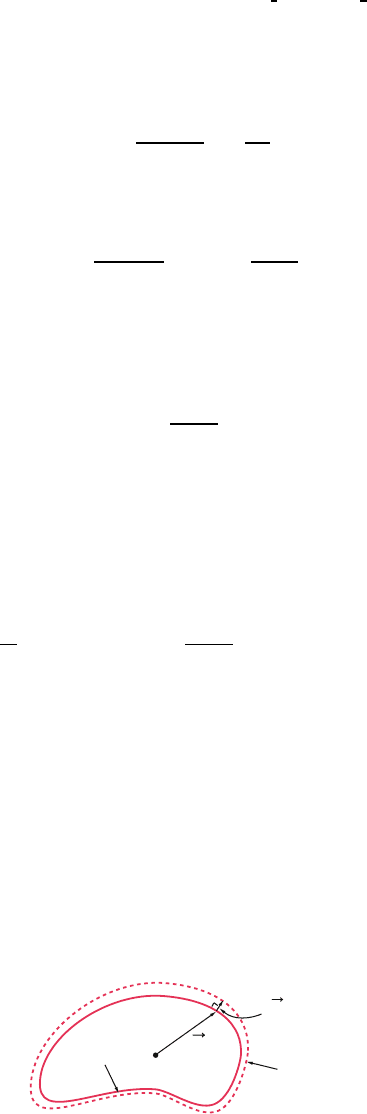
of constant frequency (see Fig. 2.10). The frequency change dω in going from 468
the surface S
λ
(ω)tothesurfaceS
λ
(ω +dω) can be expressed in terms of dq, 469
an infinitesimal displacement in q space as 470
dω =dq · [∇
q
ω
qλ
]
ω
qλ
=ω
or dω =dq
⊥
|∇
q
ω
qλ
|
ω
qλ
=ω
. (2.114)
Here, dq
⊥
is the component of dq normal to the surface of constant frequency 471
S
λ
(ω). The volume element d
3
q in wave vector space can be written d
3
q = 472
dq
⊥
dS
λ
(ω), and using (2.114) allows us to write 473
dq
q
()S
λ
ω
()Sd
λ
ω+ ω
Fig. 2.10. Constant frequency surfaces in three-dimensional wave vector space
Uncorrected Proof
BookID 160928 ChapID 02 Proof# 1 - 29/07/09
2.6 Heat Capacity of Solids 59
d
3
q =
dω
|∇
q
ω
qλ
|
ω
qλ
=ω
dS
λ
(ω). (2.115)
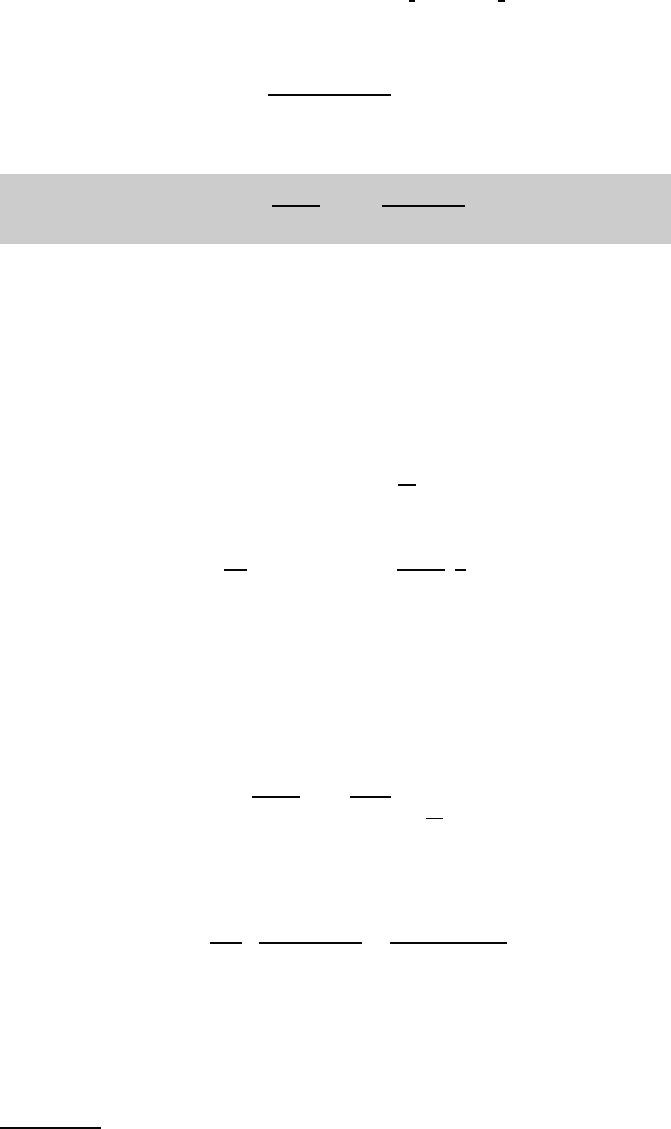
With this result, we can express the density of states as
474
g(ω)=
1
(2π)
3
λ
dS
λ
(ω)
|∇
q
ω
qλ
|
ω
. (2.116)
475
In (2.116) the integration is performed over the surface of constant frequency 476
S
λ
(ω). The denominator contains the magnitude of the gradient of ω
qλ
(with 477
respect to q) evaluated at ω
qλ
= ω. 478
2.6.3 Debye Model 479
To evaluate (2.107) and obtain the specific heat, Debye
3
introduced a simple 480
assumption about the phonon spectrum. He took ω
qλ
= s
λ
|q| for all values of 481
q in the first Brillouin zone. Then, the surfaces of constant energy are spheres 482
(i.e., S
λ
(ω) is a sphere in q space of radius q =
ω
s
λ
). In addition, Debye replaced 483
the Brillouin zone by a sphere of the same volume. Since
q∈1
st
BZ
1=N,we 484
can write 485
N =
L
2π
3
|q|<q
D
d
3
q =
V
(2π)
3
4
3
πq
3
D
. (2.117)
In (2.117) we have introduced q
D
,theDebyewavevector. A sphere of radius 486
q
D
contains the N independent values of q associated with a crystal contain- 487
ing N atoms. From (2.117), q
3
D
=6π
2
N/V ,whereV is the volume of the 488
crystal. 489
The density of states for the Debye model is very simple since |∇
q
490
ω
qλ
| = s
λ
. Substituting this result into (2.116) gives 491
g(ω)=
1
(2π)
3
λ
4πq
2
s
λ
q=
ω
s
λ
≤q
D
. (2.118)
If we introduce the unit step function θ(x)=1forx>0andθ(x)=0for
492
x<0, g(ω) can be expressed 493
g(ω)=
ω
2
2π
2
θ(s
l
k
D
− ω)
s
3
l
+
2 θ(s
t
k
D
− ω)
s
3
t
. (2.119)
Here, of course, s
l
and s
t
are the speed of a longitudinal and of a transverse 494
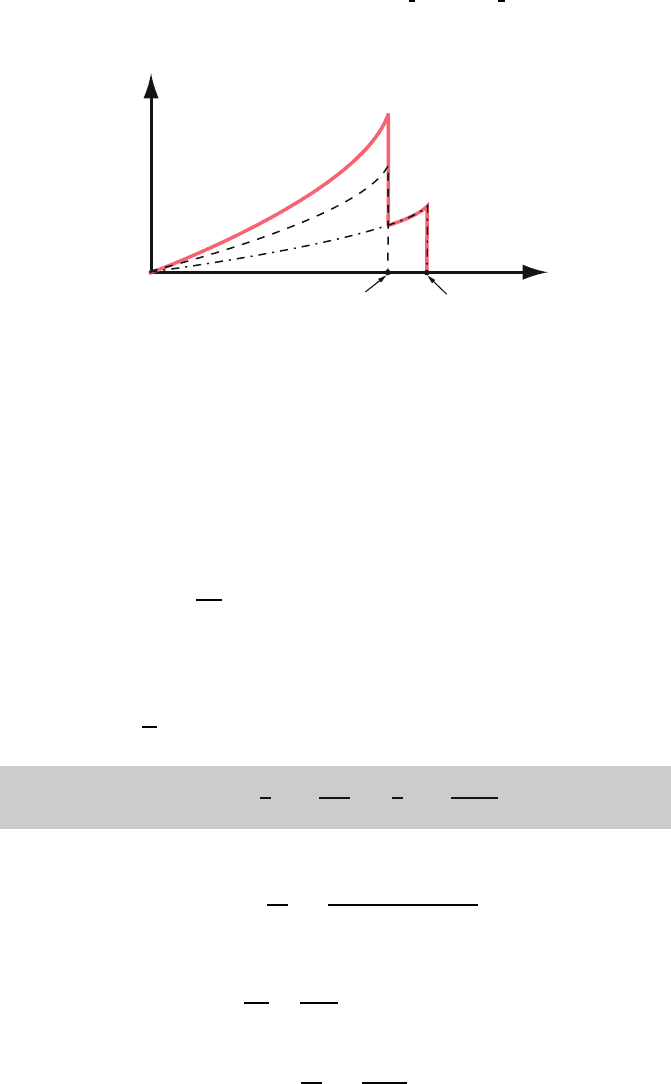
sound wave. Figure 2.11 shows the frequency dependence of the three- 495
dimensional density of states in the Debye model. Any summation over allowed 496
values of wave vector can be converted into an integral over frequency by using 497
the relation 498
3
P. Debye, Annalen der Physik 39, 789 (1912).
Uncorrected Proof
BookID 160928 ChapID 02 Proof# 1 - 29/07/09
60 2 Lattice Vibrations
ω
Dt
sq
D
sq
()
ω
g
Fig. 2.11. Three-dimensional density of states in the Debye model
qλ
f (ω
qλ
)=V
dωg(ω)f (ω). (2.120)
Here, f (ω
qλ
) is an arbitrary function of the normal mode frequencies ω
qλ
. 499
Making use of (2.120), the expression for the specific heat [(2.107)] can be 500
written 501
C
v
= k
B
V
dω
¯hω
Θ
2
e
¯hω/Θ
− 1
−1
1 − e
−¯hω/Θ
−1
g(ω). (2.121)
Here,wehaveintroducedΘ=k
B
T . We define the Debye temperature T
D
by 502
Θ
D
= k
B
T
D
=¯hs
l
q
D
. Remembering that V =6π
2
Nq
−3
D
and that the integral 503
"
dω goes from ω =0toω = ω
D
= s
l
q
D
for longitudinal waves and from ω =0 504
to ω = s
t
q
D
=
s
t
s
l
ω
D
for transverse waves, it is not difficult to demonstrate 505
that 506
C
v
=3Nk
B
1
3
F
D
Θ
D
Θ
+
2
3
F
D
s
t
Θ
D
s
l
Θ
, (2.122)
507
where the Debye function F
D
(x) is defined by 508
F
D
(x)=
3
x
3
x
0
z
4
dz
(e
z
− 1)(1 − e
−z
)
. (2.123)
Behavior at Θ Θ
D
509
In this limit, x which equals
Θ
D
Θ
or
s
t
Θ
D
s
l
Θ
is much smaller than unity. Therefore, 510
we can expand the exponentials for small argument to obtain 511
F
D
(x)
3
x
3
x
0
z
4
dz
z
2
≈ 1. (2.124)
In this limit, C
v
=3Nk
B
, in agreement with the classical Dulong–Petit law. 512
Uncorrected Proof
BookID 160928 ChapID 02 Proof# 1 - 29/07/09
2.6 Heat Capacity of Solids 61
Behavior at Θ Θ
D
513
In this limit, x is much larger than unity, and because of the exponential in 514
the denominator of the integral little error arises from replacing the upper 515
limit by infinity. This gives 516
F
D
(x)
3
x
3
∞
0
z
4
dz
(e
z
− 1)(1 − e
−z
)
. (2.125)
The integral is simply a constant. Its value can be obtained analytically
517
∞
0
z
4
dz
(e
z
− 1)(1 − e
−z
)
=
4
15
π
4
. (2.126)
The result for C
v
at very low temperature is 518
C
v
=
4
5
π
4
Nk
B
1+2
s
l
s
t
3
Θ
Θ
D
3
. (2.127)
519
This agrees with the observed behavior of the specific heat at very low 520
temperature, viz. C
v
= AT
3
,whereA is a constant. 521
2.6.4 Evaluation of Summations over Normal Modes 522
for the Debye Model 523
In our calculation of the recoil free fraction in the M¨ossbauer effect (See 524
(2.56)), and in the evaluation of (2.89), the mean square displacement u
n
· u
n
525
of an atom from its equilibrium position, we encountered sums of the form 526
I = N
−1
qλ
¯n
qλ
+
1
2
¯hω
qλ
. (2.128)
These sums can be performed by converting the sums to integrals through the
527
standard prescription 528
q
f (ω
qλ
) →
V
(2π)
3
d
3
q f (ω
qλ
), (2.129)
or by making use of the density of states g(ω) and the result that
529
qλ
f (ω
qλ
)=V
dωg(ω)f (ω). (2.130)
For simplicity, we will use a Debye model with the velocity of transverse and
530
longitudinal waves both equal to s.Then 531
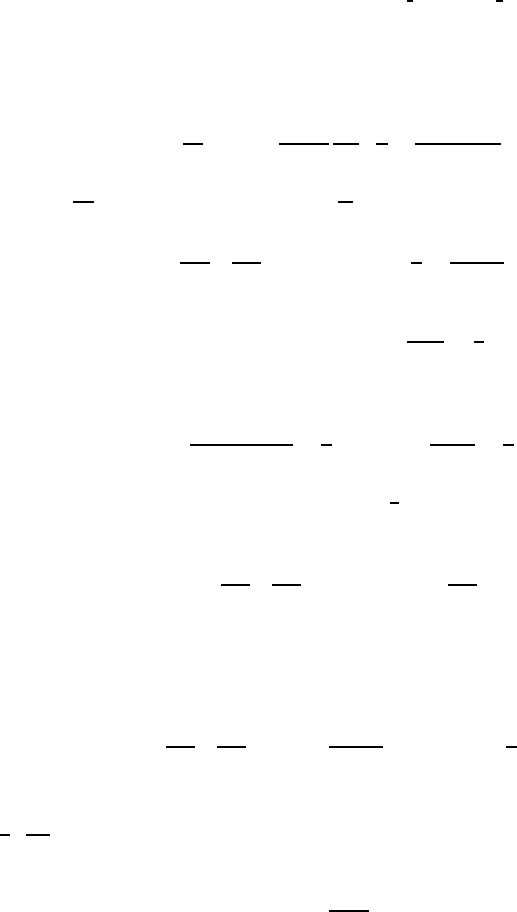
g(ω)=
3ω
2
2π
2
s
3
θ(sk
D
− ω). (2.131)
Uncorrected Proof
BookID 160928 ChapID 02 Proof# 1 - 29/07/09
62 2 Lattice Vibrations
The summation in (2.128) can then be written as 532
I =
V
N
ω
D
0
dω
3ω
2
2π
2
s
3
1
¯hω
1
2
+
1
e
¯hω/Θ
− 1
. (2.132)
Let z =
¯hω
Θ
, and make use of k
3
D
=6π
2
N
V
. Then (2.132) can be rewritten 533
I =
9
Θ
D
Θ
Θ
D
2
Θ
D
/Θ
0
dzz
1
2
+
1
e
z
− 1
. (2.133)
First, let us look at the high temperature limit of (2.133). If Θ Θ
D
, 534
then for values of z appearing in the integrand
1
e
z
−1
1
z
. This corresponds to 535
the classical equipartition of energy since the energy of a mode of frequency 536
ω
qλ
is given by 537
¯hω
qλ
1
e
¯hω
qλ
/Θ
− 1
+
1
2
¯hω
qλ
Θ
¯hω
qλ
+
1
2
,
and this is equal to Θ for every mode (the
1
2
is negligible if Θ ¯hω
qλ
)as 538
required by classical statistical mechanics. With this approximation 539
I
9
Θ
D
Θ
Θ
D
2
Θ
D
/Θ
0
dz =
9Θ
Θ
2
D
. (2.134)
At very low temperature, Θ Θ
D
, we can approximate the upper limit 540
by ∞ in the term proportional to (e
z
− 1)
−1
, since the contribution from very 541
large values of z is very small. This gives 542
I =
9
Θ
D
Θ
Θ
D
2
∞
0
dzz
e
z
− 1
+
Θ
D
/Θ
0
dz
z
2
. (2.135)
The first integral in the square bracket is a constant, while the second is
543
1
4
Θ
D
Θ
2
. The second term is much larger than the first for Θ Θ
D
,soitis 544
a reasonable approximation to take 545
I =
9
4Θ
D
. (2.136)
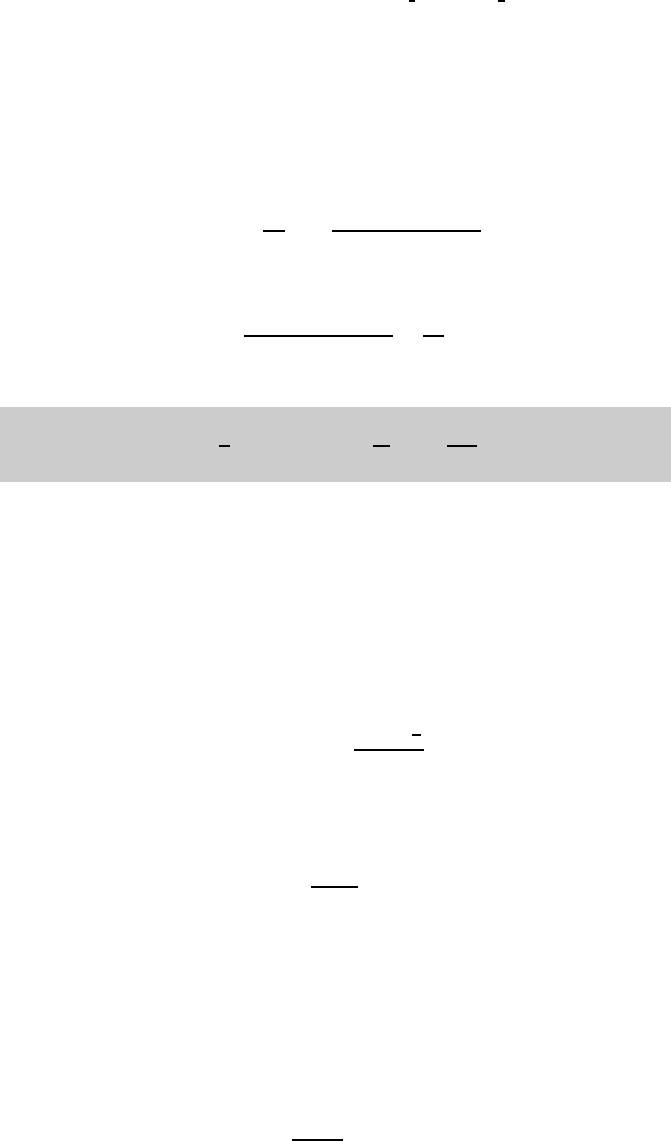
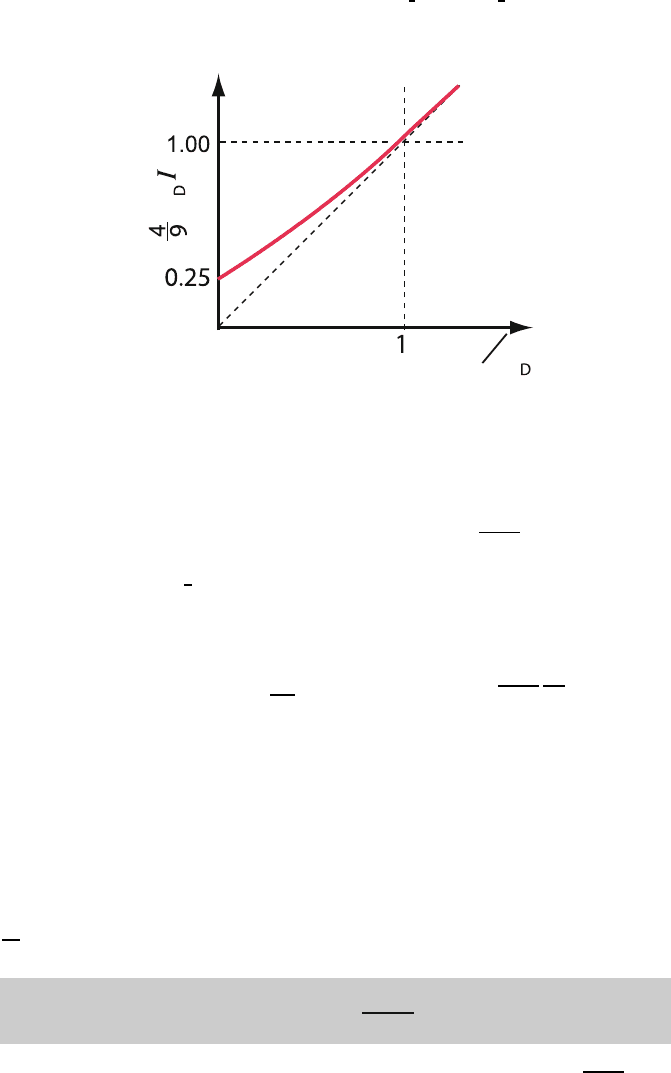
(see, for example, Fig. 2.12).
546
2.6.5 Estimate of Recoil Free Fraction in M¨ossbauer Effect 547
Equation (2.56) gave the probability of starting in a lattice state |n
i
>= 548
|n
1
,n
2
,...,n
N
> and ending, after the γ-ray emission, in the same state. If 549
we assume that the crystal is in thermal equilibrium at a temperature Θ, then 550
(2.56) is simply 551
P (¯n
i
, ¯n
i
)=e
−2E(K)I
, (2.137)
Uncorrected Proof
BookID 160928 ChapID 02 Proof# 1 - 29/07/09
2.6 Heat Capacity of Solids 63
Θ
Θ
Θ
Fig. 2.12. Behavior of an integral I for Θ ≤ Θ
D
where ¯n
i
is the Bose–Einstein distribution function, E(K) is the recoil energy, 552
and I is given by (2.132). We have just evaluated I using a simplified Debye 553
model at both high (Θ Θ
D
)andlow(Θ Θ
D
) temperatures. If we use 554
(2.134) and (2.137), we find that at (Θ
D
Θ), P e
−
9E(K)
2Θ
D
. Remember that 555
E(K) 2 × 10
−3
eV. For a typical crystal Θ
D
300K · k
B
≈ 2.5 × 10
−2
eV, 556
giving for P , P e
−
1
3
≈ 0.7. This means that at very low temperature, 70% 557
of the γ rays are emitted without any change in the number of phonons in the 558
crystal. 559
At high temperature (let us take Θ = 400 K, larger than but not much 560
larger than Θ
D
300 K) I
9Θ
Θ
2
D
giving P (¯n
i
, ¯n
i
) e
−
9E(K)
2Θ
D
4Θ
Θ
D
.Thisgives 561
P (¯n
i
, ¯n
i
) at Θ = 400 K of roughly 0.14, so that, even at room temperature 562
the M¨ossbauer recoil free fraction is reasonably large. 563
2.6.6 Lindemann Melting Formula 564
The Lindemann melting formula is based on the idea that melting will occur 565
when the amplitude of the atomic vibrations
i.e.,
(δR)
2
!
1/2
becomes
566
equal to some fraction γ of the interatomic spacing. Recall that u
n
· u
n
= 567
¯h
2
M
I where I is given by (2.128) (see (2.89)). We can use the Θ Θ
D
limit 568
for I to write 569
(δR)
2
!
9¯h
2
Θ
MΘ
2
D
. (2.138)
570
The melting temperature is assumed to be given by Θ
Melting
=
MΘ
2
D
9¯h
2
γ
2
r
2
0
, 571
where r
0
is the atomic spacing and γ is a constant in the range (0.2 ≤ γ ≤ 572
0.25). This result is only very qualitative since it is based on a very much 573
oversimplified model. 574
Uncorrected Proof
BookID 160928 ChapID 02 Proof# 1 - 29/07/09
64 2 Lattice Vibrations
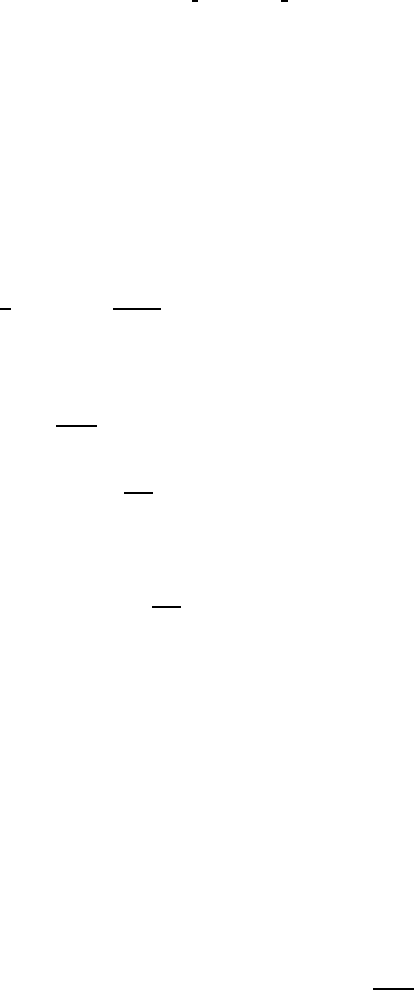
Some Remarks on the Debye Model 575
One can obtain an intuitive picture of the temperature dependence of the 576
specific heat by applying the idea of classical equipartition of energy, but only 577
to modes for which ¯hω < Θ. By this we mean that only modes whose energy 578
¯hω is smaller than Θ = k
B
T can be thermally excited at a temperature Θ and 579
make a contribution to the internal energy U, and such modes contribute an 580
energy Θ. Thus, we can write for U 581
U =
qλ
¯n
qλ
+
1
2
¯hω
qλ
3
V
(2π)
3
Θ/¯hs
0
Θ4πq
2
dq. (2.139)
In writing (2.139) we have omitted the zero point energy since it does not
582
depend on temperature and put ¯hω[¯n(ω)] Θ for all modes of energy less 583
than Θ. This gives (using V =
6π
2
N
k
3
D
and ¯hsk
D
=Θ
D
) 584
U =3N
Θ
Θ
D
3
Θ. (2.140)
Differentiating with respect to T gives
585
C
v
=12Nk
B
Θ
Θ
D
3
. (2.141)
This rough approximation gives the correct T
3
temperature dependence, 586
but the coefficient is not correct as might be expected from such a simple 587
picture. 588
Experimental Data 589
Experimentalists measure the specific heat as a function of temperature over 590
a wide range of temperatures. They often use the Debye model to fit their 591
data, taking the Debye temperature as an adjustable parameter to be deter- 592
mined by fitting the data to (2.122) or some generalization of it. Thus, if 593
you see a plot of Θ
D
as a function of temperature, it only means that at 594
that particular temperature T one needs to take Θ
D
=Θ
D
(T ) for that value 595
of T to fit the data to a Debye model. It is always found that at very low 596
T and at very high T the correct Debye temperature Θ
D
=¯hs
6π
2
N
V
1/3
597
agrees with the experiment. At intermediate temperatures these might be 598
fluctuations in Θ
D
of the order of 10% from the correct value. The rea- 599
son for this is that g(ω), the density of states, for the Debye model is 600
a considerable simplification of the actual of g(ω) for real crystals. This 601
can be illustrated by considering briefly the critical points in the phonon 602
spectrum. 603
Uncorrected Proof
BookID 160928 ChapID 02 Proof# 1 - 29/07/09
2.6 Heat Capacity of Solids 65
2.6.7 Critical Points in the Phonon Spectrum 604
Remember that the general expression for the density of states was given by 605
(2.116). Points at which ∇
q
ω
qλ
= 0 are called critical points; the integrand 606
in (2.116) becomes infinite at such points. 607
Suppose that q
c
is a critical point in the phonon spectrum. Let ξ = q−q
c
; 608
then for points in the neighborhood of q
c
we can write 609
ω
q
= ω
c
+ α
1
ξ
2
1
+ α
2
ξ
2
2
+ α
3
ξ
2
3
, (2.142)
where ξ
i
are the components of ξ,andω
c
= ω(q
c
). If α
1
, α
2
,andα
3
are all 610
negative, by substituting into the expression for g(ω) and evaluating in the 611
neighborhood of q
c
,oneobtains 612
g(ω)=
#
0ifω>ω
c
,
Constant (ω
c
− ω)
1/2
if ω<ω
c
.
(2.143)
Thus, although g(ω) is continuous at a critical point, its first derivative is
613
discontinuous. 614
In three dimensions there are four kinds of critical points: 615
1. Maxima: Points at which all three α
i
are negative. 616
2. Minima: Points at which all three α
i
are positive. 617
3. Saddle Points of the First Kind :Pointsatwhichtwoα
i
’s are positive and 618
one is negative. 619
4. Saddle Points of the Second Kind: Points at which one α
i
is positive and 620
the other two are negative. 621
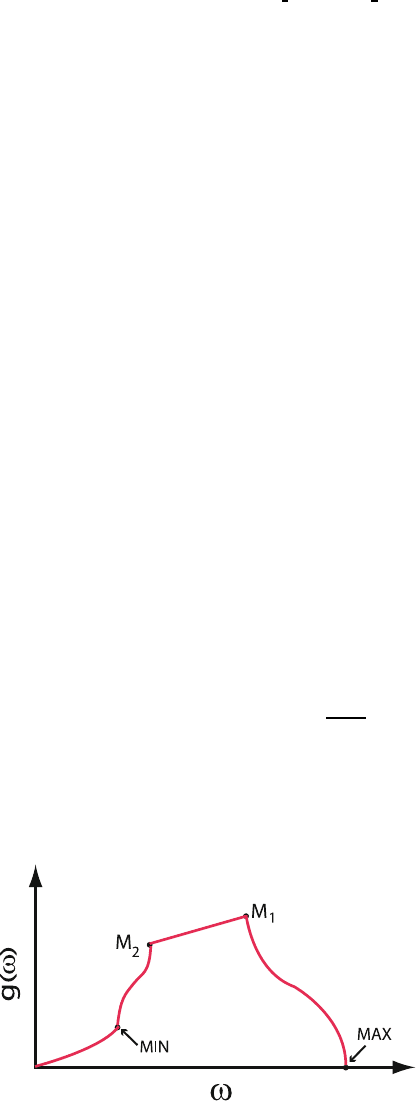
The critical points all show up as points at which
dg(ω)
dω
is discontinuous. A 622
rough sketch of g(ω)vs.ω showing several critical points is shown in Fig. 2.13. 623
It is not too difficult to demonstrate that in three dimensions the phonon spec- 624
trum must have at least one maximum, one minimum, three saddle points of 625
each kind. As an example, we look at the simpler case of two dimensions. Then 626
Fig. 2.13. Behavior of the density of states at various critical points
Uncorrected Proof
BookID 160928 ChapID 02 Proof# 1 - 29/07/09
66 2 Lattice Vibrations
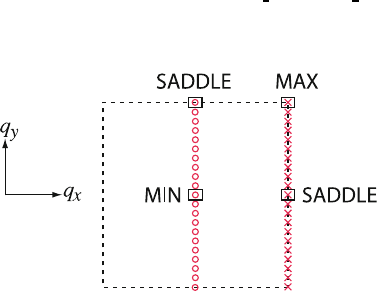
Fig. 2.14. Behavior of critical points in two dimensions
the phonon spectrum must have at least one maximum, one minimum, and 627
two saddle points (there is only one kind of saddle point in two dimensions) 628
(see Fig. 2.14). This can be demonstrated as follows: 629
1. We know ω
q
is a periodic function of q;valuesofq which differ by a 630
reciprocal lattice vector K give the same ω
q
. 631
2. For a Brillouin zone of a two-dimensional square, we can consider ω(q
x
,q
y
) 632
as a function of q
x
for a sequence of different fixed values of q
y
. Because 633
ω(q
x
,q
y
) is a periodic function of q
x
there must be at least one maximum 634
and one minimum on each line q
y
= constant. 635
3. Consider the locus of all maxima (represented by X’s in Fig. 2.14). Along 636
this locus ω(q) must have at least one maximum and one minimum as a 637
function of q
y
. These points will be an absolute maximum and a saddle 638
point. 639
4. Doing the same for the locus of all minima (represented by O’s in Fig. 2.14) 640
gives one absolute minimum and another saddle point. 641
Because of the critical points, the phonon spectrum of a real solid looks 642
quite different from that of the Debye model. However, the Debye model is 643
constructed so that 644
1. The low frequency behavior of g(ω) is correct because for very small ω, 645
ω
qλ
= s
λ
|q| is a very accurate approximation. 646
2. The total area under the curve g(ω) is correct since k
D
,theDebyewave 647
vector is chosen so that there are exactly the correct total number of modes 648
3N. 649
Because of this, the Debye model is good at very low temperature (where only 650
very low frequency modes are important) and at very high temperature (where 651
only the total number of modes and equipartition of energy are important). 652
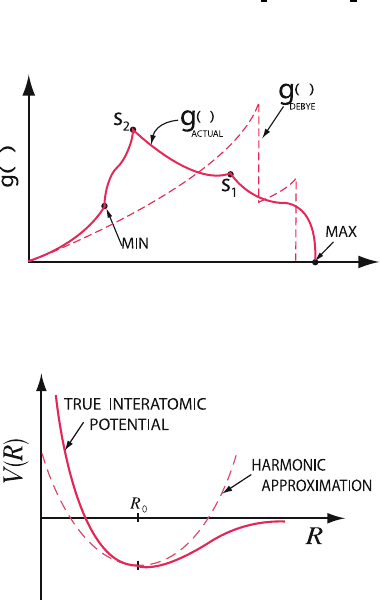
In Fig. 2.15 we compare g(ω) for a Debye model with that of a real crystal. 653
We note that
"
g
Debye
(ω)dω ≈
"
g
Actual
(ω)dω. 654
Uncorrected Proof
BookID 160928 ChapID 02 Proof# 1 - 29/07/09
2.7 Qualitative Description of Thermal Expansion 67
ω
ω
ω
ω
Fig. 2.15. Comparison of the density of states g(ω) for a Debye model and that of
arealcrystal
Fig. 2.16. Comparison of the potential felt by an atom and the harmonic approxi-
mation to it
2.7 Qualitative Description of Thermal Expansion 655
We have approximated the interatomic potential in a crystal by 656
V (R)=V (R
0
)+
ij
c
ij
u
i
u
j
+higherterms. (2.144)
In Fig. 2.16 we show a sketch of the potential felt by one atom and the
657
harmonic approximation to it. There are two main differences in the two 658
potentials: 659
1. The true interatomic potential has a very strong repulsion at u = R − R
0
660
negative (i.e., close approach of the pair of atoms). 661
2. The true potential levels off as R becomes very large (i.e., for large 662
positive u). 663
For a simple one-dimensional model we can write x = x
0
+ u,wherex
0
is the 664
equilibrium separation between a pair of atoms and u = x−x
0
is the deviation 665
from equilibrium. Then, we can model the behavior shown in Fig. 2.16 by 666
assuming that 667
V (x)=V
0
+ cu
2
− gu
3
− fu
4
. (2.145)