
Quinn J.J., Yi K.-S. Solid State Physics: Principles and Modern Applications
Подождите немного. Документ загружается.

Uncorrected Proof
BookID 160928 ChapID 02 Proof# 1 - 29/07/09
48 2 Lattice Vibrations
We shall neglect terms of order N
−2
, N
−3
,...,etc.inthisexpansion.With 248
this approximation we can write 249
n
i
|e
iK·R
N
|n
i
k
1 −
E(K)
¯hω
k
n
k
+
1
2
N
. (2.55)
To terms of order N
−1
, the product appearing on the right-hand side of (2.55) 250
is equivalent to e
−
E(K)
N
k
n
k
+
1
2
¯hω
k
to the same order. Thus, for the recoil free 251
fraction, we find 252
P (n
i
,n
i
)=e
−2
E(K)
N
k
n
k
+
1
2
¯hω
k
. (2.56)
253
Although we have derived (2.56) for a simple one-dimensional model, the 254
result is valid for a real crystal if sum over k is replaced by a three-dimensional 255
sum over all k and over the three polarizations. We will return to the evalua- 256
tion of the sum later, after we have considered models for the phonon spectrum 257
in real crystals. 258
2.4 Optical Modes 259
So far, we have restricted our consideration to a monatomic linear chain. Later 260
on, we shall consider three-dimensional solids (the added complication is not 261
serious). For the present, let us stick with the one-dimensional chain, but let 262
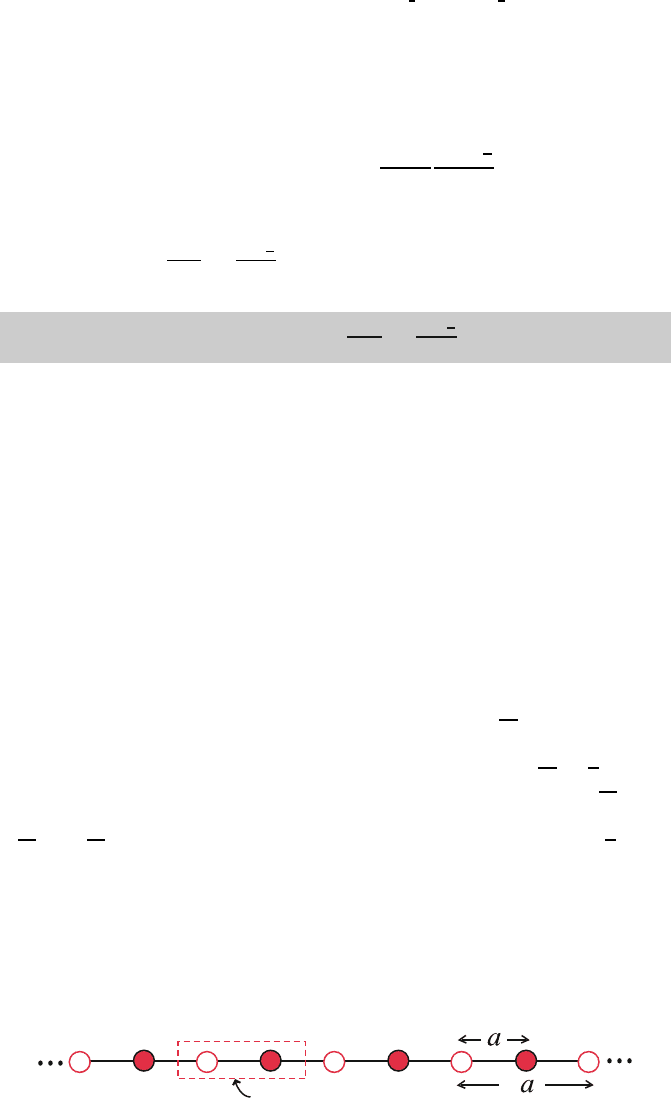
us generalize to the case of two atoms per unit cell (Fig. 2.5). 263
If atoms A and B are identical, the primitive translation vector of the 264
lattice is a, and the smallest reciprocal vector is K =
2π
a
. If A and B are 265
distinguishable (e.g. of slightly different mass) then the smallest translation 266
vector is 2a and the smallest reciprocal lattice vector is K =
2π
2a
=
π
a
.Inthis 267
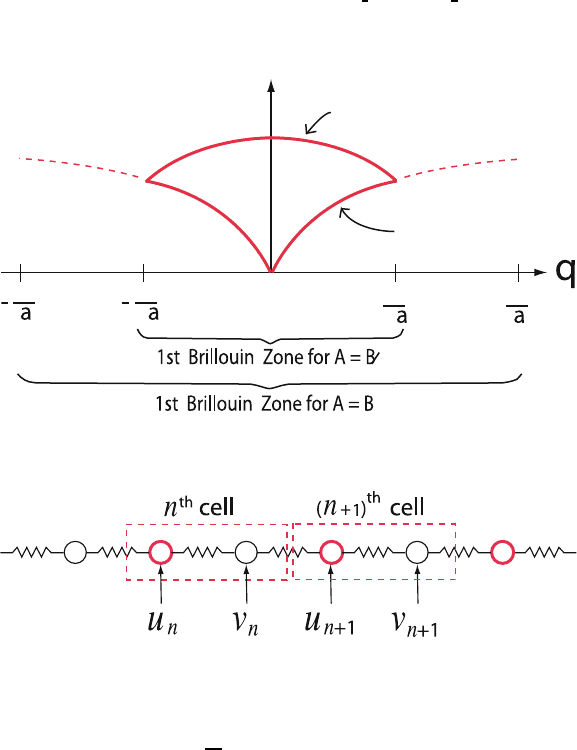
case, the part of the ω vs. q curve lying outside the region |q|≤
π
2a
must 268
be translated (or folded back) into the first Brillouin zone (region between 269
−
π
2a
and
π
2a
) by adding or subtracting the reciprocal lattice vector
π
a
.This 270
results in the spectrum shown in Fig. 2.6. Thus, for a non-Bravais lattice, the 271
phonon spectrum has more than one branch. If there are p atoms per primi- 272
tive unit cell, there will be p branches of the spectrum in a one-dimensional 273
crystal. One branch, which satisfies the condition that ω(q) → 0asq → 0is 274
called the acoustic branch or acoustic mode. The other (p − 1) branches are 275
called optical branches or optical modes. Due to the difference between the
ΑΑΑΑΑ
ΒΒΒ
Β
UNIT CELL
2
Fig. 2.5. Linear chain with two atoms per unit cell
Uncorrected Proof
BookID 160928 ChapID 02 Proof# 1 - 29/07/09
2.4 Optical Modes 49
0
ACOUSTIC
BRANCH
OPTICAL
BRANCH
π
π
2
π
2
π
ω
Fig. 2.6. Dispersion curves for the lattice vibration in a linear chain with two atoms
per unit cell
Fig. 2.7. Unit cells of a linear chain with two atoms per cell
pair of atoms in the unit cell when A = B, the degeneracy of the acoustic 276
and optical modes at q = ±
q
2a
is usually removed. Let us consider a simple 277
example, the linear chain with nearest neighbor interactions but with atoms 278
of mass M
1
and M
2
in each unit cell. Let u
n
be the displacement from its 279
equilibrium position of the atom of mass M
1
in the nth unit cell; let v
n
be 280
the corresponding quantity for the atom of mass M
2
. Then, the equations of 281
motion are 282
M
1
¨u
n
= K [(v
n
− u
n
) − (u
n
− v
n−1
)] , (2.57)
M
2
¨v
n
= K [(u
n+1
− v
n
) − (v
n
− u
n
)] . (2.58)
In Fig. 2.7, we show unit cells n and n + 1. We assume solutions of (2.57) and
283
(2.58) of the form 284
u
n
= u
q
e
iq2an−iω
q
t
, (2.59)
v
n
= v
q
e
iq(2an+a)−iω
q
t
. (2.60)
where u
q
and v
q
are constants. Substituting (2.59) and (2.60) into the equa- 285
tions of motion gives the following matrix equation. 286
Uncorrected Proof
BookID 160928 ChapID 02 Proof# 1 - 29/07/09
50 2 Lattice Vibrations
0
q
1
2/KM
2
2/KM
/2a−π
/2aπ
ω
ACOUSTIC
BRANCH
OPTICAL
BRANCH
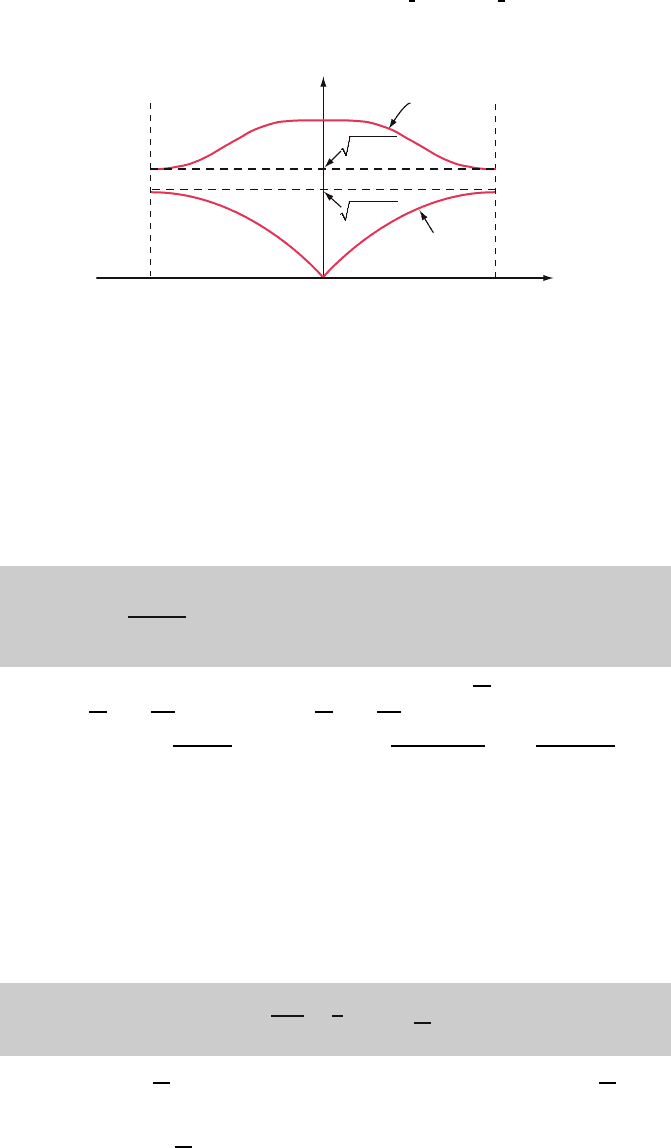
Fig. 2.8. Dispersion relations for the acoustical and optical modes of a diatomic
linear chain
−M
1
ω
2
+2K −2K cos qa
−2K cos qa −M
2
ω
2
+2K
u
q
v
q
=0. (2.61)
The nontrivial solutions are obtained by setting the determinant of the 2 ×2
287
matrix multiplying the column vector
u
q
v
q
equal to zero. The roots are
288
ω
2
±
(q)=
K
M
1
M
2
M
1
+ M
2
∓
(M
1
+ M
2
)
2
− 4M
1
M
2
sin
2
qa
1/2
.
(2.62)
289
We shall assume that M
1
<M
2
.Thenatq = ±
π
2a
,thetworootsare290
ω
2
OP
(q =
π
2a
)=
2K
M
1
and ω
2
AC
(q =
π
2a
)=
2K
M
2
.Atq ≈ 0, the two roots are 291
given by ω
2
AC
(q)
2Ka
2
M
1
+M
2
q
2
and ω
2
OP
(q)=
2K(M
1
+M
2
)
M
1
M
2
1 −
M
1
M
2
(M
1
+M
2
)
2
q
2
a
2
.
292
The dispersion relations for both modes are sketched in Fig. 2.8. 293
2.5 Lattice Vibrations in Three Dimensions 294
Now let us consider a primitive unit cell in three dimensions defined by the 295
translation vectors a
1
, a
2
,anda
3
. We will apply periodic boundary conditions 296
such that N
i
steps in the direction a
i
will return us to the original lattice site. 297
The Hamiltonian in the harmonic approximation can be written as 298
H =
i
P
2
i
2M
+
1
2
i,j
u
i
· C
ij
·u
j
. (2.63)
299
Here, the tensor C
ij
(i and j refer to the ith and jth atoms and C
ij
is a 300
three-dimensional tensor for each value of i and j)isgivenby 301
C
ij
=
∇
R
i
∇
R
j
U(R
1
, R
2
,...)
R
0
i
R
0
j
. (2.64)
Uncorrected Proof
BookID 160928 ChapID 02 Proof# 1 - 29/07/09
2.5 Lattice Vibrations in Three Dimensions 51
In obtaining (2.63) we have expanded U(R
1
, R
2
,...)inpowersofu
i
= 302
R
i
− R
0
i
, the deviation from the equilibrium position, and we have used the 303
definition of equilibrium to eliminate the term that is linear in u
i
. 304
From Hamilton’s equation we obtain the equation of motion 305
M
¨
u
n
= −
j
C
ij
·u
j
. (2.65)
We assume a solution to (2.65) of the form
306
u
n
= ξ
k
e
ik·R
0
n
−iω
k
t
. (2.66)
Here, ξ
k
is a vector whose magnitude gives the size of the displacement asso- 307
ciated with wave vector k and whose direction gives the direction of the 308
displacement. It is convenient to write 309
ξ
k
=ˆε
k
q
k
, (2.67)
where ˆε
k
is a unit polarization vector (a unit vector in the direction of ξ
k
) 310
and q
k
is the amplitude. Substituting the assumed solution into the equation 311
of motion gives 312
Mω
2
k
ε
k
=
j
C
ij
· ˆε
k
e
ik·
(
R
0
j
−R
0
i
)
. (2.68)
Because (2.68) is a vector equation, it must have three solutions for each value
313
of k. This is apparent if we define the tensor F (k)by 314
F (k)=−
j
e
ik·
(
R
0
j
−R
0
i
)
C
ij
. (2.69)
Then, (2.68) can be written as a matrix equation
315
⎛
⎝
Mω
2
k
+ F
xx
F
xy
F
xz
F
yx
Mω
2
k
+ F
yy
F
yz
F
zx
F
zy
Mω
2
k
+ F
zz
⎞
⎠
⎛
⎝
ˆε
kx
ˆε
ky
ˆε
kz
⎞
⎠
=0. (2.70)
The three solutions of the three by three secular equation for a given value of
316
k can be labeled by a polarization index λ. The eigenvalues of (2.70) will be 317
ω
2
kλ
and the eigenfunctions will be 318
ˆε
kλ
=(ˆε
x
kλ
, ˆε
y
kλ
, ˆε
z
kλ
)
with λ =1, 2, 3.
319
When we apply periodic boundary conditions, then we must have the 320
condition 321
e
ik
i
N
i
a
i
= 1 (2.71)
satisfied for i =1, 2, 3 the three primitive translation directions. In (2.71), k
i
322
is the component of k in the direction of a
i
and N
i
is the period associated 323

Uncorrected Proof
BookID 160928 ChapID 02 Proof# 1 - 29/07/09
52 2 Lattice Vibrations
with the periodic boundary conditions in this direction. From the condition 324
(2.71), it is clear that the allowed values of the wave vector k must be of the 325
form 326
k =2π
n
1
N
1
b
1
+
n
2
N
2
b
2
+
n
3
N
3
b
3
, (2.72)
327
where n
1
, n
2
,andn
3
are integers, and b
1
, b
2
, b
3
are primitive translation 328
vectors of the reciprocal lattice. As in the one-dimensional case, not all of 329
the values of k given by (2.72) are independent. It is customary to chose as 330
independent values of k those which satisfy (2.72) and the condition 331
−
N
i
2
≤ n
i
≤
N
i
2
. (2.73)
This set of k values is restricted to the first Brillouin zone, the set of all values
332
of k satisfying (2.72) that are closer to the origin in reciprocal space than to 333
any other reciprocal lattice point. The total number of k values in the first 334
Brillouin zone is N = N
1
N
2
N
3
, and there are three normal modes (three 335
polarizations λ)foreachk value. This gives a total of 3N normal modes, the 336
number required to describe a system of N = N
1
N
2
N
3
atoms each having 337
three degrees of freedom. For k values that lie outside the Brillouin zone, 338
one simply adds a reciprocal lattice vector K to obtain an equivalent k value 339
inside the Brillouin zone. 340
2.5.1 Normal Modes 341
As we did in the one-dimensional case, we can define new coordinates q
kλ
and 342
p
kλ
as 343
u
n
= N
−1/2
kλ
ˆε
kλ
q
kλ
e
ik·R
0
n
, (2.74)
P
n
= N
−1/2
kλ
ˆε
kλ
p
kλ
e
−ik·R
0
n
. (2.75)
The Hamiltonian becomes
344
H =
kλ
H
kλ
=
kλ
1
2M
p
kλ
p
∗
kλ
+
1
2
Mω
2
kλ
q
kλ
q
∗
kλ
. (2.76)
It is customary to define the polarization vectors ˆε
kλ
to satisfy ˆε
−kλ
= −ˆε
kλ
345
and ˆε
kλ
· ˆε
kλ
= δ
λλ
. Remembering that
n
e
i(k−k
)·R
0
n
= Nδ
k,k
,onecan 346
see immediately that 347
n
ˆε
kλ
· ˆε
k
λ
e
i(k−k
)·R
0
n
= Nδ
k,k
δ
λλ
. (2.77)
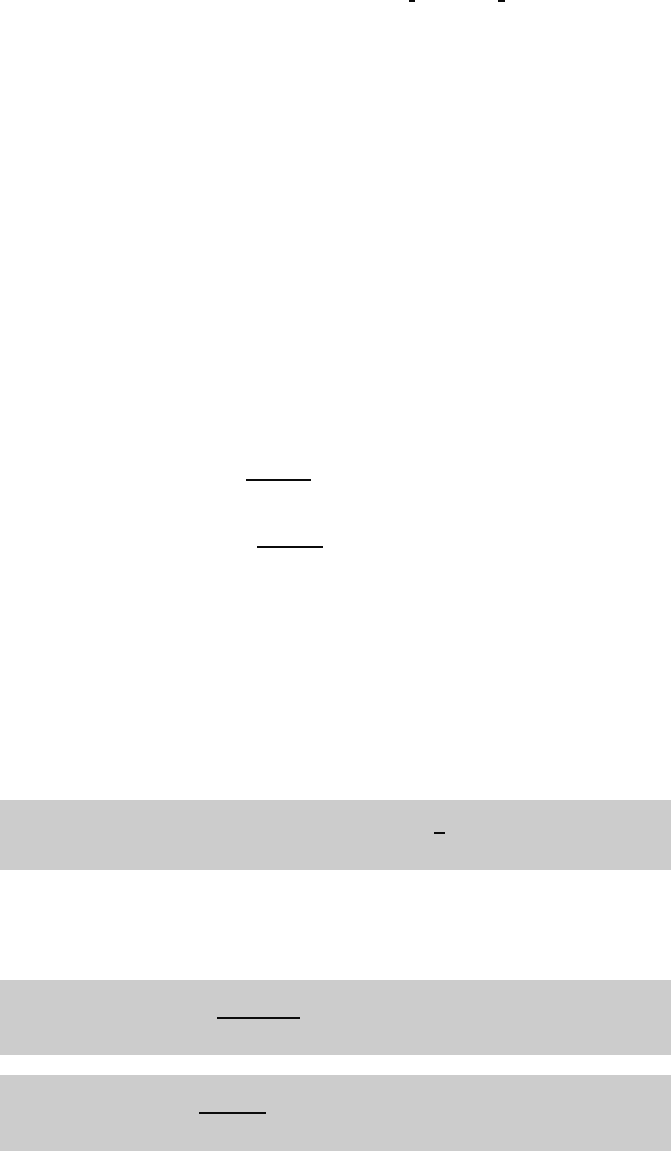
Uncorrected Proof
BookID 160928 ChapID 02 Proof# 1 - 29/07/09
2.5 Lattice Vibrations in Three Dimensions 53
The conditions resulting from requiring P
n
and u
n
to be real are 348
p
∗
kλ
= p
−kλ
and q
∗
kλ
= q
−kλ
(2.78)
where p
kλ
=ˆε
kλ
p
kλ
and q
kλ
=ˆε
kλ
q
kλ
. The condition on the scalar quantities 349
p
kλ
and q
kλ
differs by a minus sign from the vector relation (2.78) because 350
ˆε
kλ
changes sign when k goes to −k. 351
2.5.2 Quantization 352
To quantize, the dynamical variables p
kλ
and q
kλ
are replaced by quantum 353
mechanical operators ˆp
kλ
and ˆq
kλ
which satisfy the commutation relations 354
[ˆp
kλ
, ˆq
k
λ
]
−
= −i¯hδ
kk
δ
λλ
. (2.79)
It is again convenient to introduce creation and annihilation operators a
†
kλ
355
and a
kλ
defined by 356
q
kλ
=
¯h
2Mω
kλ
1/2
a
kλ
− a
†
−kλ
, (2.80)
p
kλ
= i
¯hM ω
kλ
2
1/2
a
†
kλ
+ a
−kλ
. (2.81)
The differences in sign from one-dimensional case result from using scalar
357
quantities q
kλ
and p
kλ
in defining a
kλ
and a
†
kλ
. The operators a
kλ
and a
k
λ
358
satisfy the commutation relations 359
a
kλ
,a
†
k
λ
−
= δ
kk
δ
λλ
, (2.82)
[a
kλ
,a
k
λ
]
−
=
a
†
kλ
,a
†
k
λ
−
=0. (2.83)
The Hamiltonian is given by
360
H =
kλ
¯hω
kλ
a
†
kλ
a
kλ
+
1
2
. (2.84)
361
From this point on the analysis is essentially identical to that of the one- 362
dimensional case which we have treated in detail already. In the three- 363
dimensional case, we can write the displacement u
n
and momentum P
n
of 364
the nth atom as the quantum mechanical operators given below: 365
u
n
=
kλ
¯h
2MNω
kλ
1/2
ˆε
kλ
e
ik·R
0
n
a
kλ
− a
†
−kλ
, (2.85)
366
367
P
n
=
kλ
i
¯hM ω
kλ
2N
1/2
ˆε
kλ
e
−ik·R
0
n
a
†
kλ
+ a
−kλ
. (2.86)
368

Uncorrected Proof
BookID 160928 ChapID 02 Proof# 1 - 29/07/09
54 2 Lattice Vibrations
Mean Squared Displacement of an Atom 369
As an example of how to use the quantum mechanical eigenstates and the 370
operator describing dynamical variables, let us evaluate the mean squared 371
displacement of an atom from its equilibrium position in a three-dimensional 372
crystal. We can write 373
u
n
·u
n
=
kλ,k
λ
¯h
2MN
(ω
kλ
ω
k
λ
)
−1/2
ˆε
kλ
· ˆε
k
λ
a
kλ
+ a
†
kλ
a
k
λ
+ a
†
k
λ
.
(2.87)
Here, we have again chosen the origin at the equilibrium position of the n
th
374
atom so that R
0
n
= 0. Then, we can replace ˆε
kλ
a
†
−kλ
by −ˆε
kλ
a
†
kλ
in (2.85). 375
This was done in obtaining (2.87). If we assume the eigenstate of the lattice 376
is |n
k
1
λ
1
,n
k
2
λ
2
,..., it is not difficult to see the that 377
u
n
= n
k
1
λ
1
,n
k
2
λ
2
,...|u
n
|n
k
1
λ
1
,n
k
2
λ
2
,... =0, (2.88)
and that
378
u
n
·u
n
=
kλ
¯h
2MNω
kλ
(2n
kλ
+1). (2.89)
379
2.6 Heat Capacity of Solids 380
In the nineteenth century, it was known from experiment that at room tem- 381
perature the specific heat of a solid was given by the Dulong–Petit law which 382
said 383
C
v
=3R, (2.90)
where R = N
A
k
B
,andN
A
= Avogadro number (=6.03 × 10
23
atoms/mole) 384
and k
B
= Boltzmann’s constant (=1.38×10
−16
ergs/
◦
K). Recall that 1 calorie 385
= 4.18 joule = 4.18 × 10
7
ergs. Thus, (2.90) gave the result 386
C
v
6cal/deg mole. (2.91)
The explanation of the Dulong–Petit law is based on the equipartition theo-
387
rem of classical statistical mechanics. This theorem assumes that each atom 388
oscillates harmonically about its equilibrium position, and that the energy of 389
one atom is 390
E =
p
2
2m
+
1
2
kr
2
=
1
2m
p
2
x
+ p
2
y
+ p
2
z
+
1
2
k
x
2
+ y
2
+ z
2
. (2.92)
The equipartition theorem states that for a classical system in equilibrium
391
p
2
x
2m
!
=
1
2
k
B
T . The same is true for the other terms in (2.92), so that the 392
energy per atom at temperature T is E =3k
B
T . The energy of 1 mole is 393
Uncorrected Proof
BookID 160928 ChapID 02 Proof# 1 - 29/07/09
2.6 Heat Capacity of Solids 55
3
V
C
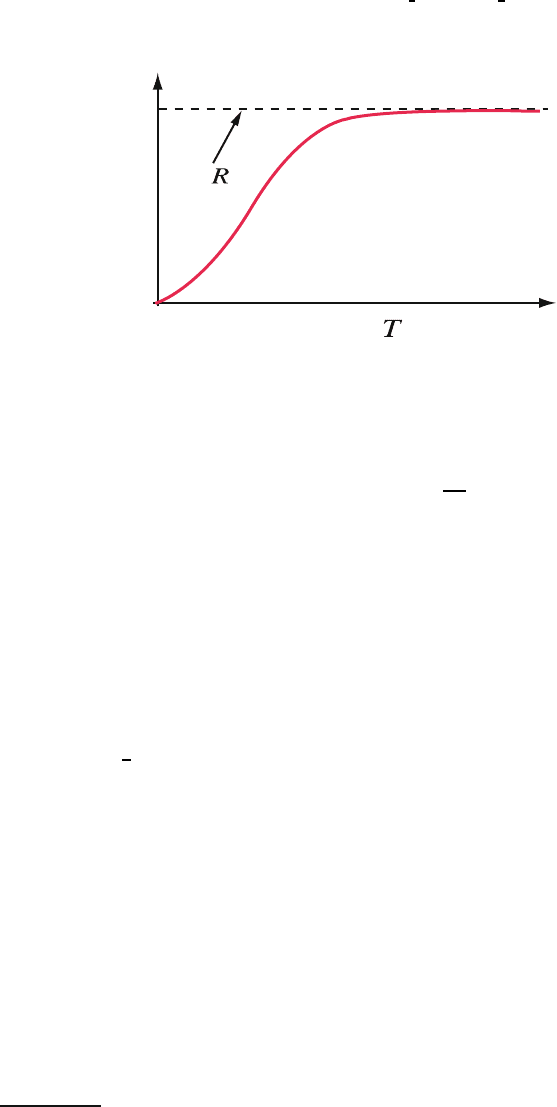
Fig. 2.9. Temperature dependence of the specific heat of a typical solid
U =3N
A
k
B
T =3RT. (2.93)
It follows immediately that C
v
, which is equal to
∂U
∂T
v
is given by (2.90). It 394
was later discovered that the Dulong–Petit law was valid only at sufficiently 395
high temperature. The temperature dependence of C
v
for a typical solid was 396
found to behave as shown in Fig. 2.9. 397
2.6.1 Einstein Model 398
To explain why the specific heat decreased as the temperature was lowered, 399
Einstein made the assumption that the atomic vibrations were quantized. 400
By this we mean that if one assumes that the motion of each atom is 401
described by a harmonic oscillator, then the allowed energy values are given 402
by ε
n
=
n +
1
2
¯hω,wheren =0, 1, 2, ...,andω is the oscillator frequency.
2
403
Einstein used a very simple model in which each atom vibrated with the same 404
frequency ω. The probability p
n
that an oscillator has energy ε
n
is propor- 405
tional to e
−ε
n
/k
B
T
. Because p
n
is a probability and
∞
n=0
p
n
= 1, we find that 406
it is convenient to write 407
p
n
= Z
−1
e
−ε
n
/k
B
T
, (2.94)
and to determine the constant Z from the condition
∞
n=0
p
n
=1.Doingso 408
gives 409
Z =e
−¯hω/2k
B
T
∞
n=0
e
−¯hω/k
B
T
n
. (2.95)
The power series expansion of (1 − x)
−1
is equal to
∞
n=0
x
n
. Making use of 410
this result in (2.95) gives 411
2
See Appendix A for a quantum mechanical solution of a harmonic oscillator
problem.
Uncorrected Proof
BookID 160928 ChapID 02 Proof# 1 - 29/07/09
56 2 Lattice Vibrations
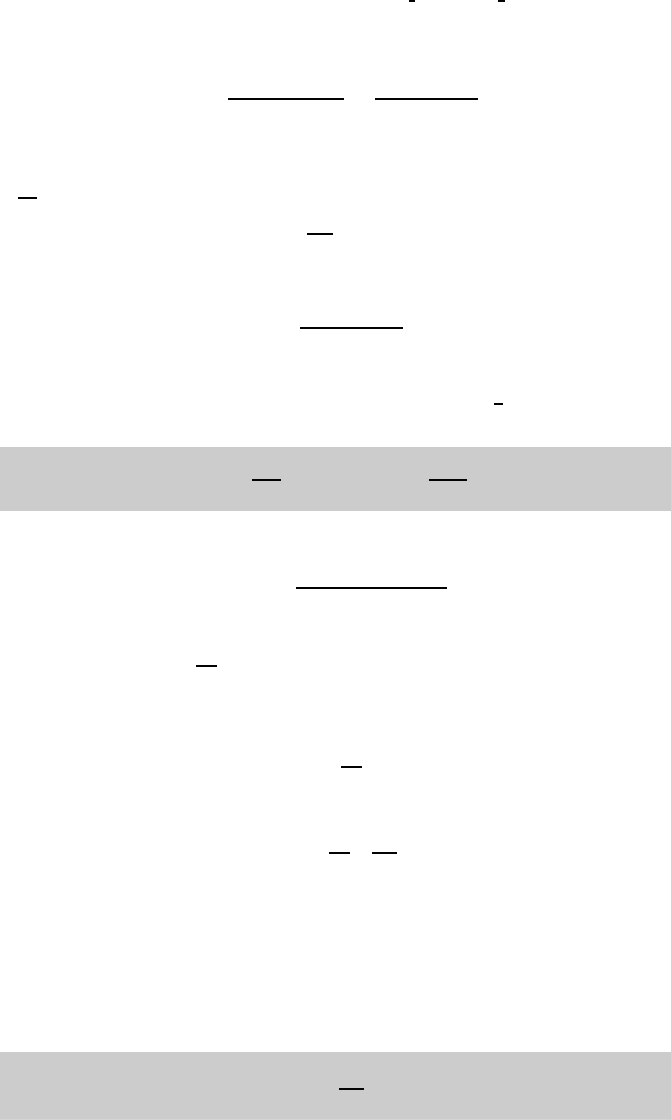
Z =
e
−¯hω/2k
B
T
1 − e
−¯hω/k
B
T
=
e
¯hω/2k
B
T
e
¯hω/k
B
T
− 1
. (2.96)
The mean value of the energy of one oscillator at temperature T is given by
412
¯ε =
n
ε
n
p
n
. Making use of (2.94) and (2.95) and the formula
n
n e
−nx
= 413
−
∂
∂x
n
e
−nx
gives 414
¯ε =
¯hω
2
+¯n¯hω. (2.97)
Here, ¯n is the thermal average of n;itisgivenby
415
¯n =
1
e
¯hω/k
B
T
− 1
, (2.98)
andiscalledtheBose–Einstein distribution function. The internal energy of
416
a lattice containing N atoms is simply U =3N¯hω
¯n +
1
2
,where¯n is given
417
by (2.98). If N is the Avogadro number, then the specific heat is given by 418
C
v
=
∂U
∂T
v
=3Nk
B
F
E
¯hω
k
B
T
, (2.99)
419
where the Einstein function F
E
(x) is defined by 420
F
E
(x)=
x
2
(e
x
− 1)(1 − e
−x
)
. (2.100)
It is useful to define the Einstein temperature T
E
by ¯hω = k
B
T
E
. Then the x 421
appearing in F
E
(x)is
T
E
T
. 422
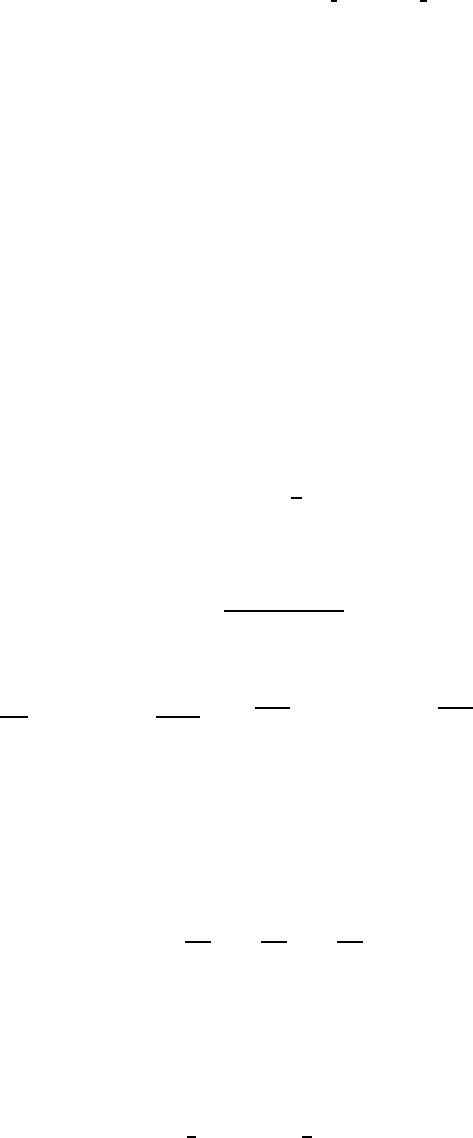
In the high-temperature limit (T T
E
), x is very small compared to unity. 423
Expanding F
E
(x) for small x gives 424
F
E
(x)=1−
1
12
x
2
+ ··· , (2.101)
and
425
C
v
=3Nk
B
1 −
1
12
T
E
T
2
+ ···
. (2.102)
This agrees with the classical Dulong–Petit law at very high temperature and
426
it falls off with decreasing T . 427
In the low temperature limit (T T
E
), x is very large compared to unity. 428
In this limit, 429
F
E
(x) x
2
e
−x
, (2.103)
and
430
C
v
=3Nk
B
T
E
T
2
e
−T
E
/T
. (2.104)
431
Uncorrected Proof
BookID 160928 ChapID 02 Proof# 1 - 29/07/09
2.6 Heat Capacity of Solids 57
The Einstein temperature was treated as a parameter to be determined by 432
comparison with experiment. The Einstein model reproduced the Dulong– 433
Petit law at high temperature and showed that C
v
decreased as the temper- 434
ature was lowered. Careful comparison of experimental data with the model 435
showed that the low temperature behavior was not quite correct. The exper- 436
imental data fit a T
3
law at low temperature (i.e., C
v
∝ T
3
) instead of 437
decreasing exponentially as predicted by the simple Einstein model. 438
2.6.2 Modern Theory of the Specific Heat of Solids 439
We know from our study of lattice vibrations that Einstein’s assumption that 440
each atom in the crystal oscillated at a single frequency ω is too great a 441
simplification. In fact, the normal modes of vibration have a spectrum ω
qλ
, 442
where q is a wave vector restricted to the first Brillouin zone and λ is a 443
label that defines the polarization of the mode. The energy of the crystal at 444
temperature T is given by 445
U =
qλ
¯n
qλ
+
1
2
¯hω
qλ
. (2.105)
In (2.105), ¯n
qλ
is given by 446
¯n
qλ
=
1
e
¯hω
qλ
/k
B
T
− 1
. (2.106)
From (2.105), the specific heat can be obtained; it is given by
447
C
v
=
∂U
∂T
v
= k
B
qλ
¯hω
qλ
k
B
T
2
e
¯hω
qλ
k
B
T
− 1
−1
1 − e
−
¯hω
qλ
k
B
T
−1
. (2.107)
To carry out the summation appearing in (2.107), we must have either more
448
information or some model describing how ω
qλ
depends on q and λ is needed. 449
Density of States 450
Recall that the allowed values of q were given by 451
q =2π
n
1
N
1
b
1
+
n
2
N
2
b
2
+
n
3
N
3
b
3
, (2.108)
where b
i
were primitive translations of the reciprocal lattice, n
i
were integers, 452
and N
i
were the number of steps in the direction i that were required before 453
the periodic boundary conditions returned one to the initial lattice site. For 454
simplicity, let us consider a simple cubic lattice. Then b
i
= a
−1
ˆx
i
,wherea is 455
the lattice spacing and ˆx
i
is a unit vector (in the x, y,orz direction). The 456
allowed (independent) values of q are restricted to the first Brillouin zone. In 457
this case, that implies that −
1
2
N
i
≤ n
i
≤
1
2
N
i
. Then, the summations over
458