
Quinn J.J., Yi K.-S. Solid State Physics: Principles and Modern Applications
Подождите немного. Документ загружается.

Uncorrected Proof
BookID 160928 ChapID 05 Proof# 1 - 29/07/09
130 5 Use of Elementary Group Theory in Calculating Band Structure
Order of a group: If a group G contains g elements, it is said to be of order g. 24
Abelian group: A group in which all elements commute. 25
Cyclic group: Agroupofg elements, in which the elements can be written 26
A, A
2
,A
3
,...,A
g−1
,A
g
= E.
Class When an element R of a group is multiplied by A and A
−1
to form 27
R
= ARA
−1
,whereA and A
−1
are elements of the group, the set of 28
elements R
obtained by using every A belonging to G is said to form a 29
class. Elements belong to the same class if they do essentially the same 30
thing when viewed from different coordinate system. For example, for 31
4 mm there are five classes: 32
(1) E,(2)R
90
◦
and R
−90
◦
,(3)R
180
◦
,(4)m
x
and m
y
,(5)m
+
and m
−
33
Rearrangement theorem If G = {E,A,B,...} is the set of elements of a group, 34
AG = {AE,AA,AB,...} is simply a rearrangement of this set. Therefore 35
R∈G
f(R)=
R∈G
f(AR). 36
Generators If all the elements of a group can be expressed in form A
m
D
n
, 37
where m and n are integers, then A and D are called generators of the 38
group. For example, the four operators of 2 mm can all be expressed in 39
terms of R and m
x
such as E = R
2
= m
2
x
, R = R, m
x
= m
x
, m
y
= R
1
m
1
x
. 40
5.2.1 Some Examples of Simple Groups 41
Cyclic Group of Order 42
n Consider an n-sided regular polygon. Rotation by R
j
=
2π
n
× j with j = 43
0, 1, 2,...,n− 1 form a group of symmetry operations. The generator of this 44
group is R
1
= rotation by
2π
n
. 45
G = {R
1
,R
2
1
,R
3
1
,...,R
n
1
= E} (5.4)
46
Symmetry Operations of an Equilateral Triangle 47
G = {E,R
120
,R
−120
,J
A
,J
B
,J
C
} (5.5)
Here, R
120
and J
A
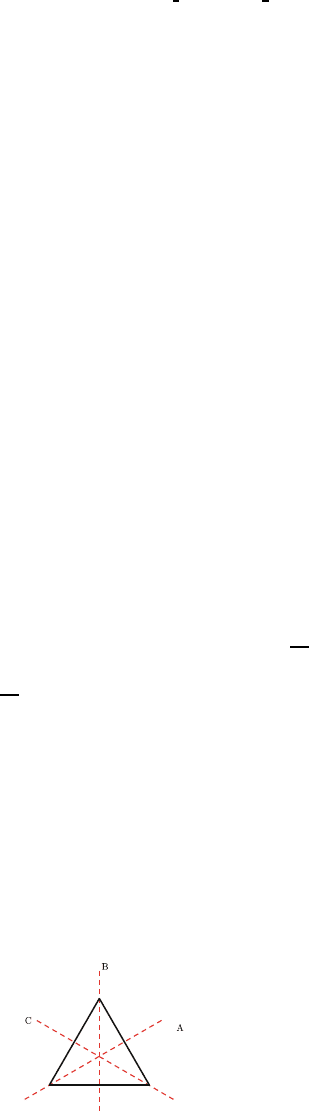
are generators of G. In this case, we have three classes of 48
{E}, {R
120
, R
−120
},and{J
A
, J
B
, J
C
}. (See Fig. 5.1.) 49
J
J
J
Fig. 5.1. Equilateral triangle
Uncorrected Proof
BookID 160928 ChapID 05 Proof# 1 - 29/07/09
5.2 Review of Elementary Group Theory 131
P
m
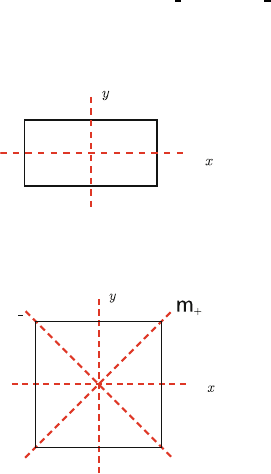
Fig. 5.2. Rectangle
P
P
P
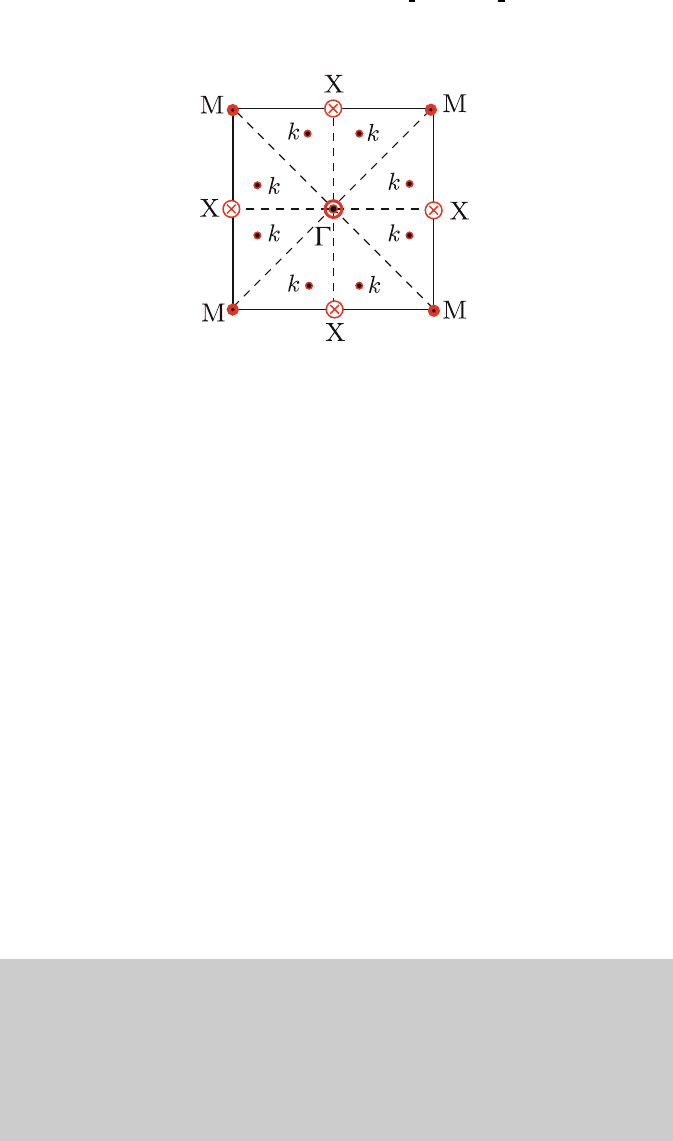
Fig. 5.3. Square
Symmetry Group of a Rectangle 50
G = {E,R,m
x
,m
y
} (5.6)
Here, R and m
x
are generators of G, and each element belongs to a different 51
class since x and y directions differ. (See Fig. 5.2.) 52
Symmetry Group of a Square 53
G = {E; R
90
(≡ R
1
) ,R
−90
(≡ R
3
);R
180
(≡ R
2
);m
x
,m
y
; m
+
,m
−
} (5.7)
Here, R
90
and m
x
are generators, and classes are discussed earlier. (See 54
Fig. 5.3.) 55
Other Examples 56
Groups of matrices, e.g., (1) n × n matrices with determinant equal to unity 57
and (2) n × n orthogonal matrices. 58
5.2.2 Group Representation 59
A group of matrices that satisfy the same multiplication as the elements of the 60
group is said to form a representation of the group. To be concrete, suppose a 61
group G = {E,A,B,...} of symmetry operations operates on some function 62
Ψ(x, y, z). These operations give us the set of functions. 63
EΨ,AΨ,BΨ,.... (5.8)

Uncorrected Proof
BookID 160928 ChapID 05 Proof# 1 - 29/07/09
132 5 Use of Elementary Group Theory in Calculating Band Structure
which form a vector space that is invariant under the operations of the group. 64
By this, we mean that the space of all functions of the form 65
Φ=c
1
EΨ+c
2
AΨ+c
3
BΨ+··· (5.9)
where c
i
are complex numbers is invariant under the operations of the group. 66
We can choose a basis set Ψ
j
with j =1, 2,...,l≤ g,whereg is the order of 67
the group. Then for any φ belonging to this vector space we can write 68
φ =
l
j=1
c
j
Ψ
j
. (5.10)
For any element R ∈G,
69
RΨ
j
=
l
k=1
D
jk
(R)Ψ
k
, (5.11)
where D(R) is a matrix. The set of matrices D(R)(foreachR ∈G)forma
70
representation of G. 71
5.2.3 Examples of Representations of the Group 4 mm 72
Under the operations of the eight elements of the group 4 mm, x always 73
transforms into ±x or into ±y as shown in Table 5.1. 74
Representation Γ
1
Consider the function Ψ
0
= x
2
+ y
2
.Itisobviousthat 75
under every operation belonging to G,Ψ
0
is unchanged. For example, 76
R
180
Ψ
0
= R
180
(x
2
+ y
2
)=(−x)
2
+(−y)
2
= x
2
+ y
2
=Ψ
0
. (5.12)
Thus, every operation of G can be represented by the unit matrix
77
D(E)=D(R
180
)=D(R
90
)=D(R
−90
)=···= D(m
−
)=1. (5.13)
This set of matrices forms a representation of G that is called the “iden-
78
tity” representation and denoted by the symbol Γ
1
(i.e. the representation 79
Γ
1
). Any function f(x, y) that transforms under the group operation R in 80
exactly the same manner as multiplication by the matrix D(R)represent- 81
ing R in the representation Γ
n
is said to belong to the representation Γ
n
. 82
t1.1 Tabl e 5. 1. Operations of the group 4 mm on functions of x and y
t1.2 Operation ER
180
R
90
R
−90
m
x
m
y
m
+
m
−
t1.3 xx−xy−yx−xy −y
t1.4 yy−y −xx−yyx−x

Uncorrected Proof
BookID 160928 ChapID 05 Proof# 1 - 29/07/09
5.2 Review of Elementary Group Theory 133
Representation Γ
4
Consider the function Ψ
4
= xy.ItisobviousthatE,R
180
, 83
m
+
, and m
−
operating on Ψ
4
leave it unchanged but that R
90
, R
−90
, m
x
, 84
and m
y
operating on Ψ
4
change it to −Ψ
4
. Therefore the matrices 85
D(E)=D(R
180
)=D(m
+
)=D(m
−
)=1
D(R
90
)=D(R
−90
)=D(m
x
)=D(m
y
)=−1
form a representation of G. This representation is called the Γ
4
represen- 86
tation. 87
By constructing Ψ
3
= x
2
− y
2
,Ψ
2
= xy(x
2
− y
2
), and Ψ
5
=
x
y
,it 88
is easy to construct Table 5.2, which illustrates the sets of matrices D
Γ
j
(R) 89
for each R ∈Gof the group 4 mm. The sets of matrices {D
Γ
j
(R)} for each 90
R ∈Gform representations of the group 4 mm. Functions belonging to the 91
representation Γ
j
transform under the operations of 4 mm in exactly the same 92
way as multiplying them by the appropriate D
Γ
j
(R). 93
t2.1 Tabl e 5.2. Group representation table of the group 4 mm
t2.2 R
Ψ
0
= x
2
+ y
2
D
Γ
1
(R)
Ψ
2
= xy(x
2
− y
2
)
D
Γ
2
(R)
Ψ
3
= x
2
− y
2
D
Γ
3
(R)
Ψ
4
= xy
D
Γ
4
(R)
Ψ
5
=
x
y
D
Γ
5
(R)
t2.3 E 1111
10
01
t2.4 R
180
1111
−10
0 −1
t2.5 R
90
11−1 −1
01
−10
t2.6 R
−90
11−1 −1
0 −1
10
t2.7 m
x
1 −11−1
10
0 −1
t2.8 m
y
1 −11−1
−10
01
t2.9 m
+
1 −1 −11
01
10
t2.10 m
−
1 −1 −11
0 −1
−10
t2.11 ⇑⇑⇑⇑⇑
t2.12 Γ
1
Γ
2
Γ
3
Γ
4
Γ
5

Uncorrected Proof
BookID 160928 ChapID 05 Proof# 1 - 29/07/09
134 5 Use of Elementary Group Theory in Calculating Band Structure
5.2.4 Faithful Representation 94
You will notice that the set of matrices forming the representation Γ
1
of 4 mm 95
to which the function x
2
+y
2
belonged were all identical, i.e. D(E)=D(R
1
)= 96
D(R
2
)=···= D(m
x
) = 1. Such a representation is a homomorphism between 97
the group of symmetry operators and the group of matrices, and it is said to be 98
an unfaithful representation. A representation in which each operation R ∈G 99
is represented by a different matrix D(R) is called a faithful representation. 100
In this case, the group of symmetry operations and the group of matrices are 101
isomorphic. 102
5.2.5 Regular Representation 103
If we construct a multiplication table for a finite group G as shown in Table 5.3 104
for 2 mm and we form 4 × 4 matrices D(E), D(R), D(m
x
), D(m
y
) by sub- 105
stituting 1 in the 4 × 4 array wherever the particular operation appears and 106
0 everywhere else, the set of matrices form a representation known as the 107
regular representation.Thus,wehave 108
109
D(E)=
⎛
⎜
⎜
⎝
1000
0100
0010
0001
⎞
⎟
⎟
⎠
,D(R)=
⎛
⎜
⎜
⎝
0100
1000
0001
0010
⎞
⎟
⎟
⎠
, etc. (5.14)
110
5.2.6 Reducible and Irreducible Representations 111
Suppose D
(1)
(R)andD
(2)
(R) are two representations of the same group, then 112
D(R) defined by 113
D(R)=
D
(1)
(R)0
0 D
(2)
(R)
(5.15)
also forms a representation of G. D(R) is called the direct sum of the first two
114
representations D
(1)
(R)andD
(2)
(R). A representation which can be written 115
as the direct sum of two smaller representations is said to be reducible. Some- 116
times a representation is reducible, but it is not at all apparent. The reason 117
for this is that if the matrices D(R) form a representation of G,then 118
t3.1 Tabl e 5. 3. Multiplication table of the group 2 mm
t3.2 E
−1
= ER
−1
= Rm
−1
x
= m
x
m
−1
y
= m
y
t3.3 EE R m
x
m
y
t3.4 RR E m
y
m
x
t3.5 m
x
m
x
m
y
ER
t3.6 m
y
m
y
m
x
RE

Uncorrected Proof
BookID 160928 ChapID 05 Proof# 1 - 29/07/09
5.2 Review of Elementary Group Theory 135
˜
D(R)=S
−1
D(R)S (5.16)
also form a representation (corresponding to a change in the basis vectors of
119
the vector space on which the matrices act). This similarity transformation 120
can scramble the block diagonal form so that the resulting
˜
D(R) do not look 121
reducible. A representation is reducible if and only if it is possible to perform 122
the same similarity transformation on all the matrices in the representation 123
and reduce them to block diagonal form. Otherwise, the representation is 124
irreducible. Clearly all one-dimensional representations (1 × 1 matrices) are 125
irreducible. 126
5.2.7 Important Theorems of Representation Theory 127
(without proof ) 128
1. Theorem one The number of irreducible representations (IRs) is equal to 129
the number of conjugate classes. 130
2. Theorem two If l
i
is the dimension of the ith IR and g is the number of 131
operations in the group G 132
i
l
2
i
= g. (5.17)
133
Example 134
1. 2 mm. There are four operations E, R, m
x
, m
y
and there are four classes 135
(remember that because the x and y directions are distinct m
x
and m
y
136
belong to different classes). From Theorem one, there are four IRs; from 137
Theorem two, they are all one dimensional so that 138
i
l
2
i
=1
2
+1
2
+1
2
+1
2
=4=g.
2. 4 mm. There are eight operations falling into five conjugate classes: E; R
2
; 139
R
1
and R
3
; m
x
and m
y
; m
+
and m
−
. Therefore, there are five IRs and four 140
IR’s must be one dimensional and one must be two dimensional so that 141
i
l
2
i
=1
2
+1
2
+1
2
+1
2
+2
2
=8=g
5.2.8 Character of a Representation
142
The character χ of a representation D(R) is defined as 143
χ(R)=
j
D
jj
(R) for each R ∈G. (5.18)
144
Because the application of a similarity transformation does not change the 145
trace of a matrix 146

Uncorrected Proof
BookID 160928 ChapID 05 Proof# 1 - 29/07/09
136 5 Use of Elementary Group Theory in Calculating Band Structure
1. χ(R) is independent of the basis used for the vector space. 147
2. χ(R) is the same for all elements R belonging to the same conjugate class. 148
Thus, we can define χ(C) to be the common value of χ(R) for all R belonging 149
to conjugate class C.
1
150
5.2.9 Orthogonality Theorem 151
In trying to determine the IRs and their characters certain orthogonality 152
theorems are very useful. We state them without proof. 153
1.
154
R∈G
χ
i
(R)χ
j
∗
(R)=gδij, (5.19)
155
where χ
i
and χ
j
are the characters of two representations. This can also 156
be written 157
C
n
C
χ
i
(C)χ
j
∗
(C)=gδ
ij
, (5.20)
where n
C
is the number of elements in the class C. 158
2.
159
i
χ
i
(C)χ
i
∗
(C
)=
g
n
C
δ
C,C
. (5.21)
160
3. If D
(i)
μν
(R)istheμν matrix element of the ith IR for the operation R,then 161
162
R∈G
D
(i)
μν
(R)
D
(j)
(R)
−1
ν
μ
=
1
l
i
δ
ij
δ
μμ
δ
νν
. (5.22)
163
For a unitary representation
D
(j)
(R)
−1
ν
μ
= D
(j)
∗
μ
ν
(R) so that for unitary 164
representation 165
R∈G
D
(i)
μν
(R)D
(j)
∗
(R)
ν
μ
=
1
l
i
δ
ij
δ
μμ
δ
νν
. (5.23)
Some Examples
166
1. 2 mm. We know there are four IRs all of which are one dimensional. We 167
label them Γ
1
,Γ
2
,Γ
3
,Γ
4
.The1× 1 matrices representing each element 168
are given in Table 5.4. 169
2. 4 mm. There are five IRs; one is two dimensional and the rest are one 170
dimensional as are shown in Table 5.5. 171
The reader should use these simple examples to demonstrate that the orthog- 172
onality theorems hold. 173
1
In the regular representation, each IR Γ
i
appears l
i
times, where l
i
is the
dimension of the IR Γ
i
.

Uncorrected Proof
BookID 160928 ChapID 05 Proof# 1 - 29/07/09
5.3 Empty Lattice Bands, Degeneracies and IRs at High-Symmetry Points 137
t4.1 Tabl e 5. 4. Irreducible representations of the group 2 mm
t4.2 Γ
1
Γ
2
Γ
3
Γ
4
t4.3 E 1 1 1 1
t4.4 R 1 1 −1 −1
t4.5 m
x
1 −11−1
t4.6 m
y
1 −1 −11
t5.1 Tabl e 5. 5. Irreducible representations of the group 4 mm
t5.2 Γ
1
Γ
2
Γ
3
Γ
4
Γ
5
t5.3 E 11 1 1
10
01
⇒ 2
t5.4 R
2
11 1 1
−10
0 −1
⇒−2
t5.5 R
1
, R
3
11− 1 −1
01
−10
,
0 −1
10
⇒ 0
t5.6 m
x
, m
y
1 −11−1
10
0 −1
,
−10
01
⇒ 0
t5.7 m
+
, m
−
1 −1 −11
01
10
,
0 −1
−10
⇒ 0
5.3 Empty Lattice Bands, Degeneracies 174
and IRs at High-Symmetry Points 175
In Sect. 5.2 we determined the free electron energies and wave functions in the 176
reduced zone scheme for a two-dimensional rectangular lattice. The starting 177
point for many band structure calculations is this empty lattice band structure 178
obtained by writing, as (5.3), 179
E
l
(k)=
¯h
2
2m
(k + K
l
)
2
,
where k is restricted to lie in the first Brillouin zone and K
l
is a reciprocal 180
lattice vector of (5.1) 181
K
l
=2π[l
1
b
1
+ l
2
b
2
+ l
3
b
3
].
Here, b
i
are the primitive translation vectors of the reciprocal lattice and 182
l
i
=0, ±1, ±2,.... We evaluate the energy at particular symmetry points, e.g. 183
at k = 0, the Γ point, along k
y
= k
z
= 0, the line Δ, etc. 184
The group of symmetry operations which leave the lattice invariant also 185
leaves the reciprocal lattice invariant. Suppose we know some wave function 186
Ψ
k
. A rotation or reflection operation of the point group acting on Ψ
k
will 187
give the same result as the rotation or reflection of k,thatis 188
RΨ
k
(x)=Ψ
Rk
(x)=Ψ
k
R
−1
x
. (5.24)
Uncorrected Proof
BookID 160928 ChapID 05 Proof# 1 - 29/07/09
138 5 Use of Elementary Group Theory in Calculating Band Structure
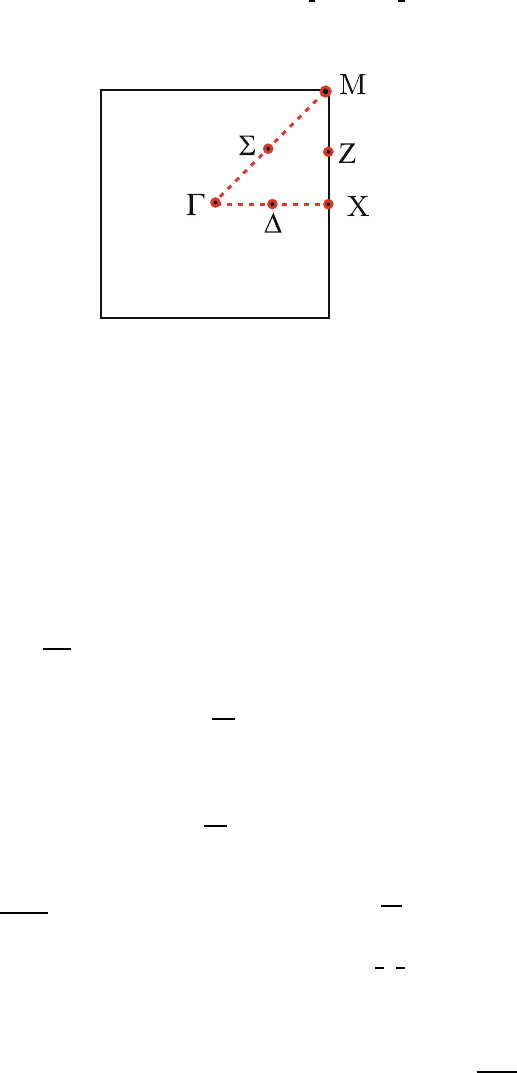
Fig. 5.4. STAR of square lattice
Here, we used the fact that applying the same orthogonal transformation to 189
both vectors in a scalar product does not change the value of the product, for 190
example k ·R
−1
r =Rk ·RR
−1
r =Rk ·r. By applying every R ∈Gtoawave 191
vector k, we generate the STAR of k. For a two-dimensional square lattice, all 192
operations leave Γ invariant so Γ is its own STAR. (See Fig. 5.4) For a general 193
point k, there will be g (=8 for 4 mm) points in the STAR of k. The symmetry 194
point X has four points in its STAR; two of these lie along the x-axis and 195
are equivalent because they are separated by a reciprocal lattice vector. The 196
other two points in the STAR of X are not equivalent to the X-point along the 197
x-axis because they are not separated from it by a reciprocal lattice vector. 198
All four points in the STAR of M are equivalent since they are all separated 199
by vectors of the reciprocal lattice. 200
5.3.1 Group of the Wave Vector k 201
The group (or subgroup of the original point group) of rotations and reflections 202
that transform k into itself or into a new k vector separated from the original 203
k point by a reciprocal lattice vector belong to the group of the wave vector k. 204
Example 205
For two-dimensional square lattice (Fig. 5.5) we remember that Δ, Z,andΣ 206
denote, respectively, any point on the line from Γ → X, X → M,andΓ→ M . 207
We have the groups of the wave vectors as follows: 208
G
Γ
= G
M
= {E,R
1
,R
2
,R
3
,m
x
,m
y
,m
+
,m
−
}
G
X
= {E,R
2
,m
x
,m
y
}
G
Δ
= {E,m
x
} (5.25)
G
Σ
= {E,m
+
}
G
Z
= {E,m
y
}
209
Uncorrected Proof
BookID 160928 ChapID 05 Proof# 1 - 29/07/09
5.3 Empty Lattice Bands, Degeneracies and IRs at High-Symmetry Points 139
Fig. 5.5. First Brillouin zone of a square lattice
When the empty lattice bands are calculated, there are often a number of 210
degenerate bands at points of high symmetry like the Γ-point, the M -point, 211
and the X-point. Because the operations of the group of the wave vector Γ 212
(or M or X) leave this point invariant, one can construct linear combinations 213
of these degenerate states that belong to representations of the group of the 214
wave vector Γ (or M or X,etc.). 215
Example 216
Empty lattice bands for a two-dimensional square lattice are written by 217
E
l
1
l
2
(k)=
¯h
2
2m
(k + K
l
1
l
2
)
2
and Ψ
l
1
l
2
(k, r)=e
i(k+K
l
1
l
2
)·r
. (5.26)
Here
218
K
l
1
l
2
=
2π
a
(l
1
ˆx + l
2
ˆy) (5.27)
with l
1
,l
2
=0, ±1, ±2,.... The empty lattice bands are labelled by the pair 219
of integers (l
1
,l
2
). (See Fig. 5.6.) By defining ξ and η by 220
k =
2π
a
[ξˆx + ηˆy] (5.28)
then we have
221
E
l
1
l
2
=
h
2
2ma
2
(ξ + l
1
)
2
+(η + l
2
)
2
and Ψ
l
1
l
2
=e
2πi
a
[(ξ+l
1
)x+(η+l
2
)y]
.
(5.29)
The parameters ξ and η are restricted to the range [−
1
2
,
1
2
]. 222
Exercise 223
Evaluate the energies E
l
1
l
2
(Γ), E
l
1
l
2
(X) for energies up to E =
h
2
2ma
2
× 10. 224
Make a sketch of the empty square lattice bands going from Γ → Δ → X. 225
(Use straight lines to connect E
l
1
l
2
(Γ) to E
l
1
l
2
(X) ). List the degeneracies at 226
Γ, Δ, and X. For example, see Table 5.6. 227