
Quinn J.J., Yi K.-S. Solid State Physics: Principles and Modern Applications
Подождите немного. Документ загружается.

Uncorrected Proof
BookID 160928 ChapID 05 Proof# 1 - 29/07/09
150 5 Use of Elementary Group Theory in Calculating Band Structure
t12.1 Table 5.12. Characters and IRs of cubic group
t12.2 (number of operations) (1) (3) (6) (6) (8) (1) (3) (6) (6) (8)
t12.3 class → E 4
2
423JJ4
2
J4 J2 J3
t12.4 representation ↓
t12.5 Γ
1
(A
1g
) 1111111111
t12.6 Γ
2
(A
2g
)11−1 −1111−1 −11
t12.7 Γ
12
(E
g
) 2200−122 00−1
t12.8 Γ
15
(T
1g
)3−11−103−11−10
t12.9 Γ
25
(T
2g
)3−1 −1103−1 −110
t12.10 Γ
1
(A
1u
) 11111−1 −1 −1 −1 −1
t12.11 Γ
2
(A
2u
)11−1 −11−1 −111−1
t12.12 Γ
12
(E
u
) 2200−1 −2 −2001
t12.13 Γ
15
(T
1u
)3−11−10−31−110
t12.14 Γ
25
(T
2u
)3−1 −110−311−10
C
x,−y,−z
(+):
⎛
⎝
x
y
z
⎞
⎠
→
⎛
⎝
−y
z
−x
⎞
⎠
, C
x,−y,−z
(−):
⎛
⎝
x
y
z
⎞
⎠
→
⎛
⎝
−z
−x
y
⎞
⎠
417
6. All of the above operations multiplied by the inversion J, 418
J
⎛
⎝
x
y
z
⎞
⎠
→
⎛
⎝
−x
−y
−z
⎞
⎠
gives the 24 improper rotations.
419
Characters and irreducible representations of the cubic group are listed in 420
Table 5.12. 421
5.6.2 Face Centered Cubic Lattice 422
The primitive translation vectors of a face centered cubic lattice are given by 423
a
1
=
a
2
(ˆx +ˆy), a
2
=
a
2
(ˆz +ˆx), a
3
=
a
2
(ˆy +ˆz). (5.48)
The primitive vectors of the reciprocal lattice (including the factor 2π)are
424
b
1
=
2π
a
(−ˆx − ˆy +ˆz), b
2
=
2π
a
(−ˆx +ˆy − ˆz), b
3
=
2π
a
(ˆx − ˆy − ˆz). (5.49)
An arbitrary vector of the reciprocal lattice can be written as
425
G
k
= h
1
b
1
+ h
2
b
2
+ h
3
b
3
,
G
k
=
2π
a
[(−h
1
− h
2
+ h
3
)ˆx +(−h
1
+ h
2
− h
3
)ˆy +(h
1
− h
2
− h
3
)ˆz] .
(5.50)
Brillouin Zone
426
There are eight shortest and six next shortest reciprocal lattice vectors 427
from the origin of reciprocal space to neighboring points (remember that the 428
reciprocal lattice of an FCC is a BCC). They are given by 429
Uncorrected Proof
BookID 160928 ChapID 05 Proof# 1 - 29/07/09
5.6 Empty Lattice Bands for Cubic Structure 151
W
Q
Z
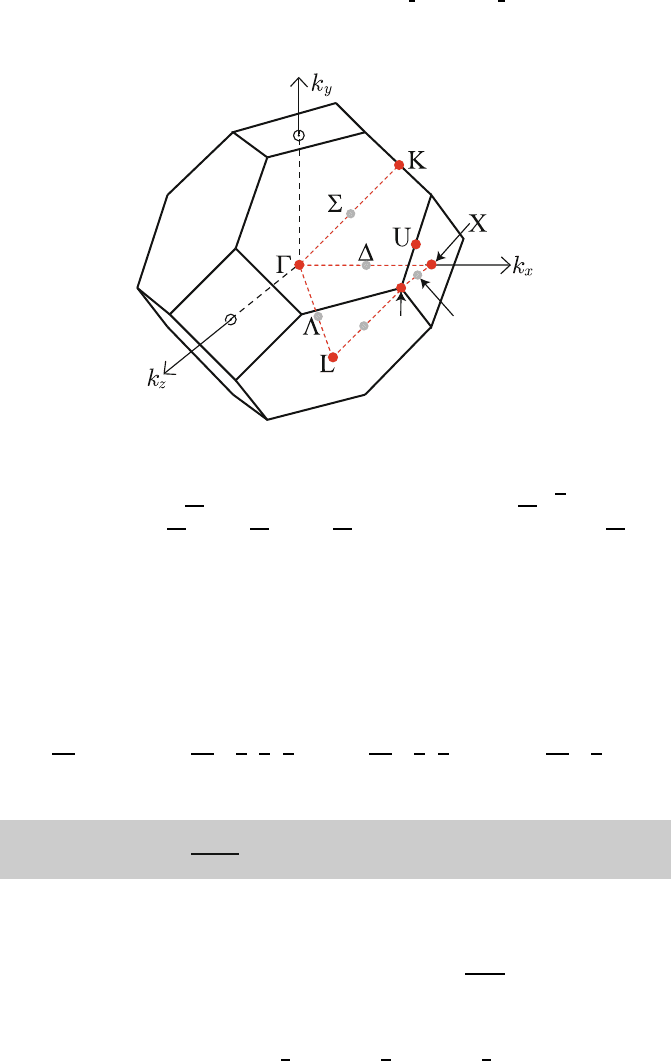
Fig. 5.8. The first Brillouin zone of FCC lattice
1. The eight vectors
2π
a
[±ˆx, ±ˆy, ±ˆz] whose length is |G| =
2π
a
√
3. 430
2. The six vectors
2π
a
(±2ˆx),
2π
a
(±2ˆy),
2π
a
(±2ˆz) whose length is |G| =
2π
a
·2. 431
The first Brillouin zone is the volume enclosed by the planes which are the 432
perpendicular bisectors of these 14 G-vectors. The first Brillouin zone of FCC 433
lattice has six square faces perpendicular to (100) and eight hexagonal faces 434
perpendicular to (111). (See Fig. 5.8.) 435
The names of high symmetry points are labelled in Fig. 5.8. Γ is the origin. 436
Arbitrary points along (100), (110), and (111) directions are called Δ, Σ, and 437
Λ, respectively. The special points X, L, K,andW are 438
X =
2π
a
(1, 0, 0),L=
2π
a
1
2
,
1
2
,
1
2
,K =
2π
a
3
4
,
3
4
, 0
,W =
2π
a
1
2
, 1, 0
.
The energy of a free electron is given by
439
E =
h
2
2ma
2
(l
1
+ ξ)
2
+(l
2
+ η)
2
+(l
3
+ ζ)
2
(5.51)
440
where 441
l
1
= −h
1
− h
2
+ h
3
,l
2
= −h
1
+ h
2
− h
3
,l
3
= h
1
− h
2
− h
3
and h
i
are integers. If we measure energy in units of
h
2
2ma
2
,then 442
E(Γ) = l
2
1
+ l
2
2
+ l
2
3
,
E(X)=(l
1
+1)
2
+ l
2
2
+ l
2
3
,
E(L)=(l
1
+
1
2
)
2
+(l
2
+
1
2
)
2
+(l
3
+
1
2
)
2
.
(5.52)
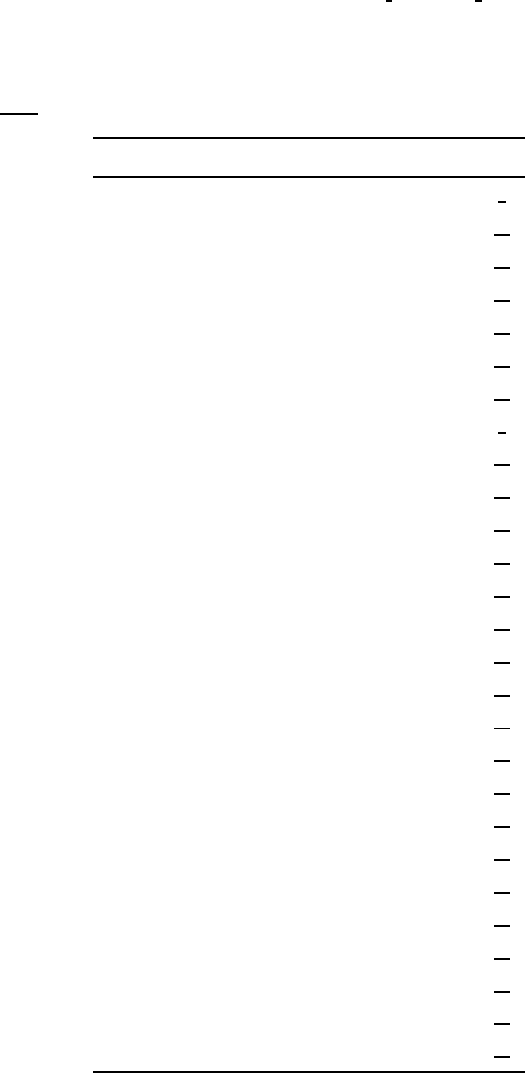
One should obtain a table similar to Table 5.13. From the table you con-
443
structed, you can draw the empty lattice band structure, showing the bands 444
going from Γ → X and from Γ → L. 445
Uncorrected Proof
BookID 160928 ChapID 05 Proof# 1 - 29/07/09
152 5 Use of Elementary Group Theory in Calculating Band Structure
t13.1 Table 5.13. Energies for FCC empty lattice E(Γ) ≤ 8. Energy is measured in units
of
h
2
2ma
2
t13.2 h
1
h
2
h
3
l
1
l
2
l
3
E(Γ) E(X) E(L)
t13.3 0 0 0 0 0 0 0 1
3
4
t13.4 1 0 0 −1 −11 3 2
11
4
t13.5 −10 0 1 1−13 6
19
4
t13.6 0 1 0 −11−13 2
11
4
t13.7 0 −101−11 3 6
19
4
t13.8 0 0 1 1 −1 − 13 6
11
4
t13.9 0 0 −1 −111 3 2
19
4
t13.10 1 1 1 −1 −1 −13 2
3
4
t13.11 −1 −1 −1111 3 6
27
4
t13.12 1 1 0 −200 4 1
11
4
t13.13 −1 −10200 4 9
27
4
t13.14 1 0 1 0 −20 4 5
11
4
t13.15 −10−1020 4 5
27
4
t13.16 0 1 1 0 0 −24 5
11
4
t13.17 0 −1 − 1002 4 5
27
4
t13.18 1 −100−22 8 9
35
4
t13.19 −11 0 0 2−28 9
35
4
t13.20 1 0 −1 − 202 8 5
35
4
t13.21 −10 1 2 0−28 13
35
4
t13.22 0 1 −1 − 220 8 5
35
4
t13.23 0 −112−20 8 13
35
4
t13.24 2 1 1 −2 −20 8 5
19
4
t13.25 −2 −1 −1220 8 13
51
4
t13.26 1 2 1 −20−28 5
19
4
t13.27 −1 −2 −1202 8 13
51
4
t13.28 1 1 2 0 −2 −28 9
19
4
t13.29 −1 −1 −2022 8 9
51
4
Uncorrected Proof
BookID 160928 ChapID 05 Proof# 1 - 29/07/09
5.6 Empty Lattice Bands for Cubic Structure 153
k
k
11
3
3
4
6
5
2
0
4
4
19/4
(4)
(8)
(6)
(2)
(6)
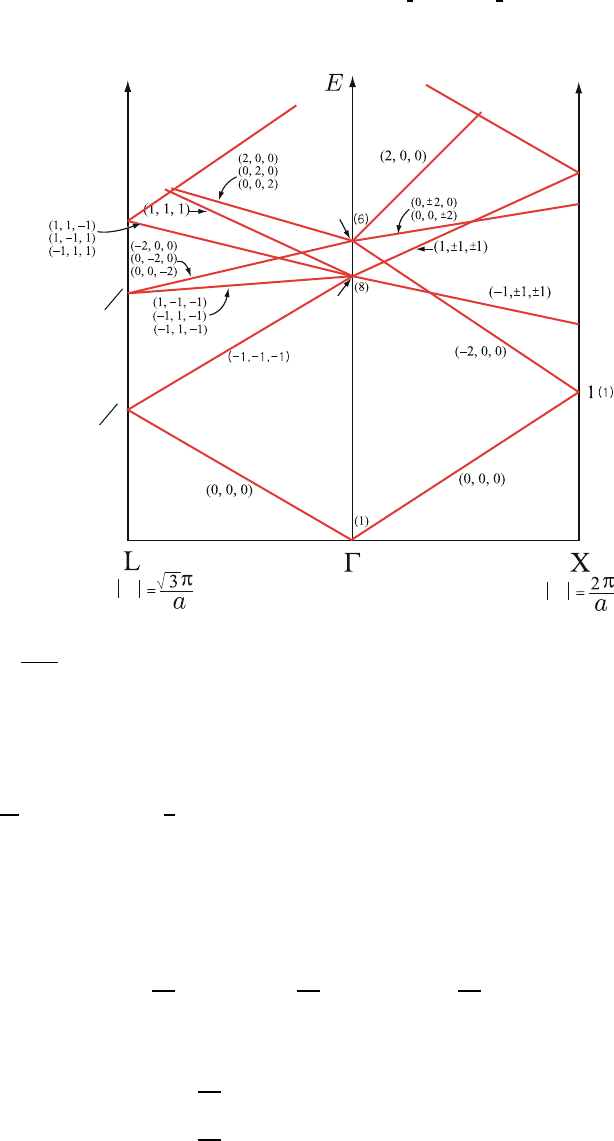
Fig. 5.9. Empty lattice band of the FCC lattice. The energy E is measured in units
of
h
2
2ma
2
and plotted as a function of k. Each band is schematically represented by a
straight line going from E
l
(Γ) to E
l
(X) or E
l
(L) even though the bands really have
a more complicated (quadratic form) dependence of the Bloch wave vector k.The
set of integers (l
1
,l
2
,l
3
) is indicated for each band
This empty lattice lattice band structure is shown in Fig. 5.9. Note that k = 446
2π
a
ˆx at X and k =
π
a
(ˆx +ˆy +ˆz)atL.TheenergyE is sketched as a function 447
of k. 448
5.6.3 Body Centered Cubic Lattice 449
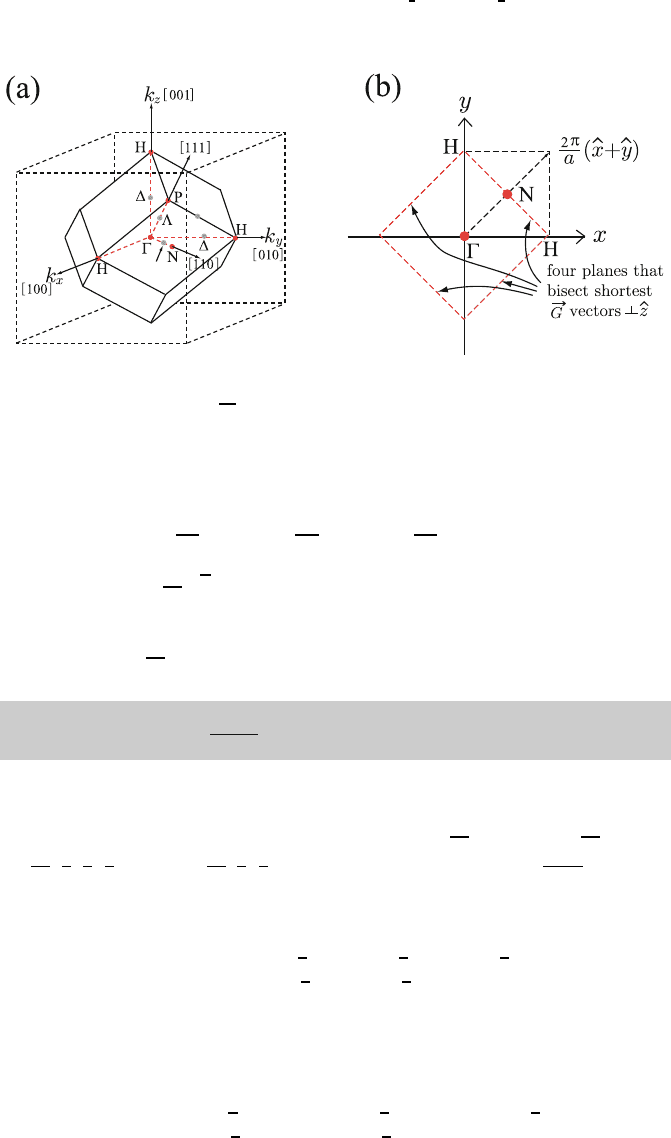
The primitive translations of the reciprocal lattice (including 2π)are 450
b
1
=
2π
a
(ˆx +ˆz), b
2
=
2π
a
(−ˆx +ˆy), b
3
=
2π
a
(−ˆy +ˆz). (5.53)
Therefore a general reciprocal lattice vector G
h
1
h
2
h
3
is given by 451
G
h
1
h
2
h
3
=
2π
a
[h
1
b
1
+ h
2
b
2
+ h
3
b
3
]
=
2π
a
[(h
1
− h
2
)ˆx +(h
2
− h
3
)ˆy +(h
3
+ h
1
)ˆz] . (5.54)
Uncorrected Proof
BookID 160928 ChapID 05 Proof# 1 - 29/07/09
154 5 Use of Elementary Group Theory in Calculating Band Structure
Σ
F
Fig. 5.10. (a)First Brillouin zone of the BCC lattice, (b) cross section of the four
planes bisecting the G = ±
2π
a
(ˆx±ˆy) perpendicular to the z-axis of the first Brillouin
zone of a BCC lattice
The 12 shortest reciprocal lattice vectors are 452
±
2π
a
(ˆx ± ˆy) , ±
2π
a
(ˆy ± ˆz) , ±
2π
a
(ˆx ± ˆz) .
They have length
2π
a
√
2. The first Brillouin zone is formed by the 12 planes 453
that bisect these 12 shortest reciprocal lattice vectors.(See Fig. 5.10a.) 454
Figure 5.10b shows the cross section of the four planes that bisect the 455
shortest G = ±
2π
a
(ˆx ± ˆy) perpendicular to the z-axis of the first Brillouin 456
zone of the BCC lattice. The empty lattice energy bands can be written by 457
E
l
1
l
2
l
3
=
h
2
2ma
2
(l
1
+ ξ)
2
+(l
2
+ η)
2
+(l
3
+ ζ)
2
(5.55)
458
where 459
l
1
= h
1
− h
2
,l
2
= h
2
− h
3
,l
3
= h
3
+ h
1
,
and h
i
are integers. We use the symbols of k =
2π
a
(ξ,η, ζ), H=
2π
a
(1, 0, 0), 460
P=
2π
a
(
1
2
,
1
2
,
1
2
), and N=
2π
a
(
1
2
,
1
2
, 0). Thus, we have, in units of
h
2
2ma
2
461
E
l
1
l
2
l
3
(Γ) = l
2
1
+ l
2
2
+ l
2
3
,
E
l
1
l
2
l
3
(H)=(l
1
+1)
2
+ l
2
2
+ l
2
3
,
E
l
1
l
2
l
3
(P )=(l
1
+
1
2
)
2
+(l
2
+
1
2
)
2
+(l
3
+
1
2
)
2
,
E
l
1
l
2
l
3
(N)=(l
1
+
1
2
)
2
+(l
2
+
1
2
)
2
+ l
2
3
.
(5.56)
Since l
1
= h
1
− h
2
, l
2
= h
2
− h
3
, l
3
= h
3
+ h
1
,wecanwrite 462
E(Γ) = (h
1
− h
2
)
2
+(h
2
− h
3
)
2
+(h
1
+ h
3
)
2
,
E(H)=(h
1
− h
2
+1)
2
+(h
2
− h
3
)
2
+(h
1
+ h
3
)
2
,
E(P )=(h
1
− h
2
+
1
2
)
2
+(h
2
− h
3
+
1
2
)
2
+(h
1
+ h
3
+
1
2
)
2
,
E(N)=(h
1
− h
2
+
1
2
)
2
+(h
2
− h
3
+
1
2
)
2
+(h
1
+ h
3
)
2
.
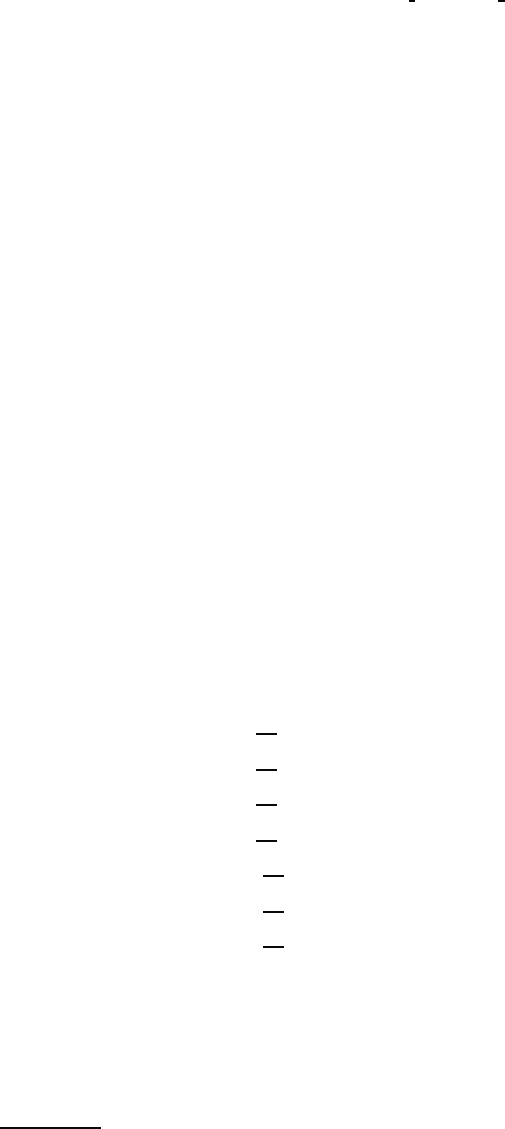
(5.57)
Uncorrected Proof
BookID 160928 ChapID 05 Proof# 1 - 29/07/09
5.7 Energy Bands of Common Semiconductors 155
5.7 Energy Bands of Common Semiconductors 463
Many common semiconductors which crystallize in the cubic zincblende struc- 464
ture have valence–conduction band structures that are quite similar in gross 465
features. This results from the fact that each atom (or ion) has four electrons 466
outside a closed shell and there are two atoms per unit cell. For example, 467
silicon has the electron configuration [Ne]3s
2
3p
2
, i.e., two 3s electrons and 468
two 3p electrons outside a closed neon core. With two silicon atoms per 469
unit cell, this gives eight electrons per unit cell. The empty lattice has a 470
single Γ
1
band at E
Γ
= 0 and 8-fold degenerate bands at E
Γ
=3.The471
eightfold degeneracy is lifted by the periodic potential, so the valence and 472
conduction bands at Γ will arise from these eight bands. Germanium has 473
the electron configuration of [Ar]3d
10
4s
2
4p
2
, and III–V compounds like GaAs 474
-
Ga
[Ar]3d
10
4s
2
4p
1
As
[Ar]3d
10
4s
2
4p
3
.
look just like Ge if one 4p electron
475
transfersfromAstoGaleavingasomewhationicGa
−
As
+
molecule in the 476
unit cell instead of two Ge atoms. The same is true if any III–V elements 477
replace a pair of Si atoms or Ge atoms in a zincblende structure. 478
A nice example of the use of group concepts in studying energy band 479
structure is a simple nearly free electron type model used to give a rather good 480
description of the valence–conduction band semiconductors with zincblende 481
structures. We will give a rough sketch of the calculation, referring the reader 482
to an article by D. Brust
2
. To describe the band structures of Si and Ge, Brust 483
use the following 15 plane-wave wave functions corresponding to the 15 bands 484
at Γ which have energy E ≤ 4. (See the 15 bands at Γ in Fig. 5.9.) We can 485
write these 15 plane waves as w
i
,withi =1, 2, 3,...,15 defined by 486
w
0
=1E
0
(Γ) = 0,
w
1
= w
∗
5
=e
2πi
a
(x+y+z)
E
1
(Γ) = E
5
(Γ) = 3,
w
2
= w
∗
6
=e
2πi
a
(x−y−z)
E
2
(Γ) = E
6
(Γ) = 3,
w
3
= w
∗
7
=e
2πi
a
(−x+y−z)
E
3
(Γ) = E
7
(Γ) = 3,
w
4
= w
∗
8
=e
2πi
a
(−x−y+z)
E
4
(Γ) = E
8
(Γ) = 3,
w
9
= w
∗
12
=e
2πi
a
x
E
9
(Γ) = E
12
(Γ) = 4,
w
10
= w
∗
13
=e
2πi
a
y
E
10
(Γ) = E
13
(Γ) = 4,
w
11
= w
∗
14
=e
2πi
a
z
E
11
(Γ) = E
14
(Γ) = 4,
From these 15 functions w
0
,w
1
,...,w
14
, one can construct linear superposi- 487
tions belonging to IRs of the group of the wave vector Γ, X, L, etc. Some 488
examples are 489
2
D. Brust, Phys. Rev. 134, A1337 (1964).
Uncorrected Proof
BookID 160928 ChapID 05 Proof# 1 - 29/07/09
156 5 Use of Elementary Group Theory in Calculating Band Structure
Ψ
1
=
1
√
V
w
0
belongs to Γ
1
,
Ψ
2
=
1
√
8V
[w
1
− w
2
− w
3
− w
4
+ w
5
− w
6
− w
7
− w
8
] belongs to Γ
1
,
.
.
.
.
.
.
Ψ
9
=
1
√
8V
[w
1
+ w
2
− w
3
+ w
4
− w
5
− w
6
+ w
7
− w
8
] belongs to Γ
15
,
Ψ
10
=
1
√
8V
[w
9
+ w
10
+ w
11
− w
12
− w
13
− w
14
] belongs to Γ
2
,
.
.
.
.
.
.
Ψ
15
=
1
√
2V
[w
11
+ w
14
] belongs to Γ
25
.
If you use these combinations of plane waves, the Schr¨odinger equation breaks
490
up into a block diagonal 15 × 15 matrix as shown in (5.58). 491
Γ
1
Γ
25
[3 × 3]
Γ
15
[3 × 3]
Γ
2
Γ
1
Γ
1
Γ
12
[2 × 2]
Γ
25
[3 × 3]
=0. (5.58)
Here Γ
1
and Γ
2
are 1×1, Γ
12
is a 2×2, and Γ
15
,Γ
25
,andΓ
25
are 3×3 matrices, 492
respectively. Off diagonal elements and bands in higher empty lattice states 493
are treated by standard nondegenerate perturbation theory. 494
Now the question arises “What do we use for the periodic potential 495
V (r)=
l
1
l
2
l
3
V
l
1
l
2
l
3
e
iK
l
·r
?” Brust simply treated the parameters V
l
1
l
2
l
3
as 496
phenomenological coefficients to be obtained by fitting band gaps and effective 497
masses measured experimentally or fitting more detailed first-principles band 498
structure calculations. He found that he could obtain a reasonably satisfactory 499
fit by keeping only three parameters: 500
V (3) = V
l
1
l
2
l
3
when l
2
1
+ l
2
2
+ l
2
3
=3,
V (8) = V
l
1
l
2
l
3
when l
2
1
+ l
2
2
+ l
2
3
=8, (5.59)
V (11) = V
l
1
l
2
l
3
when l
2
1
+ l
2
2
+ l
2
3
=11.
Remember, by cubic symmetry, V
1,1,1
= V
1,1,−1
= V
1,−1,−1
= V
−1,−1,−1
etc. 501
For Si, Brust found that V (3) −0.21 Ry,V(8) 0.04 Ry,V(11) 0.08 Ry. 502
For Ge he found that V (3) −0.23 Ry,V(8) 0.00 Ry,V(11) 0.06 Ry. 503
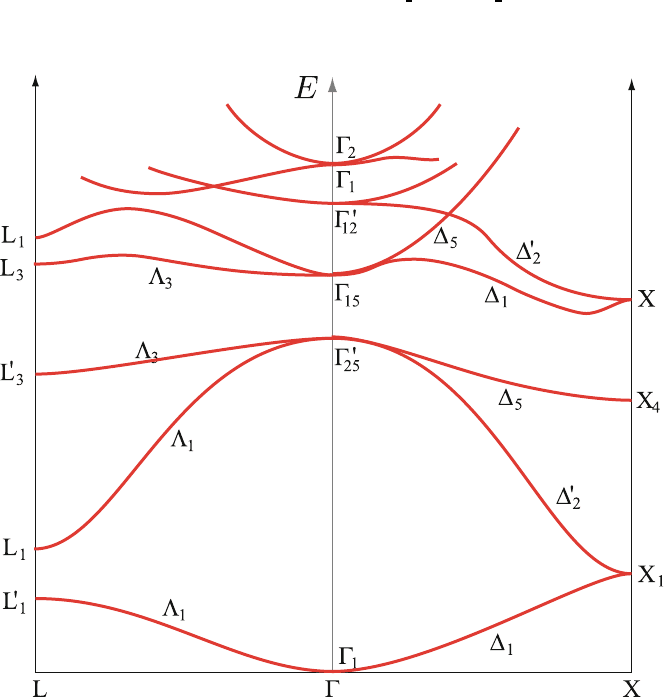
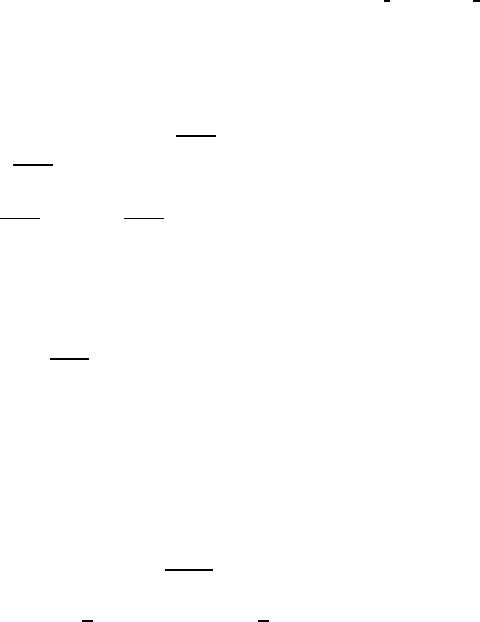
The band structure obtained for Si is illustrated in Fig. 5.11. This diagram 504
shows 11 bands at Γ out of the 15 bands we put into the calculation. Since 505
there are two atoms per unit cell and four valence electrons per atom, we 506
have eight electrons per unit cell or enough to fill four bands. Thus the Γ
25
507
state is the top of the valence band. The conduction band is Γ
15
at Γ, but 508
the minimum is at near the X-point, so the conduction band minimum has 509
six valleys, each very near one of the six X points. 510
Uncorrected Proof
BookID 160928 ChapID 05 Proof# 1 - 29/07/09
5.7 Energy Bands of Common Semiconductors 157
(1)
(1)
(1)
(2)
(3)
(3)
Fig. 5.11. Simple band structure of Si
Uncorrected Proof
BookID 160928 ChapID 05 Proof# 1 - 29/07/09
158 5 Use of Elementary Group Theory in Calculating Band Structure
Problems 511
5.1. At E(X) = 0.25
h
2
2ma
2
there are two degenerate bands. At E(X) = 512
1.25
h
2
2ma
2
there are four. Determine the linear combinations of degenerate 513
states at these points belonging to IR’s of G
X
.DothesameforE(Γ) = 514
1
h
2
2ma
2
and 2
h
2
2ma
2
515
5.2. Make a table, with values of h
1
,h
2
,h
3
, of the resulting l
1
,l
2
,l
3
and E(Γ), 516
E(X), E(L) for all bands with E(Γ) ≤ 4 for an FCC lattice. 517
5.3. Use your knowledge of the irredicible representations at E(Γ) = 0, 1, 2(in 518
units of
h
2
2ma
2
)andatE(X)=0.25 and 1.25, together with the compatibility 519
relations to determine the irreducible representations for each of these bands 520
along the line Δ. 521
5.4. Tabulate E(Γ),E(H),E(P ) for all bands that have E(Γ) ≤ 4. Then 522
sketch E vs. k along Δ(Γ → H) and along Λ(Γ → P ). 523
5.5. Do the same as above in part 4 for simple cubic lattice where 524
E
l
=
h
2
2ma
2
(l
1
+ ξ)
2
+(l
2
+ η)
2
+(l
3
+ ζ)
2
for Γ, X =
π
a
(1, 0, 0), and R =
π
a
(1, 1, 1). Sketch E vs. k along Γ → X and 525
along Γ → R for all bands having E(Γ) ≤ 4. 526
5.6. Use the irreducible representations at E(X) = 0.25 to evaluate 527
V
ij
=
Ψ
X
i
(0.25) | V (r) | Ψ
X
j
(0.25)
where Ψ
X
i
(0.25) is the wave function at E(X) = 0.25 belonging to the 528
irreducible representation X
i
. 529
(a) Show that V
ij
=0ifi = j. 530
(b) Show that the diagonal matrix elements give the same energies (and 531
band gap) as obtained by degenerate perturbation theory with the 532
original plane waves. 533
Uncorrected Proof
BookID 160928 ChapID 05 Proof# 1 - 29/07/09
5.7 Energy Bands of Common Semiconductors 159
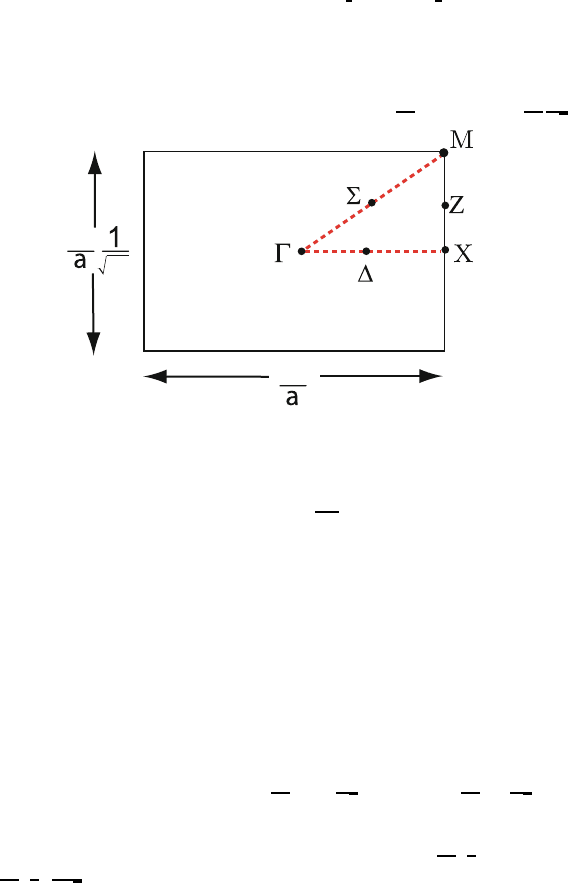
5.7. A two dimensional rectangular lattice has a reciprocal lattice whose 534
primitive translations, including the 2π,areb
1
=
2π
a
ˆx and b
2
=
2π
a
1
√
2
ˆy. 535
2π
2π
2
536
(a) List the operations belonging to G
Γ
. 537
(b) Do the same for G
X
and G
Δ
. 538
(c) For the empty lattice the wave functions and energies can be written 539
Ψ
l
(k, r)=e
i(k+K
l
)·r
and E
l
(k)=
¯h
2
2m
(k + K
l
)
2
. Here, K
l
= l
1
b
1
+ 540
l
2
b
2
,andl
1
and l
2
are integers. Tabulate the energies at Γ and at X 541
for (l
1
,l
2
) =(0,0), (0, ±1), (−1,0), (1,0), and (−1, ±1). 542
(d) Sketch (straight lines are OK) E vs. k along the line Δ (going from Γ 543
to X) for these bands. 544
(e) Two degenerate bands at the point E(Γ) = 0.5 connect to E(X) = 0.75. 545
Write down the wave functions for an arbitrary value of k
x
for these 546
two bands. 547
(f) From these wave functions, construct the linear combinations belonging 548
to irreducible representations of G
Δ
. 549
5.8. Graphene has a two-dimensional regular hexagonal reciprocal lattice 550
whose primitive translations are b
1
=
2π
a
(1, −
1
√
3
)andb
2
=
2π
a
(0,
2
√
3
). 551
(a) List the operations belonging to G
Γ
. 552
(b) Do the same for G
K
and G
M
.Notethatk
K
=
2π
a
(
2
3
, 0) and k
M
= 553
2π
a
(
1
2
,
1
2
√
3
). 554
(c) Write down the empty lattice wave functions and energies Ψ
l
(k, r)and 555
E
l
(k)atΓandK. 556
(d) Tabulate the energies at Γ and at K for (l
1
,l
2
) =(0,0), (0, ±1), (±1, 0), 557
(−1, −1), and (1, 1). 558
(e) Sketch E vs. k along the line going from Γ to K for these bands. 559
(f) Write down the wave functions for the three fold degenerate bands at 560
the energy E(K)=4/9. 561