
Quinn J.J., Yi K.-S. Solid State Physics: Principles and Modern Applications
Подождите немного. Документ загружается.

Uncorrected Proof
BookID 160928 ChapID 02 Proof# 1 - 29/07/09
38 2 Lattice Vibrations
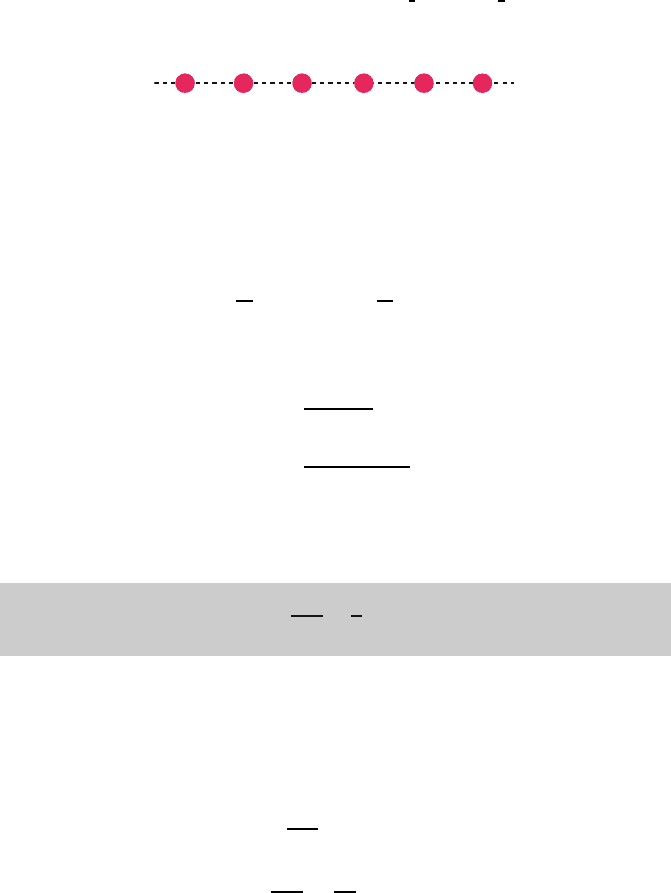
Fig. 2.1. Linear chain of N identical atoms of mass M
The first term is a constant which can simply be absorbed in setting the 24
zero of energy. By the definition of equilibrium, the second term must vanish 25
(the subscript zero on the derivative means that the derivative is evaluated at 26
u
1
,u
2
,...,u
n
= 0). Therefore, we can write 27
U(R
1
,R
2
,...,R
N
)=
1
2!
i,j
c
ij
u
i
u
j
+
1
3!
i,j,k
d
ijk
u
i
u
j
u
k
+ ··· , (2.4)
where
28
c
ij
=
∂
2
U
∂R
i
∂R
j
0
,
d
ijk
=
∂
3
U
∂R
i
∂R
j
∂R
k
0
. (2.5)
For the present, we will consider only the first term in (2.4); this is called the
29
harmonic approximation. The Hamiltonian in the harmonic approximation is 30
31
H =
i
P
2
i
2M
+
1
2
i,j
c
ij
u
i
u
j
. (2.6)
32
Here, P
i
is the momentum and u
i
the displacement from the equilibrium posi- 33
tion of the ith atom. 34
Equation of Motion 35
Hamilton’s equations 36
˙
P
i
= −
∂H
∂u
i
= −
j
c
ij
u
j
,
˙u
i
=
∂H
∂P
i
=
P
i
M
. (2.7)
can be combined to yield the equation of motion
37
M ¨u
i
= −
j
c
ij
u
j
. (2.8)
In writing down the equation for
˙
P
i
, we made use of the fact that c
ij
actually 38
depends only on the relative positions of atoms i and j, i.e., on |i − j|.Notice 39
that −c
ij
u
j
is simply the force on the ith atom due to the displacement 40
u
j
of the jth atom from its equilibrium position. Now let R
0
n
= na,sothat 41
R
0
n
−R
0
m
=(n−m)a. We assume a solution of the coupled differential equations 42
Uncorrected Proof
BookID 160928 ChapID 02 Proof# 1 - 29/07/09
2.1 Monatomic Linear Chain 39
of motion, (2.8), of the form 43
u
n
(t)=ξ
q
e
i(qna−ω
q
t)
. (2.9)
By substituting (2.9) into (2.8) we find
44
Mω
2
q
=
m
c
nm
e
iq(m−n)a
. (2.10)
Because c
nm
depends only on l = m − n, we can rewrite (2.10) as 45
Mω
2
q
=
N
l=1
c(l)e
iqla
. (2.11)
46
Boundary Conditions 47
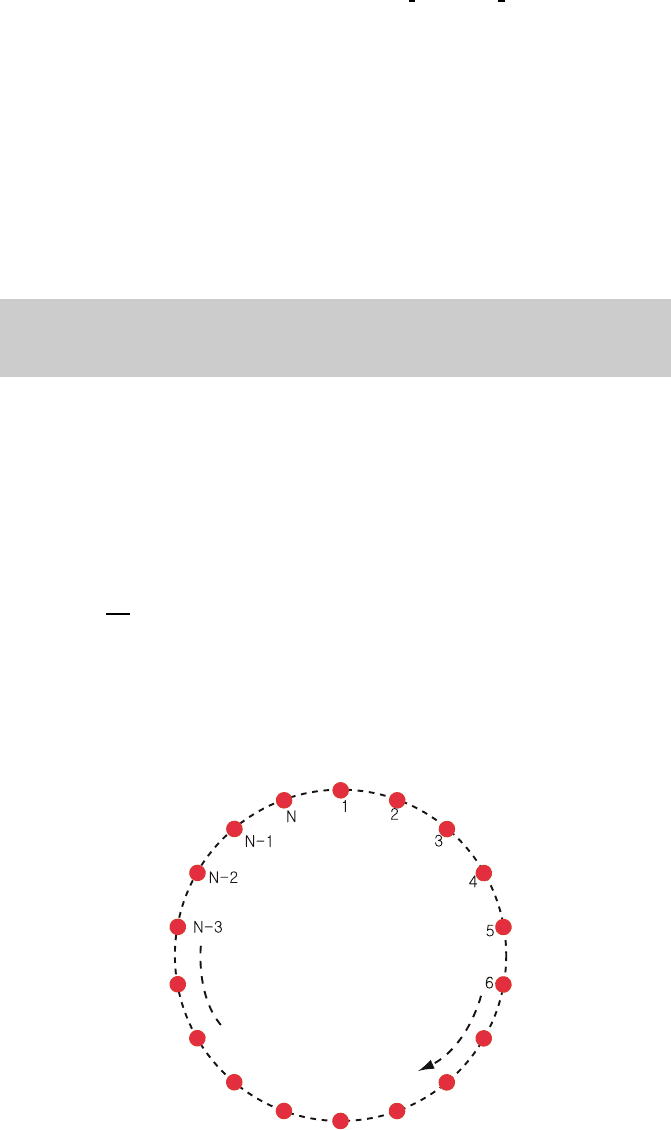
We apply periodic boundary conditions to our chain; this means that the 48
chain contains N atoms and that the N th atom is connected to the first atom 49
(Fig. 2.2). This means that the (n + N)th atom is the same atoms as the nth 50
atom, so that u
n
= u
n+N
.Sinceu
n
∝ e
iqna
, the condition means that 51
e
iqNa
=1, (2.12)
or that q =
2π
Na
×p where p =0, ±1, ±2, .... However, not all of these values 52
of q are independent. In fact, there are only N independent values of q since 53
there are only N degrees of freedom. If two different values of q,sayq and q
54
give identical displacements for every atom, they are equivalent. It is easy to 55
see that 56
e
iqna
=e
iq
na
(2.13)
Fig. 2.2. Periodic boundary conditions on a linear chain of N identical atoms

Uncorrected Proof
BookID 160928 ChapID 02 Proof# 1 - 29/07/09
40 2 Lattice Vibrations
for all values of n if q
− q =
2π
a
l,wherel =0, ±1, ±2, .... The set of inde- 57
pendent values of q are usually taken to be the N values satisfying q =
2π
L
p, 58
where −
N
2
≤ p ≤
N
2
. We will see later that in three dimensions the inde- 59
pendent values of q are values whose components (q
1
,q
2
,q
3
)satisfyq
i
=
2π
L
i
p, 60
and which lie in the first Brillouin zone, the Wigner–Seitz unit cell of the 61
reciprocal lattice. 62
Long Wave Length Limit 63
Let us look at the long wave length limit, where the wave number q tends to 64
zero. Then u
n
(t)=ξ
0
e
−iω
q=0
t
for all values of n. Thus, the entire crystal is 65
uniformly displaced (or the entire crystal is translated). This takes no energy 66
if it is done very very slowly, so it requires Mω
2
(0) =
N
l=1
c(l) = 0, or 67
ω(q = 0) = 0. In addition, it is not difficult to see that since c(l) depends only 68
on the magnitude of l that 69
Mω
2
(−q)=
l
c(l)e
−iqla
=
l
c(l
)e
iql
a
= Mω
2
(q). (2.14)
In the last step in this equation, we replaced the dummy variable l by l
and 70
used the fact that c(−l
)=c(l
). Equation (2.14) tells us that ω
2
(q)isaneven 71
function of q which vanishes at q = 0. If we make a power series expansion 72
for small q,thenω
2
(q)mustbeoftheform 73
ω
2
(q)=s
2
q
2
+ ··· (2.15)
The constant s is called the velocity of sound.
74
Nearest Neighbor Forces: An Example 75
So far, we have not specified the interaction law among the atoms; (2.15) 76
is valid in general. To obtain ω(q) for all values of q, we must know the 77
interaction between atoms. A simple but useful example is that of nearest 78
neighbor forces. In that case, the equation of motion is 79
Mω
2
(q)=
1
l=1
c
l
e
iqla
= c
−1
e
−iqa
+ c
0
+ c
1
e
iqa
. (2.16)
Knowing that ω(0) = 0 and that c
−l
= c
l
gives the relation c
1
= c
−1
= −
1
2
c
0
. 80
Therefore, (2.16) is simplified to 81
Mω
2
(q)=c
0
1 −
e
iqa
+e
−iqa
2
. (2.17)
Since 1 − cos x =2sin
2
x
2
, (2.17) can be expressed as 82
ω
2
(q)=
2c
0
M
sin
2
qa
2
, (2.18)
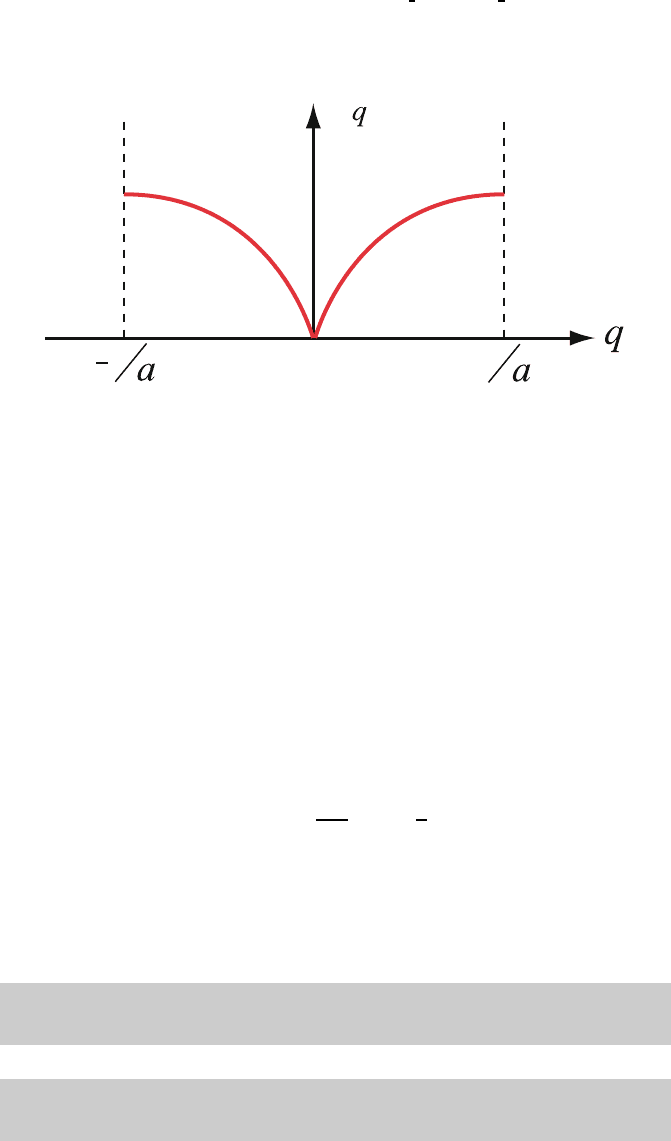
which is displayed in Fig. 2.3. By looking at the long wave length limit, the
83
coupling constant is determined by c
0
=
2Ms
2
a
2
,wheres is the velocity of 84
sound. 85
Uncorrected Proof
BookID 160928 ChapID 02 Proof# 1 - 29/07/09
2.2 Normal Modes 41
π
π
ω
Fig. 2.3. Dispersion relation of the lattice vibration in a monatomic linear chain
2.2 Normal Modes 86
The general solution for the motion of the nth atom will be a linear com- 87
bination of solutions of the form of (2.9). We can write the general solution 88
as 89
u
n
(t)=
q
ξ
q
e
iqna−iωt
+cc
, (2.19)
where cc means the complex conjugate of the previous term. The form of (2.19)
90
assures the reality of u
n
(t), and the 2N parameters (real and imaginary parts 91
of ξ
q
) are determined from the initial values of the position and velocity of 92
the N atoms which specify the initial state of the system. 93
In most problems involving small vibrations in classical mechanics, we seek 94
new coordinates p
k
and q
k
in terms of which the Hamiltonian can be written 95
as 96
H =
k
H
k
=
k
1
2M
p
k
p
∗
k
+
1
2
Mω
2
k
q
k
q
∗
k
. (2.20)
In terms of these normal coordinates p
k
and q
k
, the Hamiltonian is a sum 97
of N independent simple harmonic oscillator Hamiltonians. Because we use 98
running waves of the form e
iqna−iω
q
t
the new coordinates q
k
and p
k
can be 99
complex, but the Hamiltonian must be real. This dictates the form of (2.20). 100
The normal coordinates turn out to be 101
q
k
= N
−1/2
n
u
n
e
−ikna
, (2.21)
102
and 103
p
k
= N
−1/2
n
P
n
e
+ikna
. (2.22)
104

Uncorrected Proof
BookID 160928 ChapID 02 Proof# 1 - 29/07/09
42 2 Lattice Vibrations
We will demonstrate this for q
k
and leave it for the student to do the same 105
for p
k
. We can write (2.19) as 106
u
n
(t)=α
k
ξ
k
(t)e
ikna
, (2.23)
where ξ
k
is complex and satisfies ξ
∗
−k
= ξ
k
. With this condition u
n
(t), given 107
by(2.23),isrealandα is simply a constant to be determined. We can write 108
the potential energy U =
1
2
mn
c
mn
u
m
u
n
in terms of the new coordinates 109
ξ
k
as follows. 110
U =
1
2
|α|
2
mn
c
mn
k
ξ
k
e
ikma
k
ξ
k
e
ik
na
. (2.24)
Now, let us use k
= q − k to rewrite (2.24) as 111
U =
1
2
|α|
2
nkq
m
c
mn
e
ik(m−n)a
ξ
k
ξ
q−k
e
iqna
. (2.25)
From (2.10) one can see that the quantity in the square bracket in (2.25) is
112
equal to Mω
2
k
.Thus,U becomes 113
U =
1
2
|α|
2
nkq
Mω
2
k
ξ
k
ξ
∗
k−q
e
iqna
. (2.26)
The only factor in (2.26) that depends on n is e
iqna
. It is not difficult to prove 114
that
n
e
iqna
= Nδ
q,0
. We do this as follows: Define S
N
=1+x + x
2
+ ···+ 115
x
N−1
;thenxS
N
= x + x
2
+ ···+ x
N
is equal to S
N
− 1+x
N
. 116
xS
N
= S
N
− 1+x
N
. (2.27)
Solving for S
N
gives 117
S
N
=
1 − x
N
1 − x
. (2.28)
Now, let x =e
iqa
. Then, (2.28) says 118
N−1
n=0
e
iqa
n
=
1 − e
iqaN
1 − e
iqa
. (2.29)
Remember that the allowed values of q were given by q =
2π
Na
× integer. 119
Therefore, iqaN =i
2π
Na
aN ×integer, and e
iqaN
=e
2πi×integer
= 1. Therefore,
120
the numerator vanishes. The denominator does not vanish unless q =0.When 121
q =0,e
iqa
=1andthesumgivesN . This proves that
n
e
iqna
= Nδ(q, 0) 122
when q =
2π
Na
× integer. Using this result in (2.26) gives 123

Uncorrected Proof
BookID 160928 ChapID 02 Proof# 1 - 29/07/09
2.2 Normal Modes 43
U =
1
2
|α|
2
k
Mω
2
k
ξ
k
ξ
∗
k
N. (2.30)
Choosing α = N
−1/2
puts U into the form of the potential energy for N 124
simple harmonic oscillators labeled by the k value. By assuming that P
n
is 125
proportional to
k
p
k
e
−ikna
with p
∗
−k
= p
k
, it is not difficult to show that 126
(2.22) gives the kinetic energy in the desired form
k
p
k
p
∗
k
2M
.Theinverseof 127
(2.21) and (2.22) are easily determined to be 128
u
n
= N
−1/2
k
q
k
e
ikna
, (2.31)
129
and 130
P
n
= N
−1/2
k
p
k
e
−ikna
. (2.32)
131
Quantization 132
Up to this point our treatment has been completely classical. We quantize the 133
system in the standard way. The dynamical variables q
k
and p
k
are replaced 134
by quantum mechanical operators ˆq
k
and ˆp
k
which satisfy the commutation 135
relation 136
[p
k
,q
k
]=−i¯hδ
k,k
. (2.33)
The quantum mechanical Hamiltonian is given by H =
k
H
k
,where 137
H
k
=
ˆp
k
ˆp
†
k
2M
+
1
2
Mω
2
k
ˆq
k
ˆq
†
k
. (2.34)
ˆp
†
k
and ˆq
†
k
are the Hermitian conjugates of ˆp
k
and ˆq
k
, respectively. They are 138
necessary in (2.34) to assure that the Hamiltonian is a Hermitian operator. 139
The Hamiltonian of the one-dimensional chain is simply the sum of N indepen- 140
dent simple Harmonic oscillator Hamiltonians. As with the simple Harmonic 141
oscillator, it is convenient to introduce the operators a
k
and its Hermitian 142
conjugate a
†
k
, which are defined by 143
q
k
=
¯h
2Mω
k
1/2
a
k
+ a
†
−k
, (2.35)
144
145
p
k
= ı
¯hM ω
k
2
1/2
a
†
k
− a
−k
. (2.36)
146
The commutation relations satisfied by the a
k
’s and a
†
k
’s are 147
a
k
,a
†
k
−
= δ
k,k
and [a
k
,a
k
]
−
=
a
†
k
,a
†
k
−
=0. (2.37)

Uncorrected Proof
BookID 160928 ChapID 02 Proof# 1 - 29/07/09
44 2 Lattice Vibrations
The displacement of the nth atom and its momentum can be written 148
u
n
=
k
¯h
2MNω
k
1/2
e
ikna
a
k
+ a
†
−k
, (2.38)
149
150
P
n
=
k
ı
¯hω
k
M
2N
1/2
e
−ikna
a
†
k
− a
−k
. (2.39)
151
The Hamiltonian of the linear chain of atoms can be written 152
H =
k
¯hω
k
a
†
k
a
k
+
1
2
, (2.40)
153
and its eigenfunctions and eigenvalues are 154
|n
1
,n
2
,...,n
N
=
a
†
k
1
n
1
√
n
1
!
···
a
†
k
N
n
N
√
n
N
!
|0, (2.41)
155
and 156
E
n
1
,n
2
,...,n
N
=
i
¯hω
k
i
n
i
+
1
2
. (2.42)
157
In (2.41), |0 >= |0
1
> |0
2
> ···|0
N
> is the ground state of the entire 158
system; it is a product of ground state wave functions for each harmonic 159
oscillator. It is convenient to think of the energy ¯hω
k
as being carried by an 160
elementary excitations or quasiparticle. In lattice dynamics, these elementary 161
excitations are called phonons. In the ground state, no phonons are present 162
in any of the harmonic oscillators. In an arbitrary state, such as (2.41), n
1
163
phonons are in oscillator k
1
, n
2
in k
2
, ..., n
N
in k
N
. We can rewrite (2.41) as 164
|n
1
,n
2
,...,n
N
= |n
1
> |n
2
> ···|n
N
>, a product of kets for each oscillator. 165
2.3 M¨ossbauer Effect 166
With the simple one-dimensional harmonic approximation, we have the tools 167
necessary to understand the physics of some interesting effects. One example 168
is the M¨ossbauer effect.
1
This effect involves the decay of a nuclear excited 169
state via γ-ray emission. First, let us discuss the decay of a nucleus in a free 170
atom; to be explicit, let us consider the decay of the excited state of Fe
57
via 171
emission of a 14.4 keV γ-ray. 172
Fe
57
∗
−→ Fe
57
+ γ. (2.43)
TheexcitedstateofFe
57
has a lifetime of roughly 10
−7
s. The uncertainty 173
principle tells us that by virtue of the finite lifetime Δt = τ =10
−7
s, there 174
1
R. L. M¨ossbauer, D.H. Sharp, Rev. Mod. Phys. 36, 410–417 (1964).
Uncorrected Proof
BookID 160928 ChapID 02 Proof# 1 - 29/07/09
2.3 M¨ossbauer Effect 45
rayγ
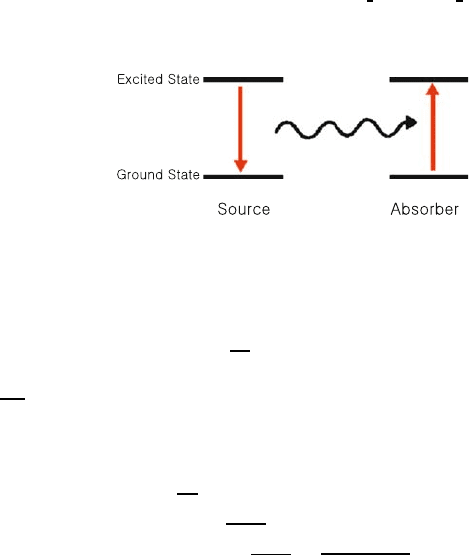
Fig. 2.4. The exact transition energy is required to be reabsorbed because of the
very sharply defined nuclear energy states
is an uncertainty ΔE in the energy of the excited state (or a natural linewidth 175
for the γ-ray) given by ΔE =
¯h
Δt
.UsingΔt =10
−7
sgivesΔω =10
7
s
−1
or 176
Δ(¯hω) 6 × 10
−9
eV. Thus, the ratio of the linewidth Δω to the frequency 177
ω is
Δω
ω
4 × 10
−13
.
AQ: Please provide
Fig. 2.4 citation.
178
In a resonance experiment, the γ-ray source emits and the target reso- 179
nantly absorbs the γ-rays. Unfortunately, when a γ-ray is emitted or absorbed 180
by a nucleus, the nucleus must recoil to conserve momentum. The momen- 181
tum of the γ-ray is p
γ
=
¯hω
c
, so that the nucleus must recoil with momentum 182
¯hK = p
γ
or energy E(K)=
¯h
2
K
2
2M
where M is the mass of the atom. The 183
recoil energy is given by E(K)=
¯h
2
ω
2
2Mc
2
=
(¯hω)
2
2(M/m)mc
2
.Butmc
2
0.5 ×10
6
eV 184
and the ratio of the mass of Fe
57
to the electron mass m is ∼2.3 × 10
5
,giv- 185
ing E(K) 2 × 10
−3
eV. This recoil energy is much larger than the energy 186
uncertainty of the γ-ray (6 ×10
−9
eV). Because of the recoil on emission and 187
absorption, the γ-ray is short by 4 × 10
−3
eV of energy necessary for reso- 188
nance absorption. M¨ossbauer had the idea that if the nucleus that underwent 189
decay was bound in a crystal (containing ∼10
23
atoms) the recoil of the entire 190
crystal would carry negligible energy since the crystal mass would replace 191
the atomic mass of a single Fe
57
atom. However, the quantum mechanical 192
state of the crystal might change in the emission process (via emission of 193
phonons). A typical phonon has a frequency of the order of 10
13
s
−1
,much 194
larger than Δω =10
7
s
−1
the natural line width. Therefore, in order for res- 195
onance absorption to occur, the γ-ray must be emitted without simultaneous 196
emission of phonons. This no phonon γ-ray emission occurs a certain fraction 197
of the time and is referred to as recoil free fraction. We would like to estimate 198
the recoil free fraction. 199
As far as the recoil-nucleus is concerned, the effect of the γ-ray emission 200
can be represented by an operator H
defined by 201
H
= Ce
iK·
ˆ
R
N
, (2.44)
where C is some constant, ¯hK is the recoil momentum, and
ˆ
R
N
is the position 202
operator of the decaying nucleus. This expression can be derived using the 203
semiclassical theory of radiation, but we simply state it and demonstrate that 204
it is plausible by considering a free nucleus. 205

Uncorrected Proof
BookID 160928 ChapID 02 Proof# 1 - 29/07/09
46 2 Lattice Vibrations
Recoil of a Free Nucleus 206
The Hamiltonian describing the motion of the center of mass of a free atom 207
is 208
H
0
=
P
2
2M
(2.45)
The eigenstates of H
0
are plane waves 209
|k = V
−1/2
e
ik·R
N
whose energy is 210
E(k)=
¯h
2
k
2
2M
.
Operating on an initial state |k>with H
gives a new eigenstate proportional 211
to |k + K>. The change in energy (i.e., the recoil energy) is 212
ΔE = E(k + K) − E(k)=
¯h
2
2M
2k · K + K
2
.
For a nucleus that is initially at rest, ΔE =
¯h
2
K
2
2M
, exactly what we had given 213
previously. 214
M¨ossbauer Recoil Free Fraction 215
When the atom whose nucleus emits the γ-ray is bound in the crystal, the 216
initial and final eigenstates must describe the entire crystal. Suppose the initial 217
eigenstate is 218
|n
1
,n
2
,...,n
N
>=
i
n
−1/2
i
a
†
k
i
n
i
|0 >.
In evaluating H
operating on this state, we write R
N
= R
0
N
+ u
N
to describe 219
the center of mass of the nucleus which emits the γ-ray. We can choose the 220
origin of our coordinate system at the position R
0
N
and write 221
R
N
= u
N
=
k
¯h
2MNω
k
1/2
a
k
+ a
†
−k
. (2.46)
Because k is a dummy variable to be summed over, and because ω
k
= ω
−k
, 222
we can replace a
†
−k
by a
†
k
in (2.46). 223
The probability of a transition from initial state |n
i
>= |n
1
,n
2
,...,n
N
> 224
to final state |m
f
>= |m
1
,m
2
,...,m
N
> is proportional to the square of the 225
matrix element m
f
|H
|n
i
. This result can be established by using time 226
dependent perturbation theory with H
as the perturbation. Let us write this 227
probability as P (m
f
,n
i
). Then P (m
f
,n
i
) can be expressed as 228
P (m
f
,n
i
)=α
m
f
Ce
iK·R
N
n
i
2
. (2.47)

Uncorrected Proof
BookID 160928 ChapID 02 Proof# 1 - 29/07/09
2.3 M¨ossbauer Effect 47
In (2.47) α is simply a proportional constant, and we have set H
= 229
Ce
iK·R
N
. Because P (m
f
,n
i
) is the probability of going from |n
i
> to |m
f
>, 230
m
f
P (m
f
,n
i
) = 1. This condition gives the relation 231
α|C|
2
m
f
m
f
e
iK·R
N
n
i
∗
m
f
e
iK·R
N
n
i
=1. (2.48)
Because e
iK·R
N
is Hermitian,
m
f
e
iK·R
N
n
i
∗
is equal to
n
i
e
−iK·R
N
m
f
.
232
We use this result in (2.48) and make use of the fact that |m
f
is part of a 233
complete orthonormal set so that
m
f
|m
f
m
f
| is the unit operator to obtain 234
α|C|
2
n
i
e
−iK·R
N
× e
iK·R
N
n
i
2
=1.
This is satisfied only if α|C|
2
= 1, establishing the result 235
P (m
f
,n
i
)=
m
f
e
iK·R
N
n
i
2
. (2.49)
236
Evaluation of P (n
i
,n
i
) 237
The probability of γ-ray emission without any change in the state of the lat- 238
tice is simply P (n
i
,n
i
). We can write R
N
in (2.49) as 239
R
N
=
k
β
k
a
k
+ a
†
k
, (2.50)
240
where we have introduced β
k
=
¯h
2MNω
k
1/2
.Ifwewrite|n
i
>= |n
1
> |n
2
> 241
···|n
N
>,then 242
n
i
e
iK·R
N
n
i
= n
1
| <n
2
|···<n
N
|[e
iK
k
β
k
(a
k
+a
†
k
)
]|n
1
> |n
2
> ···|n
N
.
(2.51)
The operator a
k
and a
†
k
operates only on the kth harmonic oscillator, so that 243
(2.51) can be rewritten 244
n
i
e
iK·R
N
n
i
=
k
n
k
|e
iKβ
k
(a
k
+a
†
k
)
|n
k
. (2.52)
Each factor in the product can be evaluated by expanding the exponential in
245
power series. This gives 246
n
k
|e
iKβ
k
(a
k
+a
†
k
)
|n
k
=1+
(iKβ
k
)
2
2!
n
k
|a
k
a
†
k
+ a
†
k
a
k
|n
k
+
(iKβ
k
)
4
4!
n
k
|(a
k
+ a
†
k
)
4
|n
k
+ ··· . (2.53)
The result for this matrix element is
247
n
k
|e
iKβ
k
(a
k
+a
†
k
)
|n
k
=1−
E(K)
¯hω
k
n
k
+
1
2
N
+ O(N
−2
). (2.54)