
Riendeau A Roger E. Brief History of Canada
Подождите немного. Документ загружается.


A BRIEF HISTORY OF CANADA
80
had been previously captured in war and returned in peace. While
politicians and diplomats negotiated the spoils of victory and defeat in
Europe, the people of New France felt a sense of both hope and fear.
They hoped that France would reconsider its low assessment of its
North American colony. But they also feared that they would suffer the
same fate as their colonial confrères in Acadia scarcely fi ve years before.
In 1763, the French-Canadian people would fi nd their hopes dashed
but their fears appeased.
An oil painting by Adam Sherriff Scott (1887–1980) depicts the French regime giving way to
the British regime in a ceremonial military transfer of power at Montreal in 1760.

81
6
THE CHALLENGE OF
IMPERIAL RULE IN BRITISH
NORTH AMERICA
(1760–1783)
U
ntil the middle of the 18th century, British interest in North
America focused overwhelmingly on the thirteen colonies along
the Atlantic seaboard. Although the fur-trading territory of the Hudson’s
Bay Company, the fi sheries of Newfoundland, the recently captured
French colony of Acadia, and the newly established naval base at
Halifax, Nova Scotia, were included within the British Empire, these
outlying areas paled in signifi cance to the well-endowed American colo-
nies, which contained a population about one-third the size of England’s.
The military conquest of New France in 1759–60, confi rmed by France’s
surrender in the Treaty of Paris in 1763, certainly gave Britain a greater
stake in the northerly reaches of the American frontier. But the chal-
lenges and complications of governing a people of different language,
religion, customs, and culture not only led to resentment between and
within the French and English communities of the St. Lawrence colony,
renamed the Province of Quebec, but also fanned the fl ames of rebellion
in the thirteen colonies, thus shattering the short-lived imperial unity
of North America. The division of the continent as agreed upon in the
Treaty of Versailles, which ended the American Revolutionary War in
1783, opened the way for two nations, one immediately and the other
eventually, to be created out of British North America.
The Roots of English Canada
When Humphrey Gilbert arrived in 1583 to claim Newfoundland as an
English colony, he found fi shing vessels from various western European

A BRIEF HISTORY OF CANADA
82
nations operating in St. John’s harbor and settlers scattered throughout
the surrounding countryside. When it became clear that the English
claim to the Avalon Peninsula did not deter international fi shing fl eets,
the imperial authorities actively encouraged the establishment of per-
manent settlement as a means of exerting greater control over the fi sh-
eries. In 1610 the London and Bristol Company sent John Guy with 40
men to start Newfoundland’s fi rst offi cial colony at Cupids on Conception
Bay. The company believed that residents would have the advantage of
occupying the best fi shing locations before the migratory fi shermen
arrived. Opposition from migratory fi shermen and the area’s lack of
agricultural potential rendered the colony unsustainable. Lord Baltimore
also attempted to establish a colony at Ferryland, south of St. John’s, in
1621, but the harshness of the winters prompted him to turn his efforts
toward Maryland in 1629. Although fi ve more English colonial enter-
prises had failed by 1661, some settlers invariably stayed behind, with
the result that the island had more than 500 permanent residents living
in about 40 communities scattered along the eastern coast from Cape
Bonavista to Trepassey. By 1680 the population had risen to about
2,000 with the arrival of people from the West Country of England,
who came out as passengers on migratory fi shing ships and decided to
stay. Potato famines in the 1720s and 1730s drove thousands of Irish
across the Atlantic to seek refuge in Newfoundland. Consequently, the
population of the island reached 10,000 by the middle of the 18th cen-
tury. But the determination of commercial fi shing interests to restrict
settlement succeeded in keeping the population below 20,000 by end
of the century.
The growth of settlement eventually led to a modifi cation of long-
standing imperial policy toward the government of Newfoundland
(Rothney 1964). Throughout the 17th and 18th centuries, Britain
remained reluctant to promote organized government in Newfound-
land because it valued the island as a fi shing station and a naval base
rather than as a colony. By the First Western Charter of 1634, the Eng-
lish government offi cially recognized the customary “fi shing admiral
system” of administration by which the captain of the fi rst ship in port
each spring had authority over the island, provided that he had the
arms and manpower to enforce his control. The inevitable problem
with this system was that the admirals stayed for only a few months of
the year and had varying interests and capacities when it came to main-
taining law and order. After contemplating the prospect of removing
the colonists, the English government passed the Newfoundland Act in
1699, affi rming the rights and authority of the fi shing admirals but

83
recognizing permanent settlement so long as it did not encroach upon
the domain of the migratory fi shermen. Colonial administration
improved somewhat in 1729, when the imperial authorities appointed
the naval offi cer in charge of the convoy escorting the fi shing fl eet to
the island to serve as governor and commander in chief during the
summer months. The naval governor was responsible for appointing
resident justices of the peace to substitute for him during the winter.
That this naval regime lasted for nearly a century further refl ected the
limited British commitment to the development of Newfoundland as a
colony (Innis 1978).
The defi ciencies of law and order adversely affected not only the
English settlers but also the native Beothuk population of Newfound-
land. As the fi shing industry and settlement extended along the eastern
and southern coasts, the Beothuk preferred to withdraw into the inte-
rior. Limited access to their long-standing coastal fi shing and hunting
sites led to severe food shortages. Beothuk efforts to access these coastal
areas often resulted in violent clashes with the fi shermen and settlers,
who felt unrestrained by legal sanctions. Those Beothuk who did not
fall victim to starvation and English brutality succumbed to tuberculo-
sis, resulting in the death of the last known Beothuk survivor in 1829.
Meanwhile, in the northwestern reaches of the North American con-
tinent, English rule was sustained by the Hudson’s Bay Company. The
founding charter of 1670 granted company control over all lands drain-
ing into Hudson Bay, a vast domain called Rupert’s Land whose limits
were unknown at the time but which actually included much of the
western prairie and northern subarctic regions. The company was
interested only in maintaining its fur-trading monopoly, and thus it
made no effort to settle the barren lands around Hudson Bay. Unlike its
St. Lawrence and Hudson River rivals to the south, the company did
not have to worry about encroaching settlement or unlicensed private
traders. Even when French traders sought to invade company domain,
they faced a perilous and costly overland voyage from Montreal to Hud-
son Bay and back before they could ship their furs to Paris via the St.
Lawrence River. By comparison, the Hudson’s Bay Company traders
benefi ted from the shorter and more direct sea voyage to London and
ready access to cheaper and better quality English trade goods, which
the Native traders preferred.
The limited competition enabled the company to maintain a policy
of “sitting by the bay,” as Cree and Assiniboine middlemen brought
furs from the interior to the posts established at the mouths of rivers
emptying into Hudson Bay. Only twice in its fi rst century of operation
THE CHALLENGE OF IMPERIAL RULE IN BRITISH NORTH AMERICA

A BRIEF HISTORY OF CANADA
84
did the company venture inland to reinforce its trade linkages with the
Native tribes in the face of French competition. Henry Kelsey became
the fi rst European to reach the western prairies in 1690–91, while
Anthony Henday reached the foothills of the Rockies in 1754. After
each expedition, the company decided not to establish costly trading
posts in the interior. Consequently, Rupert’s Land remained unex-
plored and unoccupied until the arrival of the St. Lawrence traders in
the 1770s (Rich 1967; Ray 1974).
The British government took a more active interest in colonizing the
Province of Nova Scotia in hopes of overwhelming the French popula-
tion of Acadia. Accompanying the founding of the naval base at Halifax
in 1749 was the fi rst systematic British effort to promote immigration
to Canada. Governor Edward Cornwallis brought about 2,000 immi-
grants from Britain and New England to settle in Halifax, and within
two years they were joined by some 1,500 “foreign Protestants,” mostly
of German origin, who settled in nearby Lunenburg.
After the expulsion of the Acadians in 1755, imperial authorities
launched a special campaign inviting loyal Protestants from New Eng-
land to claim the vacated French farmland around the Bay of Fundy. To
attract more New Englanders, Britain granted Nova Scotia an elected
assembly in 1758, the fi rst offi cial representative government in Can-
ada. The result was a steady fl ow of New England farmers and fi sher-
men during the 1760s, with settlement focusing in the Annapolis
Valley, the Saint John River valley, the Isthmus of Chignecto, and the
southeastern mainland coast. In 1764 the British government allowed
Acadians to return, provided that they were dispersed throughout Nova
Scotia. Hundreds of them settled around the Bay of Chaleur on the
border between present-day Quebec and New Brunswick and along the
lower Saint John River valley. Among the British immigrants arriving in
the 1760s and 1770s were some 2,000 settlers from Ulster in Northern
Ireland and several hundred Scottish Highlanders who, displaced by
the enclosure movement at home, acquired land on Cape Breton Island
and the new colony of St. John’s Island.
Formerly the French colony of Île-St-Jean, St. John’s Island (later
Prince Edward Island) had been ceded to Britain by the Treaty of Paris
in 1763. In 1767 the British government had granted all of the land on
the island to 67 military offi cers and other Crown favorites on the con-
dition that they settle their 20,000-acre holdings. Most of these land-
lords remained absentees who neglected to fulfi ll their colonizing
obligations. The establishment of the island as a separate colony in
1769 and the granting of representative government in 1773 only

85
served to protect the interests of the absentee landlords. As a result, the
colony continued to struggle with vast areas of undeveloped land as
absentee landlords refused to sell their land or to grant titles to those
who attempted to settle on their own initiative.
Maritime settlement continued to focus on peninsular Nova Scotia,
which on the eve of the American Revolution had a population
approaching 20,000, the majority of whom were New Englanders.
However, the northward fl ow of American migration had subsided by
the end of the 1760s in the wake of the opening of the Ohio-Mississippi
Valley to settlement. A constant impediment to Maritime development
would be a limited agricultural potential that rendered the region much
less attractive to settlers than the vast, fertile western interior frontier
(MacNutt 1965).
Conquest and Conciliation in the
British Province of Quebec
While the Maritime Provinces were being populated predominantly by
English-speaking people and governed by representative institutions,
the conquered French colony along the St. Lawrence River was evolv-
ing in an uncertain and unique direction. The fall of New France pre-
sented British imperial authorities with the awkward responsibility of
ruling over the subjects of its traditional European rival and the great-
est threat to its growing North American empire. In the fi nal analysis,
the controlled response of both conquerors and conquered at this criti-
cal turning point in North American history lay the foundation for the
bicultural character of the future Canadian nation (Neatby 1968).
When British commander in chief General Jeffrey Amherst pro-
claimed on September 22, 1760, that the conquered colony in the St.
Lawrence Valley would be ruled by the occupying military forces, the
French-speaking population of scarcely 65,000 had ample reason to be
fearful about the prospects of cultural survival within an English-speak-
ing American empire of more than 1.5 million people. Not only was the
memory of the Acadian expulsion still vivid, but the ravages of war had
taken their toll on the struggling French colony. Much of the town of
Quebec lay in ruins, and many of the farms in the surrounding country-
side had been devastated by the invaders. Commerce, notably the fur
trade, suffered from the severance of economic ties with France, while
agriculture had been neglected to the extent that seed was lacking for
the next harvest. The hasty retreat to France of some 2,000 members of
the colonial elite, including royal administrators, military offi cers, and
THE CHALLENGE OF IMPERIAL RULE IN BRITISH NORTH AMERICA

A BRIEF HISTORY OF CANADA
86
the leading merchants and landholders, cast an ominous shadow over
the future development of the Canadien community (Brunet 1963).
Even more precarious was the future of the Catholic Church in the
wake of the death of the bishop of Quebec, Henri-Marie de Pontbriand,
three months prior to the fall of New France. Without the appointment
of a successor, new clergy could not be ordained; and the fact that the
Catholic Church had been outlawed in Britain meant that it could no
longer count on fi nancial and legal support from the government. Cer-
tainly the refusal of the military rulers to guarantee the survival of
French laws, customs, and institutions under the terms of surrender
posed an imminent threat to Canadien society.
However, initial prospects did not conform to eventual reality. The
interim military regime maintained the traditional administrative divi-
sion of the colony into the three districts of Quebec, Trois-Rivières, and
Montreal, each headed by a military governor responsible to General
Amherst, who was headquartered in New York. The terms of surrender
offered transportation to France within 18 months for the relatively few
who wanted to leave, while the majority who chose to stay were guar-
anteed the free exercise of their Catholic religion and the security of
their property rights. Furthermore, the governors—General James
Murray in Quebec, General Ralph Burton in Trois-Rivières, and Gen-
eral Thomas Gage in Montreal—did not disturb the seigneurial system,
nor did they interfere with the collection of the church tithe. Although
judicial power rested with the military courts, they drew on the prece-
dents of the French regime and relied on French clerks and attorneys,
in addition to using the captains of militia as local magistrates. More-
over, the presence of British troops as a cash-paying market for local
products and services stimulated a revival of economic life. Within a
year, the military governors had restored agriculture, stabilized cur-
rency, and regulated supplies and prices.
The moderation and tolerance of the British military regime was a
pragmatic response to the prevailing uncertainty over both the progress
of the continuing war in Europe and the ultimate fate of the colony.
Accordingly, the chief concern of the interim administrators was to
avoid institutional change or interference with the normal way of life to
an extent that would make their task of governing the overwhelming
Canadien majority more diffi cult. Furthermore, unlike the situation in
the much smaller colony of Acadia, there was no nearby French base to
provoke popular resistance to the British conquerors. The transfer of
power and the process of readjustment were rendered easier by the
willingness of the Canadiens to accept the circumstances under which

87
they had to persevere. Tired of the turmoil of recurring warfare, people
were chiefl y concerned with a speedy and permanent return to a nor-
mal, peaceful life. The vast majority of farmers, small merchants, sei-
gneurs, and clergy had never been to France and thus preferred to
remain in the land of their birth. Any feelings that they might harbor
for France were more likely based on resentment of the imperial pow-
er’s apparent abandonment of the colony and the indifference of the
metropolitan population to the fall of New France.
Indeed, France’s disinterest in its North American empire was con-
fi rmed in the fi nal negotiations leading to the Treaty of Paris, which
formally ended the Seven Years’ War in February 1763. The unfl atter-
ing fact was that, in dividing up the spoils of war, both France and
Britain preferred the tiny West Indian sugar island of Guadeloupe
over the vast territory of Canada, whose resource value was consid-
ered to be limited to the fur trade. In the fi nal analysis, Britain chose
to retain Canada for strategic reasons. Not only would keeping Can-
ada remove the threat of France from North America, but also the
colony along the St. Lawrence River could serve as a convenient mili-
tary base in the event that the rumblings of political discontent in the
thirteen colonies erupted into armed insurrection. Thus, by the terms
of the Treaty of Paris, France gave up all claims to North America,
including transferring Louisiana to Spain and Île-St-Jean to Britain, in
return for being allowed to maintain the islands of St. Pierre and
Miquelon as unfortifi ed fi shing stations off the southeastern coast of
Newfoundland.
But before it could implement a plan to replace military rule with
civilian government in the St. Lawrence colony, Britain had to deal with
the growing unrest led by Pontiac, the Ottawa chief from the Detroit
region, who by May 1763 had organized a powerful alliance of western
tribes to resist encroaching English settlement in the upper Mississippi
and Ohio River valleys. The western tribes were also upset with the
English policy of negotiating treaties or outright purchases for Native
land, in contrast to the French practice of making annual payments of
ammunition and gifts in exchange for fur-trading rights. Hopeful of
reviving its alliance with the French, Pontiac’s confederacy attacked
British garrisons and frontier settlements and succeeded in capturing
every post west of Niagara, with the exception of Detroit. Nevertheless,
with the growing realization that French military support was not
forthcoming and with the revival of traditional intertribal rivalries,
Pontiac’s confederacy disintegrated and was eventually crushed by Brit-
ish military expeditions by late 1764.
THE CHALLENGE OF IMPERIAL RULE IN BRITISH NORTH AMERICA

A BRIEF HISTORY OF CANADA
88
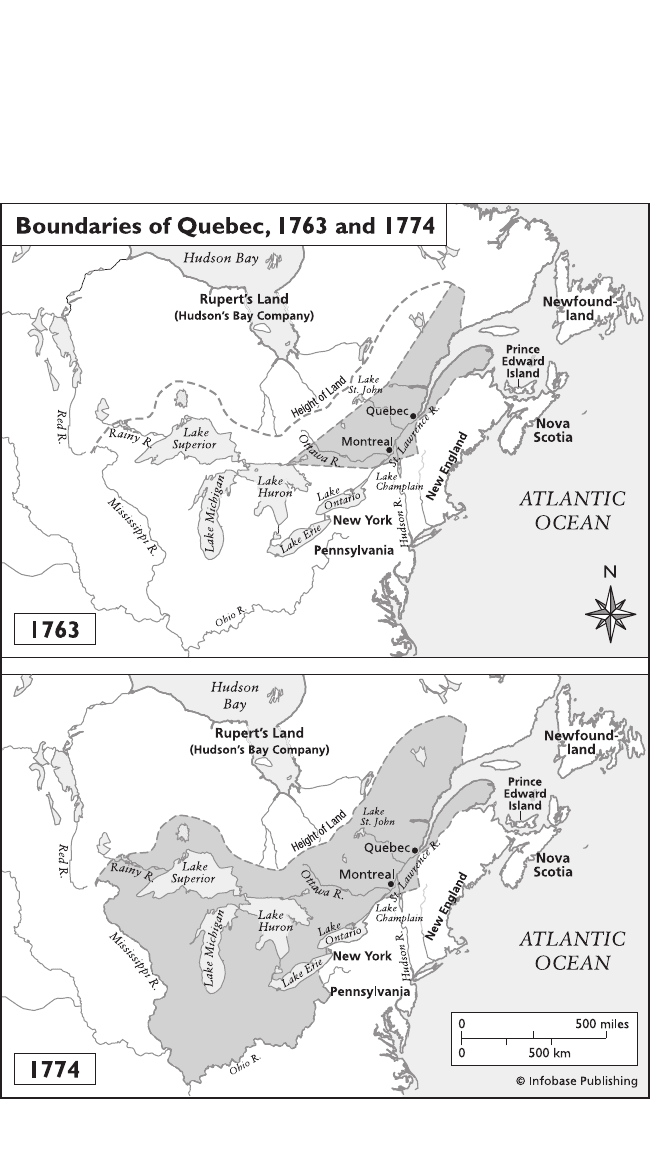
Pontiac’s uprising signifi cantly infl uenced evolving British policy for
governing the new British province of Quebec established by a royal
proclamation issued in October 1763. To pacify the western tribes, the
proclamation prohibited settlement of the land west of the Allegheny
Mountains and restricted trade in the interior only to licensed traders.
The justifi cation for this early British recognition of aboriginal rights
was that land for settlement was abundantly available to the north of
the thirteen colonies, in Nova Scotia and Quebec. Without a substantial
British military presence in the interior, however, this policy was unen-
forceable as thousands of defi ant settlers, speculators, and traders from
the thirteen colonies continued to trek across the Appalachian Moun-
tains in search of fertile land and new business opportunities in the
Ohio-Mississippi Valley. Indeed, this attempted restriction of American
enterprise contributed to the growing resentment toward British impe-
rial policies that would lead to rebellion a little over a decade later.
The Proclamation of 1763 assumed that the French Catholics of
Quebec would inevitably be assimilated by a massive infl ux of English
Protestants from the south. To that end, the fi rst constitution of Canada
under British rule promised “the enjoyment of the benefi t of the laws
of our realm of England,” including representative institutions to which
American colonists had become accustomed. However, the anticipated
northward migration did not materialize, as the St. Lawrence Valley
proved less enticing than the Ohio-Mississippi Valley. Only a few hun-
dred merchants from Britain and the thirteen colonies were attracted to
Quebec, initially by the opportunity to supply the needs of the invading
army and eventually to fi ll the void left by the departing French fur
traders. In effect, the so-called Conquest transferred Canada’s commer-
cial dependence from Paris to London, with the result that English-
speaking merchants were better connected to assume economic
leadership in Quebec than were their remaining French counterparts.
The rise of an English commercial elite to a position of dominance
would henceforth be a source of recurring confl ict in Quebec politics
and society (Miquelon 1977).
After the military regime offi cially gave way to civil government in
August 1764, the fi rst governor of Quebec, General James Murray,
sought to minimize potential cultural confl ict by modifying the terms
of the Proclamation that he considered to be inapplicable to the exist-
ing situation. Appointed by the British Crown, the governor was to rule
the province with the assistance of an appointed legislative council
until an elected assembly could be established. However, because the
laws of England specifi cally prohibited Catholics from holding offi ce,
89
Governor Murray had diffi culty fi nding enough qualifi ed people to
serve in his administration. He was particularly reluctant to establish an
elected assembly in which fewer than 500 English Protestants would
control the destiny of well over 70,000 French Catholics. Murray soon
THE CHALLENGE OF IMPERIAL RULE IN BRITISH NORTH AMERICA