
Riendeau A Roger E. Brief History of Canada
Подождите немного. Документ загружается.


A BRIEF HISTORY OF CANADA
90
realized that the Proclamation undermined the functioning of the judi-
cial system by replacing the French Catholic captains of militia as local
magistrates with English Protestant justices of the peace and bailiffs
who in most instances knew little about English law, let alone French
law. So, to maintain order, he improvised by retaining French civil law
in certain cases and by allowing Catholics to serve as lawyers and
jurors.
While the Proclamation did not interfere with seigneurial land ten-
ure or freedom of worship, it was ambiguous about the extent of these
rights within the colony, and it certainly did not address the urgent
need to appoint a new bishop for Quebec. Despite his initial distrust of
the clergy and his preference to strengthen the Protestant religion in
the colony, Murray pragmatically concluded that the support of the
church was vital to communicate with and to secure the loyalty of the
population. Therefore, he persuaded the British government to accept
the authority of the pope in Rome to select Jean Olivier Briand as the
new bishop of Quebec in 1766.
Governor Murray’s implementation of the Proclamation may have
endeared him to the traditional leaders of the French community—the
clergy and the seigneurs—but in the process he outraged many of the
English-speaking merchants. At the root of this intracultural confl ict
was a fundamental clash of values that was becoming more pronounced
in British society as the 18th century progressed. As a high-ranking
soldier and a gentleman, Murray tended to embrace aristocratic values
that enabled him to appreciate the more authoritarian and feudal nature
of French Canadian society, with its traditional belief in obedience and
deference to authority.
By contrast, he was suspicious of the English merchants, whom he
branded “Licentious Fanaticks” [sic] for their dangerously “American”
notions of freedom and democracy that he believed were designed to
destroy French society and to undermine his authority as governor.
Imbued with a modern spirit of economic individualism and capitalist
enterprise, the English merchants viewed Murray as an embodiment of
the despotic tendencies of imperialism that too often interfered with
their commercial prospects for the province of Quebec. They were
already disappointed that the Proclamation did not annex the Ohio-
Mississippi Valley to Quebec and regarded the license system for trad-
ing in the western interior as an unwarranted cost that cut too deeply
into their slim profi t margins. This attempt by the British government
to make western trade equally open to all colonial merchants proved
too diffi cult to enforce and had to be abandoned in 1768. Added to this

91
concern about excessive regulation of trade, the English merchants
were outraged at Murray’s deviation from the Proclamation in matters
of law and government, particularly his constant refusal to fulfi ll the
promise of representative government and his peculiar sympathy for
the institutions of the conquered French society. The persistent clamor
of the English merchants prompted the imperial authorities to replace
Murray as governor in June 1766.
Ironically, early political confl ict in Quebec did not feature the
expected clash between the French and English cultures but rather a
struggle between rival English classes somewhat comparable to the
discord that was breeding a rebellious spirit in the thirteen colonies
(Creighton 2002). In Quebec, mutual economic interests tended to
serve as a basis for racial cooperation in the aftermath of the conquest.
After taking over the bulk of the export and import trade from the
departed French merchants, the English merchants opened up markets
for Canadian timber and grain in Britain and the West Indies. To
increase production, they also encouraged the Canadiens to become
more effi cient in their agricultural methods.
But perhaps the most dynamic harmony of culture and enterprise
was manifested in the expansion of the St. Lawrence fur trade farther
into the western interior. With their connections in Britain, the English
merchants had lines of credit and a range of trade goods that far
exceeded the capacity of their departed French predecessors. Although
they could not compete with the assets of their English counterparts,
the remaining French merchants possessed superior knowledge and
technique when it came to organizing and conducting the western fur
trade. Moreover, the adventurous Canadien voyageur skillfully negoti-
ated the rivers and lakes in the western wilderness and knew how to
deal effectively with the Native traders. Thus, in competition with other
English merchants operating via the Hudson River and Hudson Bay, the
partnership of English capital and French labor helped to make Mon-
treal the strategic center of the western fur trade for more than a half-
century after the conquest. Only as the French focused more on
agriculture while the English remained in control of commerce would
divergent views on social matters become more pronounced and inter-
ethnic political confl ict loom larger.
Murray’s successor, Sir Guy Carleton, arrived in Quebec determined
to redress the grievances of the English merchants. But he, too, was a
soldier with an aristocratic temperament, and he soon realized the wis-
dom of Murray’s approach to colonial governance. He developed an
appreciation for the orderly, feudal Canadien way of life and a disdain
THE CHALLENGE OF IMPERIAL RULE IN BRITISH NORTH AMERICA

A BRIEF HISTORY OF CANADA
92
for the English commercial class, whom he too felt were imbued with
“radical” American democratic tendencies. As the political discontent
that led to revolution mounted in the south, Governor Carleton began
to regard Quebec as a potentially strategic military base against disloy-
alty and violence in America. In 1767, Carleton challenged the demo-
graphic assumption of the Proclamation: “The Europeans who migrate
will never prefer the long inhospitable winters of Canada, to the more
cheerful climate and more fruitful soil of His Majesty’s southern prov-
inces . . . so that, barring catastrophe shocking to think of, this country
must, to the end of time, be peopled by the Canadian race” (Shortt and
Doughty 1918, 281).
Supporting Carleton’s assertion, the French population of Quebec, as
a result of the highest birthrate ever recorded by a people of European
origin, exceeded 90,000 by the early 1770s, outnumbering the English
by about 15 to 1. Furthermore, Carleton confi dently predicted that by
placating the traditional French leaders, the clergy and seigneurs, 18,000
men capable of bearing arms could be mobilized in Quebec.
Canada’s First Constitution
The Quebec Act
Anno Decimo Quarto
Georgii III. Regis.
Cap. LXXXIII.
An Act for making more effectual Provision for the Government of the
Province of Quebec in North America. . . .
And, for the more perfect Security and Ease of the Minds of the
Inhabitants of the said Province, it is hereby declared, That His Majesty’s
Subjects, professing the Religion of the Church of Rome of and in the
said Province of Quebec, may have, hold, and enjoy, the free Exercise of
the Religion of the Church of Rome, subject to the King’s Supremacy,
declared and established by an Act, made in the First Year of the Reign
of Queen Elizabeth, over all the Dominions and Countries which then
did, or thereafter should belong, to the Imperial Crown of this Realm;
and that the Clergy of the said Church may hold, receive, and enjoy,
their accustomed Dues and Rights, with respect to such Persons only
as shall profess the said Religion. . . .
And be it further enacted by the Authority aforesaid, That all
His Majesty’s Canadian Subjects, within the Province of Quebec, the

93
To secure the loyalty and cooperation of the Canadien majority, the
British Parliament decided to follow Carleton’s advice by replacing the
ill-conceived Proclamation of 1763 with the Quebec Act in 1774. The
Quebec Act offi cially abandoned efforts to implement representative
institutions, thereby resolving the dilemma of whether to place colonial
government in the hands of the small English minority or the large
French majority. Furthermore, the Quebec Act recognized the unique-
ness of Canadien society by opening membership in the appointed legis-
lative council to French Catholics, by guaranteeing the seigneurial
system of land tenure and the collection of seigneurial dues, by legalizing
the right of the church to collect tithes from all Catholics in the colony,
and by restoring French civil law with regard to property while retaining
English criminal law. In essence, assimilation gave way to accommoda-
tion as the grand design of British colonial administration, and hence-
forth, Quebec would be treated as a province unlike the others.
The Quebec Act also extended the frontiers of the Province of Quebec
into the Great Lakes basin and the Ohio-Mississippi Valley, ostensibly
THE CHALLENGE OF IMPERIAL RULE IN BRITISH NORTH AMERICA
religious Orders and Communities only excepted, may also hold and
enjoy their Property and Possessions, together with all Customs and
Usages relative thereto, and all other their Civil Rights, in as large,
ample, and benefi cial Manner, as if the said Proclamation, Commissions,
Ordinances, and other Acts and Instruments, had not been made . . .
and that in all Matters of Controversy, relative to Property and Civil
Rights, Resort shall be had to the Laws of Canada, as the Rule for the
Decision of the same; and all Causes that shall hereafter be instituted
in any of the Courts of Justice, to be appointed within and for the said
Province, by His Majesty, His Heirs and Successors, shall, with respect
to such Property and Rights, be determined agreeably to the said
Laws and Customs of Canada, until they shall be varied or altered by
any Ordinances that shall, from Time to Time, be passed in the said
Province by the Governor, Lieutenant Governor, or Commander in
Chief, for the Time being, by and with the Advice and Consent of the
Legislative Council of the same, to be appointed in Manner herein-
after mentioned.
Provided always, That nothing in this Act contained shall extend, or
be construed to extend, to any Lands that have been granted by His
Majesty, or shall hereafter be granted by His Majesty, His Heirs and
Successors, to be holden in free and common Soccage. . . .
Source: Shortt and Doughty 1918, 1: 570–76.

A BRIEF HISTORY OF CANADA
94
to appease the St. Lawrence traders and merchants who appeared to be
most capable of conducting the fur trade successfully while maintain-
ing good relations with the western tribes. Moreover, including the
western territories within the boundaries of Quebec, with its authori-
tarian government and feudal-style landholding system, appeared
intended to thwart the expansionist ambitions of the thirteen colonies,
which were now defi antly speaking of independence. In fact, the Que-
bec Act became one of the tyrannical Intolerable Acts of British imperi-
alism that triggered the American Revolution. Thus, in the process of
trying to secure the loyalty of an “alien” northern colony, Carleton’s
vision intensifi ed the disloyalty of the southern colonies, which King
George III regarded as the “jewel” of the British Empire (Burt 1955).
The American Invasion of Quebec and Nova Scotia
By the outbreak of the Revolutionary War in 1775, American propa-
ganda denouncing British tyranny, praising democracy, and inviting
the people to join the fi ght for individual rights and liberties had circu-
lated widely in Quebec. The revolutionary leaders hoped that a signifi -
cant number of former French colonists would seize the opportunity to
be liberated from their despotic conquerors. The merchants who had
emigrated from the thirteen colonies might also welcome the prospect
of reversing the Quebec Act, which denied them the basic democratic
rights accorded all Englishmen and yet granted rights and privileges to
French Catholics that far surpassed those enjoyed by Catholics in
Britain. However, the appeals to traditional English liberties did not
emotionally stir the French Catholic population, which was not about
to sacrifi ce its majority status in Quebec for submergence in a hostile
English Protestant continental environment. Indeed, French Catholics
were well aware of British-American antipathy for the rights and privi-
leges that the Quebec Act accorded them. Despite resentment of the
political provisions of the Quebec Act, the English mercantile group
responded favorably to its revision of the provincial boundaries to
include the western interior. Most of the St. Lawrence merchants
remained aware of their dependence on imperial markets, creditors,
and supplies, without which they would be helpless in the face of
American competition. In the fi nal analysis, only a small minority of
Quebec’s French and English communities actively supported the
American revolutionary movement.
On the other hand, the American invasion of Quebec in 1775 dem-
onstrated that disinterest in the Revolution did not necessarily translate

95
into loyalty for the imperial cause, as Governor Carleton had predicted.
In order to prevent the British from following through on Carleton’s
expressed objective to use Quebec as a counterrevolutionary military
base, General George Washington dispatched General Richard Mont-
gomery to launch an invasion by way of Lake Champlain and the
Richelieu River, while Benedict Arnold led an overland expedition
through the Maine wilderness. Washington hoped fi rst to seize Quebec
before its defenses could be organized and then to withstand British
efforts to recover their losses. Weakly defended Montreal fell before
Montgomery’s attack in November 1775, with Carleton narrowly
escaping to Quebec. Following up on his victory, Montgomery joined
Arnold for a New Year’s Eve assault on the military stronghold of the
province, during which the former was killed and latter wounded. Still,
the American force of about 3,000 troops continued the siege, leaving
Carleton increasingly pessimistic about the prospects of resisting the
invaders with insuffi cient reinforcements.
When Carleton declared martial law and summoned the militia in
both Montreal and Quebec, the French clergy and seigneurs, ecstatic
over the legalization of their right to collect their respective tithes,
urged the habitants to enlist in the militia in order to protect the rights
and privileges guaranteed by the Quebec Act. For their part, the habi-
tants resented the imposition of this form of taxation, which had not
been offi cially enforced since the Conquest, so they felt as much inter-
est in supporting the British defenders as they did the American invad-
ers. Viewing the Revolution as an Anglo-Saxon family squabble, the
vast majority of French Catholics maintained an attitude of determined
neutrality. While the Revolution appeared to be progressing well for
the Americans and they were willing to pay favorable prices in cash for
supplies, the habitants appeared sympathetic to the republican cause.
But as the long winter siege at Quebec dragged on, the tide of French
Canadian public opinion turned against the invaders when they ran out
of cash and either offered to pay for their provisions with paper money
or refused to pay at all.
With a garrison that included about 1,000 local militia, a far cry from
his original prediction, Carleton was able to hold on to Quebec until
May 1776, when a fl eet of British ships with 10,000 reinforcements
sailed up the St. Lawrence and forced the ill-equipped and demoralized
Americans to retreat. British sea power rescued Canada from falling
into American hands, and in the process left unanswered the question
of whether or not the colony could have resisted on its own (Stanley
1977). The extent of Canadien neutrality also raised questions about
THE CHALLENGE OF IMPERIAL RULE IN BRITISH NORTH AMERICA
A BRIEF HISTORY OF CANADA
96
the wisdom of the Quebec Act. While the French Canadians did not
fi ght for Britain, neither did they rebel against their conquerors when
the opportunity arose. On the other hand, the Quebec Act had been
designed to gain the active loyalty, not the passive neutrality, of the
habitants.
Carleton was shocked to discover that he had miscalculated the abil-
ity of the seigneurs to rally their loyal tenants and the clergy to inspire
their parishioners from the pulpit to defend the province. The apparent
docility of the habitants about which both Murray and Carleton had
marvelled was based less on a deferential and obedient demeanor than
it was on an aversion to war and an indifference to the issues that were
of greater concern to their political and social leaders (Lanctôt 1967).
Indeed, the American Revolution turned out to be the fi rst of many
historical events that had the effect of revealing a divergence of political
perspective within French Canadian society. Many of the habitants
regarded those who had collaborated with the British as vendus—sell-
outs to the conquerors. Others considered the British to be the lesser of
two evils and pointed to the
guarantees of the Quebec Act
and the growing overseas market
for furs, grain, and timber as
indicative of the advantages of
cooperation with the imperial
authority. This ambivalence
would prompt many future Que-
bec leaders to miscalculate the
sentiments of the people.
Like the French, the Native
people had an ambivalent attitude
toward what they perceived to be
a family feud between the British
and their American offspring.
While the western tribes tended
to favor the British, who had cul-
tivated good relations since the
defeat of Pontiac, the Iroquois
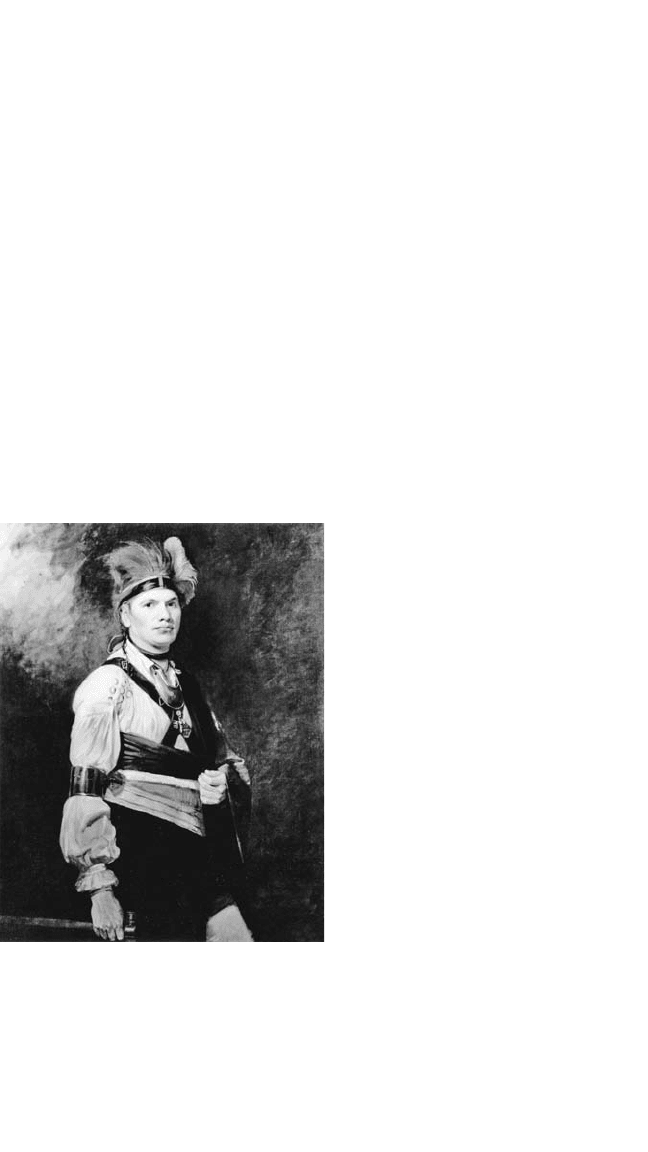
Confederacy was divided. Six
Nations chief Joseph Brant per-
suaded the Mohawk and some
Seneca to support the British,
but many Oneida and Tuscarora
1776 portrait of Mohawk chief Joseph Brant,
or Thayendanega (1742?–1807), by English
painter George Romney (1734–1802). The
renowned leader of the Six Nations (Iroquois
Confederacy) was staunchly loyal to the British
cause during the American Revolutionary
War.
(National Gallery of Canada 8005)

97
sided with the Americans. The Onondaga and Cayuga remained neutral
until an American attack in 1779 drove them into the British fold. That
both British and American recruiters enjoyed success among the Native
people in the Montreal area is a further indication of the divided loyal-
ties that characterized responses to the American Revolution.
Despite their strong economic, political, and cultural ties with their
former homeland, the Nova Scotia “Yankees” had little inclination to
support the revolutionary cause in the southern colonies. A few hun-
dred inhabitants along the vaguely defi ned Maine–Nova Scotia border,
in the lower Saint John River valley, and the Chignecto-Cumberland
region at the head of the Bay of Fundy openly supported former New
Englander Jonathan Eddy in his unsuccessful attempt to capture Fort
Cumberland (Fort Beauséjour during the French regime) in 1776. But
for the most part, even Nova Scotians who had recently migrated from
New England could not identify with American grievances against the
British government. The closing of the western frontier did not affect a
colony that had an abundance of empty land suitable for settlement.
Neither were the recent impositions of imperial trade regulations and
taxation embodied in such legislation as the Townshend Acts, the
Stamp Act, and the Tea Act considered to be burdensome or oppressive
to Nova Scotia commerce. In fact, the commercial connection with
Britain and the presence of the imperial garrison and naval forces were
vital to the pioneer economy of Nova Scotia. Even if dissension had
existed, the settled coastal communities of the colony were too scat-
tered and isolated to be mobilized into an effective resistance against
constituted authority (MacNutt 1965).
While the merchants operating from the royal naval base at Halifax
remained a bastion of loyalty to Britain, Nova Scotians in outlying com-
munities were as unresponsive to efforts to recruit colonial militia or to
levy taxes for imperial defense as they were to the revolutionary cause.
Reluctant to take up arms against family and friends whom they had
left behind only a decade or two before, most colonists chose to remain
neutral during the revolutionary confl ict and, if they had the opportu-
nity, to trade with both sides. Like the French in Quebec, the “neutral
Yankees” of Nova Scotia, along with the Acadians and the local Micmac
and Malecite, were aroused from their preoccupation with the daily
struggle to survive only when their communities were directly raided
by American privateers. With the formidable presence of the Royal
Navy discouraging any massive American assault, Nova Scotia remained
fi rmly entrenched within the British Empire at the end of the Revolu-
tionary War.
THE CHALLENGE OF IMPERIAL RULE IN BRITISH NORTH AMERICA

A BRIEF HISTORY OF CANADA
98
A Disputed Continental Boundary
The American Revolution ended in 1783 with the Treaty of Versailles,
recognizing the independence of the United States of America and the
division of the North American continent. Ironically, having withstood
the American military invasion, the province of Quebec and the future
Canadian heartland almost did not survive the diplomacy surrounding
the boundary settlement (Neatby 1968; Lawson 1989). Whereas the
eastern boundary of Quebec was easily settled, the western territory
remained a source of dispute, since Britain retained military control of
the Ohio-Mississippi Valley and the United States was determined to
acquire the land over which it had been willing to wage war with the
world’s leading imperial power.
Britain decided to adopt a conciliatory approach to the western
boundary settlement for both strategic and economic reasons. The peace
negotiations began in Paris in late 1782 while a cease-fi re was in effect
in North America but war between Britain and France continued in
Europe. In fact, the need to wage war on two distant continents was a
major reason why mighty Britain could not suppress the American
Revolution. Ultimately, Britain did not want to alienate its former colo-
nies to the extent of driving the newly formed United States into a con-
tinued alliance with France, thereby jeopardizing British hegemony in
Europe. Moreover, public opinion in Britain was decidedly split between
the advocates of continued imperial expansion and the emerging notions
of “little Englandism.” In 1776 English political economist Adam Smith
argued in The Wealth of Nations that Britain’s economic interests would
be better served by shedding the mercantile system with its burden of
colonies and by engaging in international free trade, which would bol-
ster the development of an industrial economy. So, even if it could not
politically control the new United States of America, Britain realized
that, as the world’s foremost industrial producer, it could continue to
derive the benefi ts of close trade relations with a nation that represented
a rapidly growing market for manufactured goods.
For these reasons, imperial negotiators seriously considered the ini-
tial demand of American negotiator Benjamin Franklin that Britain
should surrender all of Canada as a gesture of friendship and goodwill
toward the new republic. However, France, which had provided naval
support for the Americans during the Revolutionary War, decided to
support British claims to the Ohio valley in order to confi ne the new
republic to the Atlantic seaboard, surrounded by a powerful neighbor
and dependent on French economic and military support. Conse-
quently, Franklin was forced to offer a compromise settlement based on

99
the southern boundary of Quebec as established by the Proclamation of
1763. This boundary, running along the 45th parallel between the St.
Lawrence and Mississippi Rivers, would have enabled Britain to main-
tain the Province of Quebec but would also have effectively transferred
the future southern Ontario heartland to the United States. More con-
cerned about the uncertain course of warfare in Europe, Britain was
prepared to concede this area, which the Proclamation had reserved for
occupation by the Native tribes and which had few European settlers.
But once again, world events intervened to alter the precarious fate of
Canada. With a crucial military victory at Gibraltar suddenly turning
the tide of European warfare in Britain’s favor, imperial negotiators
raised their demands in America to embrace the extensive western
boundaries of the Quebec Act. After further compromise, both sides
agreed on a western boundary for Quebec that followed the current line
through the St. Lawrence River and the Great Lakes.
Although the Treaty of Versailles offi cially granted the land of the
Ohio-Mississippi valley to the United States in 1783, Britain refused to
surrender strategically located military and trading posts in response
to pressure from the St. Lawrence fur traders and the western Native
tribes. Competing against the American traders from Albany, New
York, the St. Lawrence fur traders wanted to delay the transfer of the
region south of the Great Lakes in order to continue to exploit its
lucrative albeit diminishing resources. In view of their support of the
imperial cause during the Revolutionary War, the Native people
expected Britain to reciprocate in their resistance to the relentless
westward movement of the American settlement frontier. Realizing
that they had handed over the western lands to the Americans without
making provisions for the rights of the Native inhabitants, imperial
authorities feared that abandoning the posts would infuriate their
Native allies and incite them to seek vengeance by attacking the pre-
carious settlements in the St. Lawrence valley. Taking advantage of
vague wording in the peace treaty and the failure of the United States
to fulfi ll treaty obligations to restore Loyalist property, Britain decided
to retain its western posts in the hope that the spread of American
settlement could be checked and that the new nation would eventually
disintegrate. The dispute dragged on until 1794, when a military expe-
dition led by General Anthony Wayne decisively defeated the Ohio
tribes at the Battle of Fallen Timbers and forced them to cede their
lands to the United States. Already at war with France, Britain readily
agreed to the terms of Jay’s Treaty, which provided for the evacuation
of the western posts by 1796 and the resolution of other outstanding
THE CHALLENGE OF IMPERIAL RULE IN BRITISH NORTH AMERICA