
Riendeau A Roger E. Brief History of Canada
Подождите немного. Документ загружается.


A BRIEF HISTORY OF CANADA
70
rear of the rapidly growing English colonies to contain them between
the Atlantic Ocean and the Allegheny Mountains. In essence, the strug-
gle on the American frontier had been transformed from a competition
between colonial trading interests to a clash of expansive European
empires.
European Warfare on the American Frontier
The outbreak of the European War of the Spanish Succession in 1702
offered yet another occasion for the resumption of hostilities in North
America. Again Acadia became a primary target, especially after a
French-Abenaki alliance endeavored to halt the northward advance of
New Englanders into their territory on the Maine–New Brunswick
frontier. The Acadians resisted repeated attacks by seafaring raiders
from New England until 1710, when an English-supported naval force
of 3,400 men and 36 ships under the command of Colonel Francis
Nicholson easily captured Port Royal. To make the English conquest
complete, Port Royal was renamed Annapolis Royal, and Acadia became
known as the province of Nova Scotia, never again to return to the
French empire.
England attempted a similar decisive strike against Quebec in 1711
by providing 5,300 of the 6,500-man naval fl eet commanded by Sir
Hovenden Walker. Another 2,300 colonial troops were dispatched by
land via the Lake Champlain route to mount an assault on Quebec from
the west. Quebec appeared doomed in the wake of an invasion force
equivalent to about one-half the population of the entire St. Lawrence
colony. But nature intervened as part of the English fl eet ran aground
in fog and gales at the mouth of the St. Lawrence. On news of this
disaster, the attack by way of Lake Champlain was abandoned.
French-English colonial confl ict also spilled over into the resident
fi sheries of the Avalon Peninsula of Newfoundland. In 1696 d’Iberville
attacked the English settlements around St. John’s, killing 200 people
and taking 700 prisoners. The following year, the English retaliated
with a naval expedition of 2,000 men that recaptured all of the settle-
ments. Plaisance was the base for additional French raids on English
settlements in 1705 and 1709. The Treaty of Utrecht, which ended
hostilities in 1713, resulted in the French surrender of Acadia and their
recognition of English claims to Newfoundland and Hudson Bay. Fore-
shadowing future imperial decisions, France was willing to sacrifi ce
these North American possessions to make concessions for losses in
Europe.

71
While mainland Nova Scotia was lost to the English, the French
held on to Cape Breton Island, where by 1720 they had built the mas-
sive stone fortress and naval base known as Louisbourg. Designed to be
an impregnable symbol of French sea power—the Gibraltar of North
America—Louisbourg was strategically located on the northeastern tip
of the island, guarding the entrance to the St. Lawrence. Over the next
quarter-century, Louisbourg became not only a launching point for the
French navy and privateers to disrupt New England fi shing and trading
fl eets but also a thriving entrepôt for trade with the West Indies. Its
construction signifi ed France’s renewed commitment to strengthening
its North American empire in order to contain its imperial rival along
the Atlantic seaboard (Crowley 1990).
To extend French control deeper into the interior of the continent,
imperial authorities collaborated with colonial fur-trading interests
eager to outfl ank the Hudson’s Bay Company in the northwest. By the
1720s an active fur trade centered around Kaministiquia (now Thunder
Bay) and Lake Nipigon. At the same time, the French government
showed a revived interest in the search for a route to the Pacifi c. In
1730 Pierre Gaulthier de Varennes et de La Vérendrye, commander of
the fur-trading post at Kaministiquia, offered to establish a post on
Lake Winnipeg and to conduct explorations for a western sea from this
base at no expense to the Crown. Supported by wealthy Montreal mer-
chants, La Vérendrye aimed to build a chain of posts to serve as fur-
trading and supply depots, closer to and more accessible for the local
Natives than the remote English posts along Hudson Bay. Accordingly,
from 1731 to 1734, La Vérendrye, accompanied by his three sons, built
Fort St. Pierre on Rainy Lake, Fort St. Charles on Lake of the Woods,
and Fort Maurepas where the Red River empties into Lake Winnipeg.
In 1738 they added Fort Rouge near present-day Winnipeg and Fort la
Reine at the present site of Portage la Prairie. From their base at Fort la
Reine, the La Vérendryes went on to establish Fort Dauphin on Lake
Manitoba and Forts Bourbon and Paskoya (The Pas) near the Saskatch-
ewan River from 1741 to 1743. Their search for the western sea also
took them southwestwardly to the Black Hills of South Dakota in
1742–43, and they may have even reached the foothills of the Rocky
Mountains. In 1751 Boucher de Niverville traveled west on the Sas-
katchewan River and built Fort Jonquière, near the present site of Cal-
gary. Thus, the French empire in North America had reached its
western limits (Miquelon 1989).
In expanding further into the northwest and in constructing the
mighty naval base at Louisbourg, the French had taken advantage of
CLASHING EMPIRES AND FRONTIERS

A BRIEF HISTORY OF CANADA
72
over three decades of relative peace in Europe and North America. The
outbreak of the War of the Austrian Succession in 1740 once again
allowed the imperial powers of Europe to renew hostilities and to extend
them to their North American empires. The New England colonies were
especially concerned about Louisbourg’s threat to colonial trade and
shipping. Governor William Shirley of Massachusetts organized a force
of 4,000 colonial militia that sailed for Louisbourg in 1745 under the
command of William Pepperell. The Royal Navy supplied a squadron of
ships under the command of Commodore Peter Warren to prevent rein-
forcements and supplies from France from reaching the beleaguered
fortress. A garrison of 2,000 French militia and civilians endured six
weeks of bombardment and blockades before surrendering. Louisbourg’s
fall revealed the limitations of French power in North America and
cleared the way for an assault on Quebec. France valued Louisbourg
enough to dispatch a naval expedition of 7,000 men to recapture the
fortress in 1746, but the fl eet was plagued by troubled seas and never
succeeded in launching a counterattack. During the peace treaty nego-
tiations at Aix-la-Chapelle, in 1748, France again manifested its concern
by sacrifi cing its conquests in the Austrian Netherlands along with the
city of Madras in India to regain Louisbourg.
The Treaty of Aix-la-Chapelle proved to be more a truce than a last-
ing peace, and both imperial rivals strengthened themselves for the
inevitable renewal of hostilities. France endeavored not only to rein-
force Louisbourg and the garrison at the mouth of the Saint John River
but also to build Fort Beauséjour (near present-day Sackville, New
Brunswick) on the Chignecto Isthmus in 1750. As New Englanders
increasingly regarded the decision to return Louisbourg to France as
evidence of a willingness to sacrifi ce colonial interests for imperial con-
sideration, England sought to consolidate its position in Nova Scotia.
To counterbalance Louisbourg, the imperial authority established Hali-
fax on Chebucto Bay in 1749. Not only was Halifax meant to replace
Annapolis Royal as the chief naval base and administrative center of
Nova Scotia, it was also to become a substantial Protestant settlement
to offset the original French Catholic Acadian population. To bolster
the defense of Nova Scotia, the English also built Fort Lawrence on the
Isthmus of Chignecto just as the French were completing nearby Fort
Beauséjour.
Seeking to make the Acadians into completely trustworthy subjects,
the governor of Nova Scotia, Edward Cornwallis, commanded them to
swear an oath of unconditional allegiance to the British Crown in 1749.
Despite threats of deportation, the Acadians generally ignored the

73
governor’s ultimatum. Already preoccupied with establishing Halifax,
Governor Cornwallis decided against risking further complications by
pressing for an immediate decision on the expulsion of the Acadians.
Another ominous challenge to the French empire in North America
was the formation of the Ohio Land Company in 1748. This Virginia-
based enterprise secured a British Crown land grant of one-half million
acres with the intention of bringing English settlers into the fertile Ohio
Valley. The battle lines were now drawn between two divergent and
incompatible forces vying for control of the continental interior. The
French sought to preserve the forest for the indigenous population and
the fur trade, while the English hoped to deliver the area to the axe of
the pioneer farmer.
In 1749 France laid a formal claim to the Ohio Valley as an expedi-
tion under Céloron de Blainville planted lead plates bearing the French
coat of arms throughout the region to symbolize imperial possession.
To check English advances into the area, the French built a chain of
forts from Lake Erie to the forks of the Ohio River, where Fort
Duquesne was situated in 1754. The reaction to this advance in the
thirteen colonies was largely indifferent. For example, Pennsylvania
was not concerned that some of its land was occupied by the French;
New York expressed doubt that the French were intruding on English
soil. Only Virginia, where the leading investors in the Ohio Company
lived, was roused to action. In 1754 the governor of Virginia sent Major
George Washington with some 300 men to expel the French, but this
fi rst English effort to gain control of the Ohio Valley was decisively
repulsed at Great Meadows. This frontier clash proved to be the spark
that ignited the fi nal confl ict over North America. Although Britain and
France would remain ostensibly at peace in Europe for two more years,
they were simultaneously motivated to devote unprecedented military
support to their embattled colonies (Stanley 1968).
The Final Showdown for New France
In 1755 both France and Britain sent large military expeditions to
North America. While the French force of 3,000 soldiers under General
Ludwig August Dieskau eventually landed in Quebec, the English force
of 1,000 regulars under General Edward Braddock joined 1,500 colo-
nial militia for an assault on Fort Duquesne. A contingent of 250
French soldiers and 600 Native allies ambushed the oncoming army
and proceeded to demonstrate its superiority at forest warfare. Braddock
was killed and his army destroyed. Two other English attacks on
CLASHING EMPIRES AND FRONTIERS

A BRIEF HISTORY OF CANADA
74
French strong points in the St. Lawrence Valley ended in stalemate
because much of the fi ghting was waged in the forest. The only early
English success came at Fort Beauséjour. The discovery of some 300
Acadians serving in arms among the French garrison prompted an
English reaction that led directly to the tragic expulsion of the entire
Acadian population.
The persistent refusal of the Acadians to take the oath of allegiance
to the British Crown was not viewed as a serious security threat in the
four decades after the Treaty of Utrecht. The Acadian population,
which had grown to over 12,000 by 1755, was content to carry on its
peaceful existence of farming, fi shing, hunting, and trading. The pro-
duce from their fertile farms found a ready market in both the English
and the French garrisons, and sometimes even in New England. The
Acadians had no special loyalty to France, which had continually
neglected them, nor were they disturbed by British rule. They were
even prepared to pledge loyalty to Britain, but they did not want to
commit to military service against France. While the British govern-
ment was averse to presiding over the wholesale deportation of a long-
settled people, Governor Colonel Charles Lawrence refused to accept
the notion of Acadian neutrality. Given the state of war, he argued that
a disloyal Acadian population could pose a serious threat to the new
English settlements in Nova Scotia. He further contended that the mere
threat of deportation would be suffi cient to persuade the Acadians to
conform and that at worst it would be necessary to take action against
some recalcitrants as proof of his resolve. The Acadians, for their part,
had reason to believe that their continued resistance would have no
more serious consequences than it had over the past four decades.
Unfortunately, both sides miscalculated, and in the general hysteria
that followed Braddock’s defeat in the Ohio Valley, the process of
uprooting this passive people from the Annapolis Valley began in ear-
nest in August 1755.
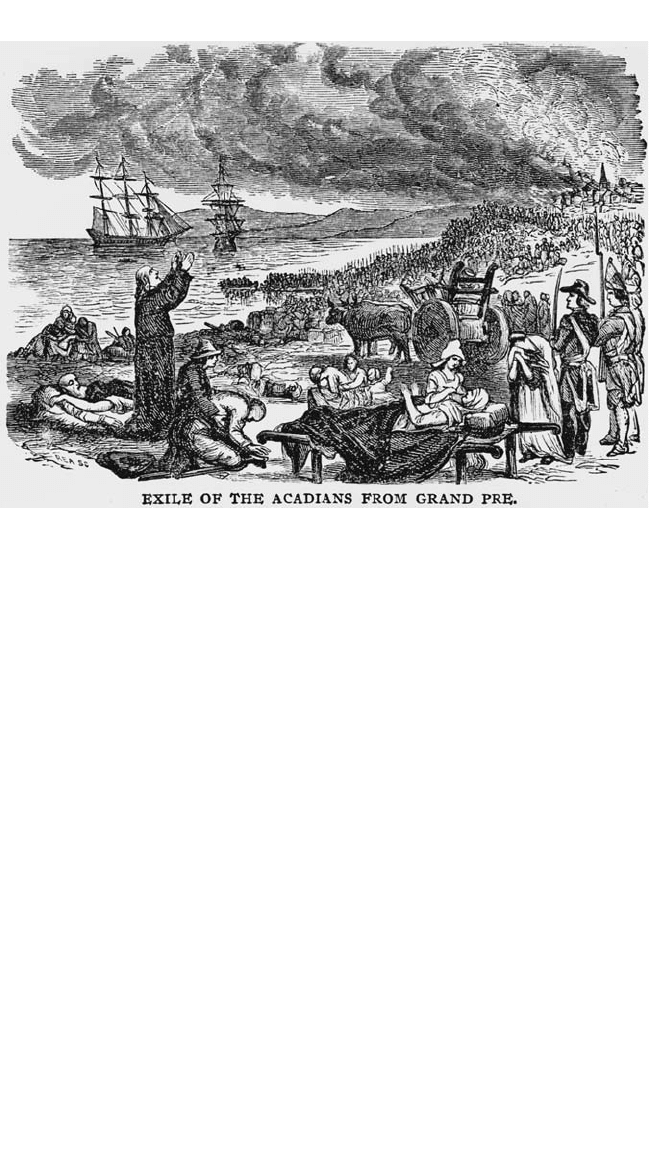
The expulsion of the Acadians was brutal and disorganized. Soldiers
forced the Acadians from their homes and held them captive until they
could be herded onto ships, which dispersed them to France, England,
and various parts of the French and British empires. An estimated 7,000
were evacuated in 1755–56 while another 2,000 to 3,000 were deported
by the time the policy was offi cially ended in 1762. While the expulsion
destroyed Acadian society as a whole, the fate of individuals and groups
of Acadians is diffi cult to track. Perhaps one-quarter to one-third died
in the evacuation or resettlement process, victims of shipwrecks, dis-
eases, and shortages of food and water. Countless families were split up
75
and never reunited. An estimated 2,000 Acadians fl ed to Île Saint-Jean
(Prince Edward Island); another 1,500 escaped to the St. Lawrence Val-
ley; others made their way to the French islands of St. Pierre and
Miquelon off the coast of Newfoundland; and 2,000 to 3,000 apparently
ended up in Louisiana, where today there are more than 1 million
descendants of the Acadians who have become known as “Cajuns.”
After the British government granted permission for Acadians to reset-
tle in Nova Scotia in 1764, an estimated 3,000 returned, even though
their land had been claimed by recently arrived New Englanders. What-
ever their ultimate fate, the Acadians stand as tragic victims of the ruth-
less ambitions of two powerful European empires (Griffi th 1973,
1985).
Meanwhile, the outbreak of the Seven Years’ War in Europe in 1756
escalated the clash of empires in North America. The contrasting impe-
rial strategies for this global confl ict would shape the course and out-
come of North American warfare. France focused on securing victories
in continental Europe, while New France fought an essentially defensive
Exile of the Acadians from Grand-Pré, a mid-19th-century wood engraving by Alfred
Sandham, relates the brutal and tragic expulsion of nearly 10,000 French settlers by the
British colonial administration in Nova Scotia in the late 1750s and early 1760s.
(Library
and Archives Canada C-024549)
CLASHING EMPIRES AND FRONTIERS

A BRIEF HISTORY OF CANADA
76
war in North America. As in the past, France expected to be in a position
to negotiate major colonial concessions in the fi nal peace treaty. On the
other hand, Britain planned to fi ght the war in Europe to a stalemate and
gain the upper hand by cutting France off from its overseas empire. This
difference in military commitment to the North American front would
prove to be decisive in determining the outcome.
General Louis Joseph, marquis de Montcalm, who replaced General
Dieskau as the commander of the French and Canadian forces in North
America in 1756, confronted the challenge of having to wage war with
limited human resources and supplies. The 3,000 regulars that France
had sent out at the outset of hostilities represented an impressive start,
but unfortunately he could expect no more than 2,000 reinforcements
for the duration of the war. Although Montcalm could also rely on a
colonial militia estimated at upwards of 10,000 men, they were also
needed on the farms to produce food, which was always in short sup-
ply. While the Native warriors overwhelmingly supported the French
cause and were fi erce fi ghters, they were diffi cult to control and tended
to have their own battle agendas.
Because of the constant manpower dilemma, Montcalm decided to
focus on the defense of the St. Lawrence valley in order to protect Mon-
treal and Quebec against an English invasion. By capturing Fort
Oswego, the main English entry to the Great Lakes, Montcalm further
protected the upper St. Lawrence region in 1756. He also safeguarded
the Lake Champlain–Richelieu River route to New France by capturing
Fort William Henry. Typically, these initial victories were achieved
through wilderness warfare tactics at which both the French militia and
the Natives were profi cient. However, Montcalm’s refusal to give suffi -
cient attention to defending the western posts raised the ire of Gover-
nor Philippe de Rigaud, marquis de Vaudreuil, and Intendant François
Bigot, whose primary interest lay in the fur trade. Although Montcalm
won this power struggle, the division within the colonial administra-
tion would inevitably add to his future military woes.
The French also benefi ted from the early ineffectiveness of the Eng-
lish military campaign. But in 1758 the tide of battle began to turn in
the English favor when Prime Minister William Pitt reorganized the
army and committed upwards of 20,000 regular soldiers to support
approximately 25,000 colonial troops in order to wage a European-
style battle. Moreover, Pitt devised a grand strategy that assigned a
more prominent role to the superior Royal Navy. By focusing on crush-
ing French maritime power, England could gain control of the sea
lanes, thereby sealing the doom of New France. The Royal Navy block-

77
ade of Canada allowed the English to obtain reinforcements and sup-
plies while depriving New France of imperial aid. As a result, New
France faced overwhelming odds of nearly three to one in ships, four
to one in soldiers, and 10 to one in fi nancial commitment. Indeed,
when Montcalm requested more military aid from France, he was
informed that the king could not commit forces and resources compa-
rable to those available to the English colonies.
Pitt’s new military direction, however, did not yield immediate
results as Sir James Abercrombie unsuccessfully led a massive English
assault on Fort Carillon (also known as Fort Ticonderoga), which Vau-
dreuil had built three years earlier at the northern end of Lake George
to block a northward advance on the St. Lawrence valley via the Riche-
lieu River–Lake Champlain route. Deciding to concentrate his force of
about 3,500 men in the path of the most direct overland route to New
France, Montcalm defeated an English army of 15,000. The French vic-
tory came at the expense of lightly guarded Fort Frontenac, which was
easily captured and destroyed by a smaller English detachment led by
Colonel John Bradstreet. Consequently, with its lines of communica-
tion to New France effectively cut off, the French garrison at Fort
Duquesne had no choice but to destroy the outpost and to retreat in the
face of the approaching English army. With the abandonment of Fort
Duquesne, which the English renamed Pittsburgh after their prime
minister, the Ohio Valley was under English control. In the meantime,
the English fl eet effectively blockaded Louisbourg, enabling the army
of 13,000 troops led by General Jeffrey Amherst to capture the fortress
with a garrison of little more than 3,000 after a siege of seven weeks.
The fall of the French bastion guarding the entrance to the St. Lawrence
cleared the way for a direct assault on Quebec, although the lengthy
French resistance did succeed in scuttling English plans for an invasion
before the onset of winter.
The military campaign of 1759 featured a full-scale French retreat to
concentrate on the defense of the heart of New France, the Montreal-
Quebec corridor. While Fort Niagara succumbed to English attack, the
French preferred to burn the recently built Fort Rouillé (present-day
Toronto) to the ground rather than have it fall into enemy hands. Thus,
the French lost control of the Great Lakes region, and the abandonment
of the posts along the Richelieu River–Lake Champlain route set the
stage for a last-ditch stand at the stronghold of Quebec.
The English invasion force of 13,500 troops commanded by General
James Wolfe held Quebec under siege for three months. Situated on the
north shore of the St. Lawrence, Quebec was protected to the west by a
CLASHING EMPIRES AND FRONTIERS
A BRIEF HISTORY OF CANADA
78
line of steep cliffs and to the east by Montcalm’s well-planned defenses
that blocked every attack. As winter was approaching, Wolfe was faced
with the possibility of having to withdraw from Quebec. In a desperate
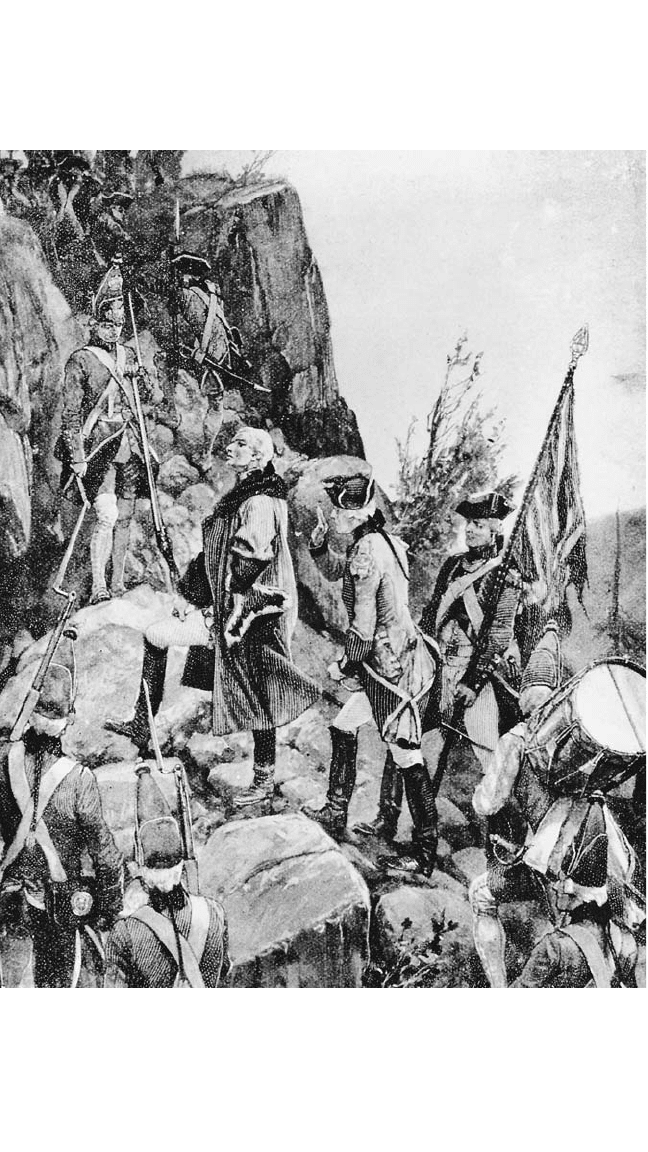
General Wolfe Climbing the Heights of Abraham is an artistic rendering by Richard Caton-
Woodville (1856–1927) of the decisive strategy leading to the British capture of Quebec in
1759. A nighttime raid up the steep cliffs enveloping the seemingly impenetrable fortress
surprised the French forces and set the stage for the Battle of the Plains of Abraham.
(Library
and Archives Canada C-001086)

79
move to land his army, Wolfe found a small cove, Anse au Foulon, from
which a narrow path led up the steep 200-foot-high cliffs. The French
had left this area lightly guarded, believing it impossible for an invasion
force to climb such heights. On the evening of September 12, Wolfe
gambled, and by daybreak, he had succeeded in leading 4,500 troops
onto the Plains of Abraham, a fi eld outside the western walls of the
fortress. As soon as he discovered Wolfe’s successful approach, Mont-
calm decided to mount an immediate counterattack to drive the Eng-
lish from the heights before they could bring up all their forces. The
decisive battle for North American supremacy lasted less than half an
hour and featured dubious military strategy highlighted by the deaths
of both commanders—certainly an uncommon occurrence in the
course of 18th-century warfare. Ultimately, the well-trained and disci-
plined British regulars triumphed over a French force that depended on
Canadiens, untrained for European-style fi ghting in line (Stanley 1968;
Steele 1994).
The loss of Quebec was a major blow to the French, although they
still controlled the St. Lawrence Valley. While the British fl eet departed
the St. Lawrence to avoid being frozen in for the winter, a sizable gar-
rison stayed behind to guard the captured fortress, under the command
of General James Murray. After a diffi cult winter, marked by shortages
of food and an outbreak of scurvy, the English found themselves under
siege by a French force from Montreal under Chevalier François-Gas-
ton de Lévis, which arrived in the spring of 1760 to liberate Quebec.
Ultimate victory at Quebec would be determined by the nationality of
the fi rst ship to sail up the St. Lawrence with the spring thaw. As it
turned out, British sea power had dealt a fatal blow to the French navy
off the western coast of France in November 1759. Accordingly, when
English ships arrived fi rst at Quebec in May 1760, the fate of New
France was sealed. The fi nal, anticlimactic chapter of the battle for
Canada unfolded in Montreal where 2,000 French soldiers confronted
17,000 British and American troops. After the capitulation of Montreal
on September 8, 1760, Canada passed into British hands.
The Seven Years’ War in Europe would not end for three more years.
Unquestionably, Britain had triumphed on the battlefi eld because it was
more willing to commit vital resources to defend its North American
empire, one built on the settlement frontier rather than on the fur-trad-
ing frontier. France’s priorities clearly resided in Europe and in other
colonies than New France. But as past experience had demonstrated,
victory on the battlefi eld was not necessarily decisive in determining
the fi nal fate of a conquered colony. New France, particularly Acadia,
CLASHING EMPIRES AND FRONTIERS