
Riendeau A Roger E. Brief History of Canada
Подождите немного. Документ загружается.


180
11
Nation-building
aspirations and
strategies (1867–1885)
I
n 1867 the new Dominion of Canada rested on a precarious foun-
dation of nationhood. The British North America Act established
a federal constitution uniting only four provinces—New Brunswick,
Nova Scotia, Ontario, and Quebec—with a total population of less
than 3.5 million, more than three-quarters of which was concentrated
in the St. Lawrence Valley and the Great Lakes basin. Fearing American
expansionism, the federal government led by Sir John A. Macdonald,
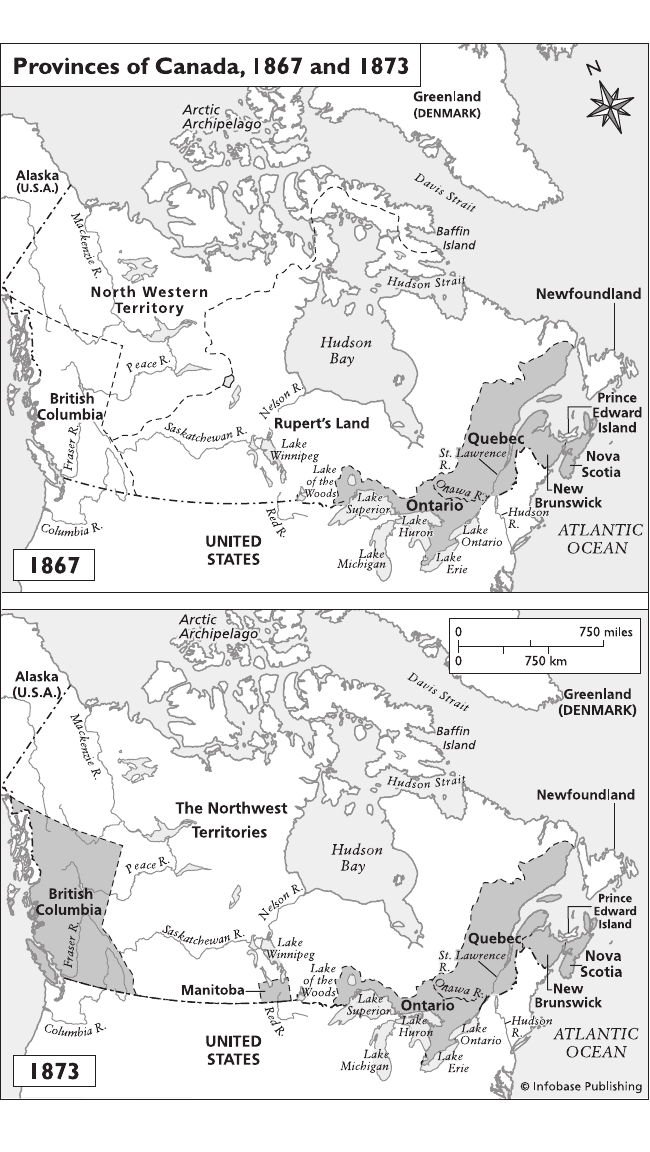
Canada’s fi rst prime minister, moved decisively to acquire the North-
West Territories from the Hudson’s Bay Company and to persuade
British Columbia and Prince Edward Island to join Confederation.
Although Canada had become a transcontinental nation by 1873, its
growth—indeed its survival—would depend on the development of
a viable economic strategy that could maintain the fragile union of
widely dispersed and divergent provinces. The hopes and aspirations
of the struggling nation would ultimately rest on Macdonald’s National
Policy, which consisted of a protective industrial tariff, a transcontinen-
tal railway system, and the settlement of the West.
A British American Constitution
Consistent with the basic character of the new nation, the Canadian
constitution was a unique blend of British and American infl uences.
The British political heritage was refl ected in the preamble to the British
North America Act of 1867, which expressed a desire for “a Constitution
similar in Principle to that of the United Kingdom” with its unwritten
tradition of governance resting on accumulated prerogatives, conven-
tions, customs, statutes, and judicial decisions responding to changing
181
NATION-BUILDING ASPIRATIONS AND STRATEGIES

A BRIEF HISTORY OF CANADA
182
requirements of government and society. Moreover, the union of prov-
inces into a national political structure was legally enacted by the
authority of the imperial Parliament rather than being established by a
compact between independent states, as in the American case. Thus,
the power to alter the constitution remained in the hands of the impe-
rial authority, although it would be used only at Canadian request.
The realities of the North American environment, however, required
a fusion of British parliamentary governance with American-style
federalism. Since Canada was to have the fi rst federal structure of
government within the British Empire, the architects of Confedera-
tion naturally looked for guidance to the United States Constitution.
Accordingly, they opted to have most of the provisions for the distri-
bution of powers between the federal and provincial governments
specifi cally written into the British North America Act. In essence,
many of the principles and practices embodied in Canada’s original
national constitution refl ected both admiration for and reservations
about the political institutions of the powerful neighbor to the south
(Creighton 1964; Morton 1964).
The interplay of British and American infl uences in general and the
written and unwritten nature of the Canadian constitution in particular
is glaringly apparent in the provisions for executive and legislative
power. The British North America Act declared executive power “to
continue . . . to be vested in the Queen.” In affi rming the principle of
monarchy as a traditional source of authority and stability, the Cana-
dian constitution rejected the American system of an elected chief
executive offi cer (the president) in favor of a head of state who was
above party politics. The Crown would be represented in Canada by the
governor-general upon whom the act appeared to assign almost auto-
cratic power to exert infl uence in Canadian affairs in the interests of the
British monarchy. The governor-general represented the might and
splendor of the empire to which Canada still belonged and thus was
subject to British laws in matters of defense and foreign affairs. But in
reality, the executive authority of the monarchy established in the writ-
ten constitution was largely overridden by the unwritten British consti-
tutional practice of responsible government in local affairs, which the
colonies had achieved in the 1840s and 1850s. In matters not affecting
the empire, executive power actually rested with the prime minister
and the Cabinet (formerly known as the Executive Council), even
though neither are mentioned in the British North America Act. As
Canada gradually asserted its national autonomy from Britain, the
power of the governor-general would eventually decline to mere sym-

183
bolic value, while that of the prime minister would ironically assume a
quasi-presidential role in the Canadian Parliament.
Legislative power rested with Parliament, which, like its namesake in
Britain and like the Congress of the United States, was bicameral in
nature. The upper house, known as the Senate, was designed to per-
form roles similar to both its American and British counterparts. Like
its American namesake, the Canadian Senate was supposed to provide
a form of equal regional representation to protect the interests of the
smaller provinces. But whereas the American Senate was based on the
equal representation of every state, the Canadian Senate strove for
equal representation of regions, with Ontario and Quebec each having
24 members while the Maritime Provinces of Nova Scotia and New
Brunswick each had 12. The principle of equal regional representation
was continued as new provinces were added to the Dominion. In
another departure from the American Senate, whose members were
chosen for six-year terms of offi ce, Canadian senators were appointed
by the Crown for life. The Senate resembled the British House of Lords
not only in its nonelective and lifetime membership but also in its
requirement of a property qualifi cation, which ensured that men of
“substance” had a base of power to counter the democratically elected
lower house, the House of Commons. In these ways and to the extent
that it was expected to review and revise legislation passed by the
House of Commons, the Senate was principally a continuation of the
old colonial Legislative Council under a new name.
Modeled on its counterpart of the same name in Britain (as was the
American congressional House of Representatives), the House of Com-
mons was to continue as the chief lawmaking and taxation body in
Parliament, as the colonial Legislative Assembly had done in the past.
Representation in the House of Commons was based on population,
with the Province of Quebec assigned a fi xed number of 65 seats and
the other provinces proportionately represented. The House of Com-
mons turned out to be a much more powerful legislative body than the
Senate because, in accordance with the established practice of the Brit-
ish parliamentary system, the executive authority of the prime minister
and the Cabinet rested solely on the vote of confi dence of the lower
house and not the upper house. Despite the provisions of the British
North America Act, the Senate never took seriously its role as defender
of provincial rights; and as the fear of democracy subsided, the upper
house lost its relevance as a bastion of property rights. Likewise, the
progress of democracy eroded the power of the governor-general,
“according to his Discretion,” to withhold royal assent of legislation
NATION-BUILDING ASPIRATIONS AND STRATEGIES

A BRIEF HISTORY OF CANADA
184
passed by Parliament. Although they possess the power in theory, nei-
ther the governor-general nor the Senate would dare to disregard the
“will of the people” as expressed through the House of Commons.
Indeed, the rise to prominence of the House of Commons in Canadian
governance refl ected the triumph of the unwritten over the written
constitution.
The provinces had much the same structure of parliamentary gov-
ernment as the Dominion. While a lieutenant governor was appointed
by the Dominion to represent the Crown in the province and to preside
formally over the provincial parliaments or legislatures, executive
authority practically resided in the prime ministers or premiers (as they
became more commonly known), who governed according to the cabi-
net system. Unlike the federal parliament, all of the provincial legisla-
tures eventually dropped their upper houses and adopted Ontario’s
single elected chamber structure in a symbolic triumph of democracy
over privilege.
The British North America
Act, 1867
(30 & 31 Victoria, C. 3)
A
n Act for the Union of Canada, Nova Scotia, and New Brunswick,
and the Government thereof: and for Purposes connected there-
with. [March 29, 1867.]
Whereas the Provinces of Canada, Nova Scotia, and New Brunswick,
have expressed their desire to be federally united into one Dominion
under the Crown of the United Kingdom of Great Britain and Ireland,
with a Constitution similar in principle to that of the United Kingdom:
And whereas such a Union would conduce to the welfare of the
Provinces and promote the interests of the British Empire . . .
Be it therefore enacted and declared by the Queen’s most Excellent
Majesty, by and with the advice and consent of the Lords Spiritual and
Temporal, and Commons, in this present Parliament assembled, and by
the authority of the same, as follows: . . .
II. UNION
3. It shall be lawful for the Queen, by and with the advice of Her
Majesty’s Most Honourable Privy Council, to declare by Proclamation

185
With no British precedent to serve as a guide, the relationship
between the federal and provincial governments in Canada was largely
infl uenced by American political principle and experience. Like the
American federal Constitution established 80 years earlier, the British
North America Act specifi ed the distribution of powers between the
federal and provincial governments and made the application of these
provisions subject to judicial review. However, in reaction to the recent
outbreak of the American Civil War, which British and Canadian
political leaders believed was caused largely by the struggle over states’
rights, the British North America Act departed deliberately and signifi -
cantly from the American model of federalism by allocating sweeping
powers to the central government while assigning only limited powers
to the provincial governments.
Section 91 of the British North America Act enumerated 29 specifi c
powers of the Dominion government, including jurisdiction over the
armed forces, postal service, banking and currency, fi sheries, criminal
that on and after a day herein appointed, not being more than six
months after the passing of this Act, the Provinces of Canada, Nova
Scotia, and New Brunswick shall form and be one Dominion under the
name of Canada. . . .
6. The parts of the Province of Canada (as it exists at the passing
of this Act) which formerly constituted respectively the Provinces of
Upper Canada and Lower Canada shall be deemed to be severed, and
shall form two separate Provinces. The part which formerly constituted
the Province of Upper Canada shall constitute the Province of Ontario,
and the part which formerly constituted the Province of Lower Canada
shall constitute the Province of Quebec.
VI. DISTRIBUTION OF LEGISLATIVE POWERS
Powers of the Parliament
91. It shall be lawful for the Queen, by and with the advice and con-
sent of the Senate and House of Commons, to make laws for the peace,
order, and good government of Canada, in relation to all matters not
coming within the classes of subjects by this Act assigned exclusively to
the Legislatures of the Provinces. . . . [Twenty-nine specifi c powers and
responsibilities are hereafter enumerated.]
Exclusive Powers of Provincial Legislatures
92. In each Province the Legislature may exclusively make laws in rela-
tion to matters coming within the [16] classes of subjects next herein-
after enumerated. . . .
NATION-BUILDING ASPIRATIONS AND STRATEGIES

A BRIEF HISTORY OF CANADA
186
law, the regulation of trade and commerce, the right to raise revenue by
direct or indirect taxation, in addition to the general authority “to make
laws for the Peace, Order, and Good Government of Canada.” Section
92 listed 16 specifi c powers of the provincial governments, including
responsibility for property and civil rights, civil law, municipal govern-
ment, licences, education, hospitals, charitable institutions, prisons,
chartering of companies within the province, and the right to raise rev-
enue by direct taxation, in addition to the general authority over “all
matters of a merely local or private nature in the province.” To avoid
the apparent fl aw in the federal system of the United States, which gave
“residual” power to the state governments, the British North America
Act granted the federal government authority over “all Matters not
coming within the Classes of Subjects by this Act assigned exclusively
to the Legislatures of the Provinces.” Section 95 also strengthened the
central government by assigning it “concurrent powers” with the prov-
inces in matters relating to agriculture and immigration, with Domin-
ion legislation prevailing in case of disputes. That the federal government
was given the right to name the provincial lieutenant governors and to
disallow provincial laws further refl ects the intention of the original
constitution to create a highly centralized state to which the provinces
would be clearly subordinate.
The British North America Act also dealt with other matters such as
provisions for the admission of new provinces, the building of the
intercolonial railway within six months after union, and the fi nancial
terms on which Confederation should operate. The fi nancial arrange-
ments proved to be controversial because, in surrendering to the new
national government their right to collect indirect taxes, and particu-
larly to levy customs duties, the provinces lost their main source of
revenue. In return, the federal government agreed to assume provincial
debts and to pay the provinces an annual subsidy based on the size of
their population. The transfer of funds between the federal and provin-
cial governments would be a constant source of contention in Canadian
politics.
While it provided the constitutional and political framework for
Confederation, the British North America Act could by no means
ensure the survival and growth of Canada as a nation. Certainly, the act
created the chief instrument for national unity and expansion; the fed-
eral government situated in Ottawa. But unless the federal government
could extend its jurisdiction over a vast territory beyond the small
nucleus of four provinces, the central purpose of Confederation could
never be realized.

187
The Transcontinental Dominion
The key strategic objective of Confederation—western expansion—was
rendered more urgent by growing American interest in the annexation
of the British Northwest, particularly in the aftermath of the purchase
of Alaska from Russia in 1867. In the wake of the imminent threat of a
peaceful American invasion, evidenced by the activity of Minnesota
traders in the Red River colony and the construction of the Northern
Pacifi c Railway linking St. Paul to the West Coast, Toronto business
and political leaders continued to press the Canadian government to
acquire the North-West Territories, which George Brown had made a
major condition for joining the Great Coalition in 1864. With the sup-
port of the imperial authority, the Canadian government reached an
agreement in 1869 to purchase Rupert’s Land, an area 10 times the size
of the new nation, from the Hudson’s Bay Company at a cost of $1.5
million. In addition, the company was allowed to retain 45,000 acres of
land surrounding its posts and one-twentieth of the “fertile belt” along
the North Saskatchewan River.
The Red River colonists resented the fact that they were not con-
sulted about the terms of the transfer of Rupert’s Land to Canada,
which was to be completed offi cially on December 1, 1869. While some
of the Red River inhabitants hoped eventually to establish a separate
colony under British rule, most of them felt immediately uneasy about
the agitation of a group of chauvinistic transplanted Ontario settlers
who too eagerly anticipated Canadian rule. Particularly alarming was
the unexpected appearance of Canadian land surveyors who divided
the territory into square lots (standard in Ontario), oblivious to the
existing tradition of strip lots that gave inhabitants access to river trans-
port. Amid the impending infl ux of more English, Protestant settlers
from Ontario, the 25,000 Native and 10,000 mixed-race inhabitants of
Red River worried about preserving their lifestyle hunting buffalo on
the plains. Slightly more numerous among the mixed-race settlers, the
French-speaking Métis were also concerned about protecting their
French culture and Catholic religion (Stanley 1960, 1974).
The Métis turned for leadership to Louis Riel who, although only 25
years of age, was a fl uently bilingual and well-educated spokesman for
the rights of the Red River settlers. Resistance to the Dominion govern-
ment began in October 1869 when Riel and a group of his followers
stopped land surveyors near the Red River and then prevented the new
Canadian governor, William McDougall, from entering the colony early
in anticipation of the offi cial transfer from Hudson’s Bay Company rule.
Taking advantage of the political vacuum created by the withdrawal of
NATION-BUILDING ASPIRATIONS AND STRATEGIES

A BRIEF HISTORY OF CANADA
188
Hudson’s Bay Company rule and the delay in the transfer of the territory
to Canadian rule, Riel set up a provisional government on December 8,
1869, not only to provide law and order for the colony but also to nego-
tiate local grievances and demands with the Canadian government.
When a small group of Canadians challenged the authority of the
provisional government by attempting to attack Fort Garry, the head-
quarters of the provisional government, Riel became determined to
assert his control over the colony by prosecuting one of the more pro-
vocative and unruly Canadians, Thomas Scott, a young member of the
vehemently anti-Catholic Loyal Orange Order of Ontario. In an impro-
vised court-martial proceeding, Scott was found guilty of hostility
toward the provisional government, abuse of prison guards, and incit-
ing other prisoners to violence. For these offenses, Riel ordered him to
be executed by fi ring squad. Despite the ambiguities over who ruled
Rupert’s Land, Riel clearly lacked the executive authority to assume
responsibility for such an act of state violence. This monumental blun-
der, a product of Riel’s political inexperience and emotional instability,
in addition to the deep-seated cultural divisions within the young
nation, unleashed a storm of anger in Ontario, where residents regarded
Scott as a martyr and Riel as a traitor and murderer. By contrast, Que-
bec regarded Riel as a protector of French, Catholic rights and a distinc-
tive way of life in the West against Anglo-Protestant encroachment.
Within this highly charged political atmosphere, Prime Minister
Macdonald endeavored to maintain a spirit of compromise and concili-
ation as negotiations to secure Rupert’s Land under Canadian control
proceeded. While he refused to recognize the Red River delegates as
agents of a legally constituted government, he did accept them as rep-
resentatives of the people of Red River. Agreement was reached for the
colony to enter the Dominion as a province and for Riel to relinquish
his authority to a lieutenant governor to be appointed by the Canadian
government. On May 12, 1870, the federal government passed the
Manitoba Act, which embodied most of the demands of Riel’s provi-
sional government and confi rmed that the Red River settlement would
become the Province of Manitoba effective July 15, 1870. The powers
and responsibilities of the British North America Act applied to Cana-
da’s fi fth province, except that, unlike the other four provinces, its
public land remained under the control of the Dominion government
as was that of the rest of the North-West Territories, which was to be
governed by a federally appointed governor and council.
While Manitoba’s entry into Confederation satisfi ed the Métis and
the French Canadians of Quebec, Macdonald sought to placate Ontario

189
by dispatching a military expedition of 1,200 men under General Gar-
net Wolseley to restore law and order in the North-West Territories.
The three-month trek across the rugged Shield and through American
territory revealed the precariousness of the Canadian hold on its fron-
tier west of Lake Superior. Fearing punishment, Riel fl ed to the United
States, leaving behind a mixed legacy. Although his leadership had
compelled the Canadian government to recognize the existence of the
Red River community, the tragedy of ethnic and religious antagonism
that accompanied the establishment of Manitoba would have enduring
repercussions for a culturally divided nation.
Canada’s acquisition of the vast North-West Territories from the
Hudson’s Bay Company opened up the prospect for bringing the dis-
tant province of British Columbia into Confederation, thereby linking
the Atlantic and Pacifi c coasts. Indeed, in an effort to overcome post–
gold rush economic stagnation and geographical isolation, the legisla-
ture of British Columbia had passed a resolution favoring a union with
Canada in 1867. Nothing came of it, however, since Hudson’s Bay
Company control of the prairies made such a political connection vir-
tually impossible. A more viable option appeared to be annexation to
the United States since the population on the mainland was dominated
by Americans who had arrived during the recent gold rush, and many
of them had developed strong commercial ties with the northwestern
states. Not only was British Columbia’s transportation and communi-
cation network well integrated with the Pacifi c coastal ports to the
south but the completion of the American Union Pacifi c Railway line
in 1869 provided the province with its fi rst links to the Atlantic sea-
board. By contrast, the province had no links with Canada and only
limited contact with Britain by sea around the tip of South America
(Morton 1964).
Nevertheless, signifi cant British political and military infl uences
were working in Canada’s favor. Despite pressure from the Hudson’s
Bay Company to maintain British Columbia as a Crown colony under
a governor and representative government, Britain wanted to lessen its
naval and administrative commitments on the Pacifi c coast without
leaving the colony vulnerable to American expansionist ambitions.
Accordingly, in 1869 the British government appointed former New-
foundland governor Anthony Musgrave to serve as governor of British
Columbia with instructions to advance the pro-Confederation move-
ment led by businessman John Robson and journalist William Alexan-
der Smith (who had legally changed his name to Amor de Cosmos in
1854). Once the transfer of Rupert’s Land from the Hudson’s Bay
NATION-BUILDING ASPIRATIONS AND STRATEGIES