
Riendeau A Roger E. Brief History of Canada
Подождите немного. Документ загружается.


A BRIEF HISTORY OF CANADA
170
blocs from each section—Brown in Canada West and Cartier in Canada
East—with the master political strategist of the era, Macdonald, to form
a powerful governing force that had the capacity to end more than a
decade of sectional deadlock and to fulfi ll the ambitions of the Province
of Canada. The coalition government resolved to work toward achiev-
ing a federal union of all the British North American colonies and, if
this effort failed, to settle for a federation of the two Canadas with a
provision to include the West. The fi rst course of action represented
the Conservative proposal made by Galt in 1858, while the alternative
embodied the plan devised by Brown and the Clear Grit Reformers in
1859.
At Brown’s insistence, the coalition agreed that the new federation in
whatever form it ultimately took would be governed on the basis of
representation by population. Despite long-standing and vigorous
objection, Cartier conceded the principle of representation primarily
because he believed that under federalism the French language and
religious and legal rights could be protected by a French-controlled
provincial government. In fact, Cartier won over those who might have
been tempted to support Dorion by arguing that federation would give
French Canadians their own government with the power to legislate
over matters that would ensure cultural survival and local develop-
ment. Although he did not express it in those precise terms, Cartier
appealed to notions of French Canada as a distinct society originally
embodied in the Quebec Act of 1774. Besides, Cartier realized that,
within a larger federation involving the Maritimes and the West, the
French-Canadian propensity to vote as a cultural bloc would be advan-
tageous in contrast to the diverse regional and political interests of the
English-speaking provinces.
For Macdonald and his English-speaking followers, the new federa-
tion ensured the unity of the St. Lawrence economy and opened up
prospects for its expansion. Macdonald’s Conservatives had been more
interested in a scheme encompassing union with the Maritimes and the
building of the vital Intercolonial Railway link, whereas Brown’s Liber-
als were more focused on western expansion. But recently, the Grand
Trunk Railway supporters had developed a more profound interest in
the prospects of British northwestern rather than American midwestern
expansion. In 1861 Edward Watkin, representing the major British
investors in the Grand Trunk, investigated the company’s “organized
mess” and reported that for the railway to pay off in the long run it
would have to be extended eastward and westward to become a trans-
continental line carrying trade from the Atlantic to the Pacifi c. Thus,

171
the vision of Canada as an entrepôt of trade between Europe and the
interior of North America was replaced by an even more grandiose
dream of Canada as the commercial intermediary between Europe and
Asia (Creighton 1964).
To follow up on this recommendation, Watkin organized other
Grand Trunk investors to purchase a controlling interest in the Hud-
son’s Bay Company in 1863, with the intention of opening up its west-
ern lands so that construction of the railway linking Canada to the
Pacifi c could soon begin. However, a sectionally divided Canada
remained unwilling and indeed unable to meet the asking price to
acquire the Hudson’s Bay Company domain and to support the building
of a railway across the western plains and the Rocky Mountains. While
the formation of the Great Coalition of 1864 was a step in the right
direction, only a larger union of British North American colonies could
command suffi cient credit in the international fi nancial markets to
undertake such an ambitious scheme of transcontinental expansion.
The possibilities of a transcontinental railway network to link a
united British North America aroused the interest of the imperial
authority for defensive reasons. Opening the West to Canada and
building a Pacifi c railway connection to transport settlers and soldiers
might save the region from advancing American settlement. An inter-
colonial railway would help to alleviate the dangerous weakness
revealed during the so-called Trent Affair of 1861. In the early stages of
the American Civil War, the North suspected Britain of being sympa-
thetic to the South because it was a vital source of cotton for the British
textile industry. Anglo-American tension reached its height when a
Northern warship intercepted the British steamer Trent on the high seas
and forcibly removed two southern agents on their way to England to
generate more support for their cause. Indignant over this violation of
freedom of the seas and anticipating war, Britain dispatched more than
10,000 reinforcements to defend Canada in the event of an American
attack. The American government recognized the folly of fi ghting with
the leading world power in the midst of its own Civil War and expedi-
tiously freed the envoys, thereby ending the military crisis. Neverthe-
less, when the British troops arrived, the St. Lawrence was already
frozen over, and the only railway link to Canada was on American soil
through Portland, Maine, via the old St. Lawrence and Atlantic line that
had been absorbed by the Grand Trunk. The need to undertake a win-
ter trek overland in sleighs through New Brunswick demonstrated the
strategic value of the proposed intercolonial railway and prompted the
British government to reconsider its commitment to colonial defense.
THE ROAD TO CONFEDERATION
A BRIEF HISTORY OF CANADA
172
Besides being a fi nancial burden that the free traders wanted to
eliminate, colonial defense was a potential source of embarrassment if
ever Britain was to suffer defeat at the hands of the United States
because it could not adequately protect its North American interests.
Britain, therefore, began to exert strong pressure for a union of the Brit-
ish North American colonies so that they could assume more of the
burden of defending themselves against the United States. For this rea-
son, above all, the imperial authorities welcomed the formation of the
Great Coalition and its initiative to negotiate a union with the Maritime
colonies (Morton 1964).
Nova Scotia, New Brunswick, and Prince Edward Island were already
planning a meeting to discuss the prospects of a Maritime union.
Accordingly, a delegation from the Province of Canada attended a
meeting at Charlottetown, Prince Edward Island, in September 1864 to
propose a federal union of British North America. Suffi cient progress
was made at the Charlottetown Conference to warrant postponement
of the Maritime union discussion until after another meeting with the
Canadians the following month at Quebec City. Over a period of
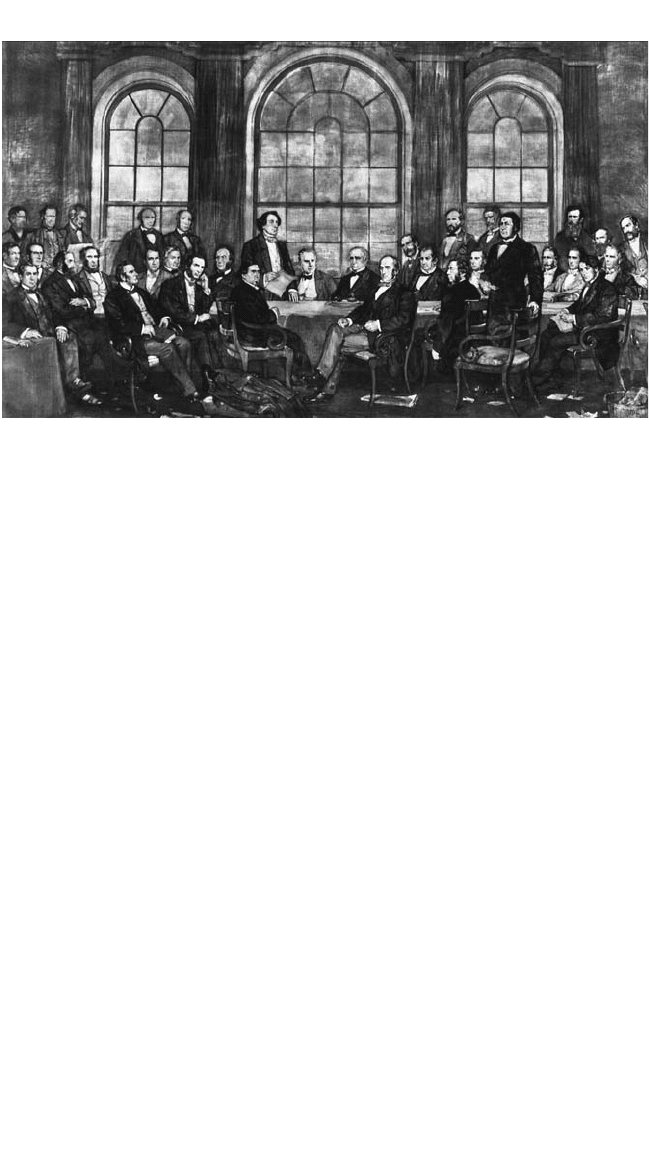
This 1883 painting by Robert Harris (1849–1919), Fathers of Confederation at the
Quebec Conference in October 1864, features the fi rst prime minister, John A. Macdonald
(standing at the table with paper in hand); Georges-Étienne Cartier (seated immediately to
the right), who led Quebec into Confederation; George Brown (seated with legs crossed in the
foreground), the owner of the infl uential Globe newspaper, who envisioned Confederation as
the key to western expansion; and Charles Tupper (standing in the foreground), who led Nova
Scotia into Confederation and would be a future prime minister.
(Library and Archives Canada
C-001855)

173
slightly more than two weeks, the Quebec Conference proved to be
decisive in drawing up 72 resolutions that laid the foundation for a new
national constitution (Whitelaw 1967; Waite 1967).
The fi rst principle of unity was federalism. The Maritime and
French-Canadian delegates insisted on a federal union so that their
respective identities would not be submerged. Mindful that the Civil
War in the United States was about to enter its fourth brutal year, the
Canadian and Maritime delegates agreed on a strong central govern-
ment to avoid the apparent mistakes of the United States Constitution
in giving the states too much power. In contrast, the new central gov-
ernment was granted residual powers—that is, all powers not specifi -
cally assigned to the provinces. In addition, the power of disallowance
gave the central authority the right to reject provincial laws of which it
did not approve. The central government would consist of an elected
body based on representation by population and an appointed body
based on equal regional representation. The smaller Maritime Prov-
inces saw the appointed branch of government as a means of offsetting
their numerical weakness in the elected branch. Because it would
assume all existing provincial debts and the cost of building the inter-
colonial railway along with such major expenditures as administration
and defense, the central government was allowed unlimited taxing
powers, including the collection of direct and indirect taxes such as
customs and excise duties, which were among the main sources of rev-
enue at that time. The provinces were restricted to levying only direct
taxes but were to be compensated for the cost of education, roads, and
other local responsibilities with an annual subsidy from the central
government amounting to 80 cents per capita. The provinces could
raise additional revenue by selling their natural resources, such as pub-
lic lands, minerals, and waterpower.
The Canadian and Maritime delegates adjourned the Quebec Confer-
ence with the understanding that they would not risk subjecting the
draft constitution to popular approval. Instead, they decided to follow
the British procedure of ratifi cation by provincial legislatures. In
essence, the aversion to direct democracy was based on the concern
that the people might not share the vision of their political leaders.
The Quebec Resolutions were debated in the Legislative Assembly of
the United Province of Canada in February 1865. Relatively little criti-
cism was expressed by members from the western section. In Canada
East, however, the Rouges led by Dorion strongly opposed the resolu-
tions, arguing that a true “confederation” was based on the supremacy
of local over central authority, that such a monumental scheme should
THE ROAD TO CONFEDERATION

A BRIEF HISTORY OF CANADA
174
be subject to electoral approval, and that the proposed union was
merely “a Grand Trunk job.” The fi nal vote taken in early March
appeared decisive: 91 in favor and 33 opposed. But the vote among the
French-Canadian members present was considerably closer: 27 in favor
and 21 opposed. Thus, French Canada embraced nationhood, but with
some serious reservations (Waite 1963; Bonenfant 1966).
Support for the Quebec Resolutions in the Atlantic Provinces was
even more precarious than it was in French Canada. Prince Edward
Island rejected Confederation outright because it did nothing to resolve
the long-standing absentee landlord issue; it left the tiny province with
little, if any, power in the central Parliament; and it offered a railway
link with Canada that was of little interest to the inhabitants. New-
foundland was completely indifferent to the idea of uniting with distant
Canada, since most of the island’s population and economic activity
were focused on the far eastern coast and therefore oriented toward
Britain. In Nova Scotia, Premier Charles Tupper’s attempts to gain sup-
port for Confederation were countered by Joseph Howe, who argued
that the province would be more likely to keep its identity and to enjoy
more prosperity by remaining within a great empire than by joining a
dubious experiment in nationhood. Not only did Tupper avoid Howe’s
challenge to call an election on the issue, he did not even dare to bring
the Quebec Resolutions to a vote in the provincial legislature. Indeed,
Confederation could have proceeded without the support of any of
these three provinces, although the involvement of Nova Scotia was
considered more highly desirable.
Without the support of New Brunswick, however, the Confederation
scheme embodied in the Quebec Resolutions would have disintegrated,
principally because a railway connection to an ice-free winter port had
to pass through the province whether the terminal was Halifax or Saint
John. Premier Leonard Tilley succumbed to pressure to call an election
on the issue of Confederation. His opponent, A. J. Smith, pointed out
that New Brunswick’s trade fl owed in a north-south rather than an east-
west direction, particularly since the Reciprocity Treaty of 1854. There-
fore, he proposed a provincial railway that linked up with Maine as a
more viable alternative to the intercolonial railway. In the election cam-
paign of March 1865, the pro-Confederation forces under Tilley were
soundly defeated, thereby leaving the plan for nationhood in serious
jeopardy.
At this critical juncture, the renewal of the American threat proved
to be a convenient factor in turning the tide in favor of Confederation.
The end of the American Civil War in the spring of 1865 raised concern

175
that the victorious Union army, then the largest in the world, would be
free to turn its aggression toward Canada as a measure of retaliation
against Britain. In fact, some of its discharged soldiers were recruited
John A. Macdonald
Speaks in the Canadian
Legislature about the Need
for a Federal Union of
British North America
T
he . . . only means of solution for our diffi culties was the junction
of the provinces either in a Federal or a Legislative union. Now, as
regards the comparative advantages of a Legislative and a Federal union,
I have never hesitated to state my own opinions. I have again and again
stated in the House, that, if practicable, I thought a Legislative union would
be preferable. (Hear, hear.) I have always contended that if we could agree
to have one government and one parliament, legislating for the whole of
these peoples, it would be the best, the cheapest, the most vigorous, and
the strongest system of government we could adopt. (Hear, hear.) But, on
looking at the subject in the Conference, and discussing the matter as we
did, most unreservedly, and with a desire to arrive at a satisfactory conclu-
sion, we found that such a system was impracticable. In the fi rst place, it
would not meet the assent of the people of Lower Canada, because they
felt that in their peculiar position—being in a minority, with a different lan-
guage, nationality and religion from the majority,—in case of a junction with
the other provinces, their institutions and their laws might be assailed, and
their ancestral associations, on which they prided themselves, attacked and
prejudiced; it was found that any proposition which involved the absorption
of the individuality of Lower Canada—if I may use the expression—would
not be received with favor by her people. We found too, that though their
people speak the same language and enjoy the same system of law as the
people of Upper Canada, a system founded on the common law of England,
there was as great a disinclination on the part of the various Maritime
Provinces to lose their individuality, as separate political organizations, as
we observed in the case of Lower Canada herself. (Hear, hear.) Therefore,
we were forced to the conclusion that we must either abandon the idea
of Union altogether, or devise a system of union in which the separate
provincial organizations would be in some degree preserved. . . .
Source: Waite 1963, 40–41.
THE ROAD TO CONFEDERATION

A BRIEF HISTORY OF CANADA
176
by the Fenian Brotherhood, a fanatical republican Irish group dedicated
to capturing the British North American colonies and using them as
ransom to negotiate with the British government for the liberation of
George-Etienne Cartier
Speaks about his Preference
for a British North
American Rather than
a Canadian Federation
and his Vision of a New
“Political Nationality”
. . . representation by population, though unsuited for application as a
governing principle as between the two provinces, would not involve
the same objection if other partners were drawn in by a federation. In a
struggle between two—one a weak, and the other a strong party—the
weaker could not but be overcome; but if three parties were con-
cerned, the stronger would not have the same advantage; as when it
was seen by the third that there was too much strength on one side,
the third would club with the weaker combatant to resist the big fi ghter.
(Cheers and laughter.). . . .
The question for us to ask ourselves was this: Shall we be content
to remain separate—shall we be content to maintain a mere pro-
vincial existence, when, by combining together, we could become a
great nation? . . . Now, when we were united together, if union were
attained, we would form a political nationality with which neither the
national origin, nor the religion of any individual, would interfere. It
was lamented by some that we had this diversity of races, and hopes
were expressed that this distinctive feature would cease. . . . We could
not do away with the distinctions of race. We could not legislate for
the disappearance of the French Canadians from American soil, but
British and French Canadians alike could appreciate and understand
their position relative to each other. They were placed like great
families beside each other, and their contact produced a healthy spirit
of emulation. It was a benefi t rather than otherwise that we had a
diversity of races. . . .
Source: Waite 1963, 40–41, 49.

177
Ireland. Although the Fenian raids of New Brunswick in April 1866
and of the Niagara frontier of Canada West less than two months later
featured only sporadic fi ghting, they intensifi ed fears of an American
THE ROAD TO CONFEDERATION
George Brown (Who Formed
the Great Coalition with
Macdonald and Cartier)
Explains his Support for
Confederation
M
r. Speaker, I go heartily for the union, because it will throw down
the barriers of trade and give us the control of a market of four
millions of people. (Hear, hear.) What one thing has contributed so
much to the wondrous material progress of the United States as the
free passage of their products from one State to another? What has
tended so much to the rapid advance of all branches of their industry,
as the vast extent of their home market, creating an unlimited demand
for all the commodities of daily use, and stimulating the energy and
ingenuity of producers? . . . But here, sir, is a proposal which is to add,
in one day, near a million of souls to our population—to add valuable
territories to our domain, and secure to us all the advantages of a large
and profi table commerce, now existing. And because some of us would
have liked certain of the little details otherwise arranged, we are to
hesitate in accepting this alliance! (Hear, hear.). . . .
Sir, the future destiny of these great provinces may be affected by the
decision we are about to give to an extent which at this moment we
may be unable to estimate—but assuredly the welfare for many years of
four millions of people hangs on our decision. (Hear, hear.) Shall we then
rise equal to the occasion?—shall we approach this discussion with-
out partisanship, and free from every personal feeling but the earnest
resolution to discharge conscientiously the duty which an over-ruling
Providence has placed upon us? Sir, it may be that some among us will
live to see the day when, as the result of this measure, a great and pow-
erful people may have grown up in these lands—when the boundless
forests all around us shall have given way to smiling fi elds and thriving
towns—and when one united government, under the British fl ag, shall
extend from shore to shore.
Source: Waite 1963, 63, 68–69, 78–79.

A BRIEF HISTORY OF CANADA
178
invasion that were already fueled by the revival of annexationist senti-
ment directed toward Canada and the British Northwest. In December
1865 the United States Congress had further undermined relations with
British North America by legislating the end of the Reciprocity Treaty,
to become effective March 1866.
The Fenian threat, coupled with the collapse of Premier Smith’s rail-
way link with Maine in the wake of the demise of reciprocity, gave New
Brunswick Governor Arthur Gordon the opportunity to maneuver the
anti-Confederation administration out of offi ce. In the subsequent elec-
tion campaign, Tilley benefi ted from the generous fi nancial support of
the Canadian government and the Grand Trunk Railway to sweep back
into power. He then successfully engineered the Quebec Resolutions
through the provincial legislature in time to join his Canadian col-
leagues at the London Conference to fi nalize the Confederation agree-
ment in December 1866. Tilley’s victory also enabled Tupper to get
support from the Nova Scotia legislature to send delegates to the Lon-
don conference.
At the London Conference, the Quebec Resolutions were only slightly
modifi ed to include protection for existing separate school rights;
increased provincial subsidies; the designation of the union as a “con-
federation” rather than a “federation”; the renaming of Canada East and
Canada West as Quebec and Ontario, respectively; and changing the
name of the new nation from the Kingdom of Canada to the Dominion
of Canada. Even while the terms of Confederation were being fi nalized
in London, Joseph Howe appealed to British offi cials in London to reject
the union on the grounds that it was being forced against the popular
will (Beck 1965). The British government ignored him, and the British
North America Act passed through Parliament without much notice in
March 1867. Indeed, Howe’s Nova Scotia delegates commented bitterly
on the limited attention devoted to the act in the House of Commons
compared to the vigor with which the members participated in the
debate on a new dog tax immediately afterward. On July 1, 1867, the
colonial age of British North America came to an end, and the provinces
of Nova Scotia, New Brunswick, Quebec, and Ontario offi cially united
to form a new nation known as the Dominion of Canada.
Confederation was effectively a marriage of economic and political
convenience between partners who had little desire to live together but
could not afford to live apart. The reluctance with which the British
North American colonies entered into their national partnership fore-
shadowed the persistence of the regional and cultural discontent that
would characterize Canada’s development in the last third of the 19th

179
century and throughout the 20th century. Despite the precarious foun-
dation of unity, Canada would manage not only to survive as an inde-
pendent nation in the shadow of a mighty southern neighbor but also
to fulfi ll the transcontinental ambitions expressed in its motto, adopted
from Psalm 72: A Mari Usque Ad Mare—“From Sea to Sea.”
THE ROAD TO CONFEDERATION