
Riendeau A Roger E. Brief History of Canada
Подождите немного. Документ загружается.


1
The Natural Domain
C
anada is a vast country, extending more than 4,000 miles from east
to west and upwards of 3,000 miles from north to south. With an
area of 3,850,000 square miles, it is the second-largest nation in the
world, exceeded in size only by Russia. Yet only about one-eighth of the
land is considered habitable, and only about one-twelfth is cultivable,
largely accounting for the fact that Canada’s population has consistently
been about one-tenth the size of that of the United States, even though
Canada’s land area is slightly larger than that of its southern neighbor.
Furthermore, because of the limited quantity of arable land available
for settlement, well over 90 percent of the Canadian population live
within 300 miles of the American border. In his book Canada and the
Canadian Question (1891). Goldwin Smith recognized the implications
of this physical reality for national unity in terms that are no less perti-
nent today than they were more than a century ago:
The habitable and cultivable parts of [Canada] . . . are not
contiguous, but are divided from each other by great barriers
of nature, wide and irreclaimable wilderness or manifold chains
of mountains. . . . Each [part], on the other hand, is closely con-
nected by nature, physically and economically, with that portion
of the habitable and cultivable continent to the south of it which
it immediately adjoins, and in which are its natural markets . . .
(Smith 1891, 1–2).
While Smith had ample reason to question the geographical viability of
Canadian nationhood, people of all cultures and from all places have
always been lured by the challenges and opportunities that Canada
offers. Originally, people of unknown origin crossed this vast land from
the north and west to establish unique civilizations that were thousands
of years old by the time that Europeans arrived from the east and south
over the past fi ve centuries. While the latecomers were equipped with
the technology that enabled them to defy and eventually conquer
1

nature, the Native peoples learned to live in harmony with nature and
to carve out their legacy in the Canadian wilderness.
In Defi ance of Nature
The paradox that the lines of geographic division in North America tend
to run north and south across the entire continent whereas the direction
of discovery and development has tended to be east and west across the
northern half of the continent has fostered a continuing tension between
nationalism and regionalism in Canada. Geographically, Canada is
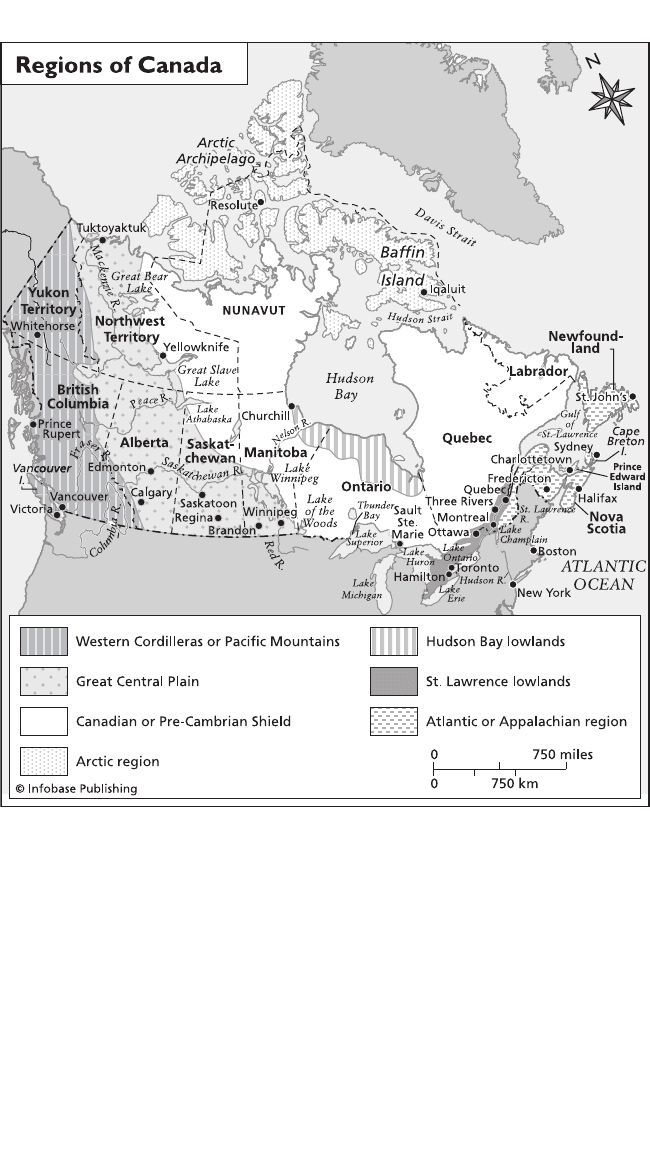
divided into seven regions, each with its distinct patterns of landform
and natural resources (Warkentin 1968; Harris and Matthews 1987).
The Atlantic Region
On the East Coast is the Atlantic or Appalachian region, including the
four provinces of Newfoundland, Nova Scotia, New Brunswick, and
Prince Edward Island as well as parts of eastern Quebec south of the
St. Lawrence River. The landscape of this region is dominated by the
Appalachian Highlands, ancient worn-down mountains and plateaus
seldom exceeding 4,000 feet above sea level. As the Appalachian
Highlands extend southward into the New England states, the coastal
plain widens, with the result that the Atlantic Provinces can accom-
modate only about one-tenth as many people as their southern coun-
terpart, even though the two regions cover basically the same land
area. The generally poor soil of the Appalachian Highlands has
restricted agricultural settlement in the Atlantic Provinces to the river
valleys and the narrow coastal plain, while the rugged terrain has been
a barrier to land transportation both within the region and with the
rest of Canada. The fact that, throughout most of their history, the
Atlantic Provinces have had easier contact with the New England
states than with the other Canadian provinces has been a constant
source of political discontent.
On the other hand, the Appalachian Highlands have endowed the
Atlantic Provinces with signifi cant forest and mineral wealth, notably
coal, which sustained economic interest in the region well into the 20th
century. But the foremost natural resource of the Atlantic region is
derived from its maritime location. The deeply indented coastline with
numerous excellent harbors became the launching point for one of the
world’s greatest fi shing grounds, including the once-renowned cod
fi sheries of Newfoundland’s Grand Banks. The lure of the sea in addi-
tion to a ready supply of timber enabled the region to become a prolifi c
A BRIEF HISTORY OF CANADA
2
3
shipbuilding and shipping center by the middle of the 19th century.
Ultimately, nature would prove to be less generous to the Atlantic
region than it was to other regions to the west and south. A shortage of
fertile land remained a deterrence to population growth, and a limited
resource base could not withstand human exploitation.
The St. Lawrence Lowlands
A stark contrast to the limited resources of the Appalachian region is
the natural abundance of the St. Lawrence Lowlands to the west.
THE NATURAL DOMAIN

A BRIEF HISTORY OF CANADA
4
Encompassing most of southern Quebec and southern Ontario, this
predominantly fl at fertile plain occupies less than 2 percent of Canada’s
total area but accommodates over 60 percent of the nation’s population.
Blessed with a favorable climate, excellent soil, and easy access by land
and water, the upper St. Lawrence Valley and Great Lakes basin was the
original agricultural heartland before becoming the commercial, indus-
trial, and fi nancial center of the nation. Indeed, the contrasting fates of
the St. Lawrence and Atlantic regions demonstrate the importance of
agriculture in laying the foundation for future economic and popula-
tion growth in Canada.
Transportation was another key to development. From the outset,
the St. Lawrence River and the Great Lakes formed a vital water high-
way linking the Atlantic Ocean with the continental interior. Ironically,
this east-west route proved to be an agent of both continentalism and
nationalism. On the one hand, the waterway facilitated the movement
of people and goods to and from New York and Pennsylvania as well as
the Ohio-Mississippi Valley, a natural extension of the St. Lawrence
lowlands. On the other hand, the St. Lawrence–Great Lakes system
launched a succession of explorers and traders along a transcontinental
course leading to the northwest and Pacifi c regions, later followed by
the railroad. Thus, the St. Lawrence region emerged as a hub of trans-
portation and trade, thriving as a benefi ciary of the north-south pull of
the United States and as a catalyst for east-west integration within a
national economic framework.
The Canadian Shield
The dominance of the St. Lawrence region was reinforced by still
another geographical factor—access to a resource frontier to the
north and west. Initially, the vast wilderness to the north, known as
the Canadian Shield, was considered to be the chief obstacle to
Canadian development. This expanse of Precambrian rock, worn
down by millions of years of glaciation, covers almost half of Canada’s
land surface, including much of the northern frontiers of Quebec,
Ontario, Manitoba, and Saskatchewan, as well as Nunavut and the
eastern edge of the Northwest Territories. The rugged terrain of the
Shield is interspersed with forest, scrub bush, muskeg swamp, numer-
ous lakes and streams, and isolated pockets of arable land that offered
little or no attraction to the farming pioneer. Thus, until the late 19th
century, the Shield remained a colossal barrier to the spread of settle-
ment westward from the St. Lawrence region. Only the fur trader

5
voyaging by canoe and portage was capable of regularly negotiating
the 1,000-mile trek.
Advancing technology and industrialization, however, would trans-
form the Shield from an uninhabitable wilderness to a valuable hinter-
land. The building of the Canadian Pacifi c Railway during the 1880s
not only regularized transportation and communication across this bar-
rier but also uncovered a treasure house of natural resources. Minerals
both base and precious, pulpwood for paper production, and hydro-
electric power harnessed from the fast-fl owing rivers and streams have
greatly enhanced industrial development, particularly in southern
Ontario and southern Quebec, and have provided another exportable
commodity for the increasingly important U.S. market. Furthermore,
the forest areas of the southern Shield, with their numerous lakes and
rivers, have become an attractive sporting and vacation land in the lei-
sure-conscious 20th century. While the opening of the northern
resource frontier has led to the establishment of small communities
around centers of activity, the lack of cultivable land in addition to a
less favorable climate has limited population growth to less than 5 per-
cent of the national total.
The Hudson Bay Lowlands
and the Arctic Region
To the north of the Shield lie two other sparsely settled regions that
together encompass nearly one-third of Canada’s land area. Surrounding
Hudson and James Bays along the northern edges of Manitoba and
Ontario, the Hudson Bay Lowlands make up an infertile plain, locked
in permafrost and characterized by marshes, peat, and innumerable
ponds. The vast Arctic region, including the northern coastal mainland
of Canada and the Arctic islands, is mostly treeless tundra and rock,
frozen eight to nine months of the year. Aside from the indigenous
population, the region has sustained small-scale fur trading posts and
whaling stations since the mid-19th century. In recent times, the region
has taken on strategic value as a location for weather and radar stations.
The future also holds out the promise of signifi cant mineral and energy
resources, but the cost of northern development and exploration tends
to place a considerable strain on an economy sustained by a population
of 31.6 million. In the fi nal analysis, the vast expanse of northland,
including the Shield, the Hudson Bay Lowlands, and the Arctic region,
is a major factor contributing to the population discrepancy between
the two North American nations.
THE NATURAL DOMAIN

A BRIEF HISTORY OF CANADA
6
The Great Central Plains
Nowhere are the limiting and divisive effects of geography more evident
than in the Great Central Plains region to the west of the Canadian
Shield. A northern extension of the great continental plain that stretches
unbroken and ever-widening from the Arctic Ocean toward the Gulf of
Mexico, this region is almost evenly divided into two distinct subregions.
The portion immediately north of the international boundary consists of
the fl at, treeless Prairie triangle extending 750 miles from eastern
Manitoba to the foothills of the Rocky Mountains and projecting 400
miles northward into Alberta. The Prairie region—including the dry belt
in southeastern Alberta and southwestern Saskatchewan where the
American desert reaches across the border—represents three-quarters of
the cultivable land in Canada. The area to the north of the main Prairie
region is generally characterized by more undulating forested land of low
agricultural potential and deteriorating climate conditions, although fer-
tile pockets of land that are diffi cult to access can be found in the Peace
and Mackenzie River valleys. While this northern parkland was attractive
to the early fur traders, the grain-growing potential of the southerly
Prairie region was the catalyst for national development in the late 19th
and early 20th centuries and a source of sectional discontent thereafter.
Distance from major markets and suppliers, dependence on fl uctuat-
ing world prices, and vulnerability to the hazards of nature, including
cyclic droughts and an erratic growing season—have all combined to
make Prairie farming a precarious occupation. Within this context, Prai-
rie farmers have grown resentful of national government policies that
appear to serve the interests of central Canadian manufacturers and
bankers at their expense. The prosperity generated by discovery of oil
and natural gas in Alberta and Saskatchewan in the mid-20th century
and subsequent disagreements between the provincial and national gov-
ernments over pricing and marketing policies have intensifi ed western
discontent over central Canadian “imperialism.” This political alien-
ation has reinforced a prevailing sense of physical isolation caused by
formidable mountain barriers to the east and west. Thus, prairie inhabit-
ants invariably feel a closer affi nity to the plains dwellers south of the
border than to their fellow Canadians to the east, west, or north.
The Western Cordilleras
Western alienation and isolation is compounded by the imposing
Cordilleras, a mountain system extending the length of the Pacifi c coast
of North and South America. The Canadian part of the Cordilleras,

7
which covers about one-sixth of the nation’s total area, dominates the
landscape of British Columbia and the Yukon Territory to the north.
Unlike those of the Canadian Shield and the Appalachian Highlands,
these are young mountains rising to a height of 13,000 feet. Early trav-
elers from the east faced the daunting prospect of surmounting the
Rockies, which loom majestically over the Alberta fl atlands. Before
reaching the Pacifi c shores they had to cross three other formidable
ranges—the Selkirk, Coast, and Cascade—rising parallel to one another.
It is therefore not surprising that this region, like the Canadian Shield,
remained the private domain of the fur traders and the indigenous
people until the completion of the Canadian Pacifi c Railway in 1885.
Thereafter, the development of British Columbia paralleled that of
the Shield region with the recognition of its abundant mineral, forest,
and hydroelectric power potential for industrial production, in addition
to its coastal fi sheries. But unlike the Shield region, British Columbia is
blessed with fertile soil and a temperate climate in its southern river
valleys, which proved attractive for agricultural settlement. In particu-
lar, the Fraser Valley in the southwest corner contains over half of the
province’s population even though it covers less than 1 percent of the
province’s area. As a result of this concentration of population close to
the U.S. border, along with the mountain barriers and the vast distance
from central Canada, British Columbians have developed a distinctly
Pacifi c outlook with stronger connections with the people of California
and the nearby American northwestern states than with their fellow
Canadians to the east.
Given the prevailing geographic realities, it seems remarkable that
Canada could have been conceived as a transcontinental nation in the
modern sense, let alone enduring and even prospering for the past 130
years. Not only have Canadians had to overcome the challenges of geog-
raphy but they have had to resist the temptation to follow the dictates
of nature and to cast their lot with a better endowed and more powerful
neighbor, as Goldwin Smith urged them to do. In choosing to defy
nature for the sake of nationalism, modern Canadians have effectively
pursued a course somewhat different from that of their indigenous
ancestors who also sought an independent existence but one essentially
in harmony with nature.
In Harmony with Nature
The original inhabitants of North America left no direct written account
of their evolution prior to sustained European contact beginning in the
THE NATURAL DOMAIN

A BRIEF HISTORY OF CANADA
8
late 15th century. But archaeological evidence suggests that they
migrated from Siberia to Alaska via a land bridge known as Beringia
toward the end of the last ice age at least 10,000 years ago. Even when
the glacial ice sheets melted and Beringia was submerged by the pres-
ent-day Bering Sea, it was still possible to make the approximately 50-
mile crossing between Siberia and Alaska. As many as 10 million people
may have gradually spread across the continent in search of more favor-
able hunting and fi shing sites. To these fi rst peoples, North America
was truly a boundless frontier; their freedom of movement was
restricted only by geographical barriers or by clashes with more power-
ful enemies. Unencumbered by political boundaries in the modern
sense, the indigenous people tended to cluster in small, culturally
diverse tribes or bands wherever it suited their needs.
The estimated 250,000 to 500,000 indigenous people who roamed
the Canadian territory probably belonged to even more than the 11
linguistic families speaking at least 53 distinct languages that currently
exist among the Native people of Canada (Dickason 2002; Jenness
2000). Although common language and customs could form the basis
of tribal organization, the nomadic lifestyle of the Native people and
the extent of territory over which they wandered often worked against
political or cultural unity on this basis. A more enduring and distin-
guishable basis of unity was more often evident among those Native
bands who adapted their way of life to the conditions and resources of
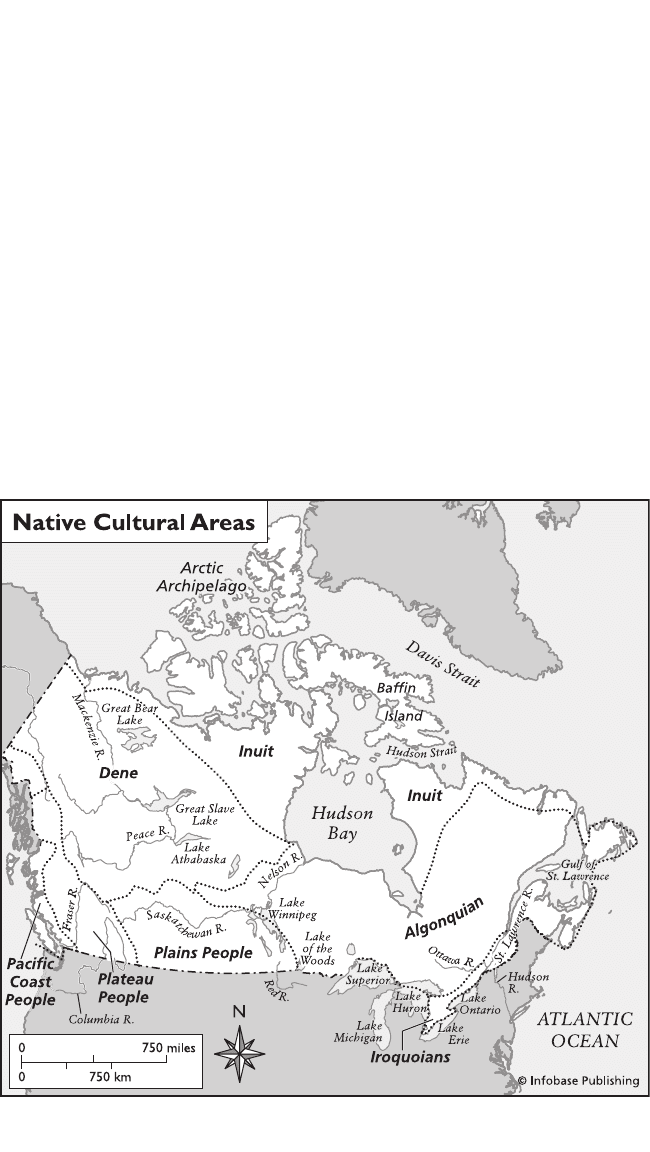
the regions that they occupied. Thus, Native cultural divisions tend to
coincide with Canada’s geographic divisions.
Eastern Woodlands
The dense forests of the Appalachian Highlands, the St. Lawrence
Lowlands, and the lower fringes of the Canadian Shield in Quebec and
Ontario provided a common environment for a Native population that
belonged to two unrelated linguistic families. An estimated 30,000 to
40,000 Algonquian-speaking people occupied the Maritime and lower
Shield regions. Most notable among the eastern Algonquians were the
Micmac of Nova Scotia and the Malecite of New Brunswick, and per-
haps the now-extinct Beothuk of Newfoundland. The Algonquians
further inland included the Montagnais along the lower St. Lawrence
Valley, the Algonquin of the Ottawa River valley, the Nipissing in the
Lake Nipissing region, the Ottawa on Manitoulin Island in Lake Huron,
and the powerful Ojibwa or Chippewa along the north shore of Lakes
Huron and Superior.
9
Depending on their location, the nomadic Algonquians hunted deer,
moose, caribou, bear, seal, and walrus as a source of food, clothing, tools,
and weapons. They gathered wild rice and an assortment of berries, nuts,
tubers, and plants, in addition to harvesting maple and birch sap. Agri-
culture as a subsistence activity was either marginal or nonexistent
among most of the Algonquians. To assist one another in obtaining
food, several closely related families joined together to form a band,
and the band-village led by a hereditary male chief became the principal
political unit. Band-villages, however, were not strictly demarcated,
and all members had equal access to basic subsistence resources. To
navigate the waterways of the St. Lawrence–Great Lakes system, the
central Algonquians became skilled in making and handling the birch-
bark canoe, which later European traders and explorers would fi nd
indispensable in opening up the Canadian frontier.
An estimated 70,000 to 90,000 Iroquoian-speaking people inhabited
much of the St. Lawrence lowlands and the neighboring New York,
THE NATURAL DOMAIN