
Riendeau A Roger E. Brief History of Canada
Подождите немного. Документ загружается.


A BRIEF HISTORY OF CANADA
20
While Herjolfsson apparently had no desire to explore the lands he
sighted, his reports about its dense forests generated some interest in
Greenland, where wood was in short supply. Around 1001, Leif Eriks-
son, the son of Greenland colonizer Erik the Red, sailed west to inves-
tigate the resources of this strange territory. He and his crew therefore
became the fi rst known Europeans to set foot on North American soil.
Norse sagas indicate that Eriksson’s expedition fi rst landed in a place
which he called Helluland, meaning “land of fl at stones,” now believed
to be either the southern coast of Baffi n Island or the northern coast of
Labrador. The expedition then sailed southward, landing at a place that
Eriksson called Markland, or “wooded land,” probably the central or
southern coast of Labrador. The third landfall was called Vinland,
which could mean “wine land,” “vine land,” “fruitful land,” or “grass-
land.” Modern historians and geographers have variously located Vin-
land from southern Labrador to Florida. After wintering in Vinland and
exploring the area further, Eriksson and his crew returned to Green-
land with a cargo of timber, vines (valued as fasteners in shipbuilding),
and “wineberries” (likely currants, gooseberries, or cranberries).
While Leif Eriksson never returned to Vinland, several Norse expe-
ditions were launched from Greenland to establish settlements in the
new western lands during the fi rst decade of the 11th century. Leif
Eriksson’s brother Thorvald led an expedition to Vinland in 1004. The
following year the fi rst recorded contact between Europeans and native
North Americans ended in violence. As they explored the coastline,
Eriksson and his men encountered and murdered a small group of
“skraelings,” as the sagas called them, a word that may be translated as
“wretches” or, as later Europeans would say, “savages.” In an ensuing
retaliatory skirmish, Eriksson was killed by a native arrow, and his men
retreated to Greenland.
Perhaps the most ambitious colonizing venture was led by Icelander
Thorfi nn Karlsefni, who brought over 160 settlers about 1011. The
colonists bartered with local Natives, but confl ict again erupted, and the
Norse were driven back to Greenland within two years. A fi nal attempt
to colonize Vinland was led by Leif Eriksson’s half sister, Freydis, but it
too ended in bloody confrontation among the settlers and the Natives.
Although there were no further colonizing efforts, Norse traders from
Greenland periodically returned to acquire timber until about the mid-
14th century when the Greenland settlements were abandoned.
Knowledge of the western exploits of the Norse was derived from the
Greenlanders’ Saga and Erik the Red’s Saga, both of which consist of
stories passed down orally from generation to generation before they

21
were written down in the late 12th and middle 13th centuries, respec-
tively. Accordingly, the sagas were designed to serve more of a literary
than a historical purpose, with the result that the distinction between
fact and legend often became blurred. Not until 1960 did archaeologists
unearth indisputable evidence of Norse settlement at L’Anse aux Mead-
ows on the northern tip of Newfoundland. Whether this site was Leif
Eriksson’s Vinland, the Karlsefni colony, or some other unknown set-
tlement, it was clear that the Norse had visited Canada at least fi ve
centuries earlier than had any other Europeans.
Renewed European Interest in the New World
In the late 15th century, Europeans discovered the New World for a
third time. Because the native experience was unrecorded and the
Norse sagas had disappeared until they were rediscovered at the end of
the 16th century, European explorers beginning with Columbus had to
approach the New World with little or no awareness of the routes and
discoveries of their predecessors. The revival of interest in the New
World once again originated by accident rather than by design. In fact,
the grand design of the age was not to fi nd a new world but to reach an
ancient world. Since ancient times, the Indies—an all-encompassing
term for southern and eastern Asia including India and China—had
been a source of goods that Europeans valued highly: silks and other
fi ne textiles, precious gemstones, and pungent and fragrant spices.
Peppers, nutmeg, cinnamon, and cloves were vital in preserving and
improving the taste of food, and especially in the aging of meat in the
absence of refrigeration. But European access to these desirable com-
modities was restricted by the rising Islamic empire that had gained
control of the overland routes to East Asia used by Marco Polo and
other Europeans in the 13th century. To the increasingly powerful
nation-states of 15th-century western Europe, economic and military
supremacy was bound up in the quest for a direct sea route to the Indies
that would bypass the intricate and costly Muslim trade monopoly
(Morison 1971, 1994; Quinn 1977).
Portugal took the lead in the race to the east when Bartholomeu Diaz
successfully circumnavigated the southern tip of Africa in 1488, and
within 10 years Vasco da Gama had crossed the Indian Ocean to reach
India. Meanwhile, rival Spain supported the expedition of Italian navi-
gator Christopher Columbus who maintained that, because the world
was round, it was possible to reach East Asia by sailing west. He was so
convinced that he had reached India at the end of his fi rst voyage in
ACCIDENTAL REDISCOVERY
A BRIEF HISTORY OF CANADA
22
1492 that he called the Native people “Indians,” a designation that
remains common. Columbus’s voyage not only intensifi ed the maritime
rivalry between Spain and Portugal but also raised questions about the
rights of the two Catholic nations to evangelize the Native peoples of
the recently “discovered” territories. Accordingly, in 1493 Pope Alex-
ander VI established a “line of demarcation,” modifi ed slightly by the
Treaty of Tordesillas the following year, whereby all lands lying to the
west of the line were under the jurisdiction of Spain while those lying
to the east belonged to Portugal. This division placed some of the
Atlantic region of Canada and much of Brazil within the Portuguese
sphere of infl uence.
Having actually discovered the Caribbean Islands, Central America,
and South America during his four voyages, Columbus still believed
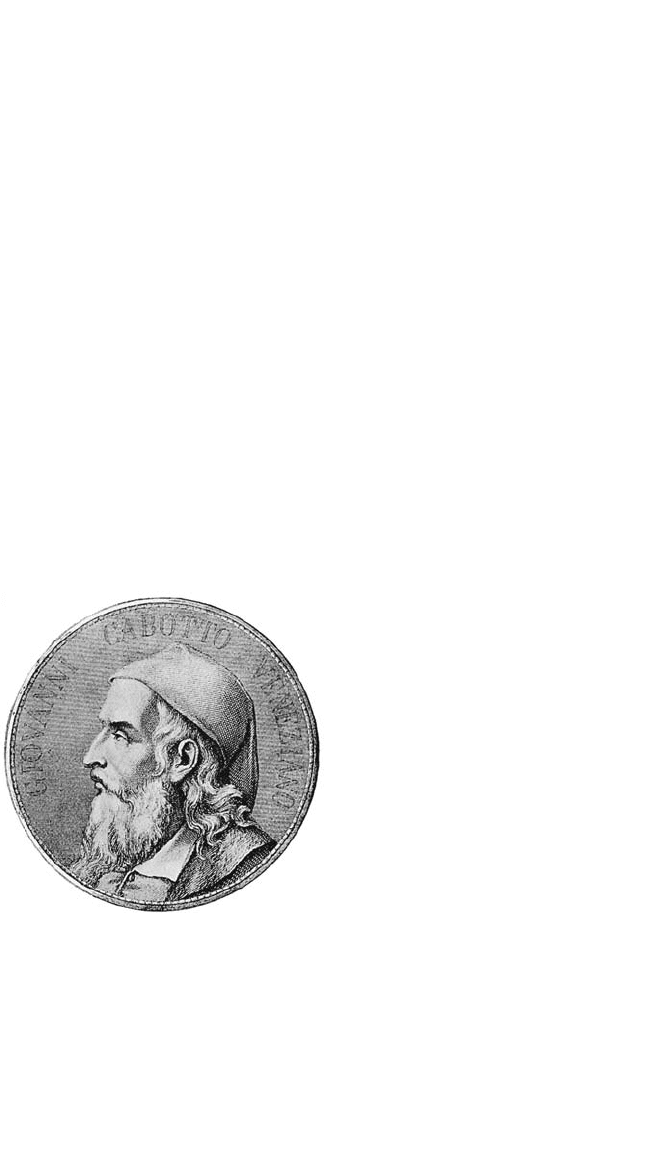
that he had reached Asia by the time another Italian navigator, Giovanni
Caboto (subsequently anglicized as John Cabot), sailed from England
on a westward voyage across the north Atlantic in 1497. On June 24,
1497, Caboto landed somewhere along the coast of Labrador, New-
foundland, or Cape Breton Island, thus marking the fi rst recorded
landfall on the North American mainland since the Norse voyages.
Claiming the land for England (although he planted the fl ags of both
England and Venice), Caboto
explored what he believed to be
the northeastern coast of China.
He did, however, make two dis-
coveries that would spur him on
to further exploration and that
would be signifi cant for the
future development of the conti-
nent. First, he found the Grand
Banks of Newfoundland, a fertile
breeding ground for cod. The sea
so swarmed with fi sh that the
crew could catch them with bas-
kets let down on ropes from the
deck of the ship. Second, Caboto
came upon a large passage, the
Gulf of St. Lawrence, which he
believed was a direct route to the
heartland of China. Encouraged
by these fi ndings, he returned
triumphantly to England, where-
This medallion designed by Carlo Barrera
Pezzi in 1881 commemorates Italian navigator
Giovanni Caboto, his name subsequently
anglicized as John Cabot, who made the fi rst
recorded landing along the Atlantic coast of
Canada in 1497 and claimed Newfoundland
and its fi sheries for England.
(Library and
Archives Canada C-005136)

23
upon the king rewarded him for reaching this “new found land” by
sponsoring a second voyage in 1498. The expedition never returned,
and it is believed that Caboto likely perished somewhere off the coast
of Newfoundland. Despite the failure to reach Asia, Caboto’s voyages
are signifi cant for establishing England’s claim to the Atlantic Coast of
North America and for stimulating further interest in pursuing a north-
ern sea route to Asia (McGhee 1989).
The rich cod fi shing grounds discovered by Caboto soon attracted
Portuguese, Spanish, English, French, and Basque fi shing fl eets seek-
ing to satisfy a market created in predominantly Catholic Europe,
where abstinence from meat was decreed for more than 150 days a
year. From March to October of each year, upwards of 10,000 fi sher-
men would gather in the waters off the coast of Newfoundland and
Cape Breton Island before returning to Europe with their catch. The
Portuguese and Spanish fi shing fl eets, using the “green” or “wet”
method of preservation, remained offshore where they caught and
heavily salted the fi sh directly onboard ship. The French and English
fl eets, using the “dry” or “shore” method of preservation, took their
catch ashore to be dried on racks or “fl akes,” which meant that the fi sh
needed only a light salting to avoid spoilage during the long voyage
home (Innis 1978).
The huts and storehouses that the “dry” fi shermen built as they
tended their cod-strewn drying racks during the summer in effect
became the fi rst semblance of European settlement, however imperma-
nent and anonymous, since the Norse efforts fi ve centuries before. The
French fi shing stations were scattered along the northern and southern
shores of Newfoundland and perhaps on the Cape Breton and mainland
Nova Scotia coasts, while the English concentrated on the eastern coast
of Newfoundland, particularly around the Avalon Peninsula. The cod
fi shing fl eets were joined by Basque whalers who from July to mid-
January established their own shore stations in the Strait of Belle Isle
between the Newfoundland mainland and Labrador. Whale oil found a
ready market in Europe as a source of light; an all-purpose lubricant;
and an additive to drugs, soap, and numerous other products. To these
temporary fi shing and whaling stations, local Natives came to exchange
their furs and beaver robes for European metal goods and textiles, a
prelude to the trading links that would open up the northern American
frontier in the next century.
While countless fi shing and whaling fl eets singularly operated in
relative historical obscurity throughout the 16th century, the quest
for a northern sea route to Asia continued to capture the public
ACCIDENTAL REDISCOVERY

A BRIEF HISTORY OF CANADA
24
imagination in Europe. The Portuguese, believing that the Atlantic
Coast of North America lay east of the papal line of demarcation and
was therefore under their sphere of infl uence, sought to complement
their eastward route to India around Africa with a westward passage.
An expedition led by Gaspar Côrte-Real explored the North Atlantic
coastline from Greenland to Newfoundland in 1500. He identifi ed the
forests of the region as a valuable supply of timber for masts and ships
and the Native peoples as promising sources of slaves comparable to
west Africa. When he returned to the Labrador coast in 1501, Côrte-
Real abducted 57 Natives and shipped them back to Portugal with his
brother Miguel. Like Caboto, Gaspar Côrte-Real and his crew never
returned from this second voyage, and the same fate befell his brother,
who came back to search for him in 1502. Around 1520 João Alvarez
Fagundes explored the southern coast of Newfoundland and the Gulf
of St. Lawrence with a view toward establishing a colony called Cabo
Bretão. Probably located on Cape Breton Island, this colony appears
to have been short-lived as a result of clashes with the local Natives.
Although no trace of the colony has ever been found and little is
known about it, Portugal’s Cabo Bretão seems to have been the fi rst
European colony established north of Florida since the time of the
Norse. But after the failure of this colony, the Portuguese—except for
those seafarers who annually fi shed the Grand Banks and the coastal
waters off Newfoundland—lost interest in North America.
By the 1520s it was becoming clearer that the land that Columbus
and Caboto had discovered was not an extension of Asia. When Span-
ish explorer Vasco Núñez de Balboa crossed a narrow strip of land in
Panama and sighted the Pacifi c Ocean in 1513, it became apparent that
a land mass of undetermined size lay between Europe and Asia. Ferdi-
nand Magellan’s ill-fated voyage around the world from 1519 to 1522,
during which he traveled westward around the southern tip of South
America and across the vast expanse of the Pacifi c Ocean before reach-
ing Southeast Asia, was further confi rmation that America was a dis-
tinct continent. Still to be determined was the northern extent of this
continental land mass.
At this point France decided to enter the race to East Asia after hav-
ing long focused its foreign policy on the Mediterranean. The fi rst
French voyages to North America had been made by Jean Denys and
Thomas Aubert, each of whom explored the eastern coast of New-
foundland in 1506 and 1508, respectively. The seven Beothuk whom
Aubert apparently brought back to France were objects of curiosity, but
not enough to sustain the interest of the French monarchy. Magellan’s

25
expedition, however, stimulated the interest of King Francis I who
sought to challenge his arch rival, Holy Roman Emperor Charles V
[King Charles I of Spain], by fi nding a more direct route to the riches
of Asia than by the circumnavigation of South America. Thus, Francis
I gave his support to an expedition led by yet another Italian mariner,
Giovanni da Verrazano, who in 1524 explored the Atlantic coastline
from Florida to Newfoundland. Verrazano hoped to fi nd either an isth-
mus dividing the Atlantic Ocean from the Pacifi c, such as Balboa had
found in Panama, or a strait across the northern tip of the continent
corresponding to the one Magellan had discovered at the southern end.
But after exploring nearly 2,000 miles of continental shoreline, Verra-
zano came to the disappointing, albeit important, conclusion that the
Atlantic and Pacifi c Oceans were not connected in the Northern Hemi-
sphere, and in fact that they were separated by a body of land not con-
nected to Asia. In effect, Verrazano heralded the existence of a new
continent, North America.
Because most of this new continent lay west of the papal line of
demarcation, Spain was anxious to investigate its potential. Spain
immediately hired Portuguese navigator Esteban Gomez to explore the
Atlantic coast from Newfoundland to Florida in 1524–25. Like the
Côrte-Reals, Gomez abducted several Native people along the New
England or Nova Scotia coast and took them back to Spain to sell as
slaves. The Spanish king was not impressed and freed the 58 Natives
who reached Spain alive. Disappointed with the results of its northern
expeditions, Spain soon found it more profi table to concentrate its
exploration and colonization efforts south of Florida.
While the existence of North America was common knowledge in
western Europe by the 1530s, the nature and extent of the new conti-
nent, beyond a superfi cial awareness of its eastern coastline, remained
a profound mystery. Being as much entrepreneurs as adventurers, these
early explorers were more anxious to bring back the “riches” of Asia
that their fi nancial backers expected than they were in recording and
mapping their discoveries. The sense of disappointment that pervaded
their voyages may account for the failure of the explorers to keep pre-
cise records of their fi ndings or of succeeding generations to ensure the
survival of vital historical documents and artifacts. As a result, the story
of the earliest moments of the European rediscovery of the northern
American frontier is little more than a rough sketch pieced together
from diverse fragments of empirical evidence, deductive reasoning, and
educated speculation. Fortunately, the story becomes a little clearer
with the voyages of Jacques Cartier.
ACCIDENTAL REDISCOVERY
A BRIEF HISTORY OF CANADA
26
The Voyages of Jacques Cartier
Unlike his recent predecessors who had sought to circumnavigate
North America, Jacques Cartier set sail from Saint-Malo, France, on
April 20, 1534, with the intent of fi nding a sea route through the con-
tinental land mass to Asia. In the process, he became the fi rst European
to penetrate inland and to leave a detailed surviving account of his
adventures, beginning with Voyages au Canada en 1534.
Having likely accompanied Verrazano on his voyages in the previous
decade, Cartier, with his expedition of two ships and 61 men, reached
Newfoundland within 20 days. When he passed through the Strait of
Belle Isle and into the Gulf of St. Lawrence 10 days later, he was in
waters previously uncharted by Europeans. He surveyed the southern
coast of Labrador, referring to it as “the land God gave Cain” (Biggar
1924, xxi), after the biblical wasteland. Following the west coast of
Newfoundland, he then veered southwestward to explore the coasts of
Prince Edward Island, eastern New Brunswick, and the Gaspé Penin-
sula. On July 3, his hopes of fi nding a passage to Asia were aroused by
the sight of a large opening in
the shoreline, which turned out
to be Chaleur Bay, dividing New
Brunswick from the Gaspé Pen-
insula of Quebec.
Here, Cartier met the native
Micmac people, who “set up a
great clamour and made frequent
signs to us to come on shore,
holding up to us some furs on
sticks” (Biggar 1924, 20). The
eagerness of the Natives to trade
their furs for metal goods sug-
gests that Cartier’s expedition
was probably preceded by Euro-
pean fi shermen who left no
record of their contact. Never-
theless, Cartier’s visit represents
the fi rst recorded exchange of
furs between Natives and Euro-
peans and the fi rst trading
exchange of any kind since the
Norse voyages. Proceeding north
to the Bay of Gaspé, which briefl y
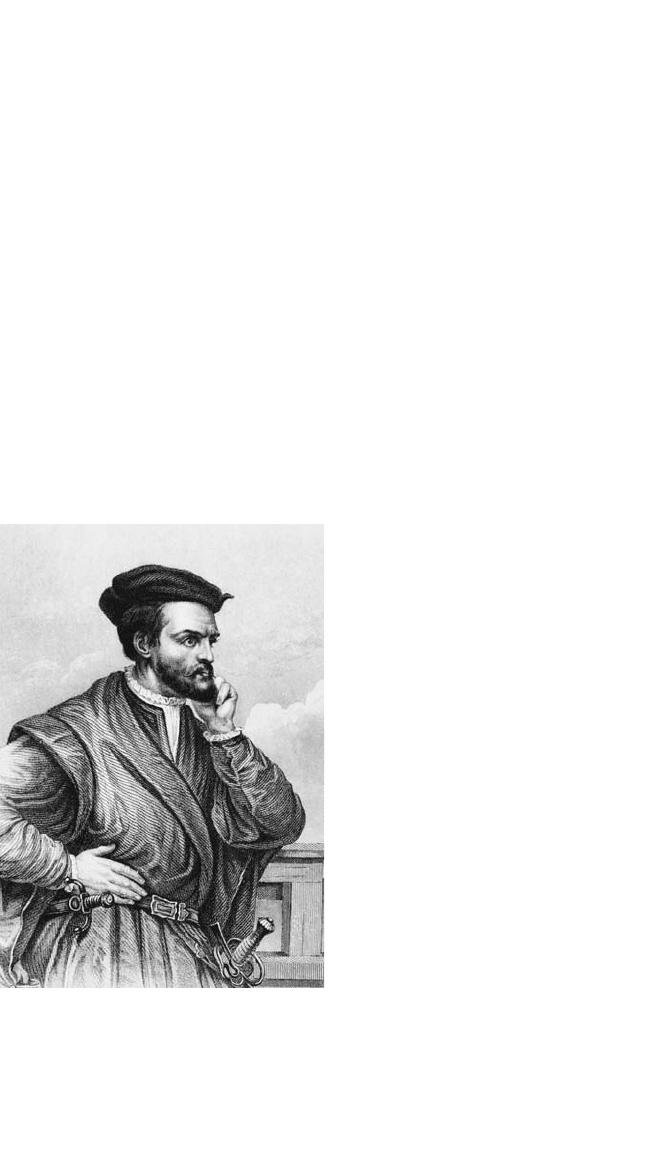
This engraving by Théophile Hamel (1817–70)
portrays Jacques Cartier, who sighted the St.
Lawrence River in 1534–35 and claimed
Quebec for France.
(Library and Archives
Canada C-007298)

27
appeared to be the elusive passage to Asia, Cartier encountered Iro-
quoian people who had come from the interior to fi sh and hunt seal.
When he raised a cross to claim possession of the land for France on
July 24, Cartier not only established trade relations with the Iroquois
but also persuaded a reluctant Chief Donnacona to allow his two sons
to make the return journey to France so that they could serve as inter-
preters and guides on the next voyage.
From the Natives, Cartier heard highly embellished but intriguing
tales of a great waterway leading to the west and the rich kingdoms to
be found in that direction. When he sailed north to Anticosti Island,
Cartier gazed upon the St. Lawrence River, which he mistook as a strait
leading to the Pacifi c Ocean. Despite the visions of fantastic Oriental
empires offering gold, silver, jewels, and spices, it was now August, and
concerns over the approach of autumn storms on the Atlantic prompted
the decision to turn back to France.
Cartier’s exploits, while falling short of expectations, suffi ciently
intrigued King Francis I, especially when supported by the imaginative
stories of Donnacona’s sons, Taignoagny and Domagaya. The king
therefore endorsed Cartier’s request to undertake a larger expedition of
three ships and 110 men, which left Saint Malo on May 19, 1535. After
a journey of 50 days, Cartier reached the Gulf of St. Lawrence and
explored its north shore for several weeks in search of a passage to Asia.
On August 13, as he approached Anticosti Island, Taignoagny and
Domagaya informed him that the route to kanata, an Iroquoian word
meaning village or settlement, lay to the south of the island. In fact,
they were referring to their own village of Stadacona, on the future site
of Quebec City. But Cartier misinterpreted “Canada” to be the name of
the territory ruled by Donnacona, chief of Stadacona. Realizing that it
was not a strait as he had surmised on his fi rst journey, Cartier also
referred to the river he was entering as the “Rivière du Canada.” But
three days earlier, he had named a bay north of Anticosti Island “Saint-
Laurent,” after the Christian martyr whose feast day it was. By the next
century, the entire gulf and the great river were commonly referred to
as the St. Lawrence (Trudel 1973).
Cartier continued up the St. Lawrence River to Stadacona where on
September 7, he renewed his acquaintance with Chief Donnacona.
Viewing the French as powerful and valuable trading partners, Don-
nacona objected to their intention to proceed inland to a larger Iroquois
village at Hochelega. The Stadaconans apparently had the customary
right to a monopoly over upriver traffi c, and Donnacona recognized the
advantages of assuming the broker’s role in the trade of furs from the
ACCIDENTAL REDISCOVERY

A BRIEF HISTORY OF CANADA
28
interior Native groups for precious European metal goods. Ignoring
Donnacona’s wishes and thus foreshadowing future European reaction
to Native land and trading rights, Cartier arrived at Hochelega on Octo-
ber 2. There he climbed to the summit of a nearby hill, which he called
“Mont Réal” (Mount Royal), and gazed in the distance at the “Lachine”
(meaning China) rapids that ended any hopes of further progress by
ship. Now nearly 1,000 miles inland, Cartier learned from his Native
informants that the St. Lawrence River stretched another three months’
journey westward, thereby giving Europeans their fi rst sense of the
vastness of the continent. He also learned from the Natives at Hochel-
ega about the Ottawa River, which led to a “land of gold and silver.”
Allowing for the fertile Native imagination and wishful European inter-
pretations, stories of the rich inland kingdoms probably had some fac-
tual basis, referring to the mineral deposits of the Canadian Shield.
With the dream of fi nding a passage to Asia fading, Cartier returned
downriver to Stadacona, where he would make a grim discovery. Too
late in the year to risk the return voyage to France, Cartier decided to
spend the winter at Stadacona, blissfully unaware of its length and
severity. Deceived by the heat of past summers and a latitude more than
two degrees south of Paris, Cartier and his men were not prepared for
a nightmarish fi ve-month winter in which their fort and ships were
buried under several feet of snow and ice. Furthermore, one-quarter of
Cartier’s crew died of scurvy before they learned of a native cure con-
sisting of boiling white cedar bark and needles to make a herbal tonic
rich in ascorbic acid (vitamin C). In preparing for a spring departure,
Cartier strained relations with the natives even further by abducting
Donnacona, his two sons, and seven of their companions in order to
retain tribal support in anticipation of a third French expedition to the
St. Lawrence region. Eventually, Donnacona agreed to accompany
Cartier to France on the promise that the 10 Iroquois would return
safely the following year. None of the Iroquois would survive to return
to their homeland.
So unimpressed was King Francis I with the accomplishments of
Cartier’s second voyage that fi ve years would pass before a third expedi-
tion received royal support. In the meantime, Francis I continued to be
preoccupied with waging war against Spain, which was challenging
French rights to exploit the wealth of the New World on the basis of
tradition. In response, the French monarch invoked the new doctrine
of imperialism to assert his right to exploit lands not previously occu-
pied by another Christian power. In essence, Francis argued, national
claims to territory in the Americas and elsewhere would henceforth rest

29
not on papal decrees but on prior discovery, conquest, and settlement.
Accordingly, to retain exclusive rights to the resources of Canada,
France decided to establish a strategically located colony. The king
sought to enhance the stature of this endeavor by designating a noble-
man, Jean-François de la Roque de Roberval, to lead the expedition and
relegating Cartier, a common sea captain, to commander of the fl eet.
The recruitment of potential colonists, however, proved to be so diffi -
cult that the royal prisons became a major source of Canada’s fi rst
French settlers.
With Roberval’s three ships expected to join him later, Cartier left
Saint-Malo with fi ve ships on May 23, 1541, and reached Stadacona
exactly three months later. Cartier admitted to the Iroquois that Donna-
cona, an old man, had died of natural causes but falsely announced that
the other nine Iroquois whom he had taken to France were not only alive
and well but also had become so prosperous that they preferred to remain
there permanently. Unsure of whether or not the Iroquois believed him,
Cartier decided to settle his 150 colonists at Cap Rouge, some 10 miles
upriver from Stadacona. This distance was insuffi cient to prevent cultural
confl ict. The Iroquois kept the French under constant siege and eventu-
ally killed 35 colonists. After a vain attempt to get past the rapids below
Hochelega and a winter as bitter as the one six years before, Cartier and
the remaining colonists set sail for France in June 1542 with a cargo of
what they believed to be gold and diamonds extracted from the nearby
cliffs. Encountering Roberval’s expedition at St. John’s harbor in New-
foundland, Cartier ignored orders to return to Cap Rouge and escaped
during the night to continue his trip to France. In a fi nal note of bitter
irony, the gold and diamonds that he triumphantly offered the king of
France turned out to be iron pyrite and quartz.
Meanwhile, Roberval, oblivious to Cartier’s ordeal, reestablished the
colony at Cap Rouge and resumed the futile attempts to get past the
Lachine Rapids. Further discouraged by Iroquois hostility and another
harsh winter during which 50 out of 200 colonists died of scurvy,
Roberval abandoned the settlement in the summer of 1543. The dismal
failure of the fi rst French colony in the New World fostered an image
of Canada as an inhospitable and uninhabitable country with little of
value to offer the economy of France. When not distracted by civil war
and confl ict with Spain, French imperial interest for the rest of the cen-
tury focused on the tropical and subtropical regions to the south, in the
Caribbean (Eccles 1969, 1990). Only the fi shing fl eets that came annu-
ally to the Grand Banks of Newfoundland and the Gulf of St. Lawrence
sustained the French presence in 16th-century Canada.
ACCIDENTAL REDISCOVERY