
Riendeau A Roger E. Brief History of Canada
Подождите немного. Документ загружается.


A BRIEF HISTORY OF CANADA
10
Pennsylvania, and Ohio regions. The Huron, Neutral, Petun, and
Tobacco tribes inhabited the southern Ontario frontier while the Sen-
eca, Cayuga, Onondaga, Oneida, and Mohawk formed the League of
Five Nations or the Iroquois Confederacy along the southern shore of
Lakes Ontario and Erie and the upper St. Lawrence River. After pro-
longed warfare, the Five Nations Iroquois drove out their northern
kinfolk by the mid-17th century.
Initially a traditional hunting and fi shing people like the neighboring
Algonquians, the Iroquois evolved into a primarily seminomadic and
agricultural people. While men were responsible for hunting, fi shing,
trading, warfare, and clearing the land for cultivation, women assumed
the responsibility of planting, cultivating, and harvesting the farm
crops, notably corn, beans, squash, and tobacco. The fertility of the soil,
therefore, became the major criterion for choosing the sites of the
stockaded villages around which their cultivated fi elds were located.
The village sites inevitably had to be moved every 10 to 15 years when
the soil and available fi rewood became exhausted.
The semisedentary life of the Iroquoian agricultural existence neces-
sitated dwellings more comfortable and permanent than the conical
birch-bark tipis or domed wigwams hastily built by their roving Algon-
quian neighbors. Accordingly, within stockaded villages of 1,500 to
2,500 people, 10 to 30 families belonging to the same clan lived together
in dwellings known as longhouses. These single-story, apartmentlike
rectangular complexes, constructed of a framework of small timbers and
covered with sheets of elm or cedar bark, stretched upwards of 60 yards
in length by 12 yards in width, with a 10-foot corridor running down
the middle of the house. Residence in these households was matrilocal.
A man could only marry a woman from outside of his clan, whereupon
he would move into his wife’s longhouse as a kind of guest. Moreover,
descent, inheritance, and succession followed the female line. Several
matrilineages comprised a clan, and three to 10 clans whose members
were scattered in various villages comprised a tribe.
The tribe formed the basis of the highly developed political organiza-
tion that became the Five Nations Confederacy by the late 15th cen-
tury. Formed to promote common action in external affairs, the Five
Nations Confederacy was governed by a council of 50 permanent and
hereditary chiefs who dealt with disputes among the tribes, conducted
negotiations, and decided on peace or war. The Huron adopted a simi-
lar political system to counteract their Iroquois enemies. The confed-
eracy gave the Iroquois a degree of political coherence that enabled it
to emerge as the most powerful military force among Canada’s Native
11
people. But foreshadowing the future Canadian Confederation, the
central council could not always control the ambitions of individual
tribal leaders who were all too willing to assert their authority in
domestic affairs and to advance their parochial interests at the expense
of national unity.
Plains
Unlike their Iroquois and Algonquian neighbors to the east, the indig-
enous people of the western Prairie region had little or no direct con-
tact with European explorers and traders until well into the 18th
century. The estimated 30,000 Natives of the Canadian plains belonged
to three linguistic families. The Algonquian-speaking people included
the Blackfoot of southern Alberta and the Plains Cree and Plains Ojibwa
in the Saskatchewan River valley and the Lake Winnipeg region. The
Assiniboine and Sioux of southern Manitoba and Saskatchewan spoke
the Siouan languages. The numerically small Scarcee tribe in the Rocky
Mountain foothills spoke an Athapascan tongue.
Although they occupied the rich agricultural prairie lands, the Plains
people had neither the tools, the knowledge, nor the necessity to till the
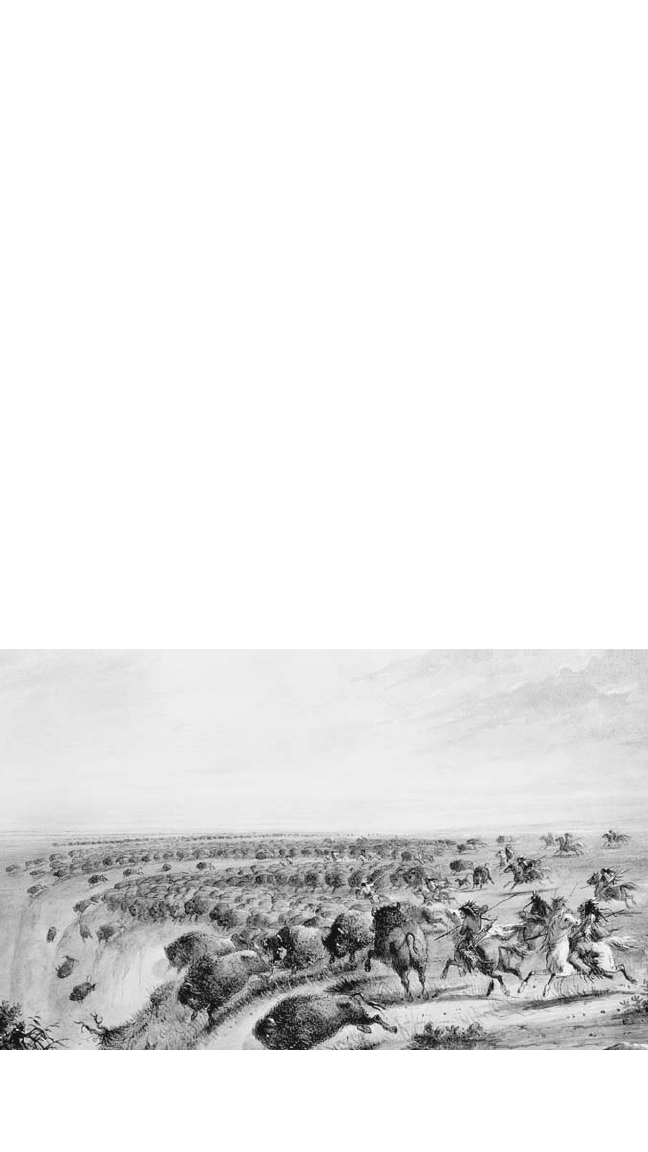
fertile soil. Instead, the immense herds of buffalo that roamed over and
fed upon these grasslands was the foundation of Plains culture. Buffalo
A Buffalo Rift, an 1867 painting by Alfred Jacob Miller (1810–74), depicts Plains Indians
hunting their chief staple by driving the herd over a cliff.
(Library and Archives Canada C-000403)
THE NATURAL DOMAIN

A BRIEF HISTORY OF CANADA
12
meat was the dietary staple, either cooked directly or ground and mixed
with fat and berries to produce pemmican. Buffalo hide was used for
clothing, footwear, shields, and cover for the conically shaped tipis that
served as homes. Buffalo bones, hooves, and horns provided tools,
weapons, and utensils. Buffalo hair and sinew was used for thread and
bowstrings. Buffalo dung was a source of fuel on the treeless plain.
The dependence on hunting buffalo along with antelope, deer, and
grouse dictated a nomadic existence. The constant search for buffalo
herds inhibited extensive social or tribal organization. Most tribes con-
sisted of loosely organized and independent bands. Only in midsummer,
when the buffalo were concentrated in large herds, would the bands
come together for a few weeks in one large communal hunting drive.
Once the well-organized buffalo hunt ended, the bands dispersed to their
own encampments to prepare for the harsh winter. Intertribal trade and
raiding brought the horse to the Canadian plains by the end of the 17th
century. The immediate result was an improvement in hunting tech-
nique, as people no longer had to follow the buffalo herd on foot. But in
addition to enhancing the mobility of the Plains people, the use of the
horse intensifi ed their sense of independence from each other, which in
turn would render them vulnerable to European encroachment.
Pacifi c Coast and Plateau
Almost half of the Native population of Canada lived in modern-day
British Columbia on the eve of European contact. Moreover, the coastal
and interior regions of British Columbia had the most linguistically
diverse indigenous population. Despite their proximity to one another,
the peoples living along the Pacifi c coast and in the interior plateau
region evolved as distinct cultural communities primarily because of
the isolating effects of the towering Cordilleran mountain ranges.
The people of the Pacifi c belong to fi ve unrelated language families
consisting of 19 distinct languages. Among the major tribes strung
along the coast from north to south are the Tlingit and the Haida of
nearby Queen Charlotte Island, each of whom speaks a unique lan-
guage that has no known relationship to any other. Immediately to the
south of the Tlingit are people who speak three languages of the Tsim-
shian language family. The Kwakwala or Kwakiutl to the south of the
Tsimshian and the Nootka on the western coast of Vancouver Island
are part of the Wakashan language family, while the southwest coastal
Salish and the inland Bella Coola are members of the large Salishan
language family.
13
The coastal people made good use of the abundant marine and forest
resources of their region. They were capable fi shers and sea hunters,
depending largely on salmon, seal, and sea otter for food, clothing, and
tools. The dense forests also provided them with ample deer, elk, bear,
and mountain goat, in addition to giant cedar and fi r timbers for their
long dugout canoes. These seaworthy canoes, with a capacity of as
many as 50 adults, enabled them to travel great distances to raid and
trade with their neighbors. The giant timbers were also split with antler
wedges into wide, smooth planks and used to build massive communal
houses. The tall, straight trunks were worked with stone and later iron
tools (derived from trade with Europeans) into elaborately sculptured
totem poles that depicted the crests and legendary histories of the chief-
tains’ families.
The abundance of resources encouraged the Pacifi c coast peoples to
live in relatively permanent villages close to navigable water under the
leadership of two or three hereditary clan chiefs. United by kinship,
dialect, or common territorial interest, villages were generally indepen-
dent of each other, although in times of war a chief of commanding
personality and fi ghting skill might form a temporary alliance with other
villages in the area. Village society was organized on the basis of a rigid
class system, in which people were generally divided into three ranks—
nobles, commoners, and slaves—that did not customarily intermarry.
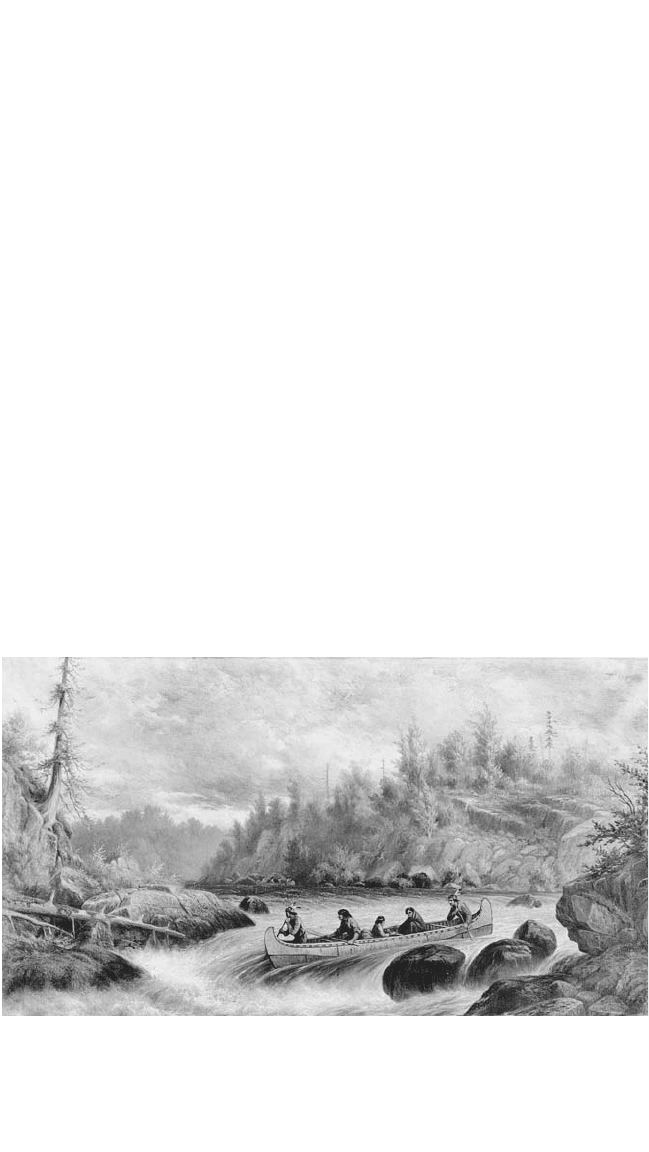
Ojibway Indians Shooting the Rapids, a painting by Frederick Arthur Verner (1836–1928),
illustrates the principal method of transportation that enabled Native peoples and Europeans
to open up the Canadian frontier.
(Library and Archives Canada, Bushnell Collection C-114480)
THE NATURAL DOMAIN

A BRIEF HISTORY OF CANADA
14
Similar to European feudal society, property was a basis of ranking and
a measure of affl uence. The noble families claimed possession of all the
land and places for hunting, fi shing, and gathering while the mass of the
common people sought their protection and employ. The slaves were
either prisoners of war or their offspring. They had no civil rights and
could be sold at their noble owner’s will. To enhance their prestige, the
chiefs and nobles would organize a potlatch, a special kind of feast that
involved a distribution of gifts according to the rank of the invited
guests. Potlatches were celebrated on all possible occasions, and noble
families often competed against each other to provide lavish gifts as a
sign of their wealth and generosity.
The indigenous peoples of the interior plateau region were less
populous and more scattered than their Pacifi c coast neighbors, primar-
ily because of the diffi culties of communication in this rugged area
between the coastal mountains and the Rockies. Included among the
Plateau societies are the Interior Salish of the Fraser River basin, an
eastern extension of the Salishan linguistic family; the Kutenai (Koote-
nay) in the Kootenay River basin to the east; and the Athapascan-speak-
ing people to the north, the largest of whom were the Carrier tribe.
Somewhat like their coastal neighbors, the seminomadic Plateau
people depended on salmon fi shing and hunting for bear, caribou,
moose, deer, and mountain goat. But in custom, dress, and housing,
they resembled the people of the Plains far more than they did those to
the west. Moreover, Plateau community life resembled the simple orga-
nizations of the nomadic hunting people of the Eastern Woodlands. A
group of families related by blood or marriage formed a band led by a
hereditary chief or headman whose advice was sought and who would
represent the group in an informal council of older men and prominent
hunters. Each band had its own hunting and fi shing territory, held in
common by all its families, who generally wandered and hunted together.
Wherever they came into contact with their stronger and more advanced
coastal neighbors, the inland people tended to adopt their ways of life,
including the hierarchical clan system and the potlatch. Unlike the
Pacifi c coast people who expressed their heritage through their art
forms, the Plateau people carried on a remote existence until the initial
European contact in the late 18th century.
Subarctic and Arctic
The inhospitable climate and terrain of the upper Canadian Shield, the
Hudson Bay Lowlands, the Mackenzie and Yukon River valleys, and the

15
northern reaches of the western Cordilleras have sustained a widely scat-
tered and sparsely populated Subarctic cultural group. In fact, Subarctic
population densities were among the lowest in the world, as little more
than 60,000 Natives occupied an area in excess of 2 million square miles
on the eve of sustained European contact. Most of the Subarctic people
were not organized politically into tribes; but neighboring bands, speak-
ing a common language dialect, exploiting the resources of the same
territory, or closely related by family ties or marriage tended to form
identifi able groups. Broadly speaking, the Subarctic peoples belong to
two regionally based language families. The Algonquian-speaking people
of the eastern Subarctic include the Innu (Montagnais-Neskapi) of north-
ern Quebec and Labrador, the Cree in the Hudson Bay Lowland and
upper Shield regions of Quebec and Ontario, and the Ojibwa northwest
of Lake Superior. More than 20 Athapascan languages are known to be
spoken among the people of the western Subarctic who are known today
as the Dene. Among the major groups spread across the Northwest and
Yukon territories from Hudson Bay to Alaska were the Chippewyan,
Slave, Beaver, Dogrib, Sekani, Tutchone, and Kutchin.
The Subarctic peoples were primarily hunters and forest dwellers
who lived in bands of 25 to 30 members. With no permanent villages,
each band moved frequently within a defi ned territory in search of
caribou, beaver, and hare in the northern districts and bear, moose, and
buffalo in the southern districts. When game was in short supply, they
fi shed in the numerous rivers and lakes. During the summer, several
local bands often resided together to take advantage of prime hunting
and fi shing sites. Most Subarctic bands did not have formal chiefs prior
to European contact; instead, they followed the leadership of a senior
male who took the initiative in undertaking particular tasks such as
trading, warfare, and communal hunting. All adult males and females
had a voice in the decision-making process, and families or individuals
who disagreed with decisions affecting the band were free to join
another band. Such a degree of personal autonomy and fl exibility in
social organization helped the Subarctic peoples respond to the oppor-
tunities and challenges of their environment.
Overcoming the limitations of the environment was an even greater
challenge for the Native people of the Arctic region. Historically known
as Eskimos, an Algonquian word roughly meaning “eaters of raw
meat,” the Arctic people in recent times have preferred to call them-
selves Inuit, simply meaning “people.” They speak one common lan-
guage, Inukitut or Eskimo-Aleut, although as many as six dialects are
THE NATURAL DOMAIN

A BRIEF HISTORY OF CANADA
16
spoken throughout the Arctic region. The Inuit are divided into eight
main tribal groups, some of which are named after the regions in which
they are located: the Labrador, the Ungava of northeastern Quebec, the
Baffi n Island, the Iglulik along the northwestern shore of Hudson Bay,
the Caribou along the mainland coast west of Hudson Bay, the Netsilik
along the Arctic coast west of Hudson Bay, the Copper of Victoria
Island and the adjacent mainland region, and the nearly extinct Mack-
enzie whose territory in the Mackenzie River delta was taken over in
the 20th century by Alaskan Natives to form the Western Arctic Inuit
community.
Over thousands of years, the Inuit developed from their Paleoeskimo
ancestors, notably the Dorset and Thule cultures, a special ability to
adapt to their barren and polar environment by making inventive use
of meager local resources. They hunted caribou, polar bear, seal, and
whale not only for their food but also for all the various necessities of
life. The skins of these animals, for example, were used to make cloth-
ing and footwear, tentlike summer shelters, and both single-seated
water craft known as kayaks and larger vessels called umiaks. From
bone and ivory, the Inuit made bows and arrows, spears and harpoons,
knives, fi shhooks, and runners for sleds pulled by dogs over snow and
ice. From seal, walrus, and whale, they derived oil for fuel and lighting.
Out of blocks of ice and snow, they constructed their dome-shaped
winter dwelling known as the igloo.
The need to wander incessantly over land, ice, and water in search of
game and sea mammals made for rather transitory community organiza-
tion. Approximately 20,000 Inuit were scattered in small communities
throughout the nearly 1 million square miles of Arctic frontier on the
eve of sustained European contact in the late 18th century. The most
important social and political unit was the regional band, several of
which together constituted a tribal group consisting of 500 to 1,000
members. During the winter, regional bands tended to congregate in
groups of 100 to 200 people to hunt seal. But in the summer they would
disperse into smaller bands of two to fi ve families to pursue their own
destinies and occasionally to form new groupings in response to social
needs and desires to interact with kin living elsewhere. Although elder
men whose strength of character and physical skills gave them prestige
in the community that allowed them to wield a certain amount of infl u-
ence, they were not chiefs and possessed no real authority over their
own or neighboring groups. Such a loosely knit community organiza-
tion refl ected the precariousness of life in an environment where human
settlement was governed by seasonally available food resources.

17
Prior to sustained European contact, in essence, the Native peoples
had already laid the foundation for future human development in the
northern half of North America in three signifi cant respects. First, a
sustainable economy was based on the exploitation of abundant, albeit
unevenly distributed, natural resources. Traditional Native technology
negated the possibility of resource depletion or of refi nement of
resources for industrial production. Second, society was invariably
multicultural and multilingual. Vast distances, geographical barriers,
and limited transportation technology often prevented an intermin-
gling of these diverse native cultures. Third, geography dictated the
persistence of regionalism as the basis for political or social organiza-
tion. Accordingly, lines of communication and exchange for the Native
peoples were more often north and south than east and west. Into this
context came Europeans with their modern technology and peculiar
concepts of property ownership and nationally based political organiza-
tions, which over a period of fi ve centuries would profoundly alter the
natural domain of Canada.
THE NATURAL DOMAIN

18
2
ACCIDENTAL REDISCOVERY
(986–1608)
A
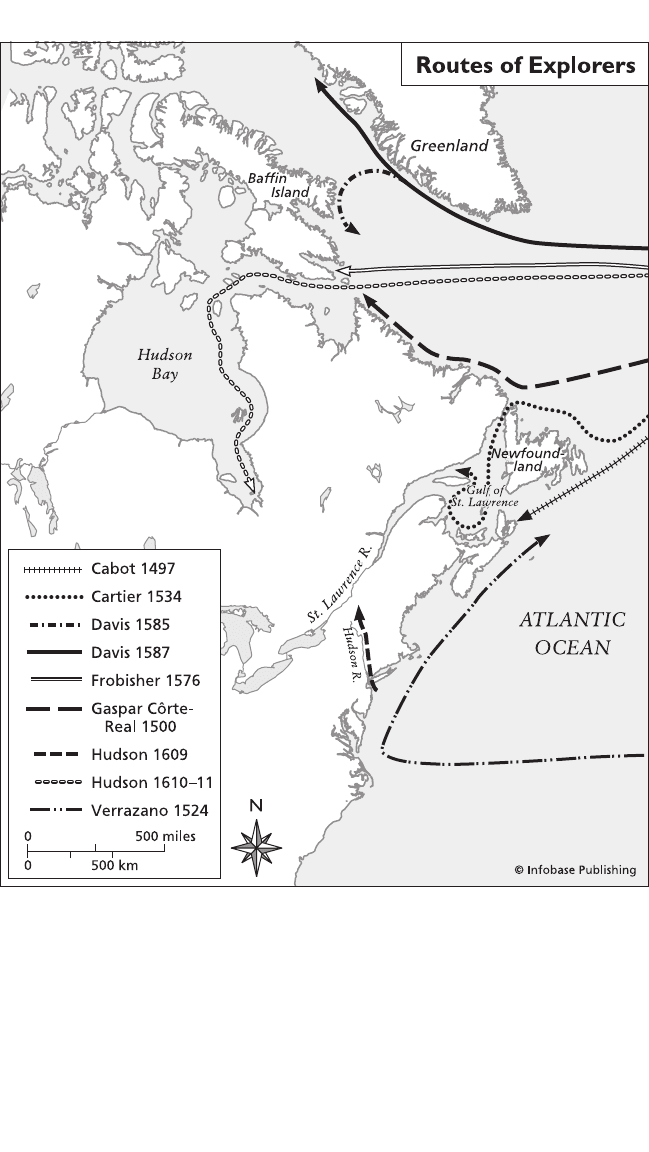
lthough Canada was originally discovered by anonymous Native
peoples, the fi rst attempts to record the process of exploring and
identifying the unknown land were undertaken by European naviga-
tors and adventurers. Yet the earliest moments of European contact are
almost as mysterious as the prehistoric period. A partial explanation
for this ambiguous beginning lies in the serendipitous nature of the
European “rediscovery” of the “New World” and the disappointment
that inevitably followed. In The Oxford History of the American People,
historian Samuel Eliot Morison points out: “America was discovered
accidentally by a great seaman who was looking for something else;
when discovered it was not wanted; and most of the exploration for the
next fi fty years was done in the hope of getting through it or around it”
(Morison 1994, 55).
While Morison was referring to Christopher Columbus’s discovery
of the West Indies in 1492, similar circumstances and sentiments sur-
rounded the early European landings in Canada. Disillusioned by their
failure to fulfi ll their destiny, the early explorers tended to make a cur-
sory note of Canada’s existence and continued hopefully in their quest
for more rewarding discoveries.
The Norse Voyages
The accident and ambiguity of the European rediscovery of Canada is
epitomized by the Norse voyages of the late 10th and early 11th centu-
ries (McGhee 1989; Morison 1971; Quinn 1977). In search of more
farmland, Scandinavian mariners, known as Norsemen or Vikings, had
ventured northwestwardly from the European mainland to discover
and colonize Iceland about 874 and Greenland in 985. According to
19
ancient Norse sagas, trader Bjarni Herjolfsson was blown off course on
his way from Iceland to Greenland in 986 when he became the fi rst
known European to sight the mainland of North America. Having
likely reached the coast of Labrador, he decided against landing, pur-
portedly concluding: “This land is unwinsome and ungainsome”
(Stefoff 1992, 15). In other words, the fi rst recorded opinion about
North America was that it was neither pretty nor profi table.
ACCIDENTAL REDISCOVERY