
Riendeau A Roger E. Brief History of Canada
Подождите немного. Документ загружается.


A BRIEF HISTORY OF CANADA
40
The signifi cance of this brief skirmish became even more far-reach-
ing less than three months later, in September 1609, when Henry Hud-
son sailed up the river that bears his name and traded with the Iroquois.
Within fi ve years, the Dutch had established a trading post—Fort Nas-
sau—where Albany, New York, is now located. Rival European trading
nations now controlled the two main navigational arteries that offered
access to the heart of the continent. The Dutch (and later the English)
supplied the Iroquois with European fi rearms in exchange for furs via
the Hudson and Mohawk Rivers; the French could similarly trade with
the Algonquians and Huron via the St. Lawrence and Ottawa Rivers.
The injection of European technology and economic motives had the
further effect of intensifying the nature and scope of intertribal warfare
in North America. Quick raids by small bands engaging in hand-to-
hand combat to infl ict relatively limited casualties and to capture a few
prisoners for ceremonial torture would give way to sustained, larger-
scale military campaigns featuring the use of fi rearms and steel weap-
ons that resulted in unprecedented brutality and death.
Champlain’s commitment to a commercial alliance with the Algon-
quians and Huron necessitated his participation in another successful
attack on the Iroquois near the mouth of the Richelieu River in 1610.
In a further effort to persuade the northern and western tribes to bring
their furs to Quebec, he inaugurated the practice of sending young
company representatives to live among the Native people to learn their
language, customs, and values. The diplomatic Champlain recognized
the value of showing due respect to his Native business partners, on
whose goodwill, knowledge, and skill French colonists were so depen-
dent. For the French were not only enormously outnumbered by the
Native population but had also learned from their Native allies about
the geography of the country and basic tactics for survival in the wilder-
ness, including the manufacture and use of such essential items as
canoes, snowshoes, and toboggans (Trudel 1973). In 1610 Champlain
arranged for young Etienne Brulé to live with the Huron. As one of the
fi rst coureurs de bois (runners of the woods), the adventurous Brulé
became a skillful interpreter and intermediary during his fi ve years
among the Huron. Traveling with his adopted people, he extensively
explored their trading area and thus was likely the fi rst European to see
the Great Lakes.
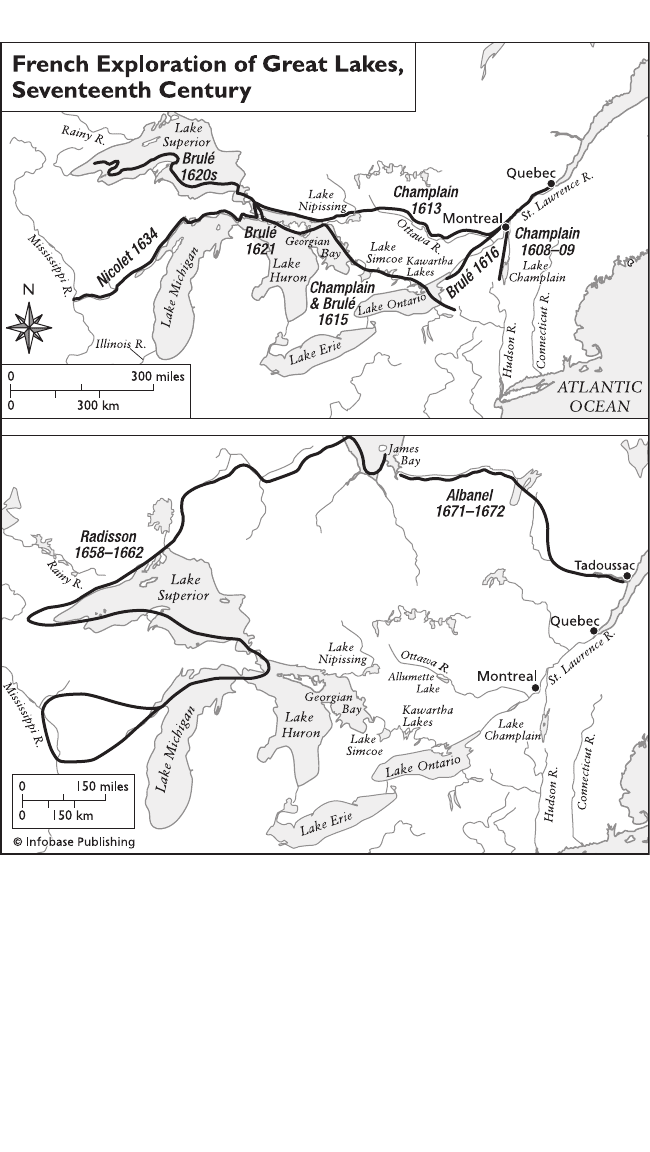
In 1615 Brulé served as Champlain’s interpreter as they accompanied
another Huron and Algonquian war party on a raid against the Iroquois,
who were obstructing the fl ow of furs to Quebec. In addition to contin-
ued trade, Champlain hoped that supporting the Huron-Algonquian

41
war effort would help overcome their reluctance to lead him into the
interior. In July 1615, Champlain and 12 others journeyed up the
Ottawa River, which he had explored two years previously, but this
time he continued westward along the entire route leading to Georgian
Bay on Lake Huron. Traveling south along the shore of Georgian Bay,
the expedition reached the heart of the Huron village encampments
near present-day Midland and Penetanguishene. During the month that
he spent in what became known as Huronia, Champlain learned much
about life within the Huron Confederacy, an alliance of several tribes
with a population exceeding 30,000 living in villages containing
upwards of 2,000 people each. The trade network of the Huron, by
virtue of their good relations with the Algonquians, extended as far as
Lake Superior to the west and James Bay to the north. In early Septem-
ber, the Huron war party with Champlain set out on its southeasterly
trek by way of the Severn and Trent River systems, reaching and cross-
ing Lake Ontario at its eastern narrows, and landing near present-day
Oswego, New York, a month later. On this occasion, however, the Iro-
quois, now equipped with Dutch fi rearms, were able to turn back this
assault on their fortifi ed village of Onondaga near Lake Oneida, and a
wounded Champlain retreated to Huronia with his Native allies.
Despite the military setback, the expedition of 1615 had far-reaching
signifi cance for the development of Canada. Although the fear of an
Despite its limited accuracy, Samuel de Champlain’s map of New France (1632) was a major
contribution to European geographical knowledge of eastern Canada.
THE COLONIZATION OF NEW FRANCE
A BRIEF HISTORY OF CANADA
42
Iroquois attack prevented the Huron from guiding Champlain back to
Quebec by way of the shorter St. Lawrence route, and thus compelled
him to winter in Huronia and return by the Ottawa route, he had
gained much knowledge about the relationship between the St. Law-
rence River and the Great Lakes, thereby opening the way for further
westward exploration. His return to Quebec in 1616 marked the end of
Champlain’s explorations, but his quest for a western sea was contin-
ued by his young protégés. Brulé reportedly reached Sault Ste. Marie

43
in 1621–22 and perhaps Lake Superior. Jean Nicolet set out from Que-
bec on his western trek in 1634, and within four years he had reached
Green Bay and approached the headwaters of the Mississippi River,
thus becoming the fi rst European to explore the American Northwest.
Certainly, Champlain’s active support of the Huron-Algonquian
campaign against the Iroquois paid commercial dividends, as this alli-
ance supplied upwards of two-thirds of the French fur trade by the
1620s. On the other hand, the Iroquois, inspired by their victory in
1615 and empowered by their trade connection with the Dutch, took
the offensive. For the remainder of the century, the Iroquois would
threaten the French fur trade empire either by disrupting interaction
with the western tribes or by assaulting the base at Quebec. Yet French
fur traders displayed little inclination toward peaceful relations with
the Iroquois out of a concern that they might allow the northern and
western tribes access to Dutch trading posts on the Hudson or serve as
brokers for them. So long as the Iroquois remained a barrier between
these tribes and the Hudson traders, the St. Lawrence traders held the
upper hand in the competition to control the North American fur trade.
In effect, the Native people, in their role as go-betweens and suppliers
for the fur trade, had become willing pawns of European imperialism
(Trigger 1985, 1989).
Catholic Missions and the Failure of Company Rule
Despite the advance of fur traders into the interior of the continent, no
more than 80 people lived permanently at Quebec by the mid-1620s,
and less than 20 acres there were under cultivation. With the state and
private enterprise unable or unwilling to encourage settlement,
Champlain turned to the Catholic Church for support. To stem the ris-
ing tide of the Protestant Reformation, the Catholic Church was eager
to spread the faith to the emerging colonies of the New World. The
French Catholic clergy, following the example of their Spanish and
Portuguese counterparts, had a vision of converting the pagan hordes
of America to Christianity. As early as 1615, four Recollets missionaries
arrived at Quebec and went to live at Huronia and among the
Montagnais at Tadoussac. A devout Catholic, Champlain hoped that
the missionaries would inspire the Algon quians and Huron to form
settlements, to farm the land, and to intermarry with the French peo-
ple. The Recollets, however, experienced diffi culty adjusting to wilder-
ness conditions, language barriers, and general hostility or indifference
to the Christian message. The Native people already had an enduring
THE COLONIZATION OF NEW FRANCE

A BRIEF HISTORY OF CANADA
44
religious tradition that adequately met their needs, and they had no
wish to abandon it. Accordingly, the Recollets sought the assistance of
the Society of Jesus (commonly known as the Jesuit Order), which sent
eight missionaries to Quebec in 1625–26.
The collaborative efforts of the Recollets and Jesuits were immediately
hampered by the Huguenot traders, who had no desire either to establish
settlement or to convert the natives to Christianity. In 1627 Cardinal
Richelieu, the chief adviser of King Louis XIII, stepped in to ban the
Huguenots from New France and to inaugurate an ambitious policy to
develop French colonies overseas. Impressed by the success of the Eng-
lish colonies of Virginia and New England, which had about 2,000 and
300 inhabitants, respectively, as well as the Dutch colony of New Neth-
erlands with about 200 settlers in the Hudson River valley, Richelieu was
determined to promote agricultural settlement and missionary activity
along the St. Lawrence. In accordance with the prevailing economic phi-
losophy of mercantilism, he hoped that New France could fulfi ll the
typical colonial function of enriching the imperial power by exporting
raw materials and by importing its manufactured products. The highly
infl uential Richelieu formed the Company of One Hundred Associates
(also known as the Company of New France), whose investors were
motivated more by religion and patriotism than by expectations of profi t.
In return for a monopoly on all commerce and title to all the land that
France claimed in North America, the company agreed to bring out 4,000
French and Catholic settlers within 15 years, and to promote missionary
activity. This most ambitious colonizing venture yet undertaken by
France began in earnest when the company sent 400 settlers with the
necessary supplies to Quebec in May 1628. However, renewed imperial
hostilities overseas would spill over into North America to interrupt
French colonization and missionary efforts for the next four years.
When hostilities broke out between France and England, the buc-
caneering Kirke brothers—David, Thomas, and Lewis—took advantage
of the opportunity to seize Tadoussac in 1627, to capture the French
ships that were bringing the settlers sent out by the Company of New
France in the following year, and to attack Quebec in 1629. Cut off
from France and lacking in food and supplies, Champlain and his gar-
rison had no choice but to surrender. Champlain returned to France
only to discover that the war between England and France had ended
three months before with the capitulation of Quebec, which now, like
Acadia, was offi cially an English possession.
England was mildly interested in Acadia because of its fi sheries and
its strategic approach to the St. Lawrence. In 1621 Scotsman Sir Wil-

45
liam Alexander persuaded King James I of England to grant him title to
all of the land of Acadia so that he could establish the colony of Nova
Scotia. In 1627 his son succeeded in bringing about 70 colonists to Port
Royal, most of whom were merely interested in the quick profi ts of the
fur trade and the fi sheries. The settlement had already disbanded by
1632 when the Treaty of St.-Germain-en-Laye restored all the French
territories that the English had seized in North America.
Having successfully campaigned for the restoration of Quebec to
French rule, Champlain returned in 1633 to rebuild the colony plun-
dered by the Kirke brothers and to resume his effort to bring out
settlers on behalf of the reorganized Company of New France.
Upstream from Quebec, he built another fur-trading post called
Trois-Rivières (Three Rivers) at the mouth of the St. Maurice River,
one of the main routes to the north. Within a few years, the Jesuits
established a mission there, and settlers began clearing the adjacent
land. But three decades of frustrating colony-building fi nally took
their toll on Champlain, who died on Christmas Day in 1635. The
passing of its founder and fi rst governor at a time when the Company
of New France was losing interest in colonization left Canada in a
precarious situation. The various proprietors of the company did not
object to settlement as such, only to its interference with trade or to
any attempt to make them subsidize it. Within the French govern-
ment, Richelieu became absorbed by the Thirty Years’ War in Europe,
and his successors were plagued by recurring civil unrest. For nearly
three decades after Champlain, then, effective colonial leadership
passed by default to the Catholic Church, particularly the Jesuit mis-
sionaries (Trudel 1973).
After the restoration of French rule in 1632, Cardinal Richelieu had
given the Jesuits a monopoly over the mission fi eld of New France. The
following year, Father Paul Le Jeune undertook to minister among the
Algonquin and Montagnais but found that their nomadic lifestyle
offered only a barren fi eld for missionary effort. The most successful
mission among the Algonquians was St. Joseph de Sillery (southwest of
Quebec), which contained about 150 baptized Montagnais by 1641.
However, the threat of Iroquois attack, continued resistance to Cathol-
icism and the French way of life, and the outbreak of European-based
diseases such as smallpox and measles led to the demise of the mission
by the end of the decade. Although similar problems plagued efforts at
Huronia, the more sedentary Huron proved to be slightly more recep-
tive after Father Jean de Brébeuf established the fi rst permanent mis-
sion there in 1634. Sainte-Marie was constructed in 1639 to serve as the
THE COLONIZATION OF NEW FRANCE

A BRIEF HISTORY OF CANADA
46
headquarters for the 11 other mission stations scattered throughout
Huronia by 1648.
French fur traders considered the missions in Huronia to be valuable
in consolidating their commercial alliance with the Huron Confeder-
acy. But the fur trade itself proved to be responsible for bringing the
missionary work at Huronia to a bloody end. When the Iroquois had
exhausted the furs of their own region, they invaded Huronia to cap-
ture the northern trade route and thereby maintain their vital traffi c in
European goods. In 1648 and 1649, the Iroquois unleashed their fury
on Huronia, obliterating both the Native population and the French
missionaries. The martyrdom of Brébeuf and his associates in Huronia,
however, did not end the work of the missionaries in evangelizing the
Native people. The priests continued their efforts among the Montag-
nais and extended them to such eastern tribes as the Micmac and
Abenaki. The Jesuits also spread westward, establishing a mission at
Sault Ste. Marie as they sought to maintain contact with their disciples
among the dispersed Huron. The Recollets and Sulpicians joined them
in following the path of the fur traders and explorers as they penetrated
the continent, together extending the frontiers of religion, commerce,
and French imperialism.
The religious orders pursued their Native conversion efforts within
the context of colonial expansion and attending to the spiritual and
social needs of the French settlers (Jaenen 1984, 1985). The Jesuits
became the principal agency for recruiting colonists and encouraging
them to clear the land. To this end, and to stimulate donations for their
missionary work, they published the annual Jesuit Relations, which from
1632 to 1673 reported on their activities in New France and praised the
merits of life in the new country. In addition to their value as immigra-
tion propaganda, the Jesuit Relations would later prove to be a useful
source of information about the early history of New France. The Jesuits
established a college at Quebec to educate colonists and natives alike as
early as 1635, a year before Harvard University was established in Mas-
sachusetts. When Marie de l’Incarnation’s Ursuline nuns arrived in
1639, they founded a school for girls and a hospital at Quebec. Mission-
ary zeal also motivated Sieur de Maisonneuve to lead some settlers,
including Jeanne Mance, Canada’s fi rst nurse, to establish Ville Marie in
1642. Strategically located at the confl uence of the Ottawa and St. Law-
rence Rivers, the mission settlement was destined to evolve into the
commercial center of Montreal over the next two decades.
Although the intervention of the Catholic Church helped to increase
the population of Canada to nearly 1,000 by the mid-1640s, colonial

47
development continued to be hampered by a lack of secular leadership
and the precariousness of frontier life. In 1645 the nearly bankrupt
Company of New France ceded the fur trade monopoly to a group of
local entrepreneurs known as the Compagnie des habitants (Company
of the habitants). In response to general dissatisfaction with the new
company’s rule, a royal decree created the fi rst form of local and repre-
sentative government in the colony. In place of a governor appointed
by the king on the nomination of the monopoly-holding company,
local authority rested in a council composed of the governor of the
colony (who resided at Quebec), the local governor of Montreal, the
Superior of the Jesuits, and syndics, or elected representatives of the
people of the three areas of settlement. Despite several modifi cations to
this structure over the next 15 years, the colony continued to be
plagued by a weak and divided administration.
The most persistently divisive issue—the sale of liquor to the Native
people—pitted commerce against religion. Alcohol had been unknown
to the Native people until the arrival of Europeans, but they quickly
acquired an appreciation for its intoxicating effects and demanded it
eagerly. Indeed, French traders found that they could obtain more furs
for a relatively small amount of alcohol than they could for larger quan-
tities of other goods. On the other hand, the clergy, appalled at the
social and moral consequences of excessive consumption by Natives
who had not yet developed a physical tolerance for alcohol and who
refused to take responsibility for their behavior while intoxicated,
wanted its sale outlawed, and declared such trade to be a mortal sin.
The arrival of Bishop Laval in 1659 and his subsequent government
appointments intensifi ed quarrels between the governor, who invari-
ably supported the fur trade, and the bishop, who saw himself as the
protector of society and the arbiter of morality.
Above all, the slow growth of population in the St. Lawrence colony
by the mid-17th century was directly related to the daunting prospects
of life in the Canadian wilderness. To start with, prospective immi-
grants were confronted with the dangers of the Atlantic crossing, which
could take anywhere from three weeks to three months depending on
headwinds and weather. Problems with food supply, sanitation, and
scurvy onboard ship often meant that upwards of 20 percent of the pas-
sengers did not survive the transatlantic journey. Those who did arrive
safely faced the arduous task of clearing the dense hardwood forest,
building log shelters with crude implements, and clearing land to plant
crops. Even when settlers had progressed that far, they faced the threat
of Iroquois attacks.
THE COLONIZATION OF NEW FRANCE

A BRIEF HISTORY OF CANADA
48
The settlements along the St. Lawrence had been largely immune
from Iroquois assaults until the early 1640s, when the escalation of
competition for control of the inland fur trade and French expansion
westward rendered them more vulnerable. By the 1650s Canada was in
a virtual state of siege, with the result that small detachments of French
soldiers began regularly patrolling the St. Lawrence from Trois-Rivières
to Montreal, the most exposed settlement. A mass invasion of Montreal
was thwarted by Adam Dollard des Ormeaux and his 16 companions,
whose heroic stand to the death at Long Sault on the Ottawa River kept
the Iroquois from completing their mission of destruction in 1660. The
fear of the Iroquois was heightened in 1664 when the English captured
the Dutch colony of New Amsterdam and renamed it New York. The
Hudson River route was thenceforth controlled by an ominous alliance
of France’s most powerful European enemy and its most relentless
Native American adversary. The prospect of both the English and the
Iroquois turning their aggressive designs on the St. Lawrence colony
appeared to seal the fate of the French empire in North America.
The plight of Acadia was even worse than that of Canada. After res-
toration to French rule in 1632, France took a momentary interest in
the colony as Cardinal Richelieu sent his cousin Isaac de Razilly with
This wood engraving by artist John Walker (1831–98) shows Quebec about 1640. The strategic
location of Canada’s fi rst permanent settlement on the heights overlooking the St. Lawrence
River enabled the garrison to withstand numerous attempts to capture it.
(Library and Archives
Canada C-006492)

49
about 300 colonists to revive Port Royal and to establish a new settle-
ment at La Hève (along the southeast coast), both on behalf of the
Company of New France. De Razilly’s death in 1636, however, proved
to be a major setback for the colony, plunging it into civil strife by the
rival claims of successors who vied for control over the fur trade of
Acadia. While Charles de Menou d’Aulnay laid claim to Port Royal as
de Razilly’s cousin, Charles de la Tour felt that his connection with the
de Poutrincourt family entitled him to govern Acadia from his fort at
the mouth of the Saint John River (in present-day New Brunswick).
Armed confl ict between the two rivals, marked by raiding, plundering,
and destroying each other’s posts, persisted until 1645 when d’Aulnay
captured de la Tour’s headquarters while he was in Boston enlisting
more support for his cause. D’Aulnay remained the sole authority in
Acadia until his death in 1650, thereby opening the way for de la Tour’s
return. Ultimately, the long-standing feud was resolved in typical Euro-
pean fashion when de la Tour married d’Aulnay’s widow in 1653. The
next year, however, an expedition from Massachusetts led by Francis
Nicholson captured Acadia, and once again the colony was part of the
English empire.
Acadia, in essence, was a victim of geography and imperialism. Because
of its strategic but exposed position between the principal French and
English colonies, Acadia was a primary target for conquest in times of
imperial confl ict. But once those hostilities subsided, Acadia’s limited
resources rendered it unworthy of further contention. Consequently, the
colony was tossed back and forth between empires, with little or no con-
cern for its development (MacNutt 1965; Griffi th 1973).
After half a century, the French empire in North America rested on
a precarious foundation. Acadia had been lost through sheer neglect,
and the survival of the larger St. Lawrence colony remained in jeop-
ardy. Under the rule of private fur-trading companies, both colonies
were too weak in numbers, resources, and administration to defend and
sustain themselves, let alone to attract more settlers and entrepreneurs.
With the complete failure of company rule, only decisive and unprec-
edented state intervention could save New France from extinction.
THE COLONIZATION OF NEW FRANCE