
Riendeau A Roger E. Brief History of Canada
Подождите немного. Документ загружается.


A BRIEF HISTORY OF CANADA
290
industrial growth inevitably transformed many farmers into wage earn-
ers, a trend that was worrisome to the traditional French-Canadian
leadership. The Catholic Church, in particular, was concerned that its
hold on the people would diminish when they moved from rural par-
ishes to urban centers where they would be exposed to such social and
moral infl uences as trade unions, socialist ideas, and materialistic oppor-
tunities and expectations that might seriously threaten their faith.
Duplessis championed clericalism and the traditional rural-agrarian ide-
alism that still appealed in the small towns and countryside of Quebec.
Duplessis’s brand of nationalism also took advantage of the height-
ened resentment during the depression toward the exploitation of the
French-Canadian laborer by the “alien” English-owned corporations
that increasingly dominated the Quebec economy. Skillfully portraying
himself as a defender of provincial rights, Duplessis led Union Nationale
to victory over the long-reigning and scandal-ridden Liberal administra-
tion of Louis-Alexandre Taschereau in the Quebec election of 1936.
Duplessis welcomed American investors to develop the province’s
resource frontier and endeavored to serve their interests by suppressing
the collective bargaining rights of trade unions. His notorious Padlock
Law in 1937, allowing for the seizure and closure of any place used for
“subversive” activity, was ostensibly directed at communists but was
broadly interpreted to apply to any group disapproved by the church or
the government. For nearly two decades (1936–39 and 1944–59),
Duplessis would rule over Quebec like a benevolent dictator.
In Ontario, Mitchell Hepburn led the Liberals to victory in the elec-
tion of 1934 on the strength of radical rhetoric to fi ght for “the dispos-
sessed and oppressed” against the “big shots.” Nonetheless, Hepburn
appealed to dissatisfi ed taxpayers, particularly among the rural and
mining interests, by cutting relief expenditures and fi ghting against
organized labor (Neatby 1972). When the American-based Committee
for Industrial Organization (CIO) organized a strike at the General
Motors plant in Oshawa in 1937, Hepburn attempted to break the
union by forming his own police force, known irreverently as “Hep-
burn’s Hussars” and “Sons-of-Mitches.” Prime Minister King’s refusal
to send in RCMP reinforcements at Hepburn’s request soured relations
between the two Liberal leaders, as did Hepburn’s propensity to cham-
pion provincial rights in matters relating to social policies and intergov-
ernmental fi nances.
In British Columbia, another Liberal premier, T. Dufferin Pattullo,
also became embroiled in a confl ict with the federal wing of his party.
After his election in 1933, Pattullo instituted a reform program, includ-

291
ing extensive public works and social services, which eventually became
known as the Little New Deal. His frustration with the limitations of
provincial power regularly clashed with King’s determination to control
the “spendthrift” provinces regardless of their political allegiance.
Confrontation between the federal and provincial governments,
which had been building since Confederation, was accentuated during
the Great Depression by discrepancies between resources and respon-
sibilities. The provinces had the constitutional power to deal with pre-
vailing social problems, but they lacked the fi nancial resources to do so
because of their limited taxation power under the British North Amer-
ica Act. On the other hand, the federal government had the fi scal
resources but not the constitutional authority to take decisive action in
the realm of social welfare. Indeed, the Judicial Committee of the Privy
Council ruled the minimum wage, maximum hours, social and unem-
ployment insurance, and fair trade practices provisions of the Bennett
New Deal to be unconstitutional because they fell within provincial
rather than federal jurisdiction. In response to this situation, the federal
government in 1937 appointed the Royal Commission on Dominion-
Provincial Relations to reexamine “the economic and fi nancial basis of
Confederation and the distribution of legislative powers in the light of
the economic and social developments of the last seventy years.”
Although the Rowell-Sirois Commission reported too late to affect the
outcome of the Great Depression, its fi ndings and recommendations
would help to lay the foundation for the Canadian welfare state (Guest
1997).
The recovery of the Canadian economy by the late 1930s was only
peripherally infl uenced by government policy. The King government
increased the amount of federal relief assistance to the provinces and,
in response to a recommendation of the National Employment Com-
mission in 1938, deliberately incorporated defi cit fi nancing into its
recovery strategy. In so doing, the federal government was following
the theories of British economist John Maynard Keynes, who argued
that if private enterprise failed to produce full employment, then the
state had to take the initiative to create jobs even if it meant incurring
substantial budgetary defi cits. For the next half-century, the Keynesian
notion of an active public sector would supersede the laissez-faire pri-
ority of balancing the budget. The King administration also attempted
to stimulate the economy by negotiating reciprocal trade agreements
with the United States in 1935 and 1938, with the result that both
countries lowered the duties on some of each other’s imports. In 1937
the federal government extended the scope of national transportation
THE PERILS OF DEPRESSION AND WAR

A BRIEF HISTORY OF CANADA
292
and communication by launching Trans-Canada Airlines (the forerun-
ner of Air Canada), which could fl y from Montreal to Vancouver in 18
hours.
One of the legacies of the Great Depression was the unproven belief
that if the government had intervened sooner and more decisively the
economic crisis would have been moderated or terminated. Ultimately,
the depression merely faded away amid the rising armament boom as
another war loomed overseas. The sad irony was that only history’s
bloodiest and most destructive war was capable of subduing history’s
greatest economic crisis.
From Isolationism to International Calamity
The economic crisis of the 1930s instilled in Canada a reluctance to
exercise the right confi rmed by the Statute of Westminster in 1931 to
participate fully in international affairs. The prevailing spirit of eco-
nomic nationalism throughout the world prompted Canada to be more
concerned with protecting its own interests and avoiding costly entan-
glements overseas. The masses of unemployed workers and drought-
ridden farmers at home were a more pressing priority than the
misfortunes of people in foreign lands. Foreign relations inevitably
affected national unity, as Quebec tended to reject the view that Canada
was part of an integrated world community whose interests extended
beyond national borders. Finally, Canada could not help but be infl u-
enced by the strong isolationist stance of its powerful neighbor and
major trading partner, the United States. While the Bennett administra-
tion was hopeful of strengthening bonds with Britain and the
Commonwealth, King was more realistic in his perspective that Canada
was a North American nation geographically, economically, and mili-
tarily (Thompson 1985).
Canada’s determination to limit its overseas commitments was evi-
dent in its response to Japan’s invasion of Manchuria in 1931. Con-
cerned about the potential loss of trade at a time of worsening depression,
Canada refused to condemn this Japanese aggression against China and
avoided taking sides in the subsequent confl icts between the two Asian
countries, which would escalate into a major theater of international
warfare in the following decade. When Italy’s fascist dictator, Benito
Mussolini, tried to revive the imperial glory of ancient Rome by invad-
ing the weak African nation of Ethiopia in 1935, Walter Riddell, Cana-
da’s delegate to the League of Nations, proposed oil sanctions against
Italy as a punitive measure. Fearing a backlash in Quebec where sym-

293
pathy for Catholic Italy was strong and wishing to avoid participation
in armed struggles not directly related to Canadian interests, Prime
Minister King declared that Riddell’s proposal was not the policy of the
Canadian government. The subsequent decision to drop the proposed
oil sanction demonstrated the league’s indecisiveness in the face of a
determined adversary (Eayrs 1965; Stacey 1981). Canada heartily sup-
ported the British and French policy of appeasement in the face of the
imperialist ambitions of Nazi dictator Adolf Hitler because it appeared
to be a way of avoiding overseas commitments. King even visited Hitler
in 1937 and came away convinced that the German leader was more
concerned about the spread of communism than in waging war with
Britain and France.
King’s faith in Hitler, like the policy of appeasement, proved to be
misguided. On September 3, 1939, Britain and France declared war on
Germany following its invasion of Poland. Unlike in 1914 when the
British declaration of war automatically included its colonies and
Dominions, Canada, as an autonomous member of the British Com-
monwealth of Nations, was determined to choose its own course of
action. “Let Parliament decide,” proclaimed King, as he clearly indi-
cated that his government would vote to support Britain and would not
resort to conscription, thereby appealing to both the English- and
French-speaking communities. With Woodsworth as the only dissent-
ing vote on pacifi st grounds, Parliament approved the Canadian decla-
ration of war, which came one week after that of Britain.
Asserting that Canada’s declaration of war did not refl ect the wishes
of Quebec, Premier Duplessis called a provincial election. Four French-
Canadian federal ministers led by Minister of Justice Ernest Lapointe
threatened to resign, thereby leaving Quebec without representation in
the federal Cabinet, if Union Nationale was returned to power. Quebec
voters declared their unqualifi ed support for the war effort by electing
the Liberals under Adelard Godbout. Always looking for an opportu-
nity to challenge the federal government, Premier Hepburn of Ontario
abusively condemned King’s conduct of the war to the point of prompt-
ing the prime minister to call a national election in March 1940. The
Liberal victory by an increased majority convinced King to reject Con-
servative demands for a coalition government to formulate and imple-
ment war policy.
At the outset of World War II, Canada expected that its primary
contribution would be the production of war supplies rather than the
mobilization of armed forces, which were hitherto small in number. In
late 1939, the Royal Canadian Air Force (RCAF) agreed to administer
THE PERILS OF DEPRESSION AND WAR

A BRIEF HISTORY OF CANADA
294
the British Commonwealth Air Training Plan, which eventually pro-
duced 130,000 aviators, more than half of whom were Canadian. Not
only did this scheme have the advantage of being acceptable to French
Canadians because it was based at home rather than abroad, but the
nearly $1.3 billion that the Canadian government invested in it was a
stimulus to the national economy. The hope that Britain and France
could subdue Germany with Canadian material support was dashed by
June 1940 when France fell and Italy entered the war on the German
side. With the neutrality of the United States and the Soviet Union con-
tinuing until 1941, Canada stood as the next strongest nation to Britain
in the fi ght against the German-Italian-Japanese Axis.
As they had during World War I, Canada’s armed forces met the
challenges of military service and all-out warfare with their customary
courage, bravery, and fi ghting effi ciency. The Canadian army, which
expanded from 4,000 troops to almost 700,000 men and women under
the command of General A. G. McNaughton, distinguished itself on
several critical battlefronts: the defense of Hong Kong in 1941, the bold
raid on the French coast at Dieppe in 1942, the conquest of Sicily in
1943, the D day landing at Normandy as well as the capture of Rome
and the Belgian port of Antwerp in 1944, and the liberation of the Neth-
erlands before the fi nal offensive against Germany in 1945. The Royal
Canadian Navy, which expanded from 17 to 900 vessels and from
3,000 troops to a force of 100,000 men and 6,500 women, played a vital
role in patrolling the sea lanes of the North Atlantic and guarding the
approaches to the harbors of North America, in addition to contribut-
ing 110 battleships to the Allied landings in Normandy. The Canadian
air force, which expanded from 4,000 to more than 200,000 men in
both RCAF squadrons and RAF crews, fought in the Battle of Britain;
participated in the nightly bombings of Germany; and fl ew over Malta
(in North Africa), Italy, India, Burma, Alaska, and the Arctic. Alto-
gether, about 1 million Canadians or more than one-twelfth of the
national population saw military service at home or overseas during
World War II. More than 40,000 Canadians were killed in the blood-
bath that claimed as many as 60 million lives worldwide from 1939 to
1945 (Stacey 1970; Granatstein 1975).
The magnitude and duration of the war effort again brought the
thorny question of conscription to the forefront of Canadian politics.
From his experience during World War I, Prime Minister King was well
aware of how divisive the issue of compulsory military service for over-
seas operations could be for the country and for his political party. For
more than two years King was determined to keep his “no conscrip-

295
tion” pledge, which had secured French-Canadian support for the war
effort, despite the persistent demands of those English-speaking Cana-
dians who had family members fi ghting overseas or who pointed to the
British and American commitment to total war on the basis of national
conscription. As pressure from public opinion and within his govern-
ment mounted in 1942, King decided to consult the Canadian people
by holding a national plebiscite that asked them if they would release
the government from its anticonscription pledge. Predictably, Quebec
voted 72 percent against while the rest of Canada voted 80 percent in
favor. The result of the plebiscite freed King from his pledge and
increased the demand for conscription in English Canada. But French
Canada felt betrayed to the extent that a new political party, the Bloc
Populaire, was formed with both Quebec and federal wings. While
some Quebec nationalists viewed conscription in terms of English
Canada’s continued attempts to assimilate French-Canadian culture or
of the federal government’s violation of provincial rights, most French
Canadians lacked enthusiasm for compulsory overseas service because
they did not feel immediately concerned with the European confl ict.
They had been estranged from France for nearly two centuries and had
no strong loyalty to Britain. Thus, the majority of French Canadians
would have preferred Canada to remain neutral as the United States did
until late 1941, but they did not oppose Canada’s participation in the
war on the basis of voluntary enlistment.
While King introduced legislation to make conscription possible, his
position remained “not necessarily conscription but conscription if
necessary.” He further specifi ed that conscription, if implemented,
would be for home service only and that overseas service would be on
a voluntary basis. The furor over conscription died down until late
1944 when Minister of Defense J. L. Ralston returned from a tour of
Canadian forces in Europe to report that more reinforcements were
needed to replace the higher than expected casualties in the Normandy
fi ghting. When attempts to raise more volunteers failed, King had little
choice but to agree to conscription for overseas service. Only 13,000
conscripts were sent overseas before the war in Europe ended in May
1945.
King and the Liberal Party escaped the second conscription crisis
with far less political fallout than Robert Borden, Arthur Meighen, and
the Conservatives had incurred in the aftermath of World War I. In
contrast to the way in which Borden and Meighen had pushed the con-
scription agenda in the face of French-Canadian opposition in 1917,
King had proceeded more cautiously and with greater sensitivity to the
THE PERILS OF DEPRESSION AND WAR
A BRIEF HISTORY OF CANADA
296
implications of the issue for national unity. So whereas the fi rst con-
scription crisis effectively crippled the Conservatives in Quebec for
much of the remainder of the 20th century, the Liberals were able to
retain their French-Canadian support in winning the national election
of 1945, albeit by a substantially reduced majority (Granatstein and
Hitsman 1985). Quebec preferred to take its frustration out on the pro-
vincial Liberals by returning Duplessis and the Union Nationale to
power in 1944. The anticonscription Bloc Populaire was not a factor in
either the provincial or the federal election and soon disappeared.
The cultural sensitivity to French Canadians that King and the Liber-
als demonstrated during the conscription controversy was not extended
to other ethnic communities, however. In particular, members of eth-
nic groups whose homelands were at war with Canada faced harsh
treatment from the government and a general public infl uenced by
patriotic propaganda. Although no evidence of subversive activity was
found, hundreds of Germans and Italians were interned in camps or
detained in jails. The worst injustice was perpetrated against more than
20,000 Japanese living in British Columbia, many of whom were Cana-
dian citizens. They were herded into camps in the interior of the prov-
ince, and many of them had their property confi scated. More than four
decades would pass before the federal government would acknowledge
the mistreatment of Japanese
Canadians and would offer an
offi cial apology and fi nancial
compensation. The prevailing
climate of racial intolerance dur-
ing World War II also blinded
Canadians, and the rest of the
world, to the Jewish Holocaust
perpetrated by Nazi Germany.
The perils of war fostered a
unity of the English-speaking
world to an extent that Goldwin
Smith would have appreciated a
half-century earlier (Creighton
1976). The military, economic,
political, and diplomatic collabo-
ration of Canada, Britain, and
the United States in a common
effort against a common enemy
reinforced the evolving concept
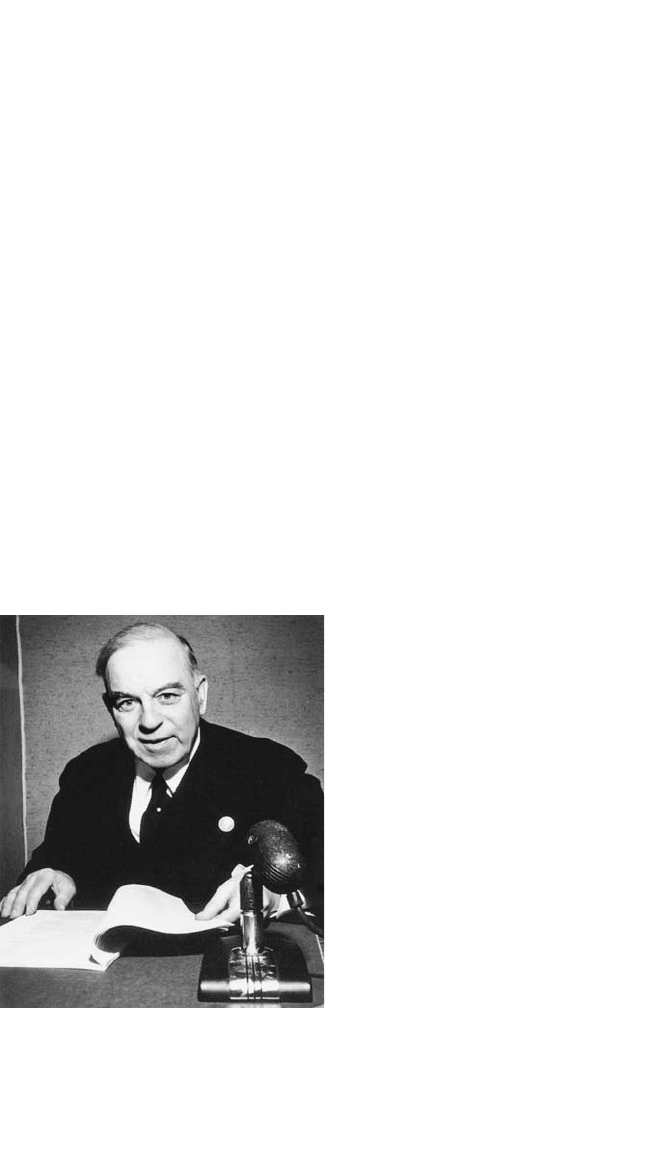
Mackenzie King (1874–1950), addressing the
Canadian people on VE Day (May 8, 1945),
served as prime minister for more than 22
years, the longest tenure in the British Empire.

297
of the “North Atlantic Triangle.” In contrast to the situation during
World War I, Canada did not have to struggle for recognition of
national autonomy in its relationship with Britain. The progress of air
transportation (Trans Canada Airlines began regular overseas fl ights in
1941) and radio communication encouraged continuous consultation
between Canada and Britain, thereby negating the need for such insti-
tutions as the Imperial War Cabinet or Imperial Conferences. Some
diehard imperialists still tried to revive the movement for imperial cen-
tralization or imperial unity, but these notions appeared anachronistic
in view of Canada’s increasingly close relations with the United States.
Growing economic ties were reinforced by common continental
defense concerns. In 1940 Canada and the United States signed the
Ogdensburg Agreement, which created the Permanent Joint Board on
Defense to “consider in the broad sense the defense of the north half of
the western hemisphere.” The board planned joint Arctic defenses
against a northern attack by air, and chains of Canadian-American air
bases and radio posts were stretched across the Arctic wilderness. The
Alaska Highway, extending 1,500 miles through the British Columbia
and Yukon wilderness, was rendered urgent by Japanese presence off
the coast of Alaska in 1942. At the same time, the Canol project, involv-
ing the building of a pipeline from the Norman oil wells in the Arctic
reaches of the Mackenzie valley to a refi nery at Whitehorse, was under-
taken to assure fuel supplies to Alaska. Canada and the United States
also established extensive air bases in Newfoundland and Labrador to
prevent the gateway to North America from falling into enemy hands.
Besides these defensive arrangements, the Hyde Park Agreement of
1941 tied the Canadian and American economies even more closely
together by encouraging joint planning of war production on a conti-
nental basis. These developments emphasized the extent to which the
strategic interests and productive capacities of Canada and the United
States were becoming integrated.
Federal Power and State Control
Coming on the heels of the Great Depression, which called for an
extraordinary measure of state intervention in the economy, World War
II further challenged Canadian government to make the most effi cient
use of national resources through even more systematic central planning
and state control. In the process, the role of the Canadian government
in economic and social life was permanently transformed, and the wel-
fare state was inexorably launched (Stacey 1970; Granatstein 1975).
THE PERILS OF DEPRESSION AND WAR

A BRIEF HISTORY OF CANADA
298
As France succumbed to the German blitzkrieg (lightning war) in
June 1940, the Canadian Parliament passed the National Resources
Mobilization Act to organize the nation’s productive capacity and
human resources for an all-out war effort. Much of the regulatory
power of the state was exercised by the newly created Department of
Munitions and Supply (originally the War Supply Board) headed by
Clarence D. Howe, who applied his extensive engineering knowledge
and experience to run Canada’s war production program with ruthless
effi ciency bordering on authoritarianism.
Howe oversaw the creation of new industries and the expansion of
existing ones to produce vital war materials such as airplanes, tanks,
battleships, minesweepers, radar equipment, artillery and ammunition,
synthetic rubber and plastics, and aviation fuel. By the end of the war,
Canadian manufacturing production had more than doubled, and the
national industrial structure had become more comprehensive and
diversifi ed. Industrial expansion meant increased demand for natural
resources, the allocation of which Howe’s department also controlled.
Consequently, hydroelectric power production expanded by half; forest
production rose by two-thirds (including the doubling of pulpwood);
and mineral production was up by one-fi fth, with nickel, asbestos, and
aluminum being in highest demand. Agricultural production, notably
mixed and dairy farming as well as the raising of hogs, cattle, and
sheep, increased by nearly half, although surplus wheat continued to be
a problem with the loss of European markets.
To assure a steady supply of war materials, the production of nones-
sential consumer goods was curtailed. Sugar, tea, coffee, butter, meat,
and gasoline, for example, were rationed through a system of govern-
ment-issued coupons. The Department of Munitions and Supply was
also responsible for mobilizing Canada’s labor force for war produc-
tion. The 400,000 unemployed at the outbreak of war were largely
absorbed into war-related industries. Not only did Howe’s department
ensure that Canadian factories operated to full capacity, it also directly
or indirectly employed more than 1 million workers. As during World
War I, women were encouraged to enter the workforce in response to
the general labor shortage created by the war. The shortage of workers
was a boost to the union movement as its membership doubled to more
than 700,000 during the war. Nevertheless, employers fi ercely resisted
union attempts to impose collective bargaining, and the federal govern-
ment constantly intervened to prevent strikes that could adversely
affect war production. In 1941 the War Time Prices and Trade Board
was established to give the federal government authority to impose

299
price and wage controls in order to prevent the spiraling infl ation that
had prevailed during World War I. But the freezing of wages proved to
be a major cause of labor unrest and industrial disputes. Labor dissat-
isfaction and union efforts to ensure recognition contributed to a wave
of strikes that resulted in 1 million working days lost in 1943.
Although the war eliminated unemployment and restored a degree
of prosperity not experienced since the late 1920s, Canadians remained
concerned, even fearful, about postwar economic and social security
(Creighton 1976). The Royal Commission on Dominion-Provincial
Relations proved to be instrumental in redefi ning the future role of
Canadian government. Chaired by Newton Rowell, who was succeeded
by Joseph Sirois after ill health forced him to retire, the commission
produced a report in 1940 that proposed a revision of Confederation to
stabilize provincial fi nances and to ensure that all Canadians received
equal services. The federal government would assume the whole burden
of unemployment relief and unemployment insurance as well as existing
provincial debts. The provinces would “rent” to the federal government
their right to collect income and corporation taxes as well as succession
duties in return for “adjustment grants” that would replace the system
of federal subsidies to the provinces agreed upon at the time of Confed-
eration. Through this new system of adjustment grants based on fi nan-
cial need, the federal government would assist the provinces to
administer a uniform standard of social and educational services.
Following the recommendation of the Rowell-Sirois Commission,
the federal government, with provincial consent and after making the
requisite amendment to the British North America Act, established the
Unemployment Insurance Commission (UIC) Fund in 1940 (Guest
1997). Supported by compulsory contributions from both employees
and employers, the UIC Fund would provide for those who might
become temporarily unemployed. About half the work force was ini-
tially covered by this scheme. Prime Minister King became even more
interested in social welfare measures when a public opinion poll in
September 1943 indicated that the CCF had edged past the Liberals and
Conservatives in popularity. The following year T. C. Douglas led the
CCF to victory in the Saskatchewan provincial election. Clearly, the
threat from the left could not be ignored. In response to a recommenda-
tion of the federal government’s Committee on Reconstruction under
the direction of Leonard Marsh, the King administration introduced the
Family Allowance Act in 1944. The program to provide monthly pay-
ments of $5 to $8 to help parents support their children became popu-
larly known as the “baby bonus.” King’s strategy to draw support away
THE PERILS OF DEPRESSION AND WAR