
Riendeau A Roger E. Brief History of Canada
Подождите немного. Документ загружается.


A BRIEF HISTORY OF CANADA
310
regarding possible threats to Canadian sovereignty. The two nations
extended their joint military commitments in 1958 by signing the
North American Air Defense (NORAD) agreement, which placed con-
tinental air forces under an American commander and a Canadian
deputy.
Concerned about being viewed as merely an American satellite,
Canada was careful to preserve its national identity and to fulfi ll its
diplomatic responsibilities even if it meant occasionally upsetting its
continental neighbor and ally. Indeed, the determination to maintain
independence from American foreign policy was evident in Canada’s
active participation in the UN. After winning recognition as a “middle
power,” Canada went on to perform distinguished service in numerous
UN food, health, education, and welfare agencies concerned with the
elimination of hunger, disease, ignorance, and poverty throughout the
world. Moreover, as a leading supporter of the UN principle of collec-
tive security, Canada gained an international reputation for its peace-
keeping role. During the Korean War, Canada made the third-largest
contribution of troops to support UN efforts to resist North Korean
aggression against South Korea. In 1954 Canada served with Poland
and India in an International Control Commission to supervise the
peace in Indochina.
Recognition of Canada’s peacekeeping and peacemaking acumen
reached a climax during the Suez Crisis in 1956. Egypt’s nationalization
of the Suez Canal incited Israel to invade the Sinai Peninsula, while
Britain and France launched their armed intervention to regain control
of the Canal Zone. With the possibility of American and Soviet military
intervention looming, Lester Pearson, who had succeeded St. Laurent
as minister of external affairs in 1948 and had been elected president of
the UN General Assembly in 1952, introduced a resolution calling for
an immediate cease-fi re to be supervised by a multinational UN Emer-
gency Force. Pearson’s plan was adopted and a Canadian-led UN Emer-
gency Force was stationed in the Canal Zone to act as a buffer between
the Egyptians and Israelis until a lasting peace could be negotiated.
Through its decisive role in the Suez Crisis, Canada bolstered its status
as a middle power unaligned with either Britain or the United States,
while Pearson was awarded the Nobel Peace Prize in 1957.
Despite its decision to oppose British military intervention during
the Suez Crisis, Canada generally maintained a signifi cant relationship
with the Commonwealth as a means of balancing its closer ties with the
United States (Creighton 1976). As partners in the UN and NATO,
Canada and Britain were major supporters of the American crusade to

311
check the spread of communism. Moreover, the multilateral General
Agreement on Tariffs and Trade (GATT), which Canada signed in
1947, included provisions for lower tariffs with its two principal trad-
ing partners, the United States and Britain. Canada also encouraged a
reconceptualization of the Commonwealth to accommodate the former
British colonies in Asia and Africa that gained their independence after
World War II. Canadian initiative helped to replace the concept of
common British and Commonwealth citizenship with one based on
nationality. The Canadian Citizenship Act of 1947 was the fi rst nation-
ality statute to defi ne the people of Canada as “Canadians” rather than
“British subjects.” As a result of Canadian efforts, the predominantly
white British Commonwealth gave way to the multiracial Common-
wealth of Nations. The new Commonwealth included not only the
Dominions like Canada, Australia, and New Zealand, which maintained
allegiance to the Crown, but also those new republics like India, Paki-
stan, Ghana, and Nigeria, which merely wished to continue their asso-
ciation with Britain and the Dominions.
In encouraging the acceptance of new Asian and African members
into the Commonwealth, Canada rationalized that it was important to
persuade these overpopulated nations that their interests were better
served by association with the Western democracies rather than with
the communist world. Accordingly, Canada joined seven other nations
of the Commonwealth in 1950 to formulate the Colombo Plan, a com-
prehensive program of economic and technical aid to the countries of
South and Southeast Asia, a region considered fertile ground for the
spread of communism. By the early 1960s, Canada had provided almost
$400 million in foreign aid under the Colombo Plan. In essence, the
Commonwealth offered Canada the opportunity to retain its traditional
“family” ties while it endeavored to infl uence the broader international
order through its middle power diplomacy.
The Politics of Prosperity
Canada’s sense of national confi dence in the postwar era was bolstered
not only by a prolonged economic boom and a growing stature on the
world stage but also by the completion of the transcontinental vision of
Confederation. After fi nally rejecting Confederation in 1894,
Newfoundland remained a British colony with responsible government
until it was granted Dominion status after World War I. Although the
Quebec-Labrador boundary dispute was settled in favor of Newfoundland
in 1927, Labrador was still only valuable to the island as a mainland
AN EXPANDING NATION IN THE AGE OF AFFLUENCE

A BRIEF HISTORY OF CANADA
312
coastal strip with whaling and fi shing stations. Not for another two
decades would the rich iron ore deposits of the interior of Labrador be
discovered and developed. During the Great Depression, Newfoundland
had to be rescued from bankruptcy by Britain, which suspended
responsible government in 1934 and appointed a governor and a com-
mission to rule the island. Prosperity returned during World War II as
Newfoundland became a strategic location for American and Canadian
military bases. By the end of the war, Newfoundland was in a position
to decide whether it would remain under commission rule or return to
responsible government under Dominion status. In 1946 the British
government arranged for a popularly elected convention to decide the
island’s future political direction.
Joseph R. Smallwood, a local journalist, introduced a third option for
the convention to consider—union with Canada. After initially receiv-
ing little support, the Confederation movement began to gain momen-
tum when Britain refused to promise continued fi nancial assistance to
restore self-government. In a referendum held in June 1948, 44 percent
of Newfoundlanders voted for responsible government, 41 percent for
Confederation, and 15 percent for commission rule. A second referen-
dum the following month resulted in a victory for Confederation over
responsible government by 53 percent to 47 percent, a margin of fewer
than 7,000 votes. The Canadian government then negotiated fi nal
terms of the Confederation agreement, and on March 31, 1949, New-
foundland, with a population of about 350,000, became Canada’s 10th
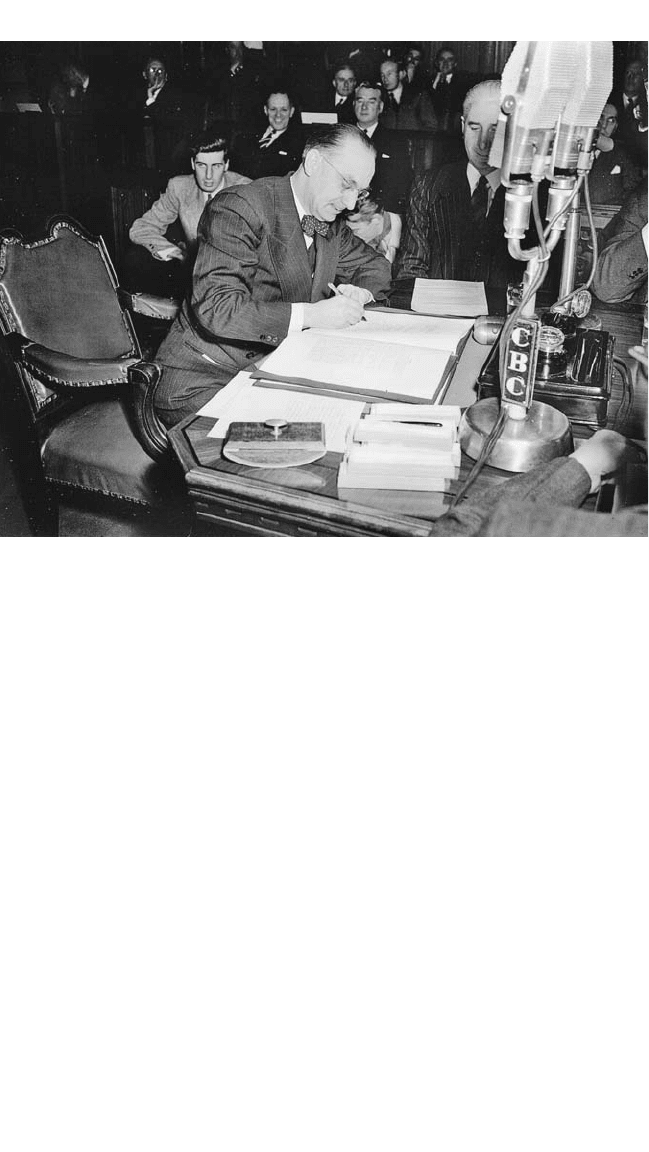
province. The next day, Smallwood, the leader of the Confederation
movement, was fi ttingly appointed Newfoundland’s fi rst premier; as
leader of the Liberal Party, he went on to win the inaugural provincial
election in the following month (Neary 1988).
With Newfoundland’s entry into Confederation confi rmed, the aging
Mackenzie King retired in November 1948 after completing 22 years as
prime minister, the longest such service in Canadian and Common-
wealth history. King’s successor, Louis St. Laurent, proved to be a
popular choice as the Liberals captured an unprecedented 190 out of
262 parliamentary seats in the election of 1949. The St. Laurent admin-
istration presided over the further clarifi cation of Canadian national
sovereignty. The Supreme Court of Canada replaced the Judicial Com-
mittee of the Privy Council as the fi nal court of appeal and thus the
ultimate judicial interpreter of the Canadian constitution in 1949. The
same year, a British statute conferred on the Canadian Parliament the
right to amend the British North America Act in matters of purely fed-
eral jurisdiction. The right of constitutional amendment, however, did
313
not extend to the alteration of the distribution of powers between the
federal and provincial governments and the protection of fundamental
rights. For more than three decades, the federal and provincial author-
ities would continue to search for a mutually agreeable formula for a
complete repatriation of the Canadian constitution. Another vestige of
British colonialism ended in 1952 when Vincent Massey became the
fi rst Canadian appointed governor-general.
The overwhelming reelection of the Liberals under St. Laurent in
1953 refl ected not only voter satisfaction in prosperous times but also
the sense that the opposition parties offered little alternative. The Con-
servatives had changed leaders three times since 1935 and had been
reduced to little more than an Ontario party, while support for CCF
and Social Credit did not extend much beyond Saskatchewan and
Alberta, respectively. Only the Liberals could claim to be a national
party with support from all parts of Canada. At the provincial level,
however, voters were more inclined to express their political opposi-
tion. In 1943 George Drew inaugurated 42 years of Conservative ascen-
Joseph (Joey) Smallwood (1900–91) became a Father of Confederation in 1949 when under
his leadership Newfoundland became Canada’s 10th province. He ruled over the province for
almost three decades.
(Library and Archives Canada PA-128080)
AN EXPANDING NATION IN THE AGE OF AFFLUENCE
A BRIEF HISTORY OF CANADA
314
dancy in Ontario before leaving to lead the national party in 1948. The
Conservative resurgence continued with triumphs in Manitoba and the
Maritime Provinces during the 1950s. Meanwhile, “third party” success
was manifested by Social Credit in Alberta and British Columbia, CCF
in Saskatchewan, and Union Nationale in Quebec. Only in Newfound-
land did the Liberals under Smallwood manage to hold on to power.
The tendency for voters to support one political party nationally and
another provincially refl ected the strained fi nancial relations between
the two levels of government after World War II. Quebec’s continuing
feud with Ottawa was refl ected in the province’s Royal Commission of
Inquiry on Constitutional Problems (the Tremblay Commission),
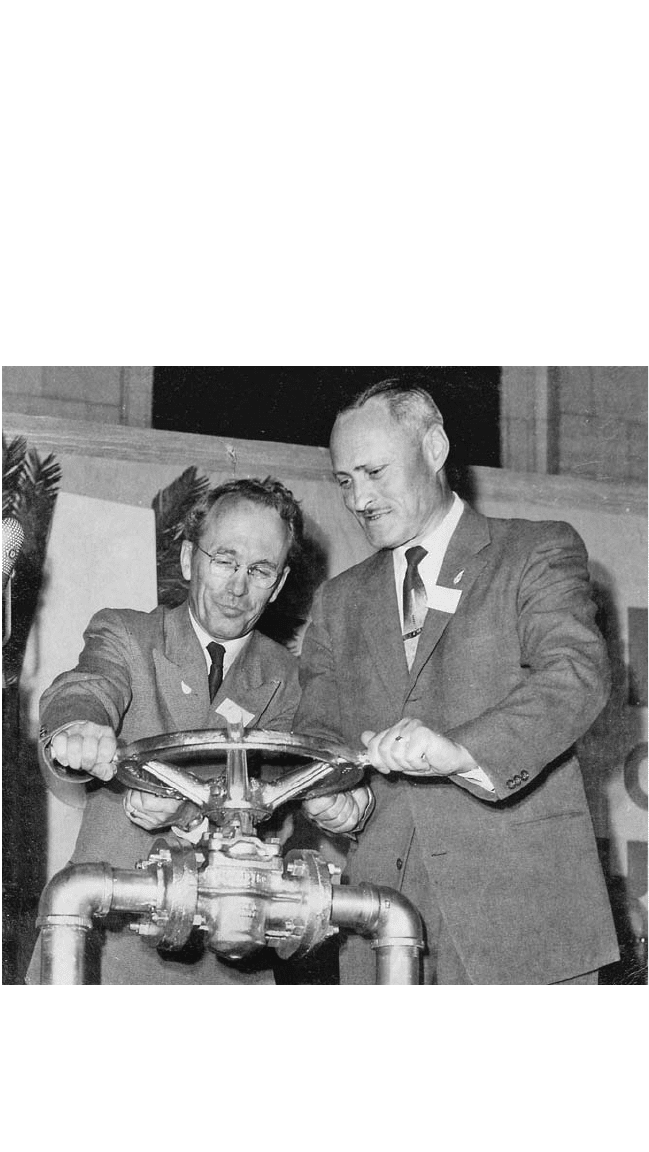
Tommy Douglas (1904–86) (at left) formed the fi rst socialist government in Canada when his
CCF party came to power in Saskatchewan in 1944. Pictured here with Weyburn mayor Jun
Staveley in 1958, Premier Douglas inaugurated North America’s fi rst government-run medical-
care insurance plan. A CBC poll recently named him the “greatest Canadian.”
(Photographer:
Ernie Neufeld. Special thanks to Darryl Ward, publisher of the Weyburn Review)

315
which in 1954 called for an end to federal “imperialism” and return to
“true federalism.” In 1957 the federal government introduced a pro-
gram of equalization payments in an effort to redistribute the national
wealth more evenly among the provinces. The federal transfers were
designed to ensure that the per capita revenues of all provinces from
shared taxes matched those of the wealthiest provinces, at that time
Ontario and British Columbia. Negotiations over the extent to which
the various provinces were “haves” or “have nots” would become
another source of tension in federal-provincial relations.
The constant wrangling with the provinces did not prevent the fed-
eral government from extending a variety of health and social services
as a safety net against misfortune (Guest 1997). A national health pro-
gramme enacted in 1948 provided federal grants to the provinces to
improve hospital care facilities. In 1951 a universal old-age pension
scheme was instituted to provide a $40 monthly payment to all citizens
over 70 years of age (65 if they were deemed needy). The needs of the
unemployed who had exhausted their unemployment insurance bene-
fi ts or who were not qualifi ed to draw them were addressed in the
Unemployment Assistance Act of 1956. The federal government also
passed the Hospital Insurance and Diagnostic Services Act in 1957 to
provide fi nancial assistance to provinces that established a publicly
administered hospital insurance program with universal coverage. Sas-
katchewan, whose CCF government had introduced Canada’s fi rst
universal and compulsory system of hospital insurance in 1947, and
British Columbia, which had adopted a similar plan in the following
year, immediately qualifi ed for federal assistance. By 1961 all provinces
had inaugurated hospital insurance plans and had entered into cost-
sharing agreements with the federal government. Aside from these
signifi cant advances, postwar prosperity, during which the national
unemployment rate ranged from 3 to 6 percent, tended to slow down
the popular demand for the expansion of the welfare state.
With a huge majority in Parliament, a popular leader in St. Laurent,
and an apparently weak opposition, the Liberals seemed destined to
remain the governing party. Heading into the election of 1957, the Liber-
als had been in power for almost 22 years, the longest unbroken tenure
of any national government in Canadian history. But the Liberals had
already sown the seeds for their unexpected defeat during the infamous
“pipeline debate” of the previous year. Minister of Trade and Commerce
C. D. Howe had introduced a bill in Parliament to provide fi nancial assis-
tance to Trans-Canada Pipe Lines to transport gas from Alberta to central
Canadian markets. While Howe compared the pipeline to the Canadian
AN EXPANDING NATION IN THE AGE OF AFFLUENCE

A BRIEF HISTORY OF CANADA
316
Quebec’s View of
Federal-Provincial
Relations as Expressed
Through the Tremblay
Report, 1954.
Act to Institute a Royal Commission of
Inquiry on Constitutional Problems
Assented to, the 12th of February, 1953
Whereas the Canadian confederation, born of an agreement between
the four pioneer provinces, is fi rst and above all a pact of honour
between the two great races which founded it and each of which makes
a most valuable and indispensable contribution to the progress and
greatness of the nation;
Whereas the constitution of 1867 grants to the provinces, and to
the Province of Quebec in particular, rights, prerogatives and liberties
scrupulous respect for which is intimately bound up with national unity
and the survival of confederation, and it imposes on them responsi-
bilities and obligations which imply correlatively the necessary corre-
sponding means of action;
Whereas the Province of Quebec intends to exercise and discharge
these rights and obligations, to which end it must safeguard the fi scal
resources which belong to it and preserve its fi nancial independence as
well as its legislative and administrative autonomy;
Whereas, since 1917, the central power has invaded important fi elds
of taxation reserved to the provinces, thereby seriously limiting the abil-
ity of the provinces to exercise their fi scal rights in those fi elds: . . .
Whereas, in a country as vast and diverse as Canada, only a decen-
tralized administration can meet the needs of every region and ensure
the harmonious development of the whole. . . .
Therefore, Her Majesty, with the advice and consent of the Legislative
Council and of the Legislative Assembly of Quebec, enacts as follows:
1. The Lieutenant-Governor in Council may constitute a royal com-
mission to inquire into constitutional problems, report its fi ndings to
him and submit to him its recommendations as to steps to be taken
to safeguard the rights of the Province and those of municipalities and
school corporations. . . .
Source: Kwavnick 1973, 1–2.

317
Pacifi c Railway in term of its importance to transcontinental economic
development, opposition to the bill focused on the American owner-
ship of Trans-Canada Pipe Lines. Faced with vigorous resistance and a
pressing deadline to start construction, Howe resorted to the power of
the Liberal majority to cut off debate and to push the bill through Par-
liament in the absence of the Conservatives and CCF, which had
walked out in protest over the allegedly high-handed use of closure. In
the subsequent election campaign, the Conservatives adeptly used this
incident as evidence that the Liberals had become arrogant and out of
touch with the public will after too long a time in power (Creighton
1976).
Also exploiting regional discontent in the Maritime and Prairie Prov-
inces, the Conservatives, led by Saskatchewan lawyer John Diefenbaker
who had succeeded George Drew in the previous year, edged out the
Liberals. Although neither party commanded majority support in Par-
liament, the Liberals decided to relinquish power and to rebuild the
party under the leadership of much-celebrated diplomat Lester Pear-
son. In pursuit of a majority government, Prime Minister Diefenbaker
took advantage of Liberal disarray to call another election in 1958. Dur-
ing the campaign, Diefenbaker expounded a vision of “a Canada of the
North” and called for “One Canada, wherein Canadians will have pre-
served to them the control of their own economic and political destiny”
(Bliss 1966, 332–333). Diefenbaker tended to model himself after Sir
John A. Macdonald and to view his northern vision as a 20th-century
equivalent of the National Policy. Canadian voters responded over-
whelmingly to Diefenbaker’s strategy as the Conservatives won a record
208 seats out of 265.
In contrast to the more temperate approach of the aging St. Laurent
or the eminent but politically inexperienced Pearson, the Diefenbaker
vision of Canada on the threshold of national greatness, along with his
fi ery oratory and his evangelical leadership style, captured the imagina-
tion of the millions of Canadians following their fi rst national election
on television. In this respect, Diefenbaker ushered in the modern age of
mass media politics in Canada. Furthermore, Diefenbaker expressed
the optimism that many Canadians felt about their personal lives and
their national destiny by the end of the 1950s.
The Roots of Cultural Nationalism
Although they were enjoying an improved standard of living and
sought to satisfy their basic material needs after World War II, Canadians
AN EXPANDING NATION IN THE AGE OF AFFLUENCE

A BRIEF HISTORY OF CANADA
318
increasingly hungered for broader cultural horizons, popular entertain-
ment, recreational amenities, and educational opportunities. In 1949
the Canadian government responded by appointing the Royal
Commission on National Development in the Arts, Letters, and
Sciences, chaired by Vincent Massey, a noted Toronto patron of the arts
and culture. The Massey Commission’s report in 1951 offered a com-
prehensive set of recommendations covering all aspects of education,
culture, and the mass media. The commission recognized that the ama-
teur, community-oriented, and voluntary character of the nation’s pre-
war cultural life was giving way to a more urban, impersonal, and
national orientation. While mourning the passing of traditional
Canadian culture, the Massey Commission expressed enthusiasm for
the new era of professional “mass culture” that was forthcoming. In the
fi nal analysis, the commission not only stimulated government support
for future national cultural development but also raised public con-
sciousness of the rich and diverse foundation of artistic and popular
cultural accomplishments upon which Canadians could continue to
build (Tippett 1990).
English- and French-Canadian literature came of age in the period
from the 1930s to the 1950s. From a “critical realism” perspective,
Morley Callaghan’s novels—Such Is My Beloved (1934), They Shall
Inherit the Earth (1935), and More Joy in Heaven (1937)—portray crime
and deprivation in Toronto and Montreal, while Irene Baird’s Waste
Heritage (1939) deals with labor unrest, class confl ict, and unemploy-
ment in Vancouver during the Great Depression. Hugh MacLennan
raised national consciousness through his novels: Barometer Rising
(1941) focuses on the great Halifax naval explosion of 1917, which
killed 1,600 people and injured 9,000 out of a population of 50,000;
and Two Solitudes (1945), which brilliantly portrays the mutual intoler-
ance of the English and French communities in Quebec, won him the
fi rst of three Governor-General’s Literary Awards for fi ction (inaugu-
rated in 1936). Sinclair Ross’s As for Me and My House (1941) and W.
O. Mitchell’s Who Has Seen the Wind (1947) capture the struggles of
living in the Prairies during the drought-plagued 1930s. Mordecai
Richler’s The Apprenticeship of Duddy Kravitz (1959) depicts the social
and moral ambivalence of a young Jewish entrepreneur in contempo-
rary Montreal, while Adele Wiseman’s The Sacrifi ce (1956) powerfully
captures the Jewish-Ukrainian experience in the Prairies. In a more
universal vein, Malcolm Lowry in Under the Volcano (1947) and Ethel
Wilson in Swamp Angel (1954) explore the psychological pressures of
alcoholism and women’s limited options in society, respectively.

319
A new generation of English-Canadian poets developed in the shad-
ows of World War II. Dorothy Livesay won the Governor-General’s
Literary Award for Day and Night (1944) and Poems for Peace (1947).
Earle Birney of Vancouver also won this prestigious award in 1942 and
1945 for his collections of poems and pioneered the teaching of creative
writing in Canadian universities. The outspoken and fl amboyant Irving
Layton produced numerous volumes since the early 1940s, which have
given him national and international recognition as a prolifi c, revolu-
tionary, and controversial poet of the “modern” school. From the 1940s
onward, the metaphysical poetry of P. K. Page and Margaret Avison
inspired modern generations of Canadian poets. Northrup Frye, a stu-
dent and colleague of poet E. J. Pratt, went on to become one of the
world’s leading literary theorists in English following the publication of
his book, Anatomy of Criticism, in 1957.
French-Canadian literature moved away from traditional rural ideal-
ism to express urban realism with the publication in 1938 of Trente
arpents (Thirty Acres) by Philippe Panneton, who wrote under the
pseudonym of Ringuet (Linteau, Durocher and Robert 1991). Unlike
Maria Chapdelaine a quarter-century earlier, the novel’s hero, Eucha-
riste Moisan, suffers for his stubborn devotion to his small farm, which
ultimately can be passed on to only one of his 12 children. His other
children must abandon their rural life for an urban existence in Mon-
treal or New England, where Euchariste ends up forlornly living out his
last days anguishing over his lost 30 acres. This Governor-General
Award-winning novel highlights the reality of the French-Canadian
fate and foreshadows the social upheaval in Quebec life that made the
Quiet Revolution necessary. Roger Lemelin’s Au pied de la pente douce
(1944, translated as The Town Below) and Les Plouffe (1950, translated
as The Plouffe Family) as well as Gabrielle Roy’s Bonheur d’occasion
(1945, translated as The Tin Flute) employ urban working-class settings
to convey social realism in mid-20th-century Quebec.
In the visual arts, the infl uence of the Group of Seven continued to
grow with the formation in 1933 of the Canadian Group of Painters
whose members included A. J. Casson, Charles Comfort, Edwin Hol-
gate, Yvonne McKague Housser, J. W. G. Macdonald, and Carl Schae-
fer. Other artists were endeavoring to move away from the rugged
landscape nationalism of the Group of Seven. John Lyman of Montreal,
who was a key fi gure emphasizing internationalism, founded the Con-
temporary Art Society in 1939. In the 1940s and 1950s, a radical group
of French-Canadian painters infl uenced by Parisian surrealism, includ-
ing Marcel Barbeau, Paul-Emile Borduas, Pierre Gauvreau, Fernand
AN EXPANDING NATION IN THE AGE OF AFFLUENCE