
Riendeau A Roger E. Brief History of Canada
Подождите немного. Документ загружается.


A BRIEF HISTORY OF CANADA
300
from the CCF appeared to pay off in the federal election of 1945 as the
party won 28 seats, four times more than in the previous election but
not enough to deprive the Liberals of a majority government.
After the election, King convened the Dominion-Provincial Confer-
ence on Reconstruction to plan the reconversion of the national econ-
omy to peacetime conditions. King hoped to convince the provinces to
continue the “temporary wartime expedient” to which they had agreed
four years earlier whereby they were appropriately compensated for
relinquishing to the federal government their authority to levy succes-
sion duties as well as income and corporation taxes. To maintain this
arrangement, the federal government offered to increase grants, to pay
part of the cost of a comprehensive health insurance plan and an old-
age pension scheme, and to expand coverage of unemployment insur-
ance. When Ontario, Quebec, and Alberta objected to the concentration
of fi nancial powers in the hands of the federal government, Ottawa
resorted to making “tax rental” agreements with individual provinces.
Viewing such arrangements as an infringement on provincial auton-
omy, Quebec insisted on operating its own income tax system. Despite
numerous attempts over the next two decades, agreement on a com-
mon federal-provincial revenue-sharing scheme could not be reached.
Canada emerged from World War II a stronger nation in three
respects. First, the nation had survived the worst economic crisis in its
history and had set in motion the public institutions to protect the
social and economic security of its citizens from being so threatened in
the future. Second, Canada once again demonstrated that it was a for-
midable force in the international arena and was prepared to abandon
its prewar isolationism to preserve world peace. Third, despite the
recurring conscription crisis, national unity remained intact at the end
of the war, and Canadians could focus on economic reconstruction and
renewal rather than on political appeasement. Indeed, the stage was set
for the remarkable postwar boom.

301
17
AN EXPANDING NATION IN
THE AGE OF AFFLUENCE
(1945–1958)
A
fter suffering through a decade and a half of depression and war,
Canada enjoyed a decade and a half of extraordinary economic
and population growth after World War II. Expansion in the level of
industrial production as well as in the exploitation of natural resources
was accompanied by the so-called baby boom and a renewed tide of
immigration that infl uenced virtually every aspect of national life.
Internationally, Canada emerged from another outstanding war effort
as a strategic “middle power” in a disturbingly bipolar world order.
Canada’s diplomatic challenge was to balance its growing prominence
within the diminished yet infl uential British Commonwealth with its
precarious position as a major trading partner and military ally of the
powerful United States. Prosperity and international recognition, how-
ever, could not stem the tide of rampant regionalism as the provinces
endeavored to renegotiate their relationships with the federal govern-
ment with the coming of the welfare state.
The Postwar Boom
While Canada’s economy had expanded and diversifi ed during World
War II, as it had during World War I, the anticipated economic down-
turn in the aftermath did not materialize. Instead of the severe recession
that struck after World War I, Canada enjoyed the continuation of war-
time prosperity after 1945 for two reasons. First, since many of the
important industrial nations lay in ruin with their productive capacities
crippled, Canadian products remained in high demand. Second, after 15
years of austerity resulting from depression and war, Canadians were
ready to spend their hard-earned money to improve their lifestyles.

A BRIEF HISTORY OF CANADA
302
Having once again helped to preserve the world for democracy,
Canadians felt entitled to reap the benefi ts for themselves. They wanted
better wages, more leisure, and the full range of material pleasures that
their money could buy. Rising consumerism was manifested in growing
sales of automobiles, television sets, and household appliances. Above
all, Canadians desired to own their own homes, and the mushrooming
suburban communities with their uniform housing subdivisions and
shopping plazas afforded them the opportunity. Indeed, not until after
World War II were urban Canadians transformed from a society of
renters to a society of homeowners. Marriages and families that had
been postponed in troubled times could now proceed. And people from
war-ravaged nations increasingly viewed Canada as a land of opportu-
nity to revitalize and stabilize their lives (Norrie and Owram 2002).
The postwar boom was sustained and characterized by the remark-
able growth of population from 11.5 million in 1941 to 18.2 million in
1961. The national annual growth rate, which had declined to less than
1 percent during the 1930s and early 1940s, approached 3 percent dur-
ing the so-called baby boom from the late 1940s to the early 1960s, a
growth rate comparable to that achieved during the country’s wheat
boom prior to World War I. The most notable feature of this population
growth was an approximately 30 percent rise in the annual birthrate
(number of live births per 1,000 population), which resulted in an
annual increase in the number of births from fewer than 250,000 in the
late 1930s to nearly 500,000 by the end of the 1950s. Equally signifi -
cant, however, was an almost 25 percent decline in the death rate,
highlighted by a more than 50 percent drop in the infant mortality rate,
both of which resulted from improved medical sciences and services as
well as better nutritional levels, personal hygiene, and housing.
The Canadian population was also bolstered by the arrival of approx-
imately 2 million immigrants in the 15 years after World War II. By
contrast to a net loss of nearly 100,000 immigrants during the 1930s
when more people left the country than entered it, Canada recorded a
net gain of more than 1 million immigrants during the 1950s, the high-
est level for any decade in Canadian history. The postwar peak was
reached in 1957 when 282,000 immigrants arrived in Canada. That
only about one-third of the postwar immigrants were of British origin
and that most of the remainder came from continental Europe was a
concern to the majority of Canadians and to their government. Prime
Minister King outlined a new federal immigration policy, which
acknowledged “that the people of Canada do not wish, as a result of
mass immigration, to make a fundamental alteration in the character of

303
our population.” Although the new policy repealed the blatantly dis-
criminatory Chinese Immigration Act of 1923, King rationalized that
restrictions must continue because “immigration from the Orient
would change the fundamental composition of the Canadian popula-
tion” and “might lead to serious diffi culties in the fi eld of international
relations” (Palmer 1975, 61).
Regarding the less worrisome but still controversial immigration
from continental Europe, King stipulated that government policy
would focus “on the admission of the relatives of persons who are
already in Canada, and on assisting in the resettlement of displaced
persons and refugees” (Palmer 1975, 59). Accordingly, about 165,000
displaced persons escaping the tyranny of Nazi Germany, fascist Italy,
and the communist regimes of Eastern Europe were admitted into
Canada during the decade after World War II, while another 35,000
refugees of the Hungarian Revolution arrived in 1956.
Most Europeans came to Canada to escape the austerity of their post-
war existence or to fi nd new prospects in a rapidly expanding Canadian
economy. Mindful of the economic instability of the prewar era, King
assured Canadians in 1947 that immigration would be related to “our
absorptive capacity . . . in response to economic conditions” (Palmer
1975, 60). As it turned out, a widespread shortage of labor caused by
the booming economy enabled Canada to accommodate far more immi-
grants than anticipated.
Post-World War II European immigrants were no longer “the stal-
wart peasants in their sheepskin coats” seeking a western homestead,
as their early-20th century counterparts had tended to be. While some
immigrants were directed or lured to the expanding northern and west-
ern resource frontiers, the vast majority fl ocked to the rapidly growing
cities, where factory and construction jobs beckoned. Prominent
among the newcomers were Dutch, Germans, Greeks, Italians, Poles,
and Portuguese, who took advantage of the government preference for
immigrants sponsored by relatives already living in Canada. Indeed,
family “chain migration” was so extensive that by 1958 Italy surpassed
Britain as the leading source of immigrants. The tendency for these
immigrants to settle in large, closely knit cultural communities within
major urban centers—notably Toronto and Montreal—added a more
cosmopolitan quality to Canadian life. These new Canadians not only
brought with them valuable knowledge, skills, and capital but also sus-
tained the vigorous consumer demand for domestic products.
The concentration of population in urban centers and suburban
communities was a major catalyst of the postwar boom. The proportion
AN EXPANDING NATION IN THE AGE OF AFFLUENCE

A BRIEF HISTORY OF CANADA
304
of Canadians living in urban centers rose from slightly more than 55
percent in 1941 to nearly 70 percent in 1961. Nearly half of the popula-
tion lived in cities having more than 100,000 inhabitants by 1961, as
compared to about one-quarter in 1941. Montreal and Toronto contin-
ued to lead the way with populations exceeding 2.1 million and 1.8
million, respectively, accounting for well over one-fi fth of the total,
while Vancouver was approaching 800,000. Postwar urbanization in
the downtown core of the major cities featured the centralization of
service functions, the proliferation of high-rise apartment complexes
and offi ce towers, and the building of public transit systems and
expressways to alleviate traffi c congestion.
Meanwhile, the fertile countryside was transformed into sprawling
suburbs in response to the construction of asphalt superhighways and
improved automobile and truck technology. With the resulting decentral-
ization of population, retail commerce, and heavy industry, planned resi-
dential subdivision, commercial-industrial parks, and multiacre shopping
centers became standard features of the expanding suburban frontier. The
complex challenges of managing these emerging urban agglomerations
led to the adoption of new forms of local or regional authority, highlighted
by the creation in 1954 of Metropolitan Toronto as a unique federation of
the city and its 12 suburbs (amalgamated into fi ve boroughs in 1967).
Postwar urban and industrial growth was a boon to organized labor
(Abella 1975). Union membership surpassed the 1-million mark, or
about 30 percent of the workforce, in 1950. As industrial demand out-
paced the labor supply, unions in the manufacturing sector enjoyed
substantial bargaining power and succeeded in negotiating favorable
wages. The growing confi dence of organized labor and a desire to make
up for ground lost during the Great Depression and World War II
resulted in a fl urry of strike activity in the late 1940s and early 1950s. The
most dramatic and bitter industrial confl icts of the era included the Steel
Company of Canada (Stelco) strike in 1946, which featured the use of
airplanes and boats by management to avoid the picket lines and to trans-
port supplies to the strikebreakers inside the plant in Hamilton; the strike
of the Conféderation des travailleurs catholiques du Canada (CTCC) in
Asbestos, Quebec, in 1949, which lasted fi ve months, resulted in police
intervention and government decertifi cation of the union, and contrib-
uted to the nationalist fervor that led to the so-called Quiet Revolution of
the 1960s; the walkout of 130,000 railway workers, which prompted the
federal government to order them back on the job in 1950; and the vio-
lent, seven-month confrontation involving copper workers at Murdoch-
ville, Quebec, which ended in defeat for the union in 1957.

305
Labor strength was refl ected not only in growing numbers but in
greater unity. The merger of the American Federation of Labor (AFL)
with the Congress of Industrial Organizations (CIO) in 1955 inspired
the union of the Trades and Labour Congress (TLC) with the Canadian
Congress of Labour (CCL) to form the powerful Canadian Labour Con-
gress (CLC) in 1956. Many of the CLC unions were affi liated with the
AFL-CIO, and Canadian workers employed by American branch plants
were not averse to belonging to American-dominated unions.
Contrasting the impressive growth of urban-industrial centers was
the persistence of rural depopulation, notably in the western Prairie
Provinces where the farm population declined by about 20 percent dur-
ing the 1940s and 1950s. Foreign demand for western grain remained
buoyant until the early 1950s when European agriculture began to
recover and the United States decided to dump its accumulated farm
surplus onto the world market. As prices fell steadily, the wheat econ-
omy could no longer sustain western growth and prosperity. Coinci-
dentally, the discovery of oil and natural gas at Leduc (southwest of
Edmonton) in 1947, followed by other major strikes across Alberta and
to a lesser extent Saskatchewan and Manitoba, triggered a petroleum
boom that strengthened the position of western Canada in the national
economy. Western oil and natural gas became the resource base for an
expanding Canadian petroleum industry through the construction of a
national system of pipelines that transported fuel to markets on the
West Coast and in eastern Canada and the United States.
Canada’s prospects as a rising industrial power were also enhanced by
the continued expansion of the northern resource frontier (Zaslow
1988). The discovery of iron in the Steep Rock Lake district north of Lake
Superior in the early 1940s was followed by the unearthing of even richer
ore deposits in the Ungava Peninsula around the Quebec-Labrador
boundary later in the decade. The opening of the atomic age stimulated
an intensive search for new sources of uranium. The discovery of ura-
nium deposits at Beaverlodge in northern Saskatchewan led to the estab-
lishment of Uranium City in 1951. In northern Ontario, the Algoma fi eld
at Blind River and the Sudbury fi eld at Elliot Lake were also opened up
in the early 1950s. The resource frontier extended into the Northwest
Territories with the discovery of lead and zinc near Great Slave Lake,
tungsten along the Yukon border, uranium and silver near Great Bear
Lake, and oil along the lower Mackenzie River. Oil prospecting was even
reaching into the distant Queen Elizabeth Islands of the Arctic.
By the early 1950s, Canada was also emerging as the world’s second-
largest producer of aluminum, with the new smelter at Kitimat, some
AN EXPANDING NATION IN THE AGE OF AFFLUENCE

A BRIEF HISTORY OF CANADA
306
500 miles up the mountainous coast from Vancouver, being the world’s
largest. This development, along with the continued expansion of the
pulp and paper industry, which supplied more than half of the world’s
newsprint, was facilitated by an abundance of cheap hydroelectric
power. The new developments of the era included power stations on
the Columbia River of British Columbia, the Nelson River of Manitoba,
and the Churchill Falls of Labrador.
Because many of the resource developments lay in the heart of the
northern wilderness, transportation improvements became important to
get machinery, workers, and supplies in and to bring the primary prod-
ucts out. Labrador City and Schefferville, for example, were linked by a
350-mile railway line to Sept-Îles on the St. Lawrence River. These new
communities also had to be supplied with housing, schools, churches,
electrical power, passable roads, and sanitation and water facilities,
among other amenities. Their needs gave new opportunities to the con-
struction and manufacturing industries that could service them.
Resource development in particular and national expansion in gen-
eral continued to be facilitated by dynamic transportation and commu-
nication projects. By 1953 the world’s longest oil pipeline ran east from
Edmonton to the petrochemical center of Sarnia nearly 1,800 miles
away to feed the eastern Canadian market, while another pipeline
extended more than 700 miles across the Pacifi c mountain ranges to
Vancouver and eventually on into the United States. Despite generating
a storm of political controversy over Canada’s dependence on American
capital, Trans-Canada Pipeline Limited completed a 2,200-mile pipe-
line transporting natural gas from Alberta to Quebec in 1958.
Meanwhile, the St. Lawrence Seaway project effectively revived the
east-west transport route that had been the backbone of Canadian
development from the nation’s beginning (Creighton 1976). Since the
early 20th century, Canada and the United States had been negotiating
to improve the St. Lawrence system to enable ocean-going ships to
travel to the head of the Great Lakes. When negotiations for a joint
construction project broke down, the Canadian government proceeded
independently in 1951. Recognizing that the St. Lawrence Seaway proj-
ect would provide vital hydroelectric power to the bordering states and
would serve as an effi cient avenue for moving iron ore from the Que-
bec-Labrador region to the American steel mills and western grain to
European markets, the United States agreed to participate in 1954, and
the project was completed in 1959.
Recalling the building of the CPR and other transcontinental rail-
ways of the early 20th century wheat boom, the federal and provincial

307
governments agreed on joint construction of the Trans-Canada High-
way in 1949. Although the highway was offi cially opened in 1962, the
billion-dollar project was not completed until 1970. Canadians could
now drive, using ferry services on both coasts, from St. John’s, New-
foundland, to Victoria, British Columbia. Canadians could also com-
municate with each other through the new medium of television as the
Canadian Broadcasting Corporation (CBC), which began transmission
in 1952 and had the capacity to broadcast from coast to coast by 1958.
Certainly, the mid-century transportation and communication improve-
ments further diversifi ed and unifi ed the transcontinental economy and
linked Canadians more closely together from east to west. But these
postwar developments also helped to reinforce Canada’s growing eco-
nomic, diplomatic, and cultural ties with the United States, its powerful
southern neighbor (Thompson and Randall 2002).
Continental Integration and Middle Power Diplomacy
The construction of the St. Lawrence Seaway and a network of pipe-
lines across the country required a volume of private capital that was
beyond Canadian means. Indeed, Canada became increasingly depen-
dent upon foreign capital to fi nance its postwar national expansion.
Foreign investment in Canada tripled during the 1950s as American
multinational corporations endeavored to avert the high Canadian tar-
iffs on imported manufactured goods by establishing branch plants.
Whereas in 1900 some 85 percent of foreign investment in Canada
came from Britain and almost all of the remainder came from the
United States, by the end of the 1950s, the roles were virtually reversed.
Foreign investors controlled nearly three-quarters of the oil industry
and one-half of both mining and manufacturing.
Likewise, the American market offered Canada the greatest opportu-
nities for expansion of foreign trade. Nearly 60 percent of Canadian
exports went to the United States as compared to about 15 percent to
Britain, while more than 70 percent of Canadian imports were from the
United States as compared to less than 10 percent from Britain. Cana-
dians debated the relative advantages and disadvantages of this situa-
tion. In 1955 the Royal Commission on Canada’s Economic Prospects,
chaired by Walter Gordon, warned of the dangers to Canadian sover-
eignty of increasing economic dependence on the United States and
urged the pursuit of a broader base of international trade as well as
greater controls on foreign investment. On the other hand, C. D. Howe,
minister of trade and commerce in the Liberal government, argued in
AN EXPANDING NATION IN THE AGE OF AFFLUENCE
A BRIEF HISTORY OF CANADA
308
1956 that if not for “the enterprise and capital of the United States . . .
our development would have been slower” (Bothwell and Kilbourn
1979, 320).
Howe favored a policy “to sell as much as possible wherever possi-
ble,” and thus argued that closer economic ties with the United States
created more jobs for Canadians and helped the country’s balance of
payments by reducing imports. The formation of the European Com-
mon Market in 1957, which further limited the prospects of overseas
trade, appeared to confi rm that continental integration was the best
prospect for the Canadian economy.
Continental integration also seemed to be an appropriate response
to the new bipolar power structure in the realm of international
relations after World War II. Britain was fading as a world power,
and thus could not be relied on to protect Canadian interests. The
United States had clearly emerged out of its prewar isolationism to
assume the role as the leader of the Western democracies competing
for global dominance against the Soviet Union and its allied commu-
nist regimes. In response to the escalation of the cold war, Canada
proved more willing to extend its international relations beyond
its traditional limits of
defending British impe-
rial interests or assert-
ing North American
isolationism.
Canada was alerted
to the reality of the cold
war in September 1945
when Igor Gouzenko, a
cipher clerk in the Soviet
Embassy in Ottawa, de-
fected and revealed the
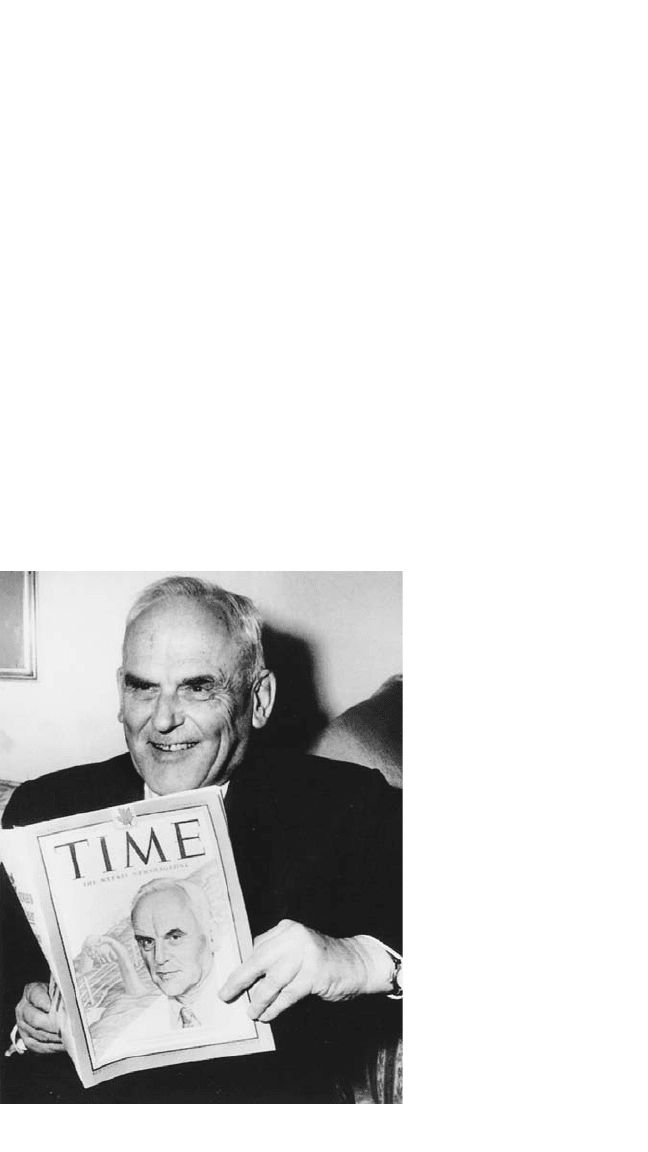
C. D. Howe (1886–1960),
minister of munitions and supply
during World War II and minister
of trade and commerce in Louis
St. Laurent’s administration,
perhaps the most infl uential
fi gure of his era, celebrates being
named Time magazine’s Man
of the Year in 1952.

309
operation of a Soviet espionage network in Canada (MacKenzie 2001).
The rise of Soviet-controlled communist regimes in Bulgaria, Hungary,
Romania, Poland, East Germany, and Czechoslovakia by 1948, in ad-
dition to revelations of Soviet atomic power, aroused Western democ-
racies to take a stand against communist imperialism, which had
drawn what British Prime Minister Winston Churchill termed an “Iron
Curtain” between East and West. In 1948 Louis St. Laurent, who had
been appointed Canada’s fi rst full-time minister of external affairs two
years earlier, called for “the creation and preservation by nations of the
Free World . . . of an overwhelming preponderance of force” (Canada
1999) that could check Soviet aggression more effectively than the
United Nations (UN) had since its inception in 1945. The UN Security
Council was stymied in its efforts to maintain international peace and
security by the veto power that had been accorded to the so-called
great powers, including the Soviet Union, the United States, Britain,
France, and China.
Accordingly, the free nations of North America and Western Europe
established the North Atlantic Treaty Organization (NATO) in 1949 as
a joint defense against Soviet aggression. While the United States pre-
ferred a purely military alliance principally committed to the contain-
ment of Soviet power, Canada sought to reinforce social and economic
links with Western Europe in order to offset American military domi-
nance. Despite Canadian efforts, rising East-West tensions, heightened
by the outbreak of the Korean War in 1950, turned NATO into an
almost exclusively military alliance. Demonstrating a widening global
interest, Canada fulfi lled its military obligations to NATO by stationing
an army brigade in Germany and an air force division in France, in
addition to providing a naval squadron to patrol the North Atlantic.
Canada’s cooperation with the United States in NATO was part of a
joint program for North American continental defense (Eayrs 1972,
1980). As relations between the United States and the Soviet Union
deteriorated, Canada became increasingly concerned about the stark
reality that the shortest air route between the two superpowers was
through its Arctic region. In order to provide warning against air and
missile attack on North America from across the North Pole, chains of
radar bases were strung across the continent during the 1950s, includ-
ing the Pine Tree Line in the vicinity of the Canadian-American border,
the Mid-Canada Line or McGill Fence along the 55th parallel, and the
Distant Early Warning (DEW) Line stretching across the Arctic wilder-
ness. The DEW Line completed in 1959 was built and maintained exclu-
sively by American funds and personnel, and thus aroused controversy
AN EXPANDING NATION IN THE AGE OF AFFLUENCE