
Riendeau A Roger E. Brief History of Canada
Подождите немного. Документ загружается.


A BRIEF HISTORY OF CANADA
280
With the growing expression and recognition of a distinct national
culture along with the unrelenting movement of people from the
countryside to the city, the basic character of modern Canada was tak-
ing shape by 1930. The National Policy had fulfi lled its objective of
transforming Canada into an industrial nation. The seeds of multicul-
turalism had been sown amid the prevailing bicultural landscape.
Canada had made an auspicious debut on the world stage, and its
national stature was confi rmed by the Statute of Westminster in 1931.
In essence, the nation was ready to advance beyond its adolescent stage
of development. But before it could continue its expansive course,
Canada would have to endure a decade and a half of national economic
crisis followed by international upheaval.

281
16
THE PERILS OF
DEPRESSION AND WAR
(1930–1945)
T
he almost continuous growth and prosperity of the fi rst three
decades of the 20th century not only ensured Canada’s survival as
a nation but also transformed it into a modern urban and industrial
society and an active participant in international affairs. Henceforth,
Canada would be able to exert greater infl uence on the course of world
development, and conversely, world events would have a more pro-
found impact on the nation’s destiny. The troublesome consequences of
this reality became strikingly evident during the 1930s, when Canada
and most of the Western world suffered through a severe and sustained
economic crisis that has become known as the Great Depression.
Then, during the fi rst half of the 1940s, much of the world was again
mobilized for a second great war that, like its forerunner a quarter of
a century earlier, challenged Canadians and their government to make
the most effective use of their fi ghting and productive capacities. In
Canada, as in most countries, the Great Depression and World War II
together caused a degree of political, social, and economic upheaval
that dramatically altered the role of government in the lives of its citi-
zens, and thus set the stage for the rise of the welfare state.
Economic Crisis and Social Distress
The spectacular crash of the New York stock market that fi nancially
wiped out thousands of stock speculators in October 1929 signaled the
start of an economic crisis of unprecedented magnitude and duration
for North America. Unlike most European nations, which struggled in
the wake of the social and economic dislocation caused by World War
I, Canada and the United States were unprepared for the abrupt end to

A BRIEF HISTORY OF CANADA
282
the boom and the optimism that they had enjoyed throughout much of
the 1920s. Political and economic leaders in both countries correctly
assumed that the great crash on Wall Street was symptomatic of declin-
ing business confi dence. But they proved to be mistaken in their belief
that this “cyclical” slump in the economy would be as short-lived as
others had typically been over the past three decades or more. A mis-
understanding of the multifaceted causes of the Great Depression led to
ineffective government responses that only served to aggravate the eco-
nomic and social distress of the numerous people who suffered or
feared the loss of their jobs.
Indeed, the causes of the Great Depression were related to factors that
were mostly beyond the control of the Canadian government and which
revealed the extreme vulnerability of the Canadian economy to world
market conditions (Safarian 1970; Norrie and Owram 2002). Because
one-third of its gross national income was derived from exports, Canada
suffered from a substantial decline in the demand for and the price of
such primary products as grain, fi sh, newsprint, lumber, and mineral
resources (with the exception of gold and nickel) in the markets of the
United States and Europe. Prices for primary commodities dropped not
only because of domestic overproduction and overcapacity but also
because of the lower demand resulting from the rise of economic nation-
alism. The United States, Canada’s largest customer, attempted to pro-
tect its own workers and farmers from foreign competition and to
stimulate its domestic market by raising tariffs to historically high levels
in 1930. European countries retaliated by raising their tariffs and further
restricting imports, much to Canada’s detriment.
The fall in wheat exports was particularly dramatic because of diffi -
culties in selling the record-breaking 1928 and 1929 crops; stiff compe-
tition from Argentina, Australia, and Russia; and reduced purchases by
European countries attempting to revive their own production through
restrictions on food imports. By 1932 the price and volume of Canadian
wheat exports had dropped to less than one-quarter of their predepres-
sion levels. The meager incomes of Prairie wheat farmers were further
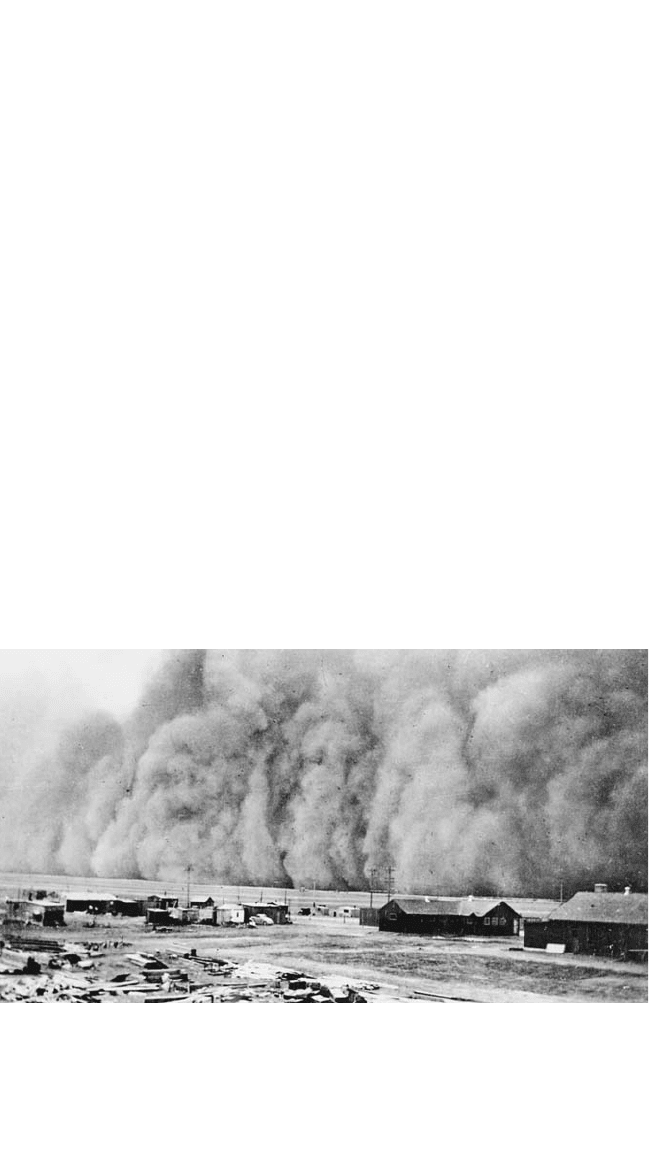
diminished by natural disasters, as drought in 1934 and again in 1937
parched the Prairie soil and scorching wind turned the landscape into
a veritable desert. Some areas of southwestern Saskatchewan and
southeastern Alberta experienced drought conditions throughout the
decade, while grasshoppers and wheat rust further contributed to crop
failures. Prairie wheat production plunged to a historic low in terms of
yield per acre in 1937, when the total crop yield was less than one-third
of the peak levels achieved in 1928. Agricultural incomes in the Prairies
283
declined by as much as 75 percent, and numerous communities,
including farmers, businesses, and governments, faced the threat of
bankruptcy.
The repercussions of the decline in wheat exports were felt through-
out the national economy. Railway revenues were drastically cut;
industry suffered from the slumping sales of farm machinery and lower
farm-purchasing power in general; and construction activity was cur-
tailed, as was the demand for consumer products. The gross national
product fell by 40 percent from 1929 to 1932. But the most tangible
indicator of the severity of the depression was the rise of unemploy-
ment to a historic high of 32 percent of the national labor force in May
1933. Thereafter, the unemployment rate declined gradually but was
still at 10 percent in 1939; only in 1941, as the Canadian war effort
escalated, did unemployment return to its predepression levels. The
unemployment problem was critical not only because of its magnitude
and duration but also because of its largely urban context. When Can-
ada had been predominantly rural and agrarian in nature, access to land
to provide a subsistence living offered greater fl exibility in times of
economic distress. But with more than half of the population living in
urban areas, the responsibility to deal with the consequences of unem-
ployment and the accompanying social and economic distress shifted
Drought conditions for much of the 1930s turned parts of the western prairies into a
“dust bowl,” as scorching winds blew the topsoil away and forced farmers to abandon their
unproductive land. This typical dust storm was photographed at Pearce Airport, west of
Lethbridge, Alberta, in 1942.
(Glenbow Archives, Calgary NA-1831-1)
THE PERILS OF DEPRESSION AND WAR

A BRIEF HISTORY OF CANADA
284
from the individual to community organizations, and ultimately to the
government.
The initial government response to the economic crisis was mis-
guided and inadequate. Prime Minister King resorted to the customary
refrain of politicians everywhere—that prosperity was “just around the
corner.” Still wedded to the laissez-faire doctrines of 19th-century liber-
alism, most politicians and economists believed that a government’s best
course of action in diffi cult economic times was to do little more than
balance the budget, maintain a sound currency, and adjust tariff poli-
cies. King continued to insist that relief for the unemployed was a local
or provincial responsibility, although he reluctantly considered the pos-
sibility of federal assistance to the provinces. During a debate on the
issue in the House of Commons, Prime Minister King responded angrily
to criticism of his government’s failure to provide suffi cient unemploy-
ment relief by insisting that he would not give a “fi ve cent piece” to
provinces under Conservative administration. The statement would
come back to haunt him in the election of 1930 (Thompson 1985).
Conservative leader R. B. Bennett, a millionaire Calgary lawyer, not
only exploited King’s unfortunate statement but also promised to aid
the provinces, to put the unemployed back to work, and to end the
depression. In particular, he promised to “blast a way into world mar-
kets” by raising tariffs to protect Canadian industry, and he attacked
the Liberals for their ineffective retaliation against the high tariff policy
that the United States had recently adopted on Canadian imports. The
voters found Bennett’s rhetoric appealing and elected the Conservatives
by a substantial majority.
The Bennett administration immediately embarked upon the most
extensive revision of the Canadian tariff system since the inauguration
of the National Policy. The general tariff level was raised by almost 50
percent as most agricultural and industrial products were given added
protection from foreign competition. Britain’s abandonment of free
trade in 1932 opened the way for negotiation of the imperial preference
agreement that Laurier had proposed earlier. Although a trade accord
was reached involving Canada, Britain, and the Commonwealth, the
participants tended to allow tariff reductions only on those products
that did not adversely affect their own economy. The success of this
effort to revive the declining imperial market was limited, and worse
still, the United States was incited to retaliate by further raising duties
on Canadian imports. Canada’s foreign trade dropped by two-thirds
from 1929 to 1933, thereby discrediting Bennett’s policy of economic
nationalism as a way out of the depression (Wilbur 1969).

285
On the whole, no coherent government plans emerged for dealing
with rural distress or chronic urban unemployment. In addition to pro-
viding loans and grants to western provinces on the verge of bank-
ruptcy, the Bennett government attempted to keep wheat prices from
falling further by purchasing more than 200 million bushels before
reestablishing the Wheat Board in 1935 to market grain abroad and to
assure farmers a minimum price for their crops. The Bennett govern-
ment also inaugurated a program to assume an increasing share of the
fi nancial burden of unemployment relief. From 1930 to 1937, the fed-
eral government spent more than $400 million (about 40 percent of the
total cost) to assist the provinces and municipalities to fulfi ll their
responsibility for providing unemployment relief. But little more than
one-quarter of this federal relief outlay came during the downswing of
the depression (1930–33) when unemployment was soaring and the
need for assistance was critical. The bulk of this relief assistance con-
sisted of direct payments to the unemployed, commonly referred to as
“the dole,” because public works programs were deemed too costly to
administer. The Department of National Defence briefl y operated relief
camps (or “slave camps,” as they became known), which provided
work for some 20,000 unmarried unemployed men who were paid a
wage of 20 cents per day. This experiment was abandoned in the wake
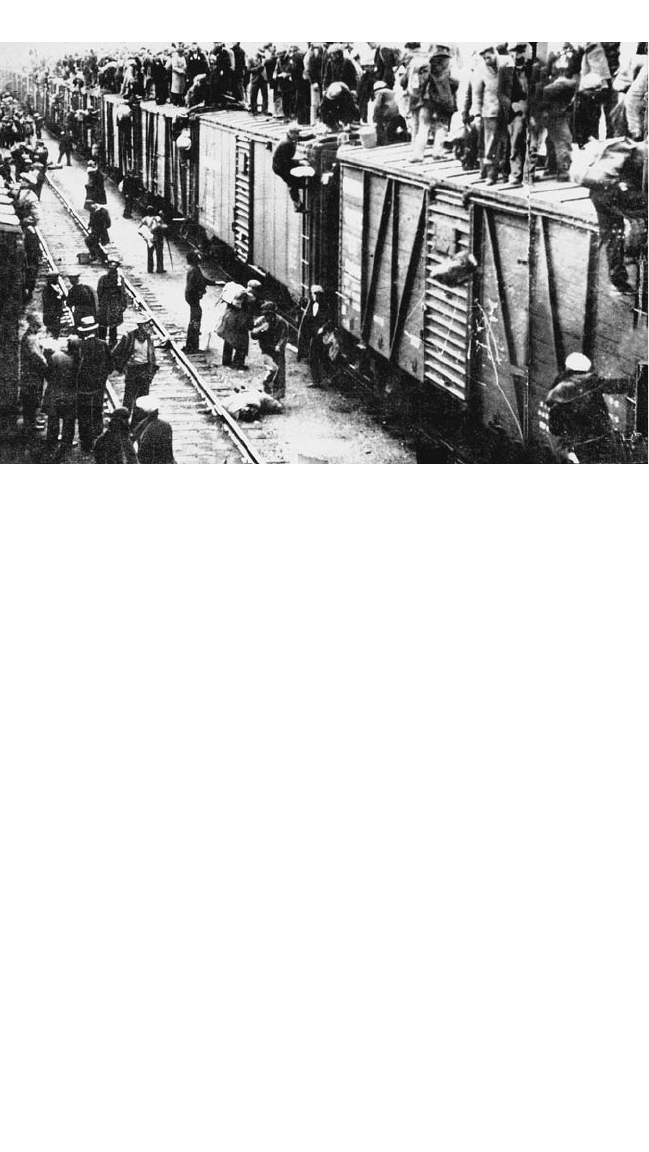
of the so-called Regina Riot in 1935 when several hundred discon-
tented camp workers participating in the “On to Ottawa Trek” to pro-
test their inhumane treatment by the government clashed with a
contingent of Royal Canadian Mounted Police. Government offi cials
constantly feared that the unemployed masses might be infl uenced by
communist propaganda.
The inadequate government response resulted in widespread human
suffering, particularly for urban workers and Prairie farmers deprived
of their livelihoods. Since Canada did not have an effective system for
dispensing public welfare, many of the unemployed and destitute had
to rely on private charity and the dole, a humiliating experience in a
society that still believed that poverty was basically the consequence of
personal failure (Struthers 1983; Horn 1984; Guest 1997). By 1934
more than 2 million Canadians (one-fi fth of the national population)
depended on public relief. When confronted with this stark reality,
Bennett was more determined to cut the federal relief budget, com-
plaining that people had become “more or less relief conscious, deter-
mined to get out of Government all they could.” The meager public
assistance that was available was administered in a haphazard manner
and at a substandard level of subsistence by local authorities, which
THE PERILS OF DEPRESSION AND WAR
A BRIEF HISTORY OF CANADA
286
themselves were dependent on federal and provincial grants to meet
their relief obligations. Overwhelmed by the fi nancial burden of unem-
ployment and relief, many cities and towns across Canada went bank-
rupt and became subject to provincial supervision and control. In
essence, municipal governments and their unemployed citizens were
victimized by the failure of the federal and provincial authorities to
recognize that mass unemployment and social welfare in a modern
urban and industrial society required a far greater and more systematic
commitment of state resources and administration.
The personal hardships of the depression decade were also evident
in demographic trends. Canada’s population increased from 10.4 mil-
lion in 1931 to 11.5 million in 1941, the slowest growth rate since the
1880s. Young people were forced to postpone marrying and starting a
family until times improved, with the result that by 1937 the birthrate
had declined by more than 25 percent since the beginning of the
decade. Canada was also a less welcoming place for immigrants during
the depression as the number accepted dropped from 169,000 in 1929
to 12,000 in 1935 and never rose above 17,000 a year for the remainder
of the decade. The prevailing fear was that immigrants would either
take scarce jobs or end up on the relief rolls. With the Immigration Act
Some 1,800 unemployed riding the rails to participate in the “On to Ottawa trek” halted at
Regina in June 1935.
(Library and Archives Canada C-024840)

287
providing for the deportation of immigrants on relief, the federal gov-
ernment returned an unprecedented 30,000 immigrants from 1930 to
1935, and even went so far as to deny refugee status to European Jews
fl eeing Nazi Germany. Not measurable by any statistic was the sense of
economic insecurity that the Great Depression instilled in Canadians
for generations to come.
The Politics of Discontent
The Great Depression dramatically altered the Canadian political land-
scape and perceptions of the role of government in social and economic
life. Disappointed with government responses to their plight, Canadians
were willing to consider political alternatives that emerged at the fed-
eral and provincial levels. When the new political personalities, parties,
and movements proved to be no more capable of remedying depression
conditions, it became necessary to renew the relationship between the
federal and provincial governments as a prelude to the building of the
welfare state (Neatby 1972).
The demand for greater government intervention was most vigor-
ously expressed by the Co-operative Commonwealth Federation (CCF),
a coalition of farmer and labor groups formed in Calgary in 1932 under
the leadership of an avowed socialist, J. S. Woodsworth. On the one
hand, CCF was an extension of
the old Progressive Party in the
sense that it was backed by the
United Farmers of Alberta and
other western farmers’ organiza-
tions. On the other hand, CCF
resembled the British Labour
Party with its belief in the British
parliamentary system and a grad-
ual, peaceful progress toward
socialist goals. Despite embrac-
ing socialism, CCF had little
inclination to associate with the
emerging Canadian Communist
Party led by Tim Buck.
The CCF platform, outlined
in the Regina Manifesto in 1933,
was infl uenced by a group of
university intellectuals based in
Social activist and political reformer James
Shaver Woodsworth (1874–1942) became
the fi rst leader of the socialist Cooperative
Commonwealth Federation (CCF) in
1933.
(Library and Archives Canada C-057365)
THE PERILS OF DEPRESSION AND WAR

A BRIEF HISTORY OF CANADA
288
Toronto and Montreal who had already formed the League for Social
Reconstruction to promote political education. The manifesto, which
called for a “new social order,” included such “radical” measures as
centralized government planning, public control of fi nancial institu-
tions, nationalization of key industries, socialized public health ser-
vices, security of land tenure for farmers, and a national labor code that
included provisions for insurance covering illness, accident, old age,
and unemployment. Deeply rooted in Prairie farm politics, especially
those of Saskatchewan, the CCF also gained support among workers in
the ports and mines of British Columbia and the factories of Ontario.
But the party was unable to make any headway in Quebec, where the
powerful Catholic Church vehemently opposed socialism, as it did
communism.
In Alberta, evangelist William Aberhart used his weekly religious
radio broadcasts to launch the Social Credit Party. Aberhart blamed the
depression on international bankers and attributed the plight of Prairie
farmers to “eastern” fi nancial interests. He further believed that the
basic fl aw in the economic system lay in the inadequate distribution of
purchasing power, which could be remedied through the payment of a
“social dividend” amounting to $25 per month to every resident of
Alberta. With this increased purchasing power, the people could buy
the goods that they needed and thus stimulate production and put the
unemployed back to work. The appeal of such a promise to an eco-
nomically desperate population, combined with the religious fervor
generated by the radio broadcasts, resulted in a landslide victory for
Social Credit in the provincial election of 1935. But when the party
attempted to put its theories into practice, its legislation was either
disallowed by the federal government or ruled unconstitutional by the
courts since monetary matters were under federal jurisdiction.
Prime Minister Bennett also faced a revolt within his own party in
1934. Minister of Trade and Commerce Harry H. Stevens chaired the
Royal Commission on Price Spreads, which revealed unfair practices of
big business with regard to corporate profi ts, consumer prices, and
labor wages. When Bennett attempted to suppress his attacks on the
iniquities of big business, Stevens resigned from the Cabinet. As the
federal election of 1935 approached, Stevens formed the Reconstruc-
tion Party with a vague platform promising to “re-establish Canada’s
industrial, economic, and social life for the benefi t of the great major-
ity,” notably the small business community.
Mounting opposition from within his party and from new political
forces demanding decisive government action to deal with the depres-

289
sion prompted Bennett to launch a bold new program of economic and
social reform under state control. Bennett had already demonstrated a
willingness to extend the realm of government intervention by reviving
the Wheat Board, increasing the federal share of the cost of old-age pen-
sions from 50 to 75 percent, and expanding federal relief grants to the
provinces. Furthermore, in 1932 the Canadian Broadcasting Commis-
sion, renamed the Canadian Broadcasting Corporation (CBC) in 1936,
was established to give the federal government regulatory control over
the whole fi eld of radio broadcasting. The Bank of Canada was founded
in 1934 as a federal government agency to regulate monetary policy and
to control private banks. Nevertheless, Canadians were astounded to
hear Bennett proclaim his intention to reform capitalism in a series of
fi ve national radio broadcasts in January 1935.
The style and substance of Bennett’s policy announcements were
reminiscent of the New Deal inaugurated by U.S. president Franklin
Roosevelt two years earlier. The “Bennett New Deal” reforms included
measures to improve farm credit and the marketing of natural products;
legislation providing for a minimum wage, a 48-hour work week,
unemployment insurance, social security, and health insurance; and
laws to enforce fair trade practices, to regulate trusts, and to control
business standards. Despite the merits of these reforms, many of which
were immediately implemented, most Canadians regarded Bennett’s
transformation from a fi scal conservative to an advocate of state pater-
nalism as mere political opportunism (Wilbur 1969).
The New Deal legislation did not prevent voters from blaming Ben-
nett for failing to end the depression as promised, with the result that
the Conservatives were reduced to 39 seats, in the election of 1935,
their worst performance up to that time. The Liberals, promising little
more than the slogan “King or Chaos,” swept back into power with an
unprecedented majority, mainly because the new parties attracted
nearly one-quarter of the voters.
In the wake of depression conditions, the winds of political change
were also blowing through the provinces. As Aberhart was leading
Social Credit to power in Alberta, Maurice Duplessis was leaving the
ranks of Quebec Conservatives to form a new French-Canadian nation-
alist party, Union Nationale. This latest nationalist movement refl ected
the ambivalent reaction to the progress of urbanization and industrial-
ization in Quebec (Jones 1984; Linteau, Durocher, and Robert 1991).
On the one hand, the industrial revolution that Quebec experienced
after World War I curtailed the migration of young French Canadians
to the factory towns of New England. On the other hand, urban and
THE PERILS OF DEPRESSION AND WAR