
Riendeau A Roger E. Brief History of Canada
Подождите немного. Документ загружается.


A BRIEF HISTORY OF CANADA
380
hopes have been raised by the discovery of possibly one of the world’s
richest deposits of natural gas located just off Sable Island, 300 kilome-
ters southeast of Halifax. The $2 billion dollar Sable Offshore Energy
Project initiated in 1995 by a conglomerate including ExxonMobil,
Shell, and Imperial Oil completed a 237-kilometer subsea natural gas
pipeline from Goldboro (northeast of Halifax) to the offshore oil plat-
form in 1999 and opened two gas fi elds over the next fi ve years. Nova
Scotia’s promising energy future, in addition to a booming tourist
industry marketing its maritime folkloric image, is offsetting the con-
tinuing decline of coal mining in Cape Breton Island. Tourism has also
boosted the prospects of New Brunswick and Prince Edward Island,
especially with the completion of the Confederation Bridge across Nor-
thumberland Strait to link the two provinces in 1997.
Despite the western resource boom, central Canada remained the
economic engine of the nation, with southern Ontario in general and the
Greater Toronto Area in particular leading the way. The tax and spend-
ing cuts of the “Common Sense Revolution” were praised by the busi-
ness community for leading the province out of its relative economic
decline after the mid-1990s, despite provoking labor unrest and acrimo-
nious debates about social welfare, health care, education, and urban
development policies. The revival of Montreal, merged with 27 other
cities and towns to become a “super city” with a population approaching
2 million in 2002, was the catalyst for the thriving Quebec economy,
which helped to temper separatist aspirations over the past decade.
While public opinion polls in the wake of the sponsorship scandal
reported support for independence rising slightly above 50 percent, this
response appeared to be primarily an expression of disgust toward the
federal Liberals rather than a concerted nationalist resurgence. Prime
Minister Harper’s controversial parliamentary motion in November 2006
recognizing that “the Québécois form a nation within a united Canada”
has rekindled a debate over the divisive sovereignty issue. Supporters
cautiously view it as a bold political step to improve Conservative Party
fortunes in Quebec and to undercut the independence movement, while
critics describe it as a recipe for tearing apart the country by playing into
separatist hands. With the anti-separatist Action Démocratique Québec
(ADQ) under Mario Dumont supplanting the Parti Québécois as the
offi cial opposition to the Liberals in the provincial election of 2007, it
would appear that the majority of Québécois, like most Canadians, are
more preoccupied with the social and economic agendas of their govern-
ments. Still, the threat of separatism looms as a strategic negotiating ploy
for greater provincial autonomy and federal consideration.
381
While regional discontent and disparity will inevitably persist in
Canada, the face of regionalism appears to be transforming in the wake
of new opportunities for economic diversifi cation. The debates over the
allocation of national resources and the determination of national policy
appear to be focusing less on the alleviation of regional imbalances and
more on the distribution of federal-provincial powers and responsibili-
ties to address adequately pressing socioeconomic realities, such as
health care for an aging population, poverty in the midst of plenty, edu-
cation responsive to a changing global economic order, and the service
and infrastructural needs of growing cities. Stronger regional economies
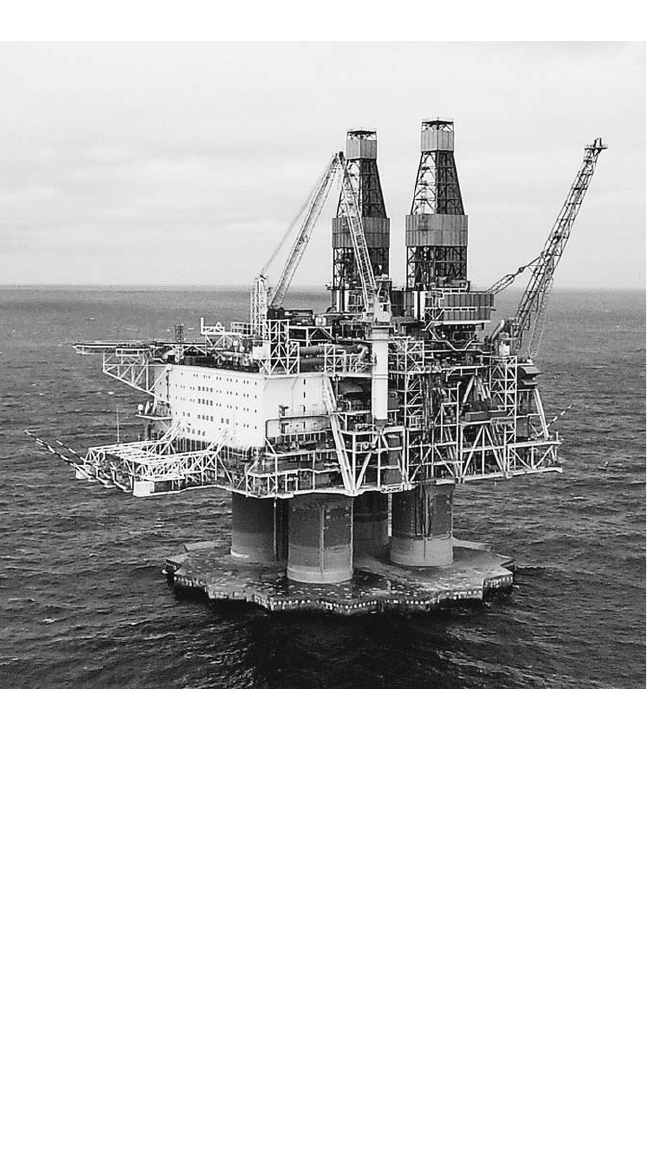
This mobile offshore drilling platform located at Hibernia off the east coast of Newfoundland
and Labrador has rejuvenated the provincial economy hard hit by the demise of its cod
fi sheries. A predecessor of this unit, the Ocean Ranger, sank to the bottom of the Atlantic in
the wake of a vicious winter storm in February 1982, resulting in the death of all 84 crew
on board.
THE ILLUSION OF CONSENSUS

A BRIEF HISTORY OF CANADA
382
tend to encourage negotiation and compromise rather than dominance
and intransigence. In essence, regionalism will always be prevalent in
Canada, not so much because of formidable barriers of geography that
can now be overcome by technology, but more because no single politi-
cal force is powerful enough to impose its continuous will.
Further complicating efforts to achieve national unity and to defi ne
a national identity is multiculturalism. Canada has always been a mul-
ticultural society in search of cultural homogeneity, and the continuous
fl ow of immigrants ensures the elusiveness of this prospect. According
to the 2001 census, 2.2 million immigrants were admitted to Canada
from 1991 to 2000 the highest ever for any decade. Nearly three-fi fths
of the 1.8 million immigrants who actually took up permanent resi-
dence in Canada came from Asia, including the Middle East; about
one-fi fth from Europe; over one-tenth from the Caribbean, Central and
South America; and one-eighth from Africa. The People’s Republic of
China was the leading country of birth among Asian immigrants, fol-
lowed by India, the Philippines, Hong Kong, Sri Lanka, Pakistan, and
Taiwan. As a result, visible minorities accounted for more than 13 per-
cent of the Canadian population in 2001, about triple the number
recorded two decades earlier. Projections indicate that by 2016, visible
minorities will make up one-fi fth of the Canadian population. With
more than 18 percent of its residents born outside the country (com-
pared to 11 percent in the United States), Canada ranks second only to
Australia, and Canada is destined to pass Australia because of its higher
annual intake of immigrants. Indeed, another 1.2 million immigrants
arrived in Canada between 2001 and 2006.
Almost three-quarters of the immigrants who arrived in the 1990s
settled in the three metropolitan areas of Toronto, Vancouver, and
Montreal, as compared to two-thirds of immigrants in the 1980s and
fewer than three-fi fths in the 1970s. The metropolitan Toronto area
attracted 43 percent of these immigrants, while Vancouver and Mon-
treal received 18 percent and 12 percent, respectively; Calgary tied with
Ottawa for fourth place with 4 percent. Vancouver boasts the highest
proportion (37 percent) of visible minorities, almost entirely Asian.
With populations that are 44 percent and 40 percent foreign-born,
Toronto and Vancouver, respectively, rank among the world’s most
multicultural cities. On the other hand, the concentration of immi-
grants in the larger urban centers belies the paradox of multicultural-
ism in Canada. For all the rhetoric and reality of their cultural mosaic,
Canadians generally continue to oppose increased immigration out of
a concern for the potential social and economic problems that it might
383
bring. Even new Canadians, regardless of ethnicity, still tend to support
closing the immigration door behind them.
The dramatic shift away from traditional British and other European
sources of immigrants over the past three decades has not only pro-
foundly altered the Canadian cultural landscape but also has prompted
a redefi nition of the concept of Canadian ethnicity. In the process, Sta-
tistics Canada has had to modify its method of recording, reporting, and
interpreting data about ethnic ancestry in two important respects. First,
in recognition of the growing trend toward intermarriage among ethnic
THE ILLUSION OF CONSENSUS
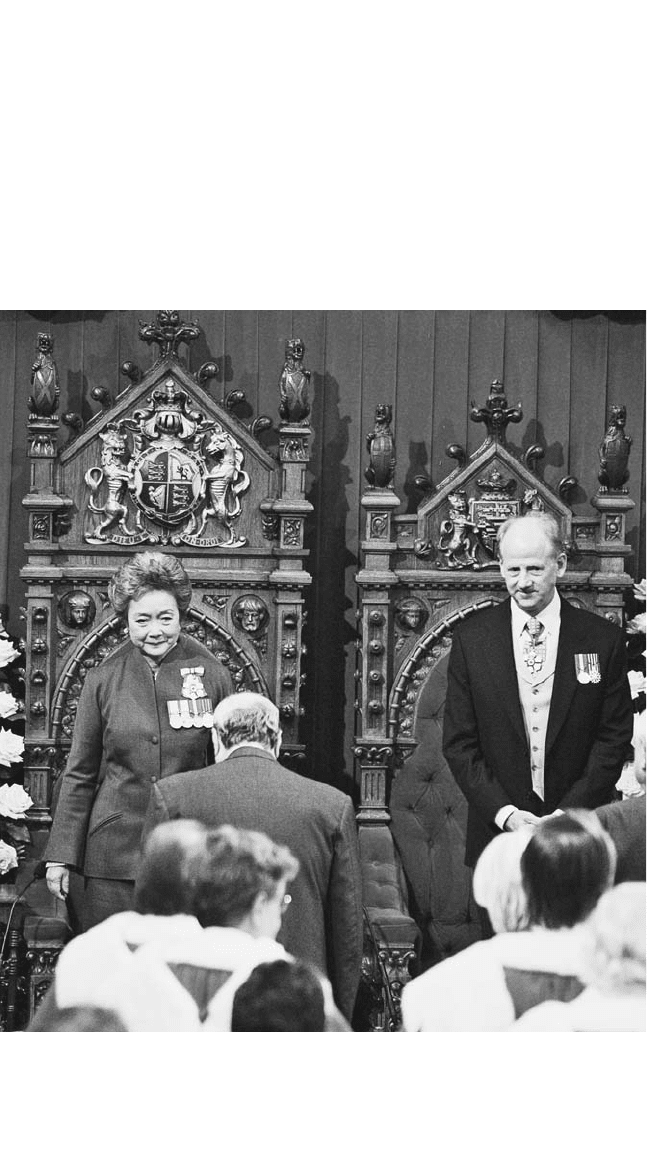
When she was appointed governor-general in 1999, Asian-born journalist Adrienne Clarkson
(1939– ), pictured here with her husband, author John Ralston Saul (1947– ), was the fi rst
member of a visible minority to become head of state in Canada.
(Canadian Press/Tom Hanson)
A BRIEF HISTORY OF CANADA
384
groups, the census of 1981, for the fi rst time, allowed respondents to
report “multiple” or “mixed” ethnic ancestry. Second, because so many
respondents to the 1991 census wrote in “Canadian” as their ethnic
origin rather than choosing an existing category, Statistics Canada
decided to recognize this self-identifi cation as an offi cial nationality in
the 1996 census. Although a precise comparison of ethnic origins from
one census to another has, therefore, become exceedingly complex, if
not impossible, the census of 2001 highlights the ever-growing diversity
of Canadian society and the awakening of a unique national identity.
Respondents to the 2001 census question on ancestry listed more than
200 ethnic groups. The most common ancestry was Canadian (or Cana-
dien, on the French questionnaire); 23 percent of the total population
reported Canadian as their only ethnic origin (compared to only 3 per-
cent in 1991), while another 16 percent reported Canadian in combina-
tion with other origins (compared to only 1 percent in 1991). Most of
these respondents who had English or French as their mother tongue
were from families who have been living in Canada for several genera-
tions and had self-identifi ed as
British (including English, Irish,
Scots, and Welsh) or French in
previous censuses. People of Brit-
ish and other European back-
grounds whose ancestors were
among the early immigrants to
Canada and therefore had more
opportunity over time for mar-
riage with people of different eth-
nic backgrounds were prevalent
among the 38 percent of respon-
dents who reported multiple eth-
nic origins. The tendency for
respondents to self-identify as
being of Canadian or mixed origin
accounts for the decline in those
reporting British (9 percent) or
French (3 percent) as their only
ethnic origin. On the other hand,
42 percent of the respondents self-
identifi ed as British in combination
with another ethnic origin, usually
Canadian, while 12 percent self-
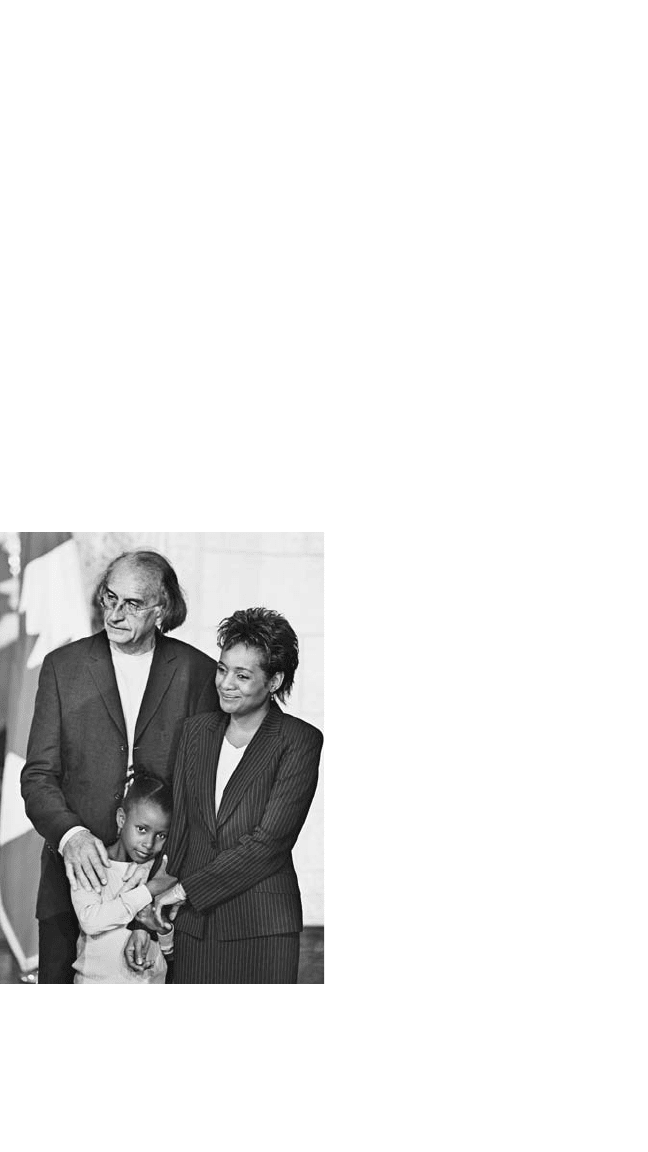
Refl ecting the growing infl uence of visible
minorities in Canada, Haitian-born Quebec
journalist Michaëlle Jean became the fi rst black
person to be appointed governor-general, in
2005.
(Canadian Press/Fred Chartrand)

385
identifi ed as French in combination with another ethnic origin, mostly
Canadian. Likewise, North American Indians and Métis who made up 3
percent and 1 percent of the population, respectively, appear more
inclined to identify their ethnic origins in combination with Canadian.
On the whole, the recent census reveals the fl uidity of the modern
concept of ethnicity and the greater willingness to embrace a sense of
Canadian nationality in the face of increasing ethnic diversity. In effect,
Canadianism is evolving more decisively from the bottom up rather than
the top down. While the politicians endlessly debate the right prescrip-
tion for achieving national unity or defi ning the national identity, usu-
ally cast in terms that will enhance their power, the Canadian people
appear to be increasingly capable and willing to accept that they are
inevitably bound by a common experience. Indeed, the formidable chal-
lenges of Canadian development have often forced people to set aside
their differences and to work together to achieve their aspirations.
The ambivalent responses of Canadians and the tensions that have
sustained them are not about to change. Canada is destined to remain a
multicultural and regional society in which private and state enterprise
collaborates to maximize the potential of the nation’s abundant natural
and human resources. Furthermore, the course of Canadian develop-
ment will continue to be infl uenced by external forces beyond national
control. The 18th century was the century of imperialism, and within
this context, Canada developed as a colony. The 19th century was the
century of nationalism, during which Canada became a nation. The 20th
century was the century of internationalism, during which Canada
became a fully autonomous nation and earned international recognition
as one of the leading places to live and work. Whatever the 21st century
may bring is bound to add to the richness of Canadian history.
THE ILLUSION OF CONSENSUS

386
APPENDIX 1
Basic Facts about
Canada
Offi cial Name
Canada. Originally called the Dominion of Canada in 1867 to indicate
its status as a self-governing colony of the British Empire (the fi rst
time it would be so used in reference to a country), the term gradually
fell out of common usage after 1931, when Canada offi cially achieved
national autonomy through the Statute of Westminster.
Government
Under the British North America Act of 1867, amended as the
Constitution Act 1982, Canada is a federation (or confederation)
governed by parliamentary democracy. The head of state, on behalf of
the Queen of the United Kingdom of Great Britain, is the governor-
general, appointed by the queen on the advice of the prime minister.
Although not stipulated in the constitution, the prime minister has
evolved through convention into the real head of government by
virtue of being the leader of the majority party or coalition in the
House of Commons. The bicameral Parliament consists of a popu-
larly elected House of Commons (lower house) which has real legis-
lative power and a predominantly ceremonial Senate (upper house)
appointed on a regional basis by the queen on the advice of the prime
minister.
Although four major political parties contest parliamentary elections
held every four to fi ve years, the centrist Liberal Party has governed for
most of the past century, while the Conservative Party (recently recon-
stituted as a right-wing coalition) has enjoyed occasional interludes in
power, and the left-wing New Democratic Party has never formed the
Offi cial Opposition. The Bloc Québécois focuses on promoting sover-
eignty or provincial autonomy for Quebec.
386

387
APPENDIX 1
Canada’s judiciary plays an important role in interpreting laws and
has the power to strike down laws that violate the constitution. The
Supreme Court of Canada is the highest court and fi nal arbiter. All
judges at the superior, appellate, and Supreme Court of Canada levels
are selected and appointed by the federal government.
Political Divisions
Ten provinces and three territories, all with a parliamentary system of
government with basically the same features as the national govern-
ment, except for an upper house in the legislature.
Capital
Ottawa, Ontario
Geography
Area
Covering nearly 10 million square kilometers, or more than 3.8 million
square miles, Canada is the second in size only to Russia.
Boundaries
To the south, mainland United States. To the north, the Arctic Ocean
and Russia. To the east, the Atlantic Ocean and Greenland. To the west,
the Pacifi c Ocean and Alaska.
To p o g r a p h y
Spanning nearly 4,000 miles from the Atlantic Ocean to the Pacifi c
Ocean, the Canadian landscape consists of the low-lying Appalachian
Highlands (reaching no more than 2,000 feet in altitude) along the east
coast; the St. Lawrence Lowlands to the southwest; the vast and rugged
Canadian, or Precambrian, Shield (reaching no more than 1,500 feet in
altitude) to the northwest and extending to the Arctic Archipelago in
the Far North, the Great Central Plain in the West, culminating with
the towering Western Cordilleras (the Rocky Mountains being the most
famous at upwards of 15,000 feet in altitude) along the west coast.
Canada has a total water area of nearly 900,000 square kilometers, or
about 350,000 miles, the most of any country in the world. More than
60 percent of the world’s lakes are located in Canada, including four of
the fi ve Great Lakes, which constitute the largest group of freshwater
lakes on Earth. Transcontinental exploration of this vast country was
possible through an extensive system of navigable rivers, the major of
which is the St Lawrence River fl owing out of the Great Lakes. The St.
Lawrence–Great Lakes waterway extends 1,900 miles from the Gulf of
387

A BRIEF HISTORY OF CANADA
388
St. Lawrence, the largest estuary in the world, into the interior heartland
of North America. The Mackenzie River in the Northwest Territories is
the second-longest river in North America after the Mississippi.
Although slightly less than 5 percent of the total land area is arable,
Canada still has the fourth most arable land in the world, behind
Russia, China, and the United States. Canada is endowed with an ines-
timable supply of natural resources, including fi sh, timber, minerals,
oil, natural gas, and hydropower.
Highest Elevation
Mount Logan (Yukon Territory) 5,959 meters, or 19,550 feet
Demographics
Population (2005)
With 33 million people, 80 percent of whom live within 200 kilome-
ters of the American border, Canada ranks only 33rd in the world. Its
population density of 3.5 per square kilometer is among the lowest in
the world.
Largest City
Toronto; the metropolitan area has a population of more than 2.5 mil-
lion (2004), while the Greater Toronto Area (GTA) has a population of
more than 5.2 million (2004).
Language
Canada is offi cially a bilingual country, with specifi c legislative provi-
sion for the equality of English and French. Almost 60 percent speak
English as a fi rst language; about 23 percent speak French as a fi rst
language; and almost 18 percent speak another fi rst language (the three
most common being Chinese, Italian, and German). An estimated 98
percent of the population can speak English. The Aboriginal peoples
speak more than 50 languages but communicate mostly in English.
Ethnic Groups
In the 2001 census, nearly 40 percent of respondents reported their eth-
nic origins as “Canadian,” most of whom tend to be of British, French,
or other European heritage of earlier immigrants. In addition, among
more than 200 ethnic groups listed, 20 percent identifi ed their origin
as English, 16 percent as French, 14 percent as Scottish, 13 percent as
Irish, 9 percent as German, and 4 percent as Italian. The total “visible
minority” population is 13 percent of the Canadian population (exclud-
ing First Nations, Métis, and Inuit peoples). Nonwhites make up 15
percent of the population, half of whom are Asians. With more than 18
percent foreign-born, Canada ranks second to Australia.

389
APPENDIX 1
Education
Literacy: 97 percent
Compulsory schooling: until 16 years of age
Health
Infant mortality rate: 4.75 deaths /1,000 live births
Life expectancy: 80 years
Fertility rate: 1.6 children born/woman
Religion
Roman Catholic: 43 percent
Protestant: 23 percent
Other: 18 percent
None: 16 percent
Economy
GDP (2004)
$1.023 trillion; the 12th largest in the world
Economic Sectors (2004)
Services: 71.3 percent
Industry: 26.4 percent
Agriculture: 2.3 percent
Main Trading Partners—Exports (2004)
United States: 85.2 percent
Japan: 2.1 percent
United Kingdom: 1.6 percent
Total exports: $315.6 billion (2004)
Main Trading Partners—Imports (2004)
United States: 58.9 percent
China: 6.8 percent
Mexico: 3.8 percent
Total imports: $256.1 billion (2004)