
Riendeau A Roger E. Brief History of Canada
Подождите немного. Документ загружается.


A BRIEF HISTORY OF CANADA
350
Provincial Power and Discontent
A contributing factor to the mounting federal defi cit was the escalating
expenditures for unemployment insurance as well as for the three
major shared-cost programs with the provinces: hospital insurance,
medical care, and postsecondary education. Unable to control provin-
cial expenditures that it had to match dollar for dollar, the federal gov-
ernment attempted to place a ceiling on its contribution to these social
programs through the Established Programs Financing (EPF) agree-
ment of 1977. Under the EPF arrangement, the federal government
withdrew from the shared-cost aspect of these programs and tied its
annual contribution to the growth in per capita gross national product
(GNP) rather than to actual provincial spending. After rancorous nego-
tiations in which they typically demanded more money from Ottawa,
the provinces agreed to the complicated formula for transfer payments
because they saw opportunities to save money through effi cient man-
agement of established programs without having to share the savings
with Ottawa. With the slowing of economic growth in the late 1970s,
federal revenue did not keep up with the rise in the per capita GNP,
with the result that Ottawa had to make larger-than-anticipated fi nan-
cial transfers to the provinces in order to live up to the terms of EPF.
Worse still, the federal government received little political credit for its
support of provincial social programs, while it remained an easy target
to blame for their shortcomings at election time.
Another source of discontent with the Trudeau government in both
English and French Canada was its continued preoccupation with
institutionalized bilingualism (Bothwell, Drummond, and English
1989). Despite the Supreme Court’s rejection of a constitutional chal-
lenge to the Offi cial Languages Act in 1974, upwards of three-quarters
of the anglophone population and one-fi fth of the francophone popu-
lation questioned bilingualism as a government priority. Within this
context, the strike of anglophone pilots and air traffi c controllers who
opposed the sanctioned use of French over Quebec airspace proved to
be uniquely popular, despite bringing air travel in Canada to a virtual
standstill in 1976. Many French Canadians implied that antipathy
toward their language, rather than air safety, was the real motive
behind the strike. A commission authorized to investigate the matter
reported in 1979 that no risks were attached to the use of both lan-
guages in air traffi c control. Support for bilingualism was further
undermined by a series of provincial enactments promoting French
unilingualism in Quebec. In 1979 the Task Force on National Unity

351
criticized the implementation of institutionalized bilingualism in the
public service as “costly and relatively ineffective.” Indeed, Canadians
have continued to debate whether bilingualism has done more to
divide or unite the country.
Further evidence of growing antipathy toward the Trudeau admin-
istration was the reduction in Liberal provincial governments from
fi ve in 1968 to none by 1979. Not surprisingly, the demise of the
Liberals was most pronounced in western Canada, where they were
effectively reduced to “third”—or “fourth”—party status. Prairie
provincial elections became contests between the Conservatives
and either the NDP (in Manitoba and Saskatchewan) or Social
Credit (Alberta), while British Columbia voters rejected the tradi-
tional parties altogether by electing either Social Credit or the NDP.
The Liberals were able to remain the Official Opposition in Ontario,
the Atlantic provinces, and Quebec. To the astonishment of most
Canadians, Premier Bourassa managed to squander the overwhelm-
ing Liberal majority in the Quebec legislature and opened the door for
a Parti Québécois victory in 1976. Trudeau’s powerful defense of
Canadian federalism in the face of an avowedly separatist government
in Quebec led to a brief resurgence in the prime minister’s popularity.
But once the shock of René Lévesque’s triumph had subsided, Cana-
dians wondered whether Trudeau was too distracted by his crusade
against Quebec sovereignty.
Not even the faltering Conservatives could stem the rising tide of
Trudeauphobia. When Stanfi eld stepped down as party leader in 1976,
a deeply divided Conservative convention chose little-known Alberta
MP Joseph Clark as his successor. In terms of political experience, per-
sonal dynamism, and perceived leadership qualities, “Joe Who?” as he
was popularly dubbed, suffered by comparison to Trudeau and NDP
leader Edward Broadbent. Nevertheless, growing voter antipathy toward
Trudeau and the Liberals in the federal election of 1979 enabled the
Conservatives to form a minority government even though the Liberal
share of the popular vote was actually about 4 percent higher. Liberal
support was too heavily concentrated in Quebec, where the party won
67 out of 75 ridings; west of Manitoba it won only one seat and scarcely
20 percent of the popular vote. For their part, the Conservatives cap-
tured the West and scored major gains in southern Ontario, but won
only two seats in Quebec.
Once in offi ce, the Clark administration realized that some of its
major election promises were not fi scally or practically feasible. A series
CONFLICT AND CONFRONTATION IN THE AGE OF ANXIETY

A BRIEF HISTORY OF CANADA
352
of policy modifi cations or retreats reduced the popularity of the gov-
ernment and reinforced Clark’s image as a weak and indecisive leader.
Before it could celebrate its fi rst anniversary, the government fell on a
motion of nonconfi dence in a budget that included not only a series of
oil-price increases to promote new explorations that would lead to
energy self-suffi ciency by 1990 but also an excise tax on gasoline
amounting to 18 cents per gallon. Finance Minister John Crosbie justi-
fi ed the new tax in terms of the need to raise billions of dollars to fi ght
the escalating federal budget defi cit. While his reasoning was sound
and far-sighted, Canadians were not yet prepared to accept his “short-
term pain for long-term gain.” Reconsidering an earlier decision to
retire from politics, Trudeau led the Liberals to a majority victory in the
election of 1980, which also saw the Créditistes eliminated from the
federal political scene.
The resilient Trudeau immediately launched the National Energy
Program (NEP) designed to promote energy self-suffi ciency, to redirect
a larger share of oil revenues to the federal government, and to encour-
age greater Canadian ownership of the oil industry. To achieve these
objectives, NEP included grants to encourage oil drilling in remote
areas, grants to consumers to convert to gas or electric heating, new
taxes on the oil industry, an expanded role for Petro-Canada, a require-
ment of 75 percent Canadian ownership to qualify for new federal
exploration grants, and a reduction of foreign participation in oil and
gas industry to below 50 percent. Predictably, the NEP was denounced
in western Canada for its usurpation of provincial rights and for unnec-
essary state intervention in the economy, while some American politi-
cians and entrepreneurs threatened retaliatory measures. Ultimately,
NEP proved to be ill-timed: the federal government spent billions of
dollars purchasing foreign oil companies and assisting oil exploration
by Canadian companies only to have world oil prices crash dramati-
cally after 1982 (Clarkson and McCall 1990, 1994). Trudeau’s fi nal
term as prime minister was also memorable for his continued confron-
tation with Quebec.
Quebec Sovereignty and the Constitution
If Trudeau was overly preoccupied with Quebec, as his critics claimed,
political developments in his native province during the 1970s and
the early 1980s gave him ample justifi cation. Regardless of which
political party governed Quebec, the language question remained at
the forefront of public debate (McRoberts 1999; Mann 2002). Whereas

353
at the time of Confederation the protection of the Catholic religion
had been the chief concern of Quebec, the protection of the French
language emerged as the key issue a century later. In response to a
decision by the school board of the Montreal suburb of Saint Léonard
that all immigrant children should attend French-language schools,
the Union Nationale government passed Bill 63 in 1969. The legisla-
tion declared French to be the prevailing language of instruction but
offered parents the freedom to choose whether their children should
be taught in French or English. That immigrants preferred English-
language education was disturbing to French Canadians who feared
that multiculturalism would lead to the relative decline of their own
culture.
The Liberal government of Robert Bourassa took up the language
issue in broader terms by passing Bill 22 in 1974. French was decreed
to be the offi cial language of the province—the language of business
and government—and all immigrant children were required to attend
French-language schools. French-Canadian nationalists criticized the
measure for failing to make French the sole public language and for
permitting English-language education for anglophones. The English-
speaking community and ethnic groups denounced the legislation as
arbitrary and tyrannical and urged open defi ance. The Trudeau gov-
ernment opposed Bill 22 as a challenge to the federal policy of bilin-
gualism. Bourassa thus pleased no one and had to face the consequences
of his government’s action when he called a premature election in
1976.
Bourassa feared that the PQ was gaining in popularity and that his
scandal-ridden administration would not fare well with the voters as
the struggling Quebec economy worsened. His strategy of a surprise
election with separatism as the issue backfi red as the PQ with a little
more than two-fi fths of the popular vote won two-thirds of the seats.
Apparently, many English-speaking and ethnic Quebeckers voted for
Union Nationale to protest Bill 22, thereby splitting the traditional Lib-
eral support. Moreover, Lévesque steered a cautious course by promis-
ing that a PQ government would not decide to separate Quebec from
Canada without seeking approval in a provincial referendum. There-
fore, many antiseparatists voted for PQ because they opposed the Liber-
als and wanted a change in government. Whatever the case, on
November 15, 1976, the Canadian political landscape was undoubtedly
complicated and transformed.
At fi rst, the PQ government focused on social and economic legisla-
tion that continued the Quiet Revolution and refl ected a left-of-center
CONFLICT AND CONFRONTATION IN THE AGE OF ANXIETY

A BRIEF HISTORY OF CANADA
354
political ideology, more closely resembling the NDP than the Liberals
or Conservatives. The PQ intensifi ed the language controversy by pass-
ing Bill 101 in 1977. The legislation extended the use of French as the
offi cial language to virtually every aspect of Quebec life and further
restricted English-language education. By requiring signs to be posted
in French only, Bill 101 was anticipating the eventual use of French as
the sole public language of Quebec. In effect, Quebec would become as
overwhelmingly French as Ontario was English.
Of course, the English-speaking community and ethnic Quebeckers
were further outraged, and they responded by launching legal chal-
lenges that in some cases the Supreme Court of Canada upheld. Con-
stant political and legal pressure would eventually persuade future
governments to moderate some of the provisions of Bill 101. But per-
haps the greatest pressure came from the sizable exodus of Anglo-Que-
beckers and corporate head offi ces from the province, citing objections
to language restrictions, high taxes, and the threat of separation from
Canada. A substantial portion of this migration was to Toronto, which
in the census of 1981 surpassed Montreal as Canada’s largest city, in
addition to becoming the undisputed fi nancial capital of the nation
(Dickinson and Young 2003).
As he developed his legislative agenda, Lévesque began referring to
the prospect of “sovereignty association” by which a politically sover-
eign Quebec would enter into an economic association with Canada.
To enhance the possibility of winning the provincial referendum
scheduled for May 20, 1980, Lévesque composed a shrewdly worded
(some would say deceptively worded) question that asked the voters
to give his government the right to “negotiate” a sovereignty associa-
tion agreement with Canada. The outcome of these negotiations
would be subject to another provincial referendum. In other words, a
oui (“yes”) vote for the question would not result in a unilateral dec-
laration of independence. Claude Ryan, who succeeded Bourassa as
provincial Liberal leader in 1978, led the non (“no”) forces within
Quebec, while Prime Minister Trudeau campaigned on behalf of the
rest of Canada. With 82 percent of eligible voters participating, Que-
bec voted non to the referendum question by a margin of 60 percent
to 40 percent. Whereas almost all of the non-French-speaking popu-
lation voted against the question, the French-speaking community
was evenly divided in its response. Nevertheless, Canadians cele-
brated the defeat of separatism and took comfort in the belief that
their nation would remain united.

355
The rejection of Lévesque’s sovereignty association proposal did
not prevent the premier from being reelected in the following year.
The voters of Quebec overwhelmingly supported Trudeau’s Liberals
in Ottawa, but they preferred a strong defender of provincial rights in
Quebec City. In the early 1980s, Ottawa and Quebec City again
clashed over the patriation of the constitution, the achievement of
which had eluded Canadian legislators for more than a half-century.
Prime Minister Trudeau thought that he had successfully negotiated
a proposal for constitutional reform, including an amendment for-
mula and a bill of rights, on which all the provinces appeared to agree
in 1971. However, at the last moment, Premier Bourassa rejected the
so-called Victoria Charter because it did not grant Quebec suffi cient
control over social policy. Buoyed by the referendum victory, Trudeau
was determined to succeed whether or not the provinces, particularly
Quebec, approved of his constitutional proposals. A Supreme Court
ruling in 1981 confi rmed that the federal government had the legal
right to patriate the British North America Act unilaterally but, at the
same time, questioned the constitutional propriety of acting without
the consent of the provinces. Trudeau pledged to attempt one last
time to negotiate a deal with the provinces before he would resort to
unilateral action.
A federal-provincial conference fi nally reached an accord on the
terms of the new constitution to replace the British North America
Act of 1867. The new Constitution Act (1982) included an amend-
ment formula and a Charter of Rights and Freedoms. The basic
amendment formula required the agreement of the federal Parlia-
ment and two-thirds of the provinces comprising at least 50 percent
of the national population. No longer was it necessary to consult the
British Parliament to change the Canadian constitution. Unlike the
Bill of Rights of 1960 that it replaced, the Charter of Rights and Free-
doms was entrenched into the new constitution in order to ensure
that the courts rather than Parliament and the legislatures would
have the last word on the protection of liberties and the validity of
laws. Again, Quebec refused to sign the constitutional agreement
because it was denied veto power as one of the two “national” groups
in Canada. Although Quebec was legally bound by the terms of the
new constitution, Lévesque spoke of it as a “betrayal” by the rest of
Canada and a symbol of the isolation of the province (Linteau, Duro-
cher, and Robert 1991).
After the disappointment of the referendum and the patriation of the
constitution, Lévesque abandoned plans for sovereignty association and
CONFLICT AND CONFRONTATION IN THE AGE OF ANXIETY

A BRIEF HISTORY OF CANADA
356
concentrated on the struggling Quebec economy. This decision upset the
more hard-line separatists within the PQ who successfully pressured him
into resigning in 1985. The defeat of the PQ at the hands of the Liberals
led by a resurrected Bourassa in 1985 appeared to signal again that the
separatist movement had run its course. The nationalist lull before the
returning storm of sovereignty would prove to be short-lived.
Lévesque’s great adversary, Trudeau, also suffered a decline in
popularity, which persuaded him to retire from politics in 1984. As
he ended his term as prime minister, the third longest in Canadian
history behind Mackenzie King and Sir John A. Macdonald, Trudeau
ironically achieved some measure of national unity, although not in
the sense that he intended. For a brief moment, the nation was
united in its antipathy toward Trudeau and all that he and his gov-
ernment represented. As a result, the Liberals went down to an over-
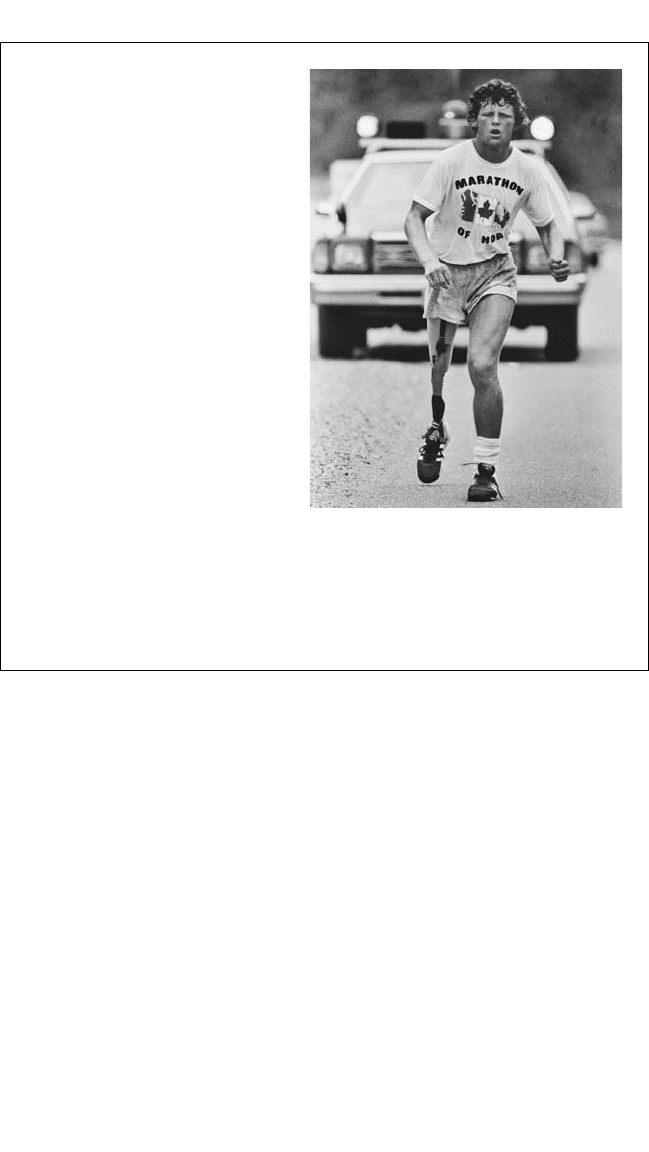
Terry Fox: The 400 Million
Dollar Man
E
very September, hundreds of thousands of people, in 60 different
countries, are inspired to run along city streets to celebrate and
keep alive the dream of a special Canadian hero. In 1980, Terry Fox
(1958–1981) captivated the popular imagination worldwide with his
determination to run across Canada in an effort to raise funds for can-
cer research. This daunting physical challenge was all the more extraor-
dinary because the athletic young man from British Columbia had lost
his right leg due to bone cancer only three years earlier.
On April 12, 1980, Terry dipped his artifi cial leg into the Atlantic
Ocean at St. John’s, Newfoundland, with the objective to dip it again
into the Pacifi c Ocean at Victoria, British Columbia. He planned to run
26.2 miles a day, the length of a typical marathon, with the result that
his unprecedented exploit became known as The Marathon of Hope.
Unfortunately, by September 1, 1980, cancer had spread to his lungs, and
he was forced to abandon his journey just northeast of Thunder Bay,
Ontario, after 143 days in which he had run more than 3,300 miles, or
about 23.3 miles per day. By the time of his death on June 28, 1981, Terry
had not only become the youngest recipient of the Order of Canada, but
also his dream of collecting $1 from every Canadian was realized, as his
Marathon of Hope raised more than $24 million for cancer research.
357
Today, his heroic persever-
ance is commemorated through
numerous awards, research
grants, and the annual Terry
Fox Run, which has raised more than $400 million worldwide for
cancer research. In a recent public opinion poll, Terry Fox was voted
the most famous Canadian of the 20th century, in addition to fi nishing
second behind Tommy Douglas as “The Greatest Canadian.”
whelming defeat in the election later that year to a rejuvenated
Conservative Party led by Brian Mulroney. Those who anticipated
that the winds of political change would bring more harmonious and
prosperous times had their hopes raised for a few years, only to be
disappointed again.
After suffering the amputation of his
right leg as a result of bone cancer,
Terry Fox (1958–81) captured the
public imagination in 1980 with
his Marathon of Hope, a cross-
country run, which started in St.
John’s, Newfoundland, but ended
abruptly in Thunder Bay, Ontario,
when it was discovered that cancer
had spread to Fox’s lungs. His
inspiration has generated nearly
$400 million in donations for cancer
research.
(Photograph courtesy of
Gail Harvey)
CONFLICT AND CONFRONTATION IN THE AGE OF ANXIETY

358
20
THE ILLUSION OF CONSENSUS
(1984–2007)
J
ust as they had turned to John Diefenbaker in the late 1950s and
Pierre Trudeau in the late 1960s, Canadians hailed Brian Mulroney
as their political savior in the mid-1980s. In the aftermath of the
cultural and intergovernmental confrontations of the Trudeau era,
Mulroney’s promise of an “era of national reconciliation” was appealing
enough to lead the Conservatives to the greatest triumph in Canadian
electoral history. A strong economic recovery marked by the steady
retreat of infl ation offered hope for the development of a new national
political consensus. In an ironic reversal of roles and results from nearly
a century before, the Conservatives succeeded in convincing voters that
free trade with the United States was the key to future national growth,
while the Liberals stood in defense of Canadian economic nationalism.
But amid the failure to negotiate a constitutional accord with Quebec, a
skyrocketing government defi cit, and a struggling economy, Canadians
became so disillusioned with Mulroney that they decimated his his-
toric political party. The Liberals by default regained their status as the
“governing” party within a fragmented federalism despite the lack of a
national vision to sustain Canada into the new millennium.
The Conservative Resurgence
The political landscape of the 1980s and 1990s contrasted sharply with
that of the 1960s and 1970s. Canadians grew tired and skeptical of the
salient features of Trudeau liberalism. Active state intervention in social
and economic life had led to uncontrolled spending and high taxation,
while strong centralist rule had incited constant confl ict and confronta-
tion with the provinces. Deprived of the opportunity to direct their
wrath against Trudeau in the national election of 1984, voters decided
to oust his successor, John Turner, after less than three months in

359
offi ce, the shortest term of any prime minister since Charles Tupper in
1896. Surpassing the Diefenbaker landslide of 1958, the Conservatives
captured 211 of 282 seats, including a majority of Quebec ridings, on
the strength of Mulroney’s vision of a more decentralized federalism
emphasizing consensus-building along with a more welcoming and less
intrusive environment for free enterprise (Bothwell, Drummond, and
English 1989).
The Mulroney government sought to reduce regional discontent by
dismantling the National Energy Program, much to the delight of the
West; by granting Nova Scotia and Newfoundland control over their
offshore mineral resources; and by promising to negotiate Quebec’s
acceptance of the constitution of 1982. A recovering economy featuring
an annual infl ation rate that dropped to 4 percent and a national unem-
ployment rate that was down to an acceptable 6–7 percent range also
helped the Mulroney administration in its relations with the provinces,
even though prosperity was unevenly distributed. Ontario and British
Columbia, particularly the metropolitan centers of Toronto and Van-
couver, respectively, were booming in the second half of the decade of
the 1980s. Indeed, Vancouver enjoyed international prominence in
1986 when it hosted the World’s Fair. On the other hand, Quebec con-
tinued to struggle in the wake of the politically induced exodus of busi-
ness from the province; the Prairie economy was hurt by the decline of
energy and agricultural prices; and the Atlantic Provinces remained vir-
tual wards of the federal government, relying more than ever on transfer
payments. In response to this disparity of wealth, the Mulroney admin-
istration launched a regional development policy that, in contrast to the
Liberal program, would be guided by economics rather than politics.
Under the Liberals, the Department of Regional Economic Expan-
sion (DREE) supported a “hodgepodge” of projects that were designed
to appease federal-provincial confl ict rather than to enhance a national
or interprovincial development strategy. With all regions of Canada
equally eligible for assistance, Liberal regional development policy
tended to move away from its original commitment to the Atlantic
Provinces. Under the Conservatives, the Department of Regional Indus-
trial Expansion (DRIE), which had replaced DREE in 1982, was reori-
ented “to promote the least developed regions.” Accordingly, Mulroney
established the Atlantic Canada Opportunities Agency (ACOA) in 1987
to ensure that national economic policies were adjusted to correspond
to the circumstance of the chronically underdeveloped region and to
assist local entrepreneurs in launching new businesses. Later that year,
the Western Diversifi cation Offi ce (WDO) was established to assist
THE ILLUSION OF CONSENSUS