
Scheffler Immo E. Mitochondria
Подождите немного. Документ загружается.

5.6.1.1 The Role of Substrates It is useful to start with a broad view of the
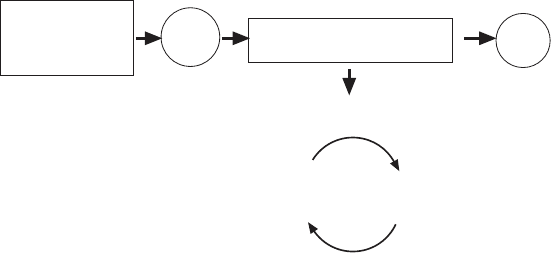
overall problem in which the major reactions are grouped as shown in Figure
5.32 . With this perspective, one can ask a few simple questions that may or
may not be easy to answer, depending on the experimental system chosen. For
example, some defi nite answers may be obtainable with isolated mitochondria,
but the in vivo conditions may be less well known.
Based on some early work by Lardy and Chance with isolated mitochon-
dria, the idea evolved that the major controlling reaction is the rate of con-
sumption of ATP and hence the availability of ADP (and P
i
). In other words,
when oxidizable substrates (fuels) were supplied, the rate of oxygen consump-
tion depended mainly on the supply of ADP + P
i
. Failure to provide a substrate
to complex V was assumed to back up the electron transport chain by mass
action and because electron transport and ATP synthesis were tightly coupled.
If the Δ μ
H
could not be dissipated by ATP synthases, further proton transloca-
tion and electron transport was inhibited upstream from the cytochrome
oxidase. For example, the antibiotic oligomycin has been known for a long
time to inhibit respiration by binding specifi cally to a peptide of the F
0
F
1
ATP
synthase and inhibiting ATP synthesis (see Section IV above). Mitochondria
supplied with a fuel (e.g., β - hydroxybutyrate) and an excess of ADP + P
i
are
said to be in “ state 3 ” and maximum respiration (oxygen consumption) is
observed. In the absence of ADP the mitochondria are said to be in “ state 4, ”
and oxygen consumption can be an order of magnitude lower. Under such
conditions the rate of respiration is controlled by the proton leakage through
other porters, namely, channels — often ill - defi ned. It is clear that meaningful
experiments require intact mitochondria, and mitochondria that have been
stored for a while or have been frozen exhibit increased proton leakage and
hence less and less “ tight coupling. ” One way to increase respiration in the
absence of ADP is to abolish the proton gradient. This can be accomplished
Figure 5.32 Schematic view of the major reactions in the consideration of the control
of respiration and oxidative phosphorylation.
FUEL
CONSUMPTION
METABOLISM
NADH
FADH
ELECTRON TRANSPORT
CHAIN
O
2
BIOLOGICAL WORK
H
Δμ
ADP + P
ATP
IMPORT
EXPORT
2
CONTROL OF RESPIRATION AND OXIDATIVE PHOSPHORYLATION 261

262 MITOCHONDRIAL ELECTRON TRANSFER
in several ways. The addition of nigericin (a K
+
/H
+
antiporter) can collapse the
Δ pH without destroying the membrane potential Δ Ψ . Alternatively, the clas-
sical uncouplers dinitrophenol or FCCP (fl uoro carbonyl cyanide phenyl
hydrazone) can collapse both Δ pH and most of the Δ Ψ by providing a path
for protons across the lipid bilayer. The action of naturally occurring proteins
in brown adipose tissue that cause proton leaks and thus are uncouplers will
be elaborated below in the discussion of thermoregulation.
ATP consumption occurs mostly in the cytosol. The adenine nucleotide
carrier/transporter (ANC/T), also known as the ATP/ADP antiport system,
therefore can become a potential regulatory site. It controls the fl ux of ATP
out of the mitochondria, controls the fl ux of ADP into mitochondria, and is
electrogenic, hence sensitive to the membrane potential. Infl ux of ADP also
transports a proton into the matrix and decreases Δ pH, thus stimulating elec-
tron transport. The phosphate carrier is electroneutral, and at least in liver its
capacity far exceeds the requirements for ATP synthesis. It is not likely to be
a regulator of OXPHOS. The structure and mechanism of these carriers will
be discussed in further detail in the following chapter.
Typically the ratio of [ATP/ADP] in vivo is very high ( ∼ 100 : 1 in the cytosol;
is it different in the matrix?). As a result, changes in relative levels of ATP are
small compared to relative changes in ADP. In addition, the ATP concentra-
tion may be buffered by the pool of creatine phosphate (depending on the
tissue). Controversy has centered around the question of whether the relevant
parameter is the change in [ATP], the change in [ADP], a change in the
[ATP]/[ADP] ratio, or even a combination including [P
i
]. A general consensus
appears to favor the view that the control of respiration by ATP consumption
is mainly due to changes in [ADP] inside the mitochondria. The enzyme
adenylate kinase catalyzes the reaction
20ADP ATP AMP (
0
↔+
′
ΔG ~)
and under physiological conditions a small change in [ATP] is accompanied
by a large (relative change in [AMP]; thus, AMP is a sensitive allosteric regula-
tor for a number of cytosolic enzymes in intermediary metabolism (glycolysis).
Another parameter that has been defi ned is the energy charge:
Energy charge
ATP] [ADP])
([ATP] [ADP] AMP])
=
+
++
1
2
2([
[
It is a measure of what fraction of the adenylate pool is in the form of ATP.
It can vary from 0 to 1, but in “ healthy ” cells it is typically in the range of
0.87 – 0.94 (313) . The question is, What mechanisms maintain this parameter in
such a narrow range? Other formal thermodynamic treatments have led to a
“ near equilibrium hypothesis ” (314, 315) for the overall scheme presented
above. In the old - fashioned way of thinking, the question becomes, What is
the rate - limiting step? Nowadays one would want to know the fl ux control
coeffi cients for each step/enzyme.
The K
m
of isolated cytochrome oxidase (absence of Δ μ
H
) for oxygen has been
estimated to be in the micromolar range, and an apparent K
m
for oxygen in iso-
lated mitochondria has been measured to be in the same range, or even signifi -
cantly lower (differing in tightly coupled mitochondria from uncoupled
mitochondria). It is believed that most cells have oxygen concentrations far
above these values, although steep gradients within tissues may exist or be
created temporarily. Most likely, however, oxygen is not a rate - limiting sub-
strate in mammalian tissues. Different considerations may apply when anoxia
is encountered as a result of injuries. In several tissues (brain, liver, kidney), res-
piration has been measured under conditions when the oxygen supply was far
below the physiological levels. Initial rates of oxygen consumption were normal,
but a subsequent decline was observed, probably due to secondary effects.
Looking at the beginning of the scheme, one may ask whether the supply
of NADH is ever a rate - limiting factor. With isolated mitochondria in vitro ,
such conditions can be created easily, but under physiological conditions in
vivo it is less certain whether NADH is in short supply. (This statement may
not apply to microorganisms such as yeasts, molds, fungi, and so on, where
environmental conditions are likely to include periods of starvation.) The
electron transport chain is limited by the intrinsic rate of electron transfer
between the various centers, and it cannot be “ pushed ” by supplying excess
NADH. At any rate, this substrate cannot by supplied directly. Instead, sub-
strates such as β - hydroxybutyrate or succinate are added to isolated mitochon-
dria; cells or tissues can be given glucose. As will be discussed elsewhere in
this volume, there are elaborate feedback mechanisms that can shut down the
Krebs cycle when NADH levels rise above a threshold.
The parameters discussed up till now have been the immediate substrates
of oxidative phosphorylation: NADH, ADP, P
i
, protons, and oxygen. So far,
their infl uence on respiration and oxidative phosphorylation has been viewed
as a mass - action effect in a system of constant cycling. NADH is re - supplied
by many diverse reactions that are individually regulated at various levels, and
the ADP supply appears to depend on the biological work performed by the
cell. Protons exert an effect because they are substrates of vectorial reactions
operating near equilibrium. One can now ask whether the specifi c activity of
the individual complexes can be modulated by various potential effectors —
Ca
2+
ions, free fatty acids, hormones, adenine nucleotides — or even by protein
phosphorylation and associated allosteric mechanisms.
Cytoplasmic calcium levels are controlled by extracellular signals such as
hormones and growth factors, and most prominently by electrical signals in
the case of muscle. Mitochondria have an electrogenic uniporter for import
and a Ca
2+
/Na
+
exchanger for effl ux (316, 317) which keep the matrix concen-
tration of Ca
2+
in the range of 100 nM to 1 μ M. Increases in free Ca
2+
are
thought to stimulate various dehydrogenases in the Krebs cycle; pyruvate
dehydrogenase may be stimulated indirectly by Ca
2+
by a conversion to the
CONTROL OF RESPIRATION AND OXIDATIVE PHOSPHORYLATION 263
264 MITOCHONDRIAL ELECTRON TRANSFER
unphosphorylated, more active form through an activation of a phosphatase.
Therefore, the NADH supply is increased, but not necessarily the rate of
respiration. The effect of cytosolic Ca
2+
on muscle activity is well known, and
muscle contraction utilizes ATP. There are some observations with liver mito-
chondria suggesting that Ca
2+
may be involved in changes in mitochondrial
volumes following a hormonal signal (317) , and this effect in turn is believed
to be responsible for increased electron fl ow. However, alternative explana-
tions have been offered (303) .
The [ATP]/[ADP] ratio may have an infl uence on the relative activities of
kinase/phosphatase couples controlling specifi c enzymes such as pyruvate
dehydrogenase (see above), or either of these nucleotides may be an effector
in the control of Krebs cycle enzymes. For example, ADP has been shown to
be an allosteric activator of isocitrate dehydrogenase by decreasing the K
m
for
isocitrate. Again, the NADH supply is controlled and elevated at higher ADP
concentrations. Both ATP and ADP have been shown to be allosteric effectors
of cytochrome oxidase (318 – 321) .
A special mechanism infl uencing the [ATP]/[ADP] ratio is the activity of
so - called futile cycles. Such cycles require a substrate (e.g., fructose - 6 -
phosphate), a specifi c kinase, and a specifi c phosphatase that may be indepen-
dently regulated. By combining the two activities, a net ATPase mechanism is
generated, and ATP wastage can be regulated. Increasing the rate of such a
futile cycle can lead to increases in the rate of respiration.
Because cytochrome oxidase does not operate on a reaction near equilib-
rium, it has been considered as a bottleneck and rate - limiting enzyme in elec-
tron transport. An intriguing observation is that complex IV is the only complex
with tissue - specifi c subunits (isozymes) (164, 322) . Subunits VIa, VIIa, and VIII
have been characterized to have a liver (L) form and a heart (H) form. With
reconstituted cytochrome oxidase from either bovine heart or liver, the labora-
tory of Kadenbach has demonstrated that ADP interacts with and stimulates
the heart enzyme but not the liver enzyme (323, 324) . The effectiveness of
intra - liposomal ADP on reconstituted COX was interpreted to indicate an
interaction with the matrix domain of the enzyme, and specifi cally with the 17
N - terminal amino acids of subunit VIa - H. This interpretation was strength-
ened by the demonstration that a monoclonal antibody directed against the
VIa - H but not VIa - L form can also enhance the activity of the enzyme,
presumably by inducing a conformational change in the heart enzyme (318) .
An even more general speculation has been proposed by Kadenbach ’ s
group: all of the nuclear - encoded subunits of complex IV may serve as targets
for allosteric effectors, with no role in the catalytic function of the enzyme (324) .
Such a proposal is based on the comparison of prokaryotic cytochrome oxidases
with eukaryotic cytochrome oxidases. In Paracoccus denitrifi cans two subunits
are suffi cient for activity, while in eukaryotes a variable number of additional
subunits (5 in Dictyostelium , 6 in yeast, 10 in mammals) are found (325) .
There have been claims over the years that the H
+
/ e
–
stoichiometry of cyto-
chrome oxidase from bovine heart is regulated by the intramitochondrial
[ATP]/[ADP] ratios (e.g., reference 326 ). In this case, an effector not only
would regulate the activity of an enzyme, but would also control the stoichi-
ometry of the reaction (a “ slipping pump ” ). How many protons are pumped
out of the matrix for each pair of electrons reaching oxygen? To reemphasize:
A P/O ratio that is not an integer can be rationalized by the chemiosmotic
hypothesis, but a variable H
+
/ e
–
ratio for a given complex, and the reaction
carried out by this complex, would be quite unorthodox. A recent statement
by expert reviewers revives this idea: “ cytochrome oxidase has the ability to
control its own pumping effi ciency . . . by ‘ intrinsic uncoupling ’ via proton
backfl ow through the protein in response to a build - up in membrane poten-
tial . . . ” (167) . An alternative mechanism for inducing slippage is protein
phosphorylation (see below).
Returning to the formalism of metabolic control analysis by Brand and
colleagues, the simplest version considers three blocks of reactions: substrate
oxidation (succinate oxidation), ATP turnover (using exogenous hexokinase
as ATP consumer), and proton leakage, all connected by the common inter-
mediate Δp , the protonmotive force, measured as ΔΨ by the distribution (and
fl uorescence) of methyltriphenylphosphonium. Titrations with an inhibitor of
substrate oxidation (malonate), with an inhibitor of the F
0
F
1
ATPase (oligo-
mycin), and in the presence of various uncoupler concentrations yield experi-
mental parameters that can be used to calculate fl ux control coeffi cients over
respiration rate. The analysis confi rms earlier conclusions that control over
respiration rate (O
2
consumption) is shared between the three blocks of reac-
tions: There is no single, clearly outstanding rate - limiting step. When respira-
tion is maximum, ATP turnover and substrate oxidation are about equally
important (control coeffi cients ∼ 0.5), while proton leakage is almost insignifi -
cant. When the respiration rate is 60% of maximum, ATP turnover dominates
(control coeffi cient ∼ 0.7), while substrate oxidation and proton leakage are
equally but less infl uential. Conditions must be specifi ed to talk about control
of OXPHOS.
The authors also discuss their results in terms of coupling effi ciency and P/O
ratios using the same dataset. Not surprisingly, it is strongly negatively con-
trolled by proton leakage and strongly positively controlled by ATP turnover,
while it is insensitive to substrate oxidation. In other words, effectors acting
only on substrate oxidation will not affect the coupling effi ciency, but the effi -
ciency can be increased by increased ATP turnover.
While the simple model introduced above is a powerful model to investi-
gate the actions of hormones and of other effectors on OXPHOS in a given
tissue ( “ Once you get the hang of it, both the theory and experimental applica-
tions are simple ” (307) ), the simplest model treats the entire electron transport
chain as “ one enzyme ” and hence is not concerned with control coeffi cients
of individual complexes (and mobile carriers such as cytochrome c). However,
the latter problem becomes of interest in the understanding of mitochondrial
diseases, when the activity of individual complexes may be affected by specifi c
mitochondrial mutations (see Chapter 8 ). Korzenievski and his colleagues
CONTROL OF RESPIRATION AND OXIDATIVE PHOSPHORYLATION 265
266 MITOCHONDRIAL ELECTRON TRANSFER
have elaborated the model considerably by decomposing the substrate oxida-
tion into three reactions involving complexes I, III, and IV (327) . Theoretical
calculations for muscle mitochondria respiring on pyruvate were made, and
control coeffi cients were calculated for each of the complexes (I, III, and IV)
and were calculated separately for substrate dehydrogenation (pyruvate to
generate NADH), complex V, the ATP/ADP carrier, the phosphate carrier,
proton leakage, and ATP turnover (hexokinase in the presence of glucose).
The highest fl ux control coeffi cient was calculated for complex III in state 3
mitochondria: 0.26. In other words, control is again distributed over many
reactions. Under physiological conditions (state 3.5 mitochondria), control
coeffi cients are generally less than 0.1 for the complexes I, III, IV, and V, while
the coeffi cient for ATP turnover was 0.8. Availability of ADP thus controls the
respiration rate. More signifi cantly, the low control coeffi cient for complex IV
(0.07 in state 3) can explain why the respiration rate is almost unaffected when
the activity of complex IV is titrated with an inhibitor to the level of ∼ 80%
inhibition; at > 80% inhibition, respiration declined sharply. Such a threshold
effect may be highly relevant for the understanding of the physiological con-
sequences of heteroplasmy and mitochondrial mutations (see, for example,
references 311 and 328 ). Lastly, a reader interested in the application of the
theory of non - equilibrium thermodynamics to the problem of the mitochon-
drial electron transport chain is referred to the treatment by Jin and Bethke
(310) . The authors claim that the resulting expression describes “ the nonlinear
dependence of fl ux on electrical potential gradient, its hyperbolic dependence
on substrate concentration, and the inhibiting effects of reaction products. ”
5.6.2 The Uncoupling Proteins in Warm - Blooded Animals
The proton gradient established by electron transport can be dissipated in two
ways: ATP synthesis through complex V, or proton leakage through the inner
membrane without the production of ATP to be used for other chemical and
biological work. By mechanisms described above, respiration may be con-
trolled by ATP/ADP levels and turnover in tightly coupled mitochondria. As
a fi rst approximation, one can describe tightly coupled mitochondria as mito-
chondria in which proton leakage outside of complex V is minimized. The
combustion of carbon compounds to CO
2
is also accompanied by the release
of a fi xed amount of heat, the inevitable byproduct of chemical reactions
occurring at fi nite rates. The free energy change associated with the conversion
of glucose to CO
2
and water is distributed between the heat released and the
useful free energy temporarily stored in the ATP pool. Additional heat will be
released from the hydrolysis of ATP. Thus, a mechanism is, in principle, pro-
vided to increase our body temperature above ambient temperatures.
It has been recognized for some time that a constant body temperature in
warm - blooded animals is maintained not only by conducting excess heat away
(perspiration, etc.), but that at low temperatures additional heat must be gen-
erated. Two mechanisms have been identifi ed: (1) thermogenesis by shivering
in effect increases ATP turnover and respiration in muscles, hence the produc-
tion of heat; and (2) nonshivering thermogenesis was discovered in newborns
and hibernating animals, and the primary role of brown adipose tissue was
established. Brown adipocytes were subsequently characterized to possess a
unique mechanism for increasing respiration without ATP synthesis (uncou-
pling). A specifi c protein was found to be induced in adipose cells, which could
transfer protons across the inner mitochondrial membrane — that is, effectively
short circuit the proton circuit, resulting in increased respiration and heat
production. Under these conditions, UCP1 constitutes up to 10% of the mem-
brane protein. The role of this uncoupling protein (UCP - 1, or thermogenin)
in brown fact in relation to development, cold adaptation, diet - induced ther-
mogenesis, and genetic obesity has been studied extensively, and a number of
authoritative reviews have been written (e.g., references 329 – 332 ). On the
other hand, it also became apparent that adult animals and humans do not
have signifi cant amounts of brown adipose tissue, and hence the problem of
thermoregulation in adult mammals could not be easily explained with the
help of UCP - 1. It was argued that in adults thermoregulation may occur in
other tissues and cell types, perhaps by means of a similar mechanism involv-
ing a related protein. Two orthologous proteins, UCP - 2 and UCP3, have now
been discovered in mammals (333 – 335) . In contrast to UCP - 1, they are
expressed in a wide variety of tissues, but at relatively low concentrations.
Their physiological functions will be addressed below.
The history, arguments, and experimental evidence leading to the identifi -
cation of UCP - 1 in brown adipose tissue have been expertly reviewed by
Nicholls and Locke (329) . The presence of an uncoupler was suspected by the
observation that brown adipose cells had insuffi cient ATPase activity (total)
to account for the observed oxygen consumption coupled to ATP turnover.
Free fatty acids were fi rst thought to be involved in the uncoupling mechanism,
but later a “ nucleotide - induced recoupling ” was added and distinguished from
the “ fatty acid - induced uncoupling. ” The binding and activity of nucleotides
was a defi ning characteristic that led to the fi rst isolation of UCP - 1 from mito-
chondria in 1978. A high - affi nity, saturable binding site for [3H] - GDP on the
outer surface of the inner membrane could be demonstrated to be identical
to a component in the inner membrane responsible for short circuiting the
membrane for protons — that is, with activity as a proton uniporter.
A small protein of molecular mass 33 kDa was found to be present exclu-
sively in brown adipose tissue from a variety of mammals, accounting for 6 –
14% of the inner membrane protein. Following the discovery by Nicholls and
his group, signifi cant contributions to the characterization of the protein and
its activity have been made by Klingenberg and co - workers (see references
336, 337, and 338 ) for recent publications with references to past work). It was
shown that H
+
transport requires free fatty acids as obligatory cofactors and
is inhibited by adenosine and guanine di - or triphosphates. This “ cofactor ”
model has since been challenged by some investigators. A recent study with
highly purifi ed UCP1 in reconstituted liposomes yielded results supporting a
CONTROL OF RESPIRATION AND OXIDATIVE PHOSPHORYLATION 267
268 MITOCHONDRIAL ELECTRON TRANSFER
model in which long - chain fatty acid anions are “ fl ipped ” across the mem-
brane. This fl ippase model proposes that fatty acid anions are transported by
the UCP1, and after protonation they can “ diffuse ” back through the lipid
bilayer as the uncharged form (339) . Nucleotide binding affi nity decreases with
pH. The pH sensor for nucleotide binding has been identifi ed and has been
incorporated into a model for the orientation of the UCP transmembrane
helices in the membrane (337) . The UCPs share homology with the ADP/ATP
transporter (antiporter) and many other members of the mitochondrial carrier
family (336, 340) . Both proteins bind nucleotides, but in one case the nucleo-
tide is a substrate capable of binding to either side, while in the other it is a
regulator binding only the cytosolic side. Originally thought to form functional
dimers in the inner membrane, with a single binding site per dimer, more
recently the monomer has been favored as the functional form of the carrier.
The entire carrier family is characterized by being relatively short peptides
with three repeat structures of ∼ 100 residues, each repeat containing two
transmembrane helices. A monomer therefore has six transmembrane helices;
the N - terminal and C - terminal domains extend into the intermembrane space.
The connecting loops on the matrix side are made up of ∼ 40 highly polar
residues. A further discussion of the ATP/ADP transporter can be found in
Chapter 6 .
Uncoupling by UCP - 1 can be regulated on at least two levels. The carrier
itself is sensitive to the proton gradient and the pH in the intermembrane
space as well as to nucleotide concentrations and fatty acids, and such mecha-
nisms lend themselves to rapid short - term control. A plausible signaling
pathway has norepinephrine bind to the β - receptor, causing a rise in cAMP,
activation of a protein kinase which controls lipolysis (by a lipase), and eventu-
ally accumulation of free fatty acids. Nucleotide inhibition is released, and
oxidation of acyl carnitine and acyl - CoA can procede at an increased rate
(329) . There is, however, also a long - term control of thermogenic capacity
related to the dietary status of an animal such as a rat, or its adaptation to
prolonged exposure to cold. The correlation of thermogenic capacity with the
levels of the UCP - 1, along with β - adrenergic stimulation of brown adipocyte
metabolism and respiration, has been the subject that has received much atten-
tion. Nicholls and Locke (329) present the topic from a more physiological
perspective. In the meantime, the cloning of the UCP - 1 gene has permitted an
analysis of its promoter and the control of its expression. An up - to - date review
(330) lists thyroid hormone and retinoic acid response elements as having a
direct infl uence, while catecholamines act via a cAMP pathway. Insulin, glu-
cocorticoids, and IGF - I may modulate gene expression via more indirect path-
ways, and CCAAT enhancer binding proteins and peroxisome proliferation
activator receptor γ 2 have also been implicated in control. UCP - 1 mRNA
appears to have a short half - life, permitting rapid fl uctuations in UCP - 1 mRNA
steady - state levels depending on the ambient temperature, food intake, and
hormone release. By regulating the level of these proteins by any one of a
number of mechanisms, it therefore becomes possible to fi ne - tune the proton
leakage in mitochondria and, as a result, uncouple respiration and heat pro-
duction from ATP synthesis.
After the cloning of the mammalian gene(s) for the UCPs, it became pos-
sible to express these proteins in yeast mitochondria to study their function,
and even in bacteria to produce larger quantities for biochemical studies in
liposomes. Various inconsistencies in the results obtained appear to be due to
differences in codon usage in these organisms, leading to proteins that cannot
be converted to the functionally native state (338) . Thus, the recent studies of
Breen et al. (341) employed a strain of E. coli (Rosetta), which uses human
codons to produce an authentic rat/mammalian protein in bacteria for purifi -
cation and reconstitution into liposomes.
The mammalian UCP1 in yeast was demonstrated to retain its properties:
proton and chloride transport, high - affi nity binding of nucleotides, and the
dependence of conductance on nucleotides and fatty acids (342) . Site - directed
mutagensis was employed to investigate systematically the functional role of
various amino acid side chains. Chemical modifi cations had already implicated
several cysteine residues in activity, and models based on dithiol – disulfi de
interconversions had been proposed. The replacement of all seven cysteine
residues by serine was subsequently found to have no effect on activity or
regulatory characteristis of the UCP - 1 in yeast (342) . Studies in yeast have
also addressed the problem of how these proteins are imported into mitochon-
dria and oriented in the inner membrane. They lack a removable signal
sequence. Instead, the fi rst loop between transmembrane helices 1 and 2 acts
a signal sequence for import, and the second matrix loop is responsible for
insertion into the inner membrane (343) .
The physiological function of the other mitochondrial uncoupling proteins,
UCP2, UCP3, . . . is still subject to debate, although some consensus is emerg-
ing. A comprehensive and expert recent review (335) refers the reader to more
than a dozen other reviews that have appeared in the past fi ve years. Although
these orthologues have been found in several mammalian tissues (as well as
in other animlas and plants), their abundance is low ( ∼ 0.01 – 0.1% of the mem-
brane proteins). Their tertiary structure in the inner membrane is similar to
that of UCP1. Investigators agree that these carriers do not transport protons
except in the presence of specifi c activators. In vitro studies revealed that
purine nucleotides are inhibitory and fatty acids are probably required for
activation. Another prominent group of activators includes reactive oxygen
species (ROS) and free - radical - derived alkenals (335) . The same controversy
exists about the mechanism of proton transport/conductance. On the one
hand, there is the view that they act as gated proton channels, and an alterna-
tive mechanism proposes fatty acid cycling back and forth across the mem-
brane, as suggested for UCP1 (339) . Mice in which UCP2 or UCP3 are knocked
out are not severely affected in the laboratory. It may be amusing ( “ uncoupling
the agony from the ecstacy ” ) to learn that mice lacking UCP3 become
more tolerant to MDMA (3,4 - methylenedioxymethamphetamine, nicknamed
“ ecstasy ” ) (344) . The recreational use of amphetamine - type stimulants by
CONTROL OF RESPIRATION AND OXIDATIVE PHOSPHORYLATION 269
270 MITOCHONDRIAL ELECTRON TRANSFER
humans can produce a marked and sometimes lethal increase in body
temperature.
A succinct formulation and critical discussion of the various functions for
UCP2 and UCP3 can be found in the reviews by Brand and Esteves (335, 345) .
These authors consider four major roles for UCP2/UCP3: (1) a role in ther-
mogenesis and protection against obesity; (2) control of mitochondrial ROS
production and protection against oxidative damage; (3) mediation of ROS
signaling and insulin secretion; and (4) transport or export of fatty acids and
fatty acid peroxides. These mechanisms are clearly not exclusive of each other
(although the issue of proton channel vs fatty acid “ fl ipping ” remains to be
resolved). Their relationship to UCP1, along with the role of UCP1 in brown
adipose tissue, invited initial speculation about their role in thermogenesis, but
there is agreement that gross thermoregulation does not depend on UCP2/
UCP3. The most convincing support for this conclusion is derived from UCP2
and UCP3 knockout mice that have normal responses to exposure to low
temperatures (and are not obese). The reaction of UCP3 knockout mice to
MDMA (ecstacy) described above nevertheless does not allow a complete
disregard for UCP3 in thermoregulation. Another argument has been made
from observations in birds: They lack brown adipose tissue and UCP1, but
have a UCP (avUCP) that is 70% identical in sequence to mammamlian
UCP2/UCP3. The regulation and properties of this avUCP are highly sugges-
tive of a role in thermogenesis (e.g., their level and proton conductance are
up - regulated when penguins are immersed in cold water). The connection of
UCP activity to obesity is obvious in a superfi cial sense. Normal food intake,
lack of exercise, and tightly coupled mitochondria would be expected to lead
to enhanced fatty acid biosynthesis.
The second postulated role of UCPs invokes their capacity for uncoupling
for the control of the mitochondrial membrane potential ( ΔΨ ) and the genera-
tion of reactive oxygen species (ROS). They act as safety valves preventing
the buildup of an excessive potential that is believed to cause excessive ROS
production. Thus, they protect us against ROS - induced damage that may lead
to neurodegenerative diseases, diabetes, and aging (346) . What is the pathway
of UCP activation? Brand and colleagues have proposed a detailed pathway
in which superoxide or the protonated hydroperoxyl radical initiates a series
of reactions involving poly - unsaturated fatty acyl groups and the ultimate
production of hydroxynonenal. GDP - sensitive UCP activation has been shown
to result from exposure to superoxide or hydroxynonenal. It may also be
considered that a rise in membrane potential above a threshold activates the
UCPs directly, without the direct participation of any ROS.
UCP2 knockout mice have been shown to have elevated ATP levels in
pancreatic islet cells. These cells also exhibit increased insulin secretion stimu-
lated by glucose. Such a fi nding can be incorporated into a widely accepted
model for glucose - stimulated insulin secretion. For a detailed discussion of this
model the reader must consult the specialized literature (see references 335
for references).