
Scheffler Immo E. Mitochondria
Подождите немного. Документ загружается.

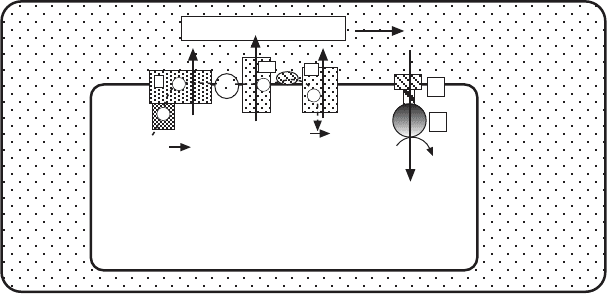
The fi rst idea was that an enzyme embedded in a membrane in a unique
orientation might catalyze a reaction by accepting substrates on one side of
the membrane and release the products on the other side. This concept was
referred to as “ vectorial metabolism. ” It arose from two major biochemical
mysteries: (a) oxidative phosphorylation and (b) the linkage between metabo-
lism and transport. Even a “ simple ” group - transfer reaction occurring in a
single aqueous phase was already considered a “ chemiosmotic ” process by
Mitchell, because “ the group - translocation pathway represents the fi eld of
action of a real through space force corresponding to the chemical potential
gradient. ” Such microscopic osmotic processes could be converted to a mac-
roscopic osmotic processe if the enzyme was “ appropriately plugged through
a membrane. ” Therefore, the free energy change associated with such a reac-
tion might be used to drive the accumulation of a molecule or ion against a
concentration gradient; that is under some conditions, an enzyme could work
like a pump. Third, a concentration gradient of a solute across a membrane
could be considered as a stored form of chemical free energy. If ions were the
solutes in question, a concentration gradient might also be manifested as a
membrane potential, and the membrane assumed properties similar to a
charged capacitor. These ideas had been theoretically explored by Nernst. As
Mitchell recalls (220) , his ideas were further infl uenced by the proposal of
electrochemical fuel cells made already in 1839 by Grove, as well as by
Guggenheim ’ s thermodynamic treatment of electrochemical cells and electric
circuits, which split chemical reactions spatially into two half - reactions, con-
nected internally by a specifi c conductor of one chemical species and con-
nected by an outside circuit conducting another chemical species.
Progress with a number of simpler experimental systems added support to
many of these individual concepts. Neurobiologists started to understand
membrane potentials, sodium and potassium gradients across a membrane,
and the mechanism of generating an action potential. Since the lipid bilayer
is completely impermeable to ions, specifi c integral membrane proteins had
to be identifi ed to act as ion pumps and regulated gates whose combined
action could explain such phenomena fi rst for excitable membranes and then
in more general situations. The Na
+
– K
+
pump of the plasma membrane and
the Ca
+
pump of the sarcoplasmic reticulum became classic examples of ion
pumps that could use the hydrolysis of ATP to pump ions against their con-
centration gradients and against an electical gradient (active transport). These
reactions were stoichiometric: A mole of ATP hydrolyzed was coupled to the
transfer of a fi xed number of ions across the membrane (3 Na
+
out of the cell,
2 K
+
into the cell in the case of the Na
+
– K
+
pump). Later, simple proton pumps
were discovered in the membranes of lysosomes, for example. Our understand-
ing at an atomic level of resolution of how such pumps translocate ions across
a membrane has advanced greatly. The pumps have been purifi ed and have
been reconstituted in pure synthetic membranes and vesicles. The correspond-
ing genes have been cloned and sequenced. The corresponding amino acid
sequences have led to predictions of structure and correlations of structure
THE CHEMIOSMOTIC HYPOTHESIS 231
232 MITOCHONDRIAL ELECTRON TRANSFER
with function. Increasingly, high - resolution crystal structures have become
available to aid in the interpretation of mechanism. It became apparent and
demonstrable that such pumps could operate in reverse following the simple
law of mass action. An artifi cially high experimentally established gradient
could drive a reaction in the reverse direction and synthesize ATP from ADP
and inorganic phosphate.
Another important concept contributed by Mitchell was the distinction
between chemiosmotic and purely osmotic reactions. An ATPase pumping
ions is an example of the former. Symport and antiport are examples of the
latter, and they describe the coupled translocations of unrelated solutes across
a membrane catalyzed by a porter: both solutes moving in one direction (sym),
or two solutes moving in opposite directions (anti). The exchange of ADP and
ATP across the mitochondrial membrane is a well - known, tightly coupled
antiport system, while the uptake of glucose into intestinal mucosa mediated
by Na
+
ions is one of the early examples of a symport system. These coupled
reactions not only are vectorial, but also involve stoichiometric amounts of
each participating solute. One can also “ couple ” a chemiosmotic reaction cata-
lyzed by one enzyme to an osmotic reaction catalyzed by a spatially distant
second enzyme: The Na
+
ion gradient established by the Na
+
/K
+
ATPase can
be used to transport glucose into a vesicle or cell by the Na
+
/glucose symporter.
From such insights it is not too far to realize that a proton gradient established
by the electron transport chain could drive ATP synthesis by a biochemically
and spatially distinct complex in mitochondria.
As more and more experiments contributed powerful support for the basic
ideas about ion and electrical gradients across membranes and about active
transport (pumps), or pumps running in reverse to make ATP, experimental
systems applying these notions to mitochondria and chloroplasts were devel-
oped and perfected as well. Signifi cantly, P. Mitchell himself stated that the
chemiosmotic hypothesis was actually a byproduct of the chemiosmotic con-
cepts of group translocation and vectorial metabolism (221) . Two facts should
be reemphasized at the outset: The ATP synthase of mitochondria resembles
a simple ion pump (e.g., in the plasma membrane) only superfi cially. Its struc-
ture is signifi cantly more complex, as will be described below. And, pumping
protons out of the matrix by electron transport through metal ion centers in
the ETC is a very complex system, with the only counterpart in chloroplasts
and bacterial membranes.
Another instructive and infl uential model system developed in the 1970s
was the purple membrane bacterium Halobacter halobium . Phosphorylation
was driven by light energy absorbed by a photopigment soon identifi ed as
bacteriorhodopsin. Bacteriorhodopsin was shown to be a light - driven proton
pump. A proton gradient in the dark could drive the synthesis of ATP in
Halobacter halobium . In combination these two observations suggested that
light energy was used to establish a proton gradient across the bacterial mem-
brane (high on the inside, low on the outside), and a proton pump running
in reverse was used to make ATP. The proteins involved were distinct and
physically separable from each other. On the one hand, this system is clearly
an illustration of the importance of a conformational change in a protein
playing a role in energy conversion. The photon absorbed by the prosthetic
group triggers an all - trans → 11 - cis isomerization and hence a conformational
change in the bacteriorhodopsin in the membrane. The conformational transi-
tions accompanying excitation and return to the ground state are coupled to
proton translocation. On the other hand, the conformational change is not
linked directly to phosphorylation of ADP, as in the simple conformation -
coupling hypothesis.
In the same vein, it is now clear that the passage of an electron through the
various redox centers of complexes I, III, and IV may be accompanied by
conformational changes throughout the complex (one or more subunits), and
at least in the case of complex IV, these conformational transitions are believed
to drive proton translocation. These changes need not be very dramatic and
may involve only a limited number of side chains along a “ channel ” for proton
translocation (see Figure 5.21 ). The situation is potentially more complicated
and controversial for complexes I and III, because the participation of ubiqui-
none creates additional theoretical possibilities for proton translocation (see
below).
A key aspect of Mitchell ’ s chemiosmotic hypothesis is the requirement that
respiratory (and photoredox) chains translocate protons across a membrane
in one direction, while ATP synthesis is driven by proton fl ow in the opposite
direction (Figure 5.22 ). A violation of this prediction would have been the end
of the hypothesis. Testing the prediction was not trivial, but eventually much
supportive evidence was accumulated. The Mitchell hypothesis is overwhelm-
ingly accepted today, but some controversy may still exist about some of the
quantitative aspects of the mechanism of oxidative phosphorylation. Expert
reviews on this subject have been written by Hinkle (230, 231) , and the most
recent one appears to put most of these contentious issues to rest. Specifi c
Figure 5.22 Schematic illustration of the chemiosmotic hypothesis.
Q
NADH NAD
+
O H O
2
2
ADP
+
P
ATP
H
+
H
+
H
+
H
+
-
e
-
e
-
e
-
e
MATRIX
---
++++++
---
Intermembrane
Space
I
III
IV
F
1
F
o
THE CHEMIOSMOTIC HYPOTHESIS 233
234 MITOCHONDRIAL ELECTRON TRANSFER
questions can be formulated as follows: (1) How many protons are pumped
out of the mitochondrial matrix for each pair of electrons passing from NADH
to oxygen? (2) How many protons are pumped at each coupling site — that is,
at complex I, complex III (Q - cycle), and complex IV? (3) How many protons
are returned to the matrix through the ATP synthase to make one ATP?
Theoretically, the oxidation of NADH by oxygen liberates enough free energy
to make > 6 ATPs from ADP and inorganic phosphate, but since even biologi-
cal reactions are not 100% effi cient, the expected number is ∼ 3 for 50%
effi ciency.
Early in the investigations of respiration and oxidative phosphorylation, the
phenomenon of “ acceptor control ” was recognized. Experimentally, it was
observed that intact mitochondria supplied with abundant substrate such as
succinate or β - hydroxybutyrate do not consume signifi cant amounts of oxygen
unless the “ acceptor ” ADP is present (inorganic phosphate is also needed, but
routinely/typically present as part of the medium). Thus, it is possible to make
precise measurements of oxygen consumption with limiting, known amounts
of ADP. The number of molecules of ADP converted to ATP compared to the
number of oxygen atoms converted to water yield a P/O ratio (or ADP/O
ratio). Over the years there have been numerous reports reporting P/O ratios
that were in the range of 2 – 3 for NADH oxidation and 1 – 2 for succinate oxi-
dation. The recent review by Hinkle (231) summarizes these data and presents
a critical discussion of the methodology, the experimental pitfalls, and the
source of possible errors. In light of what we understand now, it is clear that
the P/O ratio need not be an integer. A consensus value of ∼ 2.5 is emerging
for NADH - dependent oxidations, along with a value of ∼ 1.5 for succinate -
dependent oxidations. These experimental values may not only vary due to
methodological differences and errors, but may even depend on the tissue of
origin of the mitochondria (a P/O ratio of close to zero in mitochondria from
brown adipose tissue is an extreme example; see below).
A signifi cantly more challenging task is to measure the number of protons
pumped out of the matrix. The method is the “ respiratory pulse method, ”
which measures a pH change in a mitochondrial suspension in the presence
of a specifi c substrate following a brief pulse with a known quantity of oxygen.
This measurement can be decomposed into a measurement of the total number
of protons pumped for each pair of electrons passed from NADH to oxygen,
or measurements of the number of protons pumped at each “ coupling site, ”
now generally accepted to be complex I, complex III, and complex IV. This
number can be referred to as the H
+
/O ratio or as the H
+
/2 e
−
ratio. Hinkle ’ s
review (231) can again be cited as the most critical and complete review of
various reports over the past decades. According to Hinkle, “ the arguments
seem to be over, although not all groups have accepted the consensus explic-
itly. ” The accepted H
+
/2 e
−
ratios have values of 10 for NADH and 6 for succi-
nate. From these, one can calculate that H
+
/2 e
−
= 4 for site 1 (complex I), and
this value has direct experimental support from measurements with submito-
chondrial particles (232) . For complex IV the best experimental value for H
+
/
2 e
−
is 2.20 ± 0.2 (156, 233) . Authoritative reviewers have raised the possibility
that complex IV can control its own pumping effi ciency (167) ; that is, it need
not be a stoichiometric amount related to the redox reaction. It should be
noted that complex IV also picks up four protons on the matrix side, referred
to as substrate protons, to form water from two pairs of electrons and one
oxygen molecule. As Hinkle points out, the situation at complex III is not
controversial but not often clearly understood. The Q cycle (see below) pre-
dicts that for each 2 e
−
transferred from QH
2
to cytochrome c, four protons are
released on the outside; however, two of those are transported electrogenically
(pumped), while the other two are derived from the substrate (QH
2
) and are
therefore not transported. There is proton translocation as well as proton
absorption or formation by the overall reactions at each coupling site, and
therefore the count has to be made consistently. A summary and restatement
of the above can be given with the help of the following equations:
Complex I: 2 NADH 2 Q 10 H 2 NAD QH H
2
++ ⇒ + +
++ +
io
28
Complex III: 2 QH cyt c H 2 Q cyt c H
2
3+ 2+
++⇒++
++
44 48
io
Complex IV: cyt c H O 4 cyt c H H O
2+
2
3+ +
2
48 42++⇒ ++
+
io
Sum: 2 NADH O 22 H 2NAD H O H
2
+
2
++ ⇒ + +
++
io
220
It remains to reconcile the experimentally observed P/O ratios with the
H
+
/2 e
−
ratios and the total number of protons pumped out of the matrix. Since
one oxygen and two electrons are fi xed values, one can also predict an H
+
/P
ratio at steady state, and therefore the number of protons returned to the
matrix for each ATP molecule synthesized. Several comments are in order. It
was recognized by Mitchell and others that mitochondrial membranes are not
perfect insulators for protons, as viewed in the ideal model system, but instead
have a variety of “ proton leaks. ” These include specifi c symport or antiport
systems and/or as yet poorly specifi ed leakage channels. For example, the
ADP/ATP antiporter has been reported to be electrogenic (234) , while the
phosphate/OH
−
antiporter transports one proton into the matrix (235) . Thus,
the export of one ATP is coupled to a net import of one proton, and the H
+
/P
ratio has to include this reaction. Less than 10 protons pumped out by the
electron transport chain are therefore available for ATP synthesis. Thermody-
namic considerations and the estimated value of the electrochemical gradient
( Δ pH and Δ Ψ ) predict that more than one proton must be returned to the
matrix to drive the synthesis of one ATP. It is tempting to propose a value of
3 protons returned per ATP. This leads to a maximum value of 3 for the P/O
ratio (from NADH oxidation), and in light of the above considerations a value
of ∼ 2.5 is rational. Proton pumping by the electron transport chain and ATP
synthesis are physically distinct processes, and if the protons fi nd other paths
back into the mitochondrial matrix, ATP synthesis will be less than what would
be maximally possible in a system with a perfectly insulating membrane, the
THE CHEMIOSMOTIC HYPOTHESIS 235
236 MITOCHONDRIAL ELECTRON TRANSFER
ETC and the ATPsynthase. A reevaluation of energy loss due to proton
leakage has been made by Hinkle et al. (230) . Both systematic experimental
errors and theoretical considerations now make it possible to obtain fractional
P/O ratios that are rational and do not violate the Mitchell hypothesis.
In summation, it can be stated that Mitchell ’ s chemiosmotic hypothesis
has stood the test of time, and therefore it “ represents reality as far as it is
known. ” Its major insight was that a proton gradient across the inner mem-
brane can be set up independently by electron transport (like water moved
uphill into a dam by evaporation and condensation), and this gradient can be
used to drive ATP synthesis (water running through turbines to produce
electricity).
Two points should be made more explicitly once again. In an initial presen-
tation of the chemiosmotic hypothesis, the emphasis was on protons, and
therefore on the “ pH gradient ” across the inner membrane. Since protons are
charged, such a gradient also creates a membrane potential, ΔΨ . In considering
the thermodynamic parameters for ATP synthesis, a driving force is therefore
not only the concentration gradient represented by Δ pH, but there is also an
electrochemical contribution from moving a positive charge from high to low
potential. Other ions contribute to the overall electrochemical potential dif-
ference: Protons or hydroxyl ions participate in antiport or symport systems,
exchanging protons for metal ions, hydroxyl ions for phosphate, and so on.
Thus, the proton electrochemical gradient is conventionally denoted Δ μ H, and
its components are ΔΨ and Δ pH. A particularly useful experimental trick has
been to use the ionophore nigericin as a K
+
/H
+
antiporter. It can therefore
decrease the Δ pH across the membrane, but not the ΔΨ . In contrast, the iono-
phore valinomycin is a potassium carrier, and it can collapse the portion of
ΔΨ resulting from excess K
+
on the outside, but not Δ pH. Such experiments
will become relevant in the consideration of the control of oxidative phos-
phorylation and tightly coupled versus uncoupled mitochondria (Section 5 ).
There is also a potential misunderstanding of the nature of the pH gradient.
Excess protons are found only in the immediate vicinity of the surface of the
inner membrane. In the bulk phase of the intermembrane space the pH is
similar to that of the cytosol, since protons can presumably diffuse freely
through the porin channels of the outer membrane.
There is one fi nal point that could not have been made and appreciated
until the structure of complex V had been more fully elucidated. A full discus-
sion must be deferred until later when a detailed description of the composi-
tion, structure, and mechanism of action of complex V (ATP synthase) has
been presented. There is an originally unexpected “ symmetry mismatch ”
between the threefold rotational symmetry of the α
3
β
3
subunits of the F1
subcomplex and the number of c - type subunits in the F
0
subcomplex in the
membrane (the number is variable in different organisms, but it is not a
multiple of 3) (236 – 238) . Such structural data suggest that the average number
of protons passing through complex V per 120 ° turn is not an integer, and
the H
+
/P ratio may therefore be non integer as well.
5.4.2 The Q Cycle
The role of ubiquinone as a mobile carrier between complexes I and II and
complex III has been mentioned before, but its role in proton translocation
has not been emphasized so far. Two properties of ubiquinone are signifi cant
for the understanding of the Q cycle, proposed originally by Mitchell (149)
and critically reviewed and modifi ed by Trumpower and Brandt (152, 239) and
others (240) . First, the carrier is lipid - soluble in the oxidized and the reduced
form. The quinone moiety can therefore diffuse from one side of the mem-
brane to the other and carry hydrogen atoms with it. Second, the unprotonated
semiquinone is a relatively stable intermediate, which itself cannot diffuse
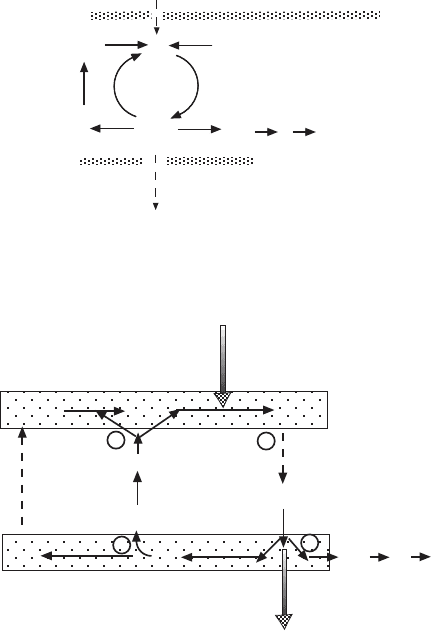
through the membrane, because of its negative charge. The complete Q cycle
actually is the sum of two cycles, shown in Figure 5.23 . The various oxidation
states of ubiquinone are shown (Figure 5.6 ).
There are 10 isoprenoid units in the naturally occurring ubiquinone, making
an aliphatic carbon chain of 40 carbons with regularly spaced double bonds
and methyl side chains. Such a chain is much longer than what is required to
span a lipid bilayer, and the usual representation of a Q diffusing through a
schematic membrane many diameters wider than the Q is likely to give a
totally wrong impression of the “ diffusion ” of Q “ across ” the membrane.
Ignoring this problem for the moment, a consideration of the Q cycle is con-
veniently started with reduced QH
2
supplied by complex I or complex II on
the matrix side of the membrane (step 1). Diffusion across the membrane
brings it to the other side and in a position to give up two protons to the
intermembrane space, passing one electron to the iron – sulfur protein (ISP,
Rieske protein) of complex III (step 2). This electron is passed on to the cyt
c
1
of the complex III and fi nally to cytochrome c. The semiquinone in the
unprotonated form gives up a second electron to the fi rst of two hemes, b
L
,
and becomes oxidized to Q (step 3); the electron is passed to the second heme
b
H
. Q diffuses back to the matrix side, and there it is reduced to the semiqui-
none by the heme b
H
(step 4). During this fi rst half of the Q cycle the net
reaction is the oxidation of QH
2
to the seminquinone, the reduction of one
cytochrome c, and the transfer of two protons to the intermembrane space. A
repeat of steps 1 – 3 starting with QH
2
generates Q, another reduced cyt c, and
a reduced heme b
H
, and it releases two more protons in the intermembrane
space. At this time, however, the heme b
H
is transferring its electron to the
semiquinone, accompanied by the pick - up of two protons from the matrix side
to form ubiquinol. The summation of the two series of reactions is
QH cyt c H Q 2 cyt c H
2oxin
+
red out
+
++⇒+ +22 4
The net reaction is that four protons are translocated to the outside (inter-
membrane space) for every pair of electrons passing through complex III from
QH
2
to cytochrome c (239) . A recent up - to - date and highly technical review
of the Q cycle discusses a detailed mechanism for the behavior of complex III
THE CHEMIOSMOTIC HYPOTHESIS 237
238 MITOCHONDRIAL ELECTRON TRANSFER
in light of very detailed structural information from X - ray crystallography
(241) . Furthermore, the reviewer draws attention to the structural similarity
of the ubiquinone binding sites in the bc
1
and the prokaryotic photosynthetic
reaction center (RC). The latter can be studied kinetically by using short
fl ashes of light, allowing the identifi cation of intermediate states. The inter-
ested reader is referred to this review, which illuminates many of the remaining
controversial aspects of the mechanism, for example, the sequential or con-
certed oxidation of ubiquinol, and the prevention of a “ short circuit ” of the
second electron into cytochrome c
1
instead of to the heme b
l
. This problem
has been addressed by other authors as well; a very readable and lucid discus-
sion of several different possibilities for short circuiting in complex III is pre-
sented by Osyczka et al. (242) . The solution requires either gating mechanisms
2H
2H
bL
antimycin
myxothiazol
T
T
+
+
-
-
.
.
MATRIX SIDE
INTERMEMBRANE SPACE
Q
ISP
Q
c
2
QH
QH
2
N
Q
1
c
P
Q
b
H
3
4
1
2
Q
QH
2
2H
+
2H
+
MATRIX
INTERMEMBRANE SPACE
b
H
b
L
ISP c c
1
Figure 5.23 Another view of the proposed Q cycle by Trumpower and colleagues.
and even double gating mechanisms, or concerted electron transfer with no
semiquinone intermediate. The proposal of a “ Fe – S lock ” — that is, a shuttling
of the Fe – S domain of the Rieske protein between two conformations (see
reference 242 for many references related to this topic) — represents a popular
model, but Crofts and colleagues also consider a model in which a quinone
serves as gate by moving about the Q
0
site (240, 243) .
The cytochrome bc1 complex is found as a dimer both in the crystal struc-
ture and in solution. This has led several authors to consider an electron
exchange between cytochrome b ’ s from adjacent monomers (145, 244) .
The protonmotive Q cycle originally proposed by Mitchell and later modi-
fi ed by Trumpower has made it into the standard textbooks, and it appears to
have gained general acceptance. Arguments in support of this formulation,
especially with reference to the two inhibitors antimycin and myxothiazol
binding at the “ center N ” and the “ center P, ” respectively, have been critically
reviewed by Brandt and Trumpower (239) . Nevertheless, some doubts about
its validity have been raised by experiments by Matsuno - Yagi and Hatefi (245,
246) , again with special attention focused on observations made with the two
inhibitors. Their proposed model has the attractive feature that the ubiquinol
does not have to execute as much motion within the membrane and the
complex. It also places the path for proton translocation within the cyt b with
its eight transmembrane helices, and it removes this function from the mobile
carrier ubiquinol. Further support for this model has not been forthcoming in
the recent literature.
5.4.3 Probing the Mitochondrial Membrane Potential with
Fluorescent Dyes
Opposition to Mitchell ’ s ideas arose in part because of misunderstandings
about ion transport, membrane potential, and the principle of electroneutrality
in solutions formulated by classical physical chemistry. The latter principle is
never violated in the bulk of the solutions on either side of the membrane. Ion
transport separates charges across an extremely thin membrane. These charges
separated by a thin insulating layer create a system analogous to a charged
capacitor. Because of the extreme thinness of biological membranes, an electri-
cal difference of 250 mV across 5 – 10 nm corresponds to > 250,000 V/cm, a very
strong electric fi eld by any standard.
The membrane potential is not the same for all mitochondria or constant
at all times for a given mitochondrion. A direct measurement would not only
provide strong experimental support for the chemiosmotic hypothesis, but
would allow continuous monitoring of the ΔΨ under varying conditions and
manipulations of mitochondria. Direct electrophysiological experiments with
isolated mitochondria have been reported, but they tend to be challenging
(247, 248) . More convenient methods have been developed over the years.
These methods initially gave only qualitative results in most hands, but
increasingly quantitative data can be obtained today with appropriate
THE CHEMIOSMOTIC HYPOTHESIS 239
240 MITOCHONDRIAL ELECTRON TRANSFER
instrumentation. The basis for these optical methods is the existence of dyes
that accumulate in mitochondria in a membrane potential - dependent manner.
Another advantage of the use of such dyes is that they can be used in living
cells to explore mitochondria in vivo . The use of dyes to investigate mitochon-
dria goes back to the last century, when mitochondria were fi rst seen without
being recognized for their function (see Chapter 1 ).
A fundamental property of the useful dyes is that they are lipophilic and
carry a positive charge that can be delocalized throughout the molecule by
resonance structures. Therefore they not only can pass through membranes,
but also will be actively transported across a membrane with a ΔΨ (249, 250) .
In the case of mitochondria, this leads to their accumulation in the mitochon-
dria. Thus, if the plasma membrane potential can be eliminated, uptake and
fl uorescence of such a dye can become a measure of the mitochondrial mem-
brane potential. At the simplest level of analysis, one can stain mitochondria
and determine their intracellular distribution, their behavior in response to
disruptions of the cytoskeleton, or their behavior during cell division (251) .
Two types of quantitative measurements should be distinguished: (1) One can
measure total, integrated fl uorescence from a fi xed number of cells and obtain
information about the overall mitochondrial activity in the population of cells;
and (2) one can monitor individual cells, and even individual mitochondria
within a cell to address questions about intercellular and intracellular hetero-
geneity. The choice of the appropriate dye is an important consideration, and
even then very precise quantitative measurements and their interpretation are
subject to theoretical limitations which should not be ignored. Experimentally,
such measurements are not as simple as measuring concentrations from absor-
bances and the use of Beer ’ s law (see reference 228 for an expert discussion
of the theory and methodology).
The fi rst dye to be used extensively was rhodamine 123 (Rh123) (252)
(Figure 5.24 ). A serendipitous observation was soon exploited by Chen ’ s labo-
ratory to demonstrate the specifi city for mitochondria in living cells. Its uptake
into mitochondria was dependent on ΔΨ , since various ionophores and uncou-
plers known to dissipate the membrane potential could be shown to prevent
Rh123 uptake. Similarly, inhibitors of the electron transport chain (rotenone,
antimycin, cyanide) can also reduce or eliminate the uptake of Rh123. It was
observed that when glycolysis produces suffi cient ATP, a membrane potential
could still be generated from the reverse reaction of the F
0
F
1
ATPase, a reac-
tion that can be inhibited by oligomycin. In the presence of the H
+
/K
+
anti-
porter nigericin, Rh123 could be used to show hyperpolarization of the
membrane, since the proton gradient can be converted into a K
+
gradient with
less inhibitory effect on electron transport. Thus, Rh123 fl uorescence was a
faithful indicator of membrane potential in mitochondria. As described in
more detail in the original literature (summarized in reference 253 ), the effects
of a plasma membrane potential can be eliminated in 137 mM K
+
, and for some
experiments the inhibitor oubain has to be included to shut off the Na
+
– K
+
pump in the plasma membrane.