
Schultz D. Encyclopedia of the United States Constitution
Подождите немного. Документ загружается.

retirement from public life in 1891. Cooley died
in Ann Arbor, Michigan.
Despite his distinguished public service and
teaching, Cooley is best known for his writing.
His A Treatise on the Constitutional Limitations
Which Rest upon the Legislative Power of the
States (1868) appeared in eight editions, with the
last in 1927. The book, for many years, was the
best available reference work on state constitu-
tional law and brought order out of the confusion
inherent in having a large number of separate,
although basically similar, constitutional systems.
Cooley emphasized limitations upon power rather
than power itself, a popular view in the second
half of the 19th century. The courts in this era
were generally inclined to accept the principles
that restricted legislative power rather than those
that sustained it.
Among the principles that owe part of their
development to Cooley is liberty of contract.
In the 1884 edition of the Limitations, Cooley
listed the right to make contracts among the fi ve
natural rights. To date, the doctrine has yet to
receive unqualifi ed judicial approval. Cooley also
attacked class legislation as a violation of the due
process guarantee in passages that were widely
quoted. He wrote that a legislature which provides
that persons following a lawful trade or employ-
ment do not have the capacity to make contracts
thereby deprives these people of liberty that is of
primary importance to their right to the pursuit
of happiness.
Cooley’s most notable contribution came with
his emphasis on due process as a substantive limi-
tation upon legislative powers. His work played a
highly infl uential role in the early interpretation
of the due process clause of the Fourteenth
Amendment to the Constitution as a support for
laissez-faire principles.
For more information: Jacobs, Clyde E. Law
Writers and the Courts: The Infl uence of Thomas
M. Cooley, Christopher G. Tiedeman, and John
F. Dillon Upon American Constitutional Law.
Berkeley: University of California Press, 1954.
—Caryn E. Neumann
Cooley v. Board of Wardens of the Port of
Philadelphia
53 U.S. 299 (1851)
In Cooley v. Board of Wardens of the Port of Phil-
adelphia, the Supreme Court laid out some impor-
tant rules of federalism that gave states the
authority to regulate local affairs and local issues.
In reaching this decision, the Court appeared
to place some limits on the commerce clause
authority of the national government.
Pennsylvania passed a law in 1803 that man-
dated ships entering or leaving Philadelphia’s port
to retain a local pilot to guide the ship through
and out of the harbor. If a ship did not comply,
a penalty would be assessed, and the proceeds
would be placed in a fund to be used for retired
pilots and their dependents. However, a ship leav-
ing (or entering) the harbor would appear to be
in interstate commerce, which Section 8 of
Article I of the U.S. Constitution states is
a power of Congress: “The Congress shall have the
power . . . To regulate commerce . . . among the
several States.”
This would seem to suggest that Philadelphia’s
board was in violation of the commerce clause, but
another act of Congress, passed in 1789, stated:
“. . . all pilots in the bays, inlets, rivers, harbors,
and ports in the United States shall continue to
be regulated in conformity with the existing laws
of the states . . . until further legislative provision
shall be made by Congress.” Cooley was a ship-
owner who refused to hire a local pilot and refused
to pay the fi ne. He argued that the board’s policies
violated the commerce clause. The Supreme Court
defi ned the question in this case as “. . . whether
the grant of the commercial power to Congress
did per se deprive the States of all power to regu-
late pilots.”
With Justices John McLean and James Moore
Wayne in dissent and Justice Daniel concurring
in the result but disagreeing with the logic, the
majority held that the Pennsylvania law was con-
stitutional. Justice Benjamin Curtis delivered the
majority opinion.
The heart of his opinion is the “local-national”
distinction. Curtis’s words speak clearly to this
distinction:
172 Cooley v. Board of Wardens of the Port of Philadelphia
xviii+446_EofUSConsti-v1.indd 172 3/12/09 3:04:30 PM
Whatever subjects of this power [from the com-
merce clause] are in their nature national, or
admit of only one uniform system, or plan of regu-
lation, may justly be said to be of such a nature as
to require exclusive legislation by Congress. That
this cannot be affi rmed of laws for the regulation
of pilots and pilotage is plain. The act of 1789 con-
tains a clear and authoritative declaration by the
fi rst Congress, that the nature of this subject is
such, that until Congress should fi nd it necessary
to exert its powers, it should be left to the legisla-
tion of the States; that it is local and not national.
The key point of the decision was that Congress
can allow the states to handle the purely local
aspects of interstate commerce until that body
explicitly exercises its power under the commerce
clause. According to some legal scholars, the case
offers two possible ways to read the commerce
clause: The congressional commerce clause power
is exclusive and that states lacked all authority to
regulate commerce, or in the absence of congres-
sional legislation, the commerce clause imposed
no limits on the states.
Cooley is important because it advances the
argument that the commerce clause is not an “all
or none” principle; that is, there is some role for
state regulation of commerce if the subject is local
and if Congress has not assumed jurisdiction over
the subject (in this instance, pilots). At the same
time, it affi rms that the commerce clause provides
great leverage for Congress on such matters. Some
suggest that this is a harbinger of later “balancing
tests” in Supreme Court decision making.
For more information: Gunther, Gerald. Con-
stitutional Law. 12th ed. New York: Foundation
Press, 1991.
—Steven A. Peterson
Cooper v. Aaron 38 U.S. 1 (1958)
In Cooper v. Aaron, the Supreme Court ruled
that state offi cials must obey court orders resting
on the Supreme Court’s authority to interpret the
Constitution. This case is important because the
Court rejected a serious challenge to its authority
and reaffi rmed its commitment to integration.
In 1957, Governor Orval Faubus of Arkansas
encouraged disobedience to court orders to inte-
grate schools by calling out the state’s National
Guard to prevent African-American children from
entering Central High School in Little Rock. As
a result of his actions, President Dwight Eisen-
hower sent in army troops to enforce the order
and protect the children. Due to these troubles,
the Little Rock School Board asked the courts
for a two-and-a-half-year delay in desegregating
their schools. The district court agreed but the
Eighth Circuit reversed. The Supreme Court, in
an unusual move, expedited hearings by holding
oral arguments three days after granting review
and issued a decision the very next day ordering
the school board to integrate.
To underscore their unanimity, all justices
signed the opinion rejecting the claim that states
have a right, equal to the courts, to interpret the
Constitution and reaffi rming the order to desegre-
gate schools. While the Court admitted that Little
Rock had had problems resulting from desegre-
gation, the trouble resulted directly from the
actions of state offi cials. This was contrary to the
Fourteenth Amendment, which states that no
“State” shall deny to any person equal protec-
tion of the laws. The state of Arkansas, by resist-
ing desegregation, was doing that and had to stop.
In response to Governor Faubus’s claim that
Arkansas is not bound by the Court, the Court
reminded Faubus that Article VI of the Consti-
tution declares the Constitution the “supreme
Law of the Land” and that, as Chief Justice John
Marshall had said in M
ARBURY V. MADISON, 1 Cr.
137 (1803), “It is emphatically the province and
duty of the Supreme Court to say what the law is.”
This principle had been respected by the Court
and country ever since and is fundamental to the
constitutional system. Further, the Court pointed
out that state offi cials take an oath to support the
Constitution and any offi cial who refuses to obey
a court order violates that oath. Finally, the Court
pointed out that even with the addition of three
new justices since B
ROWN V. BOARD OF EDUCATION
Cooper v. Aaron 173
xviii+446_EofUSConsti-v1.indd 173 3/12/09 3:04:30 PM
OF TOPEKA, 349 U.S. 483 (1954), the Court is still
unanimous in its view that Brown was correctly
decided.
In a concurring opinion, Justice Felix Frank-
furter chastised his former law students from Har-
vard who were leading members of the bar in the
South for opposing the Court. He reminded them
that rejecting the rule of law leads to anarchy.
Overall, this case marked the end of the Court’s
patience in waiting on southern states to accept
Brown and begin to desegregate. In a series of
cases over the next 20 years, the Court began the
implementation of integration through busing,
rearranging school zones, and other measures.
For more information: Freyer, Tony. The Little
Rock Crisis. Westport, Conn.: Greenwood Press,
1984; Klarman, Michael. From Jim Crow to Civil
Rights. Oxford and New York: Oxford University
Press, 2004; Patterson, James T. Brown v. Board
of Education: A Civil Rights Milestone and Its
Troubled Legacy. Oxford and New York: Oxford
University Press, 2002.
—Sean Evans
Coppage v. Kansas 236 U.S. 1 (1915)
In Coppage v. Kansas, the Supreme Court found
the state of Kansas had acted unconstitutionally in
passing a law banning “yellow dog” contracts. The
law in question prevented employers from requir-
ing employees to sign an agreement stating they
would not join a union.
T. B. Coppage was convicted of violating the
Kansas law and appealed to the Supreme Court on
grounds that the statute violated freedom of con-
tract protected by the due process clause of the
Fourteenth Amendment. The Court stated
that legitimate exercises of the state police power
could restrict freedom of contract, but there was no
relationship in this case between the statute’s pur-
pose and the state’s police-power goal.
According to the facts described in the major-
ity opinion, an individual named Hedges was
employed as a switchman by the St. Louis & San
Francisco Railway Company in July 1911. Hedges
was also a member of a labor organization called
the Switchmen’s Union of North America. The
plaintiff, Coppage, was employed by the rail-
way company as superintendent, and as such, he
requested Hedges to sign an agreement stating
he would withdraw from the Switchmen’s Union.
If Hedges refused to sign the agreement, he was
told, he could no longer remain an employee of
the company. Hedges refused to sign the agree-
ment or withdraw from the labor organization and
was thus fi red by Superintendent Coppage.
The majority opinion, written by Justice Mahlon
Pitney, approached the constitutional questions of
Coppage from the precedent of Adair v. United
States, 208 U.S. 191 (1908). In Adair, Justice John
Marshall Harlan argued that it is important
to preserve the balance of freedoms that exists
between employers and employees: “The right
of a person to sell his labor upon such terms as
he deems proper is . . . the same as the right of
the purchaser of labor to prescribe the conditions
upon which he will accept such.” In other words,
the law violated the liberties of both employers and
employees as it compelled them to accept certain
conditions in the purchasing and selling of labor.
Following the logic of Adair, Justice Pitney wrote:
“if it be unconstitutional for Congress to deprive
an employer of liberty or property for threatening
an employee with loss of employment, or discrimi-
nating against him because of his membership in a
labor organization, it is unconstitutional for a state
to similarly punish an employer.” The judgment of
the lower court was thus reversed.
In addition to the majority, Justice Oliver
Wendell Holmes, Jr., and Justice William R.
Day, along with Justice Charles Evans Hughes,
issued separate dissenting opinions. Justice Hol-
mes argued that the Constitution does not explic-
itly prohibit the Kansas law and that Adair and
L
OCHNER V. NEW YORK, 198 U.S. 45 (1905), should
be overturned, while Justices Day and Hughes
commented that they believed the law did not go
beyond a legitimate exercise of the police power.
For more information: Schwartz, Bernard. A
History of the Supreme Court. Oxford and New
York: Oxford University Press, 1993.
—Erika N. Cornelius
174 Coppage v. Kansas
xviii+446_EofUSConsti-v1.indd 174 3/12/09 3:04:31 PM
Corfi eld v. Coryell 4 Wash. (C.C. 3d) 6 Fed.
Cas. 546, No. 3,230 C.C.E.D.Pa.
(1823)
Corfi eld v. Coryell is an important lower court case
explaining what
PRIVILEGES AND IMMUNITIES means
in Article IV, Section 2 of the Constitution.
Corfi eld v. Coryell upheld a New Jersey statute
that prohibited nonresidents from harvesting oys-
ters and established terms of forfeiture for vessels
so employed. The owner of a vessel accordingly
seized contended that the act violated Congress’s
power to “regulate Commerce . . . among the
several States” (Article I, Section 8), the “Privi-
leges and Immunities” clause (Article IV, Section
2), and the Constitution’s grant of admiralty and
maritime jurisdiction to “the judicial Power” of
the United States (Article III, Section 2). Sitting
as circuit justice, Bushrod Washington articulated
without reference to the Bill of Rights a broad
and substantive interpretation of the privileges
and immunities clause, which, nonetheless, did
not include the right to harvest oysters.
Addressing the fi rst claim, Washington relied
on G
IBBONS V. OGDEN, 9 Wheat. 22 U.S. 1 (1824),
to distinguish between Congress’s sole authority
to legislate interstate commerce (Article I,
Section 8) and the right retained by states to leg-
islate on subjects within the states, even if such
legislation “may indirectly and remotely affect
commerce” (4 Wash. [C.C. 3d], 502 [1823]). The
act limited oyster harvesting but did not interfere
with the free use of the waters for commercial
intercourse or trade and thus did not constitute a
regulation of interstate commerce.
Washington rejected also the claim that the act
violated Article III, Section 2, which, in extending
the federal judicial power to cases of admiralty and
maritime jurisdiction, removes such cases from
the jurisdiction of state courts. The states’ power
to regulate their fi sheries was exclusive when the
Constitution was adopted and had not been sur-
rendered to the federal government by Article III,
Section 2.
The critical importance of Corfi eld v. Coryell,
however, lies in its interpretation of the Constitu-
tion’s guarantee that “The Citizens of each State
shall be entitled to all Privileges and Immunities
of Citizens in the several States” (Article IV, Sec-
tion 2). Addressing for the fi rst time what those
privileges and immunities were, Washington iden-
tifi ed them as those “which are, in their nature,
fundamental; which belong, of right, to the citi-
zens of all free governments; and which have, at all
times, been enjoyed by the citizens of the several
states which compose this Union” (4 Wash. [C.C.
3d], 503 [1823]). Observing that “what these fun-
damental principles are, it would perhaps be more
tedious than diffi cult to enumerate,” he neverthe-
less provided a general overview: “Protection by
the government; the enjoyment of life and liberty,
with the right to acquire and possess property of
every kind, and to pursue and obtain happiness
and safety; subject nevertheless to such restraints
as the government may justly prescribe for the
general good of the whole” (4 Wash. [C.C. 3d],
503 [1823]). Deriving from these principles were
rights, including that of interstate travel and relo-
cation, the benefi t of habeas corpus, access to
state courts, nonpunitive taxation, the franchise as
regulated by state law, and “many others.” Wash-
ington fl atly denied, however, that the clause guar-
anteed to nonresidents all the privileges enjoyed
by residents, holding that New Jersey could regu-
late its common property in a manner discrimina-
tory to nonresidents.
Washington’s central holding, that citizens pos-
sess fundamental rights not enumerated in
the Bill of Rights but that states may not abridge,
would resurface repeatedly in the debates sur-
rounding the Fourteenth Amendment, the
Civil Rights Act of 1866, and incorporation.
In addition to Corfi eld v. Coryell, two other
cases have offered interpretations of the privileges
and immunities clause of the Constitution or the
privileges or immunities clause of Section 1 of the
Fourteenth Amendment. In the B
UTCHER’S BENEV-
OLENT ASSOCIATION V. CRESCENT CITY LIVE-STOCK
L
ANDING AND SLAUGHTER-HOUSE CO. (The Slaugh-
terhouse Cases), 83 U.S. (16 Wall.) 36 (1873), the
Supreme Court rejected claims that the Four-
teenth Amendment protected independent butch-
ers from a law that required all animal slaughters
to take place in one facility. In dissent, Justice
Stephen J. Field contended that the privileges or
immunities clause of the Fourteenth Amendment
Corfi eld v. Coryell 175
xviii+446_EofUSConsti-v1.indd 175 3/12/09 3:04:31 PM
protected the right of butchers to pursue their
occupation. Finally, in S
AENZ V. ROE, 526 U.S. 489
(1999), the Supreme Court found that the right of
interstate travel is one of the rights protected by
the privileges or immunities clause.
For more information: Bogen, David S. Privi-
leges and Immunities: A Reference Guide to the
United States Constitution. Westport, Conn.: Prae-
ger/Greenwood, 2003; Harrison, John. “Recon-
structing the Privileges and Immunities Clause.”
Yale Law Journal 101, no. 7 (1992): 1,385–1,474;
Meyers, W. J. “The Privileges and Immunities of
Citizens in the Several States.” Michigan Law
Review 1, no. 4 (1903): 286–315; Simson, Gary
J. “Discrimination Against Nonresidents and the
Privileges and Immunities Clause of Article IV.”
University of Pennsylvania Law Review 28, no. 2
(1979): 379–401.
—Lorna M. Dawson
countermajoritarianism
Countermajoritarianism in the Supreme Court
occurs when the Court decides to overturn leg-
islation passed by Congress or a state or local
legislative body. The act of declaring legislation
unconstitutional through judicial review is
countermajoritarian because it effectively negates
the will of the majority. Pieces of legislation, far
more than judicial decrees, represent the policy
choices of the majority because they are drafted
by elected officials rather than appointed, life-
time-tenured justices. The “countermajoritarian
diffi culty” posed by judicial review, as Alexan-
der Mordecai Bickel describes in The Least
Dangerous Branch (1962), requires us to balance
democratic values against the Court’s legacy of
preserving the Constitution.
While some argue that the countermajoritari-
anism of the Supreme Court is a result of its efforts
to protect minority rights from being abused by
the majority, this countermajoritarian conundrum
has sparked what Barry Friedman refers to as an
“academic obsession.” Scholars question whether
the Court is truly countermajoritarian. Robert
Dahl argues in Decision-Making in a Democracy
(1962) that judicial review does not truly pres-
ent a countermajoritarian threat. Dahl looks at
instances where the Supreme Court overturns fed-
eral legislation within four years of enactment and
fi nds that in very few instances did the Court rule
federal legislation unconstitutional. The Court
appeared to behave in a countermajoritarian fash-
ion during political transitions where the judiciary
served as the keeper of the prior regime’s policy
preferences. Court appointments, argues Dahl,
permit presidents to quickly realign the Court to
refl ect current majority concerns.
Conversely, Jonathon Casper argues that by lim-
iting his analysis to federal legislation and judicial
review, Dahl misses a signifi cant percentage of the
Court’s countermajoritarian actions. For instance,
when the Court is called upon to interpret rather
than constitutionally review statutes, the Court
may undermine the majority’s legislative intent.
The Court is also asked to determine the mean-
ing and/or constitutionality of state legislation.
When the Court issues a decision that invalidates
a state statute, the effect may be felt nationally.
For example, the Court’s school prayer deci-
sions invalidating state and local school prayer
practices could be considered prime examples of
countermajoritarian behavior.
Scholars also examine the relationship between
Court decisions and public opinion when searching
for signs of countermajoritarian tendencies. Wil-
liam Mishler and Reginald Sheehan look at how
and to what degree the Court responds to trends
in public opinion. They suspect that Supreme
Court justices gradually modify their decisions to
refl ect majoritarian concerns over the long run.
Specifically, they find that the Court requires
approximately fi ve years to bring their decisions in
sync with public attitudes.
Finally, Mark Graber argues that judicial review
may be considered nonmajoritarian. In many
instances, the Court is asked by a divisive majority
to resolve controversial issues. In this sense, then,
judicial review involves the reversal of policies for
which there is no majority consensus.
For more information: Adamany, David W.,
and Joel B. Grossman. “Support for the Supreme
176 countermajoritarianism
xviii+446_EofUSConsti-v1.indd 176 3/12/09 3:04:32 PM
Court as a National Policymaker.” Law and Pol-
icy Quarterly 5 (1983): 405–437; Bickel, Alexan-
der. The Least Dangerous Branch: The Supreme
Court at the Bar of Politics. New Haven, Conn.:
Yale University Press, 1986; Casper, Jonathon.
“The Supreme Court and National Policymak-
ing.” APSR 70 (1976): 5,066; Dahl, Robert. Deci-
sion-Making in a Democracy: The Supreme
Court as a National Policy-Maker. New York:
Irvington Publishers, 1993; Friedman, Barry.
“The Birth of an Academic Obsession: The His-
tory of the Countermajoritarian Diffi culty, Part
Five.” Yale Law Journal 153 (2002): 112; Fun-
ston, Richard. “The Supreme Court and Critical
Elections.” American Political Science Review 69
(1975): 795–811; Graber, Mark A. “The Nonma-
joritarian Difficulty: Legislative Deference to
the Judiciary.” Studies in American Political
Development 7 (1993): 35–73; Mishler, William,
and Reginald Sheehan. “The Supreme Court as
Countermajoritarian Institution? The Impact of
Public Opinion on Supreme Court Decisions.”
APSR 87 (1997): 87–101; Peretti, Terri Jennings.
In Defense of a Political Court. Princeton, N.J.:
Princeton University Press, 1999.
—Alison Gash
County of Allegheny v. ACLU 492 U.S. 573
(1989)
In County of Allegheny v. ACLU, the Supreme
Court ruled on the constitutionality of religious
displays on public property. In this decision,
the Court ruled on two different types of displays,
helping to clarify what the establishment
clause permits.
Starting in 1981, a Roman Catholic group in
Pittsburgh had sponsored a crèche displayed
on the grand staircase of the Allegheny County
Courthouse at Christmastime. In 1982, a Jewish
group began sponsoring a menorah displayed out-
side the City-County Building around the time
of Hanukkah. In a deeply divided decision, the
Supreme Court held that the crèche violated the
First Amendment’s establishment clause while
the menorah did not violate the establishment
clause.
In L
YNCH V. DONNELLY, 465 U.S. 668 (1984), the
Supreme Court had ruled that a crèche could be
displayed as a component of a larger holiday dis-
play. This reasoning resulted from L
EMON V. KURTZ-
MAN, 403 U.S. 602 (1971), in which the Supreme
Court had used the “principal or primacy effect”
to decide whether a statute advances or inhib-
its religion. The application of this measure to a
religious symbol was used in Lynch to determine
whether a symbol was the primary feature of a dis-
play that advances or inhibits religion. The consti-
tutional diffi culties with the crèche in County of
Allegheny v. ACLU arose from the fact that it was
displayed without the “sanitizing” effect of other
seasonal decorations. According to the logic from
Lynch, other religious symbols and secular deco-
rations remove the centrality of a religiously based
display thereby removing the overtly religious
message. The crèche in Allegheny was displayed
singularly with the words Gloria in Excelsis Deo
(Glory to God in the highest), accompanied by an
angel on the crest above the manger. According to
the Supreme Court majority opinion, the crèche
being the single object of recognition in the dis-
play was tantamount to government endorsement
of religion and was therefore in violation of the
establishment clause. This decision upheld the
fi nding of the U.S. Court of Appeals for the Third
Circuit as it pertained to the crèche.
Regarding the menorah’s display at the City-
County Building, the Supreme Court, with a
majority different from the one ruling about the
crèche, found that the display did not violate the
establishment clause and stayed true to Lynch
because the menorah was on display with a 45-foot
Christmas tree, accompanied by a sign reading
“During this holiday season, the city of Pittsburgh
salutes liberty. Let these festive lights remind us
that we are the keepers of the fl ame of liberty and
our legacy of freedom.” This effectively made the
menorah part of a larger display thereby removing
the menorah’s centrality in the display. The deci-
sion on the menorah overruled the fi nding of the
U.S. Court of Appeals for the Third Circuit.
The decision was fragmented and contained a
strong minority of justices lining up behind the idea
that the crèche did not violate the establishment
County of Allegheny v. ACLU 177
xviii+446_EofUSConsti-v1.indd 177 3/12/09 3:04:32 PM
clause. Associate Justice Anthony M. Kennedy,
writing for the minority, stated: “accommoda-
tion, acknowledgement, and support for religion
are an accepted part of our political and cultural
heritage, and the Establishment Clause permits
government some latitude in recognizing the cen-
tral role of religion in society.” More recent cases
such as M
CCREARY COUNTY, KENTUCKY V. AMERICAN
C
IVIL LIBERTIES UNION, 545 U.S. 844 (2005), in
which the Supreme Court rejected a Ten Com-
mandments display, and V
AN ORDEN V. PERRY,
545 U.S. 677 (2005), in which the Supreme Court
accepted a display, point to the continued contro-
versy and fragmented decisions of the Court in
this area of jurisprudence.
For more information: Choper, Jesse H.; Rich-
ard H. Fallon, Jr.; Yale Kamisar; and Steven H.
Shiffrin. Constitutional Law: Cases and Com-
ments. 10th ed. New York: West Publishing,
2006.
—William Lester
Coyle v. Smith 221 U.S. 559 (1911)
In Coyle v. Smith, the Supreme Court declared
that the newly admitted state of Oklahoma had
the right to move its state capital despite restric-
tions to the contrary in its enabling act. This case
is signifi cant in the development of American fed-
eralism, because the Court ruled that new states
enter the Union on “equal footing” with existing
states and therefore have the same authority as the
“original” states to alter their state governments.
Article IV, Section 3 of the U.S. Constitution
provides: “new states may be admitted by the Con-
gress into this Union.” In 1906, Congress passed
an enabling act authorizing the admission of Okla-
homa into the Union. Among its many provisions,
the enabling legislation stipulated that Oklahoma’s
new state capital should be located in the city of
Guthrie and could not be moved until after 1913.
The voters of Oklahoma subsequently approved
the act and the new constitution, and Oklahoma
became the 46th state on November 16, 1907.
In 1910, the Oklahoma state legislature, bowing
to political and economic pressures, authorized
the relocation of the state capital to Oklahoma
City. W. H. Coyle, a businessperson from Guthrie,
fi led suit against Thomas Smith, Oklahoma secre-
tary of state, to enjoin the state from moving its
capital. The Oklahoma Supreme Court upheld the
1910 law, and Coyle appealed to the U.S. Supreme
Court. The sole question before the Court was
“whether the provision of the enabling act was a
valid limitation upon the power of the State after
its admission, which overrides any subsequent
state legislation repugnant thereto.”
Justice Horace Lurton delivered the 7-2 major-
ity opinion. Lurton recognized that Congress
has constitutional authority to impose conditions
of statehood, but once a state enters the Union,
it enters on “equal footing” with the other states.
According to Lurton, “When a new State is admit-
ted into the Union, it is so admitted with all the
powers of sovereignty and jurisdiction which per-
tain to the original States, and . . . such powers
may not be constitutionally diminished, impaired
or shorn away by any conditions, compacts or stip-
ulations embraced in the act under which the new
State came into the Union.” Joining Lurton were
Justices William R. Day, John Marshall Har-
lan, Charles Evans Hughes, Joseph R. Lamar,
Willis Van Devanter, and Edward D. White. Jus-
tices Oliver Wendell Holmes, Jr., and Joseph
McKenna dissented without a written opinion.
For more information: Gibson, Arrell Morgan.
History of Oklahoma. Norman: University of
Oklahoma Press, 1984; Graves, W. Brooke. Amer-
ican Intergovernmental Relations: Their Origins,
Historical Development, and Current Status.
New York: Scribner, 1964.
—Richard J. Hardy
Craig v. Boren 429 U.S. 190 (1976)
In Craig v. Boren, the Supreme Court created the
intermediate scrutiny standard to apply to cases
involving gender-based discrimination. The signif-
icance of this case is that the Court makes gender
a quasi-suspect class and ensures that laws that
discriminate against women will be given greater
scrutiny than normal legislation.
178 Coyle v. Smith
xviii+446_EofUSConsti-v1.indd 178 3/12/09 3:04:32 PM
Curtis Craig, a male between 18 and 21 years
old, sought injunctive relief against the enforce-
ment of an Oklahoma law that forbade the sale of
low-alcohol-content beer (3.2 beer) to males, but
not females, under the age of 21. Craig argued that
the law invidiously discriminates against males
between the ages of 18 and 21 and violates the
Fourteenth Amendment’s equal protec-
tion clause. A three-judge district court denied
relief, and the Supreme Court, in a 7-2 decision,
reversed, holding the law violated the equal pro-
tection clause.
Writing for the majority, Justice William J.
Brennan, Jr., held that laws that discriminate
on the basis of gender must serve “important gov-
ernmental objectives and must be substantially
related to achievement of those objectives.” While
Oklahoma has an important state interest in traf-
fi c safety, the law does not relate to that objective
for three reasons, according to Brennan. First,
statistical evidence shows little relation between
18–20-year-old maleness and drunk driving. Sec-
ond, Oklahoma considers 3.2 beer nonintoxicat-
ing and thus unlikely to promote drunk driving.
Third, Oklahoma allows males to drink 3.2 beer
but not buy it, which is inconsistent with the pur-
pose of the law.
In his dissent, Justice William Hubbs
Rehnquist objected to the decision for two rea-
sons. First, there is no history of discrimination
against males to justify a higher standard of review
for laws that discriminate against them. Second,
the Court creates a new standard without any cita-
tion to its source. Moreover, the Court provides
no guidance for determining what objectives are
important and how to determine whether a law
is substantially related to such objective. Justice
Rehnquist then attacked the activist majority,
claiming that this new standard is simply a justifi -
cation to strike down laws a majority of the Court
opposes. Rather than create a new standard, he
would uphold the law because Oklahoma has a
rational basis for this distinction.
This case is important because it fi nally resolved
the question of what level of scrutiny should be
applied to laws that discriminate on the basis of
gender. While the more liberal members of the
Court wanted to make gender, like race, a suspect
class subject to strict scrutiny because it is
an immutable characteristic, they were unable to
command a fi fth vote for this position in Frontiero
v. Richardson, 411 U.S. 677 (1973). In that case,
Justice Lewis Franklin Powell, Jr., noted
that women had greater success in the political
process and that the Courts should not preempt
the political branches as they were debating the
Equal Rights Amendment. Realizing that women
were more successful than racial groups in the
political process but still subject to impermissible
stereotypes, the Court eventually determined
that gender-based classifi cations deserved greater
scrutiny than normal, although not as much as
race deserved.
For more information: Cushman, Clare.
Supreme Court Decisions and Women’s Rights.
Washington, D.C.: CQ Press, 2000; Schwarzen-
bach, Sybil, and Patricia Smith. Women and the
Constitution. New York: Columbia University
Press, 2004.
—Sean Evans
cross burning
Cross burning is an act historically associated with
the Klu Klux Klan. Klan cross burning is meant to
symbolize racial superiority for whites and hatred
toward African Americans. Depending on the con-
tent and circumstances of the act of cross burning,
it may or may not receive constitutional protection
as free speech under the First Amendment.
In B
RANDENBURG V. OHIO, 395 U.S. 444 (1969),
Clarence Brandenburg was convicted of violat-
ing a law making it illegal to advocate racial strife
by attending a cross-burning ceremony during a
Klan rally. The Supreme Court overturned his
conviction, stating that unless his actions advo-
cated imminent harm that is likely to occur, then
any acts or statements are protected speech under
the First Amendment. While in this case cross
burning was not directly an issue, its presence
was critical to Brandenburg’s original conviction
because of the historical association with racial
violence.
cross burning 179
xviii+446_EofUSConsti-v1.indd 179 3/12/09 3:04:33 PM
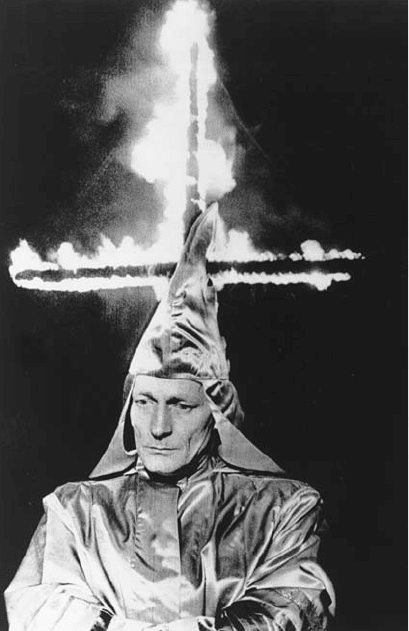
Cross burnings have been the subject of leg-
islation attempting to regulate hate speech. In
R.A.V.
V. ST. PAUL, 505 U.S. 377 (1992), at issue
was a St. Paul, Minnesota, ordinance that made
it illegal to burn crosses when one knows that
the act will arouse anger or alarm and is carried
out on the basis of race, color, creed, religion, or
gender. Here Robert A. Viktora (R.A.V.) and oth-
ers burned a cross across the street from a house
where an African-American family was staying.
Justice Antonin Gregory Scalia, writing for
the Supreme Court, declared the law unconstitu-
tional as a form of content-based and viewpoint
discrimination that was contrary to the First
Amendment. In concurrence, Chief Justice Wil-
liam Hubbs Rehnquist saw the law as over-
broad, potentially punishing types of speech that
deserve protection. Finally, while Justice Harry
A. Blackmun and others on the Court agreed that
the St. Paul law was unconstitutional, they also
sought ways to make it possible to punish hate
crimes. Instead of arguing that the law was void
as a content-based restriction, they argued that it
was unconstitutional because it involved a class of
words that are beyond the protection of the First
Amendment. Here, they drew upon C
HAPLINSKY V.
N
EW HAMPSHIRE, 315 U.S. 568 (1942), arguing that
cross burning was like “fi ghting words” and that
the Court had ruled that these types of words are
not protected by the First Amendment.
Chaplinsky and R.A.V. formed the basis of a
third decision involving cross burning that the
Court has examined. In Virginia v. Black, 538
U.S. 343 (2003), the Supreme Court held that
cross burning with intent to intimidate is not a
protected act under the First Amendment and
thus is similar to fi ghting words. Writing for the
Court, Justice Sandra Day O’Connor drew
upon Chaplinsky and R.A.V. and argued that the
cross burning in this case (which made it ille-
gal to burn a cross with the intent to intimidate
another or a group) was both like fi ghting words
and a “true threat” and not mere advocacy of a
viewpoint as was the case in Brandenburg. How-
ever, the burden of proof for the prosecution of
acts such as cross burning is to prove that there
was direct intent to intimidate through the act,
and thus the intent related to the act cannot be
inferred from the act of cross burning itself. It
must therefore be separately proven as a mat-
ter of law to the sufficiency of the court on a
case-by-case basis considering the totality of the
circumstances.
Overall, it appears that while cross burning in
and of itself may be a form of protected speech,
if it is done with the intent to intimidate others
such that it is a real threat and not a mere symbol
or statement of opinions or beliefs, then it is not
entitled to First Amendment protection.
For more information: Kalven, Harvey. A Wor-
thy Tradition: Freedom of Speech in America.
Robert Shelton, imperial wizard of the Ku Klux Klan,
stands before a burning cross in Hemingway, South
Carolina, 1965.
(Library of Congress)
180 cross burning
xviii+446_EofUSConsti-v1.indd 180 3/12/09 3:04:33 PM
New York: Harper & Row, 1988; Langran, Robert
W. The Supreme Court: A Concise History. New
York: Peter Lang, 2004.
—Ernest Gomez and David Schultz
cruel and unusual punishment
The Eighth Amendment to the U.S. Constitution
bans “cruel and unusual punishment.” However,
clarifi cation regarding types of punishment has
been a source of controversy. More often than
not, the death penalty has been the major source
of debate concerning whether its use is cruel and
unusual, yet other types of punishment, including
lengths of sentences, also are examined under the
Eighth Amendment.
Historically, at the time of the framing of
the Constitution and the writing of the Eighth
Amendment, there were literally dozens of crimes
that were punishable by death, including murder,
some forms of robbery, rape, and other types of
sex crimes. Other types of punishment, such as
torture, fl ogging, and a variety of acts of public
humiliation, were also used. Gradually, during the
19th and 20th centuries, many of these punish-
ments were eliminated, and the number of crimes
in the category meriting death was decreased.
These changes in punishment influenced the
Supreme Court, in Trop v. Dulles, 356 U.S. 86
(1958), in determining if a punishment violated
the Eighth Amendment: “[T]he words of the
Amendment are not precise, and that their scope
is not static. The Amendment must draw its mean-
ing from the evolving standards of decency that
mark the progress of a maturing society.” In Trop,
the Court invalidated expatriation as punishment
for wartime desertion. The evolving standards of
decency have continued to be of great importance
in death penalty cases and other evaluations of
punishment since 1958.
In terms of the death penalty, the Court has
declared four other types of capital punishments
to be forms of cruel and unusual punishment.
In C
OKER V. GEORGIA, 433 U.S. 584 (1977), the
Court found the use of the death penalty to pun-
ish someone who had raped an adult woman to
be cruel and unusual punishment. In Eberheart v.
Georgia, 433 U.S. 917 (1977), it was invalidated for
kidnapping. In Roper v. Simmons, 543 U.S. 551
(2005), the death penalty for individuals under
the age of 18 was found to be cruel and unusual,
and in A
TKINS V. VIRGINIA, 536 U.S. 304 (2002), the
Court found that executing the mentally retarded
was also a violation of the Eighth Amendment.
However, while the Supreme Court in F
UR-
MAN V. GEORGIA, 408 U.S. 238 (1972), invalidated
a Georgia death penalty law, along with those in
several other states, the justices did so mostly on
due process grounds. Only two justices, Thur-
good Marshall and William J. Brennan, Jr.,
used the Trop standard to invalidate as a cruel and
unusual punishment. As a result, once the Court
was convinced that the due process problems
had been addressed, it upheld the punishment in
G
REGG V. GEORGIA, 428 U.S. 153 (1976), a few years
later. Even in cases where the actual innocence
of the defendant is being asserted as a defense,
as in Herrera v. Collins, 506 U.S. 390 (1993), a
majority of justices have been unwilling to rule
that the use of death as a punishment is inherently
cruel and unusual. In that case, however, Justices
Harry A. Blackmun, John Paul Stevens, and
David H. Souter would have found executing
the innocent to be cruel and unusual, and eventu-
ally Blackmun would join Marshall and Brennan
in arguing that all forms of death as punishment
violate the Eighth Amendment. Even though the
Supreme Court continues to overturn death pen-
alty convictions, it does so mostly along due pro-
cess grounds.
Another way the court has addressed the mean-
ing of cruel and unusual punishment is by look-
ing at the proportionality of sentences in relation
to the crime committed. For example, in Weems
v. United States, 217 U.S. 349, (1910), the issue
was whether a Philippine law calling for a fine
and imprisonment ranging from 12 to 20 years
in cases where a public offi cial falsifi ed a public
document was cruel and unusual punishment. At
the time that the defendant, Paul A. Weems, was
indicted and convicted, the Philippines was part
of the United States, and it had its Bill of Rights
modeled upon the U.S. Bill of Rights including a
“cruel and unusual punishment clause.” Weems
cruel and unusual punishment 181
xviii+446_EofUSConsti-v1.indd 181 3/12/09 3:04:33 PM