
Schultz D. Encyclopedia of the United States Constitution
Подождите немного. Документ загружается.

United States v. Deveaux, 9 U.S. 61, 87 [1809]).
Today a lively debate continues over the modern-
day need for diversity jurisdiction.
Because the federal courts are courts of lim-
ited jurisdiction, Congress and the Supreme
Court have worked to limit the reach of diversity
jurisdiction. The fi rst major limitation is the statu-
tory requirement that litigants in diversity suits be
fi ghting over at least a minimum amount of money
or value to keep trivial cases out of federal court
(28 U.S.C. Section 1332[a][1]). The Judiciary
Act of 1789 initially set the amount in contro-
versy at $500. In 1958, Congress increased it to
$10,000, then to $50,000 in 1988, and to the cur-
rent amount of $75,000 in 1996 (Erwin Chemer-
inski, Federal Jurisdiction 304 [Aspen 2003]). The
amount in controversy is judged from the per-
spective of the plaintiff. All a plaintiff must do is
claim more than the $75,000 required by the stat-
ute, and federal court jurisdiction exists unless it
appears “to a legal certainty that the claim is really
for less than the jurisdictional amount” (Saint Paul
Mercy Indemnity Co. v. Red Cab Co., 303 U.S.
283, 288 [1938]).
The second major limitation on the federal
courts’ diversity jurisdiction is judicially created.
In Strawbridge v. Curtiss, 7 U.S. 267 (1806), the
Supreme Court held that the federal courts only
had diversity jurisdiction if “complete diversity”
existed, that is, only if every defendant is a citizen
of a different state from every plaintiff. A party’s
citizenship is determined by his or her domicile.
Domicile is defi ned as the place where an indi-
vidual has his or her true home, where he or she
is physically present and intends to remain (Mis-
sissippi Band of Choctaw Indians v. Holyfi eld,
490 U.S. 30, 48 [1989]). If one defendant has his
or her domicile in the same state as one plaintiff,
diversity is destroyed, and the case must be sent
to state court. Despite these limitations, however,
diversity jurisdiction remains an important door-
way into the federal courts, and so-called diversity
cases account for a signifi cant portion of the cases
tried in federal court.
For more information: Rowe, Thomas D. “Abol-
ishing Diversity Jurisdiction: Positive Side Effects
and Potential for Further Reforms.” Harvard Law
Review 92 (1979): 963–1,012.
—Alaina Fotiu-Wojtowicz
Dolan v. City of Tigard 512 U.S. 374 (1994)
In Dolan v. City of Tigard, the Supreme Court
ruled that a requirement that an owner dedicate
part of her property to a public way in return
for obtaining a building permit was an unconsti-
tutional taking of private property without just
compensation.
Dolan is among several U.S. Supreme Court
opinions, tracing back to 1897, that address the
takings clause of the Fifth Amendment. Dolan
also represents a contemporary round in the long-
standing debate over the appropriate constitu-
tional relationship between property rights and
police powers. Furthermore, Dolan itself has
been the focal point of disputes over whether the
decision’s “regulatory takings” analysis resur-
rects a pre–New Deal jurisprudence derived from
the controversial L
OCHNER V. NEW YORK, 198 U.S.
45 (1905).
Acting under its Community Development
Code and its Master Drainage Plan, the city of
Tigard attached several conditions to a redevelop-
ment permit for which Florence Dolan, owner of
A-Boy Plumbing & Electrical, had applied. The
conditions required Dolan to cede part of her
property for storm drainage system improvements
and an additional portion as a pedestrian/bicycle
pathway. Dolan’s unsuccessful pursuit of vari-
ances through a series of administrative and judi-
cial appeals in Oregon venues culminated when
the Oregon Supreme Court rejected her petition.
The Oregon court’s decision turned on its inter-
pretation that a 1987 U.S. Supreme Court decision
(Nollan v. California Coastal Commission, 483
U.S. 825) held that so long as permit conditions
were “reasonably related” to the permit requested,
such conditions raised no takings problem.
Speaking through Chief Justice William
Hubbs Rehnquist, a 5-4 U.S. Supreme Court
reversed. Notably, the Court tacitly disagreed
with the Oregon Supreme Court’s reading of the
Nollan test. Repackaging and toughening Nollan’s
202 Dolan v. City of Tigard
xviii+446_EofUSConsti-v1.indd 202 3/12/09 3:04:41 PM
“essential nexus” test, Rehnquist elaborated on
the controlling “federal constitutional norm.” “We
think a term such as ‘rough proportionality’ best
encapsulates what we hold to be the requirement
of the Fifth Amendment,” he wrote. “No precise
mathematical calculation is required, but the city
must make some sort of individualized determina-
tion that the required dedication is related both in
nature and extent to the impact of the proposed
development.”
Justice John Paul Stevens, writing for him-
self and two other dissenters, took issue with this
restated Nollan standard. “The correct inquiry,”
Stevens argued, “should . . . concentrate on
whether the required nexus is present and ven-
ture beyond considerations of a condition’s nature
or germaneness only if the developer establishes
that a concededly germane condition is so grossly
disproportionate to the proposed development’s
adverse effects that it manifests motives other
than land use regulation on the part of the city.”
The Court’s reading of Nollan is mischievous twice
over, Stevens continued, because “[t]he Court . . .
made a serious error by abandoning the traditional
presumption of constitutionality and imposing a
novel burden of proof on a city implementing an
admittedly valid comprehensive land use plan.” In
addition, the Court “resurrect[ed] . . . a species of
substantive due process analysis that it fi rmly
rejected decades ago.” “One can only hope,” Ste-
vens added, “that the Court’s . . . disavowal of the
term ‘rational basis’ to describe its new standard of
review do[es] not signify a reassertion of the kind
of superlegislative power the Court exercised dur-
ing the Lochner era.”
It remains to be seen if Justice Stevens’s hopes
will be realized or dashed. Three subsequent
takings decisions—Palazzolo v. Rhode Island,
533 U.S. 606 (2001); Tahoe-Sierra Preservation
Council v. Tahoe Regional Planning Agency, 535
U.S. 302 (2002); and K
ELO V. CITY OF NEW LONDON,
545 U.S. 469 (2005)—have muddied, rather than
clarifi ed, the situation.
For more information: Crane, Daniel A.
“Comment: A Poor Relation? Regulatory Tak-
ings after Dolan v. City of Tigard.” University
of Chicago Law Review 63 (Winter 1996): 199;
Sullivan, Edward J. “Substantive Due Process
Resurrected through the Takings Clause: Nol-
lan, Dolan, and Ehrlich.” Environmental Law
25 (Winter 1995): 155.
—James C. Foster
dormant commerce clause
The dormant commerce clause refers to a theory
of constitutional law that places limits on state
regulation of interstate trade, even in the absence
of explicit congressional action. This theory of how
to interpret the commerce clause has a long
and often controversial history.
The commerce clause of the Constitution gives
the federal government power “[t]o regulate Com-
merce . . . among the several States.” The Consti-
tution does not expressly restrict state regulation
of interstate trade; however, it is accepted that the
grant to the federal government of authority over
interstate commerce implies some limits on
the states’ authority in that area. The founders
called for the Constitutional Convention
of 1787 in large part because of divisive trade
disputes among the states, which threatened the
peace and economic viability of the new nation.
The delegates to the Constitutional Convention
gave the federal government power to regulate
interstate commerce in order to prevent those
disputes.
According to James Madison, the commerce
clause was not expected to result in federal regu-
lation of trade. Madison expected that Congress
would be unable to pass commerce-related regu-
lations because of the states’ confl icting economic
interests. Instead, he expected the commerce
clause to act mainly “as a negative and preventive
provision against injustice among the States them-
selves.” What Madison referred to as the “nega-
tive” aspect of the commerce clause is often called
the “dormant” commerce clause.
The operation of the so-called dormant com-
merce clause must not be confused with that of
the commerce clause. The dormant commerce
clause does not come into play when Congress
has passed a law regulating commerce. In that
dormant commerce clause 203
xviii+446_EofUSConsti-v1.indd 203 3/12/09 3:04:41 PM
case (unless the regulation is unconstitutional
under the commerce clause), the federal law pre-
empts any inconsistent state laws, as all federal
regulations do under the supremacy clause.
The dormant commerce clause becomes relevant
only when a state law is challenged that regulates
a trade-related matter with which Congress has
not dealt. In that case, the challenged state law is
unconstitutional if the commerce clause implic-
itly denies the states’ power to pass the chal-
lenged law.
The dormant commerce clause denies the states
power to pass three kinds of laws. First, state laws
that overtly discriminate against out-of-state com-
mercial interests for the purpose of protecting
the state’s own economic interests are unconstitu-
tional. For example, in Welton v. Missouri, 1 Otto
(91 U.S.) 275 (1876), the Court struck down a Mis-
souri law that required peddlers of goods “not the
growth, produce, or manufacture of [Missouri]” to
be licensed but did not require peddlers of Mis-
souri goods to be licensed. In P
HILADELPHIA V. NEW
J
ERSEY, 437 U.S. 617 (1978), the Court struck down
a New Jersey law that banned the importation of
garbage from sources outside the state. The Court
also has struck down ordinances passed by local
governments that discriminate against nonlocal
interests. In Dean Milk Co. v. Madison, the Court
struck down a Madison, Wisconsin, ordinance
that prohibited the sale of milk processed at plants
located outside a fi ve-mile radius of Madison.
In most cases, the state’s purpose is not evident
on the face of the statute. In such cases, the Court
has not hesitated to look beyond the text of the
statute for evidence of a protectionist purpose.
For example, in Baldwin v. Seelig, 294 U.S. 511
(1935), the Court struck down a New York law that
banned the sale of milk purchased from milk pro-
ducers at prices below minimum levels. The law
was challenged by a milk dealer who was prohib-
ited by the law from selling milk in New York that
he had purchased below the New York minimum
price in Vermont. The Court found that the law’s
purpose was to protect the economic interests of
New York milk producers.
In Bacchus Imports v. Dias, 468 U.S. 263
(1984), the Court struck down another protec-
tionist law, a Hawaii law that exempted brandy
distilled from a root native to the state from the
state liquor tax. The Court has sometimes relied
on a challenged law’s effect as evidence of a pro-
tectionist purpose. For example, in Hunt v. Wash-
ington State Apple Advertising Comm’n, 432 U.S.
333 (1977), the Court struck down a North Caro-
lina law that banned apples graded according to
any quality standard other than the U.S. Depart-
ment of Agriculture standard. In effect, the law
excluded apples from the state of Washington,
which required its apples to be graded according
to higher-quality standards. The Court has upheld
state regulations of intrastate commerce that only
“incidentally” affect interstate commerce.
In Milk Control Board v. Eisenberg Farm
Products Co., 306 U.S. 346 (1939), a law setting
minimum prices for Pennsylvania milk was chal-
lenged by a New York milk dealer. The Court
upheld the law because “[o]nly a small fraction of
the milk produced by farmers in Pennsylvania is
shipped out of [Pennsylvania]” and “[t]he purpose
of the [law] obviously is to reach a domestic situa-
tion in the interests of the welfare of the produc-
ers and consumers of milk in Pennsylvania.” In H.
P. H
OOD & SONS V. DU MOND, 336 U.S. 525 (1949),
however, the Court struck down another New
York law setting minimum prices for milk, fi nd-
ing that the law’s purpose was not to deal with a
domestic concern but rather to protect New York
milk producers.
Finally, the Court has struck down state laws
that do not facially discriminate against out-of-
state interests or have an impermissible protection-
ist purpose but that nevertheless “unduly burden”
interstate commerce. In such cases, the Court has
applied a balancing test set forth in Pike v. Bruce
Church, 397 U.S. 137 (1970): “Where the statute
regulates evenhandedly to effectuate a legitimate
local public interest, and its effects on interstate
commerce are only incidental, it will be upheld
unless the burden imposed on such commerce is
clearly excessive in relation to the putative local
benefi ts.” For example, in S
OUTHERN PACIFIC COM-
PANY V. ARIZONA, 325 U.S. 781 (1945), the Court
struck down a law that prohibited trains of more
than 14 passenger cars or 70 freight cars from run-
204 dormant commerce clause
xviii+446_EofUSConsti-v1.indd 204 3/12/09 3:04:41 PM
ning on railroads in Arizona. The Court found that
the law placed a serious burden on interstate com-
merce and that that burden was not outweighed
by Arizona’s interest in train safety. In Kassel v.
Consolidated Freightways, 450 U.S. 662 (1981),
the Court struck down, under the same balanc-
ing test, an Iowa law that prohibited most trucks
over 55 feet in length from traveling on that state’s
highways.
For more information: Benson, Paul R. The
Supreme Court and the Commerce Clause,
1937–1970. New York: Dunellan Publishing, 1970;
Schwartz, Bernard. A History of the Supreme
Court. New York: Oxford University Press, 1993.
—Nathan M. Ingebretson
double jeopardy
Double jeopardy is standing trial for the same
offense more than once. It is a procedural defense
and understood to be the citizen’s right to be pro-
tected from prosecution, for the same offense, for
a second time after being convicted or acquitted
of the offense. The right arises from the Fifth
Amendment to the Constitution, where it is delin-
eated that “nor shall any person be subject for the
same offense to be twice put in jeopardy of life or
limb.” Here, the Constitution places limitations on
the legal system and specifi cally the government
to limit potential abuse.
Tracing the roots of the concept of double
jeopardy leads back to the ancient Athenians and
Romans, who had codifi ed the concept. The ban
on double jeopardy also has its roots in English
common law, and the framers of the Constitution
read the writings of British legal thinkers such as
Sir William Blackstone’s Commentaries on
the Laws of England (1769) and used his writings
as a basis for argument.
The concept of double jeopardy can be under-
stood as further defi ned in three distinct areas,
which are protection from retrial after conviction,
protection from being tried again for a crime once
an acquittal has been rendered within the court,
and protection from multiple trials and punish-
ments for the same offense by the same jurisdic-
tion. An example of such a restriction of whether
someone can be brought to trial for the same
offense is found in the Supreme Court decision
in Fong Foo v. United States, 369 U.S. 141 (1962),
where the Court ruled that it was double jeopardy
to bring someone to trial again when he had been
acquitted for that offense. The Supreme Court
ruled in Benton v. Maryland, 39 U.S. 784 (1969),
that double jeopardy is incorporated to the states
through the due process clause of the Four-
teenth Amendment to the Constitution.
There are some exceptions to double jeopardy;
for example, this Fifth Amendment prohibition
applies only to criminal prosecution. Thus, after O.
J. Simpson was acquitted in 1995 for the murder
of his ex-wife and Ronald Goldman, he was not
placed in double jeopardy (according to the Con-
stitution) when he was found responsible for their
deaths in a civil trial in 1997. Additionally, the
Court has ruled in Heath v. Alabama, 474 U.S. 82
(1985), that double jeopardy does not attach when
one is prosecuted by separate jurisdictions. Thus,
if one faces trial at the state level and is acquit-
ted, double jeopardy does not attach if one is then
prosecuted by the federal government. During
the 1960s, it was a common practice of the Justice
Department to prosecute civil rights cases in
federal court after state acquittals. Double jeop-
ardy does not apply if one is found guilty and then
an appellate court reserves the conviction.
Finally, determining exactly when double
jeopardy attaches is not always easy to ascertain.
While it comes into play once a verdict has been
reached in a case, it is not always applicable when
one has been acquitted under one statute and
then charged under another. Here, the courts say
that double jeopardy attaches when one is being
prosecuted for the same underlying facts.
The right against double jeopardy is an impor-
tant constitutional protection. It prevents the gov-
ernment from repeatedly harassing individuals
with prosecutions until some court fi nally convicts
or the those charged with crimes give up.
For more information: LaFave, Wayne R., Jer-
old H. Israel, and Nancy J. King. Criminal Pro-
cedure. St. Paul, Minn.: Thomson/West, 2004;
double jeopardy 205
xviii+446_EofUSConsti-v1.indd 205 3/12/09 3:04:42 PM
Thomas, George C. III. Double Jeopardy: The
History, the Law. New York: New York University
Press, 1998.
—Ernest Gomez and David Schultz
Douglas, William O. (1898–1980) Supreme
Court justice
William O. Douglas was the longest-serving
Supreme Court justice in U.S. history. He was
nominated and confirmed in 1939; a debilitat-
ing stroke fi nally forced his retirement in 1975.
Throughout his life, Douglas was a relentless
champion of individual rights, civil liberties,
and the environment. While on the bench, Doug-
las was a workhorse, participating in more than
1,200 decisions and drafting nearly 800 dissents.
This penchant for dissent earned Douglas the
nicknames “the Great Dissenter” and “the Lone
Ranger.”
Douglas, the second of three children, was born
in Maine, Minnesota, on October 16, 1898. When
he was very young the Douglas family moved west,
fi nally settling in Washington State. Douglas’s early
life was quite challenging: Douglas fell ill, nearly
dying from a high fever before his second birth-
day; his father, a Presbyterian minister, died when
Douglas was six; and the family struggled with
poverty. Douglas overcame this adversity to gradu-
ate as valedictorian of his high school class. He
received a partial scholarship to attend Whitman
College, where, in 1920, he graduated Phi Beta
Kappa with a B.A. in English and economics.
After spending a few years as a high school
teacher, Douglas decided to attend Columbia
Law School. Upon graduation, he practiced law
for a brief time before taking a teaching position
at Columbia Law School and then at Yale Law
School. In 1936, President Franklin D. Roosevelt
appointed Douglas to the Securities and Exchange
Commission, and in 1937, Roosevelt elevated him
to serve as the commission’s chairman.
On February 13, 1939, Justice Louis Brandeis
retired from the Supreme Court. In March, Presi-
dent Roosevelt summoned Douglas to the White
House for “an important meeting.” Douglas feared
that he was being appointed chair of the Federal
Communications Commission, but instead, Roos-
evelt informed Douglas that he was being nomi-
nated to replace Brandeis. Douglas was quickly
confi rmed by a 62-4 vote in the Senate and was
sworn in on April 17, 1939. Douglas, only 40 at the
time, became the second youngest person ever to
serve on the Court.
Douglas, along with longtime ally and friend
Justice Hugo Black, argued for a literalist
interpretation of the First Amendment. They
believed that the First Amendment’s command
that “no law” shall restrict freedom of speech
should be interpreted literally. Douglas even
went further, believing that conduct could also be
protected by the First Amendment. He voted to
prohibit the punishment of students who wore an
armband in protest of the Vietnam War in T
INKER
V. DES MOINES INDEPENDENT COMMUNITY SCHOOL
D
ISTRICT, 393 U.S. 503 (1969). In COHEN V. CALI-
FORNIA, 403 U.S. 15 (1971), he voted to protect the
wearing of a jacket with a four-letter expletive in
a courthouse as protected speech. And he filed
a concurrence in New York Times Co. v. United
States, 403 U.S. 713 (1971), a plurality opinion that
allowed the New York Times and the Washing-
ton Post to publish the classifi ed Pentagon Papers
without fearing government censure.
Arguably Douglas’s most important and con-
troversial opinion was delivered in G
RISWOLD V.
C
ONNECTICUT, 381 U.S. 479 (1965). In striking a
state prohibition on aiding and abetting or coun-
seling the use of contraception, Douglas articu-
lated a broad constitutional right to privacy. He
found that the “specifi c guarantees in the Bill of
Rights have penumbras, formed by emanations
from those guarantees that help give them life
and substance.” Douglas argued that these various
guarantees, such as the Fifth Amendment’s self-
incrimination clause, “create zones of privacy.”
This notion of privacy, fi rst articulated in Gris-
wold, has since been expanded to protect a wom-
an’s right to abortion, the right to die, and
the rights of sexual intimacy for homosexuals.
In his waning years on the Court, Douglas
became frustrated and felt isolated. Though he
had been a champion of liberal causes for almost
15 years before Chief Justice Earl Warren and Jus-
206 Douglas, William O.
xviii+446_EofUSConsti-v1.indd 206 3/12/09 3:04:42 PM
tice William J. Brennan, Jr. joined the Court,
the couple received the credit for leading the
liberal bloc. And after the retirement of Justice
Black, Douglas never had another close relation-
ship on the bench. Douglas, however, was a true
survivor: He survived a heart attack in 1968, three
divorces, and multiple impeachment attempts.
On December 31, 1974, Douglas suffered a serious
stroke that left him partially paralyzed and con-
fi ned to a wheelchair. Though he never recovered,
Douglas attempted to continue on the Court. For
11 months he was wheeled into oral arguments
and, after usually falling asleep at the bench, car-
ried away by Court personnel. On November 12,
1975, he fi nally succumbed to the immense pres-
sure on him and announced his retirement.
Douglas died at Walter Reed Army Medical
Center in Bethesda, Maryland, on January 19,
1980. He lies buried at Arlington National Cem-
etery near the graves of Justices Brennan, Oliver
Wendell Holmes, Jr., Thurgood Marshall, and
Potter Stewart. In personal refl ection, Douglas had
often said that one of his most shameful moments
was his vote to uphold President Roosevelt’s relo-
cation of Japanese Americans in K
OREMATSU V.
U
NITED STATES, 323 U.S. 214 (1944), and one of his
proudest moments was his vote to disallow Presi-
dent Richard Nixon to use executive privilege
to keep the Watergate tapes from Congress in
U
NITED STATES V. NIXON, 418 U.S. 683 (1974).
For more information: Douglas, William O. The
Court Years 1939–1975: The Autobiography of
William O. Douglas. New York: Random House,
1980; Douglas, William O. Go East Young Man:
The Early Years. New York: Random House, 1974;
Murphy, Bruce Allen. Wild Bill: The Legend and
Life of William O. Douglas. New York: Random
House, 2003; Simon, James F. Independent Jour-
ney: The Life of William O. Douglas. New York:
Harper & Row, 1980.
—Raymond V. Carman, Jr.
draft card burning
Draft card burning refers to the destruction of
papers inducting one into the military as a means
to protest a war or some other government policy.
While such an act is clearly political in nature, the
Supreme Court has ruled that this is not protected
expression under the First Amendment.
The U.S. government issued Selective Service
Registration Certifi cates, or draft cards, to notify
young men to report for military duty. When Viet-
nam War protesters began burning their draft
cards, Congress amended the 1948 Universal
Military Training and Service Act, also referred
to as the Selective Service Act, in 1965, to make
the knowing destruction or mutilation of a draft
card a felony. Some antiwar protesters, however,
continued to burn their cards.
On March 31, 1966, David O’Brien and three of
his friends set their draft cards on fi re in front of a
Boston courthouse as a form of protest to the Viet-
nam War. After being trampled by angry onlook-
ers, O’Brien and his party were detained and later
arrested by FBI agents. O’Brien was convicted of
violating the Selective Service Act and sentenced
to six years in prison. He appealed his conviction
on the grounds that burning his draft card was
symbolic speech. He further claimed that the
Selective Service Act had been hastily amended
for the purpose of suppressing antiwar dissent.
The U.S. court of appeals agreed that Con-
gress’s intent in amending the law violated the
First Amendment, yet the court upheld O’Brien’s
conviction on the grounds of “non-possession” of
his draft card, despite the fact that he had not
been charged with this offense prior to the appeals
ruling. Both O’Brien and the U.S. government,
represented by Solicitor General Erwin Griswold,
appealed this ruling and the U.S. Supreme Court
granted review. In oral argument, Griswold con-
ceded that burning drafts cards may constitute
symbolic speech, but he argued that Congress has
the power to criminalize O’Brien’s conduct, as he
fails to report for military duty. When O’Brien
burned his draft card, in other words, he impeded
the government’s communication with the men
who are obligated to serve in the military. This
case was timely given the heightened controversy
relating to antiwar protest.
In U
NITED STATES V. O’BRIEN, 391 U.S. 367
(1968), all but one of the justices agreed with
draft card burning 207
xviii+446_EofUSConsti-v1.indd 207 3/12/09 3:04:42 PM
the government. Writing for the majority, Chief
Justice Earl Warren ruled that O’Brien’s act of
burning his draft card was not protected expres-
sion under the First Amendment but a violation of
the 1965 amendment to the Selective Service Act.
In response to O’Brien’s defense that the card in
question did not truly provide notifi cation, War-
ren explained the card’s use went beyond simply
notification and served an administrative pur-
pose that benefi ted both the government and the
registrant.
In times of war, the courts have questioned
whether the acts of protesters are protected
under the First Amendment or hinder the func-
tions of government. In this case, Chief Justice
Warren broke the precedent of Stromberg v. Cal-
ifornia 283 U.S. 359 (1931) and found that draft
card burning was not protected speech under
the Constitution. Warren also established that
“non-speech” conduct may be regulated by the
government if the interest is suffi cient to “justify
incidental limitations on the First Amendment
freedoms.”
For more information: Epstein, Lee, and
Thomas Walker. Constitutional Law for a Chang-
ing America. 5th ed. Washington, D.C.: CQ Press,
2004.
—April Willeford
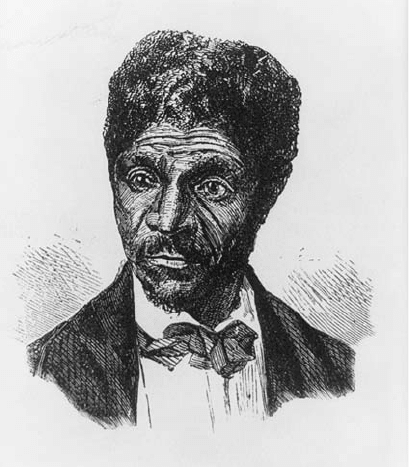
Dred Scott v. Sandford 60 U.S. 393 (1856)
In Dred Scott v. Sandford (sic), (the plaintiff’s
name is actually spelled “Sanford,” but was mis-
spelled by a court clerk) the Supreme Court
defined the status of African Americans and
upheld the constitutionality of slavery as an insti-
tution. The decision stated that a black man had
“no rights that a white man was bound to respect,”
and the Court ruled that Congress had no author-
ity to ban slavery in the western territories of the
United States. This ruling overturned the Mis-
souri Compromise of 1820, a plan that allowed
Missouri to enter the Union as a slave state while
other northern territories remained free of slav-
ery, thus giving legal sanction to slavery in the
United States.
The case originated with Dred Scott, a slave
born in Virginia whose master moved him to the
slave state of Missouri and later transferred him
into the free state of Illinois for more than two
years and then into the Wisconsin territory, where
slavery was prohibited. Dred Scott was finally
brought back into Missouri. According to Missouri
law, any slave became emancipated once his or her
owner took them into a state or territory where
slavery was prohibited. (This law had been upheld
in the 1836 case Rachel v. Walker.) In seeking to
challenge the legality of slavery, a lawsuit was fi led
seeking to obtain the freedom of Dred Scott and
his wife based on the fact that he had lived in a
free state and the legal status of slavery could not
apply to him in the state of Illinois and the Wis-
consin territory.
The Missouri Supreme Court ruled in 1852
that a doctrine of “conflict of laws” meant that
the laws of the state or territory could not trump
the laws of the state that made Dred Scott a slave
in the fi rst place. This doctrine became a central
part of the appeal to the U.S. Supreme Court, in
which the major question to be resolved was, Does
Dred Scott (Library of Congress)
208 Dred Scott v. Sandford
xviii+446_EofUSConsti-v1.indd 208 3/12/09 3:04:43 PM
residence in a free state invalidate the legal con-
cept of slavery?
The Supreme Court in a 7-2 decision found
that the move to a free state did not invalidate the
institution of slavery and in fact that the regula-
tions of the expansion of slavery by Congress were
unconstitutional. Chief Justice Roger Taney
wrote the majority opinion for the case and went
further than the basic question of the legality of
slavery by addressing the legal status of the plain-
tiff, Dred Scott. Chief Justice Taney wrote that
African Americans “were not regarded as a portion
of the people or citizens of the Government then
formed.” Therefore, Dred Scott, as a slave, was not
a citizen and therefore had no standing to fi le
a lawsuit. Justice Taney also offered that slavery
served a benefi cial role for those not capable of
surviving on their own. He further argued for the
inferiority of blacks as a race, stating:
They were at that time considered as a subordi-
nate and inferior class of beings, who had been
subjugated by the dominant race, and, whether
emancipated or not, yet remained subject to
their authority, and had no rights or privileges
but such as those who held the power and the
government might choose to grant them.
The question of whether Congress had the right
to regulate the expansion of slavery was addressed
in the decision when Justice Taney wrote that the
power of the government over territories was lim-
ited to the expressed powers granted to Congress
and that the right of private property (including the
right to own slaves) could not be abridged without
due process of law. Until these territories came
under the express rule of the United States (by
joining the Union) and individuals directly vio-
lated the laws of the country, any restriction of the
ownership of slaves was void. The act of moving
across state lines or crossing over into territories
did not invalidate state laws; therefore, Dred Scott
was not free.
Justice John McLean in his dissenting opin-
ion argued that the power to govern is inherent
in the right to acquire territory, thus the laws of
Congress (including the Missouri Compromise
prohibiting slavery) do apply in this case. He
also pointed out that if a slave escapes, that is a
breach of a legal arrangement and the slave can
be legally reclaimed, yet if a master takes the
slave into an area that prohibits slavery, Can the
slave be coerced into service without the author-
ity of local law but in fact expressly violating local
provisions? This question of local authority as
opposed to national power at the root of this case
became a bigger political problem and ultimately
led to the political upheaval that culminated in
the Civil War.
Dred Scott is considered one of the most infa-
mous and disliked Court decisions in American
history. It was overturned by Congress with the
passage of the Fourteenth Amendment.
For more information: Fehrenbacher, Don. The
Dred Scott Case: Its Significance in American
Law and Politics. New York: Oxford University
Press, 1978; Higginbotham, A. Leon. Shades of
Freedom: Racial Politics and Presumptions of the
American Legal Process. New York: Oxford Uni-
versity Press, 1996.
—Kevin Anderson
due process
The command that government not deprive any-
one of “life, liberty, or property” without “due
process of law” is found in the Fifth Amendment
(applicable to the federal government) and in the
Fourteenth Amendment (applicable to state
governments). The concept is fundamental in the
Anglo-American legal tradition, traceable at least
as far back as Chapter 39 of the Magna Carta
in 1215.
Taken literally, the language requires govern-
ment to follow certain procedures before subject-
ing anyone to such severe penalties as deprivation
of life, liberty, or property. But the phrase has also
been interpreted as including protection of cer-
tain substantive rights, making some deprivations
of liberty or property unconstitutional no matter
what procedures the government follows. These
two components are usually described (arguably
redundantly) as “procedural due process” and
due process 209
xviii+446_EofUSConsti-v1.indd 209 3/12/09 3:04:43 PM
(arguably oxymoronically) as “substantive due
process.” Procedural due process is the older
of the two, while substantive due process first
appeared in U.S. constitutional law in the decades
following the Civil War—growing out of the
Supreme Court’s interpretations of the Fourteenth
Amendment—though the concept can be seen in
a few very early Supreme Court decisions and can
be traced beyond Magna Carta to the ancient Sto-
ics and their understandings of natural law.
The Constitution’s fair procedure guarantees
serve at least two purposes: helping ensure fair
decision making and respecting the fundamental
human dignity of persons threatened with adverse
governmental action. With respect to the first,
consider the criminal trial process. Police may be
certain they have their perpetrator, but our sys-
tem presumes innocence until guilt is proven (a
procedural protection not specifi cally listed in the
Constitution but considered fundamental in our
legal tradition) in a process where both prosecu-
tion and defense can present their case and then
allow a jury of the accused’s peers make the fi nal
determination. Regarding the second, giving
people the right to be heard when facing adverse
governmental action is a sign of respect for them
as human beings.
Not all governmental deprivations are of equal
magnitude, and consequently, the question of
exactly what process is due becomes crucial. A
student facing a three-day suspension from school
does not need a full-blown trial by jury; the cost
of such a procedure would simply be prohibitive.
Yet, on the other hand, someone charged with a
capital offense deserves the full panoply of proce-
dural protections accorded by our legal tradition
generally and the Bill of Rights specifi cally—
in particular, the Fourth through Eighth Amend-
ments, concerned primarily with the rights of the
accused. It is fair to say that procedural guaran-
tees are at their zenith in criminal cases.
Most criminal trials take place in state courts,
just as most criminal offenses are defi ned by state,
not federal, laws. Federal criminal procedures,
since 1791, have been held to the standards of the
Fourth through Eighth Amendments. However,
Supreme Court interpretations of these amend-
ments had little impact nationwide since the Bill
of Rights applied only to the national government,
not states, though many of the guarantees in the
Bill of Rights found counterparts in state constitu-
tions and procedural statutes.
Dramatic changes occurred during the 1960s
when the Warren Court (1953 –69) began
applying federal constitutional standards to state
criminal processes in a development that has
been described as “the nationalization of the Bill
of Rights” or “the incorporation of the Bill of
Rights into the Fourteenth Amendment.” The
process began in 1925 when the Court held that
freedom of speech was among the liberties pro-
tected by the due process clause of the Fourteenth
Amendment against state infringement. Shortly
thereafter, freedom of the press was “incor-
porated” into the amendment, and by the late
1940s, all of the basic freedoms found in the First
Amendment had been applied to the states.
The Warren Court accelerated the process,
applying many of the safeguards of the Fourth
through Eighth Amendments to the states. Rich-
ard H. Fallon, Jr., identifi es three lines of crimi-
nal procedure cases that constitute the essential
legacy of the Warren Court in this respect: 1)
the right to counsel (Sixth Amendment),
including appointment of a lawyer for criminal
defendants who cannot afford to hire one; 2) the
right against self-incrimination, includ-
ing the requirement that police provide certain
warnings before custodial questioning of criminal
suspects; and 3) applying the so-called exclu-
sionary rule to state criminal proceedings (the
rule that evidence seized in violation of a suspect’s
constitutional rights would be excluded from the
trial).
Earl Warren was succeeded as chief justice
by Warren E. Burger, and the Burger Court
(1969–86)—and its successor Rehnquist Court
(1986–2005)—cut back on many of the criminal
procedure rulings of the Warren Court. None
of the landmark cases were explicitly overruled;
rather, these successor courts created a variety
of exceptions to the Warren Court rules and in
general handed down decisions more favorable to
prosecutors than to criminal defendants.
210 due process
xviii+446_EofUSConsti-v1.indd 210 3/12/09 3:04:43 PM
Many of the procedural guarantees found in
the Bill of Rights apply only to criminal cases, but
the Supreme Court has consistently held that pro-
cedural guarantees are essential in civil cases as
well. Prominent among the requirements of due
process in civil cases are the right to an impartial
judge, the right to fair notice of scheduled pro-
ceedings, and the right to both present and chal-
lenge evidence.
There are other instances beyond the trial
setting where the government may take actions
against people that may deprive them of liberty
or property. Municipal health inspectors may
fi nd health code violations and order a restaurant
closed until they are corrected. Customs agents
may seize contraband that a person purchased
abroad and seeks to bring into the country. A pub-
lic school principal may have reason to place a stu-
dent in detention or require that student to stay
home for several days of suspension. What proce-
dures must governmental agents follow to guide
their decision making in such instances?
The traditional approach relied on a distinction
between “rights” and “privileges.” Government
had to respect the due process clause in proceed-
ings involving rights to liberty or property, but not
with respect to benefits (privileges) voluntarily
conferred on people by the government. What
the government voluntarily gave the government
could freely take away.
In G
OLDBERG V. KELLY, 397 U.S. 254 (1970),
the Court rejected this distinction and held that
a person could not be taken off the welfare rolls
without advance notice and the opportunity for a
hearing on the facts. The Court assumed that wel-
fare benefi ts were a form of property. The Court
stressed that due process is a flexible concept
whose requirements might vary depending on
context. The Court elaborated on the appropriate
analytical method in Mathews v. Eldridge, 424
U.S. 319 (1976), arguing for a balancing approach
that addressed three factors: 1) the importance
of the interest to the individual (more important
interests will require more procedural safeguards),
2) the likelihood that additional procedures will
increase the accuracy of the fact-fi nding process
(the higher the likelihood, the greater the pro-
cedural requirements), and 3) the burden placed
on the government by requiring additional pro-
cedures, burden being understood as additional
expense.
In U.S. constitutional law, the philosophy
undergirding substantive due process can be
traced back at least to 1798 and the case of C
ALDER
V. BULL, 3 U.S. 386. Supreme Court justice Samuel
Chase wrote an opinion in which he argued that
the power of American governments is subject not
only to specifi c, written constitutional provisions
but also higher principles, such as those found in
natural law, which dictate that government must
be limited in any attempts to interfere with rights
vested in the people by the law of nature. Chase’s
opinion was rejected by a majority of his col-
leagues in Calder and by an overwhelming major-
ity of judges ever since.
The great era of substantive due process began
in the last few decades of the 19th century. By
then, the rapid industrialization that followed the
Civil War gave rise not only to great prosperity but
to serious social problems: child labor, sweat-
shops, unsafe workplaces, excessive working hours,
and payment of the lowest wages the market would
allow. Many states, as well as occasionally the fed-
eral government, sought to pass laws to regulate
some of these harmful conditions. The economic
interests that found themselves subject to such
regulation turned to the due process clause of the
Fourteenth Amendment and began to argue that
these laws interfered with fundamental liberties
protected by natural law and that such interfer-
ence with basic rights was itself a violation of due
process, however legitimate the procedures used
to enact the laws.
This approach, seen in the dissenting opinions
in the Slaughterhouse Cases, 83 U.S. 36 (1872)—
the first occasion the Supreme Court had to
interpret the newly enacted Fourteenth Amend-
ment—had by the beginnings of the 20th century
commanded a majority of the justices, as refl ected
in the case that gave its name to the Lochner era
(1905–37). In L
OCHNER V. NEW YORK, 198 U.S. 45
(1905), the Court overturned a New York law lim-
iting the weekly work hours of bakers. The Court
found a “liberty to contract” between an employer
due process 211
xviii+446_EofUSConsti-v1.indd 211 3/12/09 3:04:44 PM