
Schultz D. Encyclopedia of the United States Constitution
Подождите немного. Документ загружается.

was convicted of falsifying payroll information
and given a sentence of 15 years of prison with
hard labor and a fi ne of 4,000 pesetas. Weems’s
sentence was subsequently upheld by Philippine
courts, but the U.S. Supreme Court reversed, fi nd-
ing it disproportionate to the crime committed.
In other cases, such as Robinson v. California,
370 U.S. 660 (1962), the Court drew limits as to
what the state could punish (in this case, addic-
tion to drugs) and incorporated the proportional-
ity requirement to state offenses. Yet in R
UMMEL V.
E
STELLE, 445 U.S. 263, 266 (1980), the defendant,
William James Rummel, was convicted in 1973
for obtaining $120.75 under false pretenses. This
conviction came after a 1964 conviction for $80 in
credit card fraud and a 1969 conviction for forg-
ing a check worth $28. Upon his third conviction,
Rummel was sentenced to life under a Texas stat-
ute that provided for life imprisonment for any-
one convicted of three felonies. Rummel appealed
his sentence, claiming that life for these crimes
was cruel and unusual punishment and a dispro-
portionate sentence to the three crimes, which
resulted in his stealing less than $240 in total.
In rejecting Rummel’s claims, the Supreme
Court fi rst disposed of his arguments that recent
cases striking down death as a disproportionate
penalty were applicable to his case because death
was a unique type of penalty that had attached
to it special proportionality issues. Second, the
Supreme Court distinguished Rummel’s claims
from those found in Weems, arguing that in the
latter case, it was not merely the length of the
incarceration that was at issue. Instead, the hard
labor and other terms of confi nement were also
important to the Court’s fi nding the sentence to
be cruel and unusual and disproportionate. Third,
the Supreme Court argued that objective and not
merely subjective factors were required to deter-
mine what constituted disproportionality. Appeal-
ing merely to judges’ personal preferences was an
inappropriate way to determine what is cruel and
unusual or disproportionate. Once death is no
longer an issue, according to the Supreme Court,
determinations to what constitutes an appropriate
sentence are subjective and best left up to local
legislatures to decide.
In Hutto v. Davis, 454 U.S. 370 (1982), the
Supreme Court again deferred to local legislature
determination of what was an appropriate punish-
ment for a crime. The issue here was two concur-
rent 20-year sentences and a $20,000 fi ne for the
possession of nine ounces of marijuana. In over-
turning habeas corpus based on proportionality
and the cruel and unusual punishment clause, the
Supreme Court indicated that its Rummel deci-
sion stood for the proposition that sentencing
guidelines are generally policy issues for the
legislatures and not the courts. However, in Solem
v. Helm, 463 U.S. 277 (1983), the Court reversed
itself and invalidated a life sentence imposed on a
defendant under a South Dakota statute for issu-
ing a bad check in the amount of $100. Writing for
the majority, Justice Lewis Franklin Powell,
Jr., fi rst indicated that proportionality was deeply
rooted in English and American law and that it
applies to all types of sentences, including felo-
nies, even where death is not a penalty. Rejecting
Rummel’s claim that death is different in terms of
assessment of proportionality, the Supreme Court
indicated that it saw no reason to draw a “distinc-
tion with cases of imprisonment” versus death.
Powell stated:
In sum, we hold as a matter of principle that
a criminal sentence must be proportionate to
the crime for which the defendant has been
convicted. Reviewing courts, of course, should
grant substantial deference to the broad author-
ity that legislatures necessarily possess in deter-
mining the types and limits of punishments for
crimes, as well as to the discretion that trial
courts possess in sentencing convicted crimi-
nals. But no penalty is per se constitutional. As
the Court noted in Robinson v. California, a
single day in prison may be unconstitutional in
some circumstances.
Yet, in Harmelin v. Michigan, 501 U.S. 957 (1991),
the Court returned to its Rummel standards and
appeared to read proportionality out of the Eighth
Amendment, again stating that sentencing deci-
sions are legislative determinations. In E
WING
V. CALIFORNIA, 538 U.S. 11 (2003), in upholding
182 cruel and unusual punishment
xviii+446_EofUSConsti-v1.indd 182 3/12/09 3:04:34 PM
California’s three strikes law, the Court seemed to
concur in that sentiment.
Overall, the Supreme Court continues to look
to the evolving Trop standards of decency to help
determine what cruel and unusual punishment is.
However, except for a few narrow death penalty
issues, the Court appears to give wide latitude
to legislatures to decide what punishments are
appropriate.
For more information: Amar, Akhil Reed.
The Constitution and Criminal Procedure.
New Haven, Conn.: Yale University Press, 1997;
LaFave, Wayne R., Jerold H. Israel, and Nancy J.
King. Criminal Procedure. St. Paul, Minn.: Thom-
son/West, 2004.
—Ernest Gomez and David Schultz
Cruzan v. Director, Missouri Department
of Health
497 U.S. 261 (1990)
Cruzan v. Director, Missouri Department of
Health is a signifi cant decision in the area of pri-
vacy and health care. The Supreme Court held
that clear and convincing evidence must exist that
demonstrates an individual’s desire to refuse life-
sustaining medical care that perpetuates one’s
existence in an irreversible vegetative condition.
Nancy Cruzan was seriously injured in a car
accident, suffering irreversible brain damage that
left her in a persistent vegetative state. Cruzan’s
parents insisted that their adult daughter would
not wish to live in such a condition and requested
that the hospital withdraw food and liquids, has-
tening her death. Since the patient was incompe-
tent, explicit expression of her will was obviously
not possible. The hospital therefore refused to
withdraw life-sustaining care without a court
order. The parents petitioned state courts to com-
pel the hospital’s compliance with their request.
The courts concluded that since she could not
communicate, substituting Cruzan’s expression
of her own wish with a determination as to what
her decision would have been was reasonable. In
making such a determination, the state supreme
court required Cruzan’s parents to provide “clear
and convincing evidence” that their daughter
would not wish to live in a persistent vegetative
state. Since the Cruzan family was unable to doc-
ument Nancy’s alleged wish to the court’s satisfac-
tion, their request was denied. Cruzan’s parents
fi led suit on their daughter’s behalf, arguing that
an adult may refuse life-sustaining medical treat-
ment under the due process clause of the Four-
teenth Amendment.
Writing for the Court, Chief Justice William
Hubbs Rehnquist upheld the state court’s deci-
sion requiring clear and convincing evidence
as to Nancy Cruzan’s wishes before terminating
life-sustaining medical care. Federal case law
has long recognized that a competent adult may
refuse medical treatment, including that which is
life sustaining. This right, however, is not absolute.
It must be balanced against the state’s interest in
preserving life. In so doing, the state court’s impo-
sition of the clear and convincing evidence thresh-
old reasonably safeguards the state’s interest while
preserving the individual’s liberty interest. Specif-
ically, in a situation such as this—where the per-
son whose life is at issue cannot speak—the state
may require a heightened level of evidence dem-
onstrating the patient’s wishes in order to assure
that the family is truly advocating their loved one’s
best interest and not their own preferences.
Thus, the clear and convincing evidence
requirement is a reasonable standard that states
may impose to protect invalid adults against those
who might seek to exploit such a circumstance.
This standard balances the state’s interest with
the individual’s liberty interest to refuse medi-
cal care; where the state’s requirement is satis-
fi ed, life-sustaining medical care for an invalid
adult may be withdrawn. Conversely, where
insuffi cient evidence as to the individual’s will
exists, the state’s interest in preserving life pre-
vails. Therefore, the state’s requirement does not
impermissibly frustrate the liberty interest guar-
anteed by the due process clause of the Four-
teenth Amendment.
For more information: Glick, Henry R. The
Right to Die. New York: Columbia University
Press, 1994.
—Melanie K. Morris
Cruzan v. Director, Missouri Department of Health 183
xviii+446_EofUSConsti-v1.indd 183 3/12/09 3:04:34 PM
184
ﱶﱷﱸ
DaimlerChrysler v. Cuno 126 S. Ct. 1854
(2006)
In DaimlerChrysler v. Cuno, the Supreme Court
rejected a challenge to Ohio’s tax laws under the
dormant commerce clause because the plain-
tiffs lacked proper standing to bring their case
in federal court.
DaimlerChrysler arose when 18 Ohio taxpayers
fi led suit to challenge a development agreement
between DaimlerChrysler and the city of Toledo.
Under the agreement, DaimlerChrysler received
a 10-year exemption from local property taxes
and a credit against the state corporate franchise
tax in exchange for building a new assembly plant
near its existing facilities in Toledo. The district
court dismissed the plaintiffs’ claims that Ohio’s
tax laws violated the dormant commerce clause
because the property tax exemption and franchise
tax credit did not function as protective tariffs or
discriminatory proportional taxes.
The U.S. Court of Appeals for the Sixth Circuit
affi rmed the trial court ruling with regard to the
property tax exemption but reversed on the fran-
chise tax credit, concluding that it had a coercive
effect and violated the commerce clause. Both
the district court and the court of appeals employed
the four-part commerce clause analysis articulated
in C
OMPLETE AUTO TRANSIT, INC. V. BRADY, 430 U.S.
274 (1977), which held that a tax provision will
survive a commerce clause challenge when it “is
applied to an activity with a substantial nexus to the
taxing State, is fairly apportioned, does not discrim-
inate against interstate commerce, and is fairly
related to the services provided by the State.”
On appeal, the Supreme Court examined
whether the plaintiffs had standing to sue under
Article III of the U.S. Constitution and
whether this was an appropriate “case or contro-
versy” for the Court to decide. Chief Justice John
G. Roberts, Jr., writing for an eight-member
majority, noted that standing requires the plaintiff
to show a “concrete and particularized” injury and
“redressability” through judicial action.
The injury in this case was “conjectural or
hypothetical” because the plaintiffs could not
prove that the property tax exemption or the
franchise tax credit caused the plaintiffs to suf-
fer heavier tax burdens. Likewise, the issue of
“redressability” was speculative because there
was no evidence that eliminating the property tax
exemption or franchise tax credit would cause the
state legislature to reduce the plaintiffs’ tax bur-
dens. Chief Justice Roberts rejected the plaintiffs’
claim of standing as state taxpayers because the
limited scope of federal taxpayer standing under
V
ALLEY FORGE CHRISTIAN COLLEGE V. AMERICANS
UNITED FOR SEPARATION OF CHURCH AND STATE, INC.,
454 U.S. 464 (1982), “applies with undiminished
force to state taxpayers.” The Court ruled that
the municipal taxpayer standing doctrine of Mas-
sachusetts v. Mellon, 262 U.S. 447 (1923), could
not support a challenge to the state franchise tax
credit. The Court also declined to expand the lim-
ited exception to the taxpayer standing doctrine
established in FLAST V. COHEN, 392 U.S. 83 (1968),
to permit commerce clause challenges. Justice
Ruth Bader Ginsburg, in a separate opinion, con-
curred with her colleagues in the result but noted
her disapproval of the Court’s broader precedents
on Article III standing limits. The decision in
DaimlerChrysler demonstrates the Supreme
Court’s commitment to the principle of limited
federal court jurisdiction and the importance of
the Article III standing inquiry for plaintiffs.
D
xviii+446_EofUSConsti-v1.indd 184 3/12/09 3:04:34 PM
For more information: Georgetown Journal of
Law & Public Policy 1, no. 4 (Winter 2006) (sym-
posium issue on Daimler Chrysler v. Cuno before
the Supreme Court ruling); Mank, Bradford C.
“Prudential Standing and the Dormant Com-
merce Clause: Why the ‘Zone of Interests’ Test
Should Not Apply to Constitutional Cases.” Ari-
zona Law Review 23, no. 48 (2006): 23–65.
—Joshua A. Kimsey
Dames & Moore v. Regan 453 U.S. 654
(1981)
The Dames & Moore v. Regan case grew out of
a presidential executive order that blocked access
to Iranian assets following the taking of Ameri-
can hostages in Iran in 1979. The Supreme Court
ruling upheld the agreements that had settled the
hostage crisis.
In 1979 when Americans were taken hostage
at the U.S. Embassy in Tehran, Iran, President
Jimmy Carter declared a national emergency
on November 14. Pursuant to the International
Emergency Economic Powers Act (IEEPA),
President Carter issued Executive Order 12170,
which blocked Iranian assets. Because Iranian
assets were frozen, Dames & Moore Corpora-
tion fi led suit against several Iranian governmen-
tal agencies, alleging that services rendered for
the Atomic Energy Organization of Iran had not
been paid. A federal district court issued orders
of attachment that seized the property belong-
ing to some Iranian banks in an effort to secure
payment in any judgment that would be entered
against the Iranians.
On January 19, 1981, the American hostages
were released under terms agreed to by both gov-
ernments. One of the terms of the agreement was
that the U.S. government would drop all legal pro-
ceedings of U.S. nationals against Iran and nullify
all attachments and judgments via those pend-
ing proceedings. President Ronald Reagan then
issued Executive Order 12294, reasserting EO
12170 and requiring that banks holding Iranian
assets transfer them to the Federal Reserve Bank
of New York to be held or dispersed as the secre-
tary of the treasury directed. Dames & Moore,
seething from the presidential rebuke, fi led action
against Secretary of the Treasury Donald Regan,
alleging that both executive orders exceeded
statutory and constitutional boundaries.
The Supreme Court opinion stated that IEEPA
empowered the president to take the actions
blocking the transfer of any property of Iran, or
any foreign country, within the jurisdiction of the
United States. These blocking orders enable the
president to have another tool available in negotia-
tions with a hostile country.
Perhaps the key element to the Court’s deci-
sion was the use Justice Robert Jackson’s concur-
rence in Y
OUNGSTOWN SHEET & TUBE V. SAWYER
(1952). Although Jackson was not writing for the
Court, his template for when the Supreme Court
would support actions undertaken by the presi-
dent has become the most infl uential opinion of
the case. Jackson argued that the Supreme Court
would be most likely to rule in the president’s
favor when “the President acts pursuant to an
express or implied authorization of Congress, [as]
his authority is at its maximum, for it includes all
that he possesses in his own right plus all that
Congress may delegate.” Jackson’s opinion was
cited in the Court’s Dames & Moore opinion,
which was written by former Jackson clerk Justice
William Hubbs Rehnquist. Rehnquist stated
in the opinion of the Court that from “the infer-
ences to be drawn from the character of the leg-
islation Congress has enacted in the area, such
as the IEEPA and the Hostage Act, and from
the history of acquiescence in executive claims
settlement—we conclude that the President was
authorized to suspend pending claims pursuant
to Executive Order No. 12294.”
Overall, the Supreme Court in its opinion for
Dames & Moore v. Regan recognized that the
president’s power is at its maximum when Con-
gress has lent its support and that executive orders
are a key instrument in that power.
For more information: Galub, Arthur L.
“Dames and Moore v. Regan.” In The Burger
Court: 1968–1984. Danbury, Conn.: Grolier Edu-
cational, 1995.
—Tobias T. Gibson
Dames & Moore v. Regan 185
xviii+446_EofUSConsti-v1.indd 185 3/12/09 3:04:35 PM
Dartmouth College v. Woodward 17 U.S.
(4 Wheat.) 518, 4 L. Ed. 629
(1819)
In Dartmouth College v. Woodward, the Supreme
Court ruled that Dartmouth College’s charter was
protected by the U.S. Constitution and the New
Hampshire legislature could not constitutionally
interfere with the charter. Dartmouth College was
privately funded, and the state of New Hampshire
did not have the authority to make the school a
state institution. The case is important because of
its protection of property rights through the con-
tract clause of the Constitution.
Dartmouth College was a private institution,
and strides were being made by the New Hamp-
shire legislature to turn it into a public institu-
tion. In 1816, the New Hampshire legislature
attempted to convert the privately funded Dart-
mouth into a public college. Through the use of
three 1816 legislative acts, the New Hampshire
legislature amended the college’s original char-
ter by adding additional trustees and placing the
appointment of future trustees in the hands of the
governor. The trustees at the time challenged the
New Hampshire legislature. They retained the
services of Daniel Webster, an 1801 graduate of
Dartmouth College, to represent them against
William Woodward, who was newly appointed by
the state as Dartmouth’s treasurer. The trustees
based their claim on the charter that was granted
in 1769 to Dartmouth College by King George
III. On November 6, 1816, the New Hampshire
Superior Court of Judicature ruled on the side of
Woodward and the new governing body. The U.S.
Supreme Court later reversed the lower court’s
decision.
Chief Justice John Marshall wrote the opin-
ion for the five-person majority. In it, Marshall
considered two main points: first, whether the
contract was protected by the U.S. Constitution
and second, whether the contract is impaired by
the 1816 acts. The majority opinion held that the
contract is indeed protected by the U.S. Constitu-
tion. The majority opinion also held that the 1816
acts of the New Hampshire legislature were not in
agreement with the U.S. Constitution.
Justices Joseph Story and Bushrod Washing-
ton issued separate concurring opinions. Justice
William Johnson concurred for the reasons stated
by Chief Justice Marshall. Justice Henry Brock-
holst Livingston concurred for the reasons stated
by the Chief Justice and Justices Washington and
Story. Justice Thomas Todd did not participate in
this decision, and Justice Gabriel Duvall dissented
without issuing an opinion.
The importance of this decision was not imme-
diately recognized. However, in 1885, Sir Henry
Maine described the decision by the Marshall
Court as “the bulwark of American individual-
ism against democratic impatience and socialistic
fantasy.”
For more information: Harrison, Maureen,
and Steve Gilbert, eds. Landmark Decisions of
the United States Supreme Court VI. San Diego,
Calif.: Excellent Books, 1999; Mason, Alpheus
Thomas, and Donald Grier Stephenson, Jr., eds.
American Constitutional Law: Introductory
Essays and Selected Cases. 12th ed. Upper Saddle
River, N.J.: Prentice Hall, 1999.
—Jacqueline M. Loubet
deadly force
Deadly force is a legal concept generally under-
stood to be any violent action that is reasonably
understood to cause or be the proximate cause
of substantial bodily harm or, ultimately, death
through the causation of the action. According to
the Supreme Court in Tennessee v. Garner, 471
U.S. 1 (1985), the use of deadly force by police and
law-enforcement offi cials is examined under the
Fourth Amendment.
In some situations, law-enforcement offi cials
must use deadly force to apprehend or stop an
individual. To determine when such force may be
used, the Court stated in Garner that a balancing
of interests test must be used to determine police
liability. One must balance the nature of the intru-
sion on the individual’s Fourth Amendment right
against the government interests to justify the
intrusion. For the citizen, the interest is substan-
tial—not to die.
To overcome this citizen interest, the police
must show that the offi cer believes that the sus-
186 Dartmouth College v. Woodward
xviii+446_EofUSConsti-v1.indd 186 3/12/09 3:04:35 PM
pect poses a threat of immediate and serious
physical harm to the offi cer or others. For there to
be a serious threat the person must be armed. In
determining whether the threat is serious, merely
being armed or having recently used a weapon is
not enough to justify the use of deadly force. Fac-
tors to be weighed include asking how proximate
to the past crime was force used and does the
suspect have a history of past or previous use of
the weapon. If law-enforcement offi cials correctly
use deadly force there is no Fourth Amendment
violation.
If excessive use of deadly force is determined to
be unwarranted, it is an illegal search and seizure
under 42 U.S. Code, Section 1983, for a violation
of civil or other protected rights.
For more information: Kappeler, Victor. Criti-
cal Issues in Police Civil Liability. Long Grove,
Ill.: Waveland Press, 2006.
—Ernest Gomez and David Schultz
Declaration of Independence (1776)
The Declaration of Independence is the founding
document of the American nation. Issued by the
Continental Congress on July 4, 1776, the decla-
ration announces America’s philosophy of govern-
ment and dedicates the United States of America
to the “self-evident truths” that “all men are cre-
ated equal, that they are endowed by their Creator
with certain unalienable Rights, that among these
are Life, Liberty and the pursuit of Happiness.”
Thomas Jefferson, junior member of the
Virginia delegation to the Continental Congress,
was the principal author of the Declaration of
Independence. Jefferson was chosen to draft the
declaration chiefl y because of his “masterly pen.”
The “peculiar felicity” with which the declaration
was written plays no small part in the power of its
message.
Jefferson drew on other documents in writ-
ing the Declaration of Independence, including
John Locke’s Second Treatise of Civil Govern-
ment (1690), Jefferson’s own Summary View of
the Rights of British America (1774), the Vir-
ginia Declaration of Rights (1776), and the
preamble to the Virginia Constitution (1776). The
declaration was informed by the major political
theories of the day, but the document is primarily
a statement of the Lockean liberal theory of gov-
ernment: The principal purpose of government
is to secure individual rights. “To secure these
rights,” the declaration proclaims, “Governments
are instituted among Men.”
The Declaration of Independence has been
invoked throughout the course of U.S. history to
address a host of landmark questions of public
policy. Abraham Lincoln, universally regarded
as among the greatest of American presidents,
turned to the declaration to help abolish slavery
and save the Union, while Clarence Thomas,
the nation’s highest-ranking African-American
jurist, has relied on the declaration when consid-
ering questions of civil rights enforcement.
The principles of the declaration also were at the
heart of the classic orations of three other giants
of African-American history: Frederick Douglass’s
“What to the Slave Is the Fourth of July?” speech
(July 5, 1852); Martin Luther King, Jr.’s “I Have a
Dream” address (August 28, 1963); and Malcolm
X’s speech on “Black Revolution” (April 8, 1964).
The declaration, likewise, has been crucial to
the women’s rights movement. From 1776 to the
present, the principles of the declaration have
moved generations of women to demand equal-
ity. Abigail Adams echoed the declaration in her
letters to her husband, John Adams, one of the
leading figures of America’s founding period as
well as the second president of the United States.
The most famous document in the history of the
women’s rights movement—the Declaration of
Sentiments (1848)—was modeled directly on the
U.S. Declaration of Independence. Carrie Chap-
man Catt’s famous address to the U.S. Congress
in 1917 was replete with references to the declara-
tion, too. And the monumental, albeit unsuccess-
ful, Equal Rights Amendment of 1972 sought to
guarantee “equal justice under law” to all citizens,
regardless of gender.
The Declaration of Independence has similarly
inspired peoples around the world in their quest
for freedom and equality. The cultural possibili-
ties offered by different languages and the choices
Declaration of Independence 187
xviii+446_EofUSConsti-v1.indd 187 3/12/09 3:04:36 PM
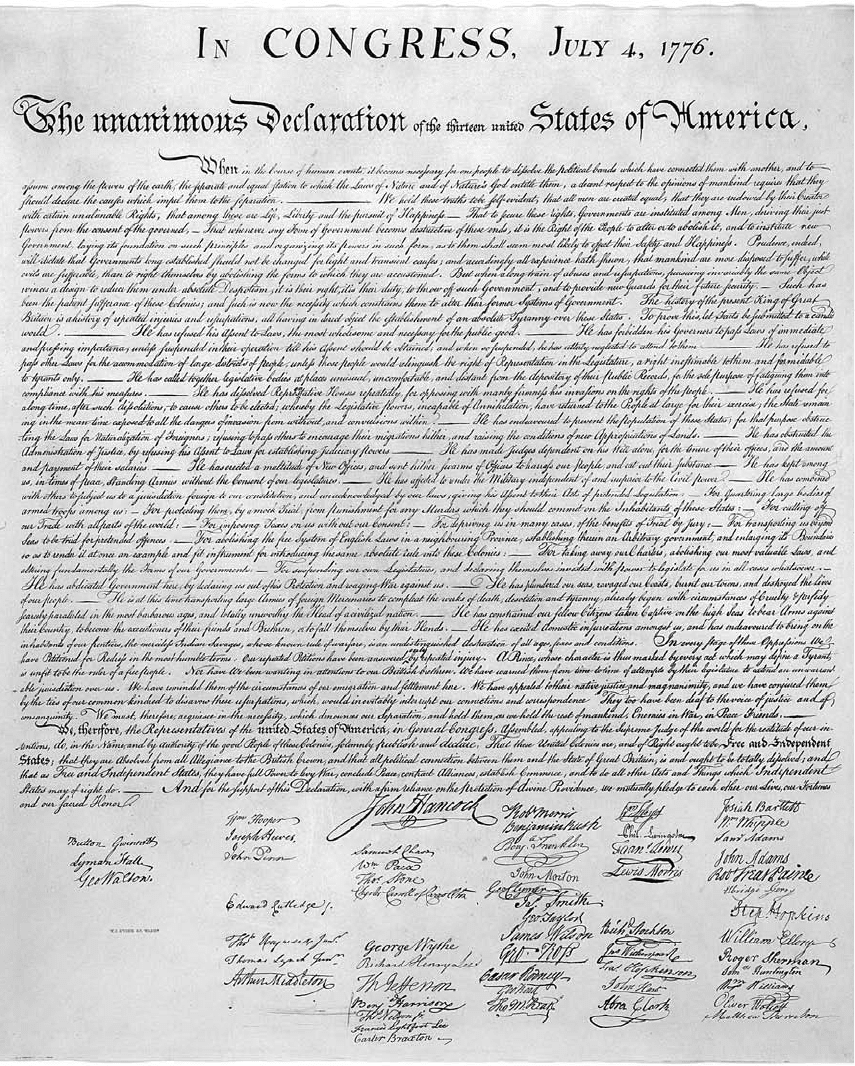
The Declaration of Independence (Wikimedia Commons)
188 Declaration of Independence
xviii+446_EofUSConsti-v1.indd 188 3/12/09 3:04:36 PM
made by individual translators have shaped the
reception of the Declaration of Independence in
different languages.
Perhaps most important of all, the Declaration
of Independence has infl uenced the political archi-
tecture and institutions of the U.S. regime. The
declaration was closely linked to the Articles of
Confederation, the fi rst constitution of the United
States. The two documents formed a completed
constitutional covenant offering a set of formative
principles and refl ecting shared commitments on
which America as a nation (a people) and as a state
(a government) was founded. The Constitution of
1787, which replaced the Articles of Confedera-
tion, and the Bill of Rights that followed also
are grounded in the principles of the Declaration
of Independence. What some might regard as
merely technical, institutional matters—feder-
alism, the rule of law, the content of public policy,
and the separation of powers—all have proved to
be integral to how the Constitution secures indi-
vidual rights. An analysis of the constitutions of
the states, the federal enabling acts defi ning the
terms upon which new states were admitted to the
Union, and the congressional statutes and presi-
dential proclamations acknowledging admission
demonstrate how closely the states identify with—
or, in the case of the Southern states following the
Civil War, were forced to identify with—the prin-
ciples of the declaration.
Members of Congress and American presi-
dents have appealed to the Declaration of Inde-
pendence throughout the course of U.S. history.
They have participated within—and, therefore,
have been infl uenced by—a political context and
tradition whose framework and principles were
fi rst articulated in the declaration. U.S. Supreme
Court justices also have referred to the Declara-
tion of Independence in written opinions in two
identifi able, and occasionally interrelated, ways: 1)
to determine a formal marker of the independence
of the United States of America and 2) to cast light
upon the founders’ views or the principles under-
lying the Constitution.
The Declaration of Independence is one of the
most valued and sacred political documents in
history. It articulates the origins, purposes, and
ideals of the U.S. regime, and it has inspired the
American people as well as peoples around the
world to seek constitutional change to conform to
its principles.
For more information: Becker, Carl L. The
Declaration of Independence: A Study in the His-
tory of Political Ideas. Rev. ed. New York: Vintage
Books, 1958; Gerber, Scott Douglas. To Secure
These Rights: The Declaration of Independence
and Constitutional Interpretation. New York: New
York University Press, 1995; Gerber, Scott Doug-
las, ed. The Declaration of Independence: Origins
and Impact. New York: CQ Press, 2002; Maier,
Pauline. American Scripture: Making the Declara-
tion of Independence. New York: Knopf, 1997.
—Scott D. Gerber
defamation
Defamation is one form of speech that generally
does not receive constitutional protection under
the First Amendment. However, the Supreme
Court has been willing, in the name of the First
Amendment, to give broad deference to individu-
als and the media who wish to criticize public offi -
cials, even if there are some factual inaccuracies
in the comments being made.
Defamation is one of the oldest torts, or civil
wrongdoings, dating back to precolonial English
law. Defamation consists of a false statement that
is communicated to third persons and causes harm
to the reputation of the person who was the sub-
ject of the communication. Similar to most torts,
defamation generally is governed by state law.
While the rules differ from state to state, there
are many similarities in defamation law in nearly
all jurisdictions of the United States.
Defamation consists of two forms: libel and
slander. Libel is a defamatory communication that
is in writing or other permanent form, including
drawings, broadcasts, and electronic communica-
tions. Slander is defamation that occurs orally or
in transitory form and not memorialized in some
form of documentation.
defamation 189
xviii+446_EofUSConsti-v1.indd 189 3/12/09 3:04:36 PM
Harm to reputation may be established by
proving a diminution in the regard that others
held for the subject of the defamation or that oth-
ers have shunned or refused to associate with the
subject. For individuals, this usually means prov-
ing that people actually have had a lower regard
for the person because of the defamatory commu-
nication. While businesses also may be the subject
of defamation, known as “trade libel,” a business
claimant usually must show that there has been a
diminution in income or revenue.
Constitutionally, the Supreme Court drew
some limits in N
EW YORK TIMES V. SULLIVAN, 376
U.S. 254 (1964), when it came to the defamation
of public offi cials. In that case, the Court ruled
that the First Amendment requires public offi cials
to show that someone acted with actual malice or
reckless disregard of the truth in printing or dis-
tributing information about them. The high bur-
den here of showing defamation was to preclude
individuals from being chilled or intimidated from
exercising their First Amendment rights of free
speech or press. In cases subsequent to Sullivan,
the Court has also extended signifi cant constitu-
tional protection against defamation when speech
is directed at public figures. Finally, the courts
have generally been unwilling to allow candidates
for political offi ce to sue for defamation when they
are criticized by their opponents or other individ-
uals or groups. In the interest of promoting robust
political debate, the courts have applied the prin-
ciples of New York Times v. Sullivan to protect
campaign speech.
For more information: O’Neil, Robert M. The
First Amendment and Civil Liability. Blooming-
ton: Indiana University Press, 2001; Schwartz,
Bernard. A History of the Supreme Court. New
York: Oxford University Press, 1993.
—Marshall Tanick
Democracy and Distrust (1980)
Democracy and Distrust: A Theory of Judicial
Review is a book by John Hart Ely, a law professor,
in which Ely argues that judges should interpret
constitutional provisions to reinforce represen-
tative democracy. Ely’s book presents one of the
most infl uential theories of judicial review.
In his book, Ely explains why neither of the
two predominant alternative theories for inter-
preting the Constitution are adequate to address
many of the most controversial issues. First, he
describes what he calls “interpretivism,” the view
that judges should “confi ne themselves to enforc-
ing norms that are stated or clearly implicit in the
written Constitution.” Ely finds this view inad-
equate because the Constitution contains several
vague and ambiguous terms, as well as terms that
expressly require judges to apply values or prin-
ciples outside the Constitution itself.
Ely then dismisses “noninterpretetivism,”
which is the view that judges should apply norms
and values that cannot be discovered within the
text of the Constitution. One view among non-
interpretivists is that judges should invoke their
own personal values when they interpret the
Constitution and should invalidate laws that are
inconsistent with those values. Ely fi nds noninter-
pretivism as equally inadequate as interpretivism
in that noninterpretivism does not constrain the
judge’s discretion and is contrary to many of the
democratic theories upon which the Constitution
is based.
As an alternative to these two views, Ely pro-
poses his own theory of judicial review. Ely fi nds
inspiration both in the history of the Constitution
itself and in the work of the Warren Court. The
Constitution, in Ely’s view, is primarily concerned,
not with protecting certain substantive values, but
rather with procedural issues. Similarly, although
many of the Warren Court’s decisions dealt with
issues of criminal procedure, which Ely describes
as process “in the most ordinary sense,” many of
the Warren Court’s decisions also addressed issues
such as free speech and voting rights, which Ely
describes as “process in the broader sense—the
process by which the laws that govern society are
made.” In Ely’s view, the Warren Court’s deci-
sions dealing with the equal protection clause
of the Fourteenth Amendment also relied on
two procedural principles: “clearing the channels
of political change” and “correcting certain kinds
of discrimination against minorities.”
190 Democracy and Distrust
xviii+446_EofUSConsti-v1.indd 190 3/12/09 3:04:37 PM
Judges applying Ely’s theory of judicial review
would invalidate laws that hamper the opportu-
nity to participate in the political process. For
example, the First Amendment’s text, which
only addresses Congress specifically, does not
prohibit the president, the judiciary, or the states
from banning speech. A judge applying Ely’s
theory, however, would hold that the free speech
clause should apply equally to all branches of
the federal government and to the states as well
because free speech rights are “critical to the
functioning of an open and effective democratic
process.” In cases dealing with the equal protec-
tion clause, judges applying Ely’s theory would
invalidate laws that threaten the ability of minor-
ities to participate in and be represented in the
political process.
For more information: Dworkin, Ronald. Free-
dom’s Law: The Moral Reading of the American
Constitution. Cambridge, Mass.: Harvard Univer-
sity Press, 1996; Tribe, Laurence. “The Puzzling
Persistence of Process-Based Constitutional The-
ories.” Yale Law Journal 89, no. 1,063 (1980).
—Winston E. Calvert
desegregation
Desegregation refers to the ending of racial segre-
gation in, for example, public places, transport, or
institutions. It is a term that has been commonly
used with reference to the United States, deseg-
regation of the military, and more especially, the
U.S. civil rights movement since the Supreme
Court’s landmark decision in B
ROWN V. BOARD OF
E
DUCATION OF TOPEKA, 347 U.S. 483 (1954), forcing
the desegregation of schools.
Historically, racial segregation has a long and
varied past in the United States. This is not to say
that integrationist ideas are a new or 20th-cen-
tury phenomenon, as the inclusion of the right
to vote for free blacks contained in the original
Tennessee state constitution of 1796 illustrates.
Unfortunately, such sentiments were not long
lasting at the time, and in many cases, reversed
(the Tennessee constitution was replaced with a
subsequent one in 1834 that did not adopt the
same voting rights for free blacks). In the United
States, two specifi c areas of the racial desegrega-
tion movement merit particular attention: deseg-
regation in the military and desegregation of the
school system.
The U.S. military remained in segregated units
based on racial lines until just shortly after World
War II. It was with Executive Order 9981 by Pres-
ident Harry S. Truman that racial integration of
the armed forces became an issue. Up until this
point, blacks and other minorities were segregated
into separate units during combat. President Tru-
man chose to use an executive order rather
than going through Congress to have legislation
passed, as he felt there would be too much opposi-
tion within Congress, especially from representa-
tives of the southern states. However, during this
same period (1948), Congress debated the Selec-
tive Services bill. An amendment to the Selective
Services bill, attached in May 1948 by Senator
Richard B. Russell, proposed enabling draft-
ees and new inductees in the military to decide
whether they wanted to serve in segregated units
or not. The attachment was defeated twice. It was
with the onset of the Korean War in 1948 and the
huge casualties among the segregated units and
the need to fi ll those units with able-bodied sol-
diers that army commanders accepted for the fi rst
time black recruits into white units, thus integrat-
ing army units. The practice of integrating units
throughout the Korean War demonstrated that
integrated combat units could perform adequately,
gaining the notice of army high command, who
formally announced plans to desegregate in 1951,
three years after Executive Order 9981 was issued
by President Truman.
It is perhaps the move toward desegregating
the school system, however, that the desegrega-
tion movement is most associated with. Beginning
with the abolitionist movement, the first steps
toward desegregation occurred: the abolition of
slavery with the Thirteenth Amendment to
the U.S. Constitution and the granting of citizen-
ship and voting rights under the Fourteenth
and Fifteenth Amendments immediately
following the end of the Civil War. During the
Reconstruction era (1865–80), there were more
desegregation 191
xviii+446_EofUSConsti-v1.indd 191 3/12/09 3:04:37 PM