
Schultz D. Encyclopedia of the United States Constitution
Подождите немного. Документ загружается.

What ended Prohibition was the Great Depres-
sion. No longer was there apparent empirical veri-
fi cation of its economic benefi ts. Regaining lost tax
revenues looked increasingly attractive. Finally,
many Americans tired of the continuous contro-
versy over alcoholic beverages. They had hoped
and expected that with Prohibition, the coun-
try could cease the intense national debate over
alcoholic beverage regulation that was distracting
attention from other important issues. This had
not occurred. The hope grew that greater har-
mony and a less liquor-obsessed politics would be
achieved by repeal.
For more information: Clark, Norman. Deliver
Us from Evil: An Interpretation of American Pro-
hibition. New York: W.W. Norton, 1976; Pegram,
Thomas. Battling Demon Rum: The Struggle for
Dry America, 1800–1933. Chicago: Ivan R. Dee,
1998.
—Steve Diamond
Eisenstadt v. Baird 405 U.S. 438 (1972)
In Eisenstadt v. Baird, the U.S. Supreme Court
expanded the implied constitutional right to pri-
vacy, ruling that single men and women were
entitled to the same access to birth control that
was provided to married couples.
Massachusetts and numerous other states made
it a crime to prescribe contraceptives until
1965 when the Supreme Court, in G
RISWOLD V.
C
ONNECTICUT, 381 U.S. 479 (1965), ruled that the
right to privacy implicit in the Bill of Rights pro-
tected the right of married couples to use birth
control devices in their homes. The next year, the
Massachusetts legislature amended state law to
permit doctors to prescribe contraception to mar-
ried couples.
The Eisenstadt case arose in 1967 when Bill
Baird, a New York birth control and abortion
rights advocate, delivered a lecture on contracep-
tion to some 2,000 students at a Boston University
auditorium. After the lecture, he offered the audi-
ence the chance to come up to the stage to pick up
packages of contraceptive foam. One student did,
and Boston police arrested Baird for violating the
law that prohibited exhibition and distribution of
contraceptives to unmarried persons.
Baird was convicted in state court of exhibiting
and distributing contraceptives; the Massachu-
setts Supreme Court upheld only the distribut-
ing conviction, ruling that the ban on exhibiting
birth control violated the First Amendment.
Baird challenged his conviction in federal court
after serving a three-month jail sentence. A fed-
eral district court upheld his conviction, but the
U.S. Court of Appeals for the First Circuit over-
turned it. Thomas Eisenstadt, the sheriff of Suf-
folk County, which includes Boston, appealed to
the U.S. Supreme Court.
By a 6-1 vote, the Supreme Court ruled that
the Massachusetts law violated the equal pro-
tection clause of the Fourteenth Amendment,
because it discriminated against unmarried indi-
viduals. Although the Griswold decision had relied
heavily on the concept of marital privacy, Justice
William J. Brennan, Jr., wrote in Eisenstadt
that marriage is just a relationship of two individu-
als and that the privacy interests involved belong
to the individuals.
In the most oft-cited portion of the opinion,
Brennan is widely credited with planting a strong
statement that would bolster the Court’s ability to
fi nd a constitutional right to abortion in a case that
was pending at the same time, ROE V. WADE, 410
U.S. 113 (1973). “If the right of privacy means any-
thing, it is the right of the individual, married or
single, to be free from unwarranted governmental
intrusion into matters so fundamentally affecting
a person as the decision whether to bear or beget
a child,” Brennan wrote in Eisenstadt. The state-
ment was quoted in Roe a year later.
Brennan said that the Massachusetts law was
marked by contradictions that made it diffi cult to
fi nd any reasonable justifi cation for it. The law, he
said, permitted access to contraceptives to prevent
disease but not to prevent pregnancy and permit-
ted married persons access to contraceptives even
for extramarital sexual activity. All of these contra-
dictions undermined any justifi cations for the law
offered by the state, the Court said. Chief Justice
Warren E. Burger dissented, saying the Court
was interfering with areas of legitimate state reg-
222 Eisenstadt v. Baird
xviii+446_EofUSConsti-v1.indd 222 3/12/09 3:04:47 PM
ulation without any constitutional justification.
Justices Lewis Franklin Powell, Jr., and
William Hubbs Rehnquist joined the Court
after the case was argued and so did not take
part in the decision. The Supreme Court decision
invalidated similar laws in at least two dozen other
states.
For more information: Garrow, David J. Liberty
and Sexuality: The Right to Privacy and the Mak-
ing of Roe v. Wade. New York: Macmillan, 1993;
Lucas, Roy. “New Historical Insights on the Curi-
ous Case of Baird v. Eisenstadt.” Roger Williams
University Law Review 9, no. 9 (2003): 9–55.
—Stephen Wermiel
electoral college
The electoral college is a mechanism established
in the Constitution as part of the process for
choosing the president and vice president of the
United States.
The Constitutional Convention in 1787
had diffi culty reaching closure on how to choose
the president. After rejecting a variety of methods
ranging from popular vote to selection by Con-
gress, the delegates fi nally determined that the
president should be chosen by a group of electors.
This decision is often explained in terms of the
limited political knowledge of the average citizen
of 1787. A more plausible motivation was the need
to win support of the small states for the Consti-
tution. The creation of a Senate with equal rep-
resentation of states, an early small state victory,
became the foundation for an electoral college
that gives the small states a numerical advantage.
The term electoral college does not appear in
the Constitution, but its original description is
found in Section 1 of Article II of the U.S.
Constitution. (The word college here means a
group of people with a common purpose.) Each
state was to choose a number of electors equal
to the number of that state’s U.S. representatives
and senators. Since each state is constitutionally
granted one representative and two senators,
regardless of size, the smallest number of electoral
votes a state can have is three.
Meeting in the state capital, each elector would
cast votes for two candidates, at least one of whom
was from a different state than the elector’s. The
results would be tallied by Congress. The top
vote-getter would become president if he received
a majority (based on the number of electors, not of
total votes cast), and the runner-up would be vice
president. If two tied, both receiving a majority,
the House of Representatives would choose
between them. If no one received a majority, the
House would choose from among the top five,
with each state delegation casting only one vote.
If two people tied for second place, the Senate
would choose between them.
After a tie occurred in 1800, the Twelfth
Amendment was added to the Constitution,
in 1804, requiring electors to indicate separate
choices for president and vice president. If there
is no majority for president, the House, still vot-
ing by states, chooses from the top three. If no
one wins a majority of votes for vice president,
the Senate chooses from the top two. In 1961,
the Twenty-third Amendment gave the Dis-
trict of Columbia three electoral votes. Thus,
with the House of Representatives currently set
at 435, and a Senate of 100, the electoral college
consists of 538 electors.
Other than the addition of these amendments,
the electoral college technically functions as con-
ceived by the framers. However, in actuality, it
was transformed early in its history by the emer-
gence of political parties, the decision by states to
choose electors by popular vote, the appearance
of partisan lists of electors pledged to a particular
candidate, and the appearance of the “winner-
take-all” rule (currently used in all states except
Maine and Nebraska) in which the candidate win-
ning the popular vote in a state receives all of that
state’s electoral votes.
The electoral college is capable of producing
various anomalies. One is the potential for “faith-
less electors,” those who make their own choice
rather than voting for the candidate to whom they
are pledged. (This has rarely happened and never
affected the outcome of an election.) Another is a
president who wins an overwhelming majority of
electoral votes but a bare majority or mere plurality
electoral college 223
xviii+446_EofUSConsti-v1.indd 223 3/12/09 3:04:47 PM
of the popular vote, as was the case in 1980 when
Ronald Reagan won 489 of 538 electoral votes but
only 51 percent of the popular vote. Yet another is
a candidate who wins the popular vote while los-
ing the electoral vote, as happened in 2000 when
Al Gore won 48.38 percent of the popular vote
and George W. Bush 47.87 percent, but Bush won
the election with 273 electoral votes to Gore’s 266.
(The Green Party candidate, Ralph Nader, won
2.74 percent.)
Mathematically, the electoral college contains
a small state bias because of the inclusion of the
two votes per state based on Senate seats. In 2000,
Bush carried 30 states to Gore’s 20 plus the Dis-
trict of Columbia. Of Bush’s 30 states, 21 had elec-
toral votes in the single digits, and only three had
21 or more votes, while only 10 Gore states had
fewer than 10 electoral votes and four had more
than 21.
The terms red states (Republican states) and
blue states (Democratic states), featured promi-
nently in the media after the 2000 election, were
based on winners of states’ electoral votes. They
illustrate the potential of electoral vote counts to
make the partisan divide appear more skewed
than it actually is. The term purple state was sub-
sequently coined for closely divided states to cor-
rect this misimpression.
Under the winner-take-all rule, the largest
states may also have a particular advantage. A
candidate can secure the presidency by winning
the 11 most populous states for a narrow victory
of 271 to 268 electoral votes, regardless of the size
of the popular vote in those top 11 or in the rest
of the country. The argument is often made that
large states are also favored because candidates
spend more time campaigning in them; however,
there is no reason to think they would spend less
time in the large population centers in a popular
vote system.
The 2000 election was unusual in that the win-
ner was ultimately decided by the U.S. Supreme
Court in a 5-4 opinion in B
USH V. GORE, 531 U.S.
98 (2000). This scenario developed out of the
desperate need of both major candidates, after
all other states’ results had been tallied, to win
Florida’s 25 electoral votes. The case resulted
from challenges to a host of voting irregularities
in Florida. Had the Court awarded the votes to
Gore, he could have claimed a decisive victory
with both the popular vote and 291 electoral
votes, while Bush’s victory was won with a bare
margin in the electoral college and despite trail-
ing Gore in the popular vote.
Opponents of the electoral college noted that
in a popular vote, winner-take-all election the
country could have escaped this travail. The
rejoinder by electoral college supporters was that
direct election would not eliminate corruption at
the polls, and a national recount could be more
costly, time-consuming, and polarizing than even
the Florida debacle.
Many proposals have been offered to abolish or
reform the electoral college. Public opinion polls
show a strong preference for direct popular vote.
Reform proposals include abolishing electors but
keeping the electoral vote so that state popular
vote outcomes would be converted to electoral
votes without risk of “faithless electors”; choos-
ing electors by congressional districts with the
two votes representing the Senate seats going to
the statewide popular vote winner, as currently
done in Maine and Nebraska; dropping the win-
ner-take-all rule and dividing each state’s electoral
vote among the candidates proportional to their
share of the popular vote (usually without actual
electors, thus allowing fractions); and dropping
the two votes based on a state’s Senate seats and
having an electoral college based only on the num-
ber of representatives in each state. None of the
proposed solutions is without its own problems.
Arguments against change include an asser-
tion that the system has worked so far, that it is
an ingredient of federalism, and that change in
one part of the Constitution may lead to pressure
to change other parts. Nationwide change would
require either a constitutional amendment or
agreement among states to make changes within
their constitutional power (such as changing the
winner-take-all rule). Either method would likely
be difficult to achieve because of the vested
interest of small states in the current system and
because neither major political party shows much
interest in change.
224 electoral college
xviii+446_EofUSConsti-v1.indd 224 3/12/09 3:04:48 PM
For more information: Best, Judith A. The
Choice of the People? Debating the Electoral Col-
lege. Lanham, Md.: Rowman & Littlefi eld Pub-
lishers, 1996; Longley, Lawrence D., and Neal
R. Peirce. The Electoral College Primer 2000.
New Haven, Conn.: Yale University Press, 1999;
Rainey, Glenn W., Jr., and Jane G. Rainey. “The
Electoral College: Political Advantage, the Small
States, and Implications for Reform.” In Counting
Votes: Lessons from the 2000 Presidential Elec-
tion in Florida. Gainesville: University Press of
Florida, 2004.
—Jane G. Rainey
Eleventh Amendment (1795)
The Eleventh Amendment prohibits suits in fed-
eral court by citizens of one state against a state
different from their own. This amendment was
adopted in order to protect the sovereign immu-
nity of states against lawsuits. Throughout U.S.
history, the Eleventh Amendment has been
invoked to insulate state governments against
a host of different types of lawsuits. Under the
Rehnquist Court, this amendment was often
invoked, along with the Tenth Amendment, to
protect state power.
Sovereign immunity is an ancient legal con-
cept that comes to the United States from English
common law. According to this concept, the king
or the government generally cannot be sued with-
out its consent. In writing the Constitution, the
framers appeared to have overlooked or under-
valued state sovereign immunity, permitting citi-
zens of one state to sue a state different from their
own under Section 2 of Article III of the U.S.
Constitution.
The Eleventh Amendment was ratifi ed in 1795
to overturn the Supreme Court decision of C
HI-
SOLM V. GEORGIA, 2 U.S. 419 (1793), where the
Court ruled it had jurisdiction to hear a suit as
a matter of original jurisdiction involving a
dispute between an individual’s estate (in South
Carolina) and the state of Georgia for debts, spe-
cifically nonpayment of military supplies. The
fear was that without the Eleventh Amendment
protection of sovereign immunity, states would be
bankrupted by suits arising from the Revolution-
ary War.
Since its adoption, the Eleventh Amendment
has had an unusual history. In Hans v. Loui-
siana, 134 U.S. 1 (1890), the Court stated that
the Eleventh Amendment is a general blanket
of sovereign immunity that protects states from
lawsuits brought by its own citizens or those of
another state. There are some exceptions. In E
X
PARTE YOUNG, 209 U.S. 123 (1908), one exception
was that state offi cials could be sued individually
if they sought to enforce unconstitutional laws.
Another exception, as developed in Welch v.
Texas Department of Highways, 483 U.S. 468
(1987), was that Congress, in some circumstances,
could abrogate, or break, sovereign immunity as
long as it clearly intended to do that. Initially, in
Pennsylvania v. Union Gas Company, 491 U.S. 1
(1989), the Court ruled that Congress could use its
commerce clause power to abrogate sovereign
immunity but, subsequently, in Seminole Tribe of
Florida v. Florida, 517 U.S. 44 (1996), decided
that the federal government can only abrogate
state sovereign immunity via the Fourteenth
Amendment because the commerce clause is
limited by the Eleventh Amendment.
Under the Rehnquist Court, the Eleventh
Amendment was employed to limit lawsuits by
individuals against states. In limiting these suits,
the Court often linked the Eleventh to the Tenth
Amendment as a constitutional means to limit
federal power. For example, in A
LDEN V. MAINE,
527 U.S. 706 (1999), the Court held that state
sovereign immunity bars state employees from
suing a state to comply with the federal Fair
Labor Standards Act. In Board of Trustees of the
University of Alabama v. Garrett, 531 U.S. 356
(2001), the Court held that state sovereignty pro-
hibited the state employees from being able to sue
under Title I of the Americans with Disability Act
(ADA). In F
EDERAL MARITIME COMMISSION V. SOUTH
C
AROLINA STATE PORTS AUTHORITY, 535 U.S. 743
(2002), the Court ruled that sovereign immunity
barred suits against states before federal adminis-
trative law bodies. However, in T
ENNESSEE V. LANE,
541 U.S. 509 (2004), the Supreme Court ruled
that states may be sued if they denied disabled
Eleventh Amendment 225
xviii+446_EofUSConsti-v1.indd 225 3/12/09 3:04:48 PM
individuals access to the courts. This decision
appeared to limit some of the more far-ranging
applications of sovereign immunity and the Elev-
enth Amendment.
For more information: Orth, John V. The Judi-
cial Power of the United States: The Eleventh
Amendment in American History. New York:
Oxford University Press, 1987.
—David Schultz
Ellsworth Court (1796–1800)
The Ellsworth Court refers to the Supreme Court
under Chief Justice Oliver Ellsworth. During his
term, the Ellsworth Court began the process of
giving life to the Supreme Court as a real institu-
tion and not simply a description found in Arti-
cle III of the U.S. Constitution.
Oliver Ellsworth was a Founding Father of great
distinction. Ellsworth was a leader of the Federal-
ist Party and served in several key leadership roles
during the revolutionary and founding era, includ-
ing representing Connecticut at the Constitu-
tional Convention, service to Connecticut in
Congress, and his work in the construction of the
Judiciary Act of 1789. Ellsworth also served as
the third U.S. Supreme Court chief justice.
Ellsworth was born in Windsor, Connecticut,
on April 29, 1745, and raised there. He pursued
his collegiate studies at Yale College, later trans-
ferring to and graduating from the College of New
Jersey (Princeton University) in 1766. Ellsworth
initially began his studies in theology but later
changed his focus to law and was admitted to the
bar in 1771. As an active member of the Federal-
ist Party, Ellsworth quickly turned to politics and
served as a member of the state general assembly
from 1773 to 1776. His involvement in the political
arena did not end there, as he served as a mem-
ber of the Continental Congress and Governor’s
Council, as well as a delegate at the Constitutional
Convention. Additionally, Ellsworth served as a
judge for the Connecticut Superior Court. Ells-
worth was later elected to offi ce as a U.S. senator,
serving from 1789 to 1796. Ellsworth was nomi-
nated by President George Washington to serve
as chief justice in the early spring of 1796. Though
Ellsworth’s tenure as chief justice lasted only three
years, there were several signifi cant cases, ranging
from Congress’s power to tax to ratifi cation of con-
stitutional amendments, as well as issues of juris-
diction. There were many cases argued before the
Ellsworth Court that settled a variety of issues
pertaining to what many view today as common
practice within the governmental system.
The fi rst case that was heard under the Ells-
worth Court was H
YLTON V. UNITED STATES, 3
U.S. 171 (1796). The Hylton case dealt with a law
enacted by Congress that imposed a tax on car-
riages owned by individuals or businesses. The
plaintiff argued that the carriage tax was not
apportioned and was a direct tax. Subsequently,
the plaintiff contended that Congress violated
its taxing and spending powers as outlined
by the Constitution. The Court struck down the
plaintiff’s argument and held that the tax imposed
by Congress was constitutional, as it was an indi-
rect tax. In the Hylton case, the Court defi ned a
direct tax as one that could not be apportioned
and reasoned that the carriage tax at issue was
properly apportioned.
In 1798, the Ellsworth Court was faced with
another issue involving the constitutionality of an
act of Congress. In Hollingsworth v. Virginia, 3
U.S. 378 (1798), the Court heard arguments that
involved the constitutionality of the president’s
involvement in the ratification of constitutional
amendments. In Hollingsworth, the Ellsworth
Court affi rmed that no presidential signature was
required for Congress to propose an amendment
to the Constitution. While the Hollingsworth deci-
sion was narrowly tailored to the particular facts in
contention, it was clear in the Court’s early years
that it was committed to protecting the integrity
of the newly ratifi ed Constitution.
Late in Chief Justice Ellsworth’s tenure, the
Court exercised for the first time its original
jurisdiction as enumerated in Article III, Sec-
tion 2, of the Constitution. In New York v. Con-
necticut, 4 U.S. 3 (1799), the Court exercised its
ability to hear a case in a dispute to which a state is
a party. In the New York case, there was a dispute
between two states over the right to a tract of land,
226 Ellsworth Court
xviii+446_EofUSConsti-v1.indd 226 3/12/09 3:04:48 PM
the “Connecticut gore.” The Court held that New
York was not a party to the ejectment action and
had no interest at stake. The case was signifi cant
because it was the fi rst time the Supreme Court
used original jurisdiction to hear a case.
In 1800, after three and a half years of service
as chief justice, Ellsworth announced his resigna-
tion. The Ellsworth Court made great advance-
ments in the Supreme Court’s young history to
protect and uphold the newly established Consti-
tution. The Ellsworth Court’s jurisprudence fol-
lowed the conservative judicial restraint of prior
Federalist courts and strengthened national insti-
tutions and federalism.
For more information: Buchanan, James M.
“Oliver Ellsworth, Third Chief Justice.” In Jour-
nal of Supreme Court History. Washington, D.C.:
Supreme Court Historical Society, 1991; Marbach,
Joseph R., Ellis Katz, and Troy E. Smith, eds. Fed-
eralism in America. Westport, Conn.: Greenwood
Publishing, 2005.
—Michael W. Hail and Sarah E. Wilson
Embargo Act of 1807
The Embargo Acts were a series of laws passed
between 1806 and 1808 during Thomas Jef-
ferson’s second term as president of the United
States. The aim was to punish Great Britain for its
operations against U.S. ships.
The British were experiencing a shortage of
sailors, mainly because of the harsh conditions
on board English ships and because many Brit-
ish sailors preferred working on American ships,
where conditions were better. The Royal Navy
consequently started stopping U.S. vessels and
impressing those sailors they suspected were
British deserters. Americans understood impress-
ments as an incursion on their independence. The
peak of this confl ict was the boarding of the USS
Chesapeake by the sailors of the HMS Leopard off
the coast of Maryland on June 21, 1807. The Brit-
ish announced to the USS Chesapeake that they
would board the American vessel on the grounds
that they were looking for deserters. When the
Americans refused, the HMS Leopard discharged
its cannons against the USS Chesapeake, leaving
18 Americans wounded and three dead. The Brit-
ish finally boarded the ship and took away four
deserters.
One of Jefferson’s fi rst measures was to issue
a proclamation by which British ships were not
allowed to navigate U.S. waters. Among other
actions such as the Non-Importation Act of
December 1807, the Jeffersonian government
began issuing a series of Embargo Acts. The
first one was passed on December 22, 1807. It
prohibited American ships from sailing foreign
waters unless specifi cally allowed by the presi-
dent himself, it did not allow exports from the
United States by sea or land, and it did not autho-
rize certain British products to enter the United
States. This Embargo Act struck a terrible blow to
foreign trade, which was one of the most impor-
tant American activities at the time. After the
outbreak of war in Europe in 1783, the United
States had dominated overseas trade. Most ships
with tropical products such as coffee, sugar, tea,
and pepper sailed fi rst into the United States, and
their cargoes were reshipped in order not to be
intercepted. The European war was also highly
benefi cial for grain and cotton growers. The econ-
omy of the young United States was based on its
capacity to remain neutral. After the acts were
passed, however, American exports dropped by
80 percent.
In January 1808, Jefferson passed a second
Embargo Act by which all American ships had to
pay a fee of twice the value of the vessel and its
cargo. Since many merchants did not follow the
Embargo Acts regulations, a third one was passed
in March 1808 prohibiting the exportation of any
goods by sea or land and punishing violators of such
rule with fi nes up to $10,000. The third act also
endowed the president with the authority to reject,
implement, or grant exceptions to this embargo.
The fourth Embargo Act (also known as
the Enforcement Act) passed in April 1808 and
enabled port authorities to bring to trial any mer-
chant they believed had violated the embargo.
The act also established that it was the president’s
right and duty to use the army and the navy to
administer the Embargo Acts.
Embargo Act of 1807 227
xviii+446_EofUSConsti-v1.indd 227 3/12/09 3:04:48 PM
Three days before Jefferson left office, Con-
gress repealed the Embargo Acts. Congress
decided to pass the Non-Intercourse Act on March
1, 1809, which repealed all the acts except those
that affected Great Britain and France. Since the
Non-Intercourse Act was also ineffective, it was
substituted in 1810 by Macon’s Bill Number 2 that
lifted the rest of the embargoes.
For more information: Cray, R. E. “Remember-
ing the USS Chesapeake: The Politics of Maritime
Death and Impressment.” Journal of the Early
Republic 25, no. 3 (2005): 445–474; Frankel, J. A.
“The 1807–1809 Embargo Against Great Britain.”
Journal of Economic History 42, no. 2 (1982):
291–308; Kaplan, Lawrence S. “Jefferson, the
Napoleonic Wars, and the Balance of Power.” Wil-
liam and Mary Quarterly 14, no. 2 (1957): 196–
217; Scofi eld, M. E. “The Fatigues of His Table:
The Politics of Presidential Dining During the
Jefferson Administration.” Journal of the Early
Republic 26, no. 3 (2006): 449–469.
—Laura Gimeno-Pahissa
eminent domain
Eminent domain is the power of the government
to take private property for a public use as long as
just compensation is paid. While this power is
considered an inherent attribute of state govern-
ments and sovereign power, the Fifth Amendment
to the Constitution defi nes the eminent domain
power of the federal government. While in B
ARRON
V. MAYOR AND CITY COUNCIL OF BALTIMORE, 32 U.S.
243 (1833), the Supreme Court had ruled that the
eminent domain provisions of the Fifth Amend-
ment did not apply to the states, starting with Chi-
cago, Burlington & Quincy Railroad Company v.
Chicago, 166 U.S. 226 (1897), the Court declared
that the just compensation requirement applied
to the states through the due process clause of
the Fourteenth Amendment. Today, all of the
provisions of the Fifth Amendment are incorpo-
rated as limits upon state power.
The power of eminent domain is one of the
basic powers of government, along with taxation
and the regulation of commerce at the federal
level and the police power with the states. The
power of eminent domain traces back to English
common law, under which individuals owned or
used land subject to the superior need and ability
of the monarchy to acquire property for its uses.
Traditionally, the superior right of the crown to
take property from individuals resided in the need
of the government to further some public projects,
such as to build roads or bridges. When this power
was passed on to the American colonies and then
on to the original thirteen states, these require-
ments generally limited their ability to use emi-
nent domain; however, there was no requirement
to pay just compensation. But, starting with the
Vermont Constitution after the Revolutionary
War, eminent domain and just compensation pro-
visions were codifi ed in state laws.
Interpretations of the Fifth Amendment’s emi-
nent domain provisions generally center on three
questions: 1) What is a taking? 2) What is a public
use? and 3) What constitutes just compensation?
All three of these issues have been the subject
of intense and often heated constitutional
interpretation by the Supreme Court.
Generally, the Supreme Court has stated that
a taking occurs when there is either a direct or
physical taking or invasion of property or when
a regulation is so extensive that it has effected a
taking. In L
ORETTO V. TELEPROMPTER MANHATTAN
CATV C
ORP., 458 U.S. 419 (1982), the Supreme
Court stated that any type of physical invasion or
trespass of private property would constitute a tak-
ing. This could be when the government formally
takes the property to build a highway, bridge, or a
school or when it uses the property for some pur-
pose, such as water runoff or drainage.
In addition, in Pennsylvania Coal Company
v. Mahon, 260 U.S. 393 (1922), Justice Oliver
Wendell Holmes, Jr., argued that while some
government regulation of private property is per-
mitted, especially if one is using property in a way
that constitutes a nuisance, if the regulation goes
too far it could constitute a taking, necessitating
the payment of compensation to the owner. In this
case, the courts have called this action a regula-
tory taking. A taking, according to the Court in
First Evangelical Church of Glendale v. County
228 eminent domain
xviii+446_EofUSConsti-v1.indd 228 3/12/09 3:04:49 PM
of Los Angeles, 482 U.S. 304 (1987), can occur
whether the government assumes permanent or
even temporary control of property.
A second issue in eminent domain surrounds
what constitutes a valid public use. Traditional
public uses limited the taking of private property
to building roads, highways, jails, schools, bridges,
and other facilities used by the public. This type
of use of eminent domain narrowly construed the
power to the taking of real property (land and
buildings) for a fi nite type of project associated
with usual government projects. However, over
time, this narrow reading of public use has been
greatly expanded to where public use no longer
means used by the public. Instead, a valid public
use is any taking that would secure the public ben-
efi t, good, or welfare.
For example, in W
EST RIVER BRIDGE V. DIX, 47
U.S. 507 (1848), the Court held that all types of
property—including contracts and franchises—
could be acquired by eminent domain. In Berman
v. Parker, 348 U.S. 26 (1956), the Court ruled it
was a valid public use to take unblighted property
for the purpose of slum clearance. In H
AWAII HOUS-
ING AUTHORITY V. MIDKIFF, 467 U.S. 229 (1984), the
Court upheld the use of eminent domain in order
to break up land monopolies or large estates and
sell smaller units to tenants. Justice Sandra Day
O’Connor, writing for the Court, declared that
the meaning of public use was equal to that of the
scope of a state’s police power. In effect, states
had broad authority to take private property for
all types of public uses including not just build-
ing bridges or highways but also for slum clear-
ance, building cemeteries, sports stadiums, public
housing, and other purposes. In K
ELO V. CITY OF
N
EW LONDON, 545 U.S. 469 (2005), many argued
that the U.S. Supreme Court pushed the public
use provision too far, upholding the taking of pri-
vate property for economic development purposes
as constituting a valid public use. The Kelo deci-
sion was seen by many as a signifi cant erosion of
property rights, and it resulted in many state and
local governments restricting the power of emi-
nent domain.
The third issue in eminent domain litigation is
that once a taking has occurred, the owner must
be paid just compensation for the property that
has been taken. Just compensation, according to
the Court, means that the owner must be paid
fair market value for the property. Fair market
value is determined by asking what a reasonable
buyer would give the owner in a private sale. To
determine this, the courts often use one of three
methods to value property. First, they would look
to what price was paid for similar properties.
Second, they would look at what it would cost to
replace or rebuild the property. Third, they look
to the income of investment value of the prop-
erty, seeking to determine its worth in terms of its
income stream. Courts are often required to use
all three of these valuation techniques when seek-
ing to ascertain what constitutes just compensa-
tion for property.
Overall, eminent domain is a powerful and
necessary tool of the federal and state govern-
ments, and it is subject to numerous restrictions
under the Fifth Amendment. Yet, many defenders
of property rights worry that the eminent domain
had been abused and that more restrictions need
to be imposed on it.
For more information: Schultz, David. Prop-
erty, Power, and American Democracy. New
Brunswick, N.J.: Transaction, 1992; Schultz,
David. “What’s Yours Can Be Mine: Are There
Any Private Takings after City of New London v.
Kelo?” UCLA Journal of Environmental Law and
Policy 24, no. 195 (2006).
—David Schultz
employment discrimination
Employment discrimination refers to making ille-
gal employment decisions based on an employee’s
race, color, age, creed, religion, national origin,
gender, or disability. While the Constitution has
been interpreted to ban intentional discrimi-
nation on the basis of race and other factors
through the equal protection clause of both
the Fourteenth Amendment and the Fifth
Amendment, most of the law regarding employ-
ment discrimination is found in legislation adopted
by Congress.
employment discrimination 229
xviii+446_EofUSConsti-v1.indd 229 3/12/09 3:04:49 PM
All employment practices, including applica-
tion procedures; interviewing; testing; selecting
and hiring; layoff and seniority policies; evalua-
tion procedures; the distribution of organizational
rewards such as pay, leave, training, and promo-
tions; and disciplining and fi ring; may be subject to
discrimination claims. Numerous federal antidis-
crimination laws are in place to reduce discrimi-
nation and harassment in the workplace; these
include Title VII of the Civil Rights Act of
1964 and, as amended in 1991, the Age Discrimi-
nation in Employment Act (ADEA) of 1967, the
Pregnancy Discrimination Act of 1978, and the
Americans with Disabilities Act (ADA) of 1990. In
addition, the federal government and many states
and municipalities forbid discrimination based on
sexual orientation, political affi liation, and marital
status. Some states give additional antidiscrimina-
tion protections to workers and groups who are
not covered by federal law.
The U.S. Supreme Court in McDonnell Doug-
las Corporation v. Green, 411 U.S. 792 (1973),
describes how to build a prima facie showing of
hiring discrimination. A prima facie case (or a
case that is valid at fi rst glance) could be created
by demonstrating that 1) applicants or employees
belonged to a protected group, 2) they applied for
and were qualifi ed for the position, 3) they were
rejected despite meeting the job qualifications,
and 4) employers continued, after rejection, to
seek employees with the same qualifi cations.
To prove illegal employment discrimination, an
applicant or employee must show disparate treat-
ment or disparate impact. Disparate treatment
claims demonstrate that an employer treated a par-
ticular group differently from another group. For
example, racial prejudice resulted in one group,
say white employees, getting hired or promoted
over black employees. Under disparate treatment,
plaintiffs must show that employers intentionally
discriminated against them.
In contrast, disparate impact claims involve
employment practices that appear neutral on the
surface and, therefore, not deliberately discrimi-
natory in nature. Although the practice makes no
reference to race, color, sex, religion, or national
origin, it may in practice have an adverse effect
on a protected group and no effect on groups who
are not in the protected category. For example,
if a correctional facility requires all prospective
prison guards to stand at least fi ve feet, four inches
tall, the height requirement could have a disparate
impact on women, who are often shorter than men.
The correctional facility may be sued for disparate
impact discrimination unless it can show a job-
related need for the height requirement. Employ-
ers cannot excuse discriminatory treatment by
saying they did not intend to discriminate. If a
plaintiff makes an initial showing of discrimina-
tion, the employer must provide a legitimate, non-
discriminatory reason for an adverse employment
practice or decision.
The Civil Rights Act of 1964 became the cen-
terpiece of antidiscrimination law and spawned
other major employee protection legislation.
Title VII of the Civil Rights Act of 1964 put fair
employment practices in the spotlight. Title VII
forbids employers from discriminating against
employees in hiring, termination, classifi cation,
and compensation and on terms, conditions, or
privileges of employment based on race, color,
religion, gender, or national origin. Because every
worker has a race, a color, a gender, a religion (or
no religious beliefs), and a national origin, persons
with any of these characteristics are protected
against discrimination. Thus, men and women are
protected from gender discrimination such as sex-
ual harassment. European Americans and African
Americans are protected against race, color, and
nationality discrimination. Protestants, Catholics,
Jews, and Muslims are protected against religious
discrimination. Congress passed the law fi rst and
foremost to protect African Americans and women
from discriminatory practices, but, in practice, the
law is quite broad and extends protections to many
more groups.
As women entered the workforce after World
War II in record numbers, many employers dis-
criminated against married women by refusing
to hire them for fear that their work productivity
would be interrupted by pregnancy. Often women
were fi red or asked to resign once they became
pregnant. To address this, Congress passed the
Pregnancy Discrimination Act, which requires
230 employment discrimination
xviii+446_EofUSConsti-v1.indd 230 3/12/09 3:04:49 PM
employers to treat pregnant women the same as
other job applicants or employees. Employment
practices that discriminate against an employee
due to pregnancy, childbirth, or medical con-
ditions associated with pregnancy are encom-
passed under Title VII and are a form of gender
discrimination.
Age discrimination spurred additional legisla-
tion. Under the Age Discrimination in Employ-
ment Act, it is illegal to make discriminatory
employment decisions against those who are 40
years of age or older if the employer regularly
employs 20 or more employees. The ADEA does
not protect employees younger than 40 who were
denied a job because they were too young. If age is
an important component of one’s job and is related
to one’s ability to perform the job, such as being
an effective fi refi ghter, certain employees may not
be covered by the ADEA. Most ADEA suits are
based on disparate treatment, claiming that the
age discrimination was intentional.
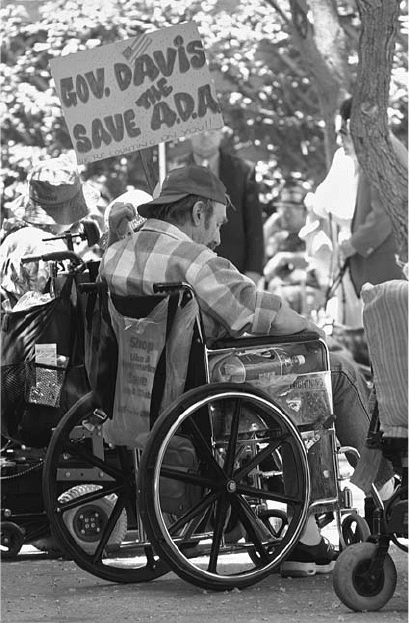
To combat discrimination against qualifi ed dis-
abled applicants and employees, Congress passed
the Americans with Disabilities Act, prohibiting
physical or mental disability discrimination and
requiring employers to make reasonable accom-
modations for the disabled. The ADA provides
three defi nitions of disability: 1) being substantially
impaired and thus unable to perform a major life
activity, such as being blind, 2) being on the record
as having a disability and being fi red because of
this medical history, and 3) being regarded as
having a disability such as being overweight and
being perceived as unable to perform required job
duties. To accommodate the disabled, employers
should ensure that work facilities are accessible
to the qualifi ed disabled applicants or employees.
This could become expensive, and consequently,
the courts have held that such accommodations
cannot impose an “undue hardship” on employers
by requiring signifi cant expense given the agency’s
size and fi nancial resources. The ADA applies to
all public employees and private employers who
employ 15 or more employees.
With increased workplace diversity and with
approximately 47 million U.S. residents age fi ve
or older speaking a language other than English,
national origin discrimination claims are on the
rise. National origin discrimination refers to
employment decisions that are linked to a person’s
birthplace or culture. One controversy associ-
ated with this area of discrimination law occurred
when some employers implemented “English-
only” policies at work. Numerous workers have
challenged these policies as a form of national ori-
gin discrimination. Employers with English-only
policies justifi ed them on grounds of safety, busi-
ness necessity, and workplace effi ciency; however,
courts have ruled that employers may not require
employees to speak in English at all times on the
job. Employees have freedom to express them-
selves in situations where they are not required to
Disabled demonstrators rally in Los Angeles, Califor-
nia, to protest the decision of the state of California
to challenge in the Supreme Court the Americans
with Disabilities Act of 1990.
(McNew/Newsmakers)
employment discrimination 231
xviii+446_EofUSConsti-v1.indd 231 3/12/09 4:34:05 PM