
Schultz D. Encyclopedia of the United States Constitution
Подождите немного. Документ загружается.

and employee (a liberty nowhere spelled out in
the Constitution) protected by the Fourteenth
Amendment. The New York law was an unreason-
able infringement on “the freedom of master and
employee to contract with each other in relation to
their employment.”
Justice Oliver Wendell Holmes, Jr., in
what is perhaps his most famous dissent, accused
the majority of writing into the ambiguous lan-
guage of the amendment their own laissez-faire
philosophy as to the proper relationship between
the individual and the state. He argued that a leg-
islature could reasonably conclude that excessive
working hours in a trade as dangerous as baking
were inimical to the health of the employee and
thus harmful to society. As Holmes caustically
noted, the “Fourteenth Amendment does not
enact Mr. Herbert Spencer’s Social Statics.”
The Lochner era ended in 1937, when a Court
dominated by Franklin Roosevelt’s appointees and
refl ecting the New Deal’s philosophy of increased
governmental regulation reversed course and
began to uphold laws addressing a variety of social
and economic ills. As the Court noted in W
EST
COAST HOTEL V. PARRISH, 300 U.S. 379 (1937),
“[t]he Constitution does not speak of freedom of
contract. It speaks of liberty and prohibits the
deprivation of liberty without due process of law.”
For more information: Abraham, Henry J., and
Barbara A. Perrey. Freedom and the Court. 8th
ed. Lawrence: University Press of Kansas, 2003;
Chemerinsky, Erwin. Constitutional Law: Prin-
ciples and Policies. 3d ed. New York: Aspen Pub-
lishers, 2006; Fallon, Richard H., Jr. The Dynamic
Constitution. New York: Cambridge University
Press, 2004.
—Philip A. Dynia
Duncan v. Louisiana 391 U.C. 145 (1968)
In Duncan v. Louisiana, the Supreme Court held
that under the Fourteenth Amendment to
the U.S. Constitution, a defendant charged with a
serious crime in state court has a right to trial
by jury. Gary Duncan had been tried without a
jury and convicted in state court for simple bat-
tery, a crime punishable under state law with a
maximum of two years’ imprisonment and a $300
fi ne. On appeal to the U.S. Supreme Court, Dun-
can argued that he was entitled to a jury trial for
this criminal charge.
The jury trial right is included in the Sixth
Amendment of the Bill of Rights, which
was added to the Constitution a few years after
its ratification, but in the leading case of B
AR-
RON V. MAYOR AND CITY COUNCIL OF BALTIMORE, 7
Pet. 243 (1833), the Court ruled that the rights
established in the Bill of Rights applied only to
the federal government, not state governments.
The Fourteenth Amendment (which was added to
the Constitution during Reconstruction) prohib-
ited the states from depriving a citizen of his life,
liberty, and property without due process, but
that amendment is silent on whether the array of
other rights in the Bill of Rights, such as the right
to a jury trial, apply to the states. Beginning in
the late 19th century, the Court began to address
this issue in a series of cases that would continue
well into the 20th century. In some cases, the
Court held that a particular right found in the
Bill of Rights was fundamental in the context of
American criminal justice systems and, therefore,
was incorporated into the concept of due process
applicable to the states under the Fourteenth
Amendment. Duncan v. Louisiana is an impor-
tant case in this series.
In concluding that the right to a jury trial was
fundamental, the Court noted that the right, which
developed as a protection against unchecked gov-
ernmental power, has deep roots in both English
and American law. Jury trials play a central role
in every American jurisdiction (both state and
federal). The Court also noted that other Sixth
Amendment rights, such as the right to coun-
sel (G
IDEON V. WAINRIGHT, 372 U.S. 335 [1963])
and the right to a speedy trial (Klopfer v. North
Carolina, 386 U.S. 213 [1967]), had already been
incorporated into the Fourteenth Amendment.
Although the Court held that the jury trial right
is incorporated into the Fourteenth Amendment,
it was not willing to extend the right to every crim-
inal case in state courts. Based on Anglo-Ameri-
can legal tradition and the original understanding
212 Duncan v. Louisiana
xviii+446_EofUSConsti-v1.indd 212 3/12/09 3:04:44 PM
of the Sixth Amendment’s jury trial provision, the
Court limited the right to serious offenses, which
raised the issue of distinguishing between petty
and serious offenses. Rejecting Louisiana’s con-
tention that the actual punishment imposed on
the defendant should be the basis for classifying
the offense, the Court suggested that the length
of possible incarceration authorized by the leg-
islature as the penalty for a particular crime is a
more useful gauge of its seriousness. After consid-
ering both a six-month and a one-year rule, the
Court deferred this question to a future case and
concluded that because the crime for which Dun-
can was charged was punishable by two years in
prison, it was a serious, not a petty, offense, and
therefore, Duncan had a right to a jury trial.
For more information: LaFave, Wayne R., Jer-
old H. Israel, and Nancy J. King. Criminal Pro-
cedure. 4th ed. St. Paul, Minn.: Thomson/West,
2004.
—Steven B. Dow
Duncan v. Louisiana 213
xviii+446_EofUSConsti-v1.indd 213 3/12/09 3:04:44 PM
214
ﱶﱷﱸ
economic protectionism and the states
Economic protection refers to a practice under-
taken by states to protect their own businesses and
industries at the expense of those located in other
states. This practice is a violation of the com-
merce clause of the Constitution.
The U.S. Constitution distributes economic
and political powers among the federal govern-
ment and the states. One of the areas in which
the Constitution apportions the respective roles
and powers of the federal government and the
states is interstate commerce (among states)
and international or foreign trade (with other
countries).
Clause 3 in Section 8 of Article I of the U.S.
Constitution, known as the commerce clause,
grants the U.S. Congress the powers “to regulate
Commerce with foreign Nations, and among the
several States, and with the Indian Tribes.” These
powers are sometimes classifi ed into three com-
ponent parts: foreign commerce clause, the inter-
state commerce clause, and the Indian commerce
clause, which deal with foreign trade, interstate
trade, and economic transactions with sovereign
tribal governments, respectively.
Whereas the commerce clause grants the fed-
eral government the power to regulate interstate
commerce, a more expansive doctrinal interpreta-
tion has emerged out of the jurisprudence of the
Supreme Court and other courts of lower juris-
dictions. This doctrine is called the dormant
commerce clause, which maintains that states
cannot pass laws that restrict interstate commerce.
It is a preemptive doctrine in that it prohibits a
priori any future state legislation that imposes
restrictions on interstate commerce.
The commerce clause, particularly the dor-
mant commerce clause, has been the subject of
various and conflicting interpretations within
the Supreme Court and among legal scholars. In
simple terms, two overriding judicial perspectives
or doctrines dominate the debate among Supreme
Court jurists and legal scholars concerning the
reach of the commerce clause. The fi rst perspec-
tive, a minimalist doctrine that is often associated
with the conservative wing of the Court, holds
that the commerce clause does not grant the fed-
eral government exclusive powers over the regu-
lation of interstate commerce, let alone preempt
any future law that states could pass to regulate
interstate trade. Antonin Gregory Scalia
and Clarence Thomas, the conservative jus-
tices of the Court, subscribe to this doctrine that
explicitly rejects the dormant commerce clause as
unconstitutional.
Proponents of the minimalist interpretation of
the commerce clause generally concur, however,
that the Constitution grants Congress and the fed-
eral government the power to regulate commerce
among states and internationally, but this power
is neither exclusive nor universal in the sense that
states retain some regulatory and legislative man-
date over certain aspects and types of interstate
commerce. Furthermore, the mandate of the
federal government is not unlimited as it may not
apply to interstate matters that are only partially
or tangentially related to commerce. A slightly
different version of the minimalist view maintains
that the commerce clause grants both Congress
and states “concurrent” powers to regulate inter-
state commerce. In this view, state regulation of
commerce is unconstitutional or invalid only if
E
xviii+446_EofUSConsti-v1.indd 214 3/12/09 3:04:44 PM
Congress passes specifi c statutes that restrict or
remove the economic powers of states.
The second perspective represents a more
maximalist doctrinal principle in that it strips the
states of all powers to regulate commerce through
protectionist measures such as tariffs and vests in
the Congress exclusive mandate over most aspects
of interstate commerce. Proponents of the second
perspective believe that the commerce clause was
designed to prevent interstate confl ict over com-
merce, a situation that could result if the states had
an exclusive mandate over interstate commerce.
These competing judicial doctrines have pro-
duced a vast body of jurisprudence on the subject
of economic protectionism, an area of continued
conflict between the prerogatives of states as
autonomous economic units and the mandate of
the federal government. This important state-fed-
eral relationship has evolved over time through a
series of amendments and precedents, with the
Supreme Court and lower courts playing a vital
role since the 19th century. The long and estab-
lished jurisprudence of the Supreme Court and
other lower courts on the commerce clause affi rms
federal authority over interstate commerce. How-
ever, recent decisions of the Court seem to give
credence to the conservative minimalist doctrine
that some state regulation is allowable under the
commerce clause.
For more information: Cho, Sungjoon. “Toward
a New Economic Constitution: Judicial Disciplines
on Trade Politics.” Wake Forest Law Review 42
(2007): 167–197; Moorman, John W. “Confl icting
Commerce Clauses: How Raich and American
Trucking Dishonor Their Doctrines.” William &
Mary Bill of Rights Journal 15 (2006) 687–710.
—Daniel G. Ogbaharya
education and the Constitution
The Constitution, the Bill of Rights, and subse-
quent amendments do not mention education
anywhere. Yet, the First Amendment’s religion,
speech, and press clauses; the Fourth Amend-
ment’s unreasonable searches clause; the Eighth
Amendment’s cruel and unusual punish-
ment clause; the Fourteenth Amendment’s
due process and equal protection clauses;
and Congress’s spending power in Section 8 of
Article I of the U.S. Constitution have all
been interpreted by the U.S. Supreme Court in
ways that have a major impact on education.
Nothing in the U.S. Constitution requires a
state to have a public elementary and secondary
school system or a public higher education system.
In S
AN ANTONIO V. RODRIGUEZ, 411 U.S. 1 (1973),
the Supreme Court rejected the argument that
a free public education was a fundamental right
under the Fourteenth Amendment due process
or equal protection clauses. However, every state
constitution requires that residents be provided a
free public education, or in some states a free and
“adequate” public education.
While educational plans and policies have
historically been viewed as the province of the
states, the federal government in the last 40 years
has played a major role in setting national edu-
cation standards and providing aid to promote
access to education programs for lower-income
populations. Beginning in 1965, with passage of
the Elementary and Secondary Education Act
(ESEA), through to 2001, with passage of the
No Child Left Behind Act, Congress has used
its “spending” power under Article I, Section 8
to set national education policy as a condition to
federal grants to states. Congress has also passed
antidiscrimination laws under the same spending
clause authority, including Title VI of the Civil
Rights Act of 1964, which prohibits discrimi-
nation based on race or national origin in pro-
grams receiving federal funds, and Title IX of the
Education Amendments of 1972, which prohibits
discrimination based on gender in education pro-
grams receiving federal funds.
The Supreme Court has also found that other
parts of the Constitution have a signifi cant impact
on education. In the case of T
INKER V. DES MOINES
I
NDEPENDENT COMMUNITY SCHOOL DISTRICT, 393 U.S.
503 (1969), the Supreme Court said that students
retain the First Amendment right to freedom of
speech in school. In the ruling, the highwater
education and the Constitution 215
xviii+446_EofUSConsti-v1.indd 215 3/12/09 3:04:45 PM
mark for recognition of student rights, the
Court stated: “It can hardly be argued that either
students or teachers shed their constitutional
rights to freedom of speech or expression at the
schoolhouse gate.” In Tinker, the Court ruled
that students who wore black armbands to school
to call for a truce in the Vietnam War should not
have been punished because there was no evi-
dence that their conduct threatened to disrupt
school activities.
In subsequent First Amendment rulings, how-
ever, the Court limited freedom of speech and
press rights, finding that schools may prohibit
speech that is lewd or profane (Bethel School
District v. Fraser, 478 U.S. 675 [1986]) and that
offi cials may censor speech or publications that
bear the imprimatur of the school, as long as offi -
cials have a legitimate pedagogical reason (H
AZEL-
WOOD SCHOOL DISTRICT V. KUHLMEIER, 484 U.S. 260
[1988]).
Hazelwood involved a school newspaper, but
it has been applied to restrict yearbooks, school
plays, and a range of other speech. Courts have
generally protected students’ right to criticize
school offi cials or policies on personal Web pages
created outside school. However, in M
ORSE V.
F
REDERICK, ___ U.S. ___ (2007), the Supreme
Court ruled that a student display of a banner at a
school event appearing to advocate the use of ille-
gal drugs was not protected by the First Amend-
ment. This decision seemed to signifi cantly retract
on many of the expressive rights that the Court
had supported since Tinker.
Courts have also generally ruled that schools
have some control but cannot engage in view-
point discrimination when students wear T-
shirts with messages on them. However, while
the Supreme Court has not addressed the issue,
lower courts have upheld school restrictions on
hair length, hats, and clothing. Dress codes have
been widely affi rmed by courts, fi nding neither a
free expression problem nor any issue of privacy
under the due process clause of the Fourteenth
Amendment.
The high court has handled dozens of cases
applying the religion clauses to public education.
The Court has ruled that the establishment
clause prohibits formal, organized school
prayer, whether in the classroom (E
NGEL V.
V
ITALE, 370 U.S. 421 [1962]), at graduation (LEE V.
W
EISMAN, 505 U.S. 577 [1992]), or at a varsity foot-
ball game (Santa Fe Independent School District
v. Doe, 530 U.S. 290 [2000]). Other activities are
prohibited, too, when they are designed to pro-
mote religion, including the teaching of creation-
ism (E
DWARDS V. AGUILLARD, 482 U.S. 578 [1987])
and other religiously motivated attempts to under-
mine the teaching of evolution.
At the same time, students have both a free
speech right and a free exercise clause right to pray
at school, as long as it is not organized by or pro-
moted by school offi cials. And schools should be
able to teach courses about the history of religion
or comparative religion, as long as the curriculum
does not promote religion. School offi cials may not
discriminate against religious organizations; when
schools allow clubs to meet after school, religious
clubs cannot be excluded simply because their
focus is religious (G
OOD NEWS CLUB V. MILFORD
C
ENTRAL SCHOOL, 533 U.S. 98 [2001]).
In numerous cases, the Supreme Court has
read the establishment clause to impose some lim-
its on when federal aid can go to private religious
schools or to support religious education. The
Court placed strict limits for many years (L
EMON V.
KURTZMAN, 403 U.S. 602 [1971]), but more recently,
the Court has said tax dollars may fl ow to religious
schools if they are part of a general aid program
that does not engage in religious indoctrination
(Agostini v. Felton, 521 U.S. 203 [1997]). The
Court has also upheld school vouchers, where
parents use tax dollars to pay for private schools,
including religious schools (Z
ELMAN V. SIMMONS-
H
ARRIS, 536 U.S. 639 [2002]).
In the area of privacy and security, the Supreme
Court has ruled that students have a reduced
expectation of privacy in school and may be sub-
jected to searches under the Fourth Amendment
based on the reasonableness of the circumstances
(N
EW JERSEY V. T.L.O., 469 U.S. 325 [1985]). The
Court has also upheld drug testing without any
individual suspicion for students participating in
extracurricular activities (B
OARD OF EDUCATION POT-
TAWATOMIE COUNTY V. EARLS, 536 U.S. 822 [2002]).
216 education and the Constitution
xviii+446_EofUSConsti-v1.indd 216 3/12/09 3:04:45 PM
Lower courts have found no Fourth Amendment
problem with metal detectors at school entrances
or with most locker searches.
The Supreme Court dealt with the Eighth
Amendment’s cruel and unusual punishment
clause in the context of corporal punishment
in school. In Ingraham v. Wright, 430 U.S. 651
(1977), the Court ruled that imposition of corpo-
ral punishment did not trigger the Eighth Amend-
ment because it was not punishment for a crime.
Ingraham also involved the due process guar-
antee of the Fourteenth Amendment. The Court
ruled that students did not have a right to notice,
a hearing, or other procedural safeguards prior
to corporal punishment. In other contexts, par-
ticularly punishment in the form of suspension or
expulsion from school, the Supreme Court said
students facing suspension of 10 days or less do
have due process rights, including a right to notice,
details of evidence and charges, and a right to give
their version of events (Goss v. Lopez, 419 U.S.
565 [1975]).
The equal protection clause of the Fourteenth
Amendment has been another source of Court
rulings and interplay between education and the
Constitution. In B
ROWN V. BOARD OF EDUCATION OF
T
OPEKA, 347 U.S. 483 (1954), the Supreme Court
ruled that segregated public schools violated the
equal protection guarantee of the Fourteenth
Amendment and, over the next 40 years, pre-
sided over efforts to desegregate public schools,
fi rst in southern states, and then throughout the
nation. In Freeman v. Pitts, 503 U.S. 467 (1992),
the Supreme Court suggested that federal courts
should relinquish control of school systems that
had met their obligation to eliminate segregation.
As emphasis on eliminating formal segregation
began to wane, a new focus developed on the use
of race in admissions to promote diversity in the
classroom. In a narrow ruling in R
EGENTS OF THE
U
NIVERSITY OF CALIFORNIA V. BAKKE, 438 U.S. 265
(1978), the Supreme Court kept the door open
to the use of race as one factor in admissions for
higher education programs in order to promote
diversity. Returning to this form of affirmative
action 25 years later, the Supreme Court ruled
in G
RUTTER V. BOLLINGER, 539 U.S. 306 (2003), that
race could be considered among numerous other
values to achieve a diverse law school classroom at
the University of Michigan. However, in G
RATZ V.
B
OLLINGER, 539 U.S. 244 (2003), the Court ruled
that Michigan’s use of race as a fi xed point value
in the undergraduate admissions process was too
much like a rigid quota and violated the Four-
teenth Amendment.
Finally, in Parents Involved in Community
Schools v. Seattle School District No. 1, ___ U.S.
___ (2007), and its companion case, the Court ruled
that race may not be used as a factor in determin-
ing assignment plans for schools. Whether this case
means that the use of race as a factor in education
has ended remains to be seen.
For more information: Imber, Michael, and Tyll
Van Geel. A Teacher’s Guide to Education Law.
3d ed. Mahwah, N.J.: Lawrence Erlbaum, 2005;
Raskin, Jamin B. We the Students: Supreme Court
Cases for and about Students. 2d ed. Washington,
D.C.: CQ Press, 2003; Russo, Charles J. Reutter’s
The Law of Public Education. 6th ed. New York:
Foundation Press, 2006.
—Stephen Wermiel
Edwards v. Aguillard 482 U.S. 578 (1987)
In Edwards v. Aguillard, the Supreme Court
reviewed Louisiana’s Balanced Treatment for
Creation Science and Evolution Science in Pub-
lic School Instruction Act and declared it uncon-
stitutional. This case is the foundation for the
contemporary movement supporting inclusion of
intelligent design theory in public education.
The Louisiana law, though not requiring any
theory on life’s origins be taught, required that
creation theory must be included if evolution the-
ory was taught, or vice versa. Because the law did
not forbid the teaching of evolution, it did not run
afoul of the precedent established in Epperson v.
Arkansas, 393 U.S. 97 (1968); however, it did face
problems with the precedent established in L
EMON
V. KURTZMAN, 403 U.S. 602 (1971).
Parents, teachers, and religious leaders chal-
lenged the state law as an unconstitutional viola-
tion of the First Amendment’s establishment
Edwards v. Aguillard 217
xviii+446_EofUSConsti-v1.indd 217 3/12/09 3:04:45 PM
clause. The state attorney general argued that
the objective of the law was to ensure that “aca-
demic freedom” was provided for teachers who
desired to teach alternative theories to evolution.
Unfortunately for the state, the bill’s author’s
remarks in the legislative record belied this argu-
ment. Senator Keith stated: “My preference would
be that neither [creationism nor evolution] be
taught.” Consequently, the Court noted, “Such
a ban on teaching does not promote—indeed, it
undermines—the provision of a comprehensive
scientifi c education.”
Justice William J. Brennan, Jr., delivered
the 7-2 majority opinion, stating the law violated
the fi rst prong of the Lemon test (a test for deter-
mining whether there is a violation of the estab-
lishment clause) since it lacked a secular legislative
purpose. Justice Antonin Gregory Scalia’s
dissent challenged that the majority’s conclusion
was hasty because the appellate court’s decision to
grant summary judgment never allowed evidence
to be introduced on legislative intent. Yet, Justice
Brennan noted:
the Act evinces a discriminatory preference . . .
requiring curriculum guides be developed and
resource services supplied for teaching cre-
ationism but not for teaching evolution, limit-
ing membership on the resource services panel
to “creation scientists,” and forbidding school
boards from discriminating against “creation
scientists,” and teaching creation science, while
failing to protect teachers of other theories or
those refusing to teach creation science.
Brennan’s statement made Justice Scalia’s remarks
disingenuous. Also, Scalia argued for abandoning
Lemon’s purpose test altogether, stating this prong
serves as “a test which exacerbates the tension
between the Free Exercise and Establishment
Clauses.”
The Lemon test’s second prong presented
problems for the law, too. The Court noted: “The
Act is designed either to promote the theory of
creation science . . . or to prohibit the teaching of
a scientifi c theory disfavored by certain religious
sects.” The legislative record details the view that
“a creator [was] responsible for the universe and
everything in it.” Furthermore, the legislative his-
tory clearly indicates “creation science” embodies
a religious belief that a supernatural creator was
responsible for the creation of humankind.
Third, the law entangled the interests of
church and state by seeking “the symbolic and
financial support of government to achieve a
religious purpose.” Because Louisiana proposed
to develop special curricula and provide teach-
ing resources for the clear purpose of advancing
creation theory but none for evolution theory,
this excessively involved the state and education
authorities in advancing a theistic viewpoint in
violation of Lemon and the First Amendment’s
establishment clause.
For more information: Forrest, Barbara, and
Paul R. Gross. Creationism’s Trojan Horse: The
Wedge of Intelligent Design. New York: Oxford
University Press, 2004; Numbers, R. L. The Cre-
ationists: The Evolution of Scientifi c Creationism.
Berkeley: University of California Press, 1993.
—Christy Woodward Kaupert
Edwards v. California 314 U.S. 160 (1941)
In Edwards v. California, the Supreme Court
held that the commerce clause (in Section 8
of Article I of the U.S. Constitution) bars
states from restricting interstate travel.
The decade of the 1930s witnessed the Great
Depression, in which scores of businesses went
bankrupt and millions of Americans became
unemployed. People in the southwestern states
were additionally impacted by farm foreclosures
caused by poor agricultural methods, oppressive
heat, severe droughts, and dirt storms. Among the
hardest-hit states in the so-called Dust Bowl were
Arkansas, Kansas, Oklahoma, and Texas. Thou-
sands of farmers and laborers from the Dust Bowl
were forced to pack their belongings and seek
employment in other states. California was one
of the states that offered hope for these displaced
Americans.
The mass migration of Americans was not with-
out controversy. This sudden infl ux of newcomers
218 Edwards v. California
xviii+446_EofUSConsti-v1.indd 218 3/12/09 3:04:46 PM
strained state budgets and limited resources. As a
result, more than 20 states enacted laws restricting
the movement of indigents into their borders. The
Welfare and Institutions Code of California was
emblematic of efforts to stem the tide of migra-
tion from the Dust Bowl. Section 2615 of that act
provided: “Every person, fi rm or corporation . . .
that brings or assists in bringing into the State any
indigent person who is not a resident of the State,
knowing him to be an indigent person, is guilty of
a misdemeanor.”
In December 1939, Fred F. Edwards, a resi-
dent of Marysville, California, drove his auto-
mobile to the home of his wife’s brother, Frank
Duncan, in Spur, Texas. Duncan was unemployed
and Edwards agreed to help his brother-in-law
in fi nding work in California. Together, the two
men returned to California with just $20 between
them. After arriving in California, Duncan lived
with Edwards’s family for 10 days, until he could
receive federal governmental assistance. Edwards
was convicted of violating Section 2615 and sen-
tenced to six months in county jail. The Califor-
nia Supreme Court affi rmed the conviction, and
Edwards appealed.
The U.S. Supreme Court reversed Edwards’s
conviction. Writing for the Court, Justice James
F. Byrnes noted that California had exceeded its
Tenth Amendment police power by unduly
restricting the freedom of travel. While the Court
recognized a state’s legitimate interests in prohib-
iting criminals from entering its borders, Byrnes
made it clear that poverty and immorality are not
synonymous and that Section 2615 violated the
commerce clause. Joining Byrnes were Justices
Felix Frankfurter, Stanley Reed, Harlan Fiske
Stone, and Owen Roberts. Justice William O.
Douglas, supported by Justices Hugo Black
and Frank Murphy, offered a concurring opinion
in which he asserted that the right of Americans
to interstate commerce is a fundamental
right that states cannot restrict. A second concur-
ring opinion, written by Justice Robert Jackson,
asserted that property qualifications and travel
restrictions on U.S. citizens violate the privi-
leges and immunities clause of the Four-
teenth Amendment.
This case is important in federal-state rela-
tions because it broadened the application of the
commerce clause and clarifi ed rights of citizens
to move freely and seek housing and employment
in other states. Jackson’s opinion in this case also
provided the groundwork for Saenz v. California
(1999), where the Supreme Court struck down
residency requirements for state welfare benefi ts
on grounds of privileges and immunities.
For more information: Gregory, James N. Amer-
ican Exodus: The Dust Bowl Migration and Okie
Culture in California. New York: Oxford Uni-
versity Press, 1998; Lange, Dorthea, and Paul S.
Taylor. An American Exodus: A Record of Human
Erosion in the Thirties. New Haven, Conn.: Oak-
land Museum/Yale University Press, 1969.
—Richard J. Hardy
Eighteenth Amendment (1919)
The Eighteenth Amendment to the Constitution,
which was ratifi ed in 1919, banned the manufac-
turing and the sale of alcohol for consumption in
the United States. It was subsequently repealed
with the Twenty-first Amendment in 1933.
The Eighteenth Amendment is commonly dis-
missed as a disaster, an inappropriate police regu-
lation in the Constitution that met with deserved
failure. It was asserted from the time of its pas-
sage that the Prohibition amendment had been
slipped by the American people while they were
at war and many, presumably hard-drinking, sol-
diers were abroad. The amendment, however, was
ratified by all but two state legislatures, and in
only a few of those states was the victory close.
No prior amendment was enacted with such near
unanimity.
Some have asserted that the amendment was
sumptuary legislation, but many of its supporters
were careful to note that they opposed the sale
of intoxicating liquor because of the social costs
that came with it. It was the sale, not drinking,
of intoxicating liquors that was prohibited. Sales
in general and saloon drinking in particular could
not be considered as private acts beyond the legit-
imate legislative jurisdiction of the state. It was
Eighteenth Amendment 219
xviii+446_EofUSConsti-v1.indd 219 3/12/09 3:04:46 PM
asserted, most famously by H. L. Mencken, that
Prohibition was foisted on to the American people
by rural evangelicals, (“Christian Moronia,” as
he called rural America), attempting to impose
a Puritan sensibility, a hatred of pleasure, on
the United States, and doing so because of their
mean-spirited resentment that others were having
a good time.
Yet Prohibition was also supported by Robert
Woods, Lillian Wald, Jane Addams, and other stal-
warts of the Progressive movement. They believed
in using law for uplift and thought that their pro-
gram was supported by the best scientifi c data and
expertise. The American Medical Association had
declared against intoxicating beverages. Empiri-
cal verifi cation supposedly confi rmed the threat
that alcoholic beverages posed to the human germ
plasm, as it was called, and intoxicating liquor’s
role in stimulating criminal activity. There was
indeed widespread disgust with the excesses of
public drinking occurring in the saloon and fear
of the threat to public order posed by what social
historians now term homosocial inebriation. War-
time centralization of powers and regimentation
eased the way to further regulatory control from
Washington.
Even most southern members of Congress,
peculiarly concerned with the preservation of
states’ rights, voted for Prohibition, or more pre-
cisely, as some of them argued, voted to let the
states decide whether to enact a prohibitory
amendment. The amendment may not have been
passed without wartime concern for protecting the
food supply, hostility to German-American brew-
ers, and increasingly centralized regimentation,
but that does not make it illegitimate. The fact that
the details of the actual amendment, in particular
the language granting concurrent authority to the
states and federal government to enforce it, do not
seem to have been subject to much thought, sug-
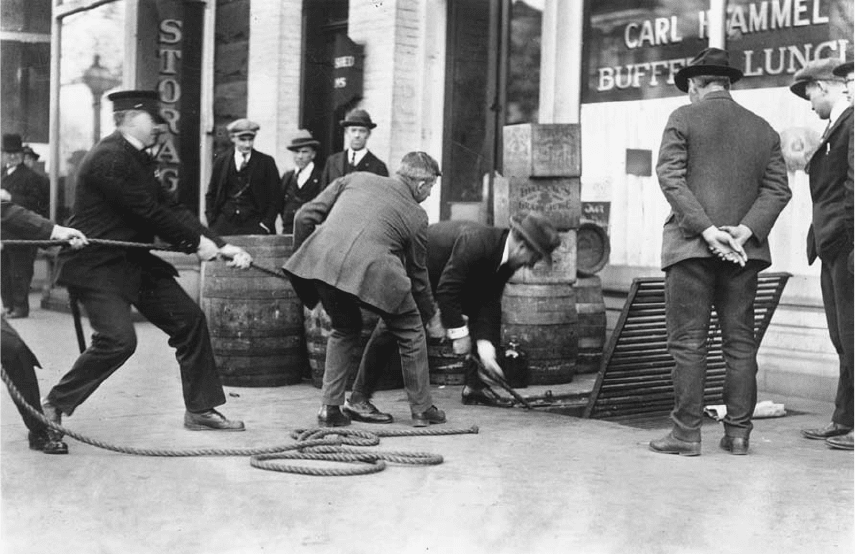
Law offi cials raid a cellar during Prohibition. (Library of Congress)
220 Eighteenth Amendment
xviii+446_EofUSConsti-v1.indd 220 3/12/09 3:04:46 PM
gests that it was perhaps drafted and evaluated in
haste, although the Anti-Saloon League insisted
that there had been 70 years of deliberate experi-
mentation with less drastic restrictions.
For all that support for Prohibition was wide-
spread, except in large cities, it was also some-
what thin and not always carefully considered.
Few people seem to understand that, in theory,
national Prohibition would be more comprehen-
sive than had been state prohibition. Although
two-thirds of the U.S. population was subject to
state prohibition in 1917, few states were bone
dry. Sale for beverage purposes was prohibited
within the state, but alcoholic beverages could
still be imported, for instance. While only manu-
facture, sale, and transportation of intoxicating
liquors for beverage purposes were prohibited by
the Eighteenth Amendment, a national ban posed
the fi rst serious threat to all access to alcoholic
beverages.
The focus of Prohibition rhetoric was the
saloon. The Anti-Saloon League, the most effec-
tive instrument in engineering passage of the
amendment, was the prototype of a single-issue
lobbying organization. Its general counsel, Wayne
Wheeler, drafted the language of the Eighteenth
Amendment and then, as the “dry boss,” as he
happily called himself, was the chief strategist of
its enforcement until his death in 1927. The Anti-
Saloon League refused to include in the amend-
ment any prohibition of drinking. Whether this was
because they thought that the American people in
general would not approve of such direct regula-
tion of personal behavior or that rich and powerful
Americans who could stockpile intoxicating bever-
ages would cease supporting Prohibition for their
employees, or whether they simply focused only
on stimulated public sale of alcoholic beverages or
some combination of these, is unclear.
As contemporary observers noted, national
Prohibition was simply another variation in a
long line of regulatory strategies. Only the man-
ufacture, sale, and transportation of intoxicating
liquors were prohibited and only for beverage
purposes. Such liquors, with restrictions, were
still available for medicinal and sacramental pur-
poses, exceptions which led to widespread evasion.
Cider was not banned, perhaps because it would
be impossible to prevent natural fermentation.
This led to allegations that the Volstead Act, the
congressional act enforcing Prohibition, permit-
ted the farmer his drink of choice, but it deprived
the urban worker of his beer. The prohibition of
sale but not consumption focused on commerce
in alcoholic beverages but invited charges that the
rich were permitted to stockpile while the poor
were deprived. Any fl exibility was criticized, per-
haps unfairly, as discriminatory.
Enforcement of Prohibition was also criticized.
First of all, it was pursued on the cheap, whether
because the Anti-Saloon League wanted to avoid
taxpayer resistance or because its supporters really
expected resistance to cease once the amend-
ment was enacted. States quickly abandoned any
enforcement efforts. The federal government fell
into a pattern of periodic sweeps accompanied by
over-sanguine predictions that enforcement, once
reorganized, would turn a corner and become
effective. The corner was never reached. Enforce-
ment was probably not helped by Wheeler’s refusal
to allow enforcement offi cers to be under civil ser-
vice protection. He thought this would permit the
selection of true believers and thus more effec-
tive enforcement (or perhaps, he just thought this
would facilitate his personal authority). The result
was a thriving patronage system. As Charles Merz
observed, Congress responded to evasion not by
funding more effective enforcement but by pass-
ing more punitive and unenforced laws. This only
highlighted the perceived gap between law and
practice and spurred a national lamentation about
American disobedience.
To call Prohibition a failure, however, is an over-
statement. Historians now conclude that increased
price and decreased availability did tend to reduce
access to alcoholic beverages, to the poor in par-
ticular. At the margin, abuse was reduced. Visits
to speakeasies were an item for conspicuous con-
sumption by the wealthy, whether male or female,
ending the homosociability of public alcoholic
beverage consumption. Urban defiance of Pro-
hibition, publicized by the press, which featured
glimpses of celebrity culture, led to an impression
that the law was being fl outed everywhere.
Eighteenth Amendment 221
xviii+446_EofUSConsti-v1.indd 221 3/12/09 3:04:47 PM