
Schultz D. Encyclopedia of the United States Constitution
Подождите немного. Документ загружается.

clause. Some have argued that a strict “neutrality”
interpretation of the establishment clause runs the
risk of violating the free exercise clause, particu-
larly as it applies to individuals in public positions
who wish to express religious views. And, what
does it mean to be neutral? Must all references
to God be deleted from public life? (The word
public in this sense refers to matters pertaining to
government property and personnel, not to activi-
ties in public view but on private property such
as a Nativity scene on a church lawn.) Some have
argued also that forbidding government-sponsored
religious activities in public schools and other gov-
ernment-owned facilities violates the free exer-
cise rights of students; however, the Court stated
that the free exercise clause “never meant that
a majority could use the machinery of the State
to practice its beliefs” (A
BINGTON TOWNSHIP V.
S
CHEMPP, 374 U.S. 203 [1963]). Finally, some have
argued that the Court was violating the establish-
ment clause when it used the free exercise clause
to allow minority religious groups to engage in
behavior not legal to the citizenry at large, such
as allowing Amish children to leave school after
the eighth grade in contradiction to compulsory
education laws.
Establishment clause cases generally fall into
two categories: those primarily involving fi nan-
cial outlays by government in support of religion
and those primarily involving symbolic support
in public schools and other public places. Early
fi nancial cases addressed the desire of parochial
schools to obtain state aid on the basis that by edu-
cating children, they were taking a burden off the
state. In the landmark Everson case, the Court,
despite its expansive defi nition of the establish-
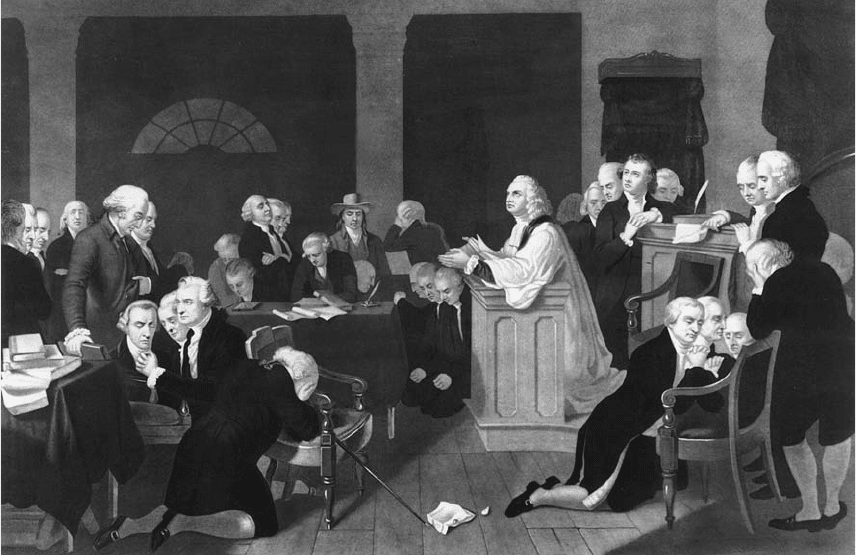
A prayer opened the fi rst session of the Continental Congress, illustrating the complex relationship of religion
and government in the United States.
(Billy Graham Museum)
242 establishment clause
xviii+446_EofUSConsti-v1.indd 242 3/12/09 3:04:53 PM
ment clause, upheld money for bus transportation
to Catholic schools by reasoning that the money
benefi ted children directly. The Court later did
the same for the loan by the state of textbooks
to children. After that, the Court began to draw
the line, disallowing such items as instructional
materials or teacher salary supplements that ben-
efi ted the school more directly. The tide began to
turn, however, in Agostini v. Felton, 114 U.S. 2481
(1997), in which the Court, in a 5-4 decision, over-
ruled its position in Aguilar v. Felton, 105 U.S.
3232 (1985), and allowed government-provided
teachers to offer remedial education in parochial
schools. Meanwhile, the issue of vouchers to help
families who chose to educate their children in
parochial schools became a rallying cry not just
for Catholic schools but for conservative Protes-
tant schools. In Z
ELMAN V. SIMMONS-HARRIS, 536
U.S. 639 (2002), the Court upheld by a 5-4 vote
a voucher program for children in substandard
schools. To the four dissenters, this case in essence
overturned Everson.
A recent financially related but non-school-
related establishment clause issue about which
the constitutionality has yet to be resolved by
the courts is President George W. Bush’s “faith-
based initiatives.” Under this, for the fi rst time,
money is available to religious organizations to
use in providing social services without requiring
those organizations to maintain strict separation
between their social service activities and their
religious mission.
While fi nancial considerations have not been
absent from public school establishment clause
rulings, these cases have focused more often on
the use of state power via public school authorities
to endorse, support, and promote religion through
such activities as teacher-led prayer recitations and
the use of the government to promote the religion
of the majority, generally Protestant Christianity.
Major Supreme Court public school cases have
addressed released time for religious instruction
during the school day, various forms of offi cially
led or government-endorsed prayers in public
schools, restrictions on the teaching of evolution
and the required teaching of the biblical creation
story or some disguised variant of it, and posting
of the Ten Commandments. Lower courts have
dealt with an even wider assortment of variations
on these issues. With the exception of allowing
religious instruction outside the school building
but during the school day, the Court, although
often very divided, has taken a consistently sepa-
rationist position in its application of the establish-
ment clause to public schools. In cases involving
religious symbolism in public places, the Court has
been more sympathetic to the accommodationist
position, allowing, for example, prayers in state
legislatures or government-sponsored displays of
Nativity scenes, menorahs, or Ten Commandments
monuments, but only in situations in which they
can make a convincing argument that tradition or
context has the overall effect of secularizing what
would otherwise be considered religious.
The Court articulated in Lemon v. Kurtzman a
three-part test for establishment clause violations.
In essence, a government action must have a secu-
lar purpose and a primary effect that is secular,
and it may not become entangled with religion or
promote religious divisiveness. The purpose and
effect prongs were drawn from Abington Town-
ship v. Schempp, while the entanglement prong
came from Walz v. Tax Commissioner, 397 U.S.
664 (1970), in which the Court upheld the right
of governments to grant property tax exemp-
tions to churches under a concept of “benevolent
neutrality.”
Far from foolproof, the Lemon test soon proved
itself open to manipulation and criticism. In some
cases, both the majority and the dissent used the
Lemon test to try to prove their points. In others,
the Court just ignored it. Some justices began to
openly deride it in their opinions. Most colorfully,
Justice Antonin Gregory Scalia described it
as “like some ghoul in a late-night horror movie”
(L
AMB’S CHAPEL V. CENTER MORICHES UNION FREE
S
CHOOL DISTRICT, 508 U.S. 384 [1993]). While the
Lemon test has not been totally disavowed by the
Court, some justices have begun sending up trial
balloons with alternative tests, allowing for a more
accommodationist application of the establish-
ment clause.
establishment clause 243
xviii+446_EofUSConsti-v1.indd 243 3/12/09 3:04:54 PM
At the start of the 21st century, and with a
decidedly more conservative membership, the
Court appeared to be gradually reshaping its stan-
dards for judging establishment clause cases. It
is too soon to predict how dramatic any changes
might be; however, as America becomes more
religiously diverse, interpreting and applying the
establishment clause will probably continue to be
a challenge for government.
For more information: Davis, Derek. “Separa-
tion, Integration, and Accommodation: Religion
and State in America in a Nutshell.” Journal of
Church and State 43, no. 1 (Winter 2001): 5–17;
Formicola, Jo Renee, et al. Faith Based Initia-
tives and the Bush Administration: The Good,
the Bad, and the Ugly. Lanham, Md.: Rowman
& Littlefi eld Publishers, 2003; Morgan, Richard
E. The Supreme Court and Religion. New York:
Free Press, 1972; Witte, John, Jr. Religion and the
American Constitutional Experiment. Boulder,
Colo.: Westview Press, 2000.
—Jane G. Rainey
Everson v. Board of Education 330 U.S. 1
(1947)
In Everson v. Board of Education, the Supreme
Court held that the government could reimburse
parents for the cost of sending their children to
Catholic schools on public buses.
The case arose from a New Jersey law that
allowed local school districts to provide transpor-
tation to and from public, private, and religious
schools. One local school district authorized a
transportation subsidy for parents who sent their
children to a religious school via public buses. A
local taxpayer sued, claiming that this practice vio-
lated the establishment clause of the First
Amendment.
In an opinion by Justice Hugo Black, the
Supreme Court held that the establishment clause
means, at a minimum, that neither a state nor
the federal government can set up a church. Fur-
thermore, government cannot pass laws that aid
religion, force a person to go to or not to go to
a church against their will, or force a person to
profess belief or disbelief in any religion. Adopt-
ing Thomas Jefferson’s metaphor, Justice Black
explained that the establishment clause erects a
wall of separation between church and state,
which must be “high and impregnable.” Even the
slightest breach of that wall of separation would
be unconstitutional.
Justice Black explained, however, that the
establishment clause does not prohibit a state from
spending tax-raised funds to pay for transporta-
tion of students at religious schools if it is part of a
general program under which it pays for the trans-
portation of students attending public and other
private schools. This subsidy was similar to provid-
ing ordinary government services such as fi re and
police protection, which could not be denied to
schools simply because of their religious nature.
The Court held that the First Amendment merely
required a state to be neutral toward religion, not
to be against it. Here, New Jersey did not con-
tribute any money or in any way support Catholic
schools; it simply provided a transportation pro-
gram to help children get to their schools. The law
was therefore constitutional.
Justice Wiley B. Rutledge dissented, argu-
ing that the subsidy supported religion via use of
the taxing power. In Justice Rutledge’s view, the
objective of the establishment clause was to cre-
ate “a complete and permanent separation of the
spheres of religious activity and civil authority by
comprehensively forbidding every form of public
aid or support for religion.” Government aid to
religion had no less destructive force than state
interference with religious practice: “Establish-
ment” and “free exercise” are similar ideas and
represented merely different facets of the single
great and fundamental freedom.
For more information: Hunt, Thomas. Religion
and Schooling in Contemporary America. New
York: Garland Publishing, 1997.
—Winston E. Calvert
Ewing v. California 538 U.S. 11 (2003)
A companion case with Lockyer v. Andrade,
538 U.S. 63 (2003), Ewing v. California upheld
244 Everson v. Board of Education
xviii+446_EofUSConsti-v1.indd 244 3/12/09 3:04:54 PM
California’s three strikes law against an Eighth
Amendment cruel and unusual punishment
challenge. The California law required defendants
with two or more “serious” or “violent” felony
convictions be sentenced to life imprisonment.
Though the Supreme Court was split, fi ve justices
found that California’s legislature was within its
constitutional boundaries when deciding that
“three strikes and you’re out” was a constitutional
way of dealing with the problem of recidivism.
The litigation commenced when Gary Ewing,
while out on parole from a nine-year prison term,
stole three golf clubs from a pro shop. He was
charged with and convicted of grand theft, a fel-
ony. Under California law, trial courts have discre-
tion in reducing some felonies to misdemeanors so
as to escape the three strikes sentence. Therefore,
Ewing, having four previous felony convictions,
asked the trial court to reduce his conviction to a
misdemeanor. The judge refused, and Ewing was
sentenced to 25 years to life in prison. The Califor-
nia court of appeal affi rmed the trial judge’s deci-
sion, and the California Supreme Court denied
review. The U.S. Supreme Court then granted
Ewing’s petition for certiorari.
In announcing the judgment of the Court and
writing a plurality opinion that also included Chief
Justice William Hubbs Rehnquist and Justice
Anthony M. Kennedy, Justice Sandra Day
O’Connor declared California’s three strikes law
did not violate the Eighth Amendment’s propor-
tionality principle. In other words, the California
legislature was within its discretion in deciding
that lengthy prison sentences for criminals who
commit numerous violent felonies fit the sever-
ity of the crime. Furthermore, Justice O’Connor
wrote, the state law “refl ects a rational legislative
judgment, entitled to deference, that offenders
who have committed serious or violent felonies
and who continue to commit felonies must be
incapacitated.”
Both Justice Antonin Gregory Scalia
and Justice Clarence Thomas wrote concur-
ring opinions. Justice Scalia agreed that the three
strikes law did not violate the Eighth Amendment,
but he chastised the plurality for applying the con-
cept of proportionality to prison sentences, since,
in his view, the proportionality requirement only
applied to retributive punishments such as execu-
tions. Justice Thomas wrote to express his view
that the Eighth Amendment does not include a
proportionality requirement and that the Court’s
attempt to decipher one has been a failure.
Justices John Paul Stevens, David H.
Souter, Ruth Bader Ginsburg, and Steven G.
Breyer dissented. Writing the principal dissent,
Justice Breyer concluded that Ewing’s sentence
was “grossly disproportionate” and, therefore,
violative of the Eighth Amendment’s prohibition
on cruel and unusual punishments. Particularly
troublesome to the dissenters was that between
1945 and 1994, when the three strikes law was
enacted, “no one like Ewing could have served
more than 10 years in prison.” Recidivists served
shorter terms than Ewing’s 25 years, and the 25
years to life in prison sentence has traditionally
been reserved for criminals “convicted of crimes
far worse than Ewing’s.”
Ewing v. California might be best understood
as another example of the Rehnquist Court’s
conservative tilt on law and order issues. Unlike
the more liberal Warren Court, the Rehnquist
Court has been more willing to allow states to fash-
ion unique remedies to the problems of crime.
For more information: Delaney, Blake J. “A
Cruel and Unusual Application of the Proportion-
ality Principle in Eighth Amendment Analysis:
Ewing v. California (2003).” Florida Law Review
56 (2004): 459–469.
—Kyle L. Kreider
exclusionary rule
The exclusionary rule provides that evidence
obtained by police officers in violation of the
Fourth Amendment prohibition of unreason-
able searches and seizures is not admissible in a
criminal trial to prove guilt. The rule was applied
by the U.S. Supreme Court to the states in Mapp
v. Ohio, 367 U.S. 642 (1961). The primary pur-
pose of the exclusionary rule is to deter police
misconduct. While some proponents argue that
the rule emanates from the Constitution, the
exclusionary rule 245
xviii+446_EofUSConsti-v1.indd 245 3/12/09 3:04:54 PM
Supreme Court has indicated it is merely a judi-
cially created remedy for violations of the Fourth
Amendment.
Application of the exclusionary rule may
lead to the exclusion of important evidence and
the acquittal of persons who are factually, if not
legally, guilty. Consequently, the rule has been
the subject of intense debate. Proponents argue
it is the only effective means of protecting indi-
vidual rights from police misconduct, while critics
decry the exclusion from trial of relevant evi-
dence. Despite calls for its abolition and shifts in
the composition of the Supreme Court, the exclu-
sionary rule remains entrenched in American
jurisprudence. But while the rule has survived, it
has not gone unscathed. Supreme Court decisions
have limited the scope of the rule and created sev-
eral exceptions.
In W
EEKS V. UNITED STATES, 232 U.S. 383 (1914),
the Supreme Court held that evidence illegally
obtained by federal law-enforcement offi cers was
not admissible in a federal criminal trial. At the
time, the Fourth Amendment did not apply to the
states. Because the Weeks decision applied only
to the federal government, state law-enforcement
offi cers were still free to seize evidence illegally
without fear of exclusion in state criminal pro-
ceedings. Additionally, evidence seized illegally by
state police could be turned over to federal law-
enforcement offi cers for use in federal prosecu-
tions as long as federal offi cers were not directly
involved in the illegal seizure. This was known as
the “silver platter doctrine.”
In W
OLF V. COLORADO, 338 U.S. 25 (1949), the
Supreme Court applied the Fourth Amendment
to the states, incorporating it into the due pro-
cess clause of the Fourteenth Amendment;
however, the Court refused to mandate the rem-
edy of the exclusionary rule. Just three years later,
the Court modifi ed its position somewhat, hold-
ing in Rochin v. California, 342 U.S. 165 (1952),
that evidence seized in a manner that “shocked
the conscience” must be excluded as violative of
due process under the Fourteenth Amendment.
Exactly what type of conduct shocked the con-
science was left to be determined on a case-by-
case basis. The exclusionary rule thus became
applicable to state criminal proceedings, but its
application was uneven.
Finally, in 1961, in Mapp v. Ohio, 367 U.S. 643
(1961), the Court took the step it failed to take
in Wolf and explicitly applied the remedy of the
exclusionary rule to the states. The Court did so
because it acknowledged that the states had failed
to provide an adequate alternative remedy for vio-
lations of the Fourth Amendment.
The Supreme Court, in Mapp, stated that the
exclusionary rule serves at least two purposes: the
deterrence of police misconduct and the protec-
tion of judicial integrity. In recent years, however,
the Court has focused almost entirely upon the
deterrence of police misconduct, leading to the
creation of several exceptions to the rule. Addi-
tionally, the Court has held that the exclusionary
rule does not apply to a variety of proceedings
other than the criminal trial.
In Massachusetts v. Sheppard, 468 U.S. 981
(1984), the Supreme Court held that evidence
obtained by the police acting in good faith on a
search warrant issued by a neutral and detached
magistrate, that is ultimately found to be invalid,
may nonetheless be admitted at trial. The Court
stressed that the primary rationale for the exclu-
sionary rule—deterrence of police misconduct—
did not warrant exclusion of evidence obtained by
police who act reasonably and in good faith reli-
ance upon the actions of a judge. By “good faith,”
the Court meant the police were unaware that the
warrant was invalid.
The Court emphasized that the good faith
exception did not apply to errors made by the
police, even if the errors were entirely inadver-
tent. The exception applies only to situations
where the police relied on others who, it later
turns out, made a mistake. Subsequent cases reit-
erated this point. In Illinois v. Krull, 480 U.S. 340
(1987), the Court extended the good faith excep-
tion to instances where the police act in reliance
on a statute that is later declared unconstitutional.
In Arizona v. Evans, 514 U.S. 1 (1995), the Court
refused to apply the exclusionary rule to evidence
seized by a police offi cer who acted on reliance of
a computer entry, made by a court clerk, that was
later found to be in error.
246 exclusionary rule
xviii+446_EofUSConsti-v1.indd 246 3/12/09 3:04:54 PM
The Court has also established the “inevitable
discovery” exception to the exclusionary rule. This
exception, developed in Nix v. Williams, 467 U.S.
431 (1984), permits the use at trial of evidence
illegally obtained by the police if they can dem-
onstrate that they would have discovered the evi-
dence anyway by legal means. The burden is on
the police to prove they would in fact have dis-
covered the evidence lawfully even if they had not
acted illegally.
The Supreme Court has been reluctant to
extend the reach of the exclusionary rule to pro-
ceedings other than the criminal trial. The Court
has consistently refused to apply the exclusionary
rule to evidence seized by private parties if they
are not acting in concert with or at the behest of
the police. The rule does not apply to evidence
presented to the grand jury. An unlawful arrest
does not bar prosecution of the arrestee, as the
exclusionary rule is an evidentiary rule rather
than a rule of jurisdictional limitation. The rule is
inapplicable in both civil tax assessment proceed-
ings and civil deportation proceedings. The exclu-
sionary rule does not apply to parole revocation
hearings.
The Court has also been reluctant to apply the
exclusionary rule to aspects of the criminal trial
that are not directly related to the determination
of guilt. Thus, illegally obtained evidence may
be used to impeach a defendant’s testimony or
to determine the appropriate sentence for a con-
victed defendant.
The exclusionary rule has aroused much debate
since its application to the states some 40 years
ago. The rule remains in place, although its appli-
cation has been limited and exceptions created.
Nonetheless, the rule still has a major and con-
tinuing impact on police practices, acting as the
primary constraint on unlawful searches and sei-
zures. No other remedies have proven effective at
deterring police misconduct.
The Supreme Court has refused numerous
opportunities to discard the rule, so as long as
the exclusionary rule exists, it will serve, to some
extent, as a limitation on police overreaching. It
will also continue to result in the freeing of some
“guilty” people. It is both the reward and the price
we pay for living under a government of limited
powers.
For more information: Amar, Akhil Reed.
The Constitution and Criminal Procedure. New
Haven, Conn.: Yale University Press, 1997; del
Carmen, Rolando V. Criminal Procedure: Law
and Practice. 7th ed. Belmont, Calif.: Wadsworth/
Thomson, 2006; Hemmens, Craig, John Wor-
rall, and Alan Thompson. Criminal Justice Case
Briefs: Signifi cant Cases in Criminal Procedure.
Los Angeles: Roxbury, 2004.
—Craig Hemmens
executive orders
Executive orders are documents that the president
of the United States issues unilaterally that have
the force of law. They are one of some two dozen
types of unilateral presidential directives, another
of which is proclamations, that are legally identical
to executive orders and often used interchangeably
(Wolsey v. Chapman, 101 U.S. 755 [1879]). Execu-
tive orders are an important tool of the presiden-
tial office and have figured in many interesting
moments in American political history.
There is no official definition of executive
orders; there is no law, nor even an executive order,
that defi nes what an executive order is. They are
written documents that the president designates
as such and that direct the actions of government
offi cials or bodies. Executive orders help the chief
executive manage the enormous executive branch
of the federal government. Many executive orders
are for minor administrative matters, but others
have a dramatic impact on government and soci-
ety. Since executive orders give presidents the
means to enact binding public policies by a mere
stroke of the pen, presidents have often used them
to circumvent Congress and the rigors of the nor-
mal policy-making process.
Just as there is no strict defi nition of executive
orders, there is also some ambiguity with regard
to their formatting, numbering, and cataloging.
Several executive orders have proscribed the for-
mat for future executive orders, but these norms
are routinely ignored, and in practice, executive
executive orders 247
xviii+446_EofUSConsti-v1.indd 247 3/12/09 3:04:55 PM
orders vary greatly in terms of form and style. The
U.S. government’s cataloging of executive orders
is spotty, as hundreds or even thousands of early
executive orders have been lost forever. Indeed,
the government’s offi cial sequential numbering of
executive orders starts only with one of Abraham
Lincoln’s directives, ignoring all earlier orders
and even some subsequent ones. In 1935, the
hundreds of executive orders issued by Franklin
Roosevelt made the government’s poor account-
ing of executive orders acutely problematic, so
Congress required that all future executive orders
and proclamations be published in the Federal
Register. Today, executive orders from 1933 to
the present—at least those that are not secret and
classifi ed—can be found online via the National
Archives.
Executive orders are not mentioned in the
Constitution, but they may be justifi ed in terms
of the broad grant of executive power and other
ambiguous phrases that can be construed to con-
fer power on the president in Article II of the
U.S. Constitution. Courts have held that execu-
tive orders cannot contradict a clear constitutional
provision or the expressed will of Congress (a law).
However, there is a great deal of leeway between
those two limits, and presidents have issued exec-
utive orders for a host of purposes that are politi-
cally and constitutionally controversial. Executive
orders can be justifi ed in terms of the president’s
constitutional authority or can be authorized by
legislation calling for some particular presidential
action or determination, but many executive orders
do not invoke any specifi c justifi cation. The legis-
lative and judicial branches can overturn execu-
tive orders, but they seldom do so. The Supreme
Court’s decision to strike down Harry Truman’s
executive order seizing the nation’s steel industry
(Y
OUNGSTOWN SHEET & TUBE V. SAWYER, 343 U.S.
579 [1952]) is an exception to the rule that the
other branches generally do not resist presidential
lawmaking by executive order. Future presidents
can issue executive orders to overturn their prede-
cessors’ executive orders, and they often do so.
Virtually every president has issued execu-
tive orders or similar directives. Early examples
include George Washington’s Neutrality Proc-
lamation and Abraham Lincoln’s Emancipation
Proclamation; however, executive orders were
generally used infrequently before the 20th cen-
tury. There was a large increase in their use under
Theodore Roosevelt, who utilized them for land
conservation and various other matters. The num-
ber of executive orders issued continued to climb
through the presidency of Franklin Roosevelt, who
used them to fi ght the depression and to prosecute
World War II, including ordering the internment
of some 120,000 Americans of Japanese descent
in 1942. There has been a drop-off in the number
of executive orders issued from the postwar era
to the present, from a couple hundred a year to
just a couple dozen. Nevertheless, presidents since
the mid-20th century have issued executive orders
for many important purposes, including to deseg-
regate the military, to establish the Peace Corps
and affirmative action, to prohibit the United
States from assassinating foreign political leaders,
to limit or alter governmental regulations, to cre-
ate new executive agencies, to establish national
monuments, and to advance certain positions
about abortion, organized labor, and environ-
mental protection. Despite periodic outcries over
particular executive orders, they continue to be
an important and powerful presidential tool in the
21st century.
For more information: Cooper, Phillip J. By
Order of the President: The Use and Abuse of
Executive Direct Action. Lawrence: Univer-
sity Press of Kansas, 2002; Dodds, Graham G.
“Executive Orders Since Nixon.” In Executing the
Constitution. New York: State University of New
York, 2006; Mayer, Kenneth R. With the Stroke of
a Pen. Princeton, N.J.: Princeton University Press,
2001; U.S. House Committee on Governmental
Operations. “Executive Orders and Proclama-
tions: A Study of a Use of Presidential Powers,
1945–1956.” December 1957.
—Graham G. Dodds
Ex parte Grossman 267 U.S. 87 (1925)
In Ex parte Grossman, the Supreme Court ruled
that the pardoning power of the president of the
248 Ex parte Grossman
xviii+446_EofUSConsti-v1.indd 248 3/12/09 3:04:55 PM
United States extended to include the pardoning
of an individual who had been held in contempt
of court. The case is signifi cant because it helped
defi ne the constitutional breadth of the power of
the president to pardon individuals.
Ex parte Grossman involved Philip Grossman,
an individual who was charged in November 1920
with the offense of maintaining a nuisance at his
business by selling alcoholic beverages in violation
of the National Prohibition Act (better known as the
Volstead Act) and the Eighteenth Amendment.
The district court judge issued a restraining order,
yet two days after the order, Grossman was charged
with selling liquor to people on the premises of his
business. He was arrested, tried, and convicted
of contempt of court for ignoring the restraining
order. He was sentenced to one-year imprisonment,
to be served in the Chicago House of Corrections,
and ordered to pay court costs and a fi ne of $1,000
to the United States. The circuit court of appeals
affi rmed the lower court decision.
In December 1923, President Calvin Coolidge
issued Grossman a presidential pardon (commuta-
tion) under the condition that Grossman pay the
$1,000 fi ne. Grossman accepted the pardon and
its conditions. In May of the following year, the
district court, ignoring the presidential pardon,
ordered Grossman imprisoned in the Chicago
House of Corrections. The case was appealed to
the Supreme Court.
The question before the Court in this situation
was, Did the president have constitutional powers
to commute Grossman’s sentence for contempt of
court? According to Section 2, Clause 1 of Arti-
cle II of the U.S. Constitution, “The Presi-
dent . . . shall have power to grant Reprieves and
Pardons for Offences against the United States,
except in Cases of Impeachment.” The Court con-
cluded, in a unanimous decision, the pardon for
criminal contempt of court was in the purview
of the powers granted to the president by the
Constitution.
For more information: Schwartz, Bernard. A
History of the Supreme Court. New York: Oxford
University Press, 1993.
—Dan Krejci
Ex parte McCardle 74 U.S. 506 (1869)
In Ex parte McCardle, the Supreme Court ruled
that it lacked the jurisdiction to hear a habeas
corpus petition by an individual even though
it had already heard oral arguments in his case.
McCardle is considered important because it
affirms the broad power of Congress to affect
or change the appellate jurisdiction of the
Supreme Court.
After the Civil War, over President Andrew
Johnson’s veto, Congress adopted the Recon-
struction Acts imposing military rule in the South.
Military rule would be lifted only if new constitu-
tions were adopted, elections were held, and the
Southern states accepted both the Thirteenth
Amendment and Fourteenth Amendment,
abolishing slavery and guaranteeing rights to for-
mer slaves, respectively. Constitutional conven-
tions required approval in elections in which a
majority of eligible voters cast ballots, and some
Southern whites attempted to block new conven-
tions by refusing to vote.
William McCardle, the editor of the Vickburg
(Mississippi) Times, wrote fi ery editorials urging
whites to boycott the voting and, some believed,
threatening harm to whites who did vote. McCa-
rdle was charged before a military commission
with impeding Reconstruction. He sought a writ
of habeas corpus in federal court under an 1867
law that had been passed to assure court proceed-
ings to free the families of slaves who had enlisted
in the Union Army. The lower court denied a writ
of habeas corpus, and McCardle appealed to the
Supreme Court.
The Supreme Court heard arguments in the
fi rst week of March 1868. Fearful that the Court
would strike down military reconstruction in the
South, Congress passed a law, over the veto of
President Johnson, that took away the Supreme
Court’s habeas corpus jurisdiction under the 1867
law. On April 6, the Court adjourned without
deciding the McCardle case. Justices Robert Coo-
per Grier and Stephen Johnson Field stated that
the Court should have reached a decision.
More than a year later, the Court heard argu-
ments about whether the repeal of its habeas cor-
pus jurisdiction could affect a case it had already
Ex parte McCardle 249
xviii+446_EofUSConsti-v1.indd 249 3/12/09 3:04:55 PM
heard. On April 12, 1869, the Court announced
that the congressional repeal of jurisdiction had
deprived the Court of its authority. Article III
of the U.S. Constitution allows Congress to
“make exceptions to the appellate jurisdiction” of
the Supreme Court, and Congress had done so.
In Ex parte McCardle, Chief Justice Salmon P.
Chase declared for a unanimous Court that the
justices would not look into the motives of Con-
gress. It was enough that Congress had exercised
its constitutional authority. “Jurisdiction is the
power to declare the law,” the chief justice said,
“and when it ceases to exist, the only function
remaining to the court is that of announcing the
fact and dismissing the cause.” Within weeks, in a
private letter, the chief justice disclosed his view
that if the Court had decided the McCardle case,
it “would doubtless have held that his [McCardle’s]
imprisonment for trial before a military commis-
sion was illegal.”
The Court was careful in McCardle not to con-
cede that Congress could deprive it completely
of all habeas corpus jurisdiction. Instead, Chief
Justice Chase warned that the 1868 congressional
action took away only the Court’s habeas corpus
jurisdiction granted in the 1867 law, but “it does
not affect the jurisdiction [over habeas corpus]
that was previously exercised [by the Court].”
In later cases, including Ex parte Yerger, 75
U.S. 85 (1869), and Felker v. Turpin, 518 U.S. 651
(1996), the Court avoided a confrontation with
Congress over the underlying issue in McCardle—
whether Congress can deprive the Court entirely
of jurisdiction in certain kinds of cases—by fi nd-
ing that the Court retained jurisdiction under
other existing laws.
For more information: Fairman, Charles. His-
tory of the Supreme Court of the United States.
Vol. 6: Reconstruction and Reunion, 1868–88.
New York: Macmillan: 1971.
—David Adamany
Ex parte Milligan 71 U.S. 4 Wall. 2 (1866)
In Ex parte Milligan, the Supreme Court ruled
that an American citizen could not be tried by
military commission when the civil federal courts
were open and operational. The significance of
the Milligan decision was that it limited the ability
of the president to try American citizens without
all the constitutionally protected guarantees when
accused of a crime.
In March 1863, Congress passed an act autho-
rizing the suspension of the writ of habeas cor-
pus by the president during the ongoing rebellion.
The following September, Abraham Lincoln
suspended the writ of habeas corpus for cases con-
cerning prisoners of war, spies, and those aiding
and abetting the enemy, as well as for members of
the armed services accused of being in violation
of the laws of war. Lamdin P. Milligan was a resi-
dent of Indiana, a citizen of the United States, and
a civilian. He was arrested on October 5, 1864,
at his home and was tried by military commis-
sion. Milligan and four other conspirators were
accused of planning to liberate prisoners of war in
a Union prison and were charged with conspiracy
against the United States, inciting insurrection,
and violating the laws of war. Milligan was found
guilty of all charges and was sentenced to death
by hanging.
Justice David Davis wrote the majority opinion
for the Supreme Court and was joined by Justices
Nathan Clifford, Stephen Johnson Field, Robert
Cooper Grier, and Samuel Nelson. The Court
reversed the ruling of the military commission,
arguing that a civilian could not be denied a civil-
ian trial when the civil federal courts are opera-
tional. Furthermore, Davis held that military
commissions could not be organized in a state that
had not been invaded and had not been engaged
in the rebellion. The Court held that military com-
missions could not be used to try a citizen that was
not a resident of a rebellious state nor a prisoner
of war and had no affi liation to the military of the
United States. Furthermore, Congress could not
grant such power to the executive to create the
commissions in question.
Chief Justice Salmon P. Chase wrote a dissent,
joined by Justices James Moore Wayne, Noah
Haynes Swayne, and Samuel Freeman Miller,
believing that military commissions were indeed
allowed to be set up by Congress. Chase reiterated
250 Ex parte Milligan
xviii+446_EofUSConsti-v1.indd 250 3/12/09 3:04:56 PM
that the Constitution grants Congress the author-
ity to make rules concerning the government of
the army and navy, as well as the authority to set
up courts inferior to the Supreme Court. One
such court that can be set up is a military com-
mission if the conditions of war require it. Chase
placed emphasis on the power of Congress, not
the courts, to decide whether the conditions of
war require such action.
Overall, Milligan appears to be an important
statement by the Court, protecting individual
rights as well as limiting the power of the execu-
tive in times of war. However, since this time, the
federal courts have decided cases more in line with
Chase’s dissent rather than the Court opinion,
stating that if Congress authorizes the commis-
sions, they stand up to judicial scrutiny (as in Ex
parte Quirin, 317 U.S. 1 [1942], and Eisentrager
v. Johnson, 339 U.S. 763 [1950]). Even Hamdan
v. Rumsfeld, 548 U.S. 557 (2006), in which the
Court stated that the military commissions of the
George W. Bush administration were not constitu-
tionally authorized, could have stood up to judicial
scrutiny had Congress given more explicit authori-
zation for their establishment.
For more information: Fisher, Louis. Presi-
dential War Power. Lawrence: University Press
of Kansas, 2004; Henkin, Louis. Constitutional-
ism, Democracy, and Foreign Affairs. New York:
Columbia University Press, 1990; Henkin, Louis.
Foreign Affairs and the United States Constitu-
tion. Oxford: Clarendon Press, 1996.
—Amanda DiPaolo
Ex parte Young 209 U.S. 123 (1908)
In Ex parte Young, the Supreme Court held that
the Eleventh Amendment does not prevent
suits against state offi cials for prospective injunc-
tive relief, even if that injunctive relief would
enjoin an offi cial state policy.
Around the turn of the 20th century, Minnesota
passed a law limiting railroad rates. The railroads
believed these regulations were unconstitutional
and sought to prevent their enforcement, but get-
ting the case to court was problematic. Although
ordinarily someone could have violated the law
and challenged its validity when arrested, Min-
nesota had an inordinately large fine of $2,500
for each violation and imprisonment for as long
as fi ve years. Because of this, the railroads were
unlikely to fi nd anyone willing to test the validity
of the law. Instead, the shareholders of the rail-
roads brought a lawsuit in federal court seeking an
injunction against the attorney general of Min-
nesota, Edward Young, individually, to prevent
him from enforcing the state law. Young claimed
that granting the injunction would be a violation
of the Eleventh Amendment and Minnesota’s sov-
ereign immunity.
A full understanding of the importance of Ex
parte Young requires a basic understanding of the
Supreme Court’s reading of the Eleventh Amend-
ment. The text of the Eleventh Amendment reads:
“The Judicial power of the United States shall
not be construed to extend to any suit in law or
equity, commenced or prosecuted against one of
the United States by Citizens of another State.”
Despite the plain language of the amendment,
in Hans v. Louisiana, 134 U.S. 1 (1890), the
Supreme Court held that the Eleventh Amend-
ment expressed a broader concept of sovereign
immunity. This principle protects states from suits
in federal court not only by citizens of other states
but also from suits by a state’s own citizens.
Unwilling to completely trust the states to
uphold the Constitution and the civil rights
of its citizens (as was the case of Jim Crow laws),
the Supreme Court has devised limited exceptions
to this broad concept of sovereign immunity. The
most important of these exceptions was announced
in Ex parte Young. The Supreme Court held that
neither the Eleventh Amendment nor the principle
of sovereign immunity barred suits for prospective
injunctive relief against state offi cers. In so hold-
ing, the Court created a legal fi ction. Because a
state can give no offi cer the power to act contrary
to the Constitution, when a state offi cer does act
contrary to the Constitution, he is stripped of state
power and can no longer hide behind the state’s
immunity from suit in federal court. The Supreme
Court, speaking through Justice Rufus Wheeler
Peckham, held: “The act to be enforced is alleged
Ex parte Young 251
xviii+446_EofUSConsti-v1.indd 251 3/12/09 3:04:56 PM