
Schultz D. Encyclopedia of the United States Constitution
Подождите немного. Документ загружается.

clause posed a threat to the free exercise of chil-
dren wanting morning devotionals.
The Schempp ruling met with substantial pub-
lic criticism. Some school districts stubbornly
continued religious exercises, and others started
them. Yet, many religious leaders endorsed the
Court’s position.
For more information: Alley, Robert S. Without
a Prayer: Religious Expression in Public Schools.
Amherst, N.Y.: Prometheus Books, 1996; Ivers,
Gregg. Redefi ning the First Freedom. New Bruns-
wick, N.J.: Transaction Publishers, 1993; Morgan,
Richard E. The Supreme Court and Religion.
New York: Free Press, 1972.
—Jane G. Rainey
abortion
Abortion, a procedure used to remove an embryo
or fetus from its mother’s womb, is a hotly con-
tested political issue. In addition, abortion and its
regulation implicates numerous legal questions,
most particularly, whether the Constitution pro-
tects a woman’s decision to terminate a pregnancy
and the rules the government may place on a
woman who makes this choice.
Throughout much of the 19th century, the
United States placed no national legal restrictions
on obtaining an abortion in the fi rst few months
of pregnancy. Not until the 1830s did state gov-
ernments begin to enact bans on abortion after
quickening (the first notice of fetal movement
during a pregnancy). In the Civil War era, the
American Medical Association (AMA) lobbied
and persuaded most state governments to outlaw
abortions, based on fears that abortions were not
being performed safely. In 1873, Congress passed
the Comstock Act, which banned any mail or
mail advertisements about objects used for abor-
tion or contraceptive purposes as well as drugs or
medicines.
Throughout the fi rst half of the 20th century,
little attention was devoted to abortion politics;
however, in the mid-1960s, in response to back-
alley deaths and unsanitary, illegal abortion pro-
cedures, pro-choice groups began to push for
abortion law reform. In response, many states
started allowing therapeutic and elective abor-
tion procedures. These early reformers argued for
abortion reforms on health grounds such as saving
the life or preserving the mental or physical health
of the mother. However, the political discourse on
abortion was headed for a dramatic change with
the fi ling of R
OE V. WADE.
One of the most controversial cases of the
20th century, Roe v. Wade, 410 U.S. 113 (1973),
involved the constitutionality of the 1857 Texas
statute that banned abortion except to save the
mother’s life. The U.S. Supreme Court declared
the Texas law unconstitutional, claiming that state
laws outlawing or restricting access to abortion
violated a constitutional right to privacy. Jus-
tice Harry Blackmun, writing for the majority,
devised a trimester formula to balance a wom-
an’s right to end her pregnancy and a valid state
interest in protecting potential human life. In the
fi rst trimester (fi rst three months) of pregnancy,
the abortion decision is left to the medical judg-
ment of the woman and her assisting physician. In
the second trimester, the state may regulate the
abortion procedure in the interest of the mother’s
health. During the third trimester, the state may
regulate or even prohibit abortions to protect the
life of a fetus, and late-term abortions would be
allowed only when necessary to protect the life or
health of the mother.
With this sweeping decision, the Supreme
Court renewed the abortion debate. Now, every
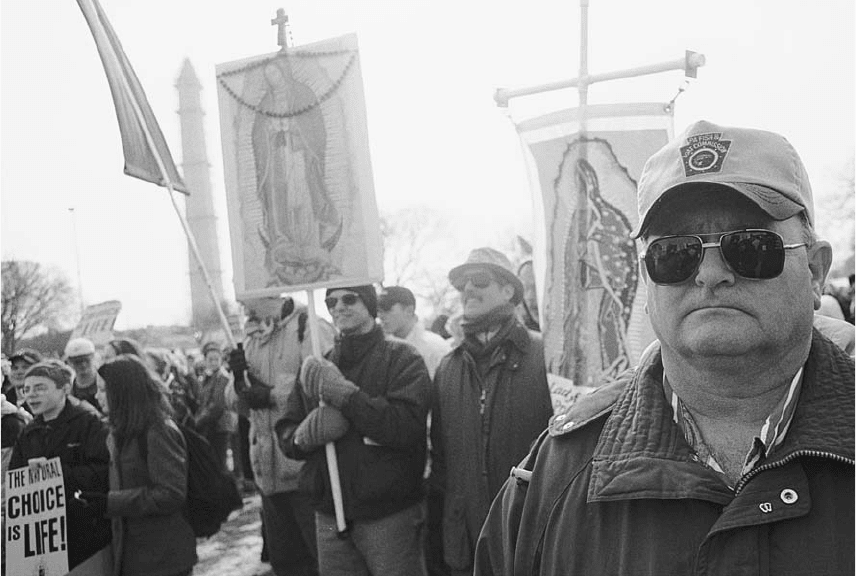
year on January 22, the anniversary of the Roe
decision, antiabortion proponents protest on the
U.S. Capitol steps by calling for the protection
of the lives of the unborn, and pro-choice advo-
cates make speeches about maintaining the right
to reproductive freedom for women. Since Roe,
abortion politics has become more polarized
and contentious than ever. In a 2006 CNN–USA
Today–Gallup poll, about half of Americans
labeled themselves “pro-choice,” while 42 per-
cent called themselves “pro-life.” Almost 60 per-
cent of Americans favor keeping abortion legal by
supporting the laws as they currently stand or by
making access to abortions less cumbersome. A
large majority of Americans favor keeping abor-
2 abortion
xviii+446_EofUSConsti-v1.indd 2 3/12/09 3:03:35 PM
tion legal if necessary to preserve the mother’s
life, when the mother’s mental health is threat-
ened, or when the pregnancy occurred due to
rape or incest. Support drops off when women
seek elective abortions for reasons such as fi nan-
cial hardship or a genetic defect of the fetus. An
extraordinary majority of Americans support leg-
islation to ban the controversial “partial-birth”
late-term abortion procedure unless the proce-
dure is necessary to save the mother’s life. Despite
the controversy over abortion since the Roe rul-
ing, most Americans oppose efforts to overturn
the decision and return to the pre-Roe era.
Since Roe, the U.S. Supreme Court has been
embroiled in numerous abortion disputes about
when and under what circumstances a woman
may obtain an abortion. One major challenge to
Roe came in P
LANNED PARENTHOOD V. CASEY, 505
U.S. 833 (1992). In Casey, the state of Pennsylva-
nia enacted a series of abortion restrictions requir-
ing parental consent, informed consent, a 24-hour
waiting period, and spousal notifi cation prior to
obtaining an abortion. Antiabortion advocates
hoped that this case would result in the overturn
of Roe. Although the Court did not overturn Roe,
it abandoned the trimester formula by holding
that any abortion restriction that placed an undue
burden on a woman’s right to an abortion would
be struck down. An undue burden was defi ned as
one which put a substantial obstacle in a woman’s
path who sought to have an abortion of a nonviable
fetus. Of Pennsylvania’s abortion restrictions, only
the spousal notifi cation requirement was struck
down as unconstitutional under the undue bur-
den standard.
Many states, heartened by the Casey ruling,
developed laws regulating and limiting access to
abortion, such as requiring that an abortion be
On the anniversary of Roe v. Wade, thousands of antiabortion protesters gather outside the White House
before the start of a rally in Washington, D.C.
(Jamal Wilson/Getty)
abortion 3
xviii+446_EofUSConsti-v1.indd 3 3/12/09 3:03:35 PM
performed by a licensed physician or in hospitals,
prohibiting partial-birth abortions and abortions
when the fetuses are viable except when necessary
to protect a woman’s life, disallowing use of pub-
lic funds to provide abortions, allowing individual
health-care providers to refuse to insure or per-
form abortion procedures, mandating counseling
for women considering an abortion, mandating
waiting periods for women who seek an abortion,
and requiring some kind of parental involvement
in a minor’s decision to get an abortion. Most of
these state restrictions have passed constitutional
muster, except for the bans on partial-birth or
late-term abortion.
In Stenberg v. Carhart, 530 U.S. 914 (2000),
the U.S. Supreme Court examined a Nebraska
law that criminalized partial-birth abortions. The
term, partial-birth abortion, generally refers to
the dilation and extraction (D & X) procedure
in which a physician pulls all of the fetus’s body
except the head from the uterus and into the vagi-
nal canal. The fetus is then killed by extracting the
contents of the skull, and fi nally the entire fetus is
delivered. The Court held that the Nebraska law
was unconstitutional because it placed an undue
burden on a woman’s right to choose, it did not
provide for allowing the D & X procedure if the
woman’s life or health were at stake, and it was
too broad, possibly encompassing other abortion
procedures aside from the D & X. In February
2006, the Court indicated a willingness to revisit
this issue by reviewing a case in which a lower fed-
eral court blocked the enforcement of the Partial-
Birth Abortion Ban Act. Yet, in a closely divided
5-4 opinion, the Court, in G
ONZALEZ, ATTORNEY
GENERAL V. CARHART, 550 U.S. ___ (2007), reversed
the lower court and upheld the law. This decision
was the fi rst one ever to uphold the banning of a
specifi c abortion procedure.
Since the turn of the 21st century, both Con-
gress and the president have shared antiabortion
tendencies and have used their legislative and
executive powers to restrict access to abortion.
In 2001, President George W. Bush reinstated
the global gag rule, stopping 430 organizations in
50 countries from performing or speaking about
abortion if they wish to qualify for U.S. foreign
aid. In 2003, he signed the Partial-Birth Abortion
Ban Act, the fi rst federal ban on abortion since
Roe v. Wade was decided. Bush supported and
signed into law the Unborn Victims of Violence
Act in early 2004, which recognizes the embryo’s
rights as a person, separate and apart from the
mother. This law makes it a federal crime to harm
an embryo or fetus. Later in 2004, Congress
enacted and the president signed legislation that
allows health-care companies to deny insurance
coverage to women who seek abortion services.
In 2005, the House of Representatives passed the
Child Interstate Abortion Notifi cation Act, which
makes it a crime for any relative or counselor other
than the parents to accompany a minor across
state lines to obtain an abortion. Bush indicated
his support for this should it pass in the Senate. In
addition, President Bush nominated and the Sen-
ate confi rmed two new Supreme Court justices
on the bench—Chief Justice John G. Roberts,
Jr., and Justice Samuel Alito—who have dem-
onstrated hostility toward Roe v. Wade in their
writings.
In Gonzales, Attorney General v. Carhart, the
Supreme Court upheld the Partial-Birth Abortion
Ban Act in a 5-4 decision, with Justice Anthony
M. Kennedy writing the majority opinion. This
was the fi rst abortion procedure ban the Supreme
Court had upheld since it decided Roe.
Antiabortion and pro-choice groups remain
on high alert. Since the 1973 Roe ruling, all nine
of the original Roe justices have died or retired.
Thus, the abortion question is far from settled,
and Roe v. Wade could be signifi cantly modifi ed or
even overruled. The abortion controversy divides
people into seemingly irreconcilable camps of
those who sponsor family values and the rights of
the unborn versus those who champion women’s
individual rights and choice. Because the abortion
issue has been framed as a “rights” issue rather
than a matter of public health, common ground
and compromise in the political arena have been
almost impossible to attain.
For more information: Burns, Gene. The Moral
Veto: Framing Contraception, Abortion, and Cul-
tural Pluralism in the United States. New York:
4 abortion
xviii+446_EofUSConsti-v1.indd 4 3/12/09 3:03:36 PM
Cambridge University Press, 2005; Herring, Mark
Y. The Pro-Life/Choice Debate. Westport, Conn.:
Greenwood Press, 2003; Hull, N. E. H., William
James Hoffer, and Peter Charles Hoffer, eds. The
Abortion Rights Controversy in America: A Legal
Reader. Chapel Hill and London: University of
North Carolina Press, 2004; Jost, Kenneth. “Abor-
tion Debates.” CQ Researcher 13 (2003): 249–272;
Nossif, Rosemary. Before Roe: Abortion Policy in
the States. Philadelphia: Temple University Press,
2001; Smith, T. Alexander, and Raymond Tatalov-
ich. Cultures at War: Moral Confl icts in Western
Democracies. Peterborough, Canada: Broadview
Press, 2003; Strickland, Ruth Ann. “Abortion:
Pro-Choice versus Pro-Life.” In Moral Contro-
versies in American Politics, 3d ed., edited by
Byron W. Danes and Raymond Tatalovich, 3–35.
Armonk, N.Y.: M. E. Sharpe, 2005.
—Ruth Ann Strickland
abstention doctrine
Abstention denotes a collection of judicially cre-
ated rules under which a federal court that has
jurisdiction over a case will decline to exercise its
jurisdiction out of deference to ongoing or antici-
pated proceedings in state court. This doctrine is
supposedly rooted in the constitutional concept of
federalism, which requires the federal courts to
respect litigation already occurring in state legal
proceedings.
Abstention represents an exception to normal
principles of judicial administration. The usual
practice is that parties may fi le overlapping law-
suits in both the state and federal courts. Each
court can proceed with its case rather than stay-
ing its hand in favor of the other, at least until one
of the cases concludes. (Once one case concludes,
doctrines of preclusion may require the second
court to honor the fi rst judgment rather than reex-
amining the same issues.) Abstention is accord-
ingly reserved for special circumstances. Several
distinct varieties of abstention have developed and
merit discussion.
One doctrine, named Pullman abstention,
requires federal courts to refrain from deciding
difficult or controversial federal constitutional
questions when the constitutional ruling could be
rendered unnecessary by future state proceed-
ings. The doctrine takes its name from Railroad
Commission of Texas v. Pullman Co., 312 U.S.
496 (1941), which involved a challenge to a state
regulation that required trains with sleeping cars
to be staffed by white employees instead of only
black employees. The railroad and some black
employees sued in federal court, contending that
the regulation both exceeded the state agency’s
authority as a matter of state law and violated the
U.S. Constitution.
The Supreme Court determined that the fed-
eral district court should abstain from deciding
the case so that the unsettled state law question
could fi rst be litigated in the state courts. If the
state court decided that the agency had exceeded
its authority, then it would be unnecessary for
the federal court to decide the constitutional
questions. The Supreme Court believed this rule
would serve the goal of avoiding rulings on dif-
ficult and divisive constitutional questions and
would reduce friction between state and federal
courts. One disadvantage, of course, is that the
plaintiffs might have to go through two lawsuits to
get relief. Pullman abstention has become increas-
ingly rare in recent decades, as many states have
established procedures allowing federal courts to
“certify” questions to state courts (that is, send a
formal request for an opinion on a matter of state
law), thus eliminating the need for a separate law-
suit in state court.
Other abstention precedents require federal
courts to abstain in favor of pending state proceed-
ings when the federal case would interfere with a
complex state administrative scheme or involves
unsettled and especially sensitive questions of
state law. Unlike the case of Pullman abstention,
in these circumstances abstention is not motivated
by a desire to avoid a federal constitutional rul-
ing but is rather more directly concerned with
respecting state interests. Like Pullman absten-
tion, these types of abstention are rare.
A more consequential abstention doctrine is
Younger abstention, which takes its name from
Younger v. Harris, 401 U.S. 37 (1971). The Younger
doctrine generally forbids federal courts from
abstention doctrine 5
xviii+446_EofUSConsti-v1.indd 5 3/12/09 3:03:36 PM
interfering with a pending state court prosecution.
Thus, a criminal defendant with a potential federal
defense must present it to the state court rather
than fi ling a separate federal case trying to stop
the prosecution. (It should be noted that a fed-
eral statute, the Anti-Injunction Act, also restricts
the federal courts’ authority to halt state lawsuits;
the judicially created Younger doctrine applies
even when the statute does not.) Younger absten-
tion refl ects notions of respect for state courts as
well as the thought that an extraordinary remedy
such as an anti-suit injunction should not be
granted when the federal defense can be heard in
the due course of the state criminal proceedings.
Later cases have applied Younger abstention prin-
ciples to certain civil cases that resemble criminal
proceedings.
The various abstention doctrines are controver-
sial because Congress defi nes the jurisdiction of
the federal courts by statute (within the bounds
set out by the Constitution). Therefore, just as it
would be improper for a court to expand its own
jurisdiction by hearing cases that it is not empow-
ered to hear, some argue that it is equally improper
for a court to refuse to act when it has been given
jurisdiction.
For more information: Chemerinsky, Erwin.
Chapters 12–14 in Federal Jurisdiction. 4th
ed. New York: Aspen, 2003; Redish, Martin H.
“Abstention, separation of powers, and the lim-
its of the judicial function.” Yale Law Journal 94
(1984): 71–115.
—Aaron-Andrew P. Bruhl
accommodation
Accommodation in the parlance of modern juris-
prudence is the interpretation of the U.S. Consti-
tution’s religion clauses in deference to traditional
views of religious liberty. This involves conces-
sions for limited nonpreferential governmental
assistance of religion. Court allowances for neu-
trally based encouragement of religion reflect
an enduring American tradition of facilitating
religious expression while separating church and
state.
The First Amendment declares: “Congress
shall make no law respecting an establishment of
religion, or prohibiting the free exercise thereof
. . .” The U.S. Supreme Court understood these
clauses at face value for decades. In its fi rst case
involving the free exercise clause—Permoli v.
First Municipality of New Orleans, 44 U.S. (3
How.) 589 (1845)—the Court declared that the
Constitution “makes no provision for protecting
the citizens of the respective states in their reli-
gious liberties; that is left to the state constitutions
and laws. . . .”
Permoli continued to be the Court’s lens for
viewing the First Amendment’s religion clauses
until a litigious environment concerning religious
practices was well under way in the 1940s. World
Wars I and II elevated issues pertaining to reli-
gious oaths, religiosity in flag salutes, and reli-
giously based draft exemptions. Industrialization
and the nationalization of commerce pushed soci-
ety to defi ne the nature of employers’ and work-
ers’ rights in matters pertaining to Sunday closing
laws, employment benefi ts, and religious obser-
vances. The expansion of publicly funded educa-
tion raised questions about state aid to parochial
schools, released time from school for religious
studies, school prayer, and compulsory educa-
tion—each of these matters putting government
and religion on overlapping territory. Likewise,
government initiatives in medicine produced
controversy about vaccinations, blood transfu-
sions, and life-saving measures. Finally, ethnically
diverse immigration produced urbanization pat-
terns that heightened controversies over religious
solicitation, religious displays in public places, and
coercive religious expression in government-spon-
sored public forums.
The expansion of religiously fueled con-
flicts made the situation ripe for federal court
intervention, especially in instances where the
coercive powers of state governments were effec-
tively advantaging some sects at the expense of
others. Consequently, the U.S. Supreme Court
found pragmatic value in adjusting its longstand-
ing jurisprudence, finding cause to incorporate
the due process clause of the Fourteenth
Amendment against the religion clauses of the
6 accommodation
xviii+446_EofUSConsti-v1.indd 6 3/12/09 3:03:36 PM
First Amendment. Initially, this jurisprudential
adjustment was not viewed as hostile to religion
since the Court was in the process of applying the
due process clause to other parts of the Bill of
Rights, an endeavor highlighted by Justice Benja-
min N. Cardozo in P
ALKO V. STATE OF CONNECTICUT,
302 U.S. 319 (1937). The purpose of the Court’s
adjustment was to make the religion clauses bind-
ing upon state and local governments as well as
the federal government. As a consequence, reli-
gion began losing its place of policy privilege in
the states; however, the trend stabilized in the
1980s and has since readjusted slightly toward
accommodation.
Accommodationists generally seek to prevent
the secular state from encroaching on the place
of religion in the public square. They argue that
courts ought to give equal treatment or even pref-
erential treatment to religious free exercise and
expression in circumstances where religious rights
clash with other private rights. Many accommo-
dationists—legal scholars, political scientists, and
government officials—believe that the modern
state threatens the church more than the church
threatens the state; hence, where roles overlap,
they believe religion ought to be shown deference
on a nonpreferential basis except in instances
where state interests have compelling value. Tra-
ditional accommodationists recognize that purely
theoretical arguments can put the interests of
atypical religions on equal footing with tradi-
tional Western religions; as a result, some of these
accommodationists elevate the historic role of
culturally embedded religion (de facto religion) in
America, creating, in essence, a bias or preference
for Christianity.
The ideal of separationism exists in contrast to
notions of accommodation. Separationists aspire
not only to separate the affairs of church and state
but to prevent public religion from impinging on
freedom of choice and a wide range of possibili-
ties for private conduct. Separationists, while not
monolithic in their philosophy, tend to believe that
the autonomy of the individual is of overriding
importance in establishing the relative priority of
competing rights. Freedom of the individual usu-
ally therefore trumps preferences or claims of reli-
gious community—a libertarian ideal. However,
separationists tend to affi rm the rights of nontra-
ditional religious communities against the estab-
lishment power of Western traditional religions,
demonstrating that an affi nity for separation can
be strategic as well as philosophical. Strict sepa-
rationists claim both theoretical and empirical
support for state-constructed barriers between
religion and the state.
Interestingly, separationism sometimes accom-
modates traditional religious practices, especially
where state government compels religionists to
compromise their traditional religious practices.
This accommodationist form of separationism
is evident in some Supreme Court decisions,
most visibly in W
ISCONSIN V. YODER, 406 U.S. 205
(1972).
It is difficult to construct a constitutionally
viable and politically feasible jurisprudence of
pure accommodation or defi nitive separation. The
Court’s landmark rulings as well as pedestrian
decisions have bounced between the two poles,
refl ecting the change of personnel on the Court,
the idiosyncrasies of the selected cases, political
pressures, and the emergence of new interpre-
tive tools. Overall, the trend has been for the high
court to hybridize accommodation and separation,
producing a middle way that fi ts most Americans.
Some scholars assert that if there is a Jefferso-
nian wall of separation it has become a serpentine
wall of varied height, well riddled with breeches
and constructed from assorted materials. From
all appearances, the Court has rationalized a set
of principles that regards the vulnerabilities, tra-
ditions, relative power, and fashionableness of
competing claims. Such assessments are hardly
derogatory to the work of the Court, the obser-
vations admitting the enormous challenges that
accompany the nationalization of religious, pri-
vate, corporate, and governmental rights.
Supreme Court cases that fi gure prominently
in accommodation jurisprudence would include
Cantwell v. Connecticut, 310 U.S. 296 (1940),
and E
VERSON V. BOARD OF EDUCATION, 330 U.S. 1
(1947): The former case nationalized free exercise
at the expense of the states, and the latter accom-
plished the same for disestablishment. Zorach v.
accommodation 7
xviii+446_EofUSConsti-v1.indd 7 3/12/09 3:03:37 PM
Clauson, 343 U.S. 306 (1952), is viewed as one of
the earliest Supreme Court decisions articulating
a principle of accommodation; in this instance, the
accommodation of a narrowly constructed school
released-time program for religious studies. It was
in this case that Justice William O. Douglas
constructed a conceptual divide between permis-
sible and impermissible accommodation, stating
that Americans are “a religious people” for whom
the accommodation of religion “follows the best of
our traditions.”
Sherbert v. Verner, 374 U.S. 398 (1963), is
important because it stood for three decades as
the central precedent in free exercise law. Sher-
bert was a separationist decision with elements
of accommodation, since it held that government
must show a compelling interest in any law or gov-
ernmental practice that puts a burden on religious
exercise. Widmar v. Vincent, 454 U.S. 263 (1981),
is noteworthy because it put the accommodation
of religious speech on the same footing as the pro-
tection of secular speech.
E
MPLOYMENT DIVISION V. SMITH, 494 U.S. 872
(1990), is widely viewed as a landmark case and
one founded on a tactical change by the Court
in its religion clause jurisprudence. In Smith,
federalism is substituted for exemptions when
generally applicable laws are neutral toward reli-
gion. This approach reduces the burden on gov-
ernment to show a compelling state interest when
its actions touch religious practice. The effect of
this jurisprudence is to place greater responsibil-
ity on state legislatures and less burden on courts
in working out confl icts that involve religious free
exercise.
Since Smith, other Court decisions such as
C
ITY OF BOERNE V. FLORES, 521 U.S. 507 (1997),
have upheld the Smith logic, notwithstanding the
efforts of the U.S. Congress in the early 1990s to
resurrect a pre-Smith approach to accommoda-
tion by means of the now largely unconstitutional
Religious Freedom Restoration Act (1993).
While the long-term future of accommodation
will refl ect the evolution of American culture, the
near-term prospects for accommodation are favor-
able. This is owed to the ideologically conserva-
tive disposition of the emerging Court majority
and the tendency of America to place religion in
its abiding self-image.
For more information: Finkleman, Paul, ed.
Religion and American Law: An Encyclope-
dia. New York: Garland Publishing, 2000; Perry,
Michael J. Under God? Religious Faith and Lib-
eral Democracy. New York: Cambridge University
Press, 2003.
—Timothy J. Barnett
Adams, John (1735–1826) fi rst U.S. vice
president, second U.S. president
John Adams was the second president of the
United States and was one of the Founding Fathers
and Revolutionary War heroes who had an enor-
mous infl uence upon the Constitution, especially
in his 1776 booklet Thoughts on Government and
his 1787 book A Defence of the Constitutions of
Government of the United States.
Adams was a blunt-speaking politician and bril-
liant political philosopher who rose to become the
second president of the United States of America,
and his impact on the formation of the country
was as profound as Thomas Jefferson’s, George
Washington’s, and James Madison’s. Adams was
born to a Massachusetts Bay family in 1735 and
obtained a law degree from Harvard. He served
nobly at the First (1774) and Second (1777) Con-
tinental Congresses as a delegate from Massachu-
setts while furthering his career as international
statesman while representing the emerging
democracy abroad.
The Revolutionary War had earlier taken him
overseas, during which time he mastered the for-
eign service both in Holland and then in France.
Through his leadership and efforts, he forged a
peace treaty with Britain and then returned
home from his post at the English court of St.
James’s. When Washington was elected president
in 1788, he was by his side as the duly elected vice
president for the fi rst term. His ego drove him
to restlessness, and his lust for action and creation
in contrast to the boredoms of his double-termed
vice presidency shine through in several of his
personal writings of the period.
8 Adams, John
xviii+446_EofUSConsti-v1.indd 8 3/12/09 3:03:37 PM
Adams rose to the presidency in 1797, and Jef-
ferson, who lost the popular election by three elec-
toral votes to Adams, became the vice president.
Adams served with Alexander Hamilton in
his corner and Jefferson in the other through the
turbulent times of the war between France and
Britain that challenged both American trade and
loyalties. The diffi culties of the relationship with
France became evident politically when the coun-
try suspended trade relations with the United
States and refused to receive the American dip-
lomatic corps. Adams seized the opportunity and
used the French alienation to high degree when he
exposed the French request for what amounted to
a bribe in order to begin commercial negotiations.
As a spokesman for his party, he stood the test
of scrutiny, gaining a fervent group of followers,
which allowed him unparalleled political success
within the Congress and the emerging democ-
racy, as well as voracious challengers from the
Republican Party. Adams successfully obtained
powers to create a provisional army, build war-
ships (with the power to add more), impose taxes,
and even get the foreigner unfriendly Alien and
Sedition Acts passed.
Adams’s contributions to the Constitution are
varied. His Thoughts on Government is consid-
ered a classic of American political thought. In it,
he defends a mixed theory of government that calls
for several distinct national institutions to form the
basis of a national government. Many attribute the
eventual development of the bicameral legis-
lature and separation of powers idea to Adams.
A Defence of the Constitutions of Government of
the United States criticized the weakness of state
governments and paralleled Madison’s call for a
stronger national government. Adams’s support for
the Alien and Sedition Acts facilitated the devel-
opment of free speech and First Amendment
ideas. The acts prompted Madison and Jefferson
to write the Virginia and Kentucky Resolutions in
opposition, laying the groundwork for those who
viewed these acts as unconstitutional violations of
free speech.
For more information: McCullough, David.
John Adams. New York: Simon & Schuster, 2001;
Ryerson, Richard Alan, ed. John Adams and the
Founding of the Republic. Boston: Massachusetts
Historical Society, 2001.
—Ernest Gomez
Adarand Constructors, Inc. v. Peña 515
U.S. 200
(1995)
In Adarand Constructors, Inc. v. Peña, the
Supreme Court ruled on the issue of the proper
level of scrutiny for analyzing governmentally
imposed racial classifi cations, including remedial
measures such as affirmative action. In a 5-4
plurality opinion, Justice Sandra Day O’Connor
wrote that all racial classifi cations imposed by any
federal, state, or local governmental actor must be
analyzed by the reviewing court under a strict
scrutiny standard.
Adarand Constructors, Inc., was the low bidder
on the guardrail portion of a highway construction
project that a division of the U.S. Department of
Transportation had awarded to prime contractor
Mountain Gravel & Construction Company. How-
ever, because the prime contract’s terms provided
that Mountain Gravel would receive additional
compensation if it hired subcontractors certi-
fied as small businesses controlled by “socially
and economically disadvantaged individuals,”
Adarand lost the subcontract to Gonzales Con-
struction Company. Federal law required that a
comparable subcontracting clause be included in
most federal agency contracts, and the clause had
to state that “[t]he contractor shall presume that
socially and economically disadvantaged individu-
als include Black Americans, Hispanic Americans,
Native Americans, Asian Pacifi c Americans, and
other minorities. . . .” Adarand claimed that this
presumption discriminated on the basis of race
in violation of the Fifth Amendment. Both the
district court and the Tenth Circuit upheld the
contract provision as constitutional, the court of
appeals holding that the Supreme Court’s deci-
sion in F
ULLILOVE V. KLUTZNICK (1980), further
developed in M
ETRO BROADCASTING, INC. V. FCC
(1990), established “a lenient standard, resembling
intermediate scrutiny” for evaluating federal race-
based action.
Adarand Constructors, Inc. v. Peña 9
xviii+446_EofUSConsti-v1.indd 9 3/12/09 3:03:37 PM
However, the Court plurality now repudiated
Fullilove and Metro Broadcasting to the extent
that they differentiated between federal and state
racial classifi cations. Noting that the Court had
already held in C
ITY OF RICHMOND V. J. A. CROSON
C
O. (1989) that the Fourteenth Amendment
requires strict scrutiny of all race-conscious action
by state and local governments, Justice O’Connor
wrote that three general principles compel a simi-
lar outcome for federally imposed classifi cations:
1) skepticism, based on the concept that “any
preference based on racial or ethnic criteria must
necessarily receive a most searching scrutiny”; 2)
consistency, which requires that the standard of
equal protection review should not depend
“on the race of those burdened or benefi ted by a
particular classifi cation”; and 3) congruence, which
dictates that Fifth Amendment equal protection
analysis should mirror that under the Fourteenth
Amendment.
In so holding, the Court finally resolved an
issue in contention since the plurality decision
in R
EGENTS OF THE UNIVERSITY OF CALIFORNIA V.
B
AKKE (1978), namely, the proper level of analy-
sis for remedial race-based governmental action.
Regardless of whether imposed by the federal or
a state or local governmental actor, any racial clas-
sifi cation, whether arguably benign or not, must
be narrowly tailored to serve a compelling gov-
ernmental interest.
Not surprisingly, in light of the fact that the
Court had been unable for almost two decades
to reach a consensus on the appropriate level of
analysis for racial distinctions made for remedial
purposes, the concurring and dissenting opinions
in Adarand were highly charged. Justice Anto-
nin Gregory Scalia opined in his concurrence
(contradicting Justice O’Connor’s claim that strict
scrutiny was not necessarily “strict in theory, but
fatal in fact”) that governments could “never have
a ‘compelling interest’ in discriminating on the
basis of race in order to ‘make up’ for past racial
discrimination in the opposite direction. Justice
Clarence Thomas in his concurrence went even
further and claimed that there was a constitutional
and moral equivalence between “laws designed to
subjugate a race and those that distribute benefi ts
on the basis of race in order to foster some cur-
rent notion of equality.” Justice John Paul Ste-
vens, joined in his dissent by Justice Ruth Bader
Ginsburg, offered a particularly stinging rebuke,
asserting that while one might reasonably dispute
the effi cacy of affi rmative action programs, “[i]t
is another thing altogether to equate the many
well-meaning and intelligent lawmakers and their
constituents—whether members of majority or
minority races—who have supported affirma-
tive action over the years, to segregationists and
bigots.”
Ultimately, it appears for the most part that Jus-
tice O’Connor’s, not Justice Scalia’s viewpoint, has
prevailed. At least some lower courts have found
that some governmental programs, primarily fed-
eral, have met the strict scrutiny test by showing
the existence of private-sector discrimination that
a congressional affi rmative action provision was
intended to address. However, although strict
scrutiny may not always be “fatal in fact,” there
can be no denying that setting the constitutional
bar at the highest level has had a profound impact
on the once ambitious affi rmative action programs
of local, state, and federal governments.
For more information: Spann, Girardeau A. The
Law of Affi rmative Action: Twenty-Five Years of
Supreme Court Decisions on Race and Remedies.
New York: New York University Press, 2000.
—Virginia Mellema
Adderley et al. v. Florida 385 U.S. 39 (1966)
In Adderley v. Florida, the Supreme Court upheld
the conviction of the defendants on a charge of
trespassing at the county jail. In a 5-4 decision,
the Court ruled that the Florida trespass statute
was not void on the grounds of vagueness, an
infringement on the Civil Rights Act of 1964,
or a denial of due process, and that the convic-
tions did not unconstitutionally deprive the defen-
dants of their rights to freedom of speech, press,
assembly, or petition.
Harriet Adderley and 31 other students at
Florida A & M University left the school and pro-
ceeded to the jail to protest the arrest of other
10 Adderley et al. v. Florida
xviii+446_EofUSConsti-v1.indd 10 3/12/09 3:03:38 PM
Florida A & M students demonstrating against
racial segregation, including at the county jail in
Tallahassee. The students gathered on a nonpublic
jail driveway and the adjacent county jail property
and demonstrated against the arrest of their class-
mates by singing, clapping, and dancing. The sher-
iff advised the students that they were trespassing
and would have to leave or be arrested; those stu-
dents who did not leave were arrested and charged
with “trespass with a malicious and mischievous
intent.” The students were tried and convicted by
a jury in Leon County, Florida, and the convic-
tions were affi rmed by the Florida circuit court
and the Florida district court of appeals. The case
was then appealed and granted certiorari by the
U.S. Supreme Court.
Justice Hugo Black, writing for the fi ve-per-
son majority, found that the conviction should be
upheld because the students gathered at a facil-
ity that has a primary public function of security
and the public protest at the jail compromised that
essential function. The students argued that their
case was similar to Edwards v. South Carolina, a
case in which a number of students were arrested
after a protest at the South Carolina State House,
yet the court had found the function of the jail to
be a mitigating factor in this circumstance. The
Court also found in Adderley that no services or
accommodations were being denied by the actions
of the sheriff, thus the complaint of violation of the
Civil Rights Act of 1964 did not apply. The Court
ruled that the actual charges did not signal a clear
violation of due process and that the restriction
on assembly hereby ordered did not infringe upon
the speech, press, petition, or assembly rights of
the students.
The importance of this case emanates from
the legitimate restrictions that can be placed on
the freedom to assemble in order to protect the
public good. In this case, the Court found reasons
to place limits on the protest in order to protect
the larger public good of security for the com-
munity. The guidelines for granting a permit for
picketing and parading are spelled out as follows:
1) The permit must be reasonable, 2) it must be
precisely drawn (including the time, date, and
location of the march), and 3) it must be applied
fairly. These guidelines help to balance the right
to assemble with the broader concern of a peace-
ful community.
For more information: Emerson, Thomas. The
System of Freedom of Expression. New York: Ran-
dom House, 1971; Stone, Geoffrey. “Fora Ameri-
cana: Speech in Public Places.” Supreme Court
Review 233 (1974): 233–279.
—Kevin Anderson
Adkins v. Children’s Hospital 261 U.S. 525
(1923)
In Adkins v. Children’s Hospital, the Supreme
Court struck down a federal statute fi xing mini-
mum wages for women and children employed
within the District of Columbia. The Court
ruled Congress had violated the Fifth Amend-
ment by interfering with a “liberty of con-
tract” protected by the Fifth’s due process
clause. This case both discarded the decision set
forth in Muller v. Oregon, 208 U.S. 412 (1908),
which had allowed legislatures to provide special
protections for female employees, and began a 14-
year period in which the notion of substantive
due process reached its zenith.
In the latter part of the 19th century, the nation’s
rapid industrialization created political pressures
on both state legislatures and Congress to restrain
a multitude of business practices. When govern-
ments responded with various types of regulations
on businesses, corporations challenged the regu-
lations in court, arguing that this use of police
power unconstitutionally deprived them of the
“liberty” guaranteed by the due process clauses
of the Fifth and Fourteenth Amendments.
This doctrine, known as substantive due process,
included the concept that employers and employ-
ees have a constitutionally protected liberty to
form an employment contract free from legislative
interference. The Supreme Court fi rst announced
the liberty of contract in Allgeyer v. Louisiana,
165 U.S. 578 (1897), but did not hold that this lib-
erty was absolutely protected from governmental
regulation. For the next two decades, the Court
struck down some pieces of labor legislation and
Adkins v. Children’s Hospital 11
xviii+446_EofUSConsti-v1.indd 11 3/12/09 3:03:38 PM