
Schultz D. Encyclopedia of the United States Constitution
Подождите немного. Документ загружается.

and the heavy burden is upon the government to
demonstrate a rational and compelling interest in
making such a distinction. More specifi cally, the
trial court held that the state’s blanket ban on
public school teaching by aliens was unconstitu-
tionally “overbroad” because it did not take into
account the subjects being taught, the relation-
ship of the alien’s home country to the United
States, and the possibility of including an alien’s
loyalty statement in lieu of declaring his or her
intent to become a citizen.
Ambach appealed to the U.S. Supreme Court
asserting that the law was “rational” and that the
lower court had inappropriately applied strict
scrutiny. Writing for a fi ve-person majority, Jus-
tice Lewis Franklin Powell, Jr., reversed the
district court ruling, holding that the New York
law was indeed rational and that the lower court
had erred in applying the stricter standard. Powell
noted that while aliens living in the United States
are entitled to many of the rights of citizens, states
nevertheless have the right to restrict aliens where
there is a compelling interest in doing so. Accord-
ing to Powell, teachers are uniquely suited to serve
as role models for children. They instill attitudes
toward government, the political processes, and
the responsibility of citizenship. Given this unique
relationship and government’s demonstrated inter-
est in promoting good citizens, Powell stated it is
indeed rational for New York State to restrict public
school teaching to U.S. citizens or those who have
expressed a desire to become one. Joining Powell
were Chief Justice Warren Burger and Justices
Byron White, William Hubbs Rehnquist, and
Sandra Day O’Connor.
Justices Harry Blackmun, Thurgood Marshall,
John Paul Stevens, and William J. Bren-
nan, Jr., dissented. Justice Blackmun argued
in part that the law in question “sweeps indis-
criminately” against aliens and is not rational
because it fails to cover aliens teaching in New
York’s private and parochial schools. Blackmun
then compared Ambach to In re Griffi ths (1973),
a case in which the U.S. Supreme Court ruled
that qualifi ed aliens have a right to take the state
bar and practice law. According to Blackmun, “If
an attorney has a constitutional right to take a
bar examination and practice law, despite being
an alien, it is impossible for me to see why a resi-
dent alien, otherwise completely competent and
qualifi ed . . . is constitutionally disqualifi ed from
teaching in the public schools of the great State
of New York.”
Ambach was one in a series of cases where the
U.S. Supreme Court grappled with constitutional-
ity of state laws restricting alien actions. Examples
are Sugarman v. Dougall, 413 U.S. 634 (1973)—
in which the Supreme Court struck down a New
York law that banned aliens from civil service
employment—and Foley v. Connelie, 435 U.S.
291 (1978)—where the Supreme Court upheld a
New York regulation restricting employment of
state troopers to U.S. citizens.
For more information: Aleinikoff, Thomas Alex-
ander, David A. Martin, and Hiroshi Motomura.
Immigration and Citizenship: Process and Policy.
4th ed. St. Paul, Minn.: West, 1998; Bosniak,
Linda. “Membership, Equality, and the Differ-
ence That Alienage Makes.” New York University
Law Review 69 (1994): 1,047; Gordon, Charles,
Stanley Mailman, and Stephen Yale-Loehr. Immi-
gration Law and Procedure. New York: Matthew
Bender, 2001; Neuman, Gerald L. Strangers to
the Constitution: Immigrants, Borders, and Fun-
damental Law. Princeton, N.J.: Princeton Univer-
sity Press, 1996.
—Richard J. Hardy
amending the Constitution
Amending the U.S. Constitution refers to the
formal process of changing the document’s lan-
guage or provisions. When the Founding Fathers
framed the Constitution in 1787, they included
in Article V a process to make amendments to
it. The amending process is a means for enabling
the government to keep the Constitution ready
to meet challenges, both present and future,
striking a balance between entrenchment and
fl exibility.
The Founding Fathers believed that amending
a written constitution was just as much an exer-
cise of constituent power as framing and adopting
22 amending the Constitution
xviii+446_EofUSConsti-v1.indd 22 3/12/09 3:03:42 PM
one and that the people had an inalienable right
to alter or abolish an inadequate government. This
revolutionary generation also believed that the act
of revising a written constitution required corre-
sponding formality and diffi culty. Formal changes
to the Constitution should be made only when
the problem to be solved cannot be done so at the
administrative, statutory, or judicial level.
Article V was included to correct defects as
they became apparent or to adapt the Constitution
to changing circumstances. According to Article
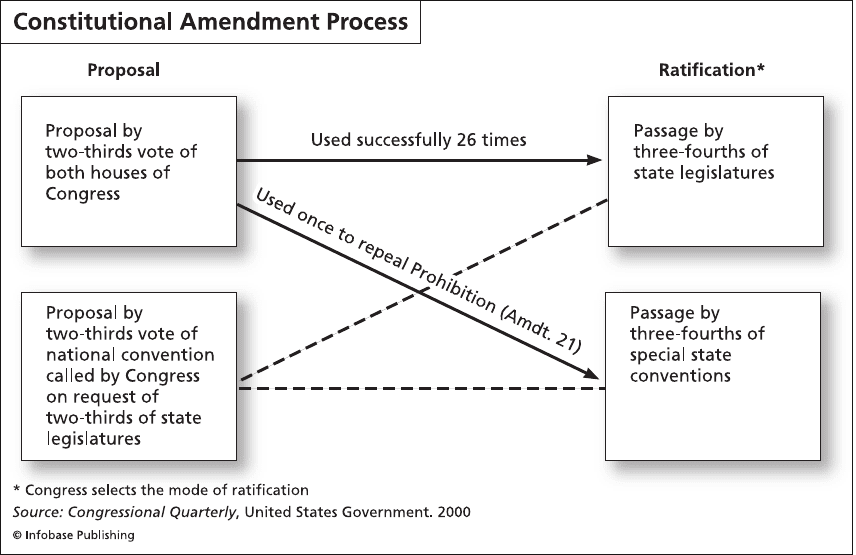
V, there are two ways to propose an amendment.
The fi rst method is for a bill to pass both houses
of the legislature by a two-thirds majority in
each. Once the bill has passed both the House
of Representatives and the Senate, it goes
to the states. The second method prescribed is
for a constitutional convention to be called by
two-thirds of the legislatures of the states and for
that convention to propose one or more amend-
ments. This method has never been used. Of the
17 amendments that have followed the Bill of
Rights, all have originated in Congress. Regard-
less of which proposed route is taken, the amend-
ment must be approved by three-fourths of the
states. The amendment as passed may specify
whether the bill must be passed by the state leg-
islatures or by a state convention. The Twenty-
first Amendment is the only one thus far to be
ratifi ed by specifi cally selected state conventions,
not state legislatures. At no time does the presi-
dent have a role in the amendment process. The
president cannot veto an amendment proposal
or ratifi cation.
Because the amending process was intention-
ally made to be difficult, of the 10,000 amend-
ments proposed, only 33 have received approval
by both the House and Senate, and just 27 have
been ratifi ed by the states. The amendments make
a statement to the world and to posterity about
what governmental principles the United States
most cherishes. They represent a kind of political
symbol of who Americans believe themselves to
be and ought to be. Twelve of the 27 amendments
amending the Constitution 23
(the Bill of Rights, the Thirteenth Amend-
ment, and the Fourteenth Amendment)
address individual rights.
The amendments that were adopted fall into
two categories: (1) defi ning or redefi ning the fun-
damental principles at the heart of the nation’s
constitutional system and (2) correcting defects in
the mechanism of government established by the
Constitution. Amendments to the Constitution
have come in separated clusters that have arisen
during four periods. The period from 1789 to
1804 produced what are referred to as the Anti-
Federalist amendments. The fi rst 10—the Bill of
Rights—adopted in 1791, were ratifi ed immedi-
ately and have been instrumental in protecting
basic liberties in the United States. These changes
were promises fulfi lled by the Federalists, who
made them to win ratification of the Con-
stitution itself. For all intents and purposes,
they are part of the original. The Eleventh
Amendment of 1795 protected universal loyalty
to states’ rights. It forbade lawsuits against a state
by citizens of another. The Twelfth Amend-
ment, adopted in 1804, provided for the separate
election of the president and vice president,
which was a reaction to the 1800 electoral college
tie between Thomas Jefferson and Aaron Burr.
It became a “fi x” of an unanticipated problem.
Sixty years elapsed before the Thirteenth,
Fourteenth, and Fifteenth Amendments were
passed. Known as the post–Civil War, or Recon-
struction, amendments, they sealed nationalism
by making U.S. citizenship the source of equal
rights and of protections that the states could not
deny. The Thirteenth Amendment, adopted in
1865, abolished slavery. In 1867, the Fourteenth
Amendment granted all citizens privileges and
immunities, due process, equal protection
under the law, apportionment of representatives,
and Civil War disqualifi cation and debt. The Fif-
teenth Amendment, adopted in 1870, guaranteed
that the rights of an individual could not be denied
because of race.
Another half-century intervened before the
ratifi cation of the Sixteenth through Nineteenth
Amendments. The Sixteenth Amendment,
adopted in 1913, provided for an income tax. The
Seventeenth Amendment, in 1913, provided
for the direct election of senators by the people.
In 1919, the Eighteenth Amendment called
for the prohibition of alcohol, and in 1920, the
Nineteenth Amendment provided women’s
suffrage. These four amendments were part of
the progressive and populist movements to curb
the power of corporations and political bosses and
restore government to the people.
The Twentieth Amendment proposed in
1932 and ratifi ed in 1933, ended the custom of a
“lame duck” Congress having an extra session after
an election that may have thrown out many of its
members. The Twenty-first Amendment,
which was ratifi ed in 1933 and was the only amend-
ment to be ratifi ed by state conventions, repealed
Prohibition. The Twenty-second Amendment
and Twenty-fifth Amendment, ratifi ed in 1951
and 1967, respectively, refl ected mid-20th century
concern with presidential succession. They lim-
ited a president to two terms and provided for his
replacement in case of disability. These are the only
amendments that do not fall into the four clusters.
The last cluster—which includes the Twenty-
third, Twenty-fourth, and Twenty-sixth
Amendment—gave the vote in presidential elec-
tions to the disenfranchised and predominantly
black citizens of the District of Columbia, to
men and women too poor to pay poll taxes or any
other kinds of levy as a prerequisite to suffrage,
and to 18-year-olds, respectively. These three
reflect the egalitarian strains of the 1960s and
might also be called the modern era of constitu-
tional amendment.
The most recent, Twenty-seventh Amend-
ment p
rovided that any pay raise that Congress
vo
tes for itself may not take effect until after
another election, thus giving voters a chance to
express their displeasure. This was sent to the
states in 1789 and ratifi ed two centuries later.
The exact wording of the Constitution can only
be changed by using the formal amendment pro-
cess; however, the meaning or the interpretation
of the Constitution can change over time. When
circumstances change, the meaning or interpreta-
tion can change as well. As the ultimate arbiter of
how the Constitution is interpreted, the judiciary
24 amending the Constitution
xviii+446_EofUSConsti-v1.indd 24 3/12/09 3:03:43 PM
wields more actual power than the Constitution
alludes to. For example, before the privacy cases,
it was perfectly constitutional for a state to forbid
married couples from using contraception, for a
state to forbid blacks and whites to marry, and for
a state to abolish abortion. Because of judicial
changes in the interpretation of the Constitution,
the nation’s outlook on these issues changed. In
these examples, the Constitution was not altered
but rather, the way people viewed the Constitu-
tion. These changes are signifi cant because they
can occur by a judge’s ruling; therefore, since they
are not a part of the written Constitution, they
can be changed later. Historically, the Supreme
Court has interpreted the original document and
its formal amendments with considerable latitude,
enabling adaptation to new circumstances and to
changes in social understanding without formal
amendments.
The Founding Fathers created a process that
provided an almost ideal balance between stabil-
ity and change. Constitutional amendments have
enduring and lasting importance in a system that
prizes America’s distinctive conception of sover-
eignty. The inclusion of Article V and its powerful
mechanisms are at the very core of the Constitu-
tion’s existence and survival.
For more information: Bernstein, R. B., and J.
Angel. Amending America: If We Love the Con-
stitution So Much, Why Do We Keep Trying to
Change It? New York: Times Books, 1993; Chism,
K. “The Constitutional Amendment Process.”
Social Education 69 (November 2005): 373–375;
Kaplan, D. A., and G. Cerio. “Tinkering with the
Constitution.” Newsweek (June 5, 1990), 115;
Kyvig, D. E. Explicit and Authentic Acts: Amend-
ing the U.S. Constitution, 1776–1995. Lawrence:
University of Kansas Press, 1996; Weisberger,
B. A. “Amending America.” American Heritage
(May/June 1995), 24–25.
—Sharon L. Morrison
American Civil Liberties Union
The American Civil Liberties Union (ACLU) is
a major national nonprofi t organization devoted
to protecting individual rights against unconsti-
tutional exercises of government power. It is best
known for bringing lawsuits, but it also monitors
and testifi es on legislation and offers public educa-
tion programming. The ACLU has approximately
500,000 members nationwide and affi liates (chap-
ters) in all 50 states and is fi nanced through mem-
bership dues, private donations, and legal fees
awarded when one of its lawsuits is successful and
such fees are available.
The organization that became the ACLU was
organized in 1917, during the height of the now
infamous Palmer Raids, “roundups” and depor-
tations of resident aliens suspected of holding
unorthodox or unpatriotic opinions. It was then
called the National Civil Liberties Bureau and
provided legal advice and aid for conscientious
objectors and people being prosecuted under the
Espionage Act of 1917 and the Sedition Act of
1918. In 1920, the organization changed its name
to the American Civil Liberties Union.
Sometimes called “liberty’s lawyer,” the ACLU
supports the individual liberties protected by the
Bill of Rights: separation of church and state,
freedom of speech and of the press, racial equality,
reproductive rights for women, full civil rights
for gays and lesbians, the Fourth Amendment
rights of criminal defendants and other citizens,
immigrants’ rights, the right to privacy, and
many others. Over the years, ACLU lawsuits have
had an enormous infl uence on U.S. constitutional
law. Some of the organization’s most famous cases
have included the 1925 Scopes case (Tennessee’s
prosecution of a science teacher who taught about
evolution despite a Tennessee law forbidding it);
K
OREMATSU V. UNITED STATES, 323 U.S. 214 (1944);
B
ROWN V. BOARD OF EDUCATION OF TOPEKA, 347 U.S.
483 (1954); and R
OE V. WADE, 410 U.S. 113 (1973).
More recently, it has vigorously opposed several
provisions of the PATRIOT Act and National
Security Agency (NSA) efforts to monitor the
communications of ordinary Americans.
As infl uential as its lawsuits have been, many
people (including many who often disagree with
the ACLU) believe the organization’s most impor-
tant function has been the mere fact that it exists
as a watchdog against abuses of government
American Civil Liberties Union 25
xviii+446_EofUSConsti-v1.indd 25 3/12/09 3:03:43 PM
power. Often, improper state and federal behavior
is averted simply because the ACLU sends a warn-
ing letter to the offi cial or agency involved.
The organization is very controversial. To some
extent, this is inevitable, because the Bill of Rights
that it protects was specifi cally designed to pro-
tect minority beliefs and unpopular people from
the passions of popular majorities. There is also
confusion about the difference between protect-
ing people’s rights and agreeing with them. Argu-
ing for an individual’s right to express an opinion
is not agreement with that opinion (the ACLU
has defended the rights of Nazis, for example, to
express opinions and take positions with which
the organization strenuously disagrees). When the
ACLU brings a lawsuit against prayers in public
schools, what the organization is opposing is not
religion but the right of government to dictate citi-
zens’ religious beliefs or observances.
For more information: Kennedy, Sheila Suess.
What’s a Nice Republican Girl Like Me Doing
at the ACLU? Amherst, N.Y.: Prometheus Books,
1997; Walker, Samuel. In Defense of American
Liberties: A History of the ACLU. Carbondale:
Southern Illinois University Press, 1999.
—Sheila Suess Kennedy
American Indians and the Constitution
The Constitution, in its expressed language and
through interpretation and application of several
of its provisions, has always treated American Indi-
ans differently from any other group of people.
Three-fi fths Compromise
Section 2 of Article I of the U.S. Constitu-
tion provides that representation in the House
of Representatives and direct taxes shall be
apportioned among the states according to their
respective populations. These numbers were to
“be determined by adding the whole Number of
free Persons, including those bound to Service
for a Term of Years, excluding Indians not taxed,
three-fi fths of all other persons.” The term other
persons was a euphemism for slaves, and the com-
promise was designed to accommodate the com-
peting concerns of southern and northern states
regarding an acceptable distribution of the direct
tax burden and representation in the House. Often
overlooked in this compelling debate about slavery
was the complete omission of Native Americans
in this calculation. American Indians as a whole
were not taxed at the time, and consequently, they
had neither a representative link to nor a particu-
lar stake in the new republic.
Commerce Clause
Article I, Section 8, provides that Congress shall
have the power to “regulate Commerce with for-
eign Nations, and among the several States, and
with the Indian Tribes.” Delegates to the Con-
stitutional Convention approached this
issue against a backdrop of years of hostilities with
American Indians on the one hand counterbal-
anced by a comparably long period of trade and
commerce with them on the other. Fractured
approaches to these issues by states had been
largely unsuccessful in producing lasting solutions.
These experiences informed the delegates that
uniform regulation, administered by a central-
ized federal authority, was essential. The result-
ing commerce clause was utilized quickly with
the passage, between 1790 and 1834, of several
Trade and Intercourse Acts (for example, 1 Stat.
137, 1790; 1 Stat. 329, 1793; 1 Stat. 469, 1796; 1
Stat. 743, 1799; and 4 Stat. 729, 1834). But the sig-
nifi cance of the commerce clause as it relates to
Native Americans advanced far beyond its original
parameters of trade and intercourse, for over time
it became a stepping-stone to the development of
the tremendous federal power over Indian affairs.
Conversely, it has in many respects served to pre-
clude state intrusion into Indian affairs.
Fourteenth Amendment
The Thirteenth, Fourteenth, and Fifteenth
Amendments, ratifi ed during the Reconstruction
era after the Civil War, were designed to establish
and protect the rights of black Americans. Accord-
ingly, Section 2 of the Fourteenth Amend-
ment revisited the Three-fi fths Compromise by
providing as follows: “Representatives shall be
apportioned among the several States according
26 American Indians and the Constitution
xviii+446_EofUSConsti-v1.indd 26 3/12/09 3:03:43 PM
to their respective numbers, counting the whole
number of persons in each State, excluding Indi-
ans not taxed.” Thus, the three-fi fths component
regarding slaves in the apportionment computa-
tion for representation in the House was abol-
ished; however, the exclusion of most Indians in
this computation continued.
Citizenship
Section 1 of the Fourteenth Amendment pro-
vides as follows: “All persons born or naturalized
in the United States and subject to the jurisdic-
tion thereof, are citizens of the United States and
of the State wherein they reside.” By design, this
provision extended national and state citizenship
to former slaves, but its broad language could cer-
tainly be construed to extend the same rights and
privileges to American Indians. The U.S. Supreme
Court rejected this position in Elk v. Wilkins, 112
U.S. 94 (1884), ruling that the “Indians not taxed”
exclusion retained in Section 2 of the amend-
ment refl ected a congressional intent to exclude
Native Americans from the grant of citizenship.
This exclusion was not a mere formality, for citi-
zenship was a prerequisite for other constitutional
rights, such as voting. Although the Fourteenth
Amendment did not extend blanket citizenship,
many American Indians attained citizenship sta-
tus under the provisions of various treaties and
statutes. These selective grants of citizenship
required some condition precedent on the part
of the Indians; for example, the General Allot-
ment Act, 24 Stat. 388 (1887), conferred citizen-
ship to American Indians who complied with the
statutory provisions and received an allotment.
Another piece of legislation bestowed citizenship
on Indian women who married non-Indian citi-
zens (25 U.S.C. Section 182 [1888]). These issues
and the impediments associated with them were
rendered moot with the passage of the Citizen-
ship Act of 1924 (8 U.S.C. Section 1401 (b)), which
extended citizenship to all Native Americans born
in the United States.
Treaty Making
Pursuant to Section 2 of Article II of the U.S.
Constitution, the president has the power, with
the advice and consent of the Senate, to make
treaties. Although this provision makes no specifi c
mention of American Indians, there was in fact a
long history of treating with tribes that predated
the Constitution. This policy was pursued by the
various colonial powers because Indian allies
were advantageous in their competition to estab-
lish dominance in the New World. After rati-
fication of the Constitution, the new and
vulnerable United States continued this policy in
order to cultivate trade, facilitate the acquisition
of land needed for white settlement, and avoid
the burdens, economic and otherwise, that would
accompany prolonged hostilities with the tribes.
For nearly 100 years thereafter, treaties were the
preferred national policy in dealing with Native
Americans, addressing a range of issues from
hunting and fi shing rights to removal and reloca-
tion, as well as reservations. This prolifi c treaty-
making era ended in 1871, when Congress, in a
rider attached to an appropriations bill, declared
that the United States would no longer contract
with Indian tribes by treaty (16 Stat. 566; 25
U.S.C. Section 71). One enduring legacy of this
period was that tribes were viewed as separate
and sovereign entities.
Tribal Sovereignty
As suggested above, the constitutional bases for
tribal sovereignty are anchored in the commerce
clause of Article I and in the treaty-making power
of Article II. The commerce clause, by group-
ing American Indian tribes with foreign nations
and the states, suggested that tribes were imbued
with a degree of inherent sovereignty comparable
to that of states and other nations. Similarly, the
national policy of making treaties with tribes, con-
ducted in much the same way as the nation entered
into treaties with foreign governments, reinforced
this attribute of tribal sovereignty. The parameters
of tribal sovereignty were fi rst addressed by the
Supreme Court in Cherokee Nation v. Georgia,
30 U.S. (5 Pet.) 1 (1831), a case in which the tribe
sought an injunction to prevent state incur-
sions into tribal territory. The Cherokee fi led their
action directly with the Supreme Court, invoking
the Court’s original jurisdiction as provided
American Indians and the Constitution 27
xviii+446_EofUSConsti-v1.indd 27 3/12/09 3:03:44 PM
in Article III, Section 2, of the Constitution. The
propriety of this tactic depended on whether the
tribe was a “foreign state.” The Court concluded
that, while the tribe was a separate entity with dis-
tinctive attributes of sovereignty, it was not a for-
eign state. Rather, Chief Justice John Marshall
characterized tribes as “domestic dependent
states.” Despite this and other setbacks, tribal sov-
ereignty continues as a viable, albeit limited con-
cept in today’s America.
Many tribes have their own governments, for
example, with legislative, executive, and judicial
branches. Some have their own police forces and
fi re departments and operate their own schools.
Also, some federal courts have ruled that viola-
tions of tribal law and federal law in one trans-
action amounted to two different offenses for
purposes of dual sovereignty and the double
jeopardy clause of the Fifth Amendment (Ramos
v. Pyramid Tribal Court, 621 F. Supp. 967, D.
Nev. [1985]). Consequently, those violations can
be prosecuted in both tribal and federal courts.
It must be remembered, however, that the extent
of tribal sovereignty must be measured against
a backdrop of tremendous federal power over
Indian affairs. In fact, this plenary power of the
federal government is the counterbalance to tribal
sovereignty, as well as to state efforts to intrude
into that sovereignty.
The federal government has wielded this
power to erode tribal sovereignty on some occa-
sions and to reinforce it on others. Erosion of
tribal sovereignty occurred, for example, with the
passage of Public Law 280, whereby the federal
government granted several states broad crimi-
nal and civil jurisdiction over reservations located
within those states (18 U.S.C. Section 1162 and 28
U.S.C. Section 1360 [1953]). On the other hand,
offi cial federal policy for the past 40 years or so
has been one of promoting tribal sovereignty and
self-determination. This endeavor, which almost
always includes governmental reinforcement of
tribal economic development, is often at odds
with the competing interests of state and local
governments. One emerging confl ict in this con-
text involves tribal gaming activities, an issue
addressed by the Supreme Court in California v.
Cabazon Band of Mission Indians, 480 U.S. 202
(1987). In that case, the tribe, pursuant to feder-
ally approved ordinances, operated high-stakes
bingo and card games. These activities were open
to the public and played mostly by non-Indi-
ans. State and local offi cials sought to prevent or
restrict these gaming activities via application of
various regulatory statutes and ordinances. They
argued that unregulated high-stakes bingo and
card games were susceptible to infiltration by
organized crime. The competing federal-tribal
interests focused on promoting tribal self-deter-
mination, providing employment opportunities
for tribal members, and generating revenue for
the tribe. The state maintained that it had juris-
diction because the gaming activities occurred on
Public Law 280 reservations. The Court rejected
this contention, ruling that while P.L. 280 ceded
jurisdiction over criminal cases and private civil
litigation, it did not grant the state general civil
regulatory authority.
The Court added that the state laws and local
ordinances were preempted by federal policy. This
preemption in turn reinforced tribal sovereignty.
In the aftermath of Cabazon, Congress passed
the Indian Gaming Regulatory Act, 25 U.S.C.
Sections 2701–2721 (1988), which established a
comprehensive framework for the regulation of
Indian gaming activities. By its express language,
the act is designed to strengthen tribal govern-
ment and promote tribal economic development
and self-suffi ciency (25 U.S.C. Section 2702). On
the other hand, the act does recognize that states
have legitimate interests that must be considered;
for example, it provides that tribes have the exclu-
sive right to regulate gaming activities that are
neither specifi cally prohibited by federal law nor
prohibited by the particular state’s criminal law
or public policy (25 U.S.C. Section 2701[5]). This
area of inquiry and the accompanying interplay
among federal, tribal, and state interests will most
certainly command attention in the future.
Bill of Rights
The Bill of Rights protected civil liberties
by limiting the powers of the federal government.
Most of those same protections were made appli-
28 American Indians and the Constitution
xviii+446_EofUSConsti-v1.indd 28 3/12/09 3:03:44 PM
cable to state action via the due process clause
of the Fourteenth Amendment and the judicially
created concept of selective incorporation. In
their relationships with the federal and state gov-
ernments, Native Americans enjoy these rights
and protections. Regarding these fundamental
rights, one area of prolifi c litigation has centered
on Indian use of peyote. The First Amendment’s
free exercise clause protects religious freedom,
and, in the exercise of that freedom, members of
the Native American Church have long used pey-
ote as a sacrament in religious ceremonies. More
recently, many states have added peyote to their
lists of controlled substances and proscribed its
use. One illustrative case involving these compet-
ing interests was E
MPLOYMENT DIVISION V. SMITH,
494 U.S. 872 (1990), in which two of the church’s
practitioners were terminated from their employ-
ment and denied unemployment benefi ts because
they had used peyote in religious services.
At the time, there was longstanding precedent
to the effect that governmental action that substan-
tially burdens religious practice must be justifi ed by
a compelling governmental interest (Sher-
bert v. Verner, 374 U.S. 398 [1963], and W
ISCONSIN
V. YODER, 406 U.S. 205 [1972]). The U.S. Supreme
Court departed from this compelling interest test
in Smith, holding instead that there was no viola-
tion of the First Amendment if the impediment to
the exercise of religion was not the object of the law
in question but “merely the incidental effect of a
generally applicable and otherwise valid provision”
(402 U.S. 872, 878). Congress responded to Smith
by passing the Religious Freedom Restora-
tion Act (RFRA), which prohibits government
from substantially burdening the free exercise of
religion unless it can demonstrate that the burden
is in furtherance of a compelling governmental
interest and is the least restrictive means of fur-
thering that interest (42 U.S.C. Section 2000bb-1).
As originally enacted, this prohibition applied to
all federal and state laws, with Congress relying
on Section 5 of the Fourteenth Amendment in
extending RFRA’s coverage to the states.
Section 5 empowers Congress to enforce, by
appropriate legislation, the amendment’s other pro-
visions, most notably the due process and equal
protection clauses. This is critical because, as
mentioned above, the Bill of Rights originally lim-
ited the federal government but had no applica-
tion to the states. The Fourteenth Amendment
provides in pertinent part that no “State shall
deprive any person of life, liberty, or property,
without due process of law. . . .” Over time, most
of the liberties contained in the Bill of Rights,
including the free exercise clause, were selectively
incorporated into the due process clause and
made applicable to the states. In C
ITY OF BOERNE
V. FLORES, 521 U.S. 507 (1997), the Supreme Court
ruled that RFRA was unconstitutional insofar as
it purported to bind the states. The Court deter-
mined that Congress in applying RFRA to state
action, had exceeded its enforcement power under
Section 5 and had in fact altered the meaning of
the free exercise clause. According to the Court,
this infringed on the interpretive power of the
judiciary and, thereby, violated the principle of
separation of powers and the federal-state bal-
ance. RFRA’s scope was subsequently narrowed
to cover only federal actions, and its application
to federal legislation was upheld in Gonzales v. O
Centro Espirita Beneficente Uniao Do Vegetal,
546 U.S. 418 (2006).
Indian Civil Rights Act
As noted above, Native Americans, in their rela-
tionships with federal and state governments,
enjoy constitutional rights and protections. Until
1968, however, there was no similar vehicle for
safeguarding fundamental rights against actions
by tribal governments. In Talton v. Mayes, 163
U.S. 376 (1896), the Supreme Court ruled that the
Bill of Rights did not apply to tribal governments,
and other courts have held that the Fourteenth
Amendment does not limit tribal authority (Barta
v. Oglala Sioux Tribe, 259 F.2d 533, 6th Cir.
[1958]). Consequently, American Indians, vis-à-vis
their relationship with tribal governments, had no
guarantees relative to these basic rights. Congress
addressed this discrepancy with the passage of the
Indian Civil Rights Act of 1968 (ICRA; 25 U.S.C.
Sections 1301–1323).
ICRA prevents tribes, in the exercise of their
powers of self-government, from denying to
American Indians and the Constitution 29
xviii+446_EofUSConsti-v1.indd 29 3/12/09 3:03:44 PM
individuals most of the rights contained in the
First, Fourth, Fifth, Sixth, Eighth, and Four-
teenth Amendments. These statutory rights, while
comparable to their constitutional counterparts,
are not exactly the same; for example, the First
Amendment guarantees the free exercise of reli-
gion and prohibits the establishment of religion.
ICRA includes a free exercise clause but contains
no establishment clause (25 U.S.C. Sec-
tion 1302 [1]). Consequently, tribal governments
may endorse a particular religion. In addition,
the Sixth Amendment has been interpreted to
require appointed counsel for indigent defendants
for all felonies (G
IDEON V. WAINWRIGHT, 372 U.S.
335 [1963]) and for many misdemeanors (Argers-
inger v. Hamlin, 407 U.S. 25 [1972], and A
LABAMA
V. SHELTON, 535 U.S. 654 [2002]). ICRA, on the
other hand, provides that a criminal defendant has
the right “at his own expense to have the assis-
tance of counsel for his defense” (25 U.S.C. Sec-
tion 1302 [6]).
For more information: Getches, David H.,
Charles Wilkinson, and Robert Williams, Jr. Fed-
eral Indian Law: Cases and Materials. St. Paul,
Minn.: West Publishing, 1993; Reese, Michael.
“The Indian Civil Rights Act: Confl ict Between
Constitutional Assimilation and Tribal Self-Deter-
mination.” Southeastern Political Review 20:
29–61.
—Michael Reese
appellate jurisdiction
Appellate jurisdiction is the power of one court
or other entity to review the actions of another
body. The power to hear cases regarding federal
constitutional and statutory issues is allocated to
the U.S. Supreme Court, the inferior (or lower)
federal courts, and the various state court systems.
The actual authority over any particular matter
may derive from either federal constitutional pro-
visions or the statutory enactments of Congress.
Article III of the U.S. Constitution
assigns the judicial power of the United States
to the Supreme Court and those inferior federal
courts created by Congress. Article III specifi cally
defi nes the judicial power by two criteria: subject
matter and class of litigants. The subject matter of
the federal judicial power includes the ability of
the federal courts to hear all cases arising under
the Constitution, federal laws or treaties, or admi-
ralty or maritime authority. Article III also extends
the judicial power to cases involving ambassadors
and other public ministers or offi cers and cases
that involve a controversy between two or more
states or between parties of differing states.
The actual exercise of appellate jurisdiction by
the Supreme Court is one characterized by signifi -
cant statutory discretion. Such discretionary fl ex-
ibility is not the rule for all other federal courts.
The appellate jurisdiction of the Supreme Court
and the other federal courts is, furthermore, sub-
ject to the “Exception and under such Regula-
tions” clause of Article III. Through the operation
of this constitutional provision, Congress has on
occasion acted to control the ability of the federal
courts to hear certain classes of cases; for example,
recent congresses have sought to limit the power
of the federal courts over such diverse matters as
busing for school integration purposes, abortion,
prayer in the public schools, and the recitation of
the Pledge of Allegiance.
The question of the extent of the appellate
jurisdiction of the Supreme Court and other fed-
eral courts is one as old as the nation itself. The
heart of the controversy lies in whether Congress
has the authority to determine which cases the
federal courts may hear under the judiciary’s con-
stitutional grant of appellate jurisdiction. The fi rst
act of Congress addressing the judicial power of
the federal courts, the Judiciary Act of 1789, 1
Stat. 73, did not provide authority for the inferior
federal courts to exercise all of the judicial power
identifi ed in Article III. This statutory basis for
the view that Congress is not required to grant
to the lower federal courts all the jurisdiction
authorized by Article III was somewhat affi rmed
by Supreme Court in the case of Sheldon v. Still,
49 U.S. 441 (1850). The Supreme Court held that
Congress has the power to establish the federal
courts and to defi ne the jurisdiction these courts
may exercise. The action by the Supreme Court
in the appeal in E
X PARTE MCCARDLE, 74 U.S. 506
30 appellate jurisdiction
xviii+446_EofUSConsti-v1.indd 30 3/12/09 3:03:44 PM
(1869), in which the Court accepted the congres-
sional withdrawal of jurisdiction over habeas
corpus appeals, would also seem to support that
view of the extensive authority of the Congress to
control boundaries of appellate jurisdiction.
The extent of the appellate jurisdiction of the
federal courts may be a somewhat unresolved
issue. The actual practice is much less compli-
cated. Three basic methods of securing judicial
review by the Supreme Court are now statu-
torily authorized: certiorari review pursuant to
28 U.S.C. sec. 1254 (1), appeals pursuant to 28
U.S.C. sec. 1253, and certifi cation of questions
pursuant to 28 U.S.C. sec. 1254 (2). The manda-
tory appeals jurisdiction of the Supreme Court
was eliminated by statute in 1988, P.L. 100-352,
102 Stat. 662.
The United States courts of appeal were cre-
ated by the Circuit Courts of Appeals Act in 1891,
26 Stat. 826. These courts were created to be an
intermediate step between the federal district
courts and the Supreme Court. This is the essen-
tial character of the courts of appeal today. The
courts of appeal are expressly courts of limited
appellate jurisdiction. The basic authority of the
courts of appeal is set out in 28 U.S.C. sec. 1291,
where jurisdiction is granted for “appeals from all
fi nal decisions of the district courts of the United
States.”
Specifi c rules of procedure, promulgated by the
Supreme Court through the work of its advisory
committees, provide in great detail how appellate
litigants are to seek judicial review through the
federal courts’ appellate jurisdiction. The proce-
dural details are contained in the various editions
of the Rules of the Supreme Court of the United
States and the Federal Rules of Appellate Pro-
cedure. These rules are subject to congressional
review, which extends, to a certain degree, con-
gressional authority over the actual practice of
appellate jurisdiction in the United States.
For more information: Fallon, Richard H.,
Daniel J. Meltzer, and David L. Shapiro. Hart
and Wechsler’s the Federal Courts and the Fed-
eral System. 4th ed. New York: Foundation Press,
2003; Stern, Roger J., Eugene Gressman, Stephen
M. Shapiro, and Kenneth S. Geller. Supreme
Court Practice. 8th ed. Washington, D.C.: Bureau
of National Affairs, 2002.
—Jerry E. Stephens
Apprendi v. New Jersey 530 U.S. 466 (2000)
In Apprendi v. New Jersey, the Supreme Court
ruled that a judge could not set a sentence above
the statutory maximum without a jury determina-
tion of the facts beyond a reasonable doubt sup-
porting such a decision. The signifi cance of this
decision is to remove more sentencing discretion
from the judge and to ensure the protection of the
right to trial by jury and the right to due
process of the defendant.
Charles Apprendi, Jr., fi red shots into the home
of an African-American family. He pled guilty to
two counts of second-degree possession of a fi re-
arm for an unlawful purpose, which carried a min-
imum of fi ve years and a maximum of 10 years in
prison, and third-degree possession of an antiper-
sonnel bomb, which carried a minimum of three
years and a maximum of fi ve years in prison.
After Apprendi pled guilty, the prosecutor fi led
a motion to enhance the sentence under the hate
crime statute. An enhancement to an existing
sentence is a statutorily determined increase of a
sentence for a particular reason. For a hate crime
enhancement, the sentence can be increased when
the committed crime is completed with a racially
discriminatory purpose. In the Apprendi case,
the judge alone heard evidence on the hate crime
enhancement and found, by a preponderance of
the evidence, that the crime was completed with a
racially biased purpose. The judge, therefore, sen-
tenced Apprendi to a prison term of 12 years for
one of the counts of second-degree possession of a
fi rearm for an unlawful purpose.
Apprendi appealed his case to the U.S.
Supreme Court, claiming that any fact deter-
mined by the judge alone that increased the statu-
tory maximum for which a defendant was charged
and convicted violated his Sixth Amendment
right to jury trial. The grounds of his claim were
based on Fourteenth Amendment rights of
due process and Sixth Amendment rights to jury
Apprendi v. New Jersey 31
xviii+446_EofUSConsti-v1.indd 31 3/12/09 3:03:45 PM