
Schultz D. Encyclopedia of the United States Constitution
Подождите немного. Документ загружается.

upheld others, depending on whether it deemed
the government’s use of police power as “reason-
able.” It was most apt to fi nd legislation “reason-
able” if it was seen to protect public health, safety,
or morals rather than individual workers.
A strong restatement of the liberty of contract
doctrine occurred in L
OCHNER V. NEW YORK, 198
U.S. 45 (1905), when the Court struck down a
New York statute prohibiting bakers from work-
ing more than 60 hours per week. The Court
maintained bakers had a liberty to determine
how many hours they chose to work and that pub-
lic health was not endangered by bread baked by
those who worked longer hours. However, just
three years later, the Court exempted women
from this liberty of contract. In Muller v. Oregon,
all nine justices agreed that states were indeed
reasonable in limiting the hours that women
could work. Lochner did not apply to them, said
Justice David Josiah Brewer, because women are
physically weaker than men, as well as legally and
economically unequal. Because of these differ-
ences between the sexes, public health and safety
concerns justifi ed the use of police power to pro-
tect women from unscrupulous employers. After
the Muller decision, legislation that “protected”
women in the workforce proliferated, as legisla-
tures freely regulated the hours, wages, and con-
ditions of women’s employment.
In 1923, Adkins v. Children’s Hospital dis-
carded the logic of Muller. In a 5-3 decision
(Justice Louis D. Brandeis, who had argued
Muller before the Court in 1908, did not par-
ticipate), the Court ruled that minimum wage
laws unconstitutionally interfered with women’s
liberty of contract. Writing for the majority, Jus-
tice George Sutherland argued that women “are
legally as capable of contracting for themselves
as men.” In distinguishing this case from Muller,
he pointed out that “great—not to say revolu-
tionary—changes which have taken place since
that utterance, in the contractual, political and
civil status of women, culminating in the Nine-
teenth Amendment” greatly diminished the
need to protect women. Furthermore, the major-
ity rejected the argument that minimum wage
laws protected women’s morals by ensuring them
a decent standard of living. “It cannot be shown
that well paid women safeguard their morals
more carefully than those who are poorly paid,”
wrote Sutherland.
Chief Justice William Howard Taft’s dissent
argued that legislatures had concluded employ-
ees were not on equal footing with employers
and “in their necessitous circumstances are prone
to accept pretty much anything that is offered.”
Whether the Court agreed with this economic
view, Taft wrote, it should defer to legislative judg-
ment in this arena. Futhermore, he said, despite
the Nineteenth Amendment, women were not on
equal footing with men either physically or eco-
nomically. Justice Oliver Wendell Holmes,
Jr., wrote a separate dissent, attacking the notion
of liberty of contract as lacking any moorings in
the text of the Constitution. Congress had used
its police powers constitutionally to “remove con-
ditions leading to ill health, immorality, and the
deterioration of the race,” he wrote. Holmes also
agreed with Taft that the Nineteenth Amendment
had not erased signifi cant differences between the
sexes and that Congress could indeed “take those
differences into account.”
Adkins did not result in the abolition of all pro-
tectionist legislation, but it did signal the begin-
ning of a period in which the Court eagerly struck
down numerous statutes that interfered with the
liberty of contract and the notion of a laissez-faire
economic system. With the advent of the Great
Depression in the 1930s, this put the Court on
a collision course with a Democratic Congress
and the New Deal policies of President Franklin
D. Roosevelt. As the composition of the Court
changed and the public support for the New Deal
remained steady, support for Adkins eroded. It
was directly overruled by the Court in 1937 in
W
EST COAST HOTEL V. PARRISH, 300 U.S. 379 (1937),
under Chief Justice Charles Evans Hughes. In the
majority opinion, Hughes reiterated many of the
points made by Taft and Holmes in their Adkins
dissents, while Sutherland, now a dissenter, clung
to a defense of liberty of contract. Sutherland was
fi ghting a lost battle, however, for the reasoning
in Adkins and the doctrine of liberty of contract
were now completely defunct.
12 Adkins v. Children’s Hospital
xviii+446_EofUSConsti-v1.indd 12 3/12/09 3:03:38 PM
For more information: Cushman, Barry.
Rethinking the New Deal Court: The Structure
of a Constitutional Revolution. New York: Oxford
University Press, 1998; Gillman, Howard. The
Constitution Besieged: The Rise and Demise of
Lochner-Era Police Powers Jurisprudence. Dur-
ham, N.C.: Duke University Press, 1993; Phillips,
Michael J. The Lochner Court, Myth and Reality:
Substantive Due Process from the 1890s to the
1930s. Westport, Conn.: Praeger, 2001.
—Gwyneth I. Williams
affi rmative action
Affi rmative action is a legal concept that refers to
the use of race, gender, or nationality in employ-
ment decisions and schools admissions in order
to diversify schools and workplaces. The use of
affirmative action is subject to significant criti-
cism, with many claiming that the use of race,
for example, for any purpose is prohibited by the
Constitution by way of the equal protection
clause of the Fourteenth Amendment. The
Constitution, in effect, is “color-blind,” prohibiting
the use of race for any purpose. Conversely, others
contend that the remedial use of race or gender
in employment or school admissions decisions is
constitutionally permitted and necessary in order
to achieve racial and gender integration.
Race has occupied an ambiguous place in
America and in the U.S. Constitution from its ear-
liest days. Slavery dominated much of America’s
early history, and the original text of the 1787
Constitution addressed the topic in terms of how
African Americans were counted for representa-
tion and in the census, for example. In D
RED SCOTT
V. SANDFORD, 60 U.S. 393 (1857), Justice Roger
Taney indicated that it was clear from the original
intent of the Constitution that African slaves could
not be citizens, and therefore, they did not have
the right to sue for their freedom in federal court.
Subsequently, the Thirteenth, Fourteenth,
and Fifteenth Amendments overturned this
decision and sought to expand the civil rights of
the freed slaves. However, in P
LESSY V. FERGUSON,
163 U.S. 537 (1896), the Court upheld segregation
with the “separate but equal” doctrine. It was not
until B
ROWN V. BOARD OF EDUCATION OF TOPEKA, 347
U.S. 43 (1954), that the Court declared school seg-
regation unconstitutional, thereby beginning the
process of dismantling legally sanctioned, or de
jure, discrimination against blacks.
Some argued that merely dropping the laws that
formally discriminated was not enough; instead,
efforts needed to be undertaken to undo past dis-
crimination. Executive Order 10925, for example,
was issued by President John F. Kennedy in 1961
to bar discrimination in the executive branch, and
it urged “affi rmative action” to diversify the fed-
eral workforce. Executive Order 11246, issued by
President Lyndon B. Johnson in 1965, reinforced
this order and again called for steps to diversify
the workforce by reaching out to women and indi-
viduals of color.
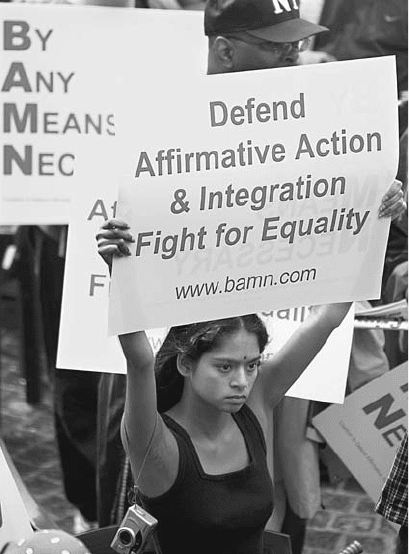
University of Cincinnati student Survi Parvatiyar
gathers with several hundred other protesters from
the group By Any Means Necessary to rally in favor
of affi rmative action, on October 23, 2001, in down-
town Cincinnati.
(Getty Images)
affi rmative action 13
xviii+446_EofUSConsti-v1.indd 13 3/12/09 3:03:39 PM
In 1972, the employment practices of both
public and private employers began to change
due to the methodology being used to deter-
mine racial inequalities. Statistics were reported
to the Offi ce of Federal Contract Compliance as
to racial makeup of those responsible to comply
with Title VII of the Civil Rights Act of 1964
and then proposals as to how they might correct
race-defined statistical inequalities. The resul-
tant effect was that employees were often hired
based on racial and ethnic origin rather than only
their paper qualifi cations. Schools also began to
consider race and gender in admissions decisions.
In R
EGENTS OF THE UNIVERSITY OF CALIFORNIA V.
BAKKE, 438 U.S. 265 (1978), the Court upheld the
use of affi rmative action in admissions policies but
established that although race may be one factor
to consider when conducting employment and
application searches, the school’s program was
unconstitutional owing to the fact that the pro-
gram amounted to a quota, because race appeared
to be the only factor in some admissions decisions.
Justice Lewis Powell, writing a separate con-
currence in a Court otherwise split 4-4, held that
the Fourteenth Amendment permitted the use
of race in school admissions in order to promote
diversity.
Subsequently, in U
NITED STEELWORKERS OF
AMERICA V. WEBER, 443 U.S. 193 (1979), the Court
upheld voluntary use of affirmative action in
employment. In FULLILOVE V. KLUTZNICK, 448 U.S.
448 (1980), the Court upheld federal programs
setting aside money for minority business enter-
prises, and in J
OHNSON V. TRANSPORTATION AGENCY
OF SANTA CLARA, CALIFORNIA, 480 U.S. 616 (1987),
it upheld a gender-based affi rmative action hiring
program. In M
ETRO BROADCASTING, INC. V. FCC,
497 U.S. 547 (1990), the Court upheld the use of
race in the awarding of broadcast licenses.
Yet, by the end of the 1980s and as the justices
changed, the Supreme Court began to rethink its
views on the use of race or gender in employment
and hiring decisions. In a series of decisions in
1989, the Court made it more diffi cult to prove
racial discrimination yet was overturned by the
1991 Civil Rights Act. But in A
DARAND CONSTRUC-
TORS, INC. V. PEÑA, 515 U.S. 200 (1995), the Court
invalidated a set-aside program using racial prefer-
ences when awarding federal contracts. The deci-
sion effectively overturned Metro Broadcasting.
In G
RUTTER V. BOLLINGER, 539 U.S. 306 (2003), the
Court upheld a law-school admissions program
that was narrowly tailored to ensure a critical
mass of minority students at the school as permit-
ted under the Fourteenth Amendment. In writing
for the Court, Justice Sandra Day O’Connor
indicated hope that in 25 years affi rmative action
would no longer be needed. However, in a com-
panion case challenging the University of Michi-
gan’s undergraduate admissions policy, the Court
invalidated it in G
RATZ V. BOLLINGER, 539 U.S.
244 (2003), claiming the school’s more rigid use
of race was the type of quota that the Court had
struck down in Bakke.
Finally, in Parents Involved in Community
Schools v. Seattle School District No. 1, 551 U.S.
___ (2007), decided together with Meredith v. Jef-
ferson, 551 U.S. ___ (2007), the Supreme Court
invalidated the use of race in school assignments.
These two cases, along with Gratz, suggest that
the Supreme Court under Chief Justice John G.
Roberts, Jr., is moving away from support for
affi rmative action as a remedial tool to diversify
and toward a “color blind” view of the Constitu-
tion that prohibits all use of race and gender in
employment and school admissions decisions.
For more information: Anderson, Terry H.
The Pursuit of Fairness: A History of Affi rmative
Action. New York: Oxford University Press, 2005;
Wise, Tim J. Affi rmative Action. New York: Taylor
& Francis, 2005.
—Ernest Gomez and David Schultz
age and the Constitution
The U.S. Constitution makes several references to
age, specifi cally to minimum age requirements for
members of the House of Representatives
and the Senate. Members of the House of Repre-
sentatives must be at least 25 years of age; senators
must be at least 30 years of age. The Constitution
further dictates that the president and vice pres-
ident must be at least 35 years of age and estab-
14 age and the Constitution
xviii+446_EofUSConsti-v1.indd 14 3/12/09 3:03:39 PM
lishes citizenship and residency requirements on
members of the House and Senate, as well as the
president and vice president.
Courts throughout the United States have
upheld the constitutionality of laws that afford
citizens and residents special privileges, respon-
sibilities, and special protections based on their
age. Chief among the privileges based on age is
the right to vote, which is afforded to U.S. citi-
zens age 18 or older who are not convicted felons,
as granted by the Twenty-sixth Amendment.
At the age of 18, U.S. citizens and residents
reach the “age of legal majority”; that is, they
become adults in the eyes of the law. Thus, they
are able to enter into contracts and own property
in their own names, live independently of their
parents, marry without parental consent, estab-
lish credit and incur debt in their own names, and
enjoy all the rights of adulthood. Upon reaching
the age of legal majority, U.S. citizens and resi-
dents are also subject to the full penalties of civil
and criminal law; they can be convicted of crimes
and imprisoned or fined, as appropriate. Male
citizens of the United States reaching age 18 are
obliged to register for selective service (the draft).
Registered voters rolls and selective service rolls
are used to summon people to jury duty, as under
the Seventh Amendment, accused persons have
the right to trial by jury. Despite reaching
legal majority, adults in the United States may not
purchase, possess, or drink alcoholic beverages
until they reach 21 years of age.
Another legal aspect of age is called the “age
of consent.” This is the age at which the law states
that people have the moral agency to consent to
sexual activity. Age of consent laws are intended
to protect children from sexual exploitation by
adults. Prior to reaching the age of consent, a per-
son may agree to engage in sexual activity, but in
the eyes of the law, such behavior is illegal. A per-
son older than the age of consent who engages in
sexual activity, even if the activity is consensual,
with someone under the age of consent may be
charged with statutory rape, child molestation, or
sexual abuse of a minor. The age of consent var-
ies across states, but the average age of consent
is 16. Age of consent laws pertain to heterosexual
and homosexual activity, and the defi nition of sex-
ual activity is broader than sexual intercourse or
penetration.
The Fair Labor Standards Act prohibits chil-
dren and youth from working under certain con-
ditions and during specifi c hours. Children age 14
through 17 may work between 7 a.m. and 7 p.m.
(up to 9 p.m. between June 1 and Labor Day) for
three hours per school day and eight hours per
non–school day, up to 18 hours per week. Gener-
ally, children age 14 and 15 may work in clerical
and retail positions, as long as their working con-
ditions are not hazardous as defi ned by law. Chil-
dren age 16 and 17 may work in any jobs that are
not deemed hazardous by the U.S. Department of
Labor; generally, jobs in driving, excavation, heavy
machinery operations, meatpacking and process-
ing, mining, paper manufacturing, and roofi ng are
considered hazardous. These laws pertain until
the age of 18. After age 18, that is, upon reach-
ing the age of legal majority, adults may work in
any type of jobs they wish, even if those jobs are
deemed hazardous.
People over age 40 also enjoy special protection
under the law, specifically from discrimination
associated with employment. The Age Discrimi-
nation in Employment Act (ADEA), passed in
1967, makes it illegal to discriminate against
workers age 40 and over in any term, condition, or
benefi t of employment. Hiring, termination, pro-
motion, layoff, pay and benefi ts, job assignments,
and training are specifi cally covered by the act.
Furthermore, it is illegal to discriminate based
on age in admission to apprenticeship programs
unless the Equal Employment Opportunity Com-
mission (EEOC) grants a specifi c exemption. Age
limits may be imposed only when the employer
can prove a bona fi de occupational qualifi cation
(BFOQ). While the ADEA does not specifi cally
prohibit inquiries about a person’s age or date
of birth, such requests tend to be closely scruti-
nized to ensure that the inquiry was made for a
legal purpose rather than for the purpose of dis-
crimination. Asking a person’s age or birth date
may prevent certain older workers from applying
for employment or may indicate an intentional
attempt to discriminate based on age.
age and the Constitution 15
xviii+446_EofUSConsti-v1.indd 15 3/12/09 3:03:40 PM
In 1990, passage of the Older Workers Benefi t
Protection Act (OWBPA) expanded the ADEA to
prohibit employers from denying benefi ts to older
workers. Employers may reduce benefits based
on age only if the cost of providing the benefi ts to
older workers is the same as that associated with
providing benefi ts to younger workers.
For more information: MacNichol, John. Age
Discrimination: An Historical and Contempo-
rary Analysis. New York: Cambridge University
Press, 2006; Schwartz, Bernard. A History of the
Supreme Court. New York: Oxford University
Press, 1993.
—Cheryl Crozier Garcia
airline passenger searches
Searches of airline passengers, like other searches,
must comply with the Fourth Amendment,
which guarantees the right to be secure against
“unreasonable searches and seizures.” The normal
requirement for “reasonableness” is particularized
suspicion and probable cause to support that sus-
picion. Search warrants are the strongest evidence
of reasonableness but are rarely used in airline
passenger searches.
Routine searches of airline passengers and
their luggage began in response to the hijackings
of the 1960s and 1970s. Their primary purpose
was to prevent hijackings by preventing weapons
from being carried on board. Since these searches
were not intended to gather evidence in criminal
cases, they were approved under an administra-
tive search exception to the warrant requirement
recognized by the Supreme Court in Camara v.
Municipal Court of San Francisco, 387 U.S. 523
(1967). Under this exception, neither particular-
ized suspicion nor probable cause is required.
The California Supreme Court case of People
v. Hyde, 12 C3d 158 (1974), analyzed these issues
in detail and concluded:
The fact that airport searches . . . will inevitably
lead to the detection of some individuals involved
in criminal conduct unrelated to the comman-
deering or destruction of aircraft does not alter
the fundamentally administrative character of
the screening procedure. If the initial intru-
sion is justifi able as part of a regulatory effort to
prevent the hijacking of airplanes, the inciden-
tal discovery of contraband does not offend the
Fourth Amendment.
Some states, such as California, permitted
evidence found in these searches to be used in
criminal cases; others, such as Illinois, allowed
contraband to be seized but prohibited its use in
criminal prosecutions.
Some courts concluded that these searches
were reasonable when they balanced the govern-
ment interest in airline security—preserving both
lives and property—against the relatively limited
intrusion of a routine search (for example, United
States v. Epperson, 454 F.2d 769 [4th Cir. 1972]).
Others ruled that they were permitted under the
consent exception, that passengers implicitly con-
sented to the search when they chose to travel
by plane (for example, United States v. Pulido-
Baquerizo, 800 F.2d 899 [9th Cir. 1986]). Other
courts acknowledged the limited options available
to travelers and questioned whether this could
properly be considered voluntary consent, but
they consistently rejected the argument that pas-
senger searches violated the constitutionally pro-
tected freedom to travel. Some parties also argued
that airline passengers no longer had a reasonable
expectation of privacy from magnetometers and
X-ray scanners, since they are now so common.
If there is no reasonable expectation of privacy,
then the searches are not subject to the Fourth
Amendment.
September 11, 2001, changed the nature of
airport searches and the legal context in which
they take place. After 9/11, it was clear that these
were not routine administrative searches but
intended to identify and incapacitate potential
threats to national security. The searches became
more intrusive, and the costs of noncooperation,
higher. With not just the security of the airplane
but the security of the nation at stake, the balance
has shifted. Courts continue to uphold intrusive
searches, authorizing the Transportation Security
Administration (TSA) to search luggage randomly
16 airline passenger searches
xviii+446_EofUSConsti-v1.indd 16 3/12/09 3:03:40 PM
(Torbet v. United Airlines, Inc., 298 F.3d 1087 [9th
Cir. 2002]), review the contents of laptop comput-
ers, and even seize suspect persons. By 2008, the
Supreme Court had not yet handed down a deci-
sion specifi cally dealing with the TSA’s authority
to search passengers and luggage, but its decisions
have deferred to other executive authority claims
based on national security.
For more information: Airline Passenger Secu-
rity Screening: New Technologies and Imple-
mentation Issues. Washington, D.C.: National
Academy Press, 1996; Lawson, Deborah. “Case-
note: Fourth Amendment Searches with Liberty
and Justice for All . . . Unless You Choose to Fly:
Torbet v. United Airlines, Inc.” Journal of Air Law
and Commerce 68 (2003): 647–654; Miller, Eric J.
“Comment: The ‘Cost’ of Securing Domestic Air
Travel.” John Marshall Journal of Computer and
Information Law 21 (2003): 405–436; Rochow-
Leuschner, Deborah von. “CAPPS II and the
Fourth Amendment: Does It Fly?” Journal of Air
Law and Commerce 69 (2004): 139–172.
—Barbara J. Hayler
Alabama v. Shelton 535 U.S. 654 (2002)
In Alabama v. Shelton, the U.S. Supreme Court,
in a 5-4 decision, with the opinion of the majority
being delivered by Justice Ruth Bader Ginsburg,
upheld the decision rendered in the Alabama
Supreme Court that a lawyer must be provided
for the accused in criminal cases that may result
in imprisonment even if it is for a short period of
time. This case, like G
IDEON V. WAINWRIGHT, 372
U.S. 335 (1963), involved the Sixth Amendment
to the U.S. Constitution and the right of an indi-
gent defendant to have the assistance of a court-
appointed counsel. The Shelton case took the
concept of right to counsel a step further by
indicating that the right to counsel also extends to
defendants who receive a suspended sentence.
The defendant was LeReed Shelton, who took
it upon himself to be his own representative at
a bench trial in the District Court of Etowah
County, Alabama. He was convicted by this
court of third-degree assault. The charge carried
a maximum penalty of one-year imprisonment
and a $2,000 fi ne. Shelton invoked his right to a
new trial before a jury in the circuit court. He
appeared before the circuit court and again repre-
sented himself and was convicted a second time.
Even though the court warned Shelton of the dan-
gers of representing himself, the court at no time
offered to provide Shelton with legal counsel. The
circuit court sentenced Shelton to 30 days, sus-
pended his sentence, and then placed him on two
years probation.
Shelton appealed this court’s decision on the
tenets of the Sixth Amendment, and the Alabama
Court of Criminal Appeals initially affi rmed this,
yet when the case was returned for remand, the
appeals court reversed itself and noted: “a sus-
pended sentence . . . does not trigger the Sixth
Amendment right to appointed counsel unless
there is ‘evidence in the record that the [defendant]
has actually been deprived of liberty.’ ” The Ala-
bama Supreme Court reversed the appeals court
decision, noting “that a defendant may not be ‘sen-
tenced to a term of imprisonment’ absent provision
of counsel.” The Alabama Supreme Court found
that a suspended sentence constituted a “term of
imprisonment” even though imprisonment was
taking place immediately after the verdict.
The U.S. Supreme Court majority opinion
noted:
We think it plain that a hearing so timed and
structured cannot compensate for the absence
of trial counsel, for it does not even address
the key Sixth Amendment inquiry: whether the
adjudication of guilt corresponding to the prison
sentence is suffi ciently reliable to permit incar-
ceration. Deprived of counsel when tried, con-
victed, and sentenced, and unable to challenge
the original judgment at a subsequent probation
revocation hearing, a defendant in Shelton’s cir-
cumstances faces incarceration on a conviction
that has never been subjected to the “crucible of
meaningful adversarial testing,” United States v.
Cronic 466 U.S. 648, 656 (1984).
The Supreme Court held that a prison term,
even though suspended, is still a prison term.
Alabama v. Shelton 17
xviii+446_EofUSConsti-v1.indd 17 3/12/09 3:03:40 PM
For more information: Bodner, Polina R.
“Imposition of a Suspended Sentence in a Misde-
meanor Case Invokes a Defendant’s Sixth Amend-
ment Right to Counsel.” Suffolk University Law
Review 37, no. 1 (2004): 211–217; Kitai, Rinat.
“What Remains Necessary Following Alabama v.
Shelton to Fulfi ll the Right of a Criminal Defen-
dant to Counsel at the Expense of the State?”
Ohio Northern University Law Review 30, no. 1
(2004): 30–58; Lewis, Anthony. Gideon’s Trum-
pet. New York: Vintage Books, 1989; Young, Adam
D. “An Analysis of the Sixth Amendment Right to
Counsel As It Applies to Suspended Sentences
and Probation: Do Argersinger and Scott Blow a
Flat Note on Gideon’s Trumpet?” Dickinson Law
Review 107, no. 3 (2003): 699–722.
—Dan Krejci
Alden v. Maine 527 U.S. 706 (1999)
In Alden v. Maine, the Supreme Court ruled that
the Eleventh Amendment barred a suit against
a state involving enforcement of the Fair Labor
Standards Act (FLSA), a law requiring employers
to pay their workers minimum wages and overtime
pay. Although the FLSA had initially exempted
federal, state, and local governments, by 1974, it
had been amended to include most government
employees.
In 1992, John Alden and other state probation
offi cers fi led suit in a Maine federal district court,
claiming that the state had violated the FLSA
and owed them overtime pay. The court agreed
and ordered the state to pay them, but the par-
ties did not agree on the amount. In the interim,
the U.S. Supreme Court had ruled that the prin-
ciple of state sovereignty, as stated in the Eleventh
Amendment, barred federal courts from exercis-
ing jurisdiction over states. Alden et al.’s case was
dismissed.
Shortly thereafter, they fi led suit in state court,
which also dismissed their case, ruling that the
doctrine of sovereign immunity incorporated the
principles of the Eleventh Amendment and that
the states cannot be sued in state court, either.
The Maine Supreme Court affi rmed, holding that
if states are immune from suit by private individu-
als in federal court, they are also immune in state
court. The court concluded that if plaintiffs can-
not sue states in federal court, they cannot simply
bring their actions to state court to achieve their
ends.
The probation offi cers’ principal argument was
that Article VI of the U.S. Constitution, known
as the supremacy clause, requires state courts
to enforce valid federal laws such as the FLSA.
Citing Congress’s power to regulate the national
economy, they emphasized that the state must
enforce the federal law in its courts. The U.S. gov-
ernment entered the case to urge the Supreme
Court to reverse the state court, declaring that the
supremacy clause prevails over a state’s sovereign
immunity. The brief for the United States noted
that the FLSA specifi es that any government may
be sued by their employees in any state or federal
court and the supremacy clause requires the state
courts to enforce the law.
In announcing the decision for the Court, Jus-
tice Anthony M. Kennedy strongly defended
the principle of state sovereign immunity, quoting
from the writings of the nation’s founders to dem-
onstrate how deeply they felt about the importance
of immunity from private lawsuits as an attribute of
state sovereignty. The Court held that the plaintiffs
must show that states had been required to relin-
quish their immunity as part of the original consti-
tutional compromise. But there was no evidence
of this in the constitutional text, he said, rejecting
the plaintiffs’ argument that the supremacy clause
in Article VI required the state to enforce federal
laws. Kennedy concluded that Congress lacked
the authority to revoke state sovereign immunity
through regulatory laws such as the FLSA.
Justice David H. Souter dissented, quoting
extensively from the constitutional debates and
arguing that there was no clear consensus among
the founders on the breadth of sovereign immu-
nity. Moreover, states should not be allowed to
violate federal rights with impunity, and this rul-
ing, he charged, would allow them to engage in
illegal wage and hours practices.
For more information: Mezey, Susan Gluck.
“The U.S. Supreme Court’s Federalism Jurispru-
18 Alden v. Maine
xviii+446_EofUSConsti-v1.indd 18 3/12/09 3:03:41 PM
dence: Alden v. Maine and the Enhancement of
State Sovereignty.” Publius: The Journal of Feder-
alism 30 (2000): 21–38; Royer, Christine. “Para-
dise Lost? State Employees’ Rights in the Wake of
New Federalism.” Akron Law Review 34 (2001):
637–688.
—Susan Gluck Mezey
Alito, Samuel (1950– ) Supreme Court justice
Samuel Anthony Alito, Jr., member of the U.S.
Supreme Court and former U.S. Court of Appeals
judge, was born on April 1, 1950, in Trenton, New
Jersey. Strong academically, Alito posted excel-
lent results at Steinert High School in Hamilton
Township, New Jersey, and was able to attend
Princeton University, where he graduated from
the Woodrow Wilson School of Public and Inter-
national Affairs in 1972. He continued his studies
at Yale Law School, where he served as editor of
the school’s prestigious legal journal and gradu-
ated with a J.D. in 1975.
Enlisted by Selective Service in 1970, Alito was
able to continue his studies while being assigned
to ROTC and a summer boot camp. He served on
active duty in 1975 following his graduation but
thereafter was assigned to inactive reserves until
he left the military in 1980.
From the start of his career, Alito has con-
structed an impressive record of employment in
the legal sector. He began as a legal clerk on the
Third Circuit and went on to work as an assistant
U.S. attorney in New Jersey. He argued numerous
cases concerning drugs and the Mafi a. In 1985,
Alito became deputy assistant to Attorney General
Edwin Meese during the second term of the Rea-
gan administration. In his post, he established him-
self as an active conservative, stating that William
F. Buckley, Alexander Mordecai Bickel, and
Barry Goldwater inspired him. He also expressed
his views on the Constitution and current affairs
at the time, stating that he did not believe in racial
or ethnic quotas nor in a constitutional protection
for the right to have an abortion.
From 1987 to 1990, Alito was a U.S. attorney
in New Jersey, before being nominated by Presi-
dent George H. W. Bush on February 20, 1999, to
the U.S. Court of Appeals for the Third Circuit,
where he remained until 2006. During some of
this time, he worked as a professor of law at Seton
Hall University.
In late 2005, Alito’s dream of becoming a mem-
ber of the U.S. Supreme Court began to come to
fruition. On October 31, 2005, he was nominated
by President George W. Bush to the Supreme
Court seat formerly occupied by Sandra Day
O’Connor. The nomination was offi cially submit-
ted to the U.S. Senate on November 10, 2005,
and Alito’s confirmation hearing took place in
January 2006.
Alito received a “well-qualified” rating from
the American Bar Association, and his nomination
was approved in committee by a vote broken along
party lines, 10 to 8. Although a fi libuster by the
Democratic opposition threatened his confi rma-
tion in the Senate, Alito was confi rmed by a vote
of 58 to 42. He was sworn in to his post shortly
after by Chief Justice John G. Roberts, Jr. Alito
joined the Court midterm.
As a result of Alito’s ascension, the U.S. Supreme
Court has become majority–Roman Catholic for
the fi rst time ever in its history. Alito’s religion,
Italian-American roots, and conservative views
have resulted in comparisons with fellow justice
Antonin Gregory Scalia. Notably, Alito is a
member of the Federalist Society, a conservative
and libertarian group. He is married and has two
children.
In his fi rst two years on the Supreme Court,
he has aligned himself with Chief Justice Roberts,
voting with him almost 90 percent of the time. He
has supported the conservative wing of the Court
in ruling that bans on partial-birth abortions do
not violate a woman’s right to terminate a preg-
nancy, and he has also voted in cases such as Hein
v. Freedom from Religion Foundation, 127 S.Ct.
2553 (2007), and Lance v. Coffman, 127 S.Ct.
1194 (2007), to tighten the rules of standing and
make it more diffi cult for plaintiffs to be able to
present their cases in federal court.
For more information: CNN.com. “Bush Nomi-
nates Alito to the Supreme Court.” Available online.
URL: http://www.cnn.com/2005/POLITICS/10/31/
Alito, Samuel 19
xviii+446_EofUSConsti-v1.indd 19 3/12/09 3:03:41 PM
scotus.bush/index.html. Downloaded November
1, 2005; Federal Judicial Center. “Alito: Judges
of the Federal Courts.” Available online. URL:
http://www.fjc.gov/public/home.nsf/hisj. Down-
loaded May 6, 2008.
—Arthur Holst
Allen v. State Board of Elections 393 U.S.
544
(1969)
In Allen v. State Board of Elections, the Supreme
Court ruling, consistent with S
OUTH CAROLINA V.
KATZENBACH (1966), upheld the constitutionality of
Section 5, affi rming a broad range of voting prac-
tices for which preclearance is required under the
Voting Rights Act of 1965.
The four cases that constitute Allen involve
the application of the 1965 Voting Rights Act to
state election laws and regulations in both Mis-
sissippi and Virginia. The Mississippi cases were
consolidated on appeal and argued together, and
because of the grounds on which the Supreme
Court decides these cases, the appeal in a Virginia
case was also disposed by the Court’s opinion in
the case. Thus, in all four cases, both states passed
new laws in which the central issue is whether the
provisions of these laws fell within the Section 5
prohibitions that prevent the enforcement of “any
voting qualifi cation or prerequisite to voting, or
standard, practice, or procedure with respect to
voting” unless the state first complies with one
of the section’s approval procedures as provided
under the Voting Rights Act.
In Allen v. State Board of Elections, the Supreme
Court ruled that provisions of both the Mississippi
and Virginia state laws violate the Voting Rights
Act of 1965. Specifi cally, in a 7-2 opinion by Chief
Justice Earl Warren, the Court interpreted Sec-
tion 5 of the Act broadly to require preclearance
for a wide range of election practices and therefore
against state prerogatives. According to the Court,
states are prohibited by Section 5 from enacting or
seeking “to administer any voting qualifi cation or
prerequisite to voting, or standard, practice, or pro-
cedure with respect to voting different from that
in force or effect on November 1, 1964,” without
fi rst submitting their intended change to the U.S.
Offi ce of the Attorney General to obtain consent or
secure a favorable declaratory judgment from the
District Court for the District of Columbia.
In cases titled Nos. 25 (Fairley v. Patterson), 26
(Bunton v. Patterson), and 36 (Whitley v. Williams),
the Mississippi parties who brought suits sought
declaratory judgments in the District Court for
the Southern District of Mississippi, alleging that
certain amendments to the Mississippi Code were
subject to the provisions of Section 5 and there-
fore not enforceable until the state has complied
with the approval requirements established by the
Voting Rights Act. Dismissing the complaints in all
three cases, a three-judge district court ruled for
the state of Mississippi and held that its amend-
ments did not come within the purview of Section
5 of the Voting Rights Act. Appellants brought
direct appeal, and the Supreme Court consolidated
the cases and postponed consideration of jurisdic-
tion to a hearing on the merits. In Allen, appellants
were functionally illiterate, duly registered voters
of the Fourth Congressional District of Virginia.
They brought a declaratory judgment action in
the U.S. District Court for the Eastern District of
Virginia claiming that a Virginia statute modifying
voting bulletin violates the equal protection
clause of the Fourteenth Amendment and the
Voting Rights Act of 1965. After the three-judge
court dismissed their complaint, a direct appeal
was lodged, and the Supreme Court similarly post-
poned consideration of jurisdiction questions to a
hearing on the merits.
Remanding all four cases to the district courts
with instructions to issue injunctions restraining
the further enforcement of the enactments until
such time as both states adequately demonstrated
compliance with Section 5 of the Voting Rights
Act, Chief Justice Warren ruled that “what a fair
interpretation of the Voting Right Act requires
is that States in some unambiguous and record-
able manner submit any legislation or regulation
directly to the Attorney General with a request
for his consideration.” The term voting, the Court
observed, included
all action necessary to make a vote effective in
any primary, special, or general election, includ-
20 Allen v. State Board of Elections
xviii+446_EofUSConsti-v1.indd 20 3/12/09 3:03:41 PM
ing, but not limited to, registration, listing . . .
or other action required by law prerequisite to
voting, casting a ballot, and having such ballot
counted properly and included in the appropri-
ate totals of votes cast with respect to candidates
for public or party office and propositions for
which votes are received in an election.
Further, the Court noted that “the Voting
Rights Act was aimed at the subtle, as well as the
obvious, state regulations which have the effect of
denying citizens their right to vote because of
their race.” Citing R
EYNOLDS V. SIMS, the Supreme
Court observed that the act gives a broad inter-
pretation to the right to vote, recognizing that vot-
ing includes “all action necessary to make a vote
effective.” The legislative history on the whole,
according to the Court, “supports the view that
Congress intended to reach any state enactment
which altered the election law of a covered State
in even a minor way.”
Thus, according to the Court, Section 5 suits
may be brought in at least three ways. First, the
state may institute a declaratory judgment. Sec-
ond, an individual may bring a suit for declara-
tory judgment and injunctive relief, claiming
that a state requirement is covered by 5 but has
not been subjected to the required federal scru-
tiny. Third, the offi ce of the Attorney General
may bring an injunctive action to prohibit the
enforcement of a new regulation because of the
state’s failure to obtain approval under Section 5.
Finally, a three-judge district court is required
for all actions challenging provisions of the Vot-
ing Rights Act.
Recently, in Presley v. Etowah County Comm’n,
502 U.S. 491 (1992), while reaffi rming Allen, the
Supreme Court emphasized that changes covered
under Section 5 must have a direct relation to vot-
ing. Seemingly retreating from its more expansive
position with Allen, the Supreme Court provided
a nonexclusive list of four categories in which vot-
ing changes covered under Section 5 would nor-
mally fall: 1) changes in the manner of voting, 2)
changes in candidacy requirements and qualifi ca-
tions, 3) changes in the composition of the elector-
ate that may vote for candidates for a given offi ce,
and 4) changes affecting the creation or abolition
of an elective offi ce.
For more information: Hasen, Richard. The
Supreme Court and Election Law: Judging Equal-
ity from Baker v. Carr to Bush v. Gore. New York:
New York University Press, 2003.
—Marc G. Pufong
Ambach v. Norwick 542 U.S. 507 (1979)
In Ambach v. Norwick, the Supreme Court nar-
rowly upheld the constitutionality of a New York
statute that restricted the permanent certifi cation
of public school teachers to U.S. citizens or aliens
who intend to apply for citizenship. The Court
ruled that because public classroom teachers are
agents of the government and have a signifi cant
infl uence over students, the state has compelling
interest in refusing to certify aliens who express no
interest in becoming U.S. citizens. In applying the
“rational basis” test, the Court rejected claims that
the law violated the Fourteenth Amendment’s
equal protection clause.
Susan M. W. Norwick was born in Scotland,
moved to the United States in 1965, and mar-
ried a U.S. citizen. Norwick was eligible to apply
for U.S. citizenship but expressed no intention
of renouncing her British citizenship. In 1973,
after graduating from college, Norwick applied to
become an elementary teacher in the state of New
York. Although otherwise qualifi ed, her applica-
tion for certifi cation was denied by the New York
Commission on Education solely on the basis of
Section 3001(3) of the New York Education Law,
which bars aliens from teaching in public schools
unless they manifest intention to become U.S.
citizens. Norwick sued Gordon M. Ambach, New
York State commissioner of education, and others
in U.S. district court, asserting that the law vio-
lated her right to equal protection under the Four-
teenth Amendment.
The three-judge federal district court, apply-
ing strict scrutiny, ruled for Norwick. Under
“strict scrutiny,” a law that on its face distin-
guishes between people in part because of their
nationality is presumed to be unconstitutional,
Ambach v. Norwick 21
xviii+446_EofUSConsti-v1.indd 21 3/12/09 3:03:42 PM