
Schultz D. Encyclopedia of the United States Constitution
Подождите немного. Документ загружается.

University of Chicago Press, 2004; Sullivan, Kath-
leen, and Gerald Gunther. Constitutional Law.
15th ed. New York: Foundation Press, 2004.
—William Crawford Green
intermediate level scrutiny test
The intermediate level scrutiny test is used by the
courts to determine if some semi-suspect classifi -
cations, such as gender, are permissible under the
equal protection clause of the Constitution.
The equal protection clause of the Four-
teenth Amendment provides that “no State
shall . . . deny to any person within its jurisdiction
the equal protection of the laws.” In guaranteeing
equality under the law, the Constitution requires
states to justify their decisions to treat persons as
legally different. Under the equal protection doc-
trine, states may treat people differently when
they base it on relevant differences among the
individuals.
The U.S. Supreme Court formulated a two-tier
level of scrutiny to determine whether laws were
constitutional. The first, applying the strictest
standard of review, is used in cases involving laws
based on race or national origin. When such a law
is challenged as unconstitutional, the government
must show it has a “compelling” reason for the law
and demonstrate that it is “necessarily” related
to the objectives it seeks to achieve. The second,
known as minimal scrutiny, is used to judge laws
that classify people on the basis of changeable
characteristics such as wealth or age. Under mini-
mal scrutiny, the state must simply show it has a
“legitimate” reason for the law and demonstrate
that the means are “rationally” related to the ends
it seeks to achieve.
The level of scrutiny is crucial to the out-
come of the case. Statutes reviewed under mini-
mal scrutiny almost always receive the Court’s
approval; conversely, laws reviewed under strict
scrutiny are almost always struck. In the 1970s,
when the federal courts became a forum for the
debate over sexual equality, the Supreme Court
was asked to determine whether laws that differ-
entiated on the basis of sex were consistent with
the equal protection clause.
Reed v. Reed, 404 U.S. 71 (1971), marked the
beginning of the Court’s new approach to constitu-
tional sex equality doctrine. For the fi rst time, the
Court struck a state or federal law on the grounds
of sex discrimination. Although it acknowledged
that the Idaho law favoring men over women as
estate administrators to expedite probate had a
legitimate purpose, it held that the classifi cation
on the basis of sex was not substantially related to
the state’s goal.
In Frontiero v. Richardson, 411 U.S. 677
(1973), the Court reviewed a law that required
women—but not men—to show they provided
more than half of their family’s support in order to
receive benefi ts. Four justices, William J. Bren-
nan, Jr., Thurgood Marshall, Byron White, and
William O. Douglas, voted to raise the level of
scrutiny for sex-based laws, because they believed
that, like race and national origin, sex was unre-
lated to ability and deserved the same searching
scrutiny as these other classifi cations. However,
although a majority voted to strike the law, there
was no majority support for changing the level of
scrutiny.
In C
RAIG V. BOREN, 429 U.S. 190 (1976), the
Court formally adopted the intermediate (or
heightened) scrutiny test for laws based on sex.
The case arose as a challenge to an Oklahoma law
allowing 18-year-old women—but not men—to
buy beer. A lower federal court upheld the law, but
the Supreme Court reversed. Speaking for a 5-4
Court, Justice William J. Brennan, Jr. announced
that prior cases established that sex-based clas-
sifications “must serve important governmental
objectives and must be substantially related to
achievement of those objectives” (Craig v. Boren,
1976, 197). Reviewing earlier cases, Brennan
noted that the Court has refused to approve laws
based on stereotypical ideas of men’s and women’s
roles. Although the purpose of the Oklahoma law
was important, that is, reducing incidents of driv-
ing under the infl uence of alcohol, the Court held
that it did not pass the new intermediate scrutiny
test because the sex-based classifi cation was not
substantially related to this goal.
Writing in dissent, Chief Justice William
Hubbs Rehnquist objected that the majority
382 intermediate level scrutiny test
xviii+446_EofUSConsti-v1.indd 382 3/12/09 3:05:39 PM
had simply imposed a higher level of scrutiny on
laws relating to sex differences without justifi ca-
tion on the basis of precedent. He argued that
this was particularly inappropriate in cases of men
challenging sex-based classifications. Because
there was no history of discrimination against
men, Rehnquist said he would only apply minimal
scrutiny to the Oklahoma law and, in his view, it
was constitutional.
In M
ISSISSIPPI UNIVERSITY FOR WOMEN V. HOGAN,
458 U.S. 718 (1982), in a challenge to the univer-
sity’s women-only nursing program, Justice San-
dra Day O’Connor added a new dimension to
the intermediate level scrutiny test by explaining
that in order to defend a sex-based classifi cation,
the state must present an “exceedingly persuasive
justifi cation” for it. The Court also held that it will
apply the heightened form of scrutiny whenever a
sex-based classifi cation is challenged, regardless of
which sex raises the issue.
For more information: Cushman, Claire, ed.
Supreme Court Decisions and Women’s Rights.
Washington, D.C.: Congressional Quarterly
Press, 2001; Mezey, Susan Gluck. Elusive Equal-
ity: Women’s Rights, Public Policy, and the Law.
Boulder, Colo.: Lynne Rienner Publishers, 2003.
—Susan Gluck Mezey
international law and the Constitution
Constitutional scholars and prominent justices
of the Supreme Court strongly disagree on the
proper application of international law in the mak-
ing of domestic statutes and interpretation of the
Constitution.
Originalists like Justice Antonin Gregory
Scalia maintain that international legal docu-
ments and traditions have limited role, if any, in
constitutional jurisprudence since the potential for
deviating from the original intent of the framers is
high when judges resort to foreign legal traditions
and treaties in interpreting the Constitution.
Constitutional comparativists like Justice
Anthony M. Kennedy, on the other hand,
uphold the constitutional principle that, as long as
foreign laws do not directly contravene democratic
values, they can serve as useful precedents to and
vital sources of judicial decisions and domestic
lawmaking. Also closely identifi ed with those who
ascribe to the living constitution tradition of
judicial interpretation, constitutional comparativ-
ists stress the importance of international legal
precedents in dealing with modern constitutional
dilemmas, such as the treatment of members of
transnational terrorist networks captured in the
“Global War on Terror,” and in formulating inter-
national agreements that are crucial to confront-
ing global challenges such as genocide, the illegal
use of child labor, climate change, patents
rights over living organisms, species extinction,
illicit (human and narcotic) traffi cking, and so on.
This comparative constitutional perspective is in
keeping with the fact that the writers of the Con-
stitution heavily borrowed from English Common
Law and European democratic political theory.
The U.S. Constitution provides at least three
different methods in which international trea-
ties and agreements can be directly incorporated
into domestic law. First, courts of various tiers
and prerogatives may refer to international legal
obligations and commitments when interpreting
domestic statutes. Second, Congress could refer to
international laws in making domestic laws. That is,
domestic laws could integrate or incorporate provi-
sions of an international treaty. Third, although
the Constitution grants the president the power to
negotiate and sign international treaties in partic-
ular and conduct foreign relations in general, the
treaty supremacy clause of the Constitution,
Article VI, requires the Senate to ratify treaties
with a majority two-thirds vote. Once a treaty is
signed by the president and ratifi ed by the Senate,
it becomes the “Supreme Law of the Land.”
Given that the constitutional framers drew a
great deal from English Common Law in craft-
ing the Constitution, customary international
laws—established customs, principles and prac-
tices adhered to by a community of nations out
of universal respect for human rights and due to
obligatory treaties—also strongly infl uence consti-
tutional jurisprudence. Prohibitions against slav-
ery and genocide, freedom from detention without
due process of law, and the rights of prisoners of
international law and the Constitution 383
xviii+446_EofUSConsti-v1.indd 383 3/12/09 3:05:39 PM
war to humane treatment are some of the most
commonly accepted customary international laws.
These fundamental human rights are enshrined
in such landmark international treaties as the
International Convention on Civil and Political
Rights and the Third Geneva Convention on the
conduct of war and the treatment of prisoners of
war. Given that the United States has signed and
ratifi ed both conventions, the prolonged detention
in Guantánamo, Cuba, of “enemy combatants”
captured in the “War on Terror” in Afghanistan
and other parts of the world is widely believed to
be a violation of U.S. obligations under custom-
ary international law. Human rights organizations
including Amnesty International, Human Rights
Watch, and American Civil Liberties Union
(ACLU) have repeatedly criticized the Bush
administration’s treatment of “enemy combatants”
as clear violations of the aforementioned human
rights conventions.
The Bush administration responds to these
criticisms by insisting that the prisoners held at
Guantánamo, Cuba, are “enemy combatants” who
do not enjoy the same rights as conventional pris-
oners of war. However, some of those detained
include U.S. citizens and nationals of various
countries who have been held without fair trial for
several months and even years, thus contravening
prohibitions under the International Convention
on Civil and Political Rights against arbitrary and
prolonged detention. Another widely reported
practice that is increasingly a subject of close scru-
tiny is “extraordinary rendition,” an extra-judicial
method used by the Central Intelligence Agency
(CIA) to extract information from suspected ter-
rorists. Suspected members and supporters of
terrorist organizations are extradited to other
countries where they could reportedly be tortured
and detained without fair trial.
The growing public scrutiny of the policies
and practices of the Bush administration’s “War
on Terror” has generated a heated debate among
scholars of international law and the U.S. Supreme
Court justices as to whether combatants of non-
state actors such as al-Qaeda can be accorded the
same rights that the Geneva Convention on the
conduct of war and the treatment of prisoners of
war guarantees. This debate is as much about the
proper treatment of “enemy combatants” captured
abroad in battles with global non-state actors as
the basic rights of suspected criminals; thus, what
is at stake is the future of the Geneva Convention
in particular and international human rights law
in general.
The central issue of human rights is further
complicated when, as in the seminal Supreme
Court case of H
AMDI V. RUMSFELD, the captive
happens to be a U.S. citizen. There is no doubt
that this debate will occupy the Supreme Court
and legal scholars for some time to come, as it
strikes at crucial intersections of international and
domestic law.
For more information: Anderson, Kenneth.
“Foreign Law and the U.S. Constitution.” Policy
Review. Available online. URL: http://www.poli-
cyreview.org/jun05/anderson.html. Visited 13 May
2008; Horner, Christopher. “Modern Develop-
ments In The Treaty Process.” (August 1, 2002.)
Available online. URL: http://www.cei.org/gen-
con/025,03243.cfm. Visited 24 December 2006;
Huhn, Ray. “The Constitutional Jurisprudence
of Sandra Day O’Connor: A Refusal to ‘Fore-
close the Unanticipated.’ ” Akron Law Review 39.
Available online. URL: http://www.policyreview.
org/jun05/anderson.html. Visited 13 May 2008;
“War on Terror” Human Rights Issues. Amnesty
International. Available online. URL: http://www.
amnestyusa.org/waronterror/detainees/us_obliga-
tions.html. Visited 24 December 2006.
—Daniel G. Ogbaharya
International Society for Krishna
Consciousness v. Lee
505 U.S. 672 (1992)
The U.S. Supreme Court, in the case of Interna-
tional Society for Krishna Consciousness v. Lee,
declared publicly owned airport terminals are not
free speech forums under the free speech clause
of the First Amendment to the U.S. Constitu-
tion. In the case, a not-for-profi t religious group
called the International Society for Krishna Con-
sciousness (ISKCON) wanted to distribute leaf-
lets and solicit monetary donations inside several
384 International Society for Krishna Consciousness v. Lee
xviii+446_EofUSConsti-v1.indd 384 3/12/09 3:05:40 PM
major public airports within the New York area.
The Port Authority of New York and New Jersey,
which owned the airports, adopted a regulation
forbidding these actions. ISKCON eventually
appealed this ban to the U.S. Supreme Court.
The Court fi rst determined that publicly owned
airport terminals are unlike traditional govern-
ment-owned forums historically used for public
gatherings and discussions such as parks, streets,
and sidewalks. In those more traditional public
forums, government must show that limiting the
speaker is justifi ed by a government interest of a
compelling (very strong) nature, and the restric-
tion on the speaker is narrowly tailored (care-
fully designed) to further that compelling interest
rather than some other interest or no interest at
all. The Court also declared that the Port Author-
ity had not intentionally created a public forum,
by the fact the airport was designed for air travel
and not free speech purposes, and also by the fact
the airport had a long history of trying to restrict
the airport for use by air travelers only, rather than
citizens who wished to distribute political or reli-
gious literature. In designated public forums, the
government must also meet the same standards
when restricting speech as it must meet in tradi-
tional public forums. However, because the air-
port terminals in the case were neither traditional
public forums nor designated as public forums, the
government could enact greater restrictions on
speech as long as those restrictions are reasonable.
The Court concluded that a total ban on solicita-
tion of money was reasonable. Stopping people
and asking them for money would delay the people
who are stopped as well as other people trying to
avoid the solicitation or whose paths are blocked
by the pedestrian congestion caused by people
stopping. This is an important problem to prevent
in crowded airports where travelers are often in a
hurry. In addition, there would be the possibility
that the people asking for money would be lying
about the reasons the money is needed. However,
busy airport customers are unlikely to take the time
to report this fraud when it occurs. Also, if the air-
ports allowed one group into the airport terminals
to solicit money, then the airports would have to
allow all political, religious, and charitable groups
to do so on an equal, nondiscriminatory basis, and
the airport terminals could become too clogged
by people to function as transportation terminals.
Thus, the Court concluded that a complete ban on
the solicitation of money inside a publicly owned
airport terminal is reasonable.
In a companion case, Lee v. ISKCON, 505 U.S.
830 (1992), the Court held that although public
airport terminals are not public forums, individu-
als have a right to peacefully distribute leaflets
inside them. This is because the distribution of
leafl ets is less disruptive to the functioning of an
airport, particularly pedestrian traffi c fl ow, than is
the solicitation of money, as individuals can simply
walk quickly by anyone holding out a leafl et for
them to take. Therefore, a complete ban on leaf-
leting inside a public airport terminal is unreason-
able, and thus violates the free speech clause of
the First Amendment.
For more information: Sullivan, Kathleen,
and Gerald Gunther. Constitutional Law. 14th
ed. New York: Foundation Press, 2001; Volokh,
Eugene. The First Amendment: Problems, Cases
and Policy Arguments. New York: Foundation
Press, 2001.
—Rick A. Swanson
interstate commerce
Article I, Section 8 of the Constitution provides,
“Congress shall have the power . . . To regulate
Commerce with foreign Nations, and among the
several States, and with the Indian Tribes.” This
provision, known as the commerce clause, is
the wellspring of Congress’s authority for enacting
legislation in such diverse areas as criminal law,
civil rights, and environmental law.
The Supreme Court fi rst interpreted the scope
of the commerce clause in G
IBBONS V. OGDEN,
22 U.S. (9 Wheat.) 1 (1824), where Chief Jus-
tice John Marshall explained that the clause
grants Congress the power to regulate “commer-
cial intercourse” respecting “more states than
one.” According to Chief Justice Marshall, this
“power of Congress does not stop at the jurisdic-
tional lines of the several States” but extends to
interstate commerce 385
xviii+446_EofUSConsti-v1.indd 385 3/12/09 3:05:40 PM
intrastate commerce if it has an impact on inter-
state activities (id. at 196). Moreover, “[t]his power,
like all others vested in Congress, is complete in
itself, may be exercised to its utmost extent, and
acknowledges no limitations, other than are pre-
scribed in the constitution” (id. at 197).
From 1887 to 1937, however, the Supreme Court
espoused a more circumscribed view of Congress’s
commerce power. Under this view, known as dual
federalism, federal and state governments are
separate sovereigns with separate zones of author-
ity, and it is the judiciary’s role to demarcate and
enforce these separate spheres. The Supreme
Court of this era narrowly defi ned commerce as
an element of business distinguishable from other
elements such as “mining” or “manufacturing”—
zones of interest reserved to the states (U
NITED
STATES V. E.C. KNIGHT CO., 156 U.S. 1 [1895]). The
Court also narrowly defi ned “among the several
States,” permitting Congress to regulate only
activity having a direct effect on interstate com-
merce (S
WIFT & CO. V. UNITED STATES, 196 U.S. 375
[1905]). And it interpreted the Tenth Amendment
to reserve to the states certain zones of interest,
such as local trade and manufacture, beyond the
scope of Congress’s commerce power (H
AMMER V.
D
AGENHART [The Child Labor Case], 247 U.S. 251
[1918]). Applying this framework, the Court invali-
dated a broad array of federal laws, including New
Deal legislation enacted under President Franklin
Roosevelt.
These decisions relied on formalistic distinc-
tions that many Americans perceived as arbitrary
and even inhumane in light of the Great Depres-
sion’s bleak economic realities. To address this
problem, President Franklin Roosevelt proposed
in 1936 to increase the Supreme Court’s size from
nine to 15 justices. The president abandoned this
“court packing” proposal after Justice Owen Rob-
erts changed his vote in NLRB
V. JONES & LAUGH-
LIN STEEL CORP., 301 U.S. 1 (1937), forming the
fi fth member of a new majority willing to expand
Congress’s commerce power. The change is aptly
known as “the switch in time that saved nine.”
Jones & Laughlin upheld Congress’s authority
to regulate intrastate activities that “have such a
close and substantial relation to interstate com-
merce that their control is essential or appropri-
ate to protect that commerce from burdens and
obstructions” (id. at 37).
The Court fully retreated from its narrow
interpretation of the commerce power in U
NITED
S
TATES V. DARBY LUMBER CO., 312 U.S. 100 (1941),
and W
ICKARD V. FILBURN, 317 U.S. 111 (1942).
Darby explicitly rejected the view that production
was a zone of interest reserved to the states, and it
expressly overruled Hammer v. Dagenhart’s hold-
ing that the Tenth Amendment affi rmatively limits
Congress’s commerce power. “The [Tenth] amend-
ment states but a truism that all is retained which
has not been surrendered” (Darby, 312 U.S. at
124). Wickard, in turn, expressly rejected earlier
distinctions between direct and indirect effects on
interstate commerce (317 U.S. at 124).
This broad interpretation survived for almost
60 years: between 1937 and 1995, the Supreme
Court did not invalidate a single federal law as
exceeding Congress’s commerce power. (See, e.g.,
Hodel v. Virginia Surface Mining & Reclama-
tion Assn., Inc., 452 U.S. 264 [1981], upholding
Congress’s authority to regulate strip mining on
intrastate land not part of interstate commerce,
even though such regulation historically had been
the province of the states, and H
EART OF ATLANTA
MOTEL INC. V. UNITED STATES, 379 U.S. 241 [1964],
upholding Congress’s authority to prohibit dis-
crimination in places of public accommodation.)
Then, in UNITED STATES V. LOPEZ, 514 U.S. 549
(1995), the Court shocked many by invalidating
a provision of the Gun-Free School Zones Act of
1990 criminalizing the possession of a handgun
within 1,000 feet of a school. The Court explained
that the interstate commerce clause authorizes
Congress to regulate three categories of activities:
1) the use of the channels of interstate commerce;
2) instrumentalities of interstate commerce, or
persons or things in interstate commerce, even
though the threat may come only from intrastate
activities; and 3) intrastate activities having a
substantial relation to interstate commerce (514
U.S. at 558–59). Only the third category was rel-
evant in Lopez. The Court held that because the
criminalization of mere possession of a handgun
“has nothing to do with commerce or any sort of
386 interstate commerce
xviii+446_EofUSConsti-v1.indd 386 3/12/09 3:05:40 PM
economic enterprise, however broadly one might
defi ne those terms,” the act “cannot, therefore, be
sustained under our cases upholding regulations
of activities that arise out of or are connected with
a commercial transaction, which viewed in the
aggregate, substantially affects interstate com-
merce” (id. at 561).
The Court confirmed in U
NITED STATES V.
M
ORRISON, 529 U.S. 598 (2000), that Lopez was
no aberration. Morrison held that Congress had
exceeded its commerce power in enacting the
Violence Against Women Act of 1994, which cre-
ated a federal civil remedy for victims of gender-
motivated crimes of violence. As in Lopez, the
Morrison Court “reject[ed] the argument that
Congress may regulate noneconomic, violent
criminal conduct based solely on that conduct’s
aggregate effect on interstate commerce” (529
U.S. at 617). The Court explained, “The regula-
tion and punishment of intrastate violence that is
not directed at the instrumentalities, channels,
or goods involved in interstate commerce has
always been the province of the States. Indeed,
we can think of no better example of the police
power, which the Founders denied the National
Government and reposed in the States, than the
suppression of violent crime and vindication of its
victims” (id. at 618).
The Supreme Court’s most recent decision con-
struing Congress’s commerce power is G
ONZALES
V. RAICH, 545 U.S. 1 (2005). There, the Court con-
sidered whether Congress may prohibit, via the
Controlled Substances Act, “the local cultivation
and use of marijuana in compliance with Califor-
nia law” (id. at 5). The Court upheld Congress’s
regulation of the intrastate, non-economic activ-
ity of growing and using marijuana for medicinal
purposes. It reasoned that when a comprehensive
regulatory scheme itself is “within the reach of
federal power, the courts have no power to excise,
as trivial, individual instances of the class” (id. at
23; internal quotation marks omitted). In such
instances, courts “need not determine whether
[the regulated] activities, taken in the aggregate,
substantially affect interstate commerce in fact,
but only whether a ‘rational basis’ exists for so
concluding” (id. at 22). Although Raich expressly
distinguished Lopez and Morrison on the ground
that the regulations at issue in those cases were
not enacted pursuant to a comprehensive regu-
latory scheme, the extent to which the presently
constituted Supreme Court will further constrict
the scope of Congress’s commerce power in the
name of dual federalism remains to be seen.
For more information: Barnett, Randy E. “The
Original Meaning of the Commerce Clause.” Uni-
versity of Chicago Law Review 68 (2001): 101–
147; Clark, Bradford R. “Translating Federalism:
A Structural Approach.” George Washington Law
Review 66 (1998): 1,161–1,197; Lessig, Lawrence.
“Translating Federalism: United States v. Lopez.”
Supreme Court Review 192 (1995): 125–215;
Rotunda, Ronald D. “The Commerce Clause, the
Political Question Doctrine, and Morrison.” Con-
stitutional Commentary 18 (June 22, 2001): 319.
—Andre Mura
Interstate Commerce Commission (ICC)
Interstate Commerce Commission (ICC) was one
of the fi rst federal regulatory bodies and was the
fi rst independent agency, nicknamed the Fourth
Branch by some in reference to the three branches
affi rmed by the Constitution.
The ICC was enacted through the Interstate
Commerce Act of 1887 and signed into existence
by President Grover Cleveland. The agency lasted
more than 100 years, fi nally being closed in 1995.
The Constitution’s Tenth Amendment gives rise to
the federal government’s power to regulate only
matters that are specifi cally delegated to it by the
Constitution. In the late 1880s, the emergence of
the railroads, coupled with the national reliance
upon the railroads, pushed the government to
attempt to regulate the unfair advantages that a
few select and very powerful private railroad com-
pany owners wielded.
The challenges to the government, as elabo-
rated through the enforcement of the Sherman
Anti-trust Act regulation of the Rockefeller fam-
ily, suggested that a railroad company could
corner the markets and control pricing, supply
quality, and concessions for transport into several
Interstate Commerce Commission 387
xviii+446_EofUSConsti-v1.indd 387 3/12/09 3:05:41 PM
markets and therefore constrain the development
of smaller business. This ability to impact both the
markets and the government power through mar-
ket manipulation created a ripe atmosphere for the
ICC to be established. The enduring impact upon
regulatory bodies and future federal agencies was
represented through the adoption by these agen-
cies of similar structure and independence stan-
dards. The seven-member board of the ICC and
the demand that no one on the board could retain
economic ties within an industry that they regu-
lated amounted to a belief in the agencies that
at times suggested that there was more honor in
regulation than politics. The ICC also drove the
idea of independence by staggering appointments
so that political impact could be avoided and the
operations of major endeavors would continue
without compromise.
In the late 1800s, anti-rail sentiment began
to become a social rallying point and a political
issue. The use of discriminatory political infl uence
practices, the lack of pricing regulation, and the
concern for the western producers of goods and
livestock were all overt practices that spurred the
call for reform of the rail systems. The emergence
of the trucking industry changed the voracity of
the ICC as the agency picked up other concerns
over time, and in the late 1920s, it was believed
that the railroads’ impact on the economy was on a
downward spiral which would never be recovered.
By the mid- to late ’20s, the Ripley plan for railroad
consolidation was established as a way to reduce
the competition that threatened to cause some
train carriers to go bankrupt. The ICC became
an early proxy for southern business rights against
the rights of southern blacks as these blacks rode
on trains through the South. The impact of the
Civil Rights Act and the Freedom Riders took
the ICC into unfamiliar places, and the leader-
ship of the ICC agreed to support the Civil Rights
legislation.
For more information: Hoogenboom, Ari, and
Olive Hoogenboom. A History of the ICC: From
Panacea to Palliative. New York: W.W. Norton,
1976; Stone, Richard D. The Interstate Commerce
Commission and the Railroad Industry: a History
of Regulatory Policy. Westport, Conn.: Praeger,
1991.
—Ernest Gomez
Iroquois Indian League and the Constitution
There are some who argue that the Iroquois
Indian League had an impact upon the framers
of the Constitution. The support for this infl uence
is not great, even though there are some apparent
parallels between the way the Iroquois organized
themselves and how the Constitution structured
the idea of federalism and the relationship
of power between the states and the national
government.
Long before the end of the colonial era, fi ve
Iroquoian-speaking tribes in Upstate New York
had formed a military and economic alliance
among themselves. At first only the Cayuga,
Mohawk, Oneida, Onondaga, and the Seneca
belonged to the Iroquois League. In 1772, the
Tuscarora tribe migrated from North Carolina
to New York to escape their enemies. They were
given land and representation at League Confer-
ence meetings, thereby making the Iroquois the
Six Indian Nations.
The word Iroquois is a French pronunciation
of the Algonquian word ireohkwa, which means
“real adders” (snakes). The Algonquian word was a
derogatory term for their Iroquoian-speaking ene-
mies. The Iroquois called themselves collectively
the Haudenosaunee, which means “the people of
the Longhouse.” Iroquois towns were protected
by wooden palisades, behind which the people
lived in longhouses made of poles covered with
elm bark. The Iroquois longhouse was a symbol
of the Iroquois League. It was a great longhouse
with the Seneca guarding the Western Door and
the Mohawks guarding the Eastern Door.
Iroquois tradition reports that they were orga-
nized into a political organization about 1570 by
two Indians into the Iroquois League (or Iroquois
Confederacy). The Cayuga, Mohawk, Oneida,
Onondaga, and Seneca were brought together
by a Huron prophet, Deganawida (the Peace-
388 Iroquois Indian League and the Constitution
xviii+446_EofUSConsti-v1.indd 388 3/12/09 3:05:41 PM
maker), and by Hiawatha, a Mohawk. Together
they traveled throughout Iroquois lands preach-
ing a message of peace and unity. Deganawida
and Hiawatha were active at a time of internecine
warfare between the clans that was rendering the
tribes into dysfunctional remnants.
Deganawida preached his vision of the tribes
united under the sheltering branches of a Tree of
Great Peace. Hiawatha and he carried a wampum
belt to symbolize the Great Law of Peace. Opposi-
tion was overcome when the principal opponent of
their plan was made the head of the League. Stud-
ies of the oral traditions of the Iroquois suggest
that the Gayaneshakgowa (Great Law of Peace)
founding the impressive Confederacy may have
begun several centuries earlier.
Some historians have claimed that the Found-
ing Fathers of the United States modeled the
democratic self-government of the original 13
states after the Iroquois Confederacy. The differ-
ent states were compared to the different tribes
of the Iroquois. The members of the House of
Representatives and the Senate were like the
50 sachems or chiefs chosen by clan mothers to
represent the tribes. The president and his cabinet
were like the honorary Pine Tree Sachems. Wash-
ington, D.C., was like the village of Onondaga,
the main village of the Onondaga tribe where the
Grand Council was held every year.
Historians today are less supportive of the
claim that the Iroquois League influenced the
Constitution. In fact the evidence is thin. More-
over, given the bias and discrimination that many
held against Indians, viewing them as uncivilized
savages, it is unlikely that the framers would have
turned to them for constitutional ideas.
For more information: Fenton, William Nelson.
The Great Law and the Longhouse: A Political
History of the Iroquois Confederation. Norman:
University of Oklahoma Press, 1998; Morgan,
Lewis Henry. League of the Iroquois. Secaucus,
N.J.: Carol Publishing Group, 1996.
—Andrew J. Waskey
Iroquois Indian League and the Constitution 389
xviii+446_EofUSConsti-v1.indd 389 3/12/09 3:05:41 PM
390
ﱶﱷﱸ
Jacobellis v. Ohio 378 U.S. 184 (1964)
Jacobellis v. Ohio was an important Supreme
Court case seeking to defi ne obscenity.
Nico Jacobellis was a theater manager in Cleve-
land Heights who showed the movie Les Amants
(The Lovers) and was subsequently convicted for
possessing and displaying an obscene fi lm in vio-
lation of Ohio law. That conviction was upheld by
Ohio’s highest court but was overturned by the
U.S. Supreme Court on June 22, 1964.
In the wake of the Supreme Court’s 1957
opinion in ROTH V. U.S., 354 U.S. 476 (decided
together with Alberts v. California), the justices
found themselves increasingly immersed in the
murky waters of obscenity. In Roth, the Court
directly held that obscenity was not covered by
the First Amendment’s umbrella that pro-
tects freedom of speech and of the press. At the
same time, the Roth opinion, written by Justice
William J. Brennan, Jr., limited the reach of
obscenity statutes under the Constitution. The
constitutional test would be “whether to the aver-
age person, applying contemporary community
standards, the dominant theme of the material,
taken as a whole, appeals to prurient interest,”
and further, that the material lacks “the slight-
est redeeming social importance.” Writing for the
6-3 majority in Jacobellis, Brennan utilized the
Roth standard while recognizing its limits. Since
obscenity was a constitutional issue, Brennan
noted, the Court simply could not avoid the dif-
fi cult and unpleasant decisions “involved in every
obscenity case” that emerged.
Importantly, in Jacobellis, Brennan clarifi ed the
meaning of “contemporary community standards,”
stating that such standards had to be national, not
local, in scope. On this point, Chief Justice Earl
Warren, in dissent, argued for the local approach
to community standards (a view eventually adopted
by the Court in its 1973 M
ILLER V. CALIFORNIA, 413
U.S. 49, decision).
Based on Roth, Brennan concluded that the
film in question was a serious undertaking that
received considerable critical praise. Obscene
material was excluded from First Amendment pro-
tection (a protection applied to the states through
the due process clause of the Fourteenth
Amendment) only because it was “utterly with-
out redeeming social importance” in going “sub-
stantially beyond customary limits of candor.” And
this was not the case with Les Amants.
Justice Hugo Black (joined by Justice Wil-
liam O. Douglas), Justice Potter Stewart and
Justice Arthur J. Goldberg wrote concurring opin-
ions in the case, while Justice John Marshall
Harlan, along with Warren (joined by Justice
Tom Clark), dissented, arguing that Ohio had
acted “within permissible limits.”
In his brief concurring opinion, Stewart stated
that obscenity laws under the Constitution were
limited to hard-core pornography. He then wrote,
“I shall not today attempt further to define the
kinds of material I understand to be embraced
within that shorthand description, and perhaps
I could never succeed intelligibly doing so. But
I know it when I see it, and the motion picture
involved in this case is not that.” Stewart’s “I know
it when I see it” comment, in many ways, would
become the signature feature of Jacobellis and
one that indicated just how far the Supreme Court
still had to go in search of constitutional clarity
regarding obscenity.
J
xviii+446_EofUSConsti-v1.indd 390 3/12/09 3:05:41 PM
For more information: Friedman, Leon, ed.
Obscenity: Oral Arguments Before the Supreme
Court. New York: The Confucian Press, 1980.
—Norman Provizer
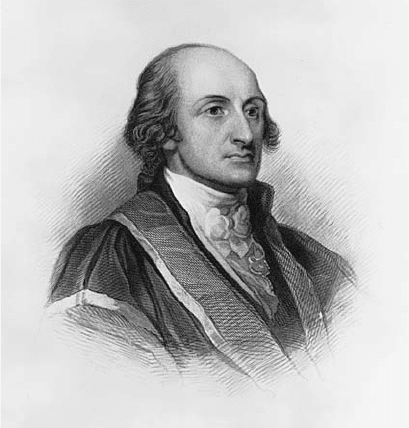
Jay, John (1745–1829) fi rst chief justice of the
United States
John Jay was the first chief justice of the U.S.
Supreme Court and a well-known political leader.
Jay was born in New York City, December 12,
1745, the youngest of eight children of Mary
Van Cortlandt Jay and Peter Jay, a prosperous
merchant. Jay’s mother taught him English and
Latin grammar until he left home to be formally
instructed. At age 14, Jay entered King’s College
(later renamed Columbia University) and received
his diploma with honors. Jay clerked in a law offi ce
and was admitted to bar in 1768. Jay became one
of the most successful attorneys in New York,
fi rst in partnership with an old college classmate,
Robert R. Livingston, Jr., and then on his own.
Jay married the cousin of his former law partner,
Sarah Van Brugh Livingston, in 1774. The Jays
had six children.
In 1774, Jay committed himself to the cause
of independence by representing his state at the
First Continental Congress. He did not sign the
Declaration of Independence because of
duties drafting the state constitution of New York.
In 1777, Jay was appointed chief justice of New
York’s newly formed Supreme Court of Judicature.
His judicial activities ended when he was sent by
New York to the Second Continental Congress in
November 1778. Jay helped with the establishment
of the fl edgling republic. Jay, as a peace commis-
sioner, along with Benjamin Franklin, negotiated
the Peace Treaty of 1783, which ended the Revo-
lutionary War with favorable terms for the United
States. Once the Constitution had been drafted,
Jay contributed fi ve essays of those that became
known as T
HE FEDERALIST PAPERS. They were
intended to persuade the citizens of New York to
ratify the Constitution.
President George Washington was reportedly
willing to consider Jay for any number of high
posts in the new government, and on Septem-
ber 24, 1789, he nominated the 43-year-old New
Yorker to be the nation’s first chief justice. As
chief justice, Jay’s most notable case was C
HISHOLM
V. GEORGIA, 2 U.S. (2 Dall.) 419 (1793). The hold-
ing of the Court established the right of citizens
of one state to sue another state in federal court,
affi rming that some of the state’s sovereignty was
subordinate to the U.S. Constitution. Because of
the unfavorable reaction to the decision, Congress
quickly proposed the Eleventh Amendment,
which reversed the Court’s decision, denying fed-
eral courts authority in suits by citizens against a
state and barring such suits unless the defendant
state consented.
Jay resigned from the Supreme Court on June
29, 1795, to serve as governor of New York for two
three-year terms. He then retired from public life
in 1801. President John Adams sent Jay’s name,
without his knowledge, to the Senate in hopes of
reappointing him chief justice. The Senate con-
fi rmed him, but Jay declined the position because
of his dislike of circuit court riding and his disap-
pointment that the Supreme Court was not vested
with suffi cient authority. He spent his unusually
Chief Justice John Jay (Library of Congress)
Jay, John 391
xviii+446_EofUSConsti-v1.indd 391 3/12/09 3:05:42 PM