
Schultz D. Encyclopedia of the United States Constitution
Подождите немного. Документ загружается.

long retirement at his 800-acre estate in West-
chester County, until his death on May 17, 1829.
For more information: Casto, William R. The
Supreme Court in the Early Republic: The Chief
Justiceships of John Jay and Oliver Ellsworth.
Columbia, S.C.: University of South Carolina
Press, 1995; Kelly, Alfred H., Winfred A. Harbi-
son, and Herman Belz. The American Constitu-
tion: Its Origins and Development. New York:
W.W. Norton & Company, 1991.
—Randy W. Hagedorn
J.E.B. v. Alabama 511 U.S. 127 (1994)
In J.E.B. v. Alabama, the U.S. Supreme Court
decided that peremptory challenges that
exclude jurors on the basis of sex violated the
equal protection clause of the Fourteenth
Amendment.
J.E.B. was the latest in a series of cases in which
the Court determined the limits on peremptory
challenges, a practice in which attorneys for either
side in civil or criminal cases may excuse poten-
tial jurors without providing an explanation. The
Court had held in B
ATSON V. KENTUCKY, 476 U.S.
79 (1986), that a prosecutor who uses peremptory
challenges in a criminal trial to eliminate jurors
based on their race violates the equal protection
clause. Therefore, the question the Court had to
answer in J.E.B. was whether to extend the prin-
ciple of Batson to sex-based peremptory strikes.
The defendant in J.E.B. was on trial for charges
related to his failure to pay child support for a
child purported to be his. Each side used peremp-
tory challenges to eliminate jurors on the basis
of sex whom they thought would be detrimental
to their side: the prosecutor used nine of his 10
peremptory challenges to strike potential male
jurors; similarly, J.E.B.’s attorney used almost
all his peremptory challenges to remove female
jurors. The resulting jury, consisting of all women,
found that he was the father of the child, and the
judge ordered him to pay child support.
The Alabama courts rejected J.E.B.’s claim
that the prosecutor’s use of sex-based peremptory
challenges violated the equal protection clause.
Speaking for a 6-3 majority, Justice Harry Black-
mun proclaimed that discrimination based on sex
violates the equal protection clause, especially in
situations in which the laws perpetuate stereotypi-
cal views of men’s and women’s abilities. Although
the state tried to justify its practices by distin-
guishing racial discrimination from sex discrimi-
nation in the jury selection procedure, the Court
refused to engage in a debate over whether women
or racial minorities suffered more discrimination
at the hands of the state. Blackmun reiterated that
the nation’s wide-ranging history of sex discrimi-
nation required the Court to consider the practice
of allowing prosecutors to base their peremptory
challenges on sex very carefully.
The Court sought to determine whether these
sex-based peremptory challenges were substan-
tially related to the state’s goal of ensuring a fair
trial and concluded they were not. In reaching this
conclusion, the Court rejected the state’s attempt
to rely on studies that showed that attitudes dif-
fered by sex, thereby justifying using sex as a proxy
to eliminate potential juror bias. Characterizing
the state’s evidence as largely gender stereotyping,
Blackmun noted that the equal protection clause
does not allow states to base laws on stereotypical
generalizations about the sexes even though there
might be some statistical evidence to support the
generalizations.
Chief Justice William Hubbs Rehnquist
dissented, arguing that the Court should main-
tain a distinction between the way it viewed racial
and sex-based classifi cations. In his view, although
racially-based peremptory strikes were clearly
unconstitutional, the equal protection clause did
not prohibit states from excluding potential jurors
on the basis of sex.
For more information: Albright, Mary M.
“Equal Protection and Peremptory Challenges:
Reconciling the Irreconcilable.” Capital Univer-
sity Law Review 25 (1996): 425–452; Grice, O.
Drew, Jr. “Comment: J.E.B. v. Alabama: A Criti-
cal Analysis of the Supreme Court’s Latest Limi-
tation on Peremptory Challenges.” Cumberland
Law Review 25 (1995): 355–381.
—Susan Gluck Mezey
392 J.E.B. v. Alabama
xviii+446_EofUSConsti-v1.indd 392 3/12/09 3:05:42 PM
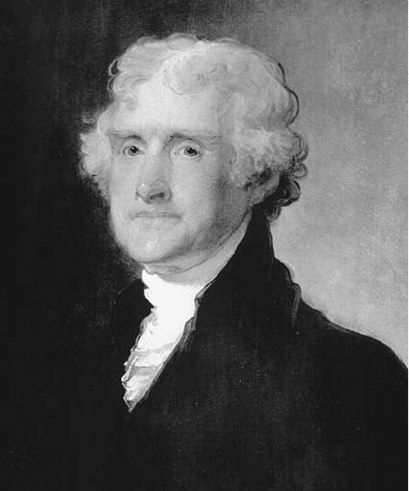
Jefferson, Thomas (1743–1826) second U.S.
vice president, third U.S. president
Thomas Jefferson, state legislator, governor,
Republican Party co-founder and leader, congress-
man, minister to France, secretary of state, vice
president, and third president of the United
States, was one of the most signifi cant fi gures in
American constitutional history.
Jefferson fi rst burst into the consciousness of
American political leaders at large with the publi-
cation of his 1774 pamphlet A Summary View of
the Rights of British America. In that pamphlet,
Jefferson developed the view of the British Con-
stitution that would mark his thinking through
the balance of his life. Building on the views of
his mentor Richard Bland, Jefferson claimed that
every man had a natural right to emigrate, that
Virginia had been founded by émigrés through
their own efforts and with their own money, that
King George III served Virginia at Virginia’s plea-
sure, and that in case he should cease to fulfill
the role they had assigned him, Virginians could
rightfully replace George with someone else. In
short, Virginia stood on a par with Great Britain
itself in the international system.
His draft of the Declaration of American Inde-
pendence in 1776 amounted to a simple restate-
ment of that position—and one that Jefferson did
not consider particularly signifi cant at the time. In
fact, in the weeks leading up to his appointment
to the congressional committee charged with pro-
ducing a declaration, Jefferson repeatedly asked to
be relieved of his congressional duties so that he
could participate in the key event of the Revolu-
tion: writing a constitution for the new Virginia
republic. To his chagrin, Jefferson’s imprecations
went unheeded, and he had to be satisfi ed with
crafting the fi rst draft of the Declaration.
The Declaration’s chief claim was that in case
government’s performance failed to satisfy the
people, they were entitled to replace it with one
more to their liking. In the context of 1776, this
was a justifi cation of secession—of Virginia’s deci-
sion, already implemented by July 4, to withdraw
from King George III’s empire. Jefferson would
remain committed to the notion that Virginia and
its fellow states formed the primary elements of
the North American political system to the day of
his death.
Jefferson was in France while the constitutional
reform movement of the 1780s crescendoed, and
he played no part in drafting the Constitution in
1787. He did, however, have thoughts about it late
in that year. Sent a copy by his friend James Mad-
ison, Jefferson said that he admired the compro-
mises between large and small states, between
producing and carrying states, and so on, but that
he had two powerful objections: fi rst, he said, the
president should be subject to a term limit.
Otherwise, so august an offi cer likely would use
the appointment power to build up a signifi cant
faction in each state, and thus to ensure himself
lifetime tenure.
Jefferson’s second objection was to the absence
of a bill of rights. Virginia in 1776, like England
in 1688, had preceded establishment of its new
regime by adoption of a declaration of rights,
and Jefferson thought the federal government
ought to be introduced similarly. When Madison
Thomas Jefferson. Painting by Thomas Sully
(National Archives)
Jefferson, Thomas 393
xviii+446_EofUSConsti-v1.indd 393 3/12/09 3:05:43 PM
responded with a series of objections to this idea,
Jefferson fi nally cut him off with the assertion that
“A bill of rights is what the people are entitled to
against every government in the world.” Partly
because of Jefferson’s insistence, Madison ulti-
mately shepherded 12 proposed amendments—
11 of which ultimately became the fi rst ten and
the 27th amendments—through the fi rst federal
Congress.
Jefferson agreed to join George Washington’s
cabinet as secretary of state in 1789. He no doubt
expected to have the leading voice in the formula-
tion of executive policy, but things did not work
out that way. Instead, Washington proved sym-
pathetic to the incisive proposals and analyses,
both in regard to matters domestic and to foreign
policy, of Secretary of the Treasury Alexander
Hamilton.
Jefferson and Hamilton came into notable
confl ict for the fi rst time in 1791, when Congress
passed the bank bill Hamilton had proposed.
Washington, aware that Madison had criticized
the bill as unconstitutional in the House of
Representatives, requested that his cabinet
members provide written appraisals of the bill. In
response, Jefferson and Hamilton each produced
one of the most notable state papers in American
history.
Jefferson took as his jumping-off point the lan-
guage of the soon-to-be-ratified Tenth Amend-
ment, which said that all powers not delegated
to the federal government via the Constitution
or denied by it to the states were reserved to the
states or to the people. This, for Jefferson, was
the key assumption of American federalism:
that all powers lay in the states except those few
carefully and—to borrow a word used by Virginia
Federalists in the Virginia Ratifi cation Conven-
tion of 1788—“expressly” delegated to the federal
government.
Jefferson’s reading of Article I, Section 8 of
the Constitution did not disclose authorization to
Congress to charter any corporation, much less
to charter a bank. Therefore, his fall-back prin-
ciple meant that that power lay solely where it had
before the Constitution’s ratifi cation: in the state
governments. Here we have one of the two classic
positions on constitutional interpretation.
It is usually known as the “state’s rights” or “strict
construction” reading of the Constitution—but
one might as well call it the “respectful” reading.
Hamilton made a contrary argument to contrary
effect, and thus established the other classic posi-
tion on constitutional interpretation—the “lib-
eral” or “broad” position.
In 1793, Washington responded to the dan-
gerous international situation by issuing his
Neutrality Proclamation. From his—and Hamil-
ton’s—perspective, the proclamation amounted
simply to informing American citizens of the legal
jeopardy they faced in case they actively took sides
in the Wars of the French Revolution. Jefferson,
however, considered the proclamation to be a
usurpation of the power of Congress to set Ameri-
can foreign policy: if America was to move from
friend of France to neutral, it should be for the
legislature, not the chief executive, to make that
determination. Perhaps the king of England could
make foreign policy, but the federal Constitution,
Jefferson insisted, gave that power to Congress.
Through the rest of the 1790s, Jefferson and a
growing body of like-minded Republicans would
wage political warfare on Hamilton and his fellow
Federalists, chiefl y on the basis of their diverging
views concerning foreign policy and concerning
the Constitution. As Jefferson understood things,
Hamilton was a not-so-secret monarchist bent on
destroying the Constitution, which any republican
(read: patriotic American) would read Jefferson’s
way; Hamiltonians favored the president over
Congress within the federal government and the
federal government over the state governments,
while Republicans stood for the opposite priori-
ties. In 1798 and 1799, Jefferson authored two sets
of Kentucky Resolutions laying out his state’s-
rights position—and claiming the rights both of
nullifi cation and of secession. This threat to resist
the federal government forcibly was never acted
upon in Jefferson’s lifetime, however, because his
party swept to victory in 1800.
Jefferson counseled in 1798 that his party
would win the next presidential election because
his opponents’ military program required so many
taxes. From the time of his victory, however,
394 Jefferson, Thomas
xviii+446_EofUSConsti-v1.indd 394 3/12/09 3:05:43 PM
which he called the “Revolution of 1800,” Jeffer-
son attributed Republican success to the people’s
sympathy for his state’s-rights constitutional views.
When, at his presidential inauguration in 1801, it
came time for him to address the party combat
of the 1790s, Jefferson said that he thought party
contention was past. It seemed to him that his
views were the self-evident views of the Revolu-
tion and that Hamilton had skillfully manipulated
Washington’s great popularity to near-disastrous
effect. Now, consensus had arrived.
Jefferson’s constitutional position entailed the
abrupt dismantlement of the army and navy, the
elimination of virtually all federal taxes, and a
pacifi st foreign policy. It meant the death of Ham-
ilton’s bank. Ultimately, it resulted in the nigh
disastrous War of 1812. Jefferson’s presidential
successor, James Madison, recanted much of the
Republican position—even going so far as to ask
Congress to charter a second Bank of the United
States and to declare war on Great Britain.
In retirement, Jefferson worked unsuccess-
fully to thwart that second bank bill. He also
maintained his commitment to state’s rights. For
example, Jefferson labored during the Missouri
Crisis of 1819–20 to thwart northerners’ efforts to
exclude slavery from Missouri. His constitutional
position was that new states must be admitted to
the Union on an equal footing with the old, and
that Missouri could not be equal to Massachusetts
and Virginia unless it, like them, got to decide on
its domestic institutions for itself. He went so far
as to counsel Missourians to declare their inde-
pendence in case Congress would not let them
join the Union with a pro-slavery constitution.
Jefferson also encouraged other Virginians in
their campaign against the nationalizing course
of the U.S. Supreme Court, headed by his cousin,
Chief Justice John Marshall. Jefferson and
Marshall developed a strong mutual loathing
because of their contrary constitutional views.
When Spencer Roane, chief judge of Virginia’s
highest court, wrote incisive newspaper columns
criticizing Marshall’s poorly reasoned opinion in
M
CCULLOCH V. MARYLAND (1819), Jefferson greeted
them with great enthusiasm. He grew increasingly
unhappy with the Court’s behavior of those years
and lamented that the Supreme Court constituted
a corps of sappers and miners working stealthily to
grind the states into one great, consolidated mass.
This vision, of course, stood directly at odds with
the vision Jefferson had fi rst developed in A Sum-
mary View a half-century before.
For more information: Gutzman, Kevin R.
Constantine. “Jefferson’s Draft Declaration of
Independence, Richard Bland, and the Revo-
lutionary Legacy: Giving Credit Where Credit
Is Due.” The Journal of the Historical Society 1
(2001): 137–154; Gutzman, Kevin R. Constantine.
“The Virginia and Kentucky Resolutions Recon-
sidered: ‘An Appeal to the Real Laws of Our
Countr y.’ ” The Journal of Southern History 66
(2000): 473–496; Mayer, David N. The Constitu-
tional Thought of Thomas Jefferson. Charlottes-
ville: University Press of Virginia, 1994.
—Kevin R. C. Gutzman
Johnson v. Transportation Agency of Santa
Clara, California
480 U.S. 616 (1987)
In Johnson v. Transportation Agency of Santa
Clara, the Supreme Court clarifi ed the standard for
evaluating voluntary affirmative action plans
under Title VII of the Civil Rights Act of 1964,
clearly distinguishing it from the far stricter stan-
dard required for such plans to meet constitutional
muster under the equal protection clause.
Paul Johnson was an employee with the Santa
Clara County Transportation Agency. In Decem-
ber 1979, the agency announced a vacancy for a
road dispatcher, and Johnson applied for the pro-
motion along with 11 other candidates, including
co-worker Diane Joyce. Both Johnson and Joyce
were deemed well qualifi ed for the position, but
ultimately the agency director chose Joyce pur-
suant to an affi rmative action plan (AAP) which
the agency had voluntarily adopted the year
before. Under the terms of the AAP, the agency
was authorized to consider the sex of a qualifi ed
applicant as one factor when making promotions
to positions within a traditionally segregated job
classification in which women had been signifi-
cantly underrepresented. At the time of Joyce’s
Johnson v. Transportation Agency of Santa Clara, California 395
xviii+446_EofUSConsti-v1.indd 395 3/12/09 3:05:43 PM
selection, none of the 238 positions in the relevant
Skilled Craft Worker job classifi cation, including
that of dispatcher, was occupied by a woman.
Johnson fi led suit under Title VII in federal dis-
trict court; in spite of the fact that the defendant
was a public employer, no constitutional challenge
was raised. The district court found that Joyce’s
sex was a determining factor in her promotion and
that the AAP was invalid under the requirement
articulated in U
NITED STEELWORKERS V. WEBER, 443
U.S. 193 (1979), that the plan be temporary. The
Ninth Circuit reversed, holding, inter alia, that
the lack of a specifi c end date in the AAP was not
dispositive in light of the express plan objective of
attaining, not maintaining, a labor force that mir-
rored the local work force. The Supreme Court
granted certiorari.
Justice William J. Brennan, Jr., writing
for the majority, affi rmed the court of appeals’s
judgment and held that the agency appropriately
took Joyce’s sex into account as one factor in the
promotion decision. Compliance with an affi rma-
tive action plan constitutes a nondiscriminatory
reason for a gender- or race-conscious promotion,
and the burden of proof rests with the challenger
to demonstrate that the plan is invalid and, thus,
a violation of Title VII. In contrast to the more
exacting constitutional standards for evaluating
AAP validity, a private employer need only show
“a conspicuous imbalance in traditionally segre-
gated job categories” in general, not its own prior
discriminatory practices. Thus, under Title VII,
employers may take proactive steps in eliminat-
ing societal discrimination, rather than merely
addressing their own history of job segregation.
The Court found that the county’s AAP took
into consideration a variety of factors and did not
require blind adherence to numerical standards.
The plan did not unnecessarily trammel the rights
of male employees nor did it constitute an absolute
bar to their career advancement. Rather, Johnson
had no entitlement to the dispatcher position since
the agency director was authorized to promote
any of the seven applicants deemed qualifi ed. The
plan, although not expressly temporary, adopted
a “moderate, gradual approach” to elimination of
the work force imbalance, and the explicit goal of
attaining, rather than maintaining, balance dem-
onstrates that the plan is not intended to be of
indefi nite duration. The Johnson decision is impor-
tant for distinguishing between Title VII’s goal of
eliminating the impact of societal discrimination
in employment versus constitutional require-
ments that suspect classifi cations such as race or
national origin or suspicious classifi cations such as
sex receive heightened judicial scrutiny, even if for
remedial purposes. Thus, private employers have
far more leeway to engage in voluntary affi rmative
action efforts than governmental employers.
For more information: Anderson, Terry H.
The Pursuit of Fairness: A History of Affi rmative
Action. New York: Oxford University Press, 2005;
Urofsky, Melvin. Affirmative Action on Trial.
Lawrence: University of Kansas Press, 1997.
—Virginia Mellema
judicial review
Judicial review is the power of the Supreme Court
of the United States and other federal courts to
refuse to enforce federal laws they fi nd contrary
to the Constitution. The term is often used more
broadly to include the power of federal or state
courts to declare unconstitutional any decisions
taken by federal or state offi cials, whether in the
form of law or not. Laws or other actions declared
unconstitutional are unenforceable in the courts
and are generally regarded as void.
The justifi cation for judicial review is usually
traced to Chief Justice John Marshall’s opinion
in M
ARBURY V. MADISON, which declared unconsti-
tutional a minor provision of federal law defi ning
the jurisdiction of the Supreme Court. Marshall’s
most persuasive justifi cations were based in Arti-
cle III of the U.S. Constitution, which pro-
vides that “the judicial power shall extend to all
cases . . . arising under the Constitution” and the
declaration in Article VI that the Constitution
“shall be the supreme law of the land.” Marshall
reasoned that “it is emphatically the province and
duty of the judicial department to say what the law
is,” and therefore if any action of the other branches
violates the Constitution, it is “the province and
396 judicial review
xviii+446_EofUSConsti-v1.indd 396 3/12/09 3:05:44 PM
duty” of the judges to uphold the “supreme law of
the land” by rejecting that action.
Marshall’s justifi cation of judicial review has
been strongly criticized throughout the nation’s
history. The “supreme law of the land” clause
refers to federal laws and treaties as well as the
Constitution, and it is followed by the phrase
that “the judges in every state shall be bound
thereby.” Critics of judicial review argue that the
supremacy clause was intended only to compel
states to follow all forms of federal law by requir-
ing state judges to enforce it, but not to authorize
any judges, state or federal, to say whether fed-
eral laws are unconstitutional. The framers, they
argue, would have explicitly stated a power for
appointed judges serving unlimited terms to undo
the work of the elected Congress and president if
they intended a power of judicial review. In fact,
the Constitutional Convention rejected
a proposal for a Council of Revision, including
judges, to disapprove laws that did not conform to
the Constitution.
Neither James Madison’s notes on the Consti-
tutional Convention, the most complete record of
those proceedings, nor the correspondence of any
of the framers during the Convention or imme-
diately afterward state that the courts shall have
authority to strike down federal laws. Later state-
ments by some framers are both for and against
judicial review, and many of those statements
appear to be dictated by the politics of later times.
During the state conventions to ratify the Consti-
tution, only fi ve references to judicial review by
members of the Constitutional Convention can be
found, and two of them opposed ratifi cation.
Judicial review, critics note, was unknown in
England, from which American law was largely
derived. Indeed, when the chancellor of England,
the highest judicial offi cial, attempted in 1603 in
Dr. Bonham’s Case to declare an act of Parliament
contrary to higher law, he was immediately over-
ruled and was soon replaced by the king. No other
case from English judges overrules a law adopted
by Parliament. The British Privy Council, a judicial
body, did review acts of the legislative assemblies
in the American colonies to determine whether
they conformed to English law and colonial char-
ters, and one scholar has said the Privy Council
vetoed about 5 percent of colonial laws. But those
vetoes were heatedly criticized by colonial politi-
cal leaders, newspapers, and the public, suggest-
ing that judicial review of legislative actions was
not widely accepted.
There is also little support for judicial review in
the period between the Revolution and the adop-
tion of the Constitution. The Articles of Confeder-
ation, which created the fi rst national government,
had no judicial branch and therefore no judicial
review. Scholars have found only two instances
during this period where state supreme courts
attempted to strike down state laws, and both
cases were met with overwhelming opposition
from state legislatures, the press, and the public.
The most important statement in the constitu-
tional period supporting judicial review is found
in Federalist 78, written by Alexander Ham-
ilton, a member of the Convention, as part of
a series of editorials arguing for ratification
of the Constitution. Hamilton described the
“limited Constitution . . . which contains specifi ed
exceptions to the legislative authority” that “can
be preserved . . . no other way than through the
medium of courts of justice, whose duty must be
to declare all acts contrary to the manifest tenor
of the Constitution void.” But Hamilton’s own plan
in the Constitutional Convention had no provision
for judicial review. And Hamilton himself played
little role in the Convention, although he was an
important fi gure in the struggle for ratifi cation.
President Thomas Jefferson and his Repub-
lican majorities were outraged by the decision in
Marbury. A year later, they attempted to impeach
Federalist Justice Samuel Chase, who narrowly
escaped removal by a close vote in the Senate.
John Marshall kept alive the concept of judicial
review only by striking down a series of state
laws, which could be justifi ed under the Article
VI supremacy clause and which found defend-
ers in Congress and the presidency because they
enhanced the power of the national government.
The Supreme Court did not void another federal
law until 1857, in D
RED SCOTT V. SANDFORD, which
struck down the Missouri Compromise of 1820
that prohibited slavery in the Louisiana Purchase
judicial review 397
xviii+446_EofUSConsti-v1.indd 397 3/12/09 3:05:44 PM
territory north of Missouri. The hostile reaction
in the North was soon overshadowed by Abra-
ham Lincoln’s election in 1860 and the onset
of the Civil War, which overturned Dred Scott’s
approval of slavery.
Despite the disastrous decision in Dred Scott,
the Supreme Court’s judicial review has expanded,
with two short exceptions, throughout American
history. One study put the number of federal
laws struck down by the Supreme Court as 160
through June, 2005. By one scholar’s count, the
Court considered 116 constitutional challenges
to federal statutes from 1865 to 1900 (an aver-
age of 3.22 challenges per year) and struck down
21 laws (an annual average of .58). In the period
from Marbury until the end of the Civil War, the
Court had heard only 13 constitutional challenges
to federal law and had struck down only two. From
1901 to 1937, the Court reviewed numerous laws
regulating economic activities. The Court heard
347 challenges to federal law (9.38 per year) and
struck down 57 (1.54 per year). After Franklin
Roosevelt’s effort in 1937 to pack the Court with
new justices, eight justices retired in just four
years and were replaced by Roosevelt appointees.
Judicial review ebbed for two decades: from 1937
to 1957, the Court heard only 148 cases challeng-
ing federal laws (6.73 per year) and struck down
only fi ve (.03 per year). However, from 1957 to
2001, the Court returned to an active role, strik-
ing down 74 federal laws (1.68 per year, its high-
est annual rate in history) in 299 (6.8 per year)
challenges.
Judicial review has been controversial through-
out American history for two distinct reasons.
First, the specific policies struck down reflect
majority views as expressed by Congress and the
president. Second, judicial review itself is counter-
majoritarian: it substitutes the will of judges who
are not elected and who serve indefinite terms
for the will of recently elected offi cials who must
regularly stand for reelection. Attorney General
Robert H. Jackson, who later served on the Court,
characterized judicial review as “the check of a
preceding generation on the present one; . . . and
nearly always the check of a rejected regime on
the one in being.”
While defenders of judicial review characterize
it as only carrying out the words of the Consti-
tution, its critics point out that the justices often
strike down laws under broad constitutional lan-
guage that does not have clear meaning. Such
phrases as “due process of law,” “equal pro-
tection of the laws,” “commerce . . . among the
several states,” or “all laws which shall be neces-
sary and proper for carrying into execution” the
other provisions of the Constitution allow justices
broad latitude to read their own views into the
Constitution. Even provisions that appear to be
specifi c leave wide room for interpretation because
of changing times and conditions: protections of
free speech and press, for example, were writ-
ten when electronic media and the Internet were
unimagined, and prohibitions against “unreason-
able searches” did not anticipate interception of
electronic communications or technology allowing
detection of objects or persons from outside the
walls of buildings.
Judicial review is defended as a protection of
individual rights. However, by one count, only
about a third of the cases striking down federal
laws related to due process for individuals, First
Amendment freedoms, privacy, or criminal
defendants’ rights. About 50 percent struck down
federal laws defining relations with the states,
regulating the economy, or taxation. About 5 per-
cent involved the separation of powers, and 8 per-
cent involved judicial power, issues relating to the
respective authority of the branches of the federal
government. Another 18 percent may have dimin-
ished individual rights by striking down federal
laws related to civil rights. While these catego-
ries are not sharply defi ned, it appears that protec-
tion of civil rights and liberties were protected by
substantially fewer than half the Supreme Court
decisions striking down federal laws.
The countermajoritarian character of judicial
review is heightened because Congress and the
president have few tools to overturn Court deci-
sions. Constitutional amendments require approval
of extraordinary majorities in Congress and
among the states: only four have been approved to
directly overturn decisions of the Supreme Court.
The justices serve indefi nite terms, and on aver-
398 judicial review
xviii+446_EofUSConsti-v1.indd 398 3/12/09 3:05:44 PM
age only one vacancy occurs every two years, so
that it may take many years to appoint enough new
justices to bring the Court into line with the pub-
lic will. Some presidents have had few opportuni-
ties to appoint justices: President Jimmy Carter,
for example, appointed none during his four-year
term, and President Bill Clinton appointed only
two in eight years. Moreover, after appointment,
justices’ decisions are often at odds with the presi-
dents who appointed them.
Congress can change the size of the Court; and
it has done so at least six times for political or pol-
icy reasons. But the last change, to nine members,
was made in 1869, and that number has appar-
ently become settled in the public mind. After his
landslide reelection in 1936, President Franklin
Roosevelt sought to reverse the Court’s decisions
striking down much of his economic program by
adding new justices, but that was overwhelmingly
opposed by the public and in Congress. Occasional
efforts by Congress to prevent judicial review of
specifi c issues by limiting the Court’s jurisdiction
have been accepted by the justices, but in each
case they have warned that they still have jurisdic-
tion under other provisions of law. In short, there
are few means to curb the Court, and efforts to do
so rarely succeed.
Judicial review is therefore a broad power of
appointed judges serving indefi nite terms to over-
turn as unconstitutional decisions of the elected
president and Congress. It contradicts the demo-
cratic ideal that the public controls the decisions
of government through the election of its offi cials.
But judicial review has become an accepted fea-
ture of American constitutionalism, because for
more than two centuries the people and Congress
have acquiesced by not amending the Consti-
tution to curb it.
For more information: Bickel, Alexander. The
Least Dangerous Branch. Indianapolis, Ind.:
Bobbs-Merrill, 1962; Bishin, William. “Judi-
cial Review in Democratic Theory.” Southern
California Law Review 50 (1977): 1,099–1,156;
Choper, Jesse. Judicial Review and the National
Political Process. Chicago: University of Chicago
Press, 1980; Dahl, Robert H. “Decision-Making
in a Democracy: The Supreme Court as a National
Policy-Maker.” Journal of Public Law 6 (1958):
279–295; Keith, Linda Camp. “The United States
Supreme Court and Judicial Review of Congress,
1803–2001.” Judicature 90 (2007): 166–176; Levy,
Leonard W. Judicial Review and the Supreme
Court: Selected Essays. New York: Harper &
Row, 1967.
—David Adamany
Judiciary Act of 1789
The Judiciary Act of 1789 established the struc-
ture of federal courts in the United States. Judi-
cial power was vested in one Supreme Court (with
a chief justice and fi ve associate justices) and 13
district courts. The act stemmed from Article
III of the U.S. Constitution, which vested
judicial power in “one Supreme Court, and in
such inferior courts as Congress may from time
to time ordain and establish.” Unlike Article I,
which clearly delineates Congress’s power, Article
III is vague on exactly what judicial power entails,
hence the need for further articulation.
The Judiciary Act was at the center of a num-
ber of controversies between the states and the
federal government in the pre–Civil War era.
At issue were the 13th and 25th Sections of the
Judiciary Act, both of which provided for federal
review of state actions. Article III, Section 2 of
the Constitution provides that the judicial power
extends to all cases under the Constitution and
to “controversies between a state and citizens of
another state.” Section 13 gave the Supreme Court
“exclusive jurisdiction” of all cases of a civil nature,
but in cases between a state and citizens of other
states, the Supreme Court had original, but not
exclusive jurisdiction. The Supreme Court’s deci-
sion in C
HISHOLM V. GEORGIA, 2 U.S. 419 (1793),
reaffi rmed the Court’s jurisdiction over disputes
between a state and a citizen of another state, irre-
spective of whether the state was a plaintiff or a
defendant in the suit.
Section 13 was also at issue in M
ARBURY V.
M
ADISON, 5 U.S. 137 (1803), a case famous for the
establishment of judicial review (and veto)
over federal legislation. At issue was whether
Judiciary Act of 1789 399
xviii+446_EofUSConsti-v1.indd 399 3/12/09 3:05:45 PM
William Marbury was entitled to his commission
as a justice of the peace. And if so, was the Court
obligated under Section 13 to issue a writ of man-
damus ordering the delivery of the commission?
Chief Justice John Marshall answered the fi rst
question in the affi rmative but ruled the Court
could not afford Marbury a remedy, since Section
13 was an unconstitutional interference with the
Court’s original jurisdiction set forth in the
Constitution.
One of the most controversial sections of the
Judiciary Act was Section 25, which provided for
review of state supreme court decisions by the U.S.
Supreme Court in cases where a federal law or the
Constitution was involved. In M
ARTIN V. HUNTER’S
LESSEE, 1 Wheaton U.S. 304 (1816) and COHENS V.
VIRGINIA, 6 Wheaton U.S. 264 (1821), the Mar-
shall Court tried to resolve these questions in
favor of the federal courts—both decisions resting
on the authority of the Court to hear appeals from
state courts—but to no avail.
Section 25 was at the center of a number of
divisive battles between the Supreme Court and
various state supreme courts. States argued that
Article III allowed for federal appellate review of
only inferior federal courts, not state courts. The
Ohio Supreme Court repeatedly clashed with the
Supreme Court on whether state taxation of state-
chartered banks violated the contract clause
of the Constitution. Ohio argued that the Supreme
Court had no jurisdiction over the state courts and
therefore, any state court decision on the validity
of the bank tax should be fi nal. In response, the
U.S. Supreme Court not only affi rmed the sanctity
of the contract clause, but in doing so, affi rmed its
authority under Section 25 to hear appeals from
and reverse the decision of state courts.
In Craig v. Missouri, 29 U.S. 410 (1830), the
Court invoked its jurisdiction under Section 25 to
strike down a Missouri law it felt interfered with
the constitutional ban on bills of credit. Section
25 came under immediate attack, as Congress
was determined to repeal it and do away once and
for all with the Court’s jurisdiction over the state
courts. This movement to repeal Section 25 also
came on the heels of two other federal-state con-
troversies—the Nullification Controversy,
in which South Carolina claimed it had the right
to nullify federal laws, and the Cherokee Indian
affair, where the Court clashed with Georgia’s
claim that it had the right to legislate over the
Cherokee Indians. Section 25 was spared, thanks
in part to Pennsylvania Representative (and later
President of the United States) James Buchanan,
who defended Section 25 as essential to the sur-
vival of the Union. In Worcester v. Georgia, 31
U.S. 515 (1832), John Marshall reasserted the
Court’s power to review state court decisions
under Section 25 and, in doing so, voided all laws
passed by Georgia concerning the Cherokee Indi-
ans. This, however, did not stop the states from
continuing to defy federal judicial authority.
For more information: Marcus, Maeva, ed.
Origins of the Federal Judiciary: Essays on the
Judiciary Act of 1789. New York: Oxford Univer-
sity Press, 1992; Warren, Charles. “Legislative
and Judicial Attacks on the Supreme Court of
the United States: A History of the Twenty-Fifth
Section of the Judiciary Act.” The American Law
Review 47 (1913): 1–47 and 161–189.
—Randa Issa
jurisdiction, power of Congress to control
The U.S. Constitution provides Congress with the
power to determine jurisdiction of federal courts
that are not provided for constitutionally. It pro-
vides original and appellate jurisdictional rules
under Article III, and Congress has several
important jurisdictional powers.
In Article III, Section 1, the Constitution
states: “In all Cases affecting Ambassadors, other
public Ministers and Consuls, and those in which
a State shall be Party, the supreme Court shall
have original jurisdiction. In all the other
Cases before mentioned, the Supreme Court shall
have appellate Jurisdiction, both as to Law and
Fact, with such Exceptions, and under such Regu-
lations as the Congress shall make.” Under this
ordain and establish clause, jurisdictional author-
ity for appellate cases not excepted by Congress
are determined as under the regulations provided
by Congress.
400 jurisdiction, power of Congress to control
xviii+446_EofUSConsti-v1.indd 400 3/12/09 3:05:45 PM
While the Constitution provides some guaran-
teed jurisdiction for federal courts under Article
III, the federal courts are subject to Congress
for the scope of all other jurisdiction. This raises
important questions regarding the extent to which
Congress can restrict the jurisdiction of federal
courts. The Constitution gives Congress some
power regarding creating and presumably abol-
ishing federal courts. M
ARBURY V. MADISON, on
the other hand, clearly states that the structural
principle of the rule of law requires that there be
judicial remedies for violation of rights. “The Con-
stitution . . . provides for only the barest minimum
of the American judicial system, with all else left
for Congress to determine,” as noted by constitu-
tional commentator James Burnham.
The ordain and establish clause of Article III,
Section 1 also provides Congress with the power
for deciding whether to create lower federal courts
and the power to determine their jurisdiction.
While there are cases that provide relatively broad
power for Congress, there are others which show
that congressional power is not unlimited.
The Judiciary Act of 1789 was the fi rst step
which Congress took to ordain the lower courts
which were prescribed by the Constitution. It was
also the basis of the landmark case Marbury v.
Madison, in which the Supreme Court established
the principle of judicial review, making the
Court the constitutional authority and arbiter in
the nation. This case also decided against the pro-
vision in the Judiciary Act of 1789 that enlarged
the original jurisdiction of the Supreme Court.
Sheldon v. Sill, 49 U.S. (8 How.) 441 (1850)
dealt with the power of Congress to decide the
jurisdiction of lower courts, specifi cally the circuit
courts. The 11th section of the Judiciary Act kept
circuit courts from taking a case “to recover the
contents of any promissory note of other chose of
action, in favor of an assignee, unless a suit might
have been prosecuted in such court to recover the
contents, if no assignment had been made, except
in cases of foreign bills of exchange.” The court
found that the Constitution ordained that there
be lower courts and defi ned the Supreme Court’s
specifi c jurisdiction while addressing the jurisdic-
tion of the judicial branch as a whole. Thus the
Constitution does not specify the jurisdiction of
the lower courts, leaving it to Congress to decide.
Similarly, the Court decided in E
X PARTE MCCA-
RDLE, 74 U.S. (7 Wall.) 506 (1868), that it was well
within the power of Congress to direct jurisdic-
tion, where allowed by the Constitution. The
Court’s appellate jurisdiction in regard to
habeas corpus was repealed, and the Congress
had the power to do so because of their Constitu-
tional authority to grant jurisdiction.
In the ruling in United States v. Klein, 80 U.S.
(13 Wall.) 128 (1871), the U.S. Supreme Court
allowed that Congress’s ability to constitutionally
govern the judicial branch is limited. After the Civil
War, presidential pardons were given to Southern-
ers who took an oath of allegiance. One V. F. Wil-
son did so, and upon his death, the administrator
of his estate, Klein, applied to have the proceeds
from the sale of Wilson’s effects given back to the
estate. Congress then passed a law denying such
proceeds to be given to those who had accepted
the presidential pardon, the acceptance being an
admission of guilt. The Court found that Con-
gress had overstepped its bounds in the area of
judicial independence and in the executive’s abil-
ity to grant pardons. Congress could not give and
remove power in the courts to affect the outcome
that it would see as best for the government. Like-
wise, the Congress has no power to stipulate the
effect of the presidential pardon, which is under
the purview of the executive branch. The presi-
dential pardon is both a pardon and amnesty, and
to assign an admission of guilt to the acceptance of
such a pardon shrinks the power of the executive
branch given in the Constitution.
Though Congress possesses constitutional
powers with regard to jurisdictional determina-
tion and regulation, the U.S. common law tradi-
tion and judicial precedents have provided federal
courts delimitation in the scope of congressional
jurisdictional prerogatives.
For more information: Bloom, Allan, ed. Con-
fronting the Constitution. Washington, D.C.: AEI
Press, 1990; Burnham, James. Congress and the
American Tradition. Washington, D.C.: Regnery
Publishing, 1996; Marbach, Joseph R., Ellis Katz,
jurisdiction, power of Congress to control 401
xviii+446_EofUSConsti-v1.indd 401 3/12/09 3:05:45 PM