
Schultz D. Encyclopedia of the United States Constitution
Подождите немного. Документ загружается.

against states. Congress’s power to abrogate,
that is, revoke, a state’s Eleventh Amendment
immunity is derived from its authority to enact
legislation under Section 5 of the Fourteenth
Amendment. For over a decade, the Supreme
Court has construed it to declare states immune
from money damages in lawsuits brought against
them for violating laws related to unfair labor
practices, employment discrimination, patent
protection, and unfair trade practices.
The ADEA, enacted in 1967 under Congress’s
authority to regulate interstate commerce,
prohibits discrimination in employment on the
basis of age. Initially limited to private employees,
it was amended in 1974 to include state employ-
ees. However, although it is likely that in amend-
ing the statute, Congress intended to allow suits
against states for money damages in federal court,
the law did not specify that Congress abrogated
the state’s Eleventh Amendment immunity. In
1994, on behalf of a group of faculty members and
librarians, plaintiffs J. Daniel Kimel and Roderick
MacPherson fi led suit against the state university
systems of Florida and Alabama for age discrimi-
nation, claiming they were denied pay increases
and promotions. Wellington Dickson, a prison
guard, sued the Florida Department of Correc-
tions, alleging discrimination on the basis of age
and disability. The states sought to dismiss the
monetary claims, citing their immunity under
the Eleventh Amendment. The lower courts were
divided, and on appeal, the Eleventh Circuit ruled
in favor of the states.
When the case reached the Supreme Court,
the outcome of the case depended on two factors:
fi rst, whether Congress intended to allow age dis-
crimination suits against states for money dam-
ages; and second, whether its authority to do so,
derived from its power to enforce the equal rights
provisions of the Fourteenth Amendment, was
suffi cient. Writing for a majority seven justices,
Justice Sandra Day O’Connor determined that
Congress clearly intended to allow individuals to
sue states for money damages. In addressing the
second issue, O’Connor now spoke for fi ve justices.
She conceded that Congress had broad authority
to legislate under Section 5 of the Fourteenth
Amendment, but such legislation must not exceed
the bounds of the Fourteenth Amendment’s guar-
antee of equality. She concluded that although
the Fourteenth Amendment allows states to pass
laws related to age as long as they are rational,
the ADEA punishes states even when they act
rationally. Moreover, because there was insuffi -
cient evidence to show that states were guilty of
age discrimination in employment, the ADEA
was a disproportionate remedy and exceeded the
bounds of Congress’s authority under the Four-
teenth Amendment.
With its broad interpretation of the protec-
tion offered states by the Eleventh Amendment,
Kimel reinforced state sovereignty at the expense
of Congress’s authority to guarantee equal rights
under the Fourteenth Amendment.
For more information: Brown, Charles. “Con-
gressional Abrogation of Eleventh Amendment
Immunity by Passing the ADEA and the ADA.”
Baylor Law Review 51 (1999): 340–372; Durham,
Lisa M. “Protection from Age Discrimination for
State Employees: Abrogation of Eleventh Amend-
ment Sovereign Immunity in the Age Discrimina-
tion in Employment Act.” Georgia Law Review 33
(1999): 541–601.
—Susan Gluck Mezey
Korematsu v. United States 323 U.S. 214
(1944)
In Korematsu v. United States, the Supreme
Court upheld the relocation of over 120,000 Japa-
nese Americans to camps during World War II.
This case questioned the extent of the powers of
the executive and the legislative branches.
After the surprise attack on Pearl Harbor on
December 7, 1941, and the entrance of the United
States into World War II with a declaration of war,
the president and Congress took action to prevent
espionage and enhance national security. These
actions forced many Americans, about 120,000,
to leave their homes and move to an internment
camp for the remainder of the war.
President Franklin D. Roosevelt issued Execu-
tive Order 9066, and Congress created statutes
412 Korematsu v. United States
xviii+446_EofUSConsti-v1.indd 412 3/12/09 3:05:48 PM
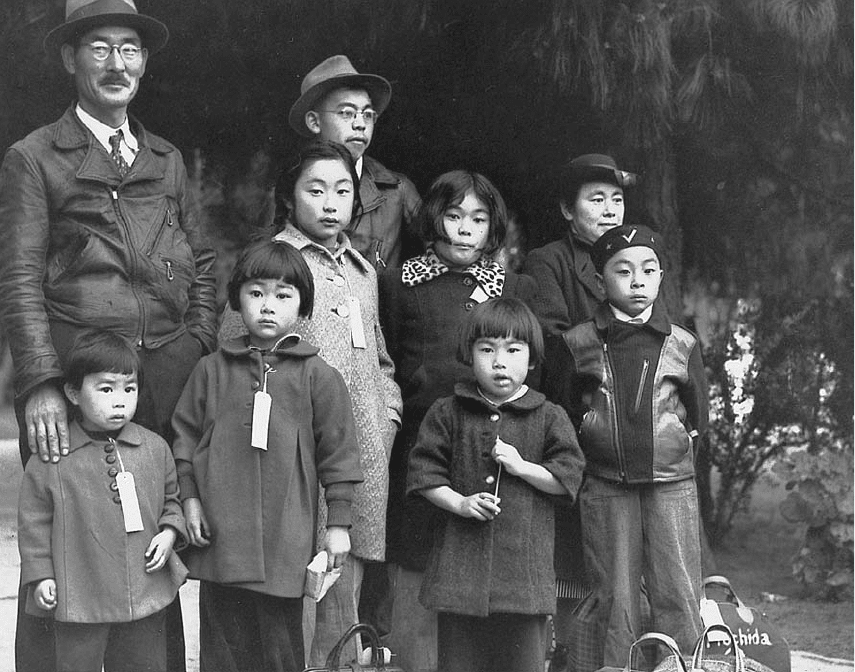
that allowed the military to exclude Japanese-
American citizens from areas deemed critical
to national defense during World War II. Japa-
nese-American citizens were forced to leave their
homes on the West Coast and move to relocation
camps. Fred Korematsu refused to leave his home
in San Leandro, California, and was arrested and
convicted for violating Civilian Exclusion Order
No. 34. He appealed his conviction to the circuit
court of appeals, who confi rmed his conviction.
Then, he appealed to the Supreme Court, ques-
tioning whether the president and Congress went
too far in restricting the rights of American citi-
zens of Japanese descent.
By the time of Fred Korematsu’s appeal, the
Supreme Court had heard many cases relating
to the internment camps and the power of the
government to detain citizens in a time of war.
Yasui v. United States, 30 U.S. 115 (1943), and
Hirabayashi v. United States, 320 United States
81 (1943), held that it was constitutional to impose
curfews based on a person’s ancestry.
The Supreme Court upheld Korematsu’s con-
viction and sided with the government in a 6-3
decision. The opinion of the court was written by
Justice Hugo Black and joined by Chief Justice
Harlan Fiske Stone, Justice Stanley Reed, Justice
William O. Douglas, Justice Wiley Rutledge,
This 1942 photograph shows the Mochida family awaiting the evacuation bus to an internment camp.
(National Archives)
Korematsu v. United States 413
xviii+446_EofUSConsti-v1.indd 413 3/12/09 3:05:49 PM
and Justice Felix Frankfurter. The Court found
that the need to protect the national security of the
country during a time of war and protect against
espionage outweighed the individual rights and
liberties of Korematsu and American citizens of
Japanese descent, though the Court did acknowl-
edge the hardships and racial discrimination asso-
ciated with moving Japanese-American citizens
to internment camps. In this case, pressing public
needs justifi ed racial discrimination since there
was a military purpose. The fact that the country
was engaged in a war played a major role in this
decision. Justice Owen Roberts and Justice Frank
Murphy dissented.
The decision in Korematsu v. United States has
been very controversial, although it has not been
overturned. Petitioner Fred Korematsu later had
his conviction overturned in 1983 before his death
in 2006. At the end of World War II, the Japanese-
American citizens could return to their homes,
even though many had lost their property, which
the federal government compensated them for in
1948. The U.S. government offi cially apologized
for the internment, issued by President Ronald
Reagan in 1988, and beginning in 1990 compen-
sation was paid to surviving detainees.
In addition to upholding the relocation, Kore-
matsu is also important for another reason. In
that case, the Court for the fi rst time established
the concept of suspect classifi cation. Justice Black
contended that the use of race as a form of clas-
sifi cation was suspect and that it would be sub-
ject to increased or heightened scrutiny. Hence,
even though the Court declared race suspect in
this case, it found a compelling governmen-
tal interest to impose internment based on
race and affi rmed its use. In subsequent cases the
Court would eventually fi nd other classifi cations
either to be suspect or semi-suspect.
For more information: Alonso, Karen. Kore-
matsu v. United States: Japanese-American
Internment Camps. Springfield, N.J.: Enslow
Press, 1998; Tushnet, Mark, ed. The Constitu-
tion in Wartime. Durham, N.C.: Duke University
Press, 2005.
—Carol Walker
Kovacs v. Cooper 336 U.S. 77 (1949)
In Kovacs v. Cooper, the U.S. Supreme Court
voted 5-4 to deny the First Amendment claim of
Kovacs that the City of Trenton, New Jersey’s ordi-
nance to ban the use of any sound system emitting
“loud and raucous” noises on its public streets vio-
lated the First and Fourteenth Amendments
including the violation of his due process. The
conviction in the City of Trenton was upheld by
the New Jersey Supreme Court. The U.S. Supreme
Court upheld the lower courts’ decision.
The City of Trenton’s ordinance No. 430 made
it unlawful to “play, use or operate . . . on or upon
the public streets, alleys and or thoroughfares . . . ,
any device known as a soundtruck, loud speaker or
sound amplifi er, or any vehicle operated or stand-
ing upon said streets or public places.” In ques-
tion was the City of Trenton’s ordinance. Was it
a violation of a person’s right of expression and
participation?
The appellant was found guilty by police judge
Cooper of the City of Trenton of violating Ordi-
nance No. 430 of the City of Trenton, New Jersey.
At the trial in the Trenton Police Court, a patrol-
man testified that he heard loud music coming
from a broadcasting truck. Once the truck was
located on a public street near a public building,
the patrolman no longer heard music. He heard
a man’s voice, which was later identified as the
appellant’s, being broadcast from the truck. The
appellant even admitted that he was the individ-
ual that was broadcasting the music and speak-
ing into the amplifi er. Although there was no real
known reason for the broadcast cited in the police
court, the Supreme Court’s opinion was that the
appellant was broadcasting his views about a labor
dispute that was going on in the City of Trenton
at the time.
The majority opinion and judgment of the
court was announced by Justice Stanley Reed, and
joined by Chief Justice Fred Vinson, and Justice
Harold Burton.
The Supreme Court decided that it was not a
violation of the Fourteenth Amendment regarding
his freedom of speech, assemblage, or freedom to
communicate. And the Court found that it was a
far cry to claim that the ordinance violated his due
414 Kovacs v. Cooper
xviii+446_EofUSConsti-v1.indd 414 3/12/09 3:05:49 PM
process because its language was too obscure and
vague to be able to interpret its true meaning of
the words “loud and raucous.” The Court felt that
a regular person would be able to determine that
“loud and raucous” noises would be found unac-
ceptable in a public place.
In upholding the city’s ordinance, it was pointed
out that it specifi cally applied to only vehicles that
were being operated on the city’s streets with
sound amplifi ers or some type of device that could
“emit loud and raucous noises.” The ordinance
specifi cally targeted the use of sound trucks and
other sound amplifi cation devices. The Supreme
Court stated that the city of Trenton should have
the right to bar or ban sound trucks that broadcast
a loud noise on behalf of its public’s interest. Such
a vehicle can blare such a loud noise as to “rise
above other street noises,” which can intrude or
interfere with the daily business or any activity on
or near the public streets.
The ban itself does not infringe on the right
of free speech, and the Court feels that the ordi-
nance is justifi ed. The city barred sound trucks,
but there is no other restriction on communica-
tions such as “the human voice, by newspapers,
by pamphlets,” etc. to elicit a “willing audience.”
It was also mentioned that a public street is an
accepted place for some form of speech and com-
munication but not without some limitation refer-
ring to “loud and raucous” noises.
The concurring opinion was held by Justice
Felix Frankfurter and Justice Robert H. Jackson.
Justice Frankfurter concluded that nothing in
the Constitution prevents the state of New Jersey
from approving the city of Trenton to pass laws
that they feel appropriate to deal with certain
matters such as sound trucks.
A concern Justice Frankfurter addressed was
the “preferred position of freedom of speech.”
In other words, the power of state should refrain
from passing laws limiting freedom of speech, as a
matter of the “exception not the rule.”
He also stated that the Constitution protects free-
dom of speech, which includes the right to commu-
nicate by whatever means necessary. Sound trucks
are a form of communication and should be pro-
tected just like any other form of communication.
In Justice Jackson’s opinion, he agreed that the
Trenton ordinance was legal. He said that such a
device does disrupt the “quiet enjoyment of home
and park and with safe and legitimate use of street
and market place.” Freedom of speech should not
include such use of a device as to “drown out the
natural speech of others.” Therefore, it should be
under the regulation of the local authorities to
maintain order in the interest of the community.
He also stated that it was not a violation of
Kovacs’s due process, because the ordinance was
not “censoring” his broadcast. But Justice Jack-
son also agreed with Justice Hugo Black when
it came to the definition of “loud and raucous”
noises.
The dissenting opinion was held by Justices
Frank Murphy, Black, William O. Douglas,
and Wiley B. Rutledge. Justice Black’s main con-
tention was that the appellant was not charged or
convicted for operating a sound truck that emits
“loud and raucous” noises, but was charged with
playing, operating, and using a device known as
a sound truck, which violated the city ordinance.
There was no proof offered that the truck even
emitted noise considered “loud and raucous.”
If he was convicted of “operating a machine
that emitted loud and raucous noises” then “he
was convicted on a charge for which he was never
tried.” His due process was violated. The New Jer-
sey Supreme Court confi rmed only the version of
the city of Trenton’s ordinance that he was origi-
nally found guilty of.
Justice Black also made reference to the Saia v.
New York, 334 U.S. 558 (1948), case inasmuch as it
pertained to “censorship.” In that case, the Court
struck down a city ordinance which required any-
one who wanted to use a sound truck within the
city limits to obtain permission from the chief of
police. In short, the Court’s decision was not based
on the all-out ban of amplifying devices but the
fact that one had to obtain permission from the
chief of police to use such a device. That left the
discretion solely up to the chief of police which
could lead to a form of censorship. The chief of
police had “arbitrary power” over who could and
could not have use of such a device in or upon
public property.
Kovacs v. Cooper 415
xviii+446_EofUSConsti-v1.indd 415 3/12/09 3:05:50 PM
When deciding that case, Justice Black said
loud speakers were put on “the same constitutional
level as freedom to speak on streets without such
devices, freedom to speak over radio, and free-
dom to distribute literature.” He also stated that
all forms of communication, present and future,
should be protected by the First Amendment and
free from censorship.
Justice Black concluded by saying that some
forms of communication can be abused and be
“an intolerable nuisance.” But a city could provide
alternatives, such as certain hours of the day where
one could use such a device, which would be better
than completely banning said devices altogether.
Justice Rutledge’s dissent was based more on
the fact that a majority upheld a conviction where
what actually constituted the crime was still
unclear. There were too many differing views. He
conceded that “state power” is capable of balanc-
ing the right to free speech and “freedom from
public nuisances,” but to forbid it altogether is
unacceptable.
For more information: Kelly, Alfred H., Win-
fred A. Harbison, and Herman Belz. The Ameri-
can Constitution: Its Origins and Development.
New York: W.W. Norton & Company, 1991.
—Thomas Caiazzo
Kyllo v. United States 533 U.S. 27 (2001)
In Kyllo v. United States, the U.S. Supreme
Court held that the use of a thermal-imaging
device aimed at the outside of a private home to
detect relative amounts of heat inside the home
was a search within the meaning of the Fourth
Amendment to the U.S. Constitution.
Federal agents suspected that Kyllo was grow-
ing marijuana inside his house. Knowing that
the grow lights necessary for indoor cultiva-
tion produce significant amounts of heat, the
agents scanned the outside of the house with a
thermo-imaging device for the purpose of detect-
ing amounts of heat that would be indicative of
such lamps. The scan showed that portions of the
exterior of Kyllo’s house were warmer than other
portions and substantially warmer than adjacent
homes. With this imaging information, along with
tips from informants and utility bills, the agents
obtained a search warrant from a federal magis-
trate. In the search, the agents found a growing
operation with more than 100 plants. After Kyllo
attempted unsuccessfully to have the seized evi-
dence excluded from the case, the case was even-
tually appealed to the U.S. Supreme Court.
The central issue for the Court was whether
scanning Kyllo’s home with this device constituted
a search. If it did, then the absence of a warrant
authorizing its use would make the search illegal,
and the information it provided could not be used
to obtain a search warrant or otherwise be used
against Kyllo. Although Anglo-American law has
traditionally given heightened protection to the
privacy associated with a home, the visual sur-
veillance of a home has never been considered to
be a search. Over the course of the last century,
the Court has had to consider the constitutionality
of law enforcement offi cers’ using various kinds of
technology in surveillance activities. In 1986, the
Court held that low-flying aerial surveillance of
private homes and surrounding areas does not con-
stitute a search. In that same year, the Court also
held that enhanced aerial photography of an indus-
trial complex was a search, but made it clear that
the case did not involve a home. The Court saw
Kyllo’s case as an opportunity to determine what
limits, if any, should be put on the use of sense-
enhancing technology not in general use to search
a home. The Court held that the use of such tech-
nology to obtain information regarding the interior
of a home (that could not have been obtained with-
out physical intrusion into the home) constitutes a
search. The Court argued that to hold otherwise
would erode an important area of privacy, one that
was protected from government intrusion under
the original intent of the Fourth Amendment.
Inasmuch as the agents had not obtained a
warrant prior to searching Kyllo’s house with the
thermo-imaging device, it followed that the infor-
mation obtained from it could not be used against
him. After reaching this conclusion, the Court
sent the case back to the trial court to determine
if the other evidence presented to the magistrate
who issued the search warrant was sufficient
416 Kyllo v. United States
xviii+446_EofUSConsti-v1.indd 416 3/12/09 3:05:50 PM
to constitute probable cause. Without probable
cause, the warrant would have been invalid and
the marijuana plants that were discovered during
the search would have been inadmissible under
the exclusionary rule.
For more information: LaFave, Wayne R., Jer-
old H. Israel, and Nancy J. King. Criminal Pro-
cedure. 4th ed. St. Paul, Minn.: Thomson/West,
2004; McKenzie, Daniel. “What Were They Smok-
ing?: The Supreme Court’s Latest Step in a Long
Strange Trip Through the Fourth Amendment:
Kyllo v. United States, 533 U.S. 27 (2001).” Jour-
nal of Criminal Law & Criminology 93 (2002):
153–194.
—Steven B. Dow
Kyllo v. United States 417
xviii+446_EofUSConsti-v1.indd 417 3/12/09 3:05:50 PM
418
ﱶﱷﱸ
labor unions
The Constitution infl uences labor regulation both
in the private sector and in the public sector. The
Supreme Court has often limited the reach of pri-
vate-sector labor laws so as to avoid confronting
constitutional issues.
The National Labor Relations Act (NLRA) is
the primary federal law governing labor relations
in the private sector. The NLRA is administered
by the National Labor Relations Board (NLRB). In
NLRB
V. JONES & LAUGHLIN STEEL CORP., 301 U.S.
1 (1937), the Supreme Court upheld the NLRA
as a valid exercise of Congress’s power under the
commerce clause of the Constitution.
The NLRA limits the expression of both
employers and unions. Under Section 8(a)(1) of the
NLRA, it is a prohibited unfair labor practice for
an employer to “interfere with, restrain, or coerce
employees” in the exercise of their organizational
rights, including their right to be represented by
a union. One way in which an employer can vio-
late the organizational rights of its employees is by
communicating with its employees. However, Sec-
tion 8(c) of the NLRA provides that the “express-
ing of any views, argument, or opinion . . . shall
not constitute or be evidence of an unfair labor
practice . . . if such expression contains no threat
of reprisal or force or promise of benefit.” The
Supreme Court has stated that section 8(c) “merely
implements the First Amendment” (NLRB v.
Gissel Packing Co., 395 U.S. 575, 617 [1969]).
In Gissel, an employer facing an organizational
campaign predicted that the election of a union
would result in a strike, which in turn “could lead
to the closing of the plant” (Gissel, 395 U.S at 588).
The NLRB determined that this and similar state-
ments were threats of reprisal and constituted an
unfair labor practice. The Court in Gissel upheld
the determination of the NLRB and further held
that the employer’s statements were not protected
by the First Amendment. The Court observed that
“an employer’s rights cannot outweigh the equal
rights of the employees to associate freely. . . .
And any balancing of those rights must take into
account the economic dependence of the employ-
ees on their employers, and the necessary ten-
dency of the former, because of that relationship,
to pick up intended implications of the latter that
might be more readily dismissed by a more disin-
terested ear” (Gissel, 395 U.S. at 617).
The NLRA regulates union expression as well
as employer expression. Section 8(b)(4) of the
NLRA, the secondary boycott provision, limits
the ability of unions to exert pressure on those
not directly involved in a labor dispute. Among
other things, section 8(b)(4) makes it an unfair
labor practice for a union to “threaten, coerce, or
restrain any person” to “cease doing business with
any another person.”
Several Supreme Court cases address the rela-
tionship between section 8(b)(4) of the NLRA and
the First Amendment. In NLRB v. Fruit Pack-
ers, 377 U.S. 58 (1964) (Tree Fruits), the union
had a dispute with fruit packing companies that
sold Washington State apples. The union picketed
supermarkets, asking patrons not to buy Wash-
ington State apples. The NLRB determined that
the union had engaged in an unlawful secondary
boycott. The Supreme Court, however, expressed
the concern that “a broad ban against peaceful
picketing might collide with the guarantees of the
First Amendment” (Tree Fruits, 377 U.S. at 63).
As the union asked only patrons to boycott the
struck product (apples) rather than the secondary
L
xviii+446_EofUSConsti-v1.indd 418 3/12/09 3:05:50 PM
business (the supermarket), the Court determined
that the union’s peaceful picketing was not prohib-
ited by the NLRA.
Tree Fruits’s protection for peaceful picket-
ing that merely “followed” the struck product
was limited in NLRB v. Retail Store Employees,
447 U.S. 607 (1980) (Safeco). The Court in Safeco
announced that picketing a struck product at a
secondary site is prohibited by the NLRA if, by
“encouraging customers to reject the struck prod-
uct, the secondary appeal is reasonably likely
to threaten the neutral party with ruin or sub-
stantial loss” (Safeco, 447 U.S. at 615 n. 11). The
Court also decided, through fractured opinions,
that such picketing was not protected by the First
Amendment.
In Edward J. DeBartolo Corp. v. Florida Gulf
Coast Building & Constr. Trades Council, 485
U.S. 568 (1988), the Court drew a sharp distinc-
tion between picketing and handbilling (leafl et-
ing), announcing that handbilling receives more
First Amendment protection. In DeBartolo, the
union had a dispute with a construction company
that was building a store in a shopping mall. The
union distributed handbills at all mall entrances,
asking customers not to shop at any stores in the
mall until the mall owner (DeBartolo) promised
that all construction at the mall would be done by
“contractors who pay their employees fair wages
and fringe benefi ts” (DeBartolo, 485 U.S. at 570).
There was no picketing at all.
The NLRB found that the union’s handbilling
was an illegal secondary boycott, but the Court
overturned this decision. To avoid the “serious
constitutional problems” that would otherwise
be raised (DeBartolo, 485 U.S. at 575), the Court
held that peaceful handbilling such as the union
conducted was not prohibited by the NLRA. The
Court distinguished its decision in Safeco on the
ground that picketing (as was present in Safeco) is
“qualitatively different from other modes of com-
munication” (DeBartolo, 485 U.S. at 580).
The First Amendment has also shaped the
Supreme Court’s interpretation of the NLRA in
other ways. To avoid confronting constitutional
issues involving the First Amendment’s right
to petition the government, the Supreme
Court has limited the NLRB’s authority to take
action against a party to a labor dispute that fi les a
retaliatory lawsuit (BE & K Constr. Co. v. NLRB,
536 U.S. 516 [2002]; Bill Johnson’s Restaurants,
Inc. v. NLRB, 461 U.S. 731 [1983]). To avoid rais-
ing issues under the First Amendment’s religion
clauses, the Court has limited the jurisdiction of
the NLRB over religiously affi liated institutions
(NLRB v. Catholic Bishop of Chicago, 440 U.S.
490 [1979]).
Because there is pervasive federal regulation
of private-sector labor relations, state and local
regulation is often found to be preempted (over-
ridden) under the supremacy clause in Article
VI of the Constitution. One often repeated rule,
drawn from San Diego Building Trades Coun-
cil v. Garmon, 359 U.S. 236 (1959), is that state
regulation of labor matters is preempted if the
regulated conduct is either arguably protected or
arguably prohibited by the NLRA. Another often
repeated rule, drawn from Machinists v. Wiscon-
sin Employment Relations Comm’n, 427 U.S. 132
(1976), is that states may not regulate conduct that
Congress intended to be unregulated.
In both the private sector and the public sector,
unions are held to have a duty to represent their
members fairly. The development of the duty of
fair representation in the private sector was infl u-
enced by constitutional considerations. The Court
first imposed a duty of fair representation on
unions in Steele v. Louisville & Nashville R. Co.,
323 U.S. 192 (1944), a case involving alleged racial
discrimination by a railway union. The Court in
Steele stated that “constitutional questions arise”
if a union is authorized by statute to be the exclu-
sive representative of employees “without any
commensurate statutory duty toward its members”
(Steele, 323 U.S. at 198). In Teamsters Local 391
v. Terry, 494 U.S. 558 (1990), the Court held that
the Seventh Amendment guarantees the right
of jury trial in an action for breach of the duty of
fair representation.
For more information: Higgins, John E. The
Developing Labor Law. Washington, D.C: BNA
Books, 2006.
—Mark S. Stein
la
b
or unions 419
xviii+446_EofUSConsti-v1.indd 419 3/12/09 3:05:51 PM
Laird v. Tatum 408 U.S. 1 (1972)
Laird v. Tatum is a case that called to question
the constitutionality of military intelligence units’
collecting data on civilians and civilian social and
political organizations.
In this case, Arlo Tatum, executive secretary of
the Central Committee for Conscientious Objec-
tors, sued Melvin Laird, the secretary of defense
and other individuals. Ultimately, the Supreme
Court ruled that the individuals who brought suit
lacked standing to do so, because there was no
evidence that they had been negatively affected by
the gathering of intelligence data gathered about
their actions.
This case began with the public revelation, in
an article by Christopher H. Pyle in the Washing-
ton Monthly, that military intelligence units had
been gathering information on civilians and civil-
ian organizations through newspaper clippings,
but also by active surveillance and by breaching
the membership of these organizations. Several of
the individuals and organizations that had been
surveilled, with the assistance of the American
Civil Liberties Union, filed a class action
challenging the constitutionality of the military’s
actions. The case was dismissed in federal dis-
trict court. District of Columbia Court of
Appeals heard the case, and remanded the case
to trial court for an evidentiary hearing.
The Supreme Court then agreed to hear the
case, upon the defendant’s petition, to decide the
issues of justiciablity and standing. The govern-
ment argued that the plaintiffs failed to describe
a genuine injury to their rights and also that the
case was moot because, according to the military,
the programs had ceased. The plaintiffs asked the
Supreme Court to affi rm the ruling of the appel-
lant court, allowing for an evidentiary hearing.
Before oral arguments began, the Court received
an amicus brief from 29 former military intelli-
gence offi cers and enlisted personnel who stated
that the data collection efforts of the military
went beyond merely clipping newspaper articles,
but also included clandestine operations such as:
agents posing as news reporters during protests
to gather information from willing, though unsus-
pecting civilian participants; personnel who pene-
trated peace organizations; and staking out Martin
Luther King’s grave to discover who visited the
site.
Despite the supporting amicus brief, the
Supreme Court, in a 5-4 decision written by Chief
Justice Warren Burger, reversed the appellate
court’s decision, affirming the dismissal of the
case. The Supreme Court supported the govern-
ment’s view that the data collection was of public
actions that had potential to lead to civil unrest.
The Court also found the case to be nonjusticiable
because there was no injury due to the military’s
actions. Without injury, the case amounted to a
political question.
It is also worth noting that Justice William
Hubbs Rehnquist arguably should have recused
himself from this decision. As the assistant attor-
ney general, Offi ce of Legal Counsel, Rehnquist
appeared before a congressional subcommittee
to defend the military’s program. Had Rehnquist
recused himself, the decision would have been a
4-4 affi rmation of the Court of Appeals decision,
allowing for an evidentiary trial.
For more information: N.A. “Laird v. Tatum: The
Supreme Court and a First Amendment Challenge
to Military Surveillance of Lawful Civilian Politi-
cal Activity.” Hofstra Law Review 1 (1973): 244–
275; Shaffer, Karen A. “Tatum v. Laird: Military
Encroachment on First Amendment Rights.” Amer-
ican University Law Review 21 (1971): 262–280.
—Tobias T. Gibson
Lamb’s Chapel v. Center Moriches Union
Free School District
508 U.S. 384 (1993)
In L
AMB’S CHAPEL V. CENTER MORICHES UNION FREE
SCHOOL DISTRICT, the Supreme Court held that
a school district’s decision to refuse a church’s
request to use school facilities to show religious
fi lms violated the free speech clause of the First
Amendment. This principle was later upheld in
G
OOD NEWS CLUB V. MILFORD CENTRAL SCHOOL,
533 U.S. 98 (2001).
In accordance with New York law, a local
school district issued regulations allowing access
to school grounds for certain social, civic, and
420 Laird v. Tatum
xviii+446_EofUSConsti-v1.indd 420 3/12/09 3:05:51 PM
recreational uses, but prohibiting use of school
facilities for religious purposes. After the school
district refused the request of Lamb’s Chapel to
use school facilities for a religious fi lm series about
family values and child-rearing, the church fi led
suit, claiming that the school district’s actions vio-
lated its free speech rights.
The Supreme Court held that denying the
church access to school premises to exhibit the
fi lm series violated the free speech clause of the
First Amendment. In his opinion for the Court,
Justice Byron White explained that the school had
created a nonpublic forum. Although access to a
nonpublic forum can be based on subject matter
or speaker identity, the distinctions drawn must be
reasonable and may not discriminate based on the
speaker’s viewpoint. Justice White explained that
the school district’s prohibition applied equally
to all religions, but it discriminated on the basis
of viewpoint by permitting school property to be
used for the presentation of all views about family
issues except those dealing with the subject from a
religious viewpoint. Therefore, the school district’s
regulations denied the request of Lamb’s Chapel
solely to suppress its point of view on an otherwise
permissible subject.
Furthermore, the Court held that permitting
the school district’s property to be used to exhibit
the religious fi lm series would not have constituted
an establishment of religion. Because the film
series would not have been shown during school
hours, it would not have been sponsored by the
school, and it would have been open to the public,
there was no realistic danger that the community
would think the school district was endorsing reli-
gion in general or Christianity in particular.
For more information: Hitchcock, James. The
Supreme Court and Religion in American Life.
Vol. 1, The Odyssey of the Religion Clauses. Princ-
eton, N.J.: Princeton University Press, 2004.
—Winston E. Calvert
Lawrence v. Texas 539 U.S. 558 (2003)
In its six to three decision in Lawrence v. Texas, the
Supreme Court declared that Texas’s homosexual
sodomy law violates the due process clause that
permits adults the liberty to engage in consensual
intimate conduct in private. Justice Anthony M.
Kennedy’s majority opinion explicitly overturned
the Court’s earlier sodomy case, B
OWERS V. HARD-
WICK, 478 U.S. 186 (1986), while Justice Sandra
Day O’Connor’s concurrence focused attention
on the Texas statute’s equal protection vio-
lation because it was directed against a group,
same-sex couples, rather than an act. Lawrence is
an example of a later generation’s looking afresh
at enduring social issues and laws in the light of
constitutional principles.
The Court found that the history of sodomy
regulations presented in Bowers misrepresented
the facts and was misconstrued by the majority in
that case to ground their shrunken view of the lib-
erty and privacy interests at stake both then and
now. The Court also noted that sodomy laws, espe-
cially those directed at only homosexual conduct,
were rarely enforced except in cases of predatory
acts, their main purpose being to demean a group
of people, such as the Court found was true of the
state constitutional amendment it struck down in
R
OMER V. EVANS, 517 U.S. 620 (1996).
The dissent by Justice Antonin Gregory
Scalia conjectured that as many of the nation’s
laws rested on a moral basis alone as understood
by the people, they were in danger of being over-
turned, and argued that as a constitutional right to
engage in sexual intercourse outside of marriage is
not rooted in the nation’s history or traditions, it is
a misapplication of the doctrine of substantive
due process to have applied any standard other
than rational basis scrutiny. Scalia expressed fear
that in the wake of Lawrence no traditional mor-
als offense could be sustained and that this is a
dangerous decision with the potential to upset the
American social order itself given the legitimate
state interest in furthering the moral choices of
the people, including majority opinion regarding
permissible sexual behavior, which in Bowers pro-
vided the rational basis for the Georgia sodomy
statute that withstood constitutional challenge.
Justice Clarence Thomas’s individual dissent
labeled the Texas law, and all others similar to
it, “uncommonly silly” and stated that were he a
Lawrence v. Texas 421
xviii+446_EofUSConsti-v1.indd 421 3/12/09 3:05:51 PM