
Schultz D. Encyclopedia of the United States Constitution
Подождите немного. Документ загружается.

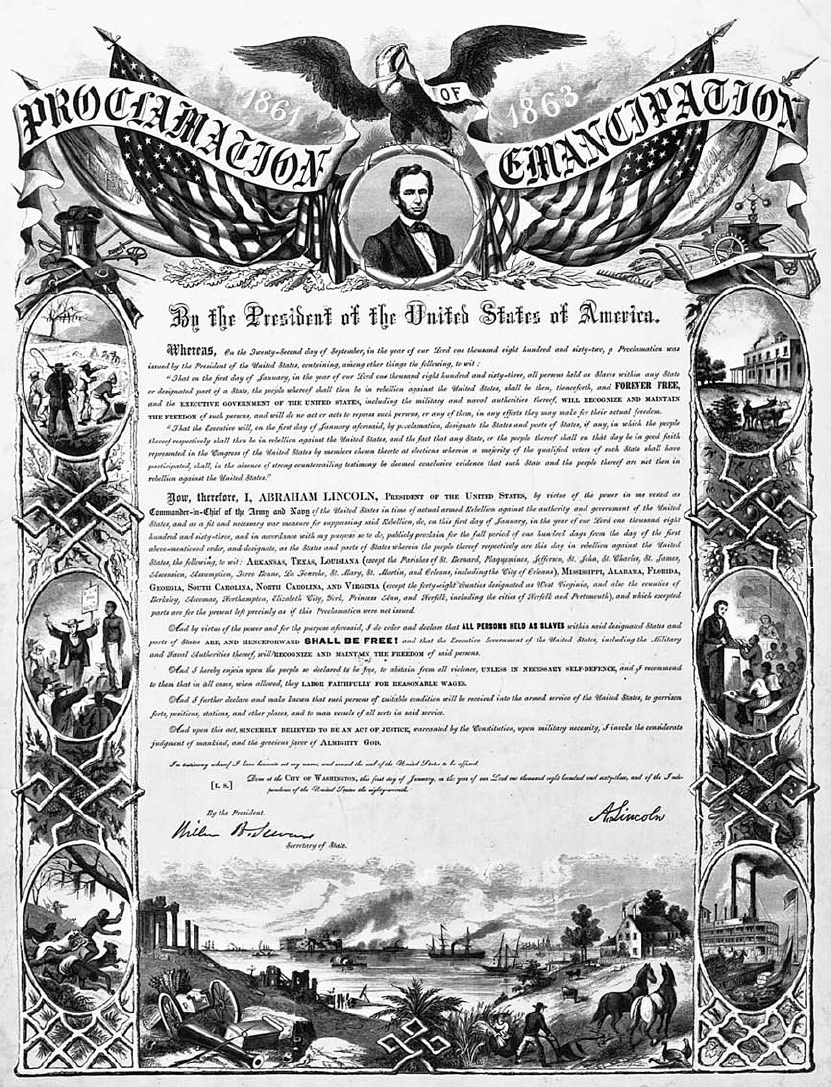
Proclamation of Emancipation (Library of Congress)
432 Lincoln, Abraham
xviii+446_EofUSConsti-v1.indd 432 3/12/09 3:05:55 PM
Unlike the British, who postponed national elec-
tions during World War II, Lincoln held the 1864
election, despite his conviction that he would be
defeated for reelection.
As most former presidents, Lincoln had sup-
ported voluntary colonization of American slaves
abroad. Yet his views evolved. After meeting
resistance to his support for compensated eman-
cipation, he finally used his war power to issue
the Emancipation Proclamation on January 1,
1863, which he followed with active support of
the Thirteenth Amendment to permanently
abolish slavery. Moreover, the Great Emancipa-
tor took steps to free the entire emerging middle
class by signing into law three of the most impor-
tant pieces of legislation in American history. The
fi rst was the Homestead Act of 1862, which James
Buchanan had vetoed previously. The second,
which Buchanan also had vetoed as unconstitu-
tional, was the Land Grant College Act of 1862,
which transformed higher education in the nation.
That same year, Lincoln signed the Pacifi c Rail-
road Act, which led to the building of the trans-
continental railroad.
Despite his stunning leadership, the Lincoln
presidency raised a host of constitutional issues:
1) whether presidents must obey Supreme Court
decisions, e.g., D
RED SCOTT (1857); 2) whether
states have a right to secede from the Union; 3)
whether part of a state may secede from an exist-
ing state, e.g., West Virginia from Virginia; 4)
whether presidents have the right to act when Con-
gress is not in session; 5) whether the Emancipa-
tion Proclamation was constitutional; 6) whether
the president’s suspension of habeas corpus was
constitutional; and 7) whether the president or
Congress should determine reconstruction, i.e.,
the extent of the president’s pardoning power. The
outcome of the Civil War itself answered some of
these questions, as did the passage of the so-called
Civil War amendments to the Constitution, as well
as the decisions of the Supreme Court during and
after the Civil War.
To appreciate Lincoln’s philosophy of the law
requires considering his role in preserving the
Union and the idea of democratic government
during an autocratic age; how he emancipated not
only the slaves but the entire middle class and the
nation as a whole; and how “the Great Reconciler”
implemented a non-Marxian “people’s jurispru-
dence” through his “with malice toward none”
philosophy.
For more information: Farber, Daniel. Lincoln’s
Constitution. Chicago: University of Chicago
Press, 2003; Neely, Mark. E., Jr. The Fate of Lib-
erty: Abraham Lincoln and Civil Liberties. New
York: Oxford University Press, 1991; Pederson,
William D. “The Impact of Abraham Lincoln’s
Constitutional Legacy: A Global Outlook.” Lin-
coln Lore 1885 (Summer 2006): 18–22.
—William D. Pederson
line-item veto
The line-item veto is a proposal that would allow
the president to veto certain items from a budget
bill, rather than requiring the president to veto
the entire bill. This type of veto power has been
requested by several presidents, and at least all
since Ronald Reagan was in offi ce.
The most recent iteration of the attempt to
gain the line-item veto is by the George W. Bush
administration. The version that was considered
by Congress was different from ideas that have
previously been considered. Like the previous
versions, the current version would allow the
president to veto a single budgetary item from a
larger bill. However, rather than seek a two-thirds
majority vote, as is required by the Constitution,
the vetoed item would be sent back to Congress
for a simple majority vote for override. President
Bush believed that this would help to alleviate
major concerns that prior administrations and the
Supreme Court have had with the line-item veto.
However, until legislation passes in both chambers
of Congress and passes what would likely be an
imminent challenge in the federal judicial system,
it is impossible to be sure of the success of this, or
any other, legislative attempt to give the president
the power of the line-item veto.
The most public rebuke of the presidential
power of line-item veto occurred in the Supreme
Court case C
LINTON V. CITY OF NEW YORK, 524
line-item veto 433
xviii+446_EofUSConsti-v1.indd 433 3/12/09 3:05:55 PM
U.S. 417 (1998). Congress granted the president
the power of the line-item veto in 1996. President
Clinton used that power about 80 times before
this case was heard. In this case, President Clinton
vetoed part of the Balanced Budget Act of 1997.
New York sued to return a provision that allowed
the state to raise taxes on hospitals and use the tax
revenue to solicit federal Medicaid payments. The
Supreme Court ruled that the Line-Item Veto Act
violated the presentment clause of the Con-
stitution (Article I, Section 7, Clause 2.). In the
decision, written by Justice John Paul Stevens,
the Supreme Court stated that “[i]f there is to be a
new procedure in which the president will play a
different role in determining the text of what may
become a law, such change must come not by leg-
islation but through the amendment procedures
set forth in Article V of the Constitution.”
The fi nding of the Supreme Court is not sur-
prising, however. On at least two separate occa-
sions, President Reagan’s own administration
noted that the line-item veto was unconstitutional.
During the latter part of the Reagan administra-
tion, there was a public attempt to argue that the
line-item veto would be a constitutional exercise
of presidential power. The most vocal advocate
was Stephen Glazier of the Wall Street Journal.
Because of the public support for Glazier’s argu-
ment, the Offi ce of Legal Counsel was asked to
prepare an opinion discussing the probability
that the line-item veto was, in fact, constitutional.
OLC’s opinion stated that it was not. The opin-
ion, penned by the head of OLC, Charles Cooper,
stated categorically that “Article I of the Constitu-
tion does not vest the President with the inherent
power to veto portions of a bill while signing the
remainder of it into law.” Cooper received severe
criticism for this decision from conservative pun-
dits. However, what many of these critics might
not have realized was that OLC had already stated
that the line-item veto was unconstitutional.
In 1985, Congress was preparing to give the
president the power of line-item veto. How-
ever, OLC was asked to give its legal opinion on
the proposed bill, and OLC decided that it was
unlikely that the bill would pass constitutional
muster. According to the decision, “[a] bill that
purports to the President a line-item veto by pro-
viding that each item of the appropriation in an
appropriation bill be enrolled, although not voted
on, as a separate bill raises serious constitutional
questions under Article I, § 7, cl. 2 of the Consti-
tution.” In other words, in two separate instances,
with two differing ideas of what might constitute
a constitutional provision to give the president the
power of the line-item veto, President Reagan’s
own legal advisors stated that a legislatively man-
dated power of this type was unconstitutional. It
is not surprising that the Supreme Court came to
the same decision.
Despite several failed previous attempts to
give the president the power of the line-item veto
through legislative action, the idea continues to
appeal to both the president, who tends to desire
more power generally, and Congress, which seems
to need assistance in curbing its own spending
power. The outcome of the president’s power of
the line-item veto will continue to be watched
closely by many people. Ultimately, the power
seems to lie in the Supreme Court’s interpretation
of the Constitution, especially Article I.
For more information: N.A. “Constitutional-
ity of Line-Item Veto Proposal.” Opinions of the
Offi ce of Legal Counsel 9 (1985): 28; N.A. “The
President’s Veto Power.” Opinions of the Offi ce of
Legal Counsel 12 (1988): 128.
—Tobias T. Gibson
living constitution
The “living constitution” refers to the notion that
in order to be viable, a constitution must not be
static but rather must be able to adapt to changing
values and circumstances, just as a living creature
grows and changes. The term is most popularly
associated with a continuing debate among con-
stitutional scholars and jurists triggered by writ-
ings and speeches by then-Justice William J.
Brennan, Jr., and then-Attorney General Edwin
Meese in the 1980s, although the dispute traces
back to the American founding and even earlier.
It would seem that a living constitution must
surely be better than the apparent alternative—a
434 living constitution
xviii+446_EofUSConsti-v1.indd 434 3/12/09 3:05:56 PM
dead constitution—but the issue is not so simple,
and it may be that the only good constitution is
a dead constitution. On its face, it is hard to see
what could be wrong with a living constitution,
especially in a democracy. If we are to govern our-
selves, there should not be unnecessary structural
or substantive obstacles to achieving the public
will. But taken to the extreme, a living constitution
would be no constitution at all, because it would
impose no constraints upon modern politics. Like
Ulysses strapped to the mast, “we the people” have
bound ourselves to constitutional constraints that
precede and are superior to ordinary politics. The
American constitution, with its division of author-
ity between federal and state levels, separation
of the national government into three branches,
and substantive rights limitations on government,
throws obstacles in the way of self-rule. That, at
least in theory, is how we secure rights against
majority tyranny and preserve some role for the
states. These restrictive clauses—mostly ratifi ed
long before anyone alive today was born—create
a certain “tyranny of the dead.”
On the other hand, rigid adherence to old text
and principles may be suffocating, preventing
adaptation to changing circumstances and per-
ceived needs. As Brennan wrote, “the genius of
the Constitution rests not in any static meaning it
might have had in a world that is dead and gone,
but in the adaptability of its great principles.” The
trick, then, is to fi nd a balance, so that constitu-
tional interpretation is not too lively, but not
comatose. Conservative critics of the living con-
stitution approach say the answer is simple: Apply
the enduring principles of the Constitution consis-
tently, and if you don’t like them, amend the Con-
stitution. But amending the Constitution is a
long and diffi cult process, making it hard to bring
in modern constitutional principles. More impor-
tant, how to identify and apply basic constitutional
principles and textual meaning is not clear.
For example, the Fourteenth Amendment
forbids denial by the states of equal protec-
tion of the law. The amendment was passed on
the heels of the Civil War and intended to secure
the rights of newly freed slaves, yet the language
is simple and sweeping. Does the amendment for-
bid or tolerate—or even require—affirmative
action programs to eradicate effects of past or
present discrimination? Should women’s rights be
enforced just as strongly as those of racial minori-
ties, even though the amendment came decades
before women even gained the right to vote?
And what about business corporations? They are
persons in the eyes of the law, so should they be
able to claim protection against state discrimina-
tion? There are no simple answers even at this
level of generality, and more uncertainties arise as
principles are applied to specifi c circumstances.
Some guidance, then, is needed to apply the
text. Critics of the living constitution advocate
immersion in the meanings and understanding of
language at the time constitutional text was writ-
ten and ratifi ed and the then-prevailing political
theories. Some argue, for example, that the Dec-
laration of Independence must be central to
informed constitutional interpretation. Skeptics
of this approach argue that going beyond the text
in this way is only an obsolete version of living
constitutionalism, but proponents say it is at least
better moored to the Constitution than modern
judicial journeys into fundamental values. They
argue that living constitutionalism easily becomes
a vehicle for substituting the personal preferences
of the judge or justice for the will of the people.
In his exchange with Justice Brennan, Edwin
Meese emphasized that adhering to the Consti-
tution promotes democracy: “The Constitution is
the fundamental will of the people. . . . To allow
the courts to govern simply by what it [sic] views
at the time as fair and decent, is a scheme of gov-
ernment no longer popular; the idea of democracy
has suffered.”
It is easy to exaggerate the differences between
proponents and critics of the living constitution, in
part because of the inherently evolving character
of constitutional doctrine, which has developed in
the pattern that judges in Anglo-American com-
mon law have followed for centuries: developing,
articulating, and applying rules in a sequence of
cases in very specific fact situations. It is these
doctrines, rather than the text itself, that most
determine the outcomes of cases and the develop-
ment of the law. So in a sense all constitutional
living constitution 435
xviii+446_EofUSConsti-v1.indd 435 3/12/09 3:05:56 PM
law is living law, gradually developing into a form
quite different from the original document. Even
conservative jurists and scholars, who are fre-
quently critics of living constitutionalism, have led
the development of new doctrines, such as in fed-
eralism and property rights cases.
On the other hand, it is diffi cult to fi nd a scholar,
and probably impossible to fi nd a judge, who is so
enthused with living constitutionalism that he or
she would advocate entirely abandoning text and
doctrine to strike out in bold new directions. Even
in these post-modern days, there is no signifi cant
dispute over the meaning of many clauses, such
as the age requirement to serve as president or
the allocation of two Senate seats per state. The
sparks start to fl y more over the substantive pow-
ers of the national government and the rights that
limit both state and federal governments. But
even here, it is still prudent to root constitutional
arguments in text and tradition, even if that is no
more than a jumping-off point. In response to the
success of the Federalist Society in nurturing an
intellectual base in the courts and universities in
support of dead originalism, liberal jurists and
scholars, who have been most commonly associ-
ated with living constitutionalism, have in turn
created the American Constitution Society as
a way to remind the public, and perhaps them-
selves, that they as well recognize the primacy of
the Constitution.
So it is probably fair to say that, paraphrasing
Thomas Jefferson, we are all living constitu-
tionalists, and we are all dead constitutionalists.
There is virtually universal recognition that inter-
pretation should be rooted in the Constitution
and that fundamental principles embedded in the
document are enduring yet adaptable to chang-
ing circumstances. But just what those principles
are and how they should be ranked and applied
is disputed. That debate is both healthy and con-
structive, arguably improving the quality of con-
stitutional development. Many liberal jurists and
scholars, for example, have been critical of the
death penalty, even suggesting that it should be
unconstitutional under the cruel and unusual
punishment clause of the Eighth Amendment.
Conservatives counter that the Constitution
includes specifi c references to capital punish-
ment, so it would be nonsensical to strike it down
under that same document. The courts have
effectively split the difference, upholding the
constitutionality of the death penalty but looking
more closely at how it is applied, holding that an
arbitrary or discriminatory application would be
unconstitutional.
We are back to where we began, and that is to
suggest that a constitution is inescapably living,
changing in its meaning as judges and justices
struggle to understand and apply its principles in
changing circumstances, yet also essentially dead,
embodying a set of principles superior to the day-
to-day whims of politics, and effective only when
interpretation is conscientiously constrained by
text. When it comes to protecting rights, federal-
ism, and separation of powers, the “cold hand of
the dead” may be inescapable. The controversy
over the living constitution will go on, because it
embodies the inescapable tensions between rights
and democracy, and between our rich legacy and
future aspirations.
For more information: Belz, Herman. A Living
Constitution or Fundamental Law?: American
Constitutionalism in Historical Perspective. Lan-
ham, Md.: Rowman & Littlefi eld, 1998; Marshall,
Thurgood. “The Constitution: A Living Docu-
ment.” Howard Law Journal 30 (1987): 623–628;
Wolfe, Christopher. How to Read the Constitu-
tion. Lanham, Md.: Rowman & Littlefi eld, 1996.
—Christopher Wolfe
lobbying and the First Amendment
Lobbying is a constitutionally protected activ-
ity. Accountability and integrity in representative
government are achieved through the ability of
the public to access and petition those elected to
represent their interests. Justice Hugo Black
observed, “The whole concept of representa-
tion depends upon the ability of the people to
make their wishes known to their representa-
tives” (Eastern Railroad Presidents Conference
v. Noerr Motors, Inc., 365 U.S. 127, 137 [1961]).
To this end, the First Amendment guarantees
436 lobbying and the First Amendment
xviii+446_EofUSConsti-v1.indd 436 3/12/09 3:05:56 PM
that no law shall abridge “the right of the people
. . . to petition the Government for a redress of
grievances.”
Lobbying is advocacy of a point of view, either
by groups or individuals, who may be paid, inde-
pendent, or volunteers. In addition to direct com-
munication with government offi cials, lobbyists
research, analyze, and draft legislation; build
coalitions around issues; and educate government
offi cials, employees, and corporate offi cers as to
the implications of legislative proposals.
Public officials must consider information
from a broad range of interested parties in order
to reach fair and informed decisions. The U.S.
Supreme Court has recognized that “[p]resent-
day legislative complexities are such that the indi-
vidual members of Congress cannot be expected
to explore the myriad pressures to which they are
regularly subjected” (United States v. Harriss, 347
U.S. 612, 625 [1954]). While the U.S. Constitution
protects freedom of speech for those speaking on
behalf of both institutional and personal interests,
courts have recognized that these rights may be
regulated to protect the public interest.
In 1928, the Senate enacted a bill requiring
lobbyists to register with the secretary of the Sen-
ate and the clerk of the House, but the House failed
to pass the legislation. The issue did not go away,
and members of Congress were concerned that
concentrated lobbying efforts by a vocal minor-
ity could distort legislation of national impact.
Eventually, Congress enacted the Federal Regu-
lation of Lobbying Act (repealed by the Lobbying
Disclosure Act of 1995) as part of the Legislative
Reorganization Act of 1946. For the fi rst time, lob-
byists were required to register and fi le quarterly
reports with the House and Senate. In 1954, the
Supreme Court upheld registration requirements
in United States v. Harriss, but defi ned the legis-
lation narrowly to exclude individuals who spent
their own money to lobby Congress directly from
the act’s requirements. Individual scandals led
to calls to strengthen lobbying laws. In 1976, the
Senate passed such a measure. Notably, concerns
that the legislation would violate the First Amend-
ment rights of lobbyists prevented the measure
from gaining traction in the House.
Even a right as basic as free speech can be regu-
lated in certain instances. The Supreme Court has
upheld campaign contribution legislation where it
was found to “serve the basic government interest
in safeguarding the integrity of the electoral pro-
cess without directly impinging upon the rights
of individual citizens and candidates to engage in
political debate and discussion” (B
UCKLEY V. VALEO,
424 U.S. 1 [1976]). Appropriate regulation in this
area is regulation which acts as a shield, protect-
ing the public and integrity of the institution, not
regulation that seeks to act as a sword by carving
out exceptions to basic First Amendment rights.
Lobbying need not be an equal opportunity activ-
ity. It makes no difference that some groups are
more effective than others in gaining support
for their positions. Rather, through appropriate
disclosure, lobbyists themselves become subject
to the same pressures they place on legislators.
Such disclosure may implicate political and ethi-
cal considerations which may prevent legislators
from undertaking certain interactions with lob-
byists. The First Amendment requires regulation
rather than prohibition. Indeed, “[b]ecause First
Amendment rights need breathing space to sur-
vive, government may regulate the area only with
narrow specifi city” (Cantwell v. Connecticut, 310
U.S. 296, 311 [1940]).
Congress has been unable to substantially
amend the substance of the provisions at issue
in Harriss. A series of amendments that would
have required disclosure by certain grassroots
organizations was defeated in 1993. New tech-
nologies have presented new challenges for regu-
lators. In 2007, the Senate struck a provision in
pending lobbying reform legislation that would
have required individuals involved in certain
grassroots efforts, including blogging, to register
as lobbyists. The effect of the Harriss decision
was to regulate only those who lobby directly.
Ironically, the very decision which upheld cer-
tain regulations on lobbyists acts to prevent fur-
ther legislation. Any additional legislation would
likely require certain interests to disclose their
activities for the fi rst time. Some fear that such
legislation could chill citizen involvement in the
legislative process.
lobbying and the First Amendment 437
xviii+446_EofUSConsti-v1.indd 437 3/12/09 3:05:57 PM
Lobbying is a tradition nearly as old as Con-
gress itself. Indeed, it would be diffi cult for Con-
gress to complete its work without lobbyists. Laws
regulating lobbying must strike a balance between
disclosure in the public interest and the First
Amendment rights of those who speak on behalf
of issues and interests.
For more information: Nowak, John E., and
Ronald D. Rotunda. Principles of Constitutional
Law. St. Paul, Minn.: Thomson/West, 2005.
—Mark A. McGinnis
Lochner v. New York 198 U.S. 45, 25 S.Ct.
539
(1905)
In Lochner v. New York, the Supreme Court
invalidated a state law restricting the number of
hours a bakery employee could work. The state
argued that the law was in place to protect the
health of employees and the general public, but
the Court held that the state was unconstitution-
ally interfering with each individual’s liberty to
contract as protected by the due process clause
of the Fourteenth Amendment.
A New York law prohibited employers from
requiring or permitting employees to work more
than 10 hours in a day or 60 hours in a week.
Joseph Lochner, the owner of a bakery in Utica,
New York, was convicted on two separate occa-
sions for overworking an employee. He appealed
the second conviction, giving rise to this case.
The state of New York contended that the law
was designed to protect workers from health haz-
ards related to long and odd hours in bakeries,
which are often hot and void of clean air. The state
also argued that overworking bakers results in a
poorer quality product, affecting the health of the
public consumers. Justice Peckham responded in
his majority opinion by stating that bakers were
fully capable of negotiating their own work hours
and that if an individual baker felt he needed to
work more to, for example, support his family, it
should be his prerogative. He pointed out that
plenty of other legislation was passed to ensure the
bakery was clean and also noted that there is no
quantifi able evidence that a loaf of bread made in a
baker’s 11th hour of work is any less clean or whole-
some than a loaf made in his 10th hour. Finally, he
hypothesized that a contrary decision would render
economic protections provided by the substantive
element of the due process clause meaningless.
Justice John Harlan dissented, arguing that
the majority underestimated the hazardous effects
of working in a bakery. Justice Oliver Wendell
Holmes, Jr., also dissented, arguing that the judi-
ciary had no right to supplant the judgment of the
New York state legislature on the issue and that
governments have restrained the public’s right of
contract for centuries. He listed Sunday laws and
usury laws as examples. Holmes’s dissent is most
famous for the statement that the “Constitution
did not enact Spencer’s Social Stats,” a reference
to the notion that the Constitution did not embody
a specifi c economic philosophy to be enforced by
the Court.
The Supreme Court used the precedent set in
Lochner to invalidate economic regulations for over
30 years. However, by the end of the 1930s Loch-
ner had lost most of its infl uence. If the Court had
left any doubt over its stance on Lochner, it made
itself clear in 1955, in Williamson v. Lee Optical,
348 U.S. 483, when Justice William O. Douglas
explained that the days were over when the Court
uses the due process clause to strike down a state’s
business and industry regulations because it deems
them unwise or improvident. Today, the Supreme
Court uses its rational basis test to analyze
challenges to most economic regulations.
For more information: Bernstein, David E.
“Lochner Era Revisionism, Revised: Lochner and
the Origins of Fundamental Rights Constitution-
alism.” Georgetown Law Journal 92 (November
2003): 1–58; Cox, Archibald. The Court and the
Constitution. Boston: Houghton Miffl in, 1987.
—Dylan R. Kytola
Locke, John (1632–1704) English political
philosopher
John Locke was an important British political
thinker who infl uenced many of the framers and
founders of the American Constitution.
438 Lochner v. New York
xviii+446_EofUSConsti-v1.indd 438 3/12/09 3:05:57 PM
The British philosopher John Locke is often
referred to as the American political philosopher
because his political thought arguably infl uenced
the nation’s founders more than any other political
theorist. Locke’s major political writings include
his Two Treatises of Government (published in
1689) and A Letter Concerning Toleration (fi rst
published anonymously in 1685), each refl ecting
the political confl icts of the times and especially
the rivalries between crown and Parliament and
between religious denominations. Locke crystal-
lized the central elements of liberalism in his day
into a coherent political regime dedicated to the
protection of “life, liberty, and estate,” with the
state playing largely the role of umpire or protec-
tive nightwatchman. Locke’s social contract argu-
ment provides a modern statement to show how
government is made legitimate and also how revolt
is legitimate when government ceases to be.
Locke’s political philosophy is based in his
empiricist and rationalist inclinations, which dic-
tate that all knowledge originally is grounded in
sensory perception and that while ideas may have
non-arbitrary, agreed-upon meanings, there are
no knowable innate or pure ideas to give human-
kind objective answers. An innate idea must be
believed in, such as an article of religious faith,
and the mind is such that it cannot be compelled to
believe that to which it has not on its own assented.
It is no indication of actual assent to a proposition
or a particular understanding if it is given under
threat of compulsion. Hence, compulsion in mat-
ters of faith is a fruitless attempt to overpower a
person’s natural liberty to willingly form his or her
own ideas, and submission to an enforced ortho-
doxy refl ects more the (illegitimate) power of the
enforcer than it does voluntary assent to an idea.
Locke argues that application of the principle of
toleration is a prudent response to divergent, sin-
cerely held beliefs and a better way to manage and
maintain a stable society than for the state to side
with one or other religious truth. Any agent, how-
ever, is welcome to try to persuade others of the
superiority of its understandings through persua-
sive arguments or good works.
Locke’s notion of consent to be governed is
roughly parallel to assent in knowledge, as con-
sent grants legitimacy to the state and cannot be
compelled, and any attempt at coercion relies on
force, not reason, and so is unjust. Locke’s version
of the social contract described a rather idyllic
state of nature in which people enjoyed natural
equality and had sufficient resources to meet
their needs, provided they worked with nature to
secure them, whereby a property claim was cre-
ated to any goods produced. In addition, the peo-
ple recognized a moral law, the Law of Nature,
which requires that the plenty that is available to
them be preserved so as much and as good should
remain for others and the next generation. When
the inevitable disputes arose regarding property
claims, disputes which need not be presumed
hostile, it became necessary fi rst to establish some
collective mechanism to deal with these inconve-
niences, something people individually could not
do nearly as well despite their “executive power”
to enforce their justifiable claims based in the
Law of Nature.
People would move out of the state of nature
and into civil society primarily in order to inter-
pret and enforce the Law of Nature more fairly
and evenly, especially as regards confl icting prop-
erty claims. Locke understood property as more
than merely material belongings or assets, and
extended this concept to include anything—espe-
cially, one’s person and one’s rights—that a person
may have an interest in, contributes to a person’s
independence from others, and provides the basis
for claims against others who violate them. Even-
tually, however, as society and the issues people
confronted or raised regarding property became
more complex, the community would need to
establish some overarching binding author-
ity—a government—entrusted with the power to
enforce the Law of Nature and arbitrate disputes
in an impartial way, making judgments based in
promulgated law and constrained to serve the
interests of the people.
Locke presents the classical liberal argu-
ment that the State is established through the
consent of the majority of the people to secure
their interests through the use of duly consti-
tuted civil power. Should the government betray
the trust placed in it through a series of abuses
Locke, John 439
xviii+446_EofUSConsti-v1.indd 439 3/12/09 3:05:57 PM
by either its executive or legislative branch, then
the people can regard it as having revolted from
them and may exercise their right to recall their
trust through, if necessary, an armed rebellion.
Locke’s arguments in favor of individual rights,
property, limited government, and the right of
the people to hold their governors accountable
to them, including through the threat of rebel-
lion, appealed to the American founding gen-
eration, infl uencing not only the drafting of the
Declaration of Independence, but also the
Constitution.
For more information: Hartz, Louis. The Lib-
eral Tradition in America: An Interpretation of
American Political Thought since the Revolution.
New York: Harcourt Brace, 1965; Pangle, Thomas
L. The Spirit of Modern Republicanism: The
Moral Vision of the American Founders and the
Philosophy of Locke. Chicago: Chicago University
Press, 1988.
—Gordon A. Babst
Locke v. Davey 540 U.S. 712 (2004)
In Locke v. Davey, the U.S. Supreme Court held
that the state of Washington did not violate the
U.S. Constitution by excluding a student from a
publicly funded scholarship program.
In 1999, the Washington legislature created the
Promise Scholarship, a program designed to assist
academically gifted students with postsecond-
ary education expenses. After satisfying various
academic and fi nancial conditions, Joshua Davey
received the scholarship funding and enrolled at
Northwest College, a church-affiliated institu-
tion. When Davey chose to major in both pastoral
ministries and business administration, however,
Washington withdrew Davey’s funding, because
Promise Scholarship funding was not available to
students attending religious colleges who studied
religion from a devotional perspective. Washing-
ton placed this limitation on Promise Scholarship
funding to comply with its state constitution’s
prohibition on public funding of clergy training.
Davey challenged this limitation, claiming that
Washington’s exclusion of him from the Promise
Scholarship on the basis of his desire to use the
funding for religious purposes violated the free
exercise, free speech, and equal protection
clauses in the U.S. Constitution.
In a 7-2 opinion, the Court rejected all of Dav-
ey’s claims. The Court found that Davey’s burden
was akin to being denied the scholarship fund-
ing in the first place—a burden that the Court
found minimal since the scholarship’s financial
and academic conditions prevented many people
from ever being eligible to receive the funding.
The Court ruled that Davey’s minimal burden
could not defeat Washington’s substantial inter-
est in enforcing the separation of church and state
required by its own state constitution.
Justice Antonin Gregory Scalia wrote a
dissenting opinion, in which Justice Clarence
Thomas joined, declaring that because the free
exercise clause categorically prohibits the govern-
ment from ever discriminating on the basis of reli-
gion, the majority wrongly focused on the weight
of Davey’s burden. Moreover, Justices Scalia and
Thomas claimed that because the withdrawn
funding cost Davey almost $3,000, the majority
would still be wrong even if the weight of Davey’s
burden were relevant.
Davey is an important case because it per-
mits states to require a greater degree of church-
state separation than the U.S. Supreme Court
has interpreted the establishment clause to
require. It is quite likely, for example, that the
Davey rule permits those states that implement
school-voucher programs to limit the use of the
funding to secular purposes, even though the
U.S. Supreme Court has expressly held that the
establishment clause does not compel this limi-
tation. Many scholars have noted, however, that
the discretion that Davey grants the government
must be limited because at some point a state’s
attempt to enforce a strict separation between
church and state will violate the free exercise
clause’s guarantee of religious liberty. Many
believe, for instance, that the free exercise clause
deprives states of the authority to prohibit state
employees from using their income for private
religious purposes, but it is not clear why states
lack this authority under the Davey rationale.
440 Locke v. Davey
xviii+446_EofUSConsti-v1.indd 440 3/12/09 3:05:57 PM
The ultimate scope of the Davey holding, and
how it will mediate the tension between the reli-
gion clauses, remains to be seen.
For more information: Berg, Thomas, and
Douglas Laycock. “Davey’s Mistakes and the
Future of State Payments for Services Provided
by Religious Institutions.” Tulsa Law Journal 40,
no. 2 (2005): 227–253; Brown, Stephen P. Trump-
ing Religion: The New Christian Right, the Free
Speech Clause, and the Courts. Tuscaloosa, A la.:
University of Alabama Press, 2002; Merriam, Jesse
R. “Finding a Ceiling in a Circular Room: Locke
v. Davey, Federalism, and Religious Neutrality.”
Temple Political & Civil Rights Law Review 16
(2006): 103–143.
—Jesse R. Merriam
Loretto v. Teleprompter Manhattan CATV
Corp.
458 U.S. 419 (1982)
In Loretto v. Teleprompter Manhattan CATV
Corp., the U.S. Supreme Court held that any gov-
ernment regulation that authorizes a permanent
physical occupation of private property will always
constitute a compensable taking pursuant to the
Fifth and Fourteenth Amendments of the
U.S. Constitution.
In 1973, the state of New York adopted a stat-
ute that prohibited landlords from interfering
with the installation of cable television facilities
on their property by local cable companies. The
statute also limited the compensation that cable
companies were required to pay landlords for this
right to an amount set by the state’s Commission
on Cable Television. At the time, the commission
set this amount at $1.
Jean Loretto was the owner of a five-story
apartment building in New York City that had
cable television equipment installed by Tele-
prompter Manhattan CATV. She brought a class
action lawsuit on behalf of all landlords serviced by
Teleprompter Manhattan CATV and alleged that
the installation of cable equipment was a physi-
cal invasion of private property that amounted to
a taking for which the plaintiffs were entitled to
just compensation.
The New York trial court found for the cable
company, and the appellate division affi rmed. The
New York Court of Appeals affirmed the lower
court’s decisions, finding that the statute was a
legitimate exercise of the legislature’s police
powers that did not constitute a taking under the
balancing test articulated in Penn Central Trans-
portation Co. v. New York City, 438 U.S. 104
(1978). The U.S. Supreme Court reversed, holding
that the cable equipment effected a permanent
physical occupation of Loretto’s private property
and was thus a per se compensable taking. In so
doing, the Court reaffi rmed its precedents that
had established this per se rule.
The Court pointed to prior cases involving tele-
graph and telephone lines, underground pipes,
and wires. The Court noted that even though a
permanent physical occupation—such as the cable
equipment—may not seriously interfere with an
owner’s use and enjoyment of their property, a
regulation requiring a permanent physical occu-
pation is qualitatively more severe than any regu-
lation of property use. The owner has lost, among
others, the rights to possess, use, dispose, and
exclude with regard to the area of such occupa-
tion. Accordingly, the Court rejected a de minimus
exception for minor permanent physical occupa-
tions reasoning that no matter how small or insig-
nifi cant, such occupations deprive an owner of all
of their property rights to that area. However, the
Court noted that the extent of the occupation is
relevant in determining just compensation. Ironi-
cally, on remand, the New York Court of Appeals
found that just compensation for the cable equip-
ment occupation was $1—the amount originally
set by the commission.
The Court’s ruling was narrow, as it applied
only to permanent physical occupations—whether
by the government or by a third party with gov-
ernment authorization. Any temporary physical
occupations, such as overfl ights, and regulations
that restrict use are instead subject to the Penn
Central balancing test. However, this case was
signifi cant for reviving the per se rule that lower
courts had ignored in favor of the Penn Central
test, which did not guarantee the fi nding of a tak-
ing or the payment of just compensation.
Loretto v. Teleprompter Manhattan CATV Corp. 441
xviii+446_EofUSConsti-v1.indd 441 3/12/09 3:05:58 PM