
Schultz D. Encyclopedia of the United States Constitution
Подождите немного. Документ загружается.

For more information: Pick, Randall J. “Loretto
v. Teleprompter: A Restatement of the Per Se
Physical Invasion Test for Takings.” Baylor Law
Review 35 (1983): 373–386.
—Matthew J. Parlow
Loving v. Virginia 388 U.S. 1 (1967)
In Loving v. Virginia, the Supreme Court over-
turned Virginia’s law banning interracial mar-
riage. In making this decision, citing Virginia’s
violations to both the equal protection and
the due process clauses of the Fourteenth
Amendment, the Court also struck down similar
antimiscegenation laws that punished and prohib-
ited such marriages in 15 other states.
Loving v. Virginia marked the fi rst time the
tribunal addressed the question whether state
laws governing marriage could utilize race as the
sole criteria in banning them.
The case reached the Supreme Court nine
years after two residents of Virginia wed. Mildred
Jeter, an African-American female, and Richard
Loving, a Caucasian male, married each other in
Washington, D.C. The District had no antimisce-
genation prohibitions, and Jeter and Loving were
legally joined. The Lovings returned to their home
in Virginia where subsequently they were charged
with violating the statute that prohibited marriages
like theirs. Pleading guilty to the charge, they were
sentenced to a year in jail, which was suspended
on the condition that they leave and not return to
the state for 25 years. They then moved to D.C.,
where they fi led a suit requesting that Virginia’s
law that banned interracial marriage be declared
unconstitutional and that the state be restrained
from enforcing its sentence on them.
Antimiscegenation statutes had their roots in
colonial slavery codes, but their passage and cod-
ifi cation was a result of Jim Crow–era laws that
in increasing and more exacting ways separated
whites and blacks. The Virginia law that the Lov-
ings tested was typical. The Racial Integrity Act,
passed in 1924, specifi cally prohibited whites from
marrying blacks. In the words of the Supreme
Court of Appeals of Virginia that upheld the Lov-
ings’ original conviction, the legitimate intent of
these laws was to “ ‘preserve the racial integrity
of its citizens,’ and to prevent ‘the corruption of
blood,’ ‘a mongrel breed of citizens,’ and ‘the oblit-
eration of racial pride.’ ”
Since the founding of the republic, domestic
relations—and the policies associated with them,
marriage, divorce, survivor rights, child custody—
remained the responsibility of the states. Thus
from state to state a wide array of laws regard-
ing these matters was enforced. At one time or
another, 30 states had approved interracial mar-
riage bans like Virginia’s, though by the time Lov-
ing was heard, 14 had repealed them. Although
the full faith and credit clause of Article IV, Sec-
tion 1 acknowledges federal interest in this area of
law, it was not until Loving that the Court squarely
addressed this question.
Employing a benchmark that had emerged in
McLaughlin v. Florida, 379 U.S. 184 (1964), where
the Court had struck down a statute that had pun-
ished interracial cohabitation, Chief Justice Earl
Warren wrote for a unanimous Court and concluded
that strict scrutiny of the Virginia ban revealed
discrimination that ran counter to the “clear and
central purpose of the Fourteenth Amendment
[which] was to eliminate all offi cial state sources of
invidious racial discrimination in the States.”
In one of the strongest statements in this deci-
sion, Warren went on to say that such bans were
“designed to maintain White Supremacy,” and
were therefore unconstitutional. He concluded,
“Under our Constitution the freedom to marry, or
not marry, a person of another race rests on the
individual and cannot be infringed by the state”
and reversed the Lovings’ convictions.
Loving v. Virginia was one in a series of cases
that the Warren Court tackled that, taken
together, mark an important shift in the consti-
tutional protections of individual civil rights,
especially for African Americans. Four decades
later, the case remains a signifi cant precedent for
the Court’s decisions relative to gay and lesbian
relationships. (See especially L
AWRENCE V. TEXAS,
539 U.S. 558 [2003].)
For more information: Moran, Rachel F. Inter-
racial Intimacy: The Regulation of Race and
442 Loving v. Virginia
xviii+446_EofUSConsti-v1.indd 442 3/12/09 3:05:58 PM
Romance. Chicago: University of Chicago Press,
2001; Woodward, C. Vann. The Strange Career of
Jim Crow. New York: Oxford Press, 1966.
—George Peery
loyalty oaths
Loyalty oaths have been a source of signifi cant con-
stitutional litigation, raising questions to whether
they violate the First Amendment. During the
1950s and the McCarthy era, loyalty oaths were
popular tools to root out communists.
Loyalty oaths do two things: declare allegiance
to the government and its institutions and disavow
support for ideologies or associations that oppose
the government and its institutions. Loyalty oaths
are common in the United States. To assume offi ce,
government offi cials like the president, members
of Congress, or of the judiciary take loyalty oaths.
Similarly, state employees (including teachers, pro-
fessors, police offi cers, etc.) often must affi rm their
allegiance and repudiate incitement of revolution.
Armed forces members and national security work-
ers also take loyalty oaths as conditions of employ-
ment. Even school children traditionally pledge
allegiance at the start of the school day.
Early in the nation’s history, the Puritans
required that members pledge their support to
the commonwealth and report dissent. The Con-
tinental Congress had members swear their loy-
alty. The original state legislatures invoked citizen
loyalty oaths to refl ect the covenant between the
state and its citizens. Even now, the oath of alle-
giance is considered the most important part of
the naturalization process for potential citizens.
Customarily, new citizens first take the oath of
naturalization and then pledge allegiance as their
fi rst act as citizens.
Courts have held that loyalty oaths as condi-
tions of employment are constitutional so long
as they are narrow and achieve a legitimate gov-
ernment purpose, even if they infringe on an
individual’s constitutional rights. Oaths must be
reasonably related to the position. Oaths consid-
ered too vague may be deemed unconstitutional.
Loyalty oaths are frequently invoked when
there is the perception of a security threat. Fol-
lowing the Civil War, some states enacted stat-
utes excluding people from certain professions
based on previous sympathy with the Confed-
eracy. In Ex parte Garland, 71 U.S. 333 (1866),
the Supreme Court held that mandating an oath
of prior loyalty as a prerequisite for admission
to the bar was unconstitutional, as it punished,
without trial, an act performed before the impo-
sition of the statute. After World War II, fear of
Communist infi ltration of the public education
system led to state establishment of loyalty oaths
as a condition of employment for educators. In
many jurisdictions, those refusing to sign could
be discharged. Most statutes required of educa-
tors pledge of allegiance to state and U.S. con-
stitutions, assertion not to incite revolution, and
declaration that they did not belong to the Com-
munist Party. Many jurisdictions still continue
the practice.
The Court has repeatedly struck down oaths
considered broad, as they violate due process
and infringe on freedom of speech (Baggett v.
Bullitt, 377 U.S. 360 [1964]). In Keyishian v.
Board of Regents, 385 U.S. 589, 605–606 (1967),
the Court declared a New York loyalty oath
threatened academic freedom by limiting teacher
speech. In Wieman v. Updegraff, 344 U.S. 183
(1952), the Court held the oath infringed on
freedom of association because it indiscrimi-
nately penalized innocent association with the
Communist Party or other groups. The Court
generally disallows attempts to condition ben-
efi t eligibility on loyalty declaration, as it would
have a chilling effect on free speech (Speiser v.
Randall, 357 U.S. 513 [1958]). In contrast, the
Court ruled that loyalty oaths that infringed on
constitutional rights to religious freedom were
not acceptable but that employers could make
reasonable accommodations (Bessard v. Califor-
nia Community College, 867 F. Supp. 1454 [E.D.
Cal. 1994]).
For more information: Levinson, Sanford.
“Constituting Communities through Words That
Bind: Reflections on Loyalty Oaths.” Michigan
Law Review 84, no. 7 (June 1986): 1,440–1,470.
—Robin A. Harper
loyalty oaths 443
xviii+446_EofUSConsti-v1.indd 443 3/12/09 3:05:59 PM
Lujan v. Defenders of Wildlife 504 U.S. 555
(1992)
In Lujan, the Supreme Court ruled that environ-
mental groups lacked standing to challenge a
regulation of the Secretary of the Interior. A rule
promulgated by the Secretary of the Interior inter-
preted the Endangered Species Act as applicable
only within the boundaries of the United States
and on the high seas. The previous regulation had
extended this act to include actions taken in for-
eign nations. The district court dismissed the law-
suit for lack of standing, but the court of appeals
reversed. On remand, and in response to a motion
for summary judgment, the district court entered
judgment in favor of the environmental groups.
The case ultimately reached the U.S. Supreme
Court, where Justice Antonin Gregory Scalia
provided the opinion of the court. He began by
noting that standing cases are typically analyzed
through the injury in fact standard. Specifi cally,
to bring suit in federal court, plaintiffs must suf-
fer a concrete, discernible injury which is neither
conjectural nor hypothetical. Furthermore, the
injury must be fairly traceable to the conduct of
the defendant state.
To help meet this standard, plaintiffs filed
two affi davits describing their foreign trips to the
traditional habitats of endangered species. Each
document disclosed past travel to the habitat as
well as a general statement of intent to return to
these locations. The affi davits claimed an injury
in fact, arguing the American role in these alleg-
edly environmentally detrimental projects would
reduce the population of the species within these
habitats. Defenders of Wildlife pressed a series of
arguments including their eco-system nexus the-
ory arguing that “any person who uses any part of
a ‘contiguous ecosystem’ adversely affected by a
funded activity has standing even if the activity is
located a great distance away” (id. at 565).
The court of appeals previously found standing
based upon a citizen-suit provision. However, the
Supreme Court disagreed. Justice Scalia stated
the judiciary branch cannot, consistent with
Article III of the U.S. Constitution, allow
judicial proceedings to proceed based upon a gen-
eralized grievance. Specifi cally, he argued a gen-
eral intent to return to previously visited sites was
not suffi cient for standing purposes. Without con-
crete travel plans, there was no showing of actual
or imminent injury to the plaintiffs. Parties may
not assert standing by merely emphasizing the
connection of all ecosystems. Instead, the injury
must be in the actual location currently in use by
complaining party. Likewise, the Court noted the
plaintiff’s professional interest in animal survival
did not provide a factual showing of actual injury.
Specifi cally, to have standing, the plaintiff should
submit specifi c facts that the protective species
living in foreign nations were threatened and that
the “Respondents members would thereby be
‘directly’ affected” (id. at 563).
For more information: Nowak, John E., and
Ronald D. Rotunda. Principles of Constitutional
Law. St. Paul, Minn.: Thomson/West, 2005.
—Daniel M. Katz
Luther v. Borden 48 U.S. 1, 39 (1849)
Luther v. Borden is an important political case
where the Supreme Court refused to decide a
case, citing the political question doctrine.
Luther rose from the Dorr Rebellion and result-
ing constitutional crisis in Rhode Island, in which
political reformers attempted to create a new con-
stitution (the People’s Constitution) in the face of
resistance from the existing Charter government.
On June 29, 1842, Luther Borden, a militiaman
under the Charter government acting under the
authority of martial law, broke into the home of
Rachel Luther looking for her son, Dorrite sym-
pathizer Martin Luther. Rachel Luther sued on
the grounds that the Charter government was
no longer the legal government of Rhode Island
since it was superseded by the People’s Consti-
tution, which was ratifi ed by the people in 1841.
The defense argued that the Charter government
was the legal government of Rhode Island at the
time, that it had the authority to declare martial
law, and that Borden was acting as an agent of the
government.
There were three main points of contention
in Luther v. Borden. First, did the Court have
444 Lujan v. Defenders of Wildlife
xviii+446_EofUSConsti-v1.indd 444 3/12/09 3:05:59 PM
jurisdiction to hear the matter or was it a political
question? Second, which government, the Char-
ter government or the People’s Constitution, was
the legal government of the State? Finally, did the
State have the authority to declare martial law?
The Court was unanimous on the fi rst two points,
but disagreed on the third.
In order to determine which law governed this
case, the Court was asked to identify which gov-
ernment was in force at the time—the People’s
Constitution or the Charter government. The
Court refused to enter this area since the Court
felt that the case posed a political question, which
was out of its purview. Justice Roger Taney, who
wrote the opinion for the Court, argued that the
determination of the validity of the People’s Con-
stitution was not a judicial question. Taney made
it clear that under Article IV, Section 4 of the
Constitution (the guarantee clause), which
guaranteed to every state a “Republican Form of
Government,” it rested with Congress to decide
what government is the established one in a state
and it is the president who decides when to inter-
fere in civil disturbances within a state. Justice
Levi Woodbury agreed with Taney that the Court
could not be called upon to serve as an umpire in
political matters.
Although the Court extolled the virtues of the
political questions doctrine as an impediment to
ruling on the matter, the doctrine did not prevent
the Court from taking a position on a political
controversy that it felt was out of its jurisdiction.
Taney and Woodbury agreed that courts were not
superior to a constitution and the people who cre-
ated it. Judicial power, they argued, commences
after a constitution is created and derives its
power from it. Accordingly, courts should not be
in the business of determining which government/
constitution is valid. However, the Court made it
clear that its power derived from an “established
government capable of enacting laws and enforc-
ing their execution, and of appointing judges to
expound and administer them” (40). Therefore,
only when a constitution is changed through the
established institutional structures set up by an
existing government will the Court consider inter-
preting it.
For more information: Dennison, George
Marshel. The Constitutional Issues of the Dorr
War: A Study in the Evolution of American Consti-
tutionalism, 1776–1849. Ph.D. Thesis. University
of Washington, 1967; Dennison, George Marshel.
“The Dorr War and Political Questions.” Supreme
Court Historical Society Yearbook (1979): 44–62;
Magrath, Peter C. “Optimistic Democrat: Thomas
W. Dorr and the Case of Luther v. Borden.” Rhode
Island History 27 (1970): 94–112; Schuchman,
John S. “The Political Background of the Politi-
cal-Question Doctrine: The Judges and the Dorr
War.” The American Journal of Legal History 16
(1972): 111–125.
—Randa Issa
Lynch v. Donnelly 465 U.S. 668 (1984)
In Lynch v. Donnelly, a majority of the Supreme
Court, in a 5-4 vote, found no constitutional prob-
lems with a government-owned crèche (Nativity
scene) as part of a larger holiday display including
a Santa, reindeer, and other items, in Pawtucket,
Rhode Island. The city argued that Christmas was
so secularized that even biblical elements such as
the crèche were no longer purely religious sym-
bols, and defended the display as both long-stand-
ing tradition and a way to lure holiday shoppers
downtown. The American Civil Liberties
Union, on behalf of a Jewish resident, argued
that the crèche, unlike other seasonal images,
remained a religious symbol, inappropriate in a
government-sponsored display.
In ruling against Pawtucket, the district court
judge said the Nativity scene’s original meaning
had not disappeared and its placement in the
context of secular items did not have the effect of
secularizing it. Applying the three-part Lemon
test that had guided the Supreme Court’s estab-
lishment clause rulings for the previous two
decades, he found no secular purpose served by
the crèche, while its primary effect implied offi -
cial government recognition of Christianity as
a favored religion. He also thought the display
risked fostering political divisiveness, thus fail-
ing the third part of the test. Two of the three
appeals court judges upheld this ruling. The lone
Lynch v. Donnelly 445
xviii+446_EofUSConsti-v1.indd 445 3/12/09 3:05:59 PM
dissenter agreed with Pawtucket that Christmas,
and all its symbols, had become entrenched in
American secular tradition. He also thought the
passive nature of the crèche kept it from violating
the establishment clause.
The split lower court decision in this case along
with similar controversies brewing in other cities
led the Supreme Court to agree to hear the case.
One reason for the uncertainty among the lower
courts was that the facts in this case differed sig-
nifi cantly from earlier establishment clause cases.
Most major cases thus far had addressed educa-
tion, and the Court had developed a consistent
pattern of applying the Lemon test and disallow-
ing religious practices in public schools. However,
in 1983, in a non-school-related case, Marsh v.
Chambers, 463 U.S. 783, the Court had taken a
different direction, upholding legislative prayers
on the basis of tradition; and it was this line of
thought that the Lynch majority chose to follow.
Chief Justice Warren Burger, writing for
the majority, provided a litany of instances in
which government acknowledged America’s reli-
gious heritage, asserted that the line of church-
state separation was not rigid, and concluded that
in the context of the secular display the crèche
passed the Lemon test. In contrast, the four dis-
senters thought the display failed all parts of the
Lemon test and disagreed with the idea that pub-
lic celebrations of Christmas had always been an
American tradition.
This case left many questions unanswered. It
addressed only a government-owned display and
not private displays on government property. Also,
the emphasis on the “secularizing” effect of the
broader display led to lighthearted but real que-
ries as to how many reindeer were needed to secu-
larize a Nativity scene. It also raised doubts about
the continuing value of the Lemon test as a mean-
ingful criterion for judging establishment clause
cases. And for some Christians, rather than help-
ing to “keep Christ in Christmas,” it served only to
trivialize the religious nature of this holiday.
For more information: Pfeffer, Leo. Religion,
State, and the Burger Court. Buffalo, N.Y.: Pro-
metheus Books, 1984; Swanson, Wayne R. The
Christ Child Goes to Court. Philadelphia, Pa.:
Temple University Press, 1990.
—Jane G. Rainey
446 Lynch v. Donnelly
xviii+446_EofUSConsti-v1.indd 446 3/12/09 3:06:00 PM
447
ﱶﱷﱸ
Madison, James (1751–1836) fourth U.S.
president
James Madison, Jr., is often called the “father” of
the U.S. Constitution. Few individuals have had
more infl uence on the writing, recording, ratifi ca-
tion, amendment, implementation, and interpreta-
tion of that document.
Born at his mother’s homestead at Port Con-
way, Virginia, in March 1751, Madison was the son
of a wealthy Virginia planter whose name he bore
and who was a leading citizen of Orange County.
Madison went to boarding school and studied
under private tutors before entering the College
of New Jersey (today’s Princeton). Although Madi-
son completed his undergraduate degree quickly,
he spent additional time studying under President
John Witherspoon before returning to Virginia.
After his return, Madison tutored his siblings
and became involved with politics. He was per-
turbed by the actions of local offi cials who were
imprisoning Baptist ministers for their views.
Madison also joined his father in opposing what he
believed to be British abuses of colonial liberties.
As Virginia edged toward independence, Madison
was appointed to the state Constitutional Con-
vention, where he served on the committee that
formulated the Virginia Bill of Rights. He helped
revise language introduced by George Mason so
that the Declaration recognized religious freedom
not simply as a matter of “toleration” but as a natu-
ral right. Madison and Thomas Jefferson later
battled Patrick Henry for the complete disestab-
lishment of church and state in Virginia.
Although subsequently losing an election to the
Virginia legislature, Madison served as a member
of the Governor’s Council and went from there to
the Continental Congress and then to the Virginia
legislature. Madison was a leader in both bodies.
He developed an unfavorable view of the weak
government under the Articles of Confedera-
tion. He recognized that this government lacked
adequate powers to promote domestic prosper-
ity, to defend itself against foreign enemies, and
to rectify abuses of individual liberties and other
excesses that he saw at that level. He soon began
advocating a stronger national government.
Madison had been selected to attend the Mount
Vernon meeting to discuss common problems
between Maryland and Virginia, but the governor
did not inform him of his appointment in time
for him to attend. By contrast, he appears to have
been a leading fi gure at the Annapolis Convention
in September 1786. With the help of Alexan-
der Hamilton and other nationalists, Madison
pushed for what was to become the Constitu-
tional Convention of 1787; he subsequently
got the Virginia legislature to lend its support.
Madison was the fi rst delegate from Virginia
to arrive in Philadelphia. He masterminded the
Virginia Plan, which got the 55 delegates who
were attending to think about formulating a new
plan of government rather than simply revising
the existing government of the Articles of Confed-
eration. The Virginia Plan proposed replacing a
government centered on Congress with one based
on separate legislative, executive, and judicial
branches. He proposed a bicameral Congress in
which states would be represented in both houses
by population to replace the unicameral Congress,
in which each state had a single vote; in addition to
being more consistent with majority rule, this pro-
posal favored states, like Virginia, with larger pop-
ulations. Madison favored a unitary president and
an independent judiciary. He had to compromise
M
vi+904_EofUSConsti-v2.indd 447 3/20/09 2:17:34 PM
on most issues. Contrary to his hopes, the Conven-
tion eventually settled on a Congress where only
one house was apportioned according to popula-
tion. The convention also defeated other pet mea-
sures of Madison’s, like a Council of Revision that
would combine executive and judicial offi cers, and
a congressional veto of state legislation.
Although the Convention met in secret, Madi-
son took comprehensive notes of the proceed-
ings. These were not published until after his
death. They remain the best record of Convention
deliberations.
Even before the Convention adjourned, some
distrusted its work. As it was sent to the states
for ratification, Madison supported Federalist
proponents of the document over anti-Federalist
opponents. Madison joined Alexander Hamil-
ton and John Jay as one of three authors of The
F
EDERALIST, a series of newspaper articles, later
collected in book form, explaining and defend-
ing the new document. Madison’s more impor-
tant contributions included: Federalist 10, where
he advanced the idea that a republican, or rep-
resentative, government spread over a large land
area would embrace more factions, making it less
likely that any one would destroy the liberties
of the others; Federalist 39, where he defended
the new government as being “partly national”
and “partly federal”; and Federalist 51, where he
argued for the advantages of a system of sepa-
rated powers.
A key argument raised during the debates cen-
tered on whether a bill of rights was necessary. In
time, Madison—who may have been infl uenced
on the subject by correspondence from Thomas
Jefferson, and who most certainly viewed the
adoption of such a bill as a way of heading off a
second convention that might undo the work of
the fi rst—agreed to work for a bill of rights once
the new constitution was adopted. Blocked by
Governor Patrick Henry from the U.S. Senate,
Madison defeated James Monroe to gain a seat
in the House of Representatives, where he
introduced the Bill of Rights and was its stron-
gest supporter. Madison did not succeed in get-
ting an amendment that would protect the rights
of conscience against state intervention, but the
fi rst 10 amendments did protect many fundamen-
tal liberties against federal abuse.
Although Madison had united with Hamilton
in defense of the new Constitution, he quickly
parted ways with the ambitious fi nancial program
that Hamilton introduced on behalf of increasing
national powers. Madison unsuccessfully joined
his friend Secretary of State Thomas Jefferson in
opposing the establishment of a national bank. He
also opposed the initiatives that the Washington
administration was taking in foreign affairs, argu-
ing that the House of Representatives should have
more say in treaty implementation. In time,
Jefferson and Madison helped found the Demo-
cratic-Republican Party, which opposed Federalist
expansion of the national government and increas-
ingly stressed the importance of states’ rights. In
1794, Madison married a widow, Dolley Todd
Payne, who would later establish herself as one
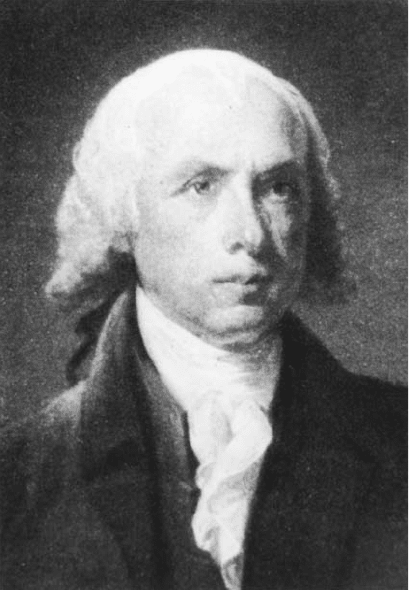
James Madison (Library of Congress)
448 Madison, James
vi+904_EofUSConsti-v2.indd 448 3/20/09 2:17:34 PM
of the most infl uential fi rst ladies. In the interim,
Madison served again in the Virginia legislature.
When the Federalists adopted the Alien
and Sedition Acts of 1798, the latter of which
restricted freedom of speech, Madison and Jeffer-
son responded by secretly authoring the Virginia
and Kentucky Resolutions. Madison’s words were
more temperate than Jefferson’s, but Madison’s
suggestion that states should be able to “inter-
pose” themselves against unconstitutional legis-
lation set the stage for more divisive theories of
federalism that followed. In his famed Report
of 1800, Madison later built on these resolutions
by stressing the powers reserved to the states and
by denying that the national government had any
authority to restrict freedom of speech or press.
Madison served as Jefferson’s secretary of state
from 1801 through 1809, a time during which the
United States purchased the Louisiana Territory,
and in which Madison became the defendant in the
case of M
ARBURY V. MADISON, 1 Cranch (5 U.S.) 137
(1803) that established the right of the judiciary to
void unconstitutional federal legislation. Madison
then served two terms as president. His presidency
was marked by the War of 1812. Despite extreme
peril, including the sacking of the White House,
Madison did not request legislation, like the Alien
and Sedition Acts, to restrict individual liberties.
Over time, Madison accepted the constitutional-
ity of the national bank, but he vetoed other mea-
sures that he did not think the Constitution had
granted to the national government.
In retirement at his plantation at Montpelier,
Madison entertained numerous guests. He served
on the board of trustees for the University of Vir-
ginia, which Thomas Jefferson had established;
was a delegate to the Virginia Constitutional
Convention of 1829–30; and grew particularly
concerned about the growing movement for nul-
lifi cation of state laws. He died on June 28, 1836,
the last delegate to the Constitutional Convention
to do so. In words published after his death, he
urged his fellow countrymen to cherish national
unity.
For more information: Meyers, Marvin, ed.
The Mind of the Founder: Sources of the Politi-
cal Thought of James Madison. Indianapolis, Ind.:
Bobbs-Merrill, 1973; Miller, William L. The Busi-
ness of May Next: James Madison and the Found-
ing. Charlottesville: University Press of Virginia,
1992; Rakove, Jack N. James Madison and the
Creation of the American Republic. Glenview, Ill.:
Scott, Foresman, 1990; Rutland, Robert Allen.
James Madison: The Founding Father. New York:
Macmillan Publishing Company, 1987; Sheldon,
Garrett Ward. The Political Philosophy of James
Madison. Baltimore, Md.: Johns Hopkins Univer-
sity Press, 2001.
—John Vile
Madsen v. Women’s Health Center, Inc.
512 U.S. 753 (1994)
In Madsen v. Women’s Health Center, the
Supreme Court decided whether anti-abortion
protestors had the right to conduct protests at
women’s health centers that performed abortions
by blocking access to the building and preventing
women from pursuing their constitutional right to
obtain abortions.
The protest activity took place at the Aware
Woman Center for Choice in Melbourne, Florida,
with protestors blocking doors and marching in
front of the building, using bullhorns to spread
their message. They approached patients to
attempt to dissuade them from getting abortions
and demonstrated at the homes of clinic staff.
When the Center filed suit in September 1992,
a state court judge ordered the protestors not to
trespass on Center property, block its entrances,
or physically abuse anyone entering or leaving the
clinic; the judge specifi cally noted that the order
was not intended to limit protestors from exercis-
ing their First Amendment rights.
About six months later, as the protestors vio-
lated the court order, the court created a 36-foot
buffer zone around the clinic entrances and drive-
ways (including the public sidewalk) within which
all anti-abortion speech was banned. It also pro-
hibited protestors from making excessive noise
and showing images that could be heard or seen
by patients during surgery and recovery. Addi-
tionally, the court established a 300-foot zone to
Madsen v. Women’s Health Center, Inc. 449
vi+904_EofUSConsti-v2.indd 449 3/20/09 2:17:34 PM
maintain a distance between protestors and clinic
patients and a 300-foot barrier around the homes
of clinic staff.
The Florida Supreme Court unanimously
upheld the order, declaring that the state’s con-
cern for public safety as well as women’s right to
abortion outweighed the demonstrators’ right to
protest against the performance of abortions.
On appeal to the U.S. Supreme Court, although
the anti-abortion protestors did not challenge the
300-foot zone in which only invited speech was
allowed, they claimed that the rest of the state
court order violated their First Amendment rights.
They also argued that the court order targeted anti-
abortion expression because pro-choice demon-
strators were allowed within the buffer zone. The
Center contended that the court order promoted a
number of interests, including public safety of clinic
staff and patients. They further maintained that the
regulation was a proper crowd control measure that
was unrelated to opinions on abortion.
When the case reached the Court, it directed
most of its attention to the constitutionality of the
36-foot buffer zone. The 6-3 ruling, announced
by Chief Justice William Hubbs Rehnquist,
found that the court order was content-neutral and
applied to all persons engaged in clinic protests,
regardless of their message. The Court determined
that the burden imposed by the order was no
greater than necessary to further the government’s
interest in preserving order and upheld the 36-
foot buffer zone around the clinic entrances and
driveway to allow access to the clinic and allow
street traffi c. It found, however, that the restric-
tions forbidding protestors from showing images
were unjustifi ed because they were an unneces-
sary burden on the protestors’ constitutional rights.
Similarly, it found the 300-foot zone around the
clinic and at staff residences too broad, because it
prevented protestors from expressing their views
peacefully and exceeded the government’s inter-
est in ensuring access to the clinic and preventing
intimidation of patients and staff.
For more information: Hagan, Melanie C. “The
Freedom of Access to Clinic Entrances Act and
the Nuremberg Files Web Site: Is the Site Properly
Prohibited or Protected Speech?” Hastings Law
Journal 51 (2000): 411–444; Hare, Ivan. “Method
and Objectivity in Free Speech Adjudication: Les-
sons from America.” International & Comparative
Law Quarterly 54 (2005): 49–87; Keast, Tiffany.
“Injunction Junction: Enjoining Free Speech after
Madsen, Schenck, and Hill.” American Univer-
sity Journal of Gender, Social Policy & the Law
12 (2004): 273–307; Zick, Timothy. “Speech and
Spatial Tactics.” Texas Law Review 84 (2006):
581–651.
—Susan Gluck Mezey
Magna Carta
The Magna Carta is an important English legal
document that also had a big impact upon the
American Constitution.
Magna Carta means “Great Charter” in Latin
(the language in which it was originally written)
and was granted by King John in 1215 under the
duress of a potential civil war. Magna Carta lim-
ited certain key powers of the king and was revised
several times over the following years. The 1225
version remains today as what many refer to as
Magna Carta, because King Edward I of England
included it in his 1297 statute rolls, thus conclud-
ing the evolution of Magna Carta itself.
King John, a Plantagenet, had come to the
throne upon a legitimate but disputed claim. The
expensive campaign that he waged to regain his
lost interests in Normandy required heavy taxa-
tion upon the aristocracy during a time of vexing
infl ation. King John’s decisive defeat at the Battle
of Bouvines in 1214 infl amed the already discon-
tented aristocracy. A powerful group of barons
directed by Stephen Langdon, archbishop of Can-
terbury, forced the issue of liberties to be granted
by the king. The Articles of the Barons, as it was
known, was sealed by King John in a fi eld at Run-
nymede, England, on June 12, 1215. The formal
version of Magna Carta was agreed upon by the
barons and the king on June 19, 1215.
Clearly, the significance of Magna Carta far
exceeds most of its actual wording. The majority of
the document had to do with largely feudal issues
benefi ting the aristocracy from which little mod-
450 Magna Carta
vi+904_EofUSConsti-v2.indd 450 3/20/09 2:17:35 PM
ern constitutional law could be gleaned. After this
has been removed, however, what remains in its
provisions is nothing short of monumental, ensur-
ing that the king would not be above legal retribu-
tion. He would also be required to consult with
the barons in important state matters, including
taxation. This would ultimately lead to the rise of
the British Parliament. For the United States, the
beginnings of representation by the people can be
traced through our English legal heritage directly
to Magna Carta.
Also important to Anglo-American legal his-
tory, Magna Carta established several specific
requirements upon the courts of the day. These
are enumerated in Clauses 17–22. Among them,
courts would have to be held in a fi xed location,
instead of traveling from place to place. Further
pertinent jurisdictional issues of the time were
addressed. Clause 40 seems somewhat modern
and fundamental, though it of course must be
taken in historical context. It stated, “To no one
will we sell, to no one will we refuse or delay right
or justice.”
Looking specifi cally to the United States Consti-
tution (and subsequently to state constitutions), the
legacy of Magna Carta is readily apparent. It can
be argued that the entire U.S. Constitution belies
a philosophy deeply steeped in limiting the powers
of government when basic individual liberties are at
issue, as seen in Magna Carta. Clearly, these rights
are particularly visible in the Bill of Rights.
Clause 39 of Magna Carta is of great signifi -
cance to the U.S. Constitution. It actually con-
tained what modern Americans might call a due
process clause. It stated that “No free man shall
be arrested or imprisoned or disseised or outlawed
or exiled or in any way victimized, neither will we
attack him or send anyone to attack him, except by
the lawful judgment of his peers or by the law of
the land.” The Fifth Amendment of the U.S. Con-
stitution clearly harkens to this concept with the
language “No person shall . . . be deprived of life,
liberty, or property, without due process of law.”
Further, the Fourteenth Amendment
applies due process rights to the states and says
“No State shall make or enforce any law which
shall abridge the privileges or immunities of
citizens of the United States; nor shall any State
deprive any person of life, liberty, or property,
without due process of law.”
Also pertaining to the Bill of Rights, though
clearly the 13th century had different stan-
dards and mores than today’s constitutional cli-
mate, one can see the beginnings in Clause 20
of Magna Carta the prohibition against cruel
and unusual punishment. The U.S. Constitu-
tion has such a clause in the Eighth Amendment.
Moreover, Clause 21 of Magna Carta shows the
beginnings of the right to a jury of our peers,
which is presented in the Sixth Amendment of
the U.S. Constitution.
Of further interest, a few clauses remain
directly in force today as British law.
Please note: Magna Carta is historically more
often and correctly referred to without the article
“The” in its name. In other words, “Magna Carta”
and not “The Magna Carta” is preferable.
For more information: Blake, Robert, ed. The
English World: History, Character, and People.
New York: Harry N. Abrams, Inc., Publishers,
1982; Lyon, Ann. Constitutional History of the
United Kingdom. Portland, Oreg.: Cavendish
Publishing Limited, 2003.
—Maria Collins Warren
Mann Act
The Mann Act, or White Slave Traffic Act, was
a federal statute enacted in 1910 to address the
fear of “white slavers” coercing young women liv-
ing in cities into prostitution. The statute made it
a felony to knowingly transport in interstate
commerce or persuade or coerce the interstate
travel of “any woman or girl for the purpose of
prostitution, debauchery, or for any other immoral
purpose” with or without her consent. Conviction
could bring a fi ne up to $5,000 and imprisonment
up to fi ve years.
The U.S. Supreme Court upheld the statute’s
constitutionality in Hoke v. United States, 227
U.S. 308 (1913). The next year, in Wilson v. United
States, 232 U.S. 563 (1914), a commercial prosti-
tution case, the Court held that a person violated
Mann Act 451
vi+904_EofUSConsti-v2.indd 451 3/20/09 2:17:35 PM