
Schultz D. Encyclopedia of the United States Constitution
Подождите немного. Документ загружается.

restriction prevents state and local candidates
and officeholders from raising or spending
funds unregulated by FECA to pay for public
communications that promote or attack federal
candidates.
BCRA placed disclosure requirements on
“electioneering communications” and prohib-
ited unions or corporations from fi nancing elec-
tioneering communications. Before BCRA, only
communications that contained words of “express
advocacy,” i.e., “vote for,” “vote against,” “elect,”
“defeat,” were subject to any limits. BCRA barred
corporations or unions from funding any broad-
cast, cable, or satellite communication mentioning
a clearly identifi able federal candidate within 30
days of a primary or 60 days of a general election
that is directed at that candidate’s electorate. This
defi nition attempted to capture the spirit of the
express advocacy restrictions, though opponents
argued that it covered a far more broad category of
communications and would unreasonably restrict
the right of citizens to engage in lobbying. The
Supreme Court upheld the electioneering com-
munications provisions, reasoning that the defi -
nition of “electioneering communication” would
better capture those ads that really were aimed at
infl uencing an election, although active litigation
continues over this provision.
The Supreme Court ruled that two key provi-
sions of BCRA were unconstitutional. First, the
Court found that a provision of BCRA requiring
parties to choose between making coordinated
expenditures with a candidate in a general elec-
tion and making “independent expenditures” in
support of candidates was unconstitutional. The
Supreme Court has repeatedly invalidated restric-
tions on parties’ expenditures and again held that
independent expenditures by parties were entitled
to First Amendment protection.
Second, the Supreme Court ruled that a minor’s
First Amendment rights extend to campaign con-
tributions, and therefore, BCRA’s prohibition on
political contributions from minors was uncon-
stitutional. Proponents of this provision argued
that contributions from minors were a mere cover
for larger contributions from their parents. The
Supreme Court ruled that so long as a contribu-
tion really was from a minor, it was constitution-
ally protected.
Subsequently in FEDERAL ELECTION COMMISSION
V. WISCONSIN RIGHT TO LIFE, INC., U.S. ___ (2007),
the United States Supreme Court ruled that Sec-
tion 203 of the Bipartisan Campaign Reform Act
of 2002 was an unconstitutional violation of the
First Amendment as applied to certain forms of
political speech.
For more information: Malbin, Michael, ed.
Life after Reform: When the Bipartisan Cam-
paign Reform Act Meets Politics. Lanham, Md.:
Rowman and Littlefi eld, 2003; Urofsky, Melvin
I. Money and Free Speech: Campaign Finance
Reform and the Courts, Lawrence: University of
Kansas Press, 2005.
—Karen Blackistone
McCreary County, Kentucky v. American
Civil Liberties Union
545 U.S. 844 (2005)
In a 5-4 decision, the Supreme Court in McCreary
County v. ACLU declared Ten Commandments
displays on the walls of two Kentucky county
courthouses to be unconstitutional. This occurred
on the same day that the Court, also in a 5-4 deci-
sion, upheld a Ten Commandments monument in
Texas (VAN ORDEN V. PERRY).
The Kentucky counties had originally posted
framed copies of an abbreviated King James ver-
sion of the Commandments. Following a com-
plaint by the ACLU, they added eight other
documents, all with religious references, such
as the national motto, “In God we trust,” and
the “endowed by their creator” reference in the
Declaration of Independence. Following
a court injunction, they replaced that display
with a new set of nine documents, including a
more complete version of the Ten Command-
ments. Other items ranged from the Magna
Carta to a picture of “Lady Justice.” Collec-
tively titled “The Foundations of American Law
and Government Display,” the documents all had
statements about their legal and historical signifi -
cance. The Ten Commandments were credited
with providing the “moral background for the
462 McCreary County, Kentucky v. American Civil Liberties Union
vi+904_EofUSConsti-v2.indd 462 3/20/09 2:17:38 PM
Declaration of Independence and the foundation
of our legal tradition.”
Using the standard that government actions
must have a secular purpose, Justice David H.
Souter, writing for the majority, chided the
counties that “the secular purpose required has to
be genuine, not a sham, and not merely secondary
to a religious objective.” He also rejected the pro-
posal to ignore the previous displays: “The Coun-
ties’ position just bucks common sense: reasonable
observers have reasonable memories.” Souter then
provided a detailed textual and contextual analy-
sis of the three displays as well as the Ten Com-
mandments display contested two decades earlier
in Stone v. Graham, 449 U.S. 39 (1980), also
from Kentucky. Particularly since more explicitly
religious language in the Commandments was
included in the third display, Souter concluded,
incredulously, “No reasonable observer could
swallow the claim that the Counties had cast off
the objectives so impermissible in the earlier dis-
plays.” He was also baffl ed by the third display’s
mix of documents purporting to educate about
American government. For example, the Magna
Carta was included, but not the Constitution.
Souter then turned his attention to the dissent-
ing opinion in which Justice Antonin Gregory
Scalia called for a return to the original intent of
the establishment clause. He reminded Sca-
lia that it had meant different things to different
Founders but clearly had the still relevant goal of
keeping government free from religious divisive-
ness. Scalia, in equally pointed tones, rebuked
Souter for reaching a new level of “false assump-
tions” by insisting on a neutrality that did not fi t
with American history. He reminded the major-
ity that even the Court had deviated occasion-
ally for what he labeled “self preservation.” Scalia
also used his space to attack Justice John Paul
Stevens’s dissent in Van Orden for Stevens’s
expansive and fl exible interpretation of the estab-
lishment clause.
In light of the extremely polarized tone of both
sides in this case, it is noteworthy that Justice Ste-
phen G. Breyer, part of the McCreary majority,
joined the McCreary dissenters to form the Van
Orden voting majority.
For more information: Boston, Rob. “Decalogue
Divide.” Church and State July/August 2005, 7–9;
Hester, Joseph P. The Ten Commandments: A
Handbook of Religious, Legal, and Social Issues.
Jefferson, N.C.: McFarland and Co., 2003; Irons,
Peter. God on Trial: Dispatches from America’s
Religious Battlefi elds. New York: Viking, 2007.
—Jane G. Rainey
McCulloch v. Maryland 17 U.S. 316 (1819)
In MCCULLOCH V. MARYLAND, the Supreme Court
upheld the power of Congress to create a national
bank under the necessary and proper clause
of the Constitution, and it also ruled that the state
of Maryland had no authority to tax the bank. This
opinion by John Marshall ranks as one of the
most important cases in American constitutional
history.
The underlying facts of the case began to
develop from what were believed to be unfair
competitive advantages enjoyed by the Bank of
the United States, which had been chartered by
Congress in 1816. The fi nancial practices of the
Bank of the United States often disallowed mar-
ket and pricing opportunities. Maryland believed
this to be an egregious abuse of national power by
the Bank of the United States, and in an approach
to restrict banking operations within the state
and specifically the Bank of the United States,
the state of Maryland imposed a tax on the bank.
The Bank of the United States refused to accept
that this tariff was valid and refused to pay. In
doing so, their sovereign rights were called into
question, and the rights of the states and their
abilities to impact the federal government would
be challenged for years to come. The case then
moved to court. Maryland argued that the federal
government and especially the Congress did not
have the authority to establish a bank, because
that power was not delegated to either of them in
the Constitution.
The Supreme Court’s unanimous decision
upheld the authority of Congress to establish a
national bank, and thus Maryland lost its chal-
lenge. Chief Justice John Marshall’s opinion does
in some manner concede that the Constitution
McCulloch v. Maryland 463
vi+904_EofUSConsti-v2.indd 463 3/20/09 2:17:39 PM
does not explicitly grant Congress the right to
establish a national bank, but noted that the action
by Congress does in spirit fall within the necessary
and proper clause (Article I, Section 8, Clause
18) of the Constitution. This necessary and proper
clause gives Congress the authority to do whatever
is required so as to exercise its enumerated pow-
ers, and so the Court recognized the existence of
implied powers within the Constitution. According
to Marshall:
This clause is nothing more than a declaration
of the authority of congress to make laws, to exe-
cute the powers expressly granted to it, and the
other departments of the government. But the
laws which they are authorized to make, are to
be such as are necessary and proper for this pur-
pose. No terms could be found in the language,
more absolutely excluding a general and unlim-
ited discretion than these. It is not “necessary or
proper,” but “necessary and proper.” The means
used must have both these qualities. It must be,
not merely convenient—fi t—adapted—proper,
to the accomplishment of the end in view; it must
likewise be necessary for the accomplishment of
that end. Many means may be proper, which are
not necessary; because the end may be attained
without them.
Marshall also crushed Maryland’s attempt at
taxation of the U.S. government bank. Marshall
offered that, within the issue as it relates to the
authority of Maryland to tax the national bank, the
Court understood that “the power to tax involves
the power to destroy. . . . If the states may tax one
instrument [of the federal government] they may
tax any and every other instrument . . . the mail
. . . the mint . . . patent rights . . . judicial process.”
The Court stated also that this was not believed
to be the intention of the American people. Also,
the Court believed that the intention of the people
and framers of the Constitution did not design the
government to be dependent upon the respective
states. With this statement, Chief Justice Marshall
again defi ned himself to be a staunch supporter of
the Constitution, further establishing within the
law the rights of Congress and thereby limiting
the rights of the states in action against the fed-
eral government.
Overall, McCulloch v. Maryland offered an
important statement about the power of the
national and state governments, and it defined
how the Constitution would be interpreted in this
regard.
For more information: Killenbeck, Mark Rob-
ert. McCulloch v. Maryland: Securing a Nation.
Lawrence: University Press of Kansas, 2006;
White, G. Edward. The Marshall Court and Cul-
tural Change, 1815–1835. New York: Oxford Uni-
versity Press, 1991.
—Ernest Gomez
Megan’s Law
Megan’s Law is a term used to denote a number
of state laws in the United States that require law
enforcement authorities to identify sex offenders
to the public. States must implement some form
of sex- and child-offender registration and com-
munity-notifi cation legislation in order to receive
10 percent of anticrime funds as well as to protect
children from sex offenders.
Since 1996, every state has enacted legisla-
tion requiring sex offenders to register with law
enforcement and have their personal information
available to the community, often for life. Regis-
tration must take place upon release from custody.
Slightly over half of all states require registration
and community notifi cation for juveniles adjudi-
cated delinquent for sex offenses. The fi rst Megan’s
Law was passed in New Jersey in 1994 after the
rape and murder of Megan Kanka by Jesse Tim-
mendequas. Timmendequas was a convicted sex
offender who had lived across the street from
Megan. Timmendequas had twice been convicted
of sexual offenses against children and raped and
murdered his neighbor, seven-year-old Megan
Kanka. Megan’s mother claimed that her daugh-
ter would still be alive if she had known about
her neighbor’s history of sexual offenses. Megan’s
mother and thousands of supporters implored the
New Jersey legislature to help citizens identify
sexual offenders in their neighborhoods.
464 Megan’s Law
vi+904_EofUSConsti-v2.indd 464 3/20/09 2:17:39 PM
The basic intention of Megan’s Law is to give
parents and guardians the ability to protect their
children by making them aware of the presence
of convicted sex offenders in their neighborhood.
The individual who murdered Megan Kanka was
a convicted sex offender whose background the
Kanka family claims not to have been aware of.
Supporters of Megan’s Law maintain that the law
is imperative because of the inability of sex offend-
ers to be “cured.” Additionally, supporters contend
that sex offenders have extremely high recidivism
rates, so passing the legislation might combat
sexual abuse recidivism. Supporters oppose using
the law for the purpose of harassing or violating
the rights of sex offenders, even if only to prevent
the law from being repealed on the grounds that it
may facilitate such illegal behavior.
Megan’s Law is not such an unusual law, since
information about convicted criminals has always
been public information. In fact, sex offender
registration laws had existed in fi ve states since
1986 and in almost half of the states by 1993.
Most of these laws limited the release of registra-
tion information to law enforcement agencies to
facilitate the location of subjects when new crimes
occurred. One prominent federal law stood out
as a means to combat sexual abuse recidivism.
In 1994, Congress passed the Jacob Wetterling
Act, which required states to create registries of
sexually violent offenders, including offenders who
targeted children. These registries were required
to annually track offenders’ residences for a mini-
mum of 10 years after their release from custody.
Recidivistic offenders were lifetime registers.
Due to several high-profi le rape and murder cases
involving children in the 1990s, sex registration
laws were again reviewed. The state of Washing-
ton lobbied the legislature for community notifi ca-
tion as a citizen’s tool for protecting children and
was successful by 1990. Many states followed suit,
with Megan’s Law becoming the formal policy.
Megan’s Law basically enhanced the Wetterling
Act by requiring community notification of sex
offenders.
Megan’s Law simply makes it easier for parents
and guardians to access information about sex
offenders in lieu of tiresome research. The intent
of Megan’s Law is not to punish sex offenders but
to facilitate in the quest for public safety, particu-
larly where children are concerned. Megan’s Law
provides an easy way for schools, churches, day-
care centers, and volunteer youth organizations to
screen applicants for positions. Parents and guard-
ians can also check babysitters or live-in domestics
against a registry database. On May 17, 1996, Pres-
ident Bill Clinton signed into law the fi rst federal
version of Megan’s Law. According to this version,
every state in the country is required by law to tell
a community when a dangerous sexual predator
is a resident. The law was written by Congress-
man Dick Zimmer and has been amended several
times since the original bill was passed. Different
states have different procedures for making the
required disclosures.
Despite the successful passage of Megan’s
Law, it is not without criticism. For example, not
all state agencies agree that juveniles should be
treated as adults under Megan’s Law. The argu-
ment is that states have failed to consider the
distinct characteristics of juvenile sex offending,
such as exceptionally low recidivism rates and cul-
pability complications arising from age-of-consent
laws. Additionally, while most felony convictions
infringe, in part, a released individual’s rights and
opportunities, no other type of offense results in
such pervasive post-release requirements as do
sexual offenses, particularly those perpetrated
against minors. As a result, there have been at
least two important constitutional challenges to
sex offender registry laws.
In the first case, S
MITH V. DOE, 538 U.S. 84
(2002), the Court heard arguments as to whether
Alaska’s sex offender registration and notifi cation
law and the implementation of community notifi -
cation through the Internet imposes punishment
in violation of the ex post facto clause of the
U.S. Constitution. The argument on behalf of the
United States was that Megan’s law was a remedial
measure designed to protect the public, not to pun-
ish offenders. The argument against registering on
the Internet was that the posting of sex offenders’
criminal history and personal information on the
Internet available to the general public constitutes a
form of punishment that violates the constitutional
Megan’s Law 465
vi+904_EofUSConsti-v2.indd 465 3/20/09 2:17:39 PM
rights of those offenders who committed their
crimes prior to the enactment of the law.
The second notable challenge in 2002, Con-
necticut Department of Public Safety v. Doe, 538
U.S. 1 (2002), involved the due process clause.
Connecticut’s “Megan’s Law” requires persons
convicted of sexual offenses to register with the
Department of Public Safety (DPS) upon their
release into the community and requires DPS to
post a sex offender registry containing registrants’
names, addresses, photographs, and descriptions
on an Internet Web site and to make the registry
available to the public in certain state offi ces. One
convicted sex offender claimed that the law violates
the Fourteenth Amendment’s due process
clause. The district court and Second Circuit Court
concluded that such disclosure both deprived reg-
istered sex offenders of a “liberty interest” and vio-
lated the due process clause because offi cials did
not afford registrants a predeprivation hearing to
determine their level of dangerousness. This rul-
ing was reversed on the grounds that mere injury
to reputation does not constitute the deprivation of
liberty interest. Additionally, even if that offender
has been deprived of a liberty interest, due pro-
cess does not entitle him to a hearing to establish
a fact—that he is not currently dangerous—that is
not material under the statute.
For more information: Garfinkle, Elizabeth.
“Coming of Age in America: The Misapplication
of Sex-Offender Registration and Community-
Notifi cation Laws to Juveniles.” California Law
Review 91 (2003): 163–206.
—Kim MacInnes
Metro Broadcasting, Inc. v. FCC 497 U.S.
547
(1990)
In Metro Broadcasting, Inc. v. FCC, the U.S.
Supreme Court upheld the Federal Communi-
cations Commission’s use of race as a factor in
awarding certain types of broadcast licenses to
minority-owned companies in order to increase
diversity in on-air programming.
The 5-4 decision, written by Justice William
J. Brennan, Jr., refl ected the deep divisions in
the Court over the issue of affirmative action,
a rift that spanned 25 years.
One aspect of the rift was refl ected in a short-
lived portion of the Metro Broadcasting decision,
that affi rmative action programs implemented by
the federal government should be afforded more
deference under the Constitution than similar
programs of state and local governments. This
portion of the ruling held that federal affi rmative
action should be measured under an intermediate
constitutional standard—whether there was an
important governmental objective and whether the
means of achieving it was substantially related to
the goal—instead of the stricter standard applied
to state and local affi rmative action programs. But
five years later, in ADARAND CONSTRUCTORS, INC.
V. PENA, 515 U.S. 200 (1995), the Supreme Court
overruled this portion of Metro Broadcasting and
said that any use of race by a government at any
level is inherently suspect and must be subjected
to the strictest standard of review in court.
The case had its origins in 1978, when the FCC
announced that it would consider minority owner-
ship as one of many factors when comparing com-
peting applicants for radio or television broadcast
licenses. The FCC also said that licensees facing
loss of their broadcast outlet in what is known as a
“distress sale” may assign their licenses to minor-
ity-owned broadcast companies. Both of these
new policies were designed to increase minority
participation in broadcasting.
Metro Broadcasting challenged the FCC’s
award of a license to a minority-owned company,
Rainbow Broadcasting, for a new UHF television
station in Orlando, Florida. The Rainbow license
was upheld by the U.S. Court of Appeals for the
District of Columbia Circuit, and Metro
appealed to the Supreme Court. In a related case,
Shurberg Broadcasting objected to a distress sale
of a Hartford, Connecticut, license to a minority-
owned company, Astroline Communications Co.
The D.C. Circuit struck down the FCC distress
sale policy, and Astroline appealed to the Supreme
Court, where the two appeals were combined.
Justice Brennan concluded that “the diversity
of views and information on the airwaves serves
important First Amendment values” and said
466 Metro Broadcasting, Inc. v. FCC
vi+904_EofUSConsti-v2.indd 466 3/20/09 2:17:40 PM
the Court should defer to the FCC’s view that
“there is an empirical nexus between minority
ownership and broadcasting diversity.” He also
concluded that Congress had endorsed FCC
efforts to promote minority ownership.
Justice Sandra Day O’Connor wrote the
main dissent, joined by Chief Justice William
Hubbs Rehnquist and Justices Antonin Greg-
ory Scalia and Anthony M. Kennedy. Accus-
ing the majority of departing from established
principles, O’Connor said, “This departure marks
a renewed toleration of racial classifi cations and
a repudiation of our recent affi rmation that the
Constitution’s equal protection guarantees
extend equally to all citizens.”
It was O’Connor who wrote the subsequent
Adarand decision. That ruling, focused on fed-
eral highway contracts, overruled Metro’s use
of a lower standard to judge federal affi rmative
action programs. But the Adarand decision had
no occasion to reconsider the goal of broadcast
diversity as a rationale to justify the use of racial
classifi cations.
For more information: Baynes, Leonard M.
“Life after Adarand: What Happened to the Metro
Broadcasting Diversity Rationale for Affi rmative
Action in Telecommunications Ownership?” Uni-
versity of Michigan Journal of Law Reform 33
(2000): 87–132.
—Stephen Wermiel
Miami Herald v. Tornillo 418 U.S. 241
(1974)
In Miami Herald Publ’g. Co. v. Tornillo, the
Supreme Court ruled that newspapers can-
not be required to publish materials by political
candidates responding to published criticisms.
The decision enhanced the doctrine under the
freedom of expression provisions of the First
Amendment that government generally may not
require individuals or entities to say or print par-
ticular matters.
The case arose out of a state statute in Florida
that granted political candidates a right to equal
space in newspapers to reply to criticisms and
attacks on their records. A candidate for local
office in Florida sought to activate the “right
reply” law after he was criticized by a newspaper
editorial.
The Florida measure was intended to allow
political candidates who are harmed or defamed
by published matter to respond or reply to the
publication. It paralleled a doctrine that had been
established by the Federal Communications Com-
mission (FCC), which regulates the broadcast
industry. Under FCC’s “Fairness Doctrine,”
broadcast media, which are subject to government
licensure, were required for many years to provide
an opportunity for those who were attacked in the
media to respond. The Equal Time Law, a fed-
eral law, also requires broadcasters to give parity
to candidates for political offi ces during election
campaigns.
The candidate’s claim was upheld by the state
court, but the ruling was reversed by the U.S.
Supreme Court, which held that the law violated
the freedom of press and speech provision of the
First Amendment by forcing publication of unde-
sired speech. The Court struck down the statute
on several grounds: (1) because it “exacts a penalty
on the basis of the content of a newspaper”; (2)
it encourages newspapers to “avoid controversy”;
and (3) it results in compelled “intrusion into the
function of editors.”
While the case involved only the “right of reply”
for newspapers, its impact is much broader. The
effect of the ruling prohibits government from
requiring anyone—traditional media, electronic
communications like bloggers, or others—to pub-
lish material that responds to criticisms. The Tor-
nillo doctrine does not proscribe defamation
claims, but limits remedies for claims to damages,
rather than requiring the publishers of defamatory
materials to furnish the subject of the defamation
the opportunity to reply.
For more information: Bezanson, Randall P.
How Free Can the Press Be? Champaign: Univer-
sity of Illinois Press, 2003; Schwartz, Bernard. A
History of the Supreme Court. New York: Oxford
University Press, 1993.
—Marshall Tanick
Miami Herald v. Tornillo 467
vi+904_EofUSConsti-v2.indd 467 3/20/09 2:17:40 PM
military and the Constitution
The military or armed forces are subject to
numerous constitutional limitations, raising issues
regarding which branches of the national govern-
ment have control over them.
Having just been through a major war, the
framers of the Constitution were skeptical of
standing armies. Thus, the Second Amendment
discusses the importance of a “well regulated
Militia,” while the Third Amendment makes it
illegal to quarter soldiers in civilian homes dur-
ing peacetime. Despite this, the Framers vested
considerable war-making powers in the hands of
the Congress (including the power to declare war,
raise and support armies, and maintain a navy)
and the president (who is the commander in
chief of the army and navy).
At the same time, the framers were unclear
about the Supreme Court’s power to review mili-
tary acts. Alexander Hamilton, in Federal-
ist 78, spoke of a natural presumption favoring
judicial review but in other places suggested
that issues of war and peace were beyond the
judiciary’s scope. The Supreme Court appeared
to adopt this view in M
ARBURY V. MADISON, 5 U.S.
(1 Cranch) 137 (1803), when it refused to rule on
“political questions”—a category that specifi cally
included military matters. Chief Justice John
Marshall reasoned that such questions were
best discussed by the political branches (Congress
and the president).
Although the antebellum period saw some con-
stitutional debate surrounding the War of 1812 and
the Mexican-American War, it was the Civil War
that put the constitutional arrangements govern-
ing military power to the test. President Abraham
Lincoln suspended habeas corpus, blockaded
Southern ports, silenced dissenting voices, and
established military tribunals. During this time,
the Court deferred to Lincoln—usually over the
dissent of Chief Justice Roger Taney. When
Taney argued that only Congress could suspend
the writ of habeas corpus, Lincoln responded that
it was meaningless to enforce all the laws if the
government fell to pieces.
Reconstruction saw a more assertive Court.
Facing an unpopular president (Andrew John-
son), the Supreme Court, in E
X PARTE MILLIGAN,
71 U.S. (4 Wall.) 2 (1866), granted habeas corpus
to an Indiana citizen sentenced to death by a mili-
tary commission for conspiracy. In reaching this
decision, the Court explained that unlike during
the Civil War, “public safety is assured.” How-
ever, this newfound assertiveness had limits. The
Supreme Court did not challenge the basis of mil-
itary governments in Southern states and, in E
X
PARTE MCCARDLE, 74 (7 Wall.) 505 (1868), agreed
that Congress could strip the Court’s jurisdiction
to hear a case involving criticism of Mississippi’s
military government.
Although the First World War saw a number
of prosecutions brought against critics of conscrip-
tion, it did not generate a constitutional crisis.
World War II, however, was another matter. In
Ex parte Quirin, 317 U.S. 1 (1942), the Supreme
Court upheld the power of the president to estab-
lish military commissions to try “enemy combat-
ants”—in this case Nazi saboteurs. The main
confl ict, however, centered on President Franklin
Roosevelt’s order deporting Japanese Americans
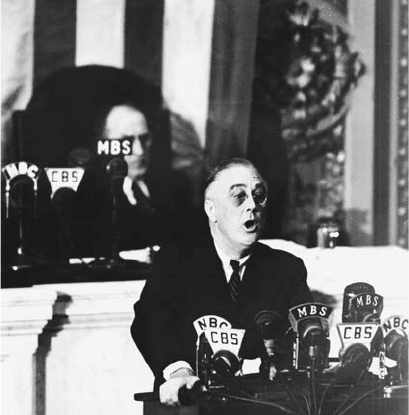
This 1941 photograph shows President Franklin
D. Roosevelt asking Congress to declare war on
Japan the day after the Japanese attack on Pearl
Harbor.
(Library of Congress)
468 military and the Constitution
vi+904_EofUSConsti-v2.indd 468 3/20/09 2:17:40 PM
living on the West Coast of the United States to
internment camps. Although the deportation
order was issued in early 1942—shortly after the
attack on Pearl Harbor—the Supreme Court did
not rule on its constitutionality until 1944. In
K
OREMATSU V. UNITED STATES, 325 U.S. 219 (1944),
the Supreme Court upheld the order, noting that
“the properly constituted military authorities”
feared an invasion. Later, however, in Ex parte
Endo, 323 U.S. 283 (1944), issued the day after
Roosevelt announced the closing of the camps,
the Court held that an individual could challenge
her deportation to a camp. Signifi cantly, by this
time, the administration of the internment camps
had been turned over to a civilian organization—a
factor that may have made the Court more willing
to rule against the military.
More recently, the Supreme Court has, in a
series of cases related to the war on terror, lim-
ited the state’s power to detain enemy combatants.
In HAMDI V. RUMSFELD, 542 U.S. 507 (2004), the
Court held that the government cannot indefi-
nitely detain an enemy combatant. In Rasul v.
Rumsfeld, 542 U.S. 466 (2004), the Court held
that civilian courts can hear habeas challenges
from Guantánamo Bay prisoners. Finally, Ham-
dan v. Rumsfeld, 126 S.Ct. 2749 (2006)—a highly
technical ruling—saw the Court invalidate Presi-
dent George W. Bush’s plan to use military com-
missions to try enemy combatants as going beyond
the power he had been given by Congress.
While these cases appear to break from the
pattern of judicial deference on military mat-
ters, they can also be understood as responses to
a weak president at a time (2004–06) when the
fear of terrorism had begun to dissipate. Further-
more, none of the decisions have (so far) struck
a mortal blow against the Bush administration’s
detention of enemy combatants. (For example,
after Hamdan, President Bush was able to go back
and gain congressional authorization for military
commissions.)
Questions of the constitutional position of the
military also arise in the wide variety of cases that
force the Court to review some aspect of mili-
tary life. Here, as well, courts treat the military
with great deference. In part, this is because the
military, like other professional groups, possesses
specialized knowledge. But while courts are occa-
sionally willing to challenge the norms of doctors,
lawyers, and accountants, they tend to treat the
military as a separate society with its own rules.
Deference to the military often trumps other
constitutional rights. For example, in Goldman v.
Weinberger, 475 U.S. 503 (1986), the Court held
that the First Amendment right to free expres-
sion did not cover an air force doctor who sought
to wear a yarmulke while on active duty. The simi-
lar argument was used in ROSTKER V. GOLDBERG,
453 U.S. 57 (1981), which held that male-only
draft registration did not violate the constitution.
At the same time, deference to the military
does not always lead to a rollback of civil rights.
In GRUTTER V. BOLLINGER, 539 U.S. 306 (2005), the
armed forces submitted an amicus brief which
stated that the ROTC and service academies
would be unable, without race-conscious admis-
sions standards, to fi eld a military that was highly
qualified and racially diverse. Justice Sandra
Day O’Connor quoted from this brief repeatedly
in her plurality opinion upholding affirmative
action in higher education.
For more information: Lichtman, Steven B.
“The Justices and the Generals: A Critical Exami-
nation of the U.S. Supreme Court’s Tradition of
Deference to the Military, 1918–2004.” Maryland
Law Review 65 (2006): 907–949; Neely, Mark
E., Jr. The Fate of Liberty: Abraham Lincoln and
Civil Liberties. Oxford: Oxford University Press,
1992; O’Connor, John F. “Statistics and the Mili-
tary Deference Doctrine: A Response to Profes-
sor Lichtman.” Maryland Law Review 66 (2007):
668–706; Pilon, Roger. “The War Powers in Brief:
On the Irreducible Politics of the Matter.” Car-
dozo Public Law, Policy and Ethics Journal 2
(2003) 49–58; Pushaw, Robert J. “The ‘Enemy
Combatant’ Cases in Historical Context: The
Inevitability of Pragmatic Judicial Review.” Notre
Dame Law Review 82 (2007): 1,005–1,083; Vagts,
Detlev F. “Military Commissions: A Concise His-
tory.” American Journal of International Law 101
(2007): 35–48.
—Robert A. Kahn
military and the Constitution 469
vi+904_EofUSConsti-v2.indd 469 3/20/09 2:17:41 PM
Miller-El v. Cockrell 537 U.S. 322 (2003)
In Miller-El v. Cockrell, the Supreme Court held
that the Fifth Circuit Court of Appeals improperly
denied petitioner Thomas Joe Miller-El’s Certifi -
cate of Appealability by failing to properly review
the district court’s decision to deny petitioner’s
habeas corpus petition for relief based on the
Dallas county prosecutor’s discriminatory use of
peremptory strikes to remove African Americans
from Miller-El’s state capital murder trial.
In this case, the petitioner, Miller-El, sought
relief from a 1986 Texas state court capital mur-
der conviction through a habeas corpus petition
based on a violation of his equal protection
rights. Miller-El’s petition was based on his claim
that prosecutors had used 10 of 11 peremptory
strikes to eliminate African Americans from the
jury hearing Miller-El’s case in a purposeful and
discriminatory manner.
At the state trial court level, Miller-El had
asked the judge to strike the jury due to the
prosecutor’s improper and discriminatory use of
peremptory strikes. The trial court denied Miller-
El’s request, and subsequently, he was convicted
by the jury of capital murder. Miller-El fi led both
direct appeals and habeas relief before the Texas
state courts. During the time period when Miller-
El fi led his state court appeals, the U.S. Supreme
Court, in B
ATSON V. KENTUCKY, 476 U.S. 79, 106
S.Ct. 1712, 90 L.Ed.2d 69, created a new standard
for analyzing equal protection claims. Under Bat-
son, the Supreme Court established a three-step
process for evaluating claims that prosecutors had
exercised peremptory challenges in violation
of a defendant’s equal protection. Under the new
three-step process: (1) the defendant must show
with prima facie evidence that the peremptory
challenges had been exercised on the basis of race;
(2) if the defendant succeeds with step one, then
the prosecution must offer a “race-neutral basis”
for striking jurors; and (3) the trial court must
determine if the defendant has shown purposeful
discrimination.
After failing at the state court level, Miller-El
filed a habeas petition with the federal district
court raising a Batson claim. The federal court
denied his petition in deference to the state court
decision. The Fifth Circuit Court of Appeals sub-
sequently denied a Certificate of Appealability
to Miller-El, required before that court can take
control of the case.
In its decision, the Supreme Court found
that Miller-El’s case was entitled to review by
the Fifth Circuit Court of Appeal, because he
had presented overwhelming evidence that the
prosecution had improperly exercised peremp-
tory strikes against potential African-American
jurors. Under the Batson standard, the Supreme
Court found that Miller-El had convincingly
established that peremptory strikes used by the
prosecution in his state trial were exercised in a
discriminatory manner. Specifically, Miller-El
showed that prosecutors had exercised peremp-
tory strikes and removed 91 percent of the eli-
gible African-American jurors and only removed
13 percent of other, non-black jurors. Also, under
Batson, the Court found that the prosecution
did not provide a credible race-neutral basis for
striking African-American jurors. Miller-El also
presented evidence showing that the prosecu-
tor asked jurors different questions regarding
capital punishment and minimum sentences
during voir dire, depending on their race. Miller-
El also showed that one of the prosecutors in
his case had access to a Dallas County policy to
strike minorities from juries.
Justice Clarence Thomas was the lone dis-
sent in this case. In his separate opinion, Thomas
claimed that petitioner had not shown by clear and
convincing evidence that the prosecution’s strik-
ing African Americans from the jury was done due
to race.
On remand to the Fifth Circuit Court of
Appeals, this court again ruled against Miller-El
on the merits of his Batson claim that prosecutors
had exercised peremptory strikes in a discrimina-
tory manner. The Supreme Court heard on certio-
rari Miller-El’s subsequent appeal of his case in
Miller-El v. Dretke, 545 U.S. 231 (2005), not on
the question on whether the court of appeals had
improperly failed to issue a Certifi cate of Appeal-
ability, but this time on the direct issue of discrim-
ination. In this case, the Supreme Court reversed
the Fifth Circuit’s decision.
470 Miller-El v. Cockrell
vi+904_EofUSConsti-v2.indd 470 3/20/09 2:17:41 PM
The two Miller-El decisions were part of
a group of cases in which the Supreme Court
expressed dissatisfaction with the decisions of the
Fifth Circuit Court of Appeals and Texas district
courts that approved of death penalty convictions
in light of prosecutorial misconduct.
For more information: Johnstone, Mattie, and
Joshua M. Zachariah. “Peremptory Challenges
and Racial Discrimination: The Effects of Miller-
El v. Cockrell.” Georgetown Journal of Legal Eth-
ics 17 (Summer 2004): 863–886.
—Lydia Brashear Tiede
Miller v. California 413 U.S. 15 (1973)
In Miller v. California, the Supreme Court, in a
5-4 decision, stipulated three legal tests for deter-
mining if material was considered obscene. First,
material is obscene, according to the Court, if the
work, taken in its entirety, appeals to the prurient
interest in sex. In other words, if the material is
intended for the sole purpose of arousing a dis-
tasteful interest in sexual activity, then the material
is considered obscene. Second, if the work depicts
in a “patently offensive way, sexual conduct spe-
cifi cally defi ned by the applicable state law,” then
it is obscene. Third, the work is obscene if, taken
in its entirety, it lacks any “serious literary, artis-
tic, political, or scientifi c value.” The signifi cance
of this case was that it was seen as an answer to
a previous case, ROTH V. UNITED STATES, 354 U.S.
476 (1957), a case that set the “average person”
obscenity standard. In the Roth case, Justice
William J. Brennan, Jr., noted the standard
for obscenity as “whether to the average person,
applying contemporary community standards, the
dominant theme of the material taken as a whole
appeals to prurient interests.”
Marvin Miller, the appellant in this case, had
been arrested, tried, and convicted pursuant to
California Penal Code Section 311.2(a) for dis-
tributing obscene material. Miller sent through
the mail an advertisement for the sale of adult
books that depicted men and women engaging in
sexual activity. Five of these brochures ended up
at a restaurant located in Newport Beach, Califor-
nia, where the manager and his mother opened
the material and subsequently made a complaint
to local law enforcement.
Chief Justice Warren Burger delivered the
opinion of the Court. He was joined by Justices
White, Blackmun, Lewis Powell, and Wil-
liam Hubbs Rehnquist (Justices William O.
Douglas, Brennan, Stewart, and Marshall dis-
sented). In addition to setting the three tests dis-
cussed above, the Court noted that it was “not our
function to propose regulatory schemes for the
sates. That must await their concrete legislative
efforts. It is possible, however, to give a few plain
examples of what a state statute could defi ne for
regulation.” They then proceed to provide exam-
ples of lewd sexual conduct that the Court consid-
ered to be obscene. In addition, the Court noted
that the “First Amendment protects works
which, taken as a whole, have serious literary,
artistic, political, or scientifi c value, regardless of
whether the government or a majority of the peo-
ple approve of these ideas the works represent.”
Basically, the protection of speech and press is
done in order to bring about free and open dis-
course in the marketplace of ideas. The publica-
tion of hard-core sexual activity for nothing more
than commercial gain for the vendor or just for
the sake of depicting hard-core sexual activity is
a different matter and may not be protected by
the First Amendment to the Constitution of the
United States of America.
After the decision was rendered by the Court,
law enforcement agencies saw this as an opportu-
nity to close various pornographic establishments.
However, they soon learned that the Miller deci-
sion did not provide them with carte blanche to
pursue even those people who displayed “four-let-
ter” words. The Court, as previously stipulated,
held that only hard-core pornography lay outside
the purview of the First Amendment.
For more information: Farber, Daniel A., Wil-
liam N. Eskridge, Jr., and Philip P. Frickey. Cases
and Materials on Constitutional Law: Themes for
the Constitution’s Third Century. St. Paul, Minn.:
Thompson/West, 1993; Wayne, Stephen J., G. Cal-
vin Mackenzie, and Richard L. Cole. Confl ict and
Miller v. California 471
vi+904_EofUSConsti-v2.indd 471 3/20/09 2:17:41 PM