
Schultz D. Encyclopedia of the United States Constitution
Подождите немного. Документ загружается.

objectionable materials, and it has fi ned individu-
als, such as Howard Stern, for using certain words
or because of their content. However, the FCC
has also permitted more adult language to be used
on cable and in nonfamily hours.
The music censorship landscape changed dra-
matically in 1985 with the formation of the Par-
ents’ Music Resource Center (PMRC), a group
composed mainly of the wives of some of the most
influential public figures in Washington, D.C.,
including Tipper Gore, wife of former Vice Presi-
dent Al Gore. The group aimed to inform parents
that much of the popular music enjoyed by their
children explicitly glorified drugs, alcohol, vio-
lence, and sex. They wanted the music industry
to voluntarily label recordings containing explicit
lyrics to help parents determine whether certain
music was suitable for their children. A key part of
their strategy was convincing the Senate to hold
a hearing in 1985 on the content of rock music.
Much of the testimony was combative, with state-
ments from members of the PMRC that linked
various social ills to music lyrics, and testimony
by musicians that called the hearing a censorship
charade. Ultimately, the music industry agreed
to place “Parental Advisory: Explicit Content”
stickers on CDs according to their own internal
standards.
Since 1990, some major retail chains, includ-
ing Wal-Mart, have refused to sell CDs containing
warning labels, and some stores restrict sales of
labeled music to people over 18 years old. Some
recording companies have marketed “clean” ver-
sions of songs in order to get the music on the
shelves. A number of states have debated legisla-
tion that would prevent the sale of labeled music,
and some have considered taxing recordings that
contain warning labels. Over the years, Music
Television (MTV) has chosen to ban certain music
videos based on both lyrical and visual content.
Although no music censorship cases have been
heard by the U.S. Supreme Court, one came close.
In 1990, a Florida judge declared 2 Live Crew’s
album As Nasty as They Want to Be obscene, and
the Broward County sheriff ordered it removed
from stores. Although three retailers were
arrested, charges were eventually dropped, and
on appeal, a federal court found that the record-
ing was not obscene; the Supreme Court did not
grant certiorari. As the Internet becomes more
integral to the music industry in the 21st century,
actions against the content of music are likely to
move in new directions.
For more information: Chastagner, Claude.
“The Parents’ Music Resource Center: From
Information to Censorship.” Popular Music 18
(May 1999): 179–192; Cohen, Ronald D. “The
Delinquents: Censorship and Youth Culture
in Recent U.S. History.” History of Education
Quarterly 37 (Autumn 1997): 251–270; Paulson,
Kenneth A. “Regulation through Intimidation:
Congressional Hearings and Political Pressure
on America’s Entertainment Media.” Vanderbilt
Journal of Entertainment Law and Practice 7
(Winter 2004): 61–89.
—Margaret Tullai
Muskrat v. United States 219 U.S. 346 (1911)
In Muskrat v. United States, the Court reversed
and dismissed the claims of David Muskrat that
challenged the constitutionality of a series of con-
gressional restrictions imposed on land owned by
Cherokees. More broadly, however, this decision
acknowledged that Article III of the U.S.
Constitution limits the exercise of federal judi-
cial power to actual cases and controversies that
are brought to the courts for resolution.
In this opinion, the Court put words to a tradi-
tion that had guided its decision making for more
than a century, but one that had never before
been clearly stated: namely, that it would not hear
friendly suits, nor issue hypothetical opinions, nor
address any questions beyond those contained in
real cases or controversies.
The Muskrat case has its origin in a long list
of disputes that grew out of the complexities of
Indian treaties and the congressional struggle
at the turn of the 19th to the 20th century to
address them. The General Allotment Act of 1887
pronounced a new federal Indian policy: Former
tribal lands were to be subdivided, then individu-
ally bought and sold. This initiated a complex pro-
492 Muskrat v. United States
vi+904_EofUSConsti-v2.indd 492 3/20/09 2:17:48 PM
cess wherein Indian claims to land titles became a
critical element in determining federal allotments,
tribal boundaries, treaty provisions, and corpo-
rate and personal ownership.
Subsequent congressional legislation, in order
to clarify the factual questions that arose as well
as to remedy the bureaucratic inadequacies that a
multitude of these disputes revealed, often would
invite suits against the government. The legislation
specifi ed that these cases were to be tried in fed-
eral courts of claims to determine the details and
resolve the differences in these matters, and that
such decisions could be reviewed by the Supreme
Court.
Muskrat v. United States bears all of these
characteristics. It was born of a 1907 statute,
wherein Muskrat and others were individually
named and authorized to bring suit in the court
of claims “to determine the validity of any acts
of Congress” (Opinion of the Court, p. 360) that
since 1902 had regulated Cherokee lands. The
legislation instructed the attorney general to rep-
resent the federal government in the case, and
the U.S. Treasury to pay the lawyers’ fees for the
attorneys who represented Muskrat and Cherokee
citizens. Muskrat’s suit was, in short, orchestrated,
planned, and paid for by Congress.
In delivering the opinion for a unanimous (7-0)
court, Justice Day highlighted the lack of genu-
ine adversarial interests that existed between the
Cherokees and the United States, the transparent
objective to garner Supreme Court approval for
the “doubtful character” of congressional legisla-
tion in these matters, and the unoffi cial practice
of the Court only to hear actual cases and con-
troversies. Faced with an unabashed congressio-
nal invitation to render an advisory opinion here,
Day declared, “Is such a determination within the
judicial power conferred by the Constitution . . . ?
We think it is not” (361).
Day’s opinion traced the development of this
tradition to Washington’s presidency, when the
administration and Congress asked for the jus-
tices’ advice and counsel on a wide range of issues
from treaty matters with France and Britain to set-
tling Revolutionary War pensions for widows and
orphans. In correspondence, Chief Justice John
Jay and his associates declined to assist on the
grounds that such action would violate the unique
power that was vested only in the judiciary by Arti-
cle III of the U.S. Constitution (see appendix).
Declaring that this was neither a case nor a
controversy and, as such, fell outside its consti-
tutional jurisdiction, Justice Day laid the founda-
tion for the gradual development of the modern
court’s limitation of congressional attempts to
place issues before the court. The holdings of
Muskrat were reaffi rmed in Aetna Life Insurance
Co. v. Haworth, 300 U.S. 227 (1937), and further
sharpened in L
UJAN V. DEFENDERS OF WILDLIFE, 504
U.S. 555 (1997), which said it is the Court, not the
Congress, that ultimately determines what is a
true case or controversy.
For more information: Casto, William R. “The
Early Supreme Court Justices’ Most Signifi cant
Opinion.” Ohio Northern University Law Review
29 (2002): 173–207; Kannan, Phillip M. “Advisory
Opinions by Federal Courts.” University of Rich-
mond Law Review 32 (1998): 769–798.
—George Peery
Myers v. United States 272 U.S. 52, 47 S.
Ct. 21, 71 L. Ed. 160
(1926)
Myers v. U.S. established the president’s authority
unilaterally to remove inferior executive officers
appointed “by and with the Advice and Consent of
the Senate” (Article II, Section 2). The Court
thereby resolved a question long debated: When the
Constitution is explicit about the mode of appointing
offi cials, but silent about the mode of their removal,
who may remove offi cials jointly appointed? The
Court’s answer established a sweeping executive
authority and derived a substantial power from his
obligation to “take Care that the Laws be faithfully
executed” (Article II, Section 3).
Although the Tenure of Office Act (1867),
which sought to restrict the executive’s removal
power, had been repealed in 1887, an 1876 stat-
ute that required Senate consent to the removal
of all fi rst-, second-, and third-class postmasters
remained on the books. In January 1920, Presi-
dent Wilson removed Postmaster First-Class
Myers v. United States 493
vi+904_EofUSConsti-v2.indd 493 3/20/09 2:17:48 PM
Frank S. Myers before his term expired and with-
out Senate consent, in violation of that law. After
Myers sought unsuccessfully to recover his lost
salary in the U.S. Court of Claims, he appealed to
the Supreme Court.
In a 6-3 decision, authored by Chief Justice
William Howard Taft, the Court entered the
fray and held the 1876 statute unconstitutional.
A lengthy review of history led the Court to con-
clude that “the executive Power” (Article II, Sec-
tion 1) was a broad grant of substantive power, and
that the appointing provisions of Article II, Sec-
tion 2 were to be understood as limitations to this
power which were to be construed strictly. Con-
gress’s power to determine the mode of appoint-
ment of “inferior offi cers” (Article II, Section 2)
thus does not extend to it the power to limit their
removal once appointed. The power to remove is
inherently executive: The president must be able
to remove offi cials in whom he has lost confi dence
in order to fulfi ll his own obligation to “take Care
that the Laws be faithfully executed” (Article II,
Section 3).
In dissent, Justice McReynolds followed Taft’s
foray into history to conclude that the president
had no such “illimitable” power (272 U.S 52, 192
[1926]), one inconsistent with a Constitution of
limited and enumerated powers. The obligation to
ensure faithful execution of the laws cannot jus-
tify infraction of some of those laws. Further, the
Court’s holding had been “expressly repudiated”
(272 U.S. 52, 202 [1926]) in MARBURY V. MADISON,
5 U.S. (I CR.) 137 (1803), and consistently denied
in subsequent cases.
Agreeing with McReynolds’s conclusions,
Brandeis added pointedly that there is “no express
grant to the President of incidental powers resem-
bling those conferred upon Congress by clause 18
of Article I, 8” (272 U.S. 52, 246 [1926]).
Finally, Justice Oliver Wendell Holmes,
Jr. argued that because Congress had created
the offi ce and had conferred upon the president
the power to appoint its officers, its assent was
required for their removal. The president’s obliga-
tion to ensure the faithful execution of the laws
“does not go beyond the laws or require him to
achieve more than Congress sees fi t to leave within
his power” (292 U.S. 52, 295 [1926]).
For more information: Corwin, Edward S. The
President’s Removal Power under the Constitu-
tion. New York: National Municipal League, 1927;
Entin, Jonathan L. “The Pompous Postmaster and
Presidential Power: The Story of Myers v. United
States.” Case Legal Studies Research Paper No.
05-39 (November 2005); Fisher, Louis. Con-
stitutional Conflicts between Congress and the
President. 4th ed. Lawrence: University Press of
Kansas, 1997.
—Lorna M. Dawson
494 Myers v. United States
vi+904_EofUSConsti-v2.indd 494 3/20/09 2:17:49 PM
495
ﱶﱷﱸ
National Endowment for the Arts v. Finley
524 U.S. 569 (1998)
In National Endowment for the Arts v. Finley, the
Supreme Court rejected the notion that Congress
was barred by the First Amendment from con-
ditioning federal arts funding on adherence to a
vague standard of decency.
After taxpayer-subsidized grants from the
National Endowment for the Arts were awarded
to controversial artists Robert Mapplethorpe and
Andres Serrano in 1989, angry congressional con-
servatives inserted an amendment in the NEA’s
1990 reauthorization, directing the NEA to “take
into consideration general standards of decency.”
Subsequently, the NEA denied the grant applica-
tion of performance artist Karen Finley, who was
renowned for reenacting rape by stripping to the
waist and smearing her body with chocolate. Finley
and three other rejected applicants then challenged
the new directive as violating the First Amend-
ment’s bar against viewpoint discrimination.
By an 8-1 vote, the Supreme Court disagreed,
with Sandra Day O’Connor characterizing the
decency amendment as in fact viewpoint neutral.
However, Justice O’Connor arrived at this con-
clusion in tortuous fashion, by declaring that the
amendment was “merely hortatory.” While the
NEA was entitled to use decency as a factor in
evaluating grant proposals, O’Connor argued, it
was not compelled to do so.
This interpretation of the new directive
stunned observers. The amendment’s congressio-
nal sponsors had fully intended to make the new
rule mandatory, and to reinforce that desire, Con-
gress had slashed the NEA’s budget by $45,000—
the precise total of the grants provided for the
Mapplethorpe and Serrano exhibits. Legal schol-
ars were likewise unsatisfied. Prominent First
Amendment commentator Frederick Schauer
described O’Connor’s handiwork as “an implau-
sible doctrinal structure.”
But perhaps O’Connor’s most trenchant critic
was a colleague. In his concurring opinion, Anto-
nin Gregory Scalia excoriated O’Connor’s dis-
ingenuousness about the amendment, as well as
what he saw as fealty to a fl awed vision of freedom
of speech. Headlining his argument with an all-
capital-letters scold, “THE STATUTE MEANS
WHAT IT SAYS,” Scalia argued that the govern-
ment is free to require that the money it hands
out be used the way it wants it used. Whereas
O’Connor had ducked the question of whether
whoever pays the piper gets to call the tune by
essentially declaring that no tune was actually
being “called,” Scalia embraced government’s abil-
ity to discriminate against disfavored viewpoints
whenever it was subsidizing speech.
Scalia’s doctrinaire argument may have been
more consistent with the intentions of Congress,
but it has never found favor with a majority of the
justices. Indeed, the Court once again declined to
embrace it in U
NITED STATES V. AMERICAN LIBRARY
ASSOCIATION, 539 U.S. 194 (2003), in which it
upheld the federal government’s power to forbid
federal fi nding for libraries that refused to install
anti-pornography fi ltering software on public com-
puters. Yet two of the four justices who signed on
to the plurality opinion (Anthony M. Kennedy
and Stephen G. Breyer) specifi cally noted that
their approval was based on the fact the libraries
were free to turn the fi lters off at patrons’ request,
thus indicating the continuing unacceptability of
the kind of unabashedly mandatory scheme that
Scalia would countenance.
N
vi+904_EofUSConsti-v2.indd 495 3/20/09 2:17:49 PM
For more information: Finley, Karen. A Dif-
ferent Kind of Intimacy: The Collected Writings
of Karen Finley. New York: Thunder’s Mouth
Press, 2000; Grazia, Edward de. Girls Lean
Back Everywhere: The Law of Obscenity and the
Assault on Genius. New York: Random House,
1992.
—Steven B. Lichtman
National Labor Relations Board v. Jones
and Laughlin Steel Corp.
301 U.S. 1
(1937)
In NLRB v. Jones and Laughlin Steel Corp., the
U.S. Supreme Court ruled 5 to 4 that the National
Labor Relations Act (NLRA) was constitutional
under Congress’s power to regulate commerce
among the states. The ruling by the Court was
signifi cant in that it signifi ed an important shift
in the Court’s approach to the commerce power
of Congress.
In previous cases, such as UNITED STATES V.
E.C. KNIGHT CO., 156 U.S. 1 (1895), and CARTER
V. CARTER COAL CO., 298 U.S. 238 (1936), the
Court had reasoned that labor practices, as ele-
ments of production rather than distribution,
were activities outside of congressional author-
ity because they had only an indirect effect on
interstate commerce. Distributive activi-
ties, so long as they did not infringe upon states’
reserved powers, were under the regulatory
authority of Congress, as those activities would
have a direct effect on commerce among the
states. The Court’s decision in NLRB v. Jones
and Laughlin Steel Corp. did away with both
the production/distribution distinction as well as
the direct/indirect effects test established by the
Court in the earlier cases.
In 1935, Congress passed the NLRA in
response to the Court’s striking down a collective
bargaining protection provision of the National
Industrial Relations Act (NIRA) in SCHECHTER
POULTRY CORP. V. UNITED STATES, 295 U.S. 495
(1935). The NLRA, known as the Wagner Act,
provided for the establishment of the National
Labor Relations Board (NLRB) to guarantee col-
lective bargaining rights for workers and granted
the NLRB authority to compel action by employ-
ers who ran afoul of fair labor practices that would
affect interstate commerce. A claim was brought
to the NLRB by workers at Jones and Laughlin
Steel Corporation, charging that the company
had discouraged workers from unionizing and
had fi red 10 workers who had engaged in union
activities. The board upheld the charges against
the company and ordered the company to rein-
state the employees. Jones and Laughlin refused
to abide by the board’s order and challenged the
constitutionality of the Wagner Act, which granted
authority to the NLRB. The company argued that,
consistent with U.S. Supreme Court precedent,
labor practices were primarily elements of pro-
duction, had only an indirect effect on interstate
commerce, and were therefore beyond the scope
of congressional authority to regulate. The NLRB
responded by seeking enforcement of its order in a
U.S. district court, but that petition was rejected.
The NLRB appealed to the U.S. Supreme Court,
which granted certiorari.
Justice Hughes wrote the opinion for the
Court. Hughes reasoned that the National Labor
Relations Act’s grant of authority to the NLRB
was constitutional, because labor disputes and
labor unrest may give rise to strikes and other acts
“which directly burden or obstruct interstate or
foreign commerce, or its free fl ow.” Consequently,
such acts are “within the reach of the congressio-
nal power” to regulate. “Acts having that effect are
not rendered immune because they grow out of
labor disputes.” According to the Court, the Jones
and Laughlin Steel Corporation had substantial
commercial dealings on a national scale, “making
their relation to interstate commerce the dominant
factor in their activities,” which led the Court to
the conclusion that the labor disputes that would
arise without NLRB protections would lead to
substantial barriers to the free fl ow of interstate
commerce.
The dissent in the case argued that the major-
ity had simply rejected, without due consideration,
the line of precedent established in production-
related cases. They noted that the indirect effect
on interstate commerce of labor practices in man-
ufacturing steel was so remote as not to fall under
496 National Labor Relations Board v. Jones and Laughlin Steel Corp.
vi+904_EofUSConsti-v2.indd 496 3/20/09 2:17:49 PM
congressional authority to regulate. Discontent
among a few workers might lead to a strike, which
may lead to a reduction in goods traveling inter-
state. But, Justice McReynolds wrote, “By this
chain of indirect and progressively remote events
we fi nally reach the evil” with which the legisla-
tion purports to deal. “A more remote and indirect
interference with interstate commerce or a more
definite invasion of the powers reserved to the
states is diffi cult, if not impossible, to imagine.”
NLRB v. Jones and Laughlin Steel Corp. is an
important case to consider in light of its contribu-
tion to the development of the Court’s approach
to the commerce clause. This case signaled a
new direction for the Court in commerce clause
cases, away from the tests established earlier to
limit congressional authority in manufacturing
and toward a much more broad understanding of
the scope of congressional power to regulate inter-
state commerce.
Moreover, the case is viewed as a turning point
in constitutional development. From 1933 to 1937,
the Court had repeatedly turned back major New
Deal legislation aimed at regulating the national
economy. In this case, the Court rejected those
limits it had embraced prior to President Roos-
evelt’s court-packing proposal (in which Roosevelt
proposed to increase the number of Supreme
Court judges from nine to 15). Though the pro-
posal was rejected by Congress, the “switch in
time that saved nine” is remembered for its pro-
found contribution to constitutional development
and a greater role for Congress in the nation’s
economy. As the Court became dominated by
appointees of President Franklin Roosevelt, sub-
sequent cases, like U
NITED STATES V. DARBY LUMBER
CO., 312 U.S. 100 (1941), and WICKARD V. FILBURN,
317 U.S. 111 (1942), consolidated that constitu-
tional revolution.
For more information: Cortner, Richard C. The
Jones and Laughlin Case. New York: Knopf, 1970;
Hardin, Patrick, et al. The Developing Labor Law:
The Board, the Courts, and the National Labor
Relations Act. 4th ed. Washington, D.C.: Bureau
of National Affairs, 2001.
—Brian M. Harward
National League of Cities v. Usery 426 U.S.
833
(1976)
In National League of Cities v. Usery, the Supreme
Court, in a closely divided decision, held that a
federal law that required states to pay a mini-
mum wage to state and local employees violated
the Tenth Amendment because it “operate[s] to
directly displace the States’ freedom to structure
integral operations in areas of traditional govern-
mental functions.” Usery is the only decision of the
Supreme Court between 1937 and 1990 to strike
down a federal law as unconstitutional under the
Tenth Amendment. The Court subsequently over-
ruled Usery in G
ARCIA V. SAN ANTONIO METROPOLI-
TAN TRANSIT AUTHORITY, 469 U.S. 528 (1985).
At issue in Usery was whether Congress had
the power, pursuant to the commerce clause of
Article I of the U.S. Constitution, to enact
the Fair Labor Standards Act, which required that
states pay their state and local employees a mini-
mum wage. The issue arose when a consortium of
cities and states brought suit against the secretary
of labor, Mr. Usery, contending that Congress
could not exercise its commerce power “so as to
force directly upon the States its choices as to how
essential decision[s] regarding the conduct of inte-
gral governmental functions are to be made.” In
the view of appellant National League of Cities,
the Tenth Amendment reserved to the states deci-
sions regarding traditional state and local func-
tions, such as the setting of minimum wages for
state employees.
In an opinion written by then-Justice William
Hubbs Rehnquist for four other justices, the
Court agreed that the states retained the power
to set minimum wages for state employees. Justice
Rehnquist reasoned that, although it is “beyond
peradventure that the commerce clause . . . is a
grant of plenary authority to Congress,” the power
is not without limits. “Congressional enactments
which may be fully within the grant of legislative
authority contained in the commerce clause may
nonetheless be invalid if they offend” particu-
lar constitutional provisions, such as the Sixth
Amendment’s right to trial by jury or the
Fifth Amendment’s guarantee of due process.
The Usery Court held that the Tenth Amendment
National League of Cities v. Usery 497
vi+904_EofUSConsti-v2.indd 497 3/20/09 2:17:50 PM
refl ects one such limitation: it limits the federal
government from interfering with traditional
state or local functions. Forcing states to pay
their employees a federal minimum wage would
require the states to raise taxes or cut services to
pay increased wages and, in turn, may force states
to “substantially restructure traditional ways in
which the local governments have arranged their
affairs.”
Justice Blackmun penned a short concur-
rence downplaying the possible implications of
the majority’s opinion. In his view, the majority
opinion adopted a balancing approach that would
“not outlaw federal power in areas such as envi-
ronmental protection, where the federal interest
is demonstrably greater and where state facility
compliance with imposed federal standards would
be essential.”
In dissent, Justice William J. Brennan, Jr.,
joined by Justices White and Marshall, contended
that the Tenth Amendment did not affi rmatively
limit Congress’s power under the commerce
clause and assailed the majority for setting forth
an unworkable standard for ascertaining the limits
of congressional power. In a separate dissent, Jus-
tice John Paul Stevens argued that the Court
had failed to articulate a principled basis to deter-
mine whether a particular federal law violates the
Tenth Amendment.
Following Usery, the Court struggled to
defi ne what powers were reserved to the states
under the Tenth Amendment. A decade later,
the Court, in an opinion by Justice Blackmun,
expressly overruled Usery in Garcia v. San Anto-
nio Metropolitan Transit Authority, rejecting as
“unsound in principle and unworkable in prac-
tice, a rule of state immunity from federal regula-
tion that turns on a judicial appraisal of whether
a particular government function is ‘traditional’
or ‘integral.’ ”
For more information: McAffee, Thomas B.,
Jay S. Bybee, and A. Christopher Bryant. Powers
Reserved for the People and the States: A History
of the Ninth and Tenth Amendments. Westport,
Conn.: Praeger Publishers, 2006.
—Andre Mura
national security and the Constitution
The making of national security under the Con-
stitution is assigned primarily to the president
in Article II as commander in chief of the
armed forces and to Congress under its various
powers outlined in Article I. While both of
these branches of government have historically
shared responsibility in the creation of national
security policy, at different times Congress and
the president have sought to assume more respon-
sibility, thereby setting up confl ict and competi-
tion between the two. Moreover, the making of
national security policy also raises issues regarding
the scope of protection for individual rights when
the United States faces a security threat. The com-
petition between Congress and the president and
the balance of freedom versus security can espe-
cially be seen since the events of 9/11, as the presi-
dent has sought to assume more authority in the
making of national security and foreign policy, and
as critics contend that many of his actions violated
the Constitution and the Bill of Rights.
The authors of the Constitution of the United
States created a system of ordered liberty, in which
the Constitution distributes powers for securing
national security among the three branches of gov-
ernment. To the president and the Congress were
given the major portions of power and responsi-
bility, including law enforcement and war powers
as outlined in Articles I and II. Article I, Section
8 of the Constitution describes several exclusive
powers of Congress in the area of war making and
foreign policy, including the authority to declare
war, to raise and support an army and navy, and
to make regulations for the military. Article II,
Section 2 makes the president exclusively the
commander in chief of the armed forces. Finally,
Article II, Section 2 gives Congress and the presi-
dent joint authority to nominate and confirm
ambassadors and to negotiate and ratify treaties.
In general, the courts have had the responsibil-
ity to settle disputes between them and to protect
the liberties of the people, deciding cases between
order and liberty.
Throughout American history there has been
a continuing debate regarding where the lines are
drawn to divide the constitutional authority of the
498 national security and the Constitution
vi+904_EofUSConsti-v2.indd 498 3/20/09 2:17:50 PM
president from that of the Congress. While dur-
ing the Civil War, President Abraham Lincoln
and Congress often clashed, the Supreme Court
generally endorsed Lincoln’s authority to act. For
example, in the Prize Cases, 67 U.S. 635 (1863),
the Court upheld Lincoln’s order to blockade the
South’s ports, ruling that the president’s power as
commander in chief was broad enough to permit
this action. However, in E
X PARTE MILLIGAN, 71
U.S. 4 Wall. 2 (1866), the Supreme Court ruled
that an American citizen could not be tried by
military commission when the civil federal courts
were open and operational. The significance of
the Milligan decision was that it limited the ability
of the president to try American citizens without
all the constitutionally protected guarantees when
accused of a crime. Finally, in EX PARTE MCCARDLE,
74 U.S. 506 (1869), the Supreme Court ruled that
it lacked the jurisdiction to hear a habeas cor-
pus petition by an individual even though it had
already heard oral arguments in his case. These
three Civil War–era cases seem to suggest that
the courts will defend or ignore individual rights,
presidential power, and congressional authority at
different times when the United States is facing
security threats.
Congress and the president competed for rival
infl uence in foreign and national security policy
after the Civil War and through World Wars I
and II, but individual rights were challenged in a
series of cases, such as SCHENCK V. UNITED STATES,
249 U.S. 47 (1919), and WHITNEY V. CALIFORNIA,
274 U.S. 357 (1927). The Supreme Court upheld
laws criminalizing individuals who criticized
World War I or who otherwise were deemed to
have engaged in subversive activity. Similarly, dur-
ing the cold war after World War II, in cases such
as Dennis v. United States, 341 U.S. 494 (1951),
the Court upheld the conviction of a member of
the Communist Party for a violation of the Smith
Act, which had made it illegal to “knowingly or
willfully advocate, abet, advise or teach the duty,
necessity, desirability or propriety of overthrow-
ing the Government of the United States or of
any State by force or violence, or for anyone to
organize any association which teaches, advises
or encourages such an overthrow, or for anyone
to become a member of or to affiliate with any
such association.” The Smith Act and other poli-
cies such as loyalty oaths, during the Cold
War and McCarthy eras, effectively make it illegal
simply to be a communist. All these actions were
taken as necessary to protect national security,
and the Supreme Court displayed a mixed record
in upholding or voiding them on constitutional
(generally First Amendment) grounds.
One of the most important Court cases exam-
ining the relationship between the powers of
these two branches is found in YOUNGSTOWN SHEET
& TUBE V. SAWYER, 343 U.S. 579 (1952). Here Presi-
dent Truman stepped in via executive order and
had the steel mills of the nation seized in order to
avert a strike during the Korean War. The Supreme
Court overturned the seizure. Justice Robert
Jackson’s concurrence in the case suggested that
the president’s or commander in chief’s authority
is limited in scope, and he cannot act on his own
without the consent of Congress on most matters
that offer other methods for recourse.
Jackson described three categories of presiden-
tial power: (1) “When the President acts pursuant
to an express or implied authorization of Congress,
his authority is at its maximum”; (2) “When the
President acts in absence of either a congressional
grant or denial of authority, he can only rely upon
his own independent powers, but there is a zone
of twilight in which he and Congress may have
concurrent authority, or in which its distribution
is uncertain”; and (3) “When the President takes
measures incompatible with the expressed or
implied will of Congress, his power is at its lowest
ebb, for then he can rely only upon his own consti-
tutional powers minus any constitutional powers
of Congress over the matter.” Jackson’s concur-
rence sets up a trifold analysis of presidential and
congressional power in national security based on
whether the two branches are cooperating or in
confl ict.
The lines between congressional and presiden-
tial power were again tested in the Vietnam War.
Here, Presidents Lyndon Johnson and Richard
Nixon deployed hundreds of thousands of troops
without a formal declaration of war by Congress.
They instead relied upon the Gulf of Tonkin Reso-
national security and the Constitution 499
vi+904_EofUSConsti-v2.indd 499 3/20/09 2:17:50 PM
lution, which was adopted by Congress on August
7, 1964, in response to an alleged attack on the
United States by North Vietnam. The resolution
seemed to empower the president to take any steps
necessary to protect the United States. Many con-
tended that the Vietnam War and the deployment
of troops was unconstitutional, but in cases such
as Mora v. McNamara, 389 U.S. 934 (1967), the
Supreme Court refused to address this question.
In 1973, Congress sought to close the gap
between the lines of authority of Congress to make
war versus the president’s power as commander in
chief by adopting the War Powers Act. This act
provides for limited presidential engagement of
troops for up to 60 days, and it also mandates that
the president must consult with Congress when
possible before deploying troops. Congress, by
joint resolution, could also require the president
to bring the troops home sooner. However, the act
has thus far been invoked by the president only
once—in 1975, when Gerald Ford sent troops in
to rescue members of the Mayaguez who had been
captured by Cambodia—and the constitutionality
of it is in question, since it relies upon a legisla-
tive veto. In INS v. Chada, 462 U.S. 919 (1983),
the Supreme Court declared unconstitutional a
one-house legislative veto, leaving open whether
even a two-house veto would be upheld.
The terrorist attacks of September 11, 2001,
on the United States have yet again raised ques-
tions about what powers the president as com-
mander in chief has. Similarly to what happened
in Vietnam, Congress authorized the president to
respond to the attacks with the authorization to
use military force (AUMF) of September 14, 2001,
“to use all necessary and appropriate force against
those nations, organizations, or persons he deter-
mines planned, authorized, committed or aided
the terrorist attacks that occurred on September
11, 2001, . . . in order to prevent any future acts of
international terrorism against the United States
by such nations, organizations, or persons.” The
authorization appeared, or has been invoked, to
give him extensive power to respond to terrorist
attacks. President Bush has invoked AUMF, as well
as claims of inherent executive authority as com-
mander in chief, to undertake a variety of actions,
including electronic surveillance of overseas com-
munications without warrants issued by the courts
and the detaining of suspected terrorists without
arraignments. These claims of presidential author-
ity, along with AUMF and the adoption of the
PATRIOT Act, have raised concerns that the war
on terrorism is both threatening individual liber-
ties and producing a usurping of congressional
power by the president.
The Supreme Court has addressed some of
the constitutional issues arising out of the actions
taken by the president and Congress since 9/11. In
H
AMDI V. RUMSFELD, 542 U.S. 507 (2004), RASUL V.
BUSH, 545 U.S. 466 (2004), RUMSFELD V. PADILLA,
542 U.S. 426 (2004), and Hamdan v. Rumsfeld,
126 S.Ct. 2749 (2006), the Supreme Court has
generally ruled that the president lacks the author-
ity to detain indefi nitely both American citizens
and aliens without hearings, and the Court has
also ruled that the tribunals and procedures set
up so far have not complied with the Constitution.
In addition, in American Civil Liberties Union v.
National Security Agency, 438 F. Supp. 2d 754
(D. Mich. 2006), a Michigan district court struck
down as unconstitutional the president’s warrant-
less electronic surveillance program, fi nding that
it violated both the First and Fourth Amend-
ments. More important, this case rejected the
500 national security and the Constitution
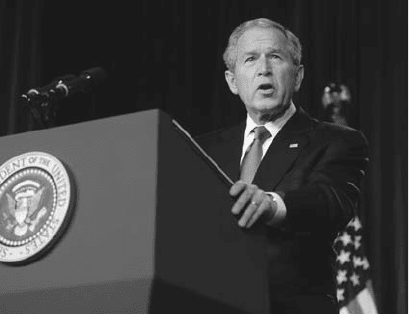
President George W. Bush speaks to members of the
armed forces, Department of Defense, and Depart-
ment of State in the Pentagon auditorium on March
19, 2008.
vi+904_EofUSConsti-v2.indd 500 3/20/09 2:17:51 PM
government’s claims that the president has inher-
ent authority for this type of surveillance. How-
ever, a Sixth Circuit decision overturned the
Michigan court, ruling that the plaintiffs lacked
standing because they had failed to demonstrate
an injury.
Overall, recent post-9/11 debates and litigation
continue to highlight the tension between the pow-
ers of the president and Congress and the status
of individual rights that are constitutionally raised
when national security issues are implicated.
For more information: Ball, Howard. The USA
Patriot Act of 2001: Balancing Civil Liberties
and National Security: A Reference Handbook.
Santa Barbara, Calif.: ABC-CLIO, 2004; Dycus,
Stephen, et al. National Security Law. New York:
Aspen Law and Business, 2006; Graham, Edward
M., and David M. Marchick. U.S. National Secu-
rity and Foreign Direct Investment. Washington,
D.C.: Institute for International Economics, 2006;
Moore, John Norton, and Robert F. Turner, eds.
National Security Law. Durham, N.C.: Carolina
Academic Press, 2005; Posner, Richard A. Not
a Suicide Pact: The Constitution in a Time of
National Emergency. New York: Oxford Univer-
sity Press, 2006; Shanor, Charles A., and L. Lynn
Hogue. National Security and Military Law in a
Nutshell. St. Paul, Minn.: Thomson/West, 2003.
—David Schultz and Andrew J. Waskey
natural law
Natural laws (also known as the laws of nature)
are principles, conditions, or patterns that are not
of human making or human design; rather, natu-
ral laws are those laws that exist independently of
human will and that have as their origin nature
itself or a divine entity. For some, such as Justice
Clarence Thomas, natural laws are the basic
rules or principles that should guide the constitu-
tion and interpretation of human laws, including
the Constitution.
Theories of natural law generally claim that
natural law is morally superior to positive law
(law made by governments) and that positive laws
should be evaluated in relation to the standards
set by the laws of nature. Theories of natural law
also tend to argue that natural laws have a uni-
versal claim to our obedience. That is, natural law
theory tends to conceptualize natural law as a law
that imposes obligations that form the boundar-
ies of acceptable human choices and actions. Fur-
thermore, natural law theorists have generally
taught that humans know natural law by virtue of
a special human attribute, usually reason (or, for
theologically minded natural law theorists, reason
assisted by revelation). A belief in natural law is
a prevalent theme in ancient, medieval, and early
modern political and moral philosophy. Theo-
ries of natural law have also influenced Ameri-
can political thought and jurisprudence since the
colonial period, including the writing of the Dec-
laration of Independence and the Constitu-
tion. In fact, many of the rights found in the Bill
of Rights were thought of as natural rights, and
the limitations on the powers of the government
found in the Constitution may have had natural
law origins.
The roots of natural law theory can be traced
to antiquity. Arguments grounded in assumptions
about the existence of natural law can be found
in the classical Greek political theories of Plato
(427?–347 b.c.) and Aristotle (384–322 b.c.) and
in the teachings of Greek and Roman Stoics (Zeno,
Cicero, Seneca, Marcus Aurelius). While disagree-
ing about the specifi c content of the best political
life or the best political system, for example, both
Plato and Aristotle taught that there are certain
standards (of justice, virtue, goodness, etc.) that
are transcendent and objective, in that the sub-
stance of such standards are not reducible to the
mere opinions of humans, but, rather, exist in a
realm of truth more enduring and reliable than
the fads or whims of the moment.
Indeed, Aristotle wrote that humanness itself
was identifi able by means of its natural (objectively
true) and lawlike qualities. Aristotle taught, for
example, that man was, by nature, a creature who,
according to his very essence as a man, could live
fully only as a member of a polis (political commu-
nity). Someone who might appear to be a man but
who lived outside the polis would be essentially
(i.e., naturally) of a different character—such a
natural law 501
vi+904_EofUSConsti-v2.indd 501 3/20/09 2:17:51 PM