
Seybold J.S. Introduction to RF Propagation
Подождите немного. Документ загружается.

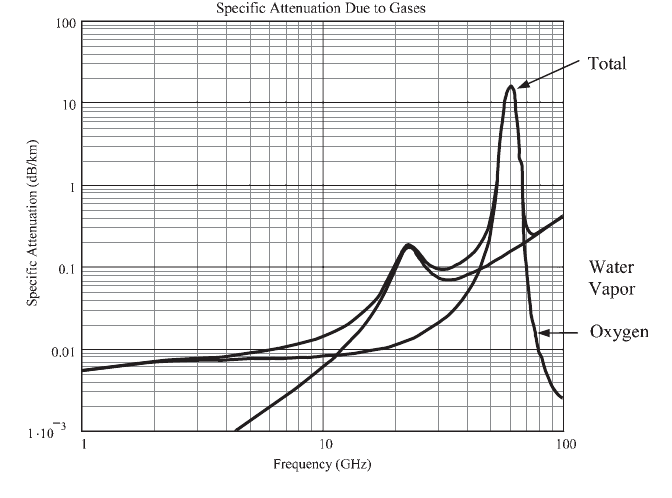
in Figure 6.4 is for a horizontal path in a standard atmosphere at sea level.
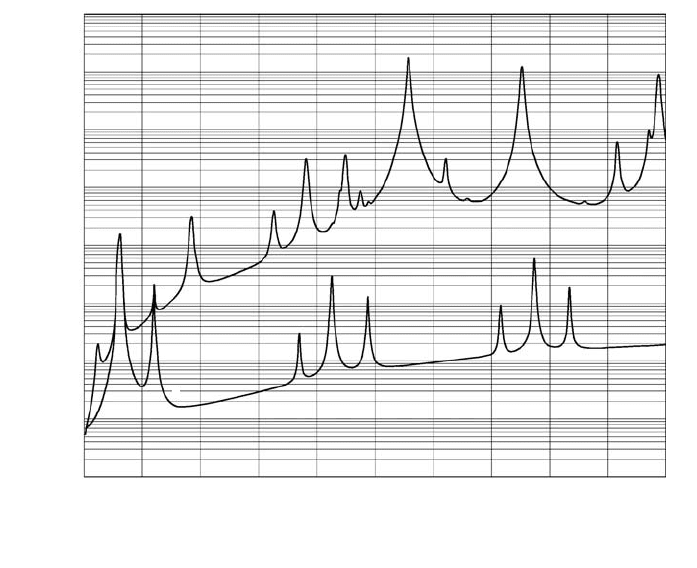
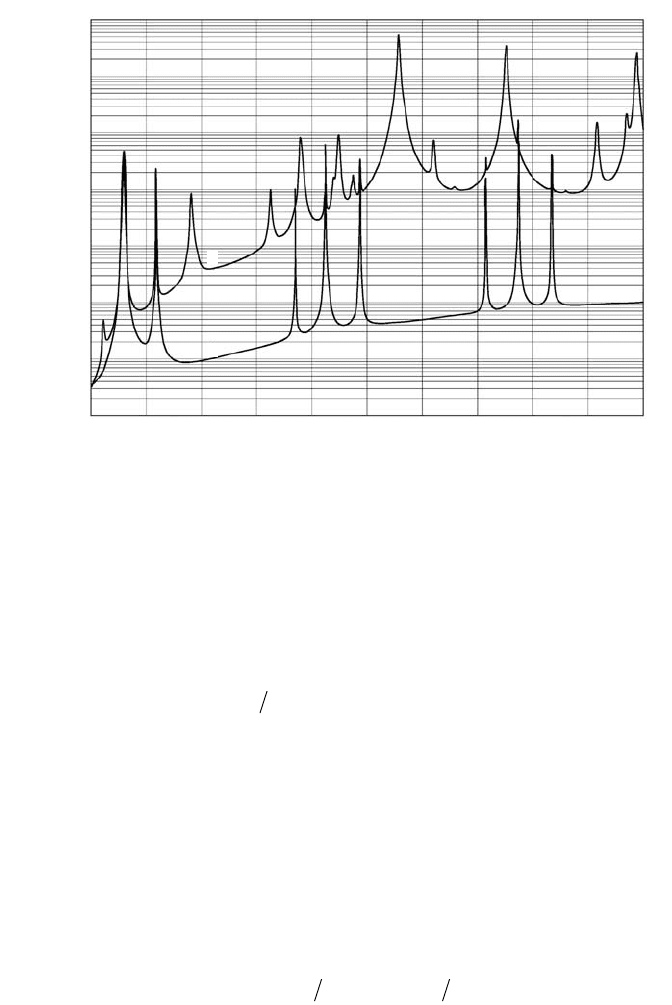
Figure 6.5 is the same plot over a much greater frequency range for both a
standard reference atmosphere and for dry air, while Figure 6.6 provides the
total attenuation through the entire atmosphere on a vertical path.
From the plots of g, it can be seen that water vapor has an absorption line
at 22 GHz. It can also be seen that dry air has an oxygen absorption line at
60 GHz. The areas between absorption lines are called windows. Note that at
1 GHz, g~0.05 dB/km, so even a 10-km path only incurs 0.5 dB of loss. The
total loss due to atmospheric absorption for terrestrial paths is found by
multiplying the path length by the specific attenuation. It is important to
remember to multiply by 2 for radar applications since transmission must
occur in two directions to complete the “link.”
For slant paths, the calculations must allow for the variation in absorption
with altitude. This is done by treating the atmosphere as a series of horizon-
tal layers each with different pressure and temperature. While the actual
absorption will be a fairly smooth function of altitude, treating it as discrete
layers simplifies computation and provides a good estimate of the resulting
attenuation. The ITU [12] provides detailed information on how to perform
the calculations.A generalized approach for slant paths is given in Chapter 11,
which is sufficient for most applications.
122 ATMOSPHERIC EFFECTS
Figure 6.4 Specific attenuation due to atmospheric gases for a standard atmosphere.
For short-range communications, it is possible to operate at or near one of
the absorption lines to improve frequency re-use or stealth since it reduces the
distance a signal travels and therefore makes interference or stand-off signal
detection unlikely.
Example 6.3. Consider a point-to-point mmw link that requires SNR = 10dB
and SIR = 25 dB for proper operation. What is the maximum operating dis-
tance and minimum frequency re-use distance of this system? Given:
f = 60 GHz, l=0.005m
G
ANT
= 30 dB
B = 50 MHz
F = 5dB
P
T
= 20 dBm
ATMOSPHERIC ATTENUATION 123
10
5
10
4
10
3
10
2
10
–1
10
–2
10
–3
0 100 200 300 400 500 600 700 800 900 1000
10
1
Frequency, f(GHz)
Curves A: mean global reference atmosphere (7.5 g/m
3
)
B: dry atmosphere
Specific attenuation (dB/km)
5
2
5
2
5
2
5
2
5
2
5
2
5
2
5
2
A
B
Figure 6.5 Specific attenuation of a standard atmosphere and of dry air versus fre-
quency for a horizontal path. (Figure 1 from Ref. 12, courtesy of the ITU.)
The noise floor is kT
0
BF,so
Thus
So we have
of margin for path loss. The total path loss is
The maximum interference signal is S
min
- 25 dB =-107 dBm. Since P
T
=
20 dBm, 127 dB of path loss is required to mitigate interference. From the solid
PL d d=-
()()
+◊20 4log G 15 dB kmlp
PS
T
-= --
()
=
min
20 82 102dBm dBm dB
S
min
=- + =-92 10 82 dBm
N =- + -174 77dB-W Hz dB-Hz + 5 dB = 92 dBm
124 ATMOSPHERIC EFFECTS
10
5
10
4
10
3
10
2
10
–1
10
–2
0 100 200 300 400 500 600 700 800 900 1000
10
1
Frequency, f(GHz)
Curves A: mean global reference atmosphere (7.5 g/m
3
at sea level)
B: dry atmosphere
Zenith attenuation (dB)
5
2
5
2
5
2
5
2
5
2
5
2
5
2
A
B
Figure 6.6 Total atmospheric attenuation at zenith versus frequency for a standard
reference atmosphere and for dry air. (Figure 3 from Ref. 12, courtesy of the ITU.)
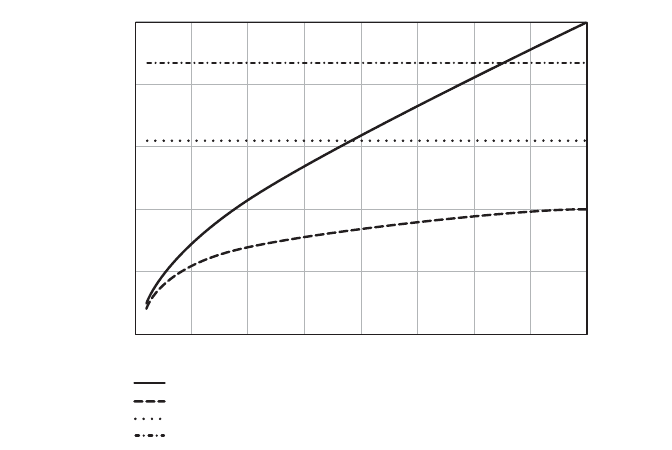
curve in Figure 6.7, it can be estimated that the maximum operating distance
is 1.8 km and the minimum separation to avoid interference will be about 3.3
km (assuming main beam intersection of the transmitter and the victim
receiver).
Figure 6.7 shows the path loss at 60 GHz for this system both with and
without the atmospheric absorption. It is clear that the atmospheric absorp-
tion plays a significant role. It increases the required EIRP for communication
(or reduces the communication distance), but it also permits frequency reuse
as close as 3.3 km. 䊐
6.4 LOSS FROM MOISTURE AND PRECIPITATION
Moisture in the atmosphere takes many forms, some of which play a signifi-
cant role in attenuating electromagnetic waves. The effects are, of course,
frequency-dependent. Precipitation in the form of rain, freezing rain, or wet
snow is a significant problem above about 10 GHz and is treated separately in
Chapter 10. Water vapor is essentially a gas and was treated in Section 6.3.
Suspended droplets of moisture, such as clouds or fog, is neither precipitation
nor water vapor and is therefore treated separately. Dry snow and dust also
presents a unique challenge to the modeler.
LOSS FROM MOISTURE AND PRECIPITATION 125
0 0.5 1 1.5 2 2.5 3 3.5 4
40
60
80
100
120
140
Path Loss + Atmospheric Loss
Path Loss Only
Max Loss for Detection
Min Loss for Interference
Path Loss at 60 GHz
Distance in km
Path Loss in dB
Figure 6.7 Path loss for a 60-GHz communication link showing the impact of atmos-
pheric absorption.
6.4.1 Fog and Clouds
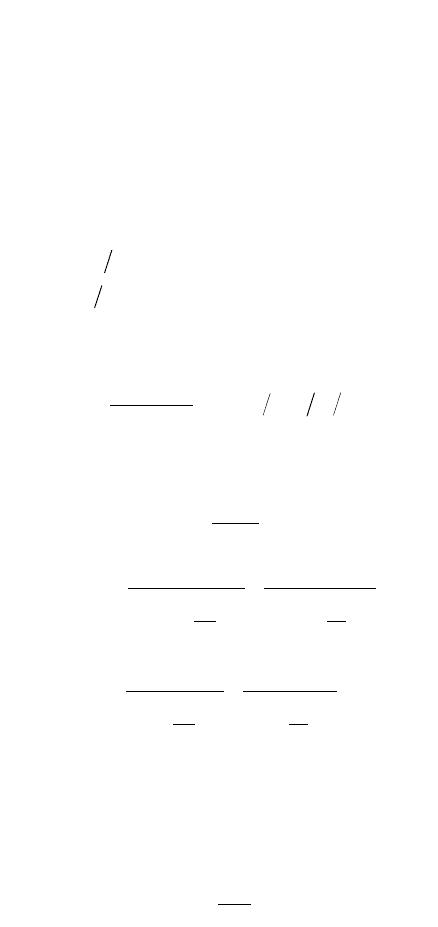
The ITU provides a recommended model for fog or cloud attenuation [14]
that is valid up to 200 GHz. Application of this model and a few representa-
tive design curves for planning are presented in this section. The specific at-
tenuation due to clouds or a fog bank is
where
g
c
is the specific attenuation of the cloud in dB/km
K
l
is the specific attenuation coefficient of the cloud in (dB/km)/(g/m
3
)
M is the liquid water density of the cloud in g/m
3
The ITU gives the liquid water density of a cloud or fog as
The mathematical model for the specific attenuation coefficient is given as
(6.19)
where f is the frequency in GHz and
q=
300
T
e
2
351= .
e
1
548= .
eq
0
77 6 103 3 1=+ -
()
..
e¢
ee ee
ef
f
f
f
f
ps
()
=
-
()
+
Ê
Ë
ˆ
¯
È
Î
Í
˘
˚
˙
+
-
()
+
Ê
Ë
ˆ
¯
È
Î
Í
˘
˚
˙
+
01
2
12
2
2
11
e≤
ee ee
f
f
f
f
f
f
f
f
f
p
p
s
s
()
=
-
()
+
Ê
Ë
ˆ
¯
È
Î
Í
˘
˚
˙
+
-
()
+
Ê
Ë
ˆ
¯
È
Î
Í
˘
˚
˙
01
2
12
2
11
h
e
e
=
+2 ¢
≤
K
f
l
=
+
()
()
()
0 819
1
2
.
eh≤
dB km g m
3
M
M
=
()
=
()
005
05
.
.
g m for medium fog 300-m visibility
g m for dense fog 50
-
m visibility
3
3
g
c
KM
l
=
126 ATMOSPHERIC EFFECTS
Here the temperature, T, is in kelvins. The principal and secondary relaxation
frequencies are given by
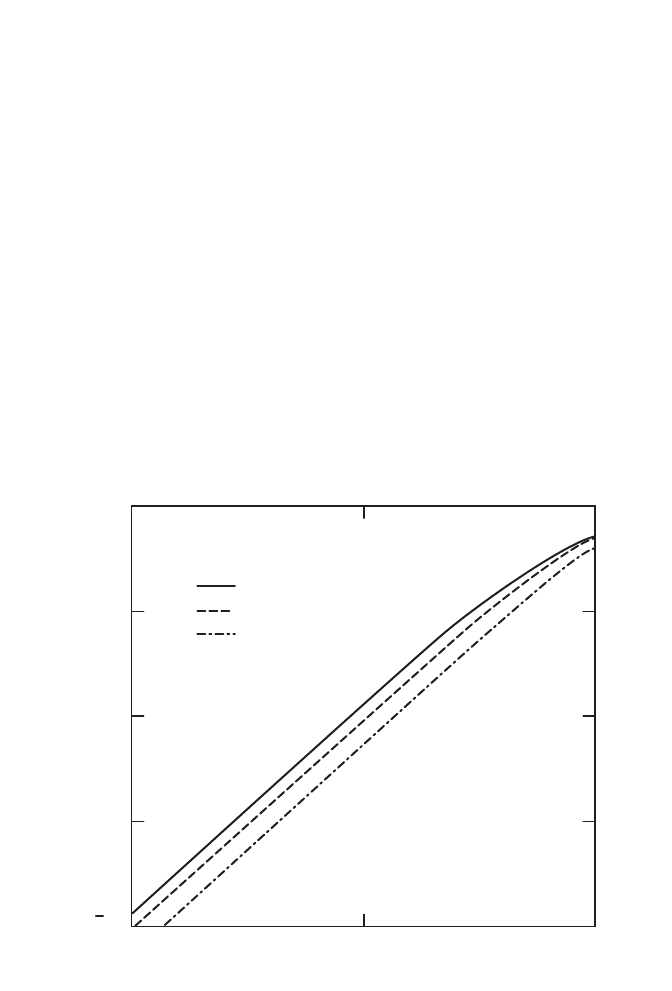
Figure 6.8 shows a plot of the specific attenuation coefficient, K
l
, versus fre-
quency for -10°C, 0°C, and 20°C. For clouds, the 0°C curve should be used.
Values from this curve can be used along with liquid water density to estimate
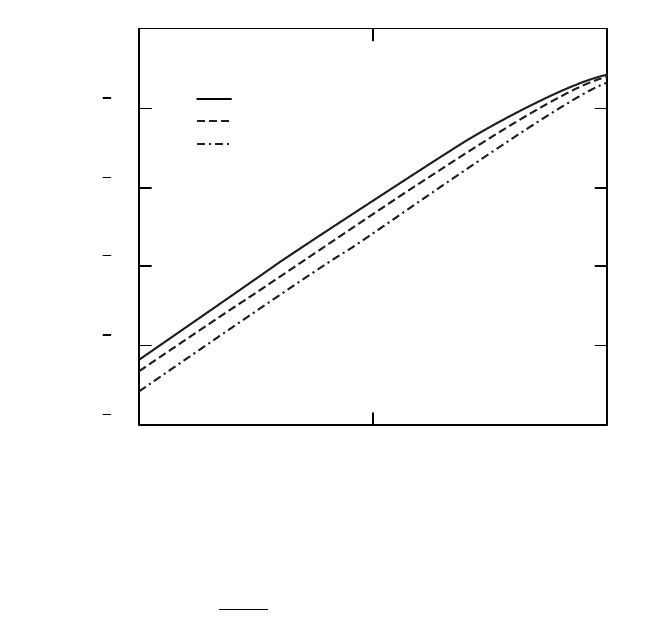
the specific attenuation (dB/km) due to clouds or fog. Figure 6.9 is a plot of
the specific attenuation versus frequency of clouds or fog for a liquid water
density of 0.5 g/m
3
. In the absence of specific measured liquid water density,
these curves can be used to estimate the specific attenuation of clouds or fog.
Here again, the 0°C curve should be used for clouds.
To determine the total attenuation through the atmosphere due to clouds,
the elevation angle and the total columnar content of liquid water, L, must be
known. The total columnar content of liquid water may be estimated for a
given probability using the plots provided in Ref. 14. The worst-case value is
1.6 kg/m
2
. The expression for the total cloud attenuation is
f
s
=- -
()
590 1500 1q GHz
f
p
=--
()
+-
()
20 09 142 1 294 1
2
. qqGHz
LOSS FROM MOISTURE AND PRECIPITATION 127
1 10 100
1
.
10
3
0.01
0.1
1
10
-10 Deg C
0 Deg C
20 Deg C
Specific Attenuation Coefficient
Frequency (GHz)
Kl in (dB/km)/(g/m^3)
Figure 6.8 Specific attenuation coefficient versus frequency for clouds and fog.
(6.20)
where
L is the total columnar liquid water in kg/m
2
K
l
is the specific attenuation coefficient in dB/km
q is the elevation angle of the path
Note that the units of L and K
l
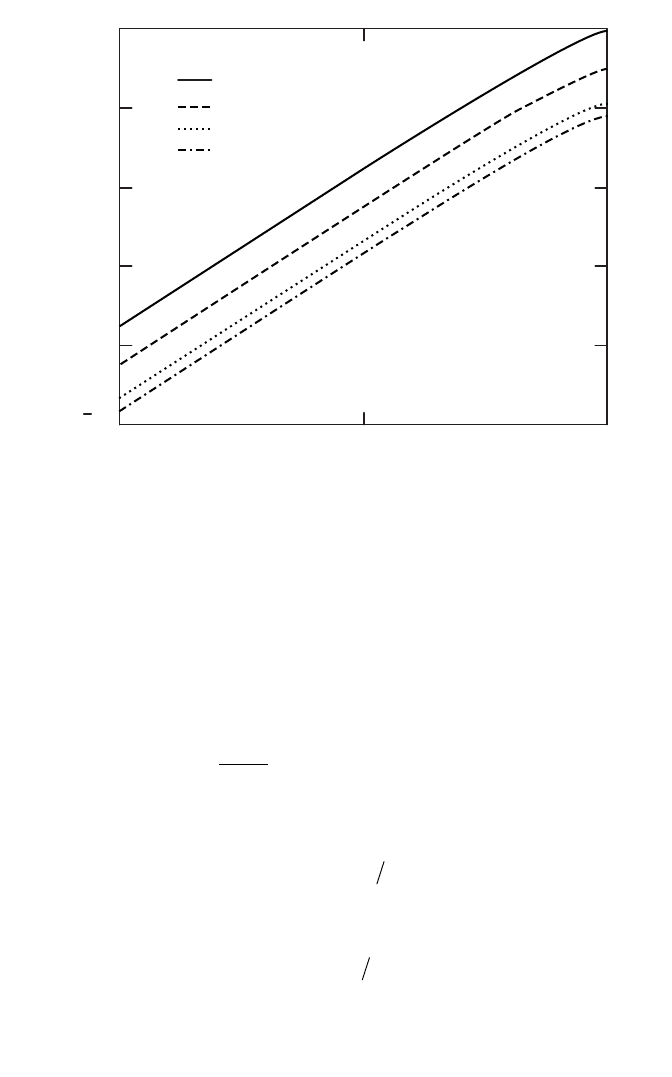
are such that the end result will be in dB. Figure
6.10 shows a plot of the worst-case cloud attenuation through the atmosphere
for several different elevation angles. It can be seen that cloud attenuation
starts to become a consideration above about 10 GHz.
It is intuitive that fog will not be present during a heavy rain. Therefore if
the attenuation due to fog is less than the required rain margin, only the rain
margin need be included in the link budget. While clouds are likely to be
present during rain, the rain models are based on empirical measurements,
which include any cloud attenuation, so again the cloud attenuation need not
be included in the link budget if it is smaller than the rain margin (or vice
versa).
A
LK
l
=
()
∞≥ ≥ ∞
sin q
qdB for 90 5
128 ATMOSPHERIC EFFECTS
1 10 100
1
.
10
7
1
.
10
6
1
.
10
5
1
.
10
4
1
.
10
3
0.01
-10 Deg C
0 Deg C
20 Deg C
Specific Attenuation, Kl*M vs Frequency
Frequency (GHz)
Specific Attenuation of Clouds (dB/km)
Figure 6.9 Specific attenuation versus frequency for clouds and fog, liquid water
density of 0.5 g/m
3
.
Example 6.4. Consider a ground to air communication link operating at
20 GHz. If the aircraft is a high-altitude craft, operating well above the clouds,
what is the worst-case additional path loss due to cloud cover? Assume that
the minimum operational elevation angle is 15 degrees.
Using the expression for cloud attenuation,
K
1
at 20 GHz and 0°C can be computed as
The worst-case value for L was given as
and
q= ∞15
L = 16.kgm
2
K
1
036= .mkg
2
A
LK
l
=
()
∞≥ ≥ ∞
sin q
qdB for 90 5
LOSS FROM MOISTURE AND PRECIPITATION 129
1 10 100
1
.
10
3
0.01
0.1
1
10
100
5 Deg
15 Deg
45 Deg
90 Deg
Total Cloud Attenuation vs Frequency
Frequency (GHz)
Attenuation of Clouds (dB)
Figure 6.10 Total cloud attenuation versus frequency for several elevation angles
using worst-case cloud density.

The worst-case attenuation due to heavy cloud cover can then be predicted to
be
which is consistent with the plot in Figure 6.10. 䊐
Example 6.5. Consider a 10-GHz ship-to-shore communication link. If the
maximum communication distance is 12 km, what is the worst-case loss due to
fog?
Using
for the liquid water density and
the specific attenuation coefficient is computed as
and the resulting specific attenuation is
Multiplying the specific attenuation by the maximum communication distance
of 12 km results in a maximum attenuation of
which is hardly enough loss to be concerned about, especially when compared
to the likely rain loss. Depending upon the location, fog may occur much more
often than rain, so each case must be treated separately. 䊐
6.4.2 Snow and Dust
The attenuation of electromagnetic waves due to snow or dust [13] is pre-
dominantly a function of the moisture content of the particles. For that reason,
the attenuation effects are expected to be less than those due to rain. Specific
procedures for modeling the effects of snow or dust are few and far between
and since, to the author’s knowledge, none have gained wide acceptance, a
model is not provided in this book.The recommendation is that the rain atten-
uation models more than cover the snow and dust cases and since the effects
A = 0.79 dB
g=0 066.dBkm
K
1
0 132= .mkg
2
T =- ∞10 C
M = 0.5 g m
3
A = 2.23 dB
130 ATMOSPHERIC EFFECTS
are mutually exclusive, planning for dry snow or dust is superfluous in most
cases. Note that snow accumulation on antennas and radomes is a separate
phenomenon from the effect of atmospheric snow.
The effect of hail will depend upon its moisture content and the size of
the hailstones relative to the wavelength of the wave. Here again, definitive
models are difficult to come by. The relative infrequency of hailstorms and
their association with thunderstorms makes modeling the effects of hail inde-
pendently from rain unnecessary for most applications.
6.5 SUMMARY
There is a wide diversity of atmospheric effects that must be considered based
on the frequency of operation, the path elevation, and the local environment.
Atmospheric refraction occurs when the density gradient of the atmosphere
moves the apparent radio horizon beyond the geometric horizon for nearly
horizontal links. The effect is most often compensated for by using a 4/3 earth
radius model for determining the distance to the horizon. If detailed atmos-
pheric data are available, it is possible to find a more accurate representation
of the radio horizon. A related phenomenon is ducting, which is attributed to
water vapor in the atmosphere. A duct may either exist at the surface or be
elevated as much as 1500 m. The effect of a duct is to trap the RF wave and
prevent the usual geometric spreading loss, resulting in excessively strong
receive signals if the receiver is located in the same duct with the transmitter.
If the receiver is not in the same duct, the result will be a significant fade, which
can be treated as a multipath fade.
Atmospheric multipath models are based on empirical measurements (and
hence they include cross-duct fades). The current ITU model is similar to pre-
viously used models and has been shown to match empirical data very well
[10]. It consists of two different models for low-probability fades and a third,
more detailed model that is validated for all fade probabilities.
The third major effect of the atmosphere is absorption and attenuation of
RF waves. The dominant absorption effects of the atmosphere are due to
oxygen and water vapor. The absorption is generally described by a specific
attenuation in dB/km for terrestrial paths and by a total attenuation as a func-
tion of elevation angle for slant paths that exit the troposphere.
There are three forms of water that are of interest to the propagation
analyst: precipitation, water vapor, and suspended water droplets, forming
clouds or fog. Each has unique properties and affects electromagnetic waves
differently. The effect of clouds and fog is rarely significant, but it can be a
factor, particularly for log terrestrial paths or for satellite links. The ITU
models for determining the specific attenuation due to fog and for determin-
ing the total attenuation due to clouds on a slant path were both described.
The attenuation of RF waves by snow and dust is directly related to the mois-
ture content of the particles and is small relative to rain attenuation.
SUMMARY 131