
Seybold J.S. Introduction to RF Propagation
Подождите немного. Документ загружается.

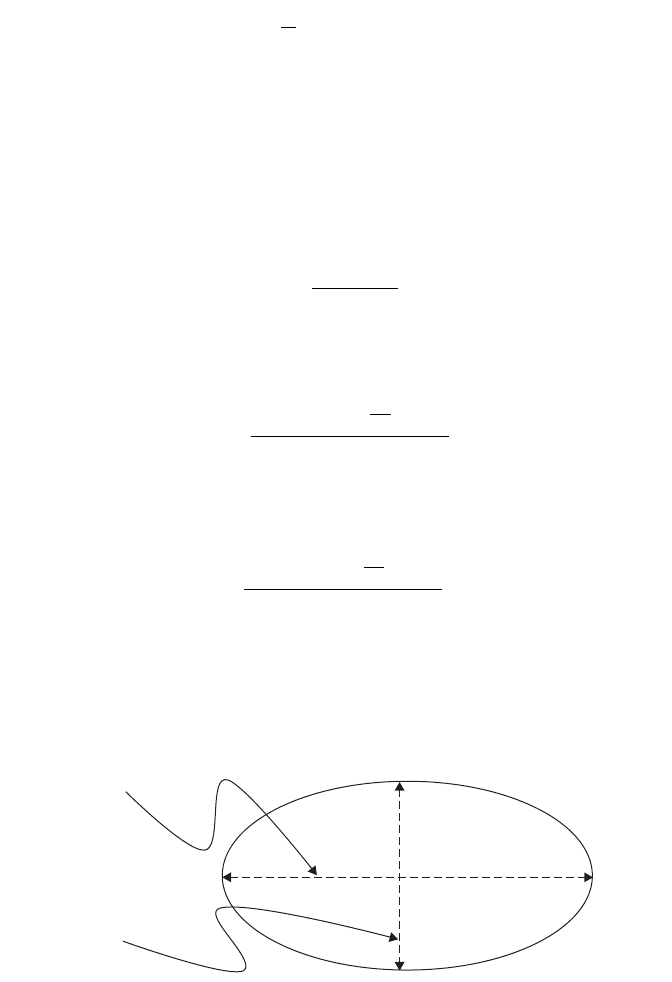
At steeper angles, when beam-limited, the clutter area is simply the area of
the elliptical footprint as shown in Figure 5.12:
(5.18)
The total radar cross section of the clutter in the radar cell is the clutter patch
area multiplied by the backscatter coefficient:
(5.19)
Consider the pulse-limited, low grazing angle case where (5.17) applies. From
(5.8), the clutter reflection power seen at the radar is
Substituting the expression for the s
c
into (5.8) yields
or
(5.20)
Thus as the distance, R, increases, the clutter power decreases as 1/R
3
, whereas
the target power decreases as 1/R
4
. This is due to the beam spreading with dis-
P
PG
c
R
c
TAZ
=
()
()
22 0
3
3
2
lsq
t
y
p
sec
4
P
PG
c
R
c
TAZ
=
()
()
22 0
3
4
2
lsq
t
y
p
sec
4
P
PG
R
c
Tc
=
()
22
3
4
ls
p4
ss
cc
A=
0
AR
cELAZ
=
()
p
qq y
4
2
csc
102 RADAR SYSTEMS
R
q
EL
csc (y )
Rq
AZ
Figure 5.12 Shape of beam-limited clutter cell.
tance increasing the width of the radar footprint in the clutter patch and there-
fore the amount of clutter return that is seen. For the beam-limited case, the
clutter area is a function of R
2
rather than R, so the return clutter power is
proportional to 1/R
2
, versus 1/R
4
for the target power.
As seen from the preceding development, these values are approximate. In
addition, the antenna beam has a roll-off, and it does not drop off to zero gain
at the edge of the 3 dB (or 1.5 dB) beamwidth. Even so, this is standard prac-
tice for determining the expected clutter return and it provides good estimates.
The limiting factor on predicting clutter return is most often the variability in
the clutter backscatter coefficient of the actual clutter encountered.
There are a variety of ways that the system designer can mitigate the effects
of clutter. These methods include (a) using narrow antenna beams and short
pulses to reduce the amount of clutter return that is seen (b) averaging mul-
tiple “looks” when the clutter has a short correlation time such as vegetation
or (c) making use of Doppler. If the target is moving, it is possible to take mul-
tiple looks and then filter the sequence (FFT) to extract the moving target. If
the radar is stationary, the clutter will be centered at the zero Doppler bin and
can be filtered out without losing a moving target.
If the radar is airborne, the ground clutter will have a nonzero Doppler
shift, but it can be identified and ignored as long as the target has motion
relative to the ground. The number of range samples used and their spacing
determine the Doppler resolution. There can be Doppler ambiguities if the
Doppler shift is sufficiently large. This is a form of aliasing and is controlled
by decreasing the time between samples, PRI, at the expense of the unam-
biguous range [23].
Example 5.2. Consider a radar system with
What is the SNR of the return from a 1-m
2
target at 20 km?
The wavelength is
and the bandwidth is approximately
To compute the noise floor, the noise figure must first be determined:
B ª=110t kHz
l= =cf 003.m
P
G
T
f
T
ANT
eff
=
=
=
=
=
1 000 000
28
100
200
10
,, W
dB
s
K
GHz
tm
CLUTTER 103

Then the total noise power in the bandwidth of interest can be computed:
Next, compute the return or received signal power
which yields
Finally, the signal-to-noise ratio is
䊐
Example 5.3. For the same system as Example 5.2, if the azimuth beamwidth
is q
AZ
= 0.3°, the grazing angle is y=5°, and s
0
= 0.01, what is the signal-to-
clutter ratio (SCR) and the clutter-to-noise ratio (CNR)?
First the clutter return is computed. The clutter area is given by (5.17):
So,
which can be expressed as 62 dB-m
2
or 62 dBsm.
Next compute the power received from clutter reflection:
So the clutter return is
The signal-to-clutter ratio is
SCR dB=-42
P dBW
c
=-77 5.
P
PG A
R
c
Tc
=
()
22 0
3
4
4
ls
p
Am
c
2
= 1 575 000,,
AR
c
cAZ
=
()
q
t
y
2
sec
SNR dB= 42 2.
P =-119 5. dBW
P
PGG
R
TT R
=
()
sl
p
2
3
4
4
NF
N
=- +
()
+
=-
204 10 10
161 7
dBW Hz log kHz
dBW.
FTT=+
()
=10 1 2 3
0
log dB
eff
.
104 RADAR SYSTEMS
and the clutter-to-noise ratio is
So for this system, clutter is the limiting factor (80 dB over the noise) and the
signal is buried in clutter. It would require a significant amount of processing
to extract a meaningful signal from 42 dB below the clutter. 䊐
5.4.2 Volume Clutter
When considering volume clutter, the amount of clutter that is illuminated
depends upon the range gate length, the range to the range gate of interest,
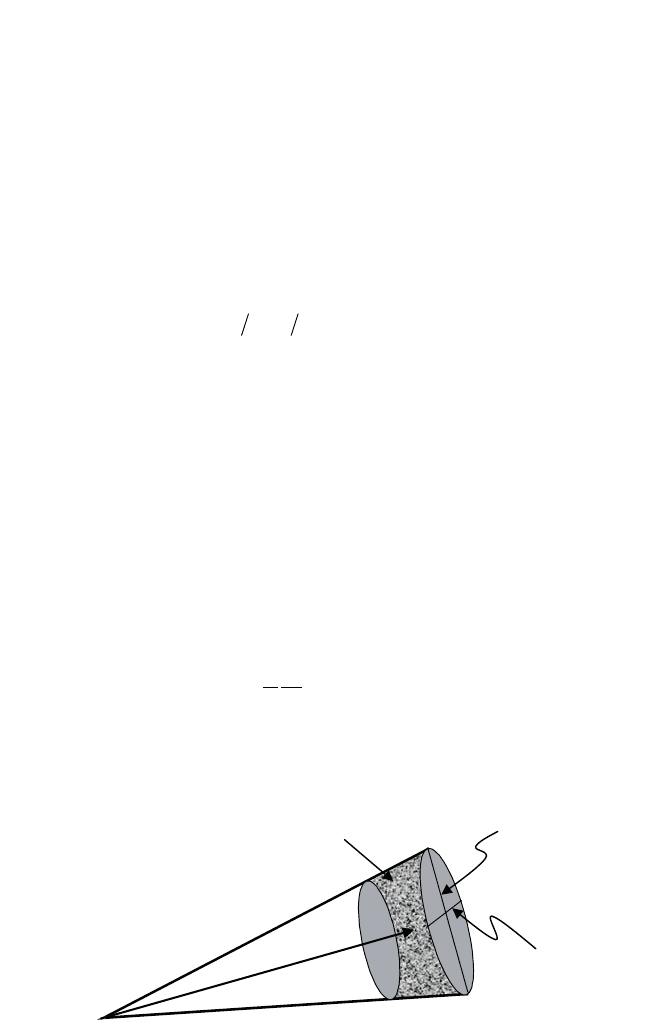
and the azimuth and elevation beamwidths of the antenna as depicted in
Figure 5.13. The volume of the clutter cell will be approximately [24]
(5.21)
where
c is the velocity of propagation
t is the pulse width
R is the range to the center of the clutter cell
q
EL
and q
AZ
are the two-way, 3-dB, elevation and azimuth antenna
beamwidths (or the 1.5-dB beamwidths)
Volume clutter is characterized by the backscatter cross section per unit
volume, h, which has units of m
2
/m
3
. The total clutter cross section then
becomes
(5.22)
sh
pt
qq=
42
22
c
R
AZ EL
m
VcRR
EL AZ
=
()( )
pt qq42
23
m
CNR dB= 84 2.
CLUTTER 105
Rq
EL
Rq
AZ
R
Clutter
Volum
e
Figure 5.13 Volume clutter cell.

So when the radar range equation is applied, the clutter return only decreases
as R
2
because of the dependence of the clutter volume on R
2
.
The backscatter cross section per unit volume can be approximated by [25]
(5.23)
where f is the frequency in GHz and RR is the rain rate in mm/hr.
Other potential sources of volume clutter include snow and hail, which are
difficult to characterize because of their wide variability and limited data.
Dust, fog, and smoke are significant attenuators in the visible light band, but
have little or no attenuation or backscatter effect on radar and are generally
ignored.
5.4.3 Clutter Statistics
The statistics of clutter that must be considered are the temporal and spatial
variability. Moving clutter such as seawater, moving foliage, or blowing rain
and snow present a time-varying clutter background to a radar system. This
can result in significant false alarms or missed detects if not designed for. Simi-
larly, static clutter will vary from location to location and over look angle
(both azimuth and elevation).Again, this variability must be considered by the
radar designer if successful performance is to be achieved. Various types of
detection algorithms, range coding Doppler processing, and other techniques
are used to mitigate the effects of clutter.
5.5 ATMOSPHERIC IMPAIRMENTS
The atmospheric impairments that affect communication links also affect
radar systems.The effect is compounded for radar systems since it entails two-
way propagation, plus the potential for backscatter since the receiver is tuned
to same frequency that was just transmitted. The backscatter effects are
treated in the previous section on volume clutter, so only the attenuation
effects are discussed in the sections that follow.
Multipath is a significant problem for many radar installations. The recep-
tion of more than one return from the target can cause significant fading; more
importantly, however, it disrupts the phase front of the received wave, which
reduces the radar’s ability to accurately measure the target angle. Multipath
can also have the undesired effect of spreading the target return in range and
thereby corrupting the range measurement. This is mitigated in systems that
expect to experience multipath by using leading-edge trackers rather than
tracking on the target range centroid.
Atmospheric scintillation can be a concern for radar systems that have ele-
vation look angles near zero degrees (horizontal). The variation due to scin-
tillation is sufficiently slow that it can generally be treated more as a fade in
h= ¥
-
710
416 1223
fRR
.
mm
106 RADAR SYSTEMS
a radar system. The fades can be significant, however, and should be planned
for, especially in coastal areas or over large bodies of water. Atmospheric scin-
tillation is usually only a concern during nighttime hours. A related phenom-
enon is atmospheric ducting, which can be very troublesome for radar systems.
When ducting occurs, the propagation loss is not inversely proportional to R
4
,
but is considerably less. This can cause target detections well beyond the
normal range of the radar and in fact sometimes well beyond the radio
horizon. Atmospheric scintillation is treated in the following chapter. The
models in Chapter 6 are for one-way propagation, however, so appropriate
adjustments must be made.
Refraction is the bending of radio waves downward. This is due to the fact
that the atmosphere is less dense as elevation increases. The effect is negligi-
ble for elevation look angles above 2 or 3 degrees [26]. For low elevation
angles, the effect is to extend the radio horizon.The effect is taken into account
by using the so-called 4/3’s-earth model. The model consists of simply replac-
ing the earth’s radius by 4/3 of its actual value in horizon calculations. The 4/3’s
factor is based on an ITU reference standard atmosphere at sea level and as
such represents an average. While not universal, the 4/3’s-earth model is very
widely used.
The effect of atmospheric loss (absorption) is identical to the absorption
for communication systems except that of course it must be doubled to
account for the two-way path. A model for atmospheric absorption is pre-
sented in the following chapter. Precipitation is covered in Chapter 10 (rain
attenuation), so no further discussion is presented here. While more of an
environmental than atmospheric impairment, wildlife such as birds or swarms
of insects can cause false detections and degrade the performance of some
radars.
5.6 SUMMARY
Since radar relies on the reflection of a transmitted signal, radar systems suffer
path loss that is proportional to R
4
rather than the R
2
for the one-way propa-
gation of a communication system. The radar range equation is based on the
radar cross section and two-way application of the Friis free-space loss equa-
tion and provides a means of predicting return signal strength. It can also be
used to determine the maximum detection range for a given target RCS. Radar
cross section is measured in units of m
2
, or dBsm, and may or may not corre-
late with the physical size.
Radar systems measure range and usually azimuth and elevation angle of
targets. Radar may also measure Doppler shift (velocity), the range profile, or
range and cross-range images of targets to permit identification or classifica-
tion of targets. Angular measurement is usually accomplished by using a split
aperture antenna and monopulse processing. Range tracking can be per-
formed using two time samples or range gates that straddle the target.
SUMMARY 107
In addition to thermal noise, radar systems must often cope with unwanted
environmental reflections called clutter. Clutter can be either area (ground) or
volume (weather). Since the clutter area or volume grows with R or R
2
, the
clutter does not decrease with distance as quickly as the signal strength from
a limited extent target does. Area clutter is characterized by the backscatter
coefficient s
0
, which is the RCS per unit area. The backscatter coefficient is a
function of the terrain and the grazing angle of the radar signal.Volume clutter
is characterized by the clutter backscatter coefficient per unit volume, usually
designated by h and expressed in m
2
/m
3
.
For those interested in further study on radar systems, the books by Skolnik
[23], Stimson [27], and Peebles [10] are a suggested starting point.
REFERENCES
1. J. S. Seybold and K. L. Weeks, Arithmetic versus geometric mean of target radar
cross section”, Microwave and Optical Technology Letters, April 5, 1996, pp.
265–270.
2. A. K. Bhattacharyya and D. L. Sengupta, Radar Cross Section Analysis & Control,
Artech House, Norwood, MA, 1991.
3. L. V. Blake, Radar Range Performance Analysis, Munro Publishing Company, Silver
Spring, MD, 1991.
4. J. V. DiFranco and W. L. Rubin, Radar Detection, Artech House, Norwood, MA
1980.
5. P. Swerling and W. L. Peterman, Impact of target RCS fluctuations on radar meas-
urement accuracy, IEEE Transactions on Aerospace and Electronic Systems, Vol 26,
No. 4, July 1990, pp. 685–686.
6. P. Swerling, Radar probability of detection for some additional fluctuating target
cases, IEEE Transactions on Aerospace and Electronic Systems, Vol 33, No. 2, April
1997, pp. 698–709.
7. P. Swerling, More on detection of fluctuating targets (corresp.), IEEE Transactions
Information Theory, Vol 11, No. 3, July 1965, pp. 459–460.
8. P. Swerling, Detection of radar echos in noise revisited, IEEE Transactions Infor-
mation Theory, Vol 12, No. 3, July 1966, pp. 348–361.
9. P. Swerling, Probability of detection for fluctuating targets, IEEE Transactions
Information Theory, Vol 6, No. 2, April 1960, pp. 269–308.
10. P. Z. Peebles, Jr., Radar Principles, John Wiley & Sons, New York, 1998, pp. 197–204.
11. N. C. Currie and C. E. Brown, Principles and Applications of Millimeter-Wave
Radar, Artech House, Norwood, MA 1987, Figure 17.5, p. 769.
12. D. R.Whener, High Resolution Radar, Artech House, Norwood, MA, 1987, Chapter
5.
13. M. I. Skolnik, Introduction to Radar Systems, McGraw-Hill, New York, NY 2001,
pp. 246–248.
14. S. M. Sherman, Monopulse Principles and Techniques, Artech House, Norwood,
MA, 1984.
108
RADAR SYSTEMS
15. A. I. Leonov and K. I. Fomichev, Monopulse Radar, Artech House, Norwood, MA,
1986.
16. M. I. Skolnik, Introduction to Radar Systems, McGraw-Hill, New York, 2001, p. 216.
17. S. M. Sherman, Monopulse Principles and Techniques, Artech House, Norwood,
MA, 1984, p. 305.
18. I. Kanter, The probability density function of the monopulse ratio for n looks at a
combination of constant and Rayleigh targets, IEEE Transactions on Information
Theory, Vol. 23, No. 5, September 1977, pp. 643–648.
19. A. D. Seifer, Monopulse-radar angle tracking in noise or noise jamming, IEEE
Transactions on Aerospace and Electronic Systems, Vol. 28, No. 3, October 1994,
pp. 308–314.
20. D. R.Whener, High Resolution Radar, Artech House, Norwood, MA, 1987, Chapter
6.
21. J. S. Seybold and S. J. Bishop, “Three-dimensional ISAR imaging using a conven-
tional high-range resolution radar”, 1996 IEEE National Radar Conference Pro-
ceedings, May 1996, pp. 309–314.
22. F. E. Nathanson, Radar Design Principles, McGraw-Hill, New York, 1969, pp. 63–67.
23. M. I. Skolnik, Introduction to Radar Systems, McGraw-Hill, New York, 2001,
Chapter 3.
24. N. C. Currie, R. D. Hayes, and R. N. Trebits, Millimeter-Wave Radar Clutter, Artech
House, Norwood, MA, 1992, p. 9.
25. M. I. Skolnik, Introduction to Radar Systems, McGraw-Hill, New York, 2001, p. 444.
26. M. I. Skolnik, Introduction to Radar Systems, McGraw-Hill, New York, 2001,
pp. 499–500.
27. G. W. Stimson, Introduction to Airborne Radar, Sci-Tech Publishing, Mendham, NJ,
1998.
EXERCISES
1. Consider a radar system with the following parameters:
P
T
= 100 W
f = 10 GHz
T
eff
= 100 K
G
ant
= 28 dB
Pulsewidth t=1 ms
Minimum SNR for reliable detection = 3dB
What is the maximum distance at which a 2-m
2
target can be detected?
2. Consider a pulse radar system with the following parameters:
Transmit power P
t
= 10.0 kW
Antenna gain G = 25 dB
Pulse duration t=1ms
EXERCISES 109
Receiver noise figure F = 6dB
Frequency f = 10GHz
What is the minimum target RCS that can be detected at 8km if the SNR
required for detection is 3 dB? Show your work and give your answer in
dBsm and m
2
.
3. For the same radar in problem 1, if the antenna beamwidth is 3 degrees in
each dimension and clutter backscatter coefficient is unity (s
0
= 0dB), what
is the signal-to-clutter and clutter-to-noise ratio for the system? Assume a
grazing angle of 5 degrees.
4. Consider a radar system with the following parameters:
Transmit power P
t
= 10.0 kW
Antenna gain G = 25 dB
Frequency f = 10 GHz
What is the received signal level from a 13-dBsm target at 10km?
5. Some radar systems use coherent integration (pre-detection) to improve
the signal-to-noise ratio and thereby the sensitivity of a radar system. The
principle is that multiple returns from the same target will add coherently,
whereas the noise with each return is independent and therefore adds non-
coherently. Thus the noise increases as the square root of N and the signal
increases as N, where N is the number of pulses or returns that are
integrated.
(a) For the radar given in problem 2, if the same value for minimum RCS
is used, but the required signal-to-noise ratio for detection is 7 dB, how
many pulses should be integrated assure reliable detection?
(b) Would the integration have any effect on the signal-to-clutter ratio?
Explain.
(c) Would the integration have any effect on the clutter-to-noise ratio?
Explain.
110 RADAR SYSTEMS

111
Introduction to RF Propagation, by John S. Seybold
Copyright © 2005 by John Wiley & Sons, Inc.
CHAPTER 6
Atmospheric Effects
6.1 INTRODUCTION
Many communication systems rely on RF propagation through the atmos-
phere. Thus modeling atmospheric effects on RF propagation is an important
element of system design and performance prediction. For the purpose of
propagation modeling, the atmosphere can be divided into three regions: tro-
posphere, stratosphere, and tropopause. The troposphere is the lowest region
of the atmosphere where temperature tends to decrease with height and where
weather occurs. The stratosphere is the region above the weather where air
temperature remains constant with height. The tropopause is the boundary
region between the troposphere and the stratosphere. Some texts also include
the effects of the ionosphere as an atmospheric effect. Ionospheric refrac-
tion/reflection is limited to frequencies below a few hundred megahertz.There
are a few other ionospheric effects, which occur at higher frequencies, such as
group delay, Faraday rotation, and fading/scintillation. These effects of the
ionosphere are all discussed in Chapter 11, “Satellite Communications,” and
are not addressed further in this chapter.
The atmospheric effects of interest for RF propagation are refraction/
reflection, scattering, and absorption/attenuation.With the exception of refrac-
tion, these effects are all minimal below 30 MHz. Between 30MHz and 1 GHz,
refraction/reflection is the primary concern. Above 1 GHz or so, attenuation
starts to be a significant factor and refraction/reflection becomes less of
an issue except for nearly horizontal paths. Atmospheric multipath also starts
to be observed above 1 GHz and can cause extreme fading on terrestrial
microwave links.Absorption due to atmospheric gases (including water vapor)
is discussed in detail in the sections that follow. The effects of precipitation are
also examined in this chapter and in greater detail in Chapter 10 (rain attenu-
ation). The effects of interest for propagation analysis are in the troposphere
and, to a limited extent, the tropopause.The stratosphere is well approximated
as free-space.