
Smith R., Minton R. Calculus
Подождите немного. Документ загружается.


P1: OSO/OVY P2: OSO/OVY QC: OSO/OVY T1: OSO
MHDQ256-Ch16 MHDQ256-Smith-v1.cls January 7, 2011 11:30
LT (Late Transcendental)
CONFIRMING PAGES
CHAPTER
16
Second-Order
Differential Equations
In a classic television commercial from years ago, the great jazz vocal-
ist Ella Fitzgerald broke a wineglass by singing a particular high-pitched
note.Thephenomenonthat makesthispossibleiscalledresonance, which
is one of the topics in this chapter. Resonance results from the fact that
the crystalline structures of certain solids have natural frequencies of vi-
bration. An external force of the same frequency will “resonate” with the
object, with potentially dramatic results. For instance, if the frequency of
a musical note matches the natural vibration of a crystal wineglass, the
glass will vibrate with increasing amplitude until it shatters.
Resonance can be so serious that engineers must pay special atten-
tion to it. For instance, buildings are designed to eliminate the chance of
destructive resonance and electronic devices are built to limit some forms
of resonance.
One well-known instance of resonance is that caused by soldiers
marching in step across a footbridge. Should the frequency of their steps
match the natural frequency of the bridge, the resulting resonance can
cause the bridge to start moving violently up and down. To avoid this,
soldiers are instructed to march out of step when crossing a bridge.
A related incident is the Tacoma Narrows Bridge disaster of 1940.
You have likely seen video clips of this large suspension bridge twist-
ing and undulating more and more until it finally tears itself apart.
This disaster was initially thought to be the result of resonance, but the
cause has come under renewed scrutiny in recent years. While engineers
are still not in complete agreement as to its cause, it has been shown that
the bridge was not a victim of resonance, but failed due to some related
design flaw. Some of the stability issues that had a role in this disaster
will be explored in this chapter.
In this chapter, we extend our study of differential equations to those
of second order, by developing the basic theory and exploring a small
number of important applications.
1073

P1: OSO/OVY P2: OSO/OVY QC: OSO/OVY T1: OSO
MHDQ256-Ch16 MHDQ256-Smith-v1.cls January 7, 2011 11:30
LT (Late Transcendental)
CONFIRMING PAGES
1074 CHAPTER 16
..
Second-Order Differential Equations 16-2
16.1 SECOND-ORDER EQUATIONS WITH
CONSTANT COEFFICIENTS
Today’s sophisticated technology often requires very precise motion control to maintain
acceptable performance. For instance, a video camera should record a steady image even
when the hand holding it is shaking. In this section and section 16.2, we begin to explore
the mathematics behind such mechanical vibrations.
Displacement
= u(t)
Equilibrium
position
FIGURE 16.1
Spring-mass system
A simple version of this problem is easy to visualize. In Figure 16.1, we show a
mass hanging from a spring that is suspended from the ceiling. We call the natural length
of the spring l. Observe that hanging the mass from the spring will stretch the spring a
distance l beyond its natural length. We measure the displacement u(t) of the mass from
this equilibrium position. Further, we consider downward (where the spring is stretched
beyond its equilibrium position) to be a positive displacement and consider upward (where
the spring is compressed from its equilibrium position) to be the negative direction. So, the
mass in Figure 16.1 has been displaced from its natural length by a total of u(t) + l.
To describe the motion of a spring-mass system, we begin by identifying the three
primary forces acting on the mass. First, gravity pulls the mass downward, with force mg.
Next, the spring exerts a restoring force when it is stretched or compressed. If the spring is
compressed to less than its natural length, the spring exerts a downward force. If the spring
is stretched beyond its natural length, the spring exerts an upward force. So, the spring force
has the opposite sign from the total displacement from its natural length. Hooke’s law states
that this force is proportional to the displacement from the spring’s natural length. (That
is, the more you stretch or compress the spring, the harder the spring resists.) Putting this
together, the spring force is given by
Spring force =−k(u + l),
for some positive constant k (called the spring constant), determined by thestiffness of the
spring. The third force acting on the mass is the damping force that resists the motion, due
to friction such as air resistance. (A familiar device for adding damping to a mechanical
system is the shock absorber in your car.) The damping force depends on velocity: the faster
an object moves, the more damping there is. A simple model of the damping force is then
Damping force =−cv,
where v = u
is the velocity of the mass and c is a positive constant.
Combining these three forces, Newton’s second law of motion gives the following:
mu
(t) = ma = F = mg − k[u(t) + l] −cu
(t)
or
mu
(t) +cu
(t) +ku(t) = mg − kl. (1.1)
We can simplify this equation by observing that if the mass is not in motion, then u(t) = 0,
for all t. In this case, u
(t) = u
(t) = 0 for all t and equation (1.1) reduces to
0 = mg − kl.
While we can use this to solve for the spring constant k in terms of the mass and l (see
Remark 1.1), this also simplifies (1.1) to
mu
(t) +cu
(t) +ku(t) = 0. (1.2)
Equation (1.2) is a second-order differentialequation, since it includes a second derivative.
Solving equations such as (1.2) gives us insight into spring motion as well as many other
diverse phenomena.
REMARK 1.1
The spring constant k is given
by
k =
mg
l
(weight divided by
displacement from natural
length).
Before trying to solve this general equation, we first solve a few simple examples of
second-order equations. The simplest second-order equation is y
(t) = 0. Integrating this
once gives us
y
(t) = c
1
,

P1: OSO/OVY P2: OSO/OVY QC: OSO/OVY T1: OSO
MHDQ256-Ch16 MHDQ256-Smith-v1.cls January 7, 2011 11:30
LT (Late Transcendental)
CONFIRMING PAGES
16-3 SECTION 16.1
..
Second-Order Equations with Constant Coefficients 1075
for some constant c
1
. Integrating again yields
y(t) = c
1
t +c
2
,
where c
2
is another arbitrary constant. We refer to this as the general solution of the
differential equation, meaning that every solution of the equation can be written in this
form. It should not be surprising that the general solution of a second-order differential
equation should involve two arbitrary constants, since it requires two integrations to undo
the two derivatives. A slightly more complicated equation is
y
− y = 0. (1.3)
We can discover the solution of this, if we first rewrite the equation as
y
= y.
Think about it this way: we are looking for a function whose second derivative is itself. One
such function is y = e
t
. It’s not hard to see that a second solution is y = e
−t
. It turns out
that every possible solution of the equation can be written as a combination of these two
solutions, so that the general solution of (1.3) is
y = c
1
e
t
+ c
2
e
−t
,
for constants c
1
and c
2
.
General solution of y
= y
More generally, we want to solve
ay
(t) +by
(t) +cy(t) = 0, (1.4)
where a, b and c are constants. Notice that equation (1.4) is the same as equation (1.2),
except for the name of the dependent variable. In a full course on differential equations,
you will see that if you can find two solutions y
1
(t) and y
2
(t), neither of which is a constant
multiple of the other, then all solutions can be written in the form
y(t) = c
1
y
1
(t) +c
2
y
2
(t),
for some constants c
1
and c
2
. The question remains as to how to find these two solutions.
As we’ve already seen, the answer starts with making an educated guess.
Notice that equation (1.4) asks us to find a function whose first and second derivatives
are similar enough that the combination ay
(t) +by
(t) +cy(t) adds up to zero. As we al-
ready saw with equation (1.3), one candidate for such a function is the exponential function
e
rt
. So, we look for some (constant) value(s) of r for which y = e
rt
is a solution of (1.4).
Observe that if y(t) = e
rt
, then y
(t) = re
rt
and y
(t) = r
2
e
rt
. Substituting into (1.4),
we get
ar
2
e
rt
+ bre
rt
+ ce
rt
= 0
and factoring out the common e
rt
, we have
(ar
2
+ br + c)e
rt
= 0.
Since e
rt
> 0, this can happen only if
ar
2
+ br + c = 0. (1.5)
Equation (1.5) is called the characteristic equation, whose solution(s) can be foundby the
quadratic formula to be
r
1
=
−b +
√
b
2
− 4ac
2a
and r
2
=
−b −
√
b
2
− 4ac
2a
.
So, there are three possibilities for solutions of (1.5) :(1) r
1
and r
2
are distinct real solutions
(if b
2
− 4ac > 0), (2)r
1
= r
2
is a (repeated) real solution (if b
2
− 4ac = 0) or (3) r
1
and r
2
are complex solutions (if b
2
− 4ac < 0). All three of these cases lead to different solutions
of the differential equation (1.4), which we must consider separately.

P1: OSO/OVY P2: OSO/OVY QC: OSO/OVY T1: OSO
MHDQ256-Ch16 MHDQ256-Smith-v1.cls January 7, 2011 11:30
LT (Late Transcendental)
CONFIRMING PAGES
1076 CHAPTER 16
..
Second-Order Differential Equations 16-4
Case 1: Distinct Real Roots
If r
1
and r
2
are distinct real solutions of (1.5), then y
1
= e
r
1
t
and y
2
= e
r
2
t
are two solutions
of (1.4) and y(t) = c
1
e
r
1
t
+ c
2
e
r
2
t
is the general solution of (1.4). We illustrate this in
example 1.1.
EXAMPLE 1.1 Finding General Solutions
Find the general solution of (a) y
− y
− 6y = 0 and (b) y
+ 4y
− 2y = 0.
Solution In each case, we solve the characteristic equation and interpret the
solution(s).
For part (a), the characteristic equation is
0 = r
2
−r − 6 = (r −3)(r +2).
So, there are two distinct real solutions of the characteristic equation: r
1
= 3 and
r
2
=−2. The general solution is then
y(t) = c
1
e
3t
+ c
2
e
−2t
.
For part (b), the characteristic equation is
0 = r
2
+ 4r − 2.
Since the polynomial does not easily factor, we use the quadratic formula to get
r =
−4 ±
√
16 + 8
2
=−2 ±
√
6.
We again have two distinct real solutions and so, the general solution of the differential
equation is
y(t) = c
1
e
(−2+
√
6)t
+ c
2
e
(−2−
√
6)t
.
Case 2: Repeated Root
If r
1
= r
2
(repeated root of the characteristic equation), then we have found only one
solution of (1.4): y
1
= e
r
1
t
. We leave it as an exercise to show that a second solution in this
case is y
2
= te
r
1
t
. The general solution of (1.4) is then y(t) = c
1
e
r
1
t
+ c
2
te
r
1
t
. We illustrate
this case in example 1.2.
EXAMPLE 1.2 Finding General Solutions (Repeated Root)
Find the general solution of y
− 6y
+ 9y = 0.
Solution Here, the characteristic equation is
0 = r
2
− 6r + 9 = (r −3)
2
.
So, here we have the repeated root r = 3. The general solution is then
y(t) = c
1
e
3t
+ c
2
te
3t
.
Case 3: Complex Roots
Ifr
1
andr
2
arecomplexrootsofthecharacteristicequation,wecanwritetheseasr
1
= u + vi
andr
2
= u − vi, wherei istheimaginarynumberi =
√
−1.Thequestionishowtointerpret
a complex exponential like e
(u+vi)t
. The answer lies with Euler’s formula, which says that
e
iθ
= cosθ + i sinθ . The solution corresponding to r = u + vi is then
e
(u+vi)t
= e
ut+vti
= e
ut
e
vti
= e
ut
(cosvt + i sinvt).
It can be shown that both the real and the imaginary parts of this solution (that is, both
y
1
= e
ut
cosvt and y
2
= e
ut
sinvt) are solutions of the differential equation. So, in this
P1: OSO/OVY P2: OSO/OVY QC: OSO/OVY T1: OSO
MHDQ256-Ch16 MHDQ256-Smith-v1.cls January 7, 2011 11:30
LT (Late Transcendental)
CONFIRMING PAGES
16-5 SECTION 16.1
..
Second-Order Equations with Constant Coefficients 1077
case, the general solution of (1.4) is
y(t) = c
1
e
ut
cosvt + c
2
e
ut
sinvt. (1.6)
In example 1.3, we see how to use this solution.
EXAMPLE 1.3 Finding General Solutions (Complex Roots)
Find the general solution of the equations (a) y
+ 2y
+ 5y = 0 and (b) y
+ 4y = 0.
Solution For part (a), the characteristic equation is
0 = r
2
+ 2r + 5.
Since this does not factor, we use the quadratic formula to obtain
r =
−2 ±
√
4 − 20
2
=−1 ±2i.
From (1.6) the general solution is
y(t) = c
1
e
−t
cos2t + c
2
e
−t
sin2t.
For part (b), there is no y
-term and so, the characteristic equation is simply
r
2
+ 4 = 0.
This gives us r
2
=−4, so that r =±
√
−4 =±2i. From (1.6) the general solution is
then
y(t) = c
1
cos2t + c
2
sin2t.
Notice that the general solution of a second-order differential equationalways involves
two arbitrary constants. In order to determine the value of these constants, we specify
two initial conditions, most often y(0) and y
(0) (corresponding to the initial position
and initial velocity of the mass, in the case of a spring-mass system). A second-order
differentialequation plus two initial conditions is called an initial value problem. Example
1.4illustrates howto applytheseconditionstothe general solution of adifferentialequation.
1.5
1
2
t
y
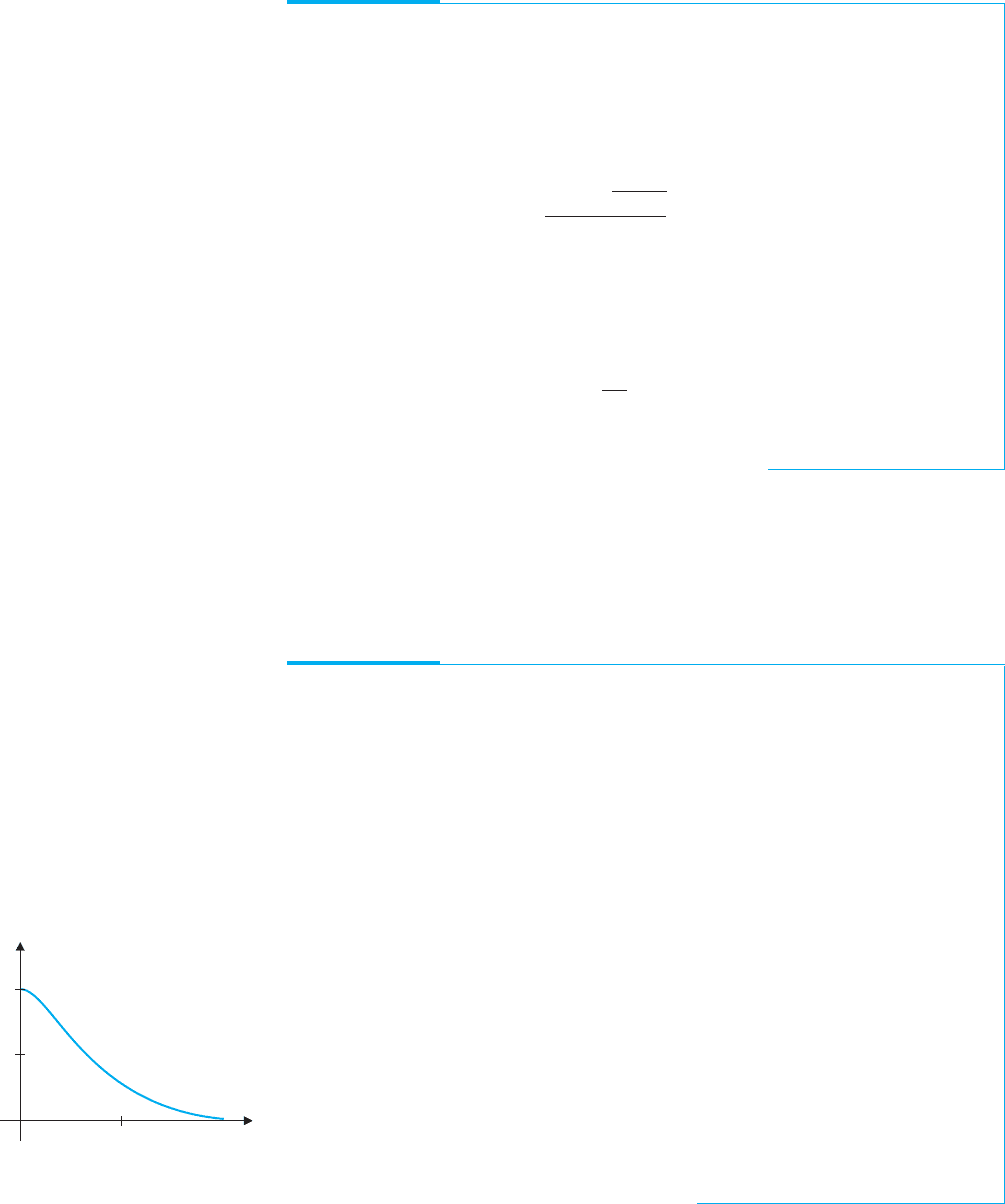
FIGURE 16.2
y =−e
−3t
+ 3e
−t
EXAMPLE 1.4 Solving an Initial Value Problem
Find the solution of the initial value problem y
+ 4y
+ 3y = 0, y(0) = 2, y
(0) = 0.
Solution Here, the characteristic equation is
0 = r
2
+ 4r + 3 = (r +3)(r +1),
so that r =−3 and r =−1. The general solution is then
y(t) = c
1
e
−3t
+ c
2
e
−t
,
so that y
(t) =−3c
1
e
−3t
− c
2
e
−t
.
The two initial conditions then give us
2 = y(0) = c
1
+ c
2
(1.7)
and 0 = y
(0) =−3c
1
− c
2
. (1.8)
From (1.8), we have c
2
=−3c
1
. Substituting this into (1.7) gives us
2 = c
1
+ c
2
= c
1
− 3c
1
=−2c
1
,
so that c
1
=−1. Then c
2
=−3c
1
= 3. The solution of the initial value problem is then
y(t) =−e
−3t
+ 3e
−t
.
A graph of this solution is shown in Figure 16.2.
P1: OSO/OVY P2: OSO/OVY QC: OSO/OVY T1: OSO
MHDQ256-Ch16 MHDQ256-Smith-v1.cls January 7, 2011 11:30
LT (Late Transcendental)
CONFIRMING PAGES
1078 CHAPTER 16
..
Second-Order Differential Equations 16-6
In example 1.5, the differential equation has no y
-term. Physically, this corresponds
to the case of a spring-mass system with no damping.
EXAMPLE 1.5 Solving an Initial Value Problem
Find the solution of the initial value problem y
+ 9y = 0, y(0) = 4, y
(0) =−6.
Solution Here, the characteristic equation is r
2
+ 9 = 0, so that r
2
=−9 and
r =±
√
−9 =±3i. The general solution is then
y(t) = c
1
cos3t + c
2
sin3t,
so that y
(t) =−3c
1
sin3t + 3c
2
cos3t.
From the initial conditions, we now have
4 = y(0) = c
1
and −6 = y
(0) = 3c
2
.
So, c
2
=−2 and the solution of the initial value problem is
y(t) = 4cos3t −2sin3t.
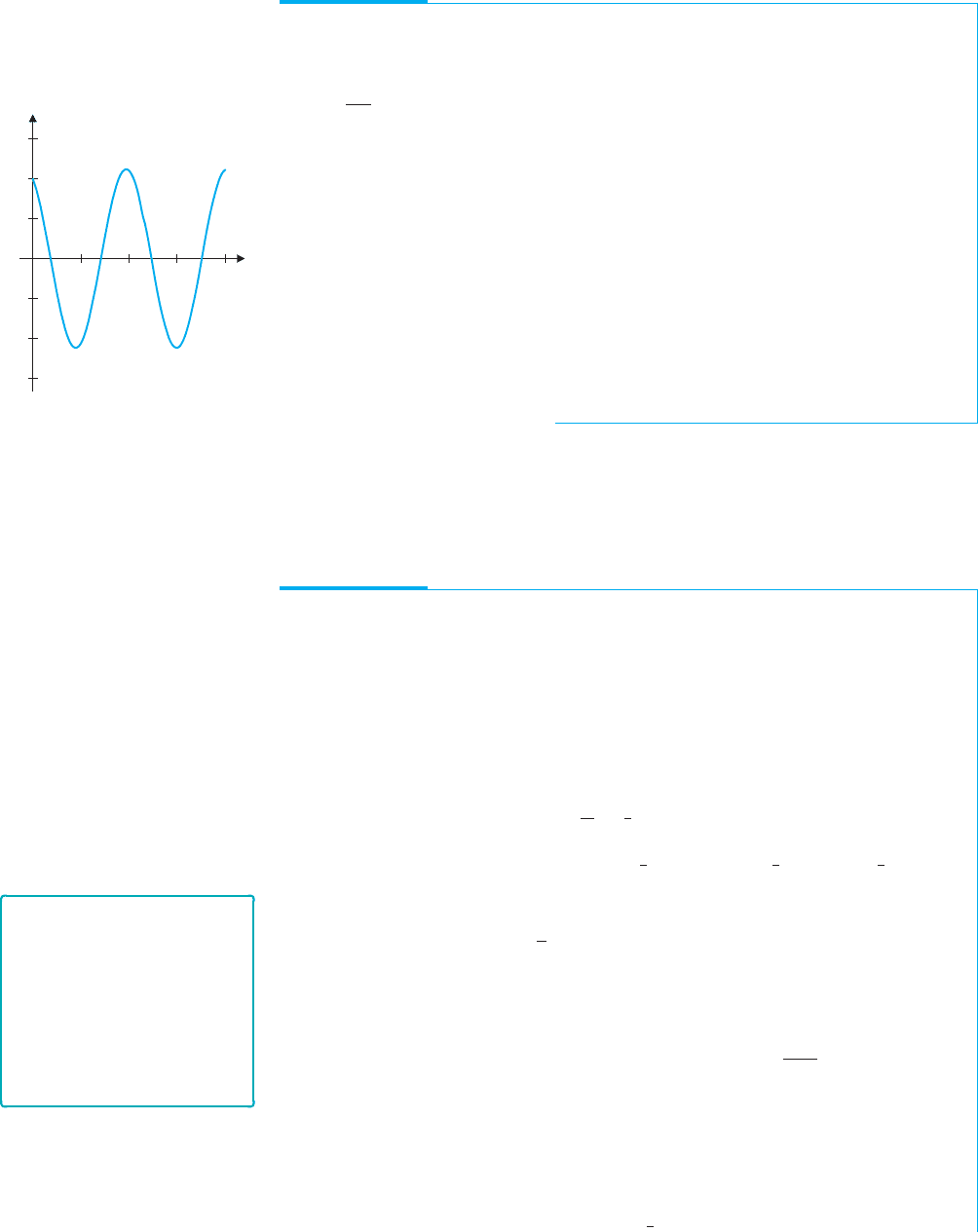
A graph is shown in Figure 16.3.
We now have the mathematical machinery needed to analyze a simple spring-mass
system. In example 1.6, pay careful attention to the amount of work we do in setting up the
problem. Remember: you can’t get the right solution if you don’t have the right equation!
3421
t
y
4
6
2
2
4
6
FIGURE 16.3
y = 4 cos 3t − 2 sin 3t
REMARK 1.2
In the English system of units,
with pounds (weight), feet and
seconds,
g ≈ 32ft/s
2
.
In the metric system with kg
(mass), meters and seconds,
g ≈ 9.8m/s
2
.
EXAMPLE 1.6 Spring-Mass System with No Damping
A spring is stretched 6 inches by an 8-pound weight. The mass is then pulled down an
additional 4 inches and released. Neglecting damping, find an equation for the position
of the mass at any time t and graph the position function.
Solution The general equation describing the spring-mass system is
mu
+ cu
+ ku = 0. We need to identify the mass m, damping constant c and spring
constant k. Since we are neglecting damping, we have c = 0. The mass m is related to
the weight W by W = mg, where g is the gravitational constant. Since the weight is
8 pounds, we have 8 = m(32) or m =
8
32
=
1
4
. (The units of mass here are slugs.) The
spring constant k is determined from the equation mg = kl. Here, the mass stretches
the spring 6 inches, which we must convert to
1
2
foot. So, l =
1
2
and 8 = k
1
2
, leaving
us with k = 16. The equation of motion is then
1
4
u
+ 0u
+ 16u = 0
or u
+ 64u = 0.
Here, the characteristic equation is r
2
+ 64 = 0, so that r =±
√
−64 =±8i and the
general solution is
u(t) = c
1
cos8t + c
2
sin8t. (1.9)
To determine the values of c
1
and c
2
, we need the initial values u(0) and u
(0). Read the
problem carefully and notice that the spring is released after it is pulled down 4 inches.
This says that the initial position is 4 inches or
1
3
foot down (the positive direction) and

P1: OSO/OVY P2: OSO/OVY QC: OSO/OVY T1: OSO
MHDQ256-Ch16 MHDQ256-Smith-v1.cls January 7, 2011 11:30
LT (Late Transcendental)
CONFIRMING PAGES
16-7 SECTION 16.1
..
Second-Order Equations with Constant Coefficients 1079
so, u(0) =
1
3
. Further, since the weight is pulled down and simply released, its initial
velocity is zero, u
(0) = 0. Using these initial conditions with (1.9) gives us
1
3
= u(0) = c
1
(1) + c
2
(0) = c
1
and 0 = u
(0) =−8c
1
(0) + 8c
2
(1) = 8c
2
,
so that c
1
=
1
3
and c
2
= 0. The solution of the initial value problem is now
u(t) =
1
3
cos8t.
The graph of this function in Figure 16.4 shows the smooth up and down motion of an
undamped spring (called simple harmonic motion).
For a real spring-mass system, there is always some damping, so that the idealized
perpetual motion of example 1.6 must be modified somewhat. In example 1.7, again take
note of the steps required to obtain the equation of motion.
EXAMPLE 1.7 Spring-Mass System with Damping
A spring is stretched 5 cm by a 2-kg mass. The mass is set in motion from its equilibrium
position with an upward velocity of 2 m/s. The damping constant is c = 4. Find an
equation for the position of the mass at any time t and graph the position function.
t
y
0.3
0.3
0.2
0.2
0.1
0.1
123456
FIGURE 16.4
u(t) =
1
3
cos8t
t
y
0.1
0.05
0.05
0.1
12345
FIGURE 16.5
u(t) =−
2
√
195
e
−t
sin
√
195t
Solution The equation of motion is mu
+ cu
+ ku = 0, where the damping
constant is c = 4 and the mass is m = 2kg. With these units, g ≈ 9.8 m/s
2
, so that the
weight is W = mg = 2(9.8) = 19.6. The displacement of the mass is 5cm or 0.05
meter. The spring constant is then k =
W
l
=
19.6
0.05
= 392 and the equation of motion is
2u
+ 4u
+ 392u = 0
or u
+ 2u
+ 196u = 0.
Here, the characteristic equation is r
2
+ 2r + 196 = 0. From the quadratic formula, we
have r =
−2 ±
√
4 − 784
2
=−1 ±
√
195i. The general solution is then
u(t) = c
1
e
−t
cos
√
195t +c
2
e
−t
sin
√
195t,
so that
u
(t) =−c
1
e
−t
cos
√
195t −c
1
√
195e
−t
sin
√
195t −c
2
e
−t
sin
√
195t
+ c
2
√
195e
−t
cos
√
195t.
Since the mass is set in motion from its equilibrium position, we have u(0) = 0 and
since it’s set in motion with an upward velocity of 2 m/s, we have u
(0) =−2. (Keep in
mind that upward motion corresponds to negative displacement.) These initial
conditions now give us
0 = u(0) = c
1
and −2 = u
(0) =−c
1
+ c
2
√
195 = c
2
√
195,
since c
1
= 0. So, c
2
=
−2
√
195
and the displacement of the mass at any given time is given
by
u(t) =−
2
√
195
e
−t
sin
√
195t.
The graph of this solution in Figure 16.5 shows a spring whose oscillations rapidly die
out.

P1: OSO/OVY P2: OSO/OVY QC: OSO/OVY T1: OSO
MHDQ256-Ch16 MHDQ256-Smith-v1.cls January 7, 2011 11:30
LT (Late Transcendental)
CONFIRMING PAGES
1080 CHAPTER 16
..
Second-Order Differential Equations 16-8
BEYOND FORMULAS
A major difference between solving second-order equations and solving first-order
equations is that for second-order equations of the form ay
(t) +by
(t) +cy(t) = 0,
you need to find two different solutions y
1
and y
2
(neither one of which is a constant
multiple of the other). The form of these solutions depends on the type of the
solutions to the characteristic equation, but in all cases the general solution is given by
c
1
y
1
(t) +c
2
y
2
(t), where the values of c
1
and c
2
are determined from two initial
conditions.
EXERCISES 16.1
WRITING EXERCISES
1. Briefly discuss the role that theory plays in this section. In
particular, if we didn’t know that two different solutions were
enough, would our method of guessing exponential solutions
lead to a general solution?
2. Briefly describe why our method of guessing exponential so-
lutions would not work on equations with nonconstant coef-
ficients. (You may want to work with a specific example like
y
+ 2ty
+ 3y = 0.)
3. It can be shown that e
2t
and 2e
2t
are both solutions of
y
− 3y
+ 2y = 0. Explain why these can’t be used as the
two functions in the general solution. That is, you can’t write
all solutions in the form c
1
e
2t
+ c
2
2e
2t
.
4. Discuss Figures 16.4 and 16.5 in physical terms. In particular,
discuss the significance of the y-intercept and the increas-
ing/decreasingproperties of the graph interms of the motion of
the spring. Further, relate themotion of the spring tothe forces
acting on the spring.
In exercises 1–12, find the general solution of the differential
equation.
1. y
− 2y
− 8y = 0 2. y
− 2y
− 6y = 0
3. y
− 4y
+ 4y = 0 4. y
+ 2y
+ 6y = 0
5. y
− 2y
+ 5y = 0 6. y
+ 6y
+ 9y = 0
7. y
− 2y
= 0 8. y
− 6y = 0
9. y
− 2y
− 6y = 0 10. y
+ y
+ 3y = 0
11. y
−
√
5y
+ y = 0 12. y
−
√
3y
+ y = 0
............................................................
In exercises 13–20, solve the initial value problem.
13. y
+ 4y = 0, y(0) = 2, y
(0) =−3
14. y
+ 2y
+ 10y = 0, y(0) = 1, y
(0) = 0
15. y
− 3y
+ 2y = 0, y(0) = 0, y
(0) = 1
16. y
+ y
− 2y = 0, y(0) = 3, y
(0) = 0
17. y
− 2y
+ 5y = 0, y(0) = 2, y
(0) = 0
18. y
− 4y
+ 4y = 0, y(0) = 2, y
(0) = 1
19. y
− 2y
+ y = 0, y(0) =−1, y
(0) = 2
20. y
+ 3y
= 0, y(0) = 4, y
(0) = 0
............................................................
21. Show that c
1
coskt +c
2
sinkt = A sin(kt +δ), where
A =
c
2
1
+ c
2
2
and tanδ =
c
1
c
2
. We call A the amplitude and
δ the phase shift. Use this identity to find the amplitude
and phase shift of the solution of y
+ 9y = 0, y(0) = 3 and
y
(0) =−6.
............................................................
In exercises 22–24, solve the initial value problem and use the
result of exercise 21 to find the amplitude and phase shift of the
solution.
22. y
+ 4y = 0, y(0) = 1, y
(0) =−2
23. y
+ 20y = 0, y(0) =−2, y
(0) = 2
24. y
+ 12y = 0, y(0) =−1, y
(0) =−2
............................................................
25. Aspringisstretched6inchesbya12-poundweight.Theweight
is then pulled down an additional 8 inches and released. Ne-
glect damping. Find an equation for the position of the spring
at any time t and graph the position function.
26. A spring is stretched 20 cm by a 4-kg mass. The weight is
released with a downward velocity of 2 m/s. Neglect damping.
Find an equation for the position of the spring atany time t and
graph the position function.
27. Aspringisstretched10cmbya4-kgmass.Theweightispulled
downanadditional20cmandreleasedwithanupwardvelocity
of 4 m/s. Neglect damping. Find an equation for the position of
the spring at any time t and graph the position function. Find
the amplitude and phase shift of the motion.
28. A spring is stretched 2 inches by a 6-pound weight. The weight
is then pulled down an additional 4 inches and released with a
downwardvelocityof4ft/s.Neglectdamping.Findanequation
forthepositionof the spring atanytimet and graph the position
function. Find the amplitude and phase shift of the motion.
29. Aspring isstretched4inchesbya16-poundweight.The damp-
ing constant equals 10. The weight is then pushed up 6 inches
and released. Find an equation for the position of the spring at
any time t and graph the position function.

P1: OSO/OVY P2: OSO/OVY QC: OSO/OVY T1: OSO
MHDQ256-Ch16 MHDQ256-Smith-v1.cls January 7, 2011 11:30
LT (Late Transcendental)
CONFIRMING PAGES
16-9 SECTION 16.1
..
Second-Order Equations with Constant Coefficients 1081
30. A spring is stretched 8 inches by a 32-pound weight. The
damping constant equals 0.4. The weight is released with a
downward velocity of 3 ft/s. Find an equation for the position
of the spring at any time t and graph the position function.
31. A spring is stretched 25cm by a 4-kg mass. The weight is
pushed up
1
2
meter and released. The damping constant equals
c = 2. Find an equation for the position of the spring at any
time t and graph the position function.
32. A spring is stretched 10cm by a 5-kg mass. The weight is
released with a downward velocity of 2m/s. The damping
constant equals c = 5. Find an equation for the position of the
spring at any time t and graph the position function.
33. Show that in the case of a repeated root r = r
1
to the charac-
teristic equation, the function y = te
r
1
t
is a second solution of
the differential equation ay
+ by
+ cy = 0.
34. Show that in the case of complex roots r = u ± vi to the
characteristic equation, the functions y = e
ut
cosvt and
y = e
ut
sinvt are solutions of the differential equation
ay
+ by
+ cy = 0.
35. For the equation u
+ cu
+ 16u = 0, compare solutions with
c = 7, c = 8 and c = 9. Thefirst case iscalled underdamped,
the second case is called critically damped and the last case
is called overdamped. Briefly explain why these terms are
appropriate.
36. For the general equation mu
+ cu
+ ku = 0, show that crit-
ical damping occurs with c = 2
√
km. Without solving any
equations, briefly describe what the graph of solutions look
like with c < 2
√
km, compared to c > 2
√
km.
37. A spring is stretched 3 inches by a 16-pound weight. Use
exercise 36 to find the critical damping value.
38. Show that for both the critically damped case and the over-
damped case, the mass can pass through its equilibrium posi-
tion at most once. (Hint: Show that u(t) = 0 has at most one
solution.)
39. Ifyouare designing a screendoor, you cancontrolthe damping
by changing the viscosity of the fluid in the cylinder in which
the closure rod is embedded. Discuss whether overdamping or
underdamping would be more appropriate.
40. Show that e
t
and e
−t
are solutions of the equation
y
− y = 0, and conclude that a general solution is given by
y = c
1
e
t
+ c
2
e
−t
. Then show that sinht and cosh t are so-
lutions of y
− y = 0, and conclude that a general solution
is given by y = c
1
sinht + c
2
cosht. Discuss whether or not
these two general solutions are equivalent.
41. As in exercise 40, show that y = c
1
sinhat +c
2
cosh at is
a general solution of y
− a
2
y = 0, for any constant a > 0.
Compare this to the general solution of y
+ a
2
y = 0.
42. For the general equation ay
+ by
+ cy = 0, if the roots of
the characteristic equation are complex, a > 0 and b > 0,
show that the solution y(t) → 0ast →∞.
43. Forthe generalequationay
+ by
+ cy = 0, ifac > 0, b > 0
and the roots of the characteristic equation are real numbers
r
1
< r
2
,showthatboth rootsare negativeandthus, thesolution
y(t) → 0ast →∞.
44. For the general equation ay
+ by
+ cy = 0, suppose that
there is a repeated root r
1
< 0 of the characteristic equation.
Show that lim
t→∞
te
r
1
t
= 0 and thus, the solution y(t) → 0as
t →∞.
45. Use the results of exercises 42–44 to show that if a, b and c
are all positive, then the solution y(t)ofay
+ by
+ cy = 0
goes to 0 as t →∞.
46. Interpret the result of exercise 45 in terms of the spring equa-
tion mu
+ cu
+ ku = 0. In particular, if there is nonzero
damping, then what is the eventual motion of the spring?
EXPLORATORY EXERCISES
1. In this exercise, you will explore solutions of a different type
of second-order equation. An Euler equation has the form
x
2
y
+ axy
+ by = 0 for constants a and b. Notice that this
equation requires that x times the first derivative and x
2
times
the second derivative be similar to the original function. Ex-
plain why a reasonable guess is y = x
r
. Substitute this into
the equation and (similar to our derivation of the characteristic
equation) show that r must satisfy the equation
r
2
+ (a − 1)r + b = 0.
Use this to find the general solution of
(a)x
2
y
+ 4xy
+ 2y = 0and(b) x
2
y
− 3xy
+ 3y = 0. Dis-
cuss the main difference in the graphs of solutions to (a) and
(b). Can you say anything definite about the graph of a solution
of (c) x
2
y
+ 2xy
− 6y = 0 near x = 0? There remains the
issue of what to do with complex and repeated roots. Showthat
if you get complex roots r = u ± vi, then y = x
u
cos(v ln x)
and y = x
u
sin (v ln x) are solutions for x > 0. Use this infor-
mation to find the general solution of (d) x
2
y
+ xy
+ y = 0.
Use the form of the solutions corresponding to complex roots
to guess the second solution in the repeated roots case. Find
the general solution of (e) x
2
y
+ 5xy
+ 4y = 0.
2. Inthisexercise,youwillexploresolutionsof higher-order dif-
ferentialequations.Fora third-orderequationwithconstantco-
efficientssuch as (a) y
− 3y
− y
+ 3y = 0, make a reason-
ableguessofthe form of thesolution,writedownthecharacter-
istic equation and solve the equation (which factors). Use this
ideato findthegeneralsolutionof(b) y
+ y
+ 3y
− 5y = 0
and(c) y
− y
− y
+ y = 0. Oddlyenough, anequation like
(d) y
− y = 0causes more problems than (a)–(c). Howmany
solutions of the characteristic equation do you find? Show that
y = te
t
is not a solution. Show that y = e
t/2
cos
√
3
2
t and
y = e
t/2
sin
√
3
2
t are two additional solutions. Identify the two
r-values to which these solutions correspond. Show that these

P1: OSO/OVY P2: OSO/OVY QC: OSO/OVY T1: OSO
MHDQ256-Ch16 MHDQ256-Smith-v1.cls January 7, 2011 11:30
LT (Late Transcendental)
CONFIRMING PAGES
1082 CHAPTER 16
..
Second-Order Differential Equations 16-10
r-values are in fact solutions of the characteristic equation.
Conclude that a more thorough understanding of solutions
of complex equations is necessary to fully master third-order
equations.Toend on amorepositivenote,findthegeneral solu-
tionsofthefourth-order equation (e) y
(4)
− y = 0andthefifth-
order equation (f) y
(5)
−3y
(4)
−5y
+15y
+ 4y
−12y =0.
16.2 NONHOMOGENEOUS EQUATIONS:
UNDETERMINED COEFFICIENTS
Ifyou’veevershot a videotape with a handheld camera, you probably understand theimpact
ajittery hand can haveonthequality of your video. In section16.1,wedevelopedandsolved
a simple model for mechanical vibrations. In this section, we extend that model to cases
where an external force such as a shaky hand complicates the problem.
TODAY IN
MATHEMATICS
Shigefumi Mori (1951– )
A Japanese mathematician who
earned the Fields Medal in 1990.
A colleague wrote, “The most
profound and exciting
development in algebraic
geometry during the last decade
or so was the Minimal Model
Program or Mori’s Program....
Shigefumi Mori initiated the
program with a decisively new
and powerful technique, guided
the general research direction
with some good collaborators
along the way and finally finished
up the program by himself
overcoming the last difficulty....
Mori’s theorems were stunning
and beautiful by the totally new
features unimaginable by those
who had been working, probably
very hard too, only in the
traditional world of algebraic ...
surfaces.’’
The starting place for our model again is Newton’s second law of motion: F = ma.
Adding an external force F(t) to the spring force and damping force considered in section
16.1, we get that if u(t) is the displacement from equilibrium, then
mu
(t) =−ku(t) − cu
(t) + F(t)
or
mu
(t) +cu
(t) +ku(t) = F(t). (2.1)
Notice that equation (2.1) is the same as the spring model developed in section 16.1,
except that the right-hand side of the equation is no longer zero. Equation (2.1) is called
homogeneous when F(t) = 0 for all t and nonhomogeneous otherwise.
Our goal is to find the general solution of such equations (that is, the form of all solu-
tions). We can do this by first finding one particular solution u
p
(t) of the nonhomogeneous
equation (2.1). Notice that if u(t) is any other solution of (2.1), then we have that
m(u − u
p
)
+ c(u − u
p
)
+ k(u − u
p
) = (mu
+ cu
+ ku) −(mu
p
+ cu
p
+ ku
p
)
= F(t) − F(t) = 0.
That is, the function u − u
p
is a solution of the corresponding homogeneous equation
mu
+ cu
+ ku = 0 solved in section 16.1. So, if the general solution of the homogeneous
equation is c
1
u
1
+ c
2
u
2
, then u − u
p
= c
1
u
1
+ c
2
u
2
, for some constants c
1
and c
2
.We
summarize this in Theorem 2.1.
THEOREM 2.1
Let u = c
1
u
1
+ c
2
u
2
be the general solution of mu
+ cu
+ ku = 0 and let u
p
be any
solution of mu
+ cu
+ ku = F(t). Then the general solution of
mu
+ cu
+ ku = F(t)isgivenby
u = c
1
u
1
+ c
2
u
2
+ u
p
.
We illustrate this result with example 2.1.
EXAMPLE 2.1 Solving a Nonhomogeneous Equation
Find the general solution of u
+ 4u
+ 3u = 30e
2t
, given that u
p
= 2e
2t
is a solution.
Solution One of the two pieces of the general solution is given to us: we have
u
p
= 2e
2t
. The other piece is the solution of the homogeneous equation
u
+ 4u
+ 3u = 0. Here, the characteristic equation is
0 = r
2
+ 4r + 3 = (r +3)(r +1),