
Smith R., Minton R. Calculus
Подождите немного. Документ загружается.


P1: OSO/OVY P2: OSO/OVY QC: OSO/OVY T1: OSO
MHDQ256-Ch00 MHDQ256-Smith-v1.cls December 8, 2010 15:25
LT (Late Transcendental)
CONFIRMING PAGES
0-3 SECTION 0.1
..
The Real Numbers and the Cartesian Plane 3
Similarly, the open interval (a, b) is the set of numbers between a and b, but not
including the endpoints a and b, that is,
(a, b) ={x ∈ R | a < x < b},
as illustrated in Figure 0.4, where the open circles indicate that a and b are not included
in (a, b). Similarly, we denote the set {x ∈ R | x > a} by the interval notation (a, ∞) and
{x ∈ R | x < a}by (−∞, a). In both of these cases, it is important to recognize that ∞ and
−∞ are not real numbers and we are using this notation as a convenience.
a b
FIGURE 0.4
An open interval
You should already be very familiar with the following properties of real numbers.
THEOREM 1.1
If a and b are real numbers and a < b, then
(i) For any real number c, a + c < b + c.
(ii) For real numbers c and d,ifc < d, then a + c < b +d.
(iii) For any real number c > 0, a · c < b ·c.
(iv) For any real number c < 0, a · c > b ·c.
REMARK 1.1
We need the properties given in Theorem 1.1 to solve inequalities. Notice that
(i) says that you can add the same quantity to both sides of an inequality. Part (iii)
says that you can multiply both sides of an inequality by a positive number. Finally,
(iv) says that if you multiply both sides of an inequality by a negative number, the
inequality is reversed.
We illustrate the use of Theorem 1.1 by solving a simple inequality.
EXAMPLE 1.1 Solving a Linear Inequality
Solve the linear inequality 2x + 5 < 13.
Solution We can use the properties in Theorem 1.1 to solve for x. Subtracting 5 from
both sides, we obtain
(2x + 5) − 5 < 13 −5
or
2x < 8.
Dividing both sides by 2, we obtain
x < 4.
We often write the solution of an inequality in interval notation. In this case, we get the
interval (−∞, 4).
You can deal with more complicated inequalities in the same way.
EXAMPLE 1.2 Solving a Two-Sided Inequality
Solve the two-sided inequality 6 < 1 − 3x ≤ 10.
Solution First, recognize that this problem requires that we find values of x such that
6 < 1 − 3x and 1 − 3x ≤ 10.
It is most efficient to work with both inequalities simultaneously. First, subtract 1 from
each term, to get
6 − 1 < (1 −3x) − 1 ≤ 10 − 1
or
5 < −3x ≤ 9.
P1: OSO/OVY P2: OSO/OVY QC: OSO/OVY T1: OSO
MHDQ256-Ch00 MHDQ256-Smith-v1.cls December 8, 2010 15:25
LT (Late Transcendental)
CONFIRMING PAGES
4 CHAPTER 0
..
Preliminaries 0-4
Now, divide by −3, but be careful. Since −3 < 0, the inequalities are reversed. We have
5
−3
>
−3x
−3
≥
9
−3
or
−
5
3
> x ≥−3.
We usually write this as
−3 ≤ x < −
5
3
,
or in interval notation as [−3, −
5
3
).
y
4224
8
4
4
8
x
1
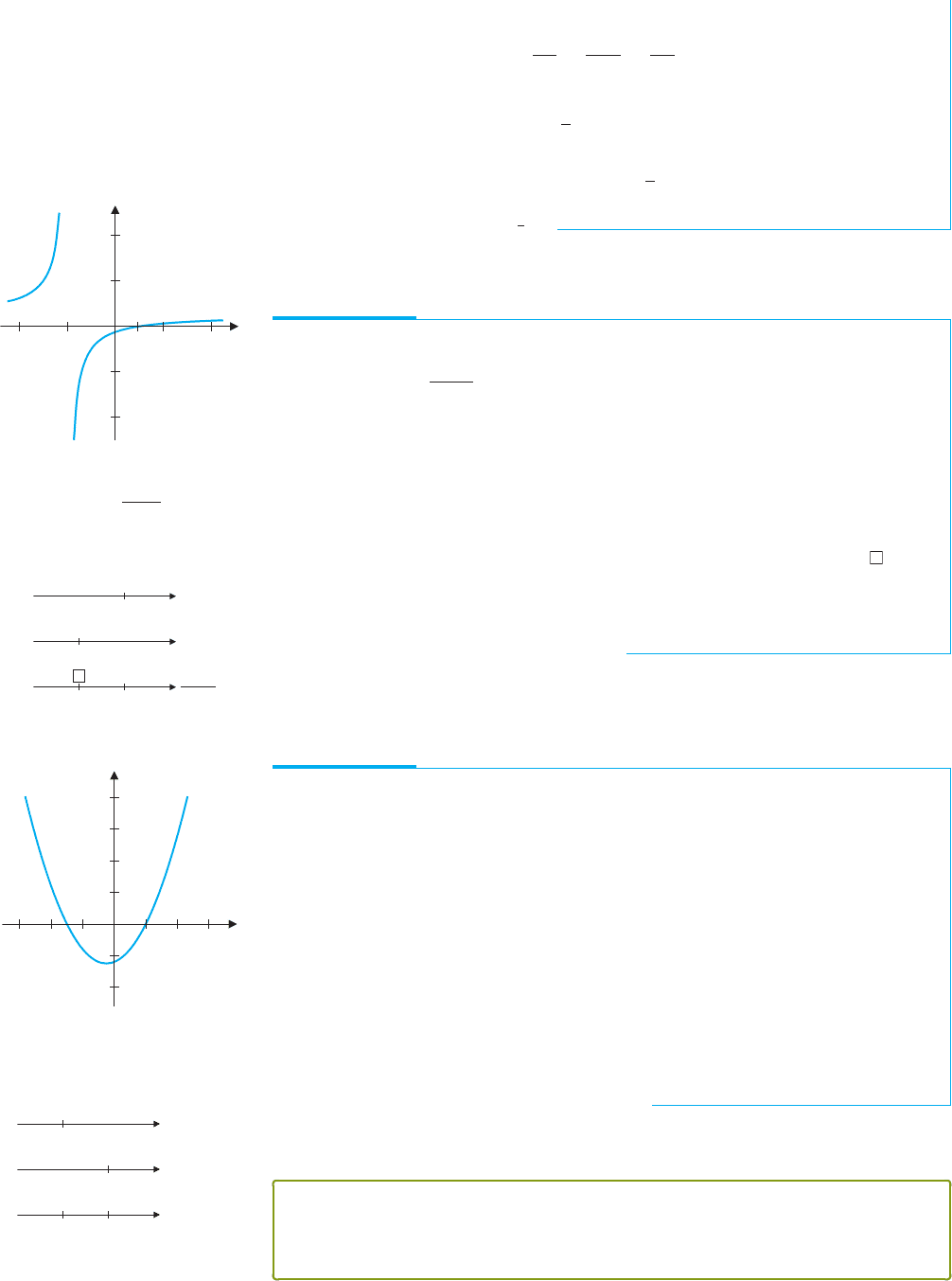
FIGURE 0.5
y =
x − 1
x + 2
You will often need to solve inequalities involving fractions. We present a typical
example in the following.
EXAMPLE 1.3 Solving an Inequality Involving a Fraction
Solve the inequality
x −1
x +2
≥ 0.
Solution In Figure 0.5, we show a graph of the function, which appears to indicate
that the solution includes all x < −2 and x ≥ 1. Carefully read the inequality and
observe that there are only three ways to satisfy this: either both numerator and
denominator are positive, both are negative or the numerator is zero. To visualize this,
we draw number lines for each of the individual terms, indicating where each is positive,
negative or zero and use these to draw a third number line indicating the value of the
quotient, as shown in the margin. In the third number line, we have placed an “
”
above the −2 to indicate that the quotient is undefined at x =−2. From this last
number line, you can see that the quotient is nonnegative whenever x < −2 or x ≥ 1.
We write the solution in interval notation as (−∞, −2) ∪ [1, ∞). Note that this solution
is consistent with what we see in Figure 0.5.
For inequalities involving a polynomial of degree 2 or higher, factoring the polynomial
and determining where the individual factors are positive and negative, as in example 1.4,
will lead to a solution.
EXAMPLE 1.4 Solving a Quadratic Inequality
Solve the quadratic inequality
x
2
+ x −6 > 0.
(1.1)
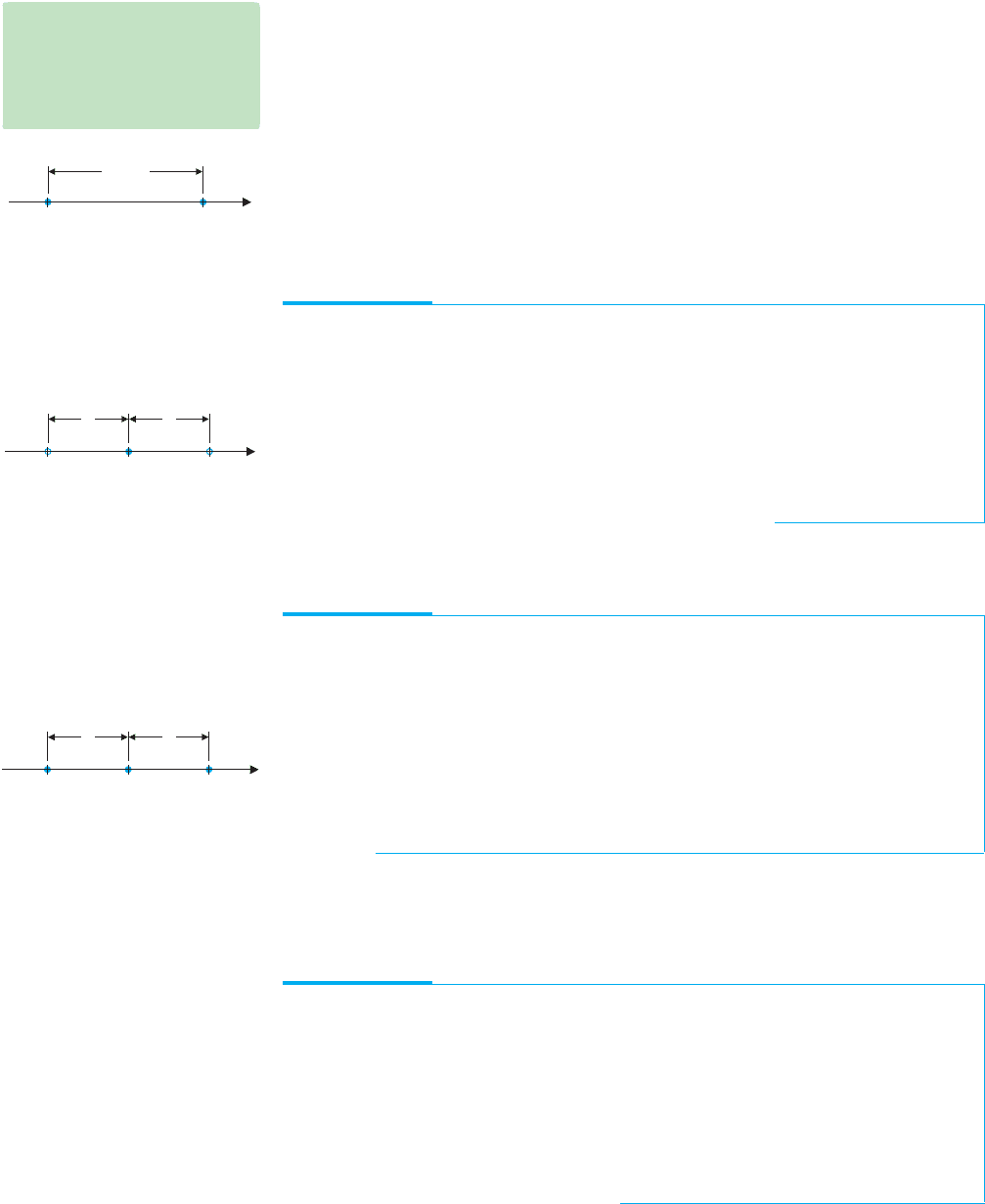
Solution In Figure 0.6, we show a graph of the polynomial on the left side of the
inequality. Since this polynomial factors, (1.1) is equivalent to
(x + 3)(x − 2) > 0. (1.2)
This can happen in only two ways: when both factors are positive or when both factors
are negative. As in example 1.3, we draw number lines for both of the individual
factors, indicating where each is positive, negative or zero and use these to draw a
number line representing the product. We show these in the margin. Notice that the third
number line indicates that the product is positive whenever x < −3 or x > 2. We write
this in interval notation as (−∞, −3) ∪ (2, ∞).
x 1
x 2
1
0
2
x 1
1
0
x 2
2
0
y
x
10
10
20
624246
FIGURE 0.6
y = x
2
+ x − 6
(x 3)(x 2)
2
00
3
x 2
2
0
x 3
3
0
No doubt, you will recall the following standard definition.
DEFINITION 1.1
The absolute value of a real number x is |x|=
x, if x ≥ 0
.
−x, if x < 0
P1: OSO/OVY P2: OSO/OVY QC: OSO/OVY T1: OSO
MHDQ256-Ch00 MHDQ256-Smith-v1.cls December 8, 2010 15:25
LT (Late Transcendental)
CONFIRMING PAGES
0-5 SECTION 0.1
..
The Real Numbers and the Cartesian Plane 5
Makecertain that you read Definition 1.1 correctly. If x is negative, then −x is positive.
This says that |x|≥0 for all real numbers x. For instance, using the definition,
|−4|=−(−4) = 4.
Notice that for any real numbers a and b,
|a · b|=|a|·|b|,
although
|a + b| =|a|+|b|,
in general. (To verify this, simply take a = 5 and b =−2 and compute both quantities.)
However, it is always true that
|a + b|≤|a|+|b|.
NOTES
For any two real numbers a and b,
|a − b| gives the distance between
a and b. (See Figure 0.7.)
This is referred to as the triangle inequality.
Theinterpretation of|a − b|asthe distancebetweena andb (seethenotein themargin)
is particularly useful for solving inequalities involving absolute values. Wherever possible,
we suggest that you use this interpretation to read what the inequality means, rather than
merely following a procedure to produce a solution.
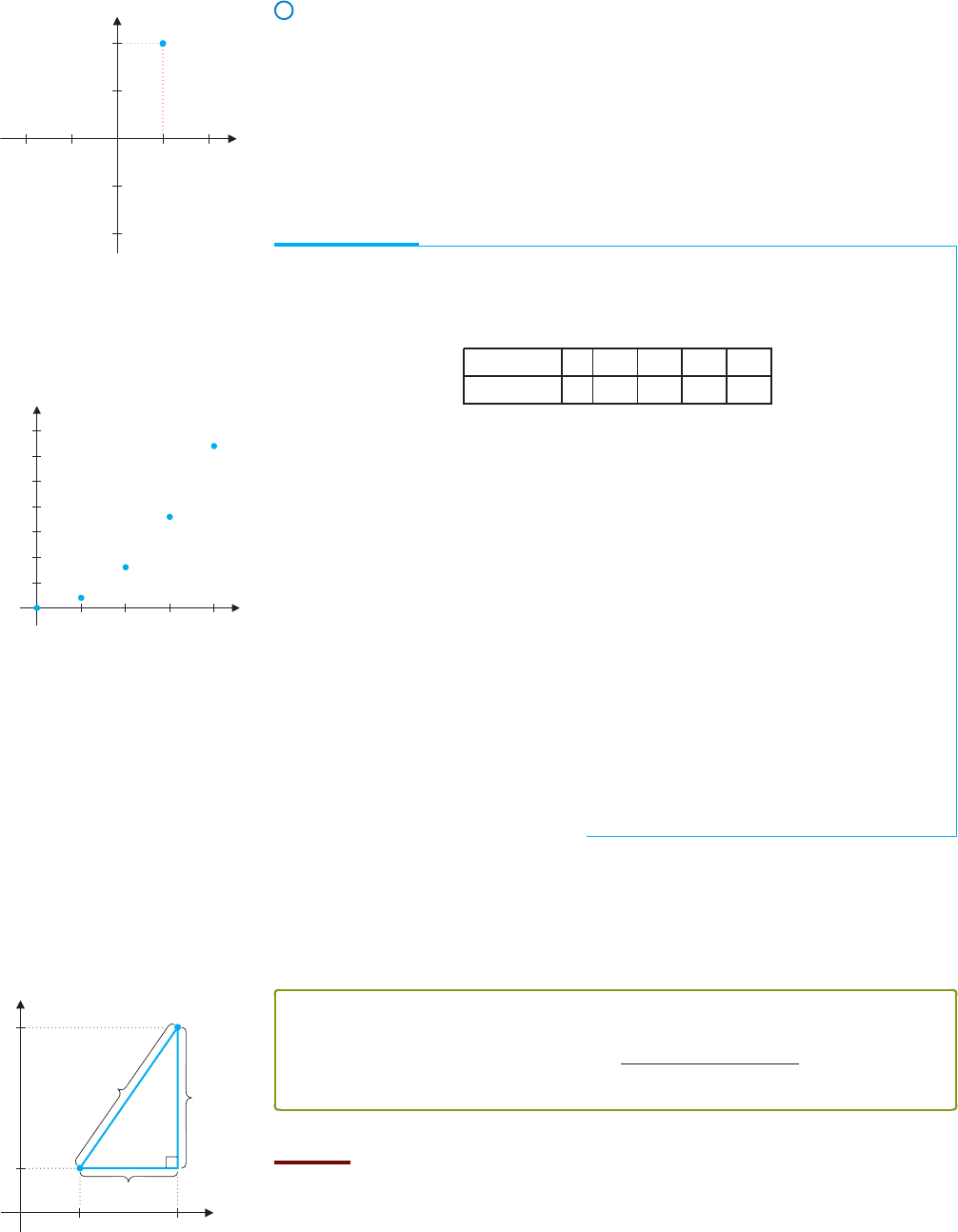
a b
兩a b兩
FIGURE 0.7
The distance between a and b
EXAMPLE 1.5 Solving an Inequality Containing an Absolute Value
Solve the inequality
|x − 2|< 5. (1.3)
Solution First, take a few moments to read what this inequality says. Since |x −2|
gives the distance from x to 2, (1.3) says that the distance from x to 2 must be less than
5. So, find all numbers x whose distance from 2 is less than 5. We indicate the set of all
numbers within a distance 5 of 2 in Figure 0.8. You can now read the solution directly
from the figure: −3 < x < 7 or in interval notation: (−3, 7).
2 5 32 5 72
5 5
FIGURE 0.8
|x − 2|< 5
Many inequalities involving absolute values can be solved simply by reading the in-
equality correctly, as in example 1.6.
EXAMPLE 1.6 Solving an Inequality with a Sum Inside an Absolute Value
Solve the inequality
|x + 4|≤7. (1.4)
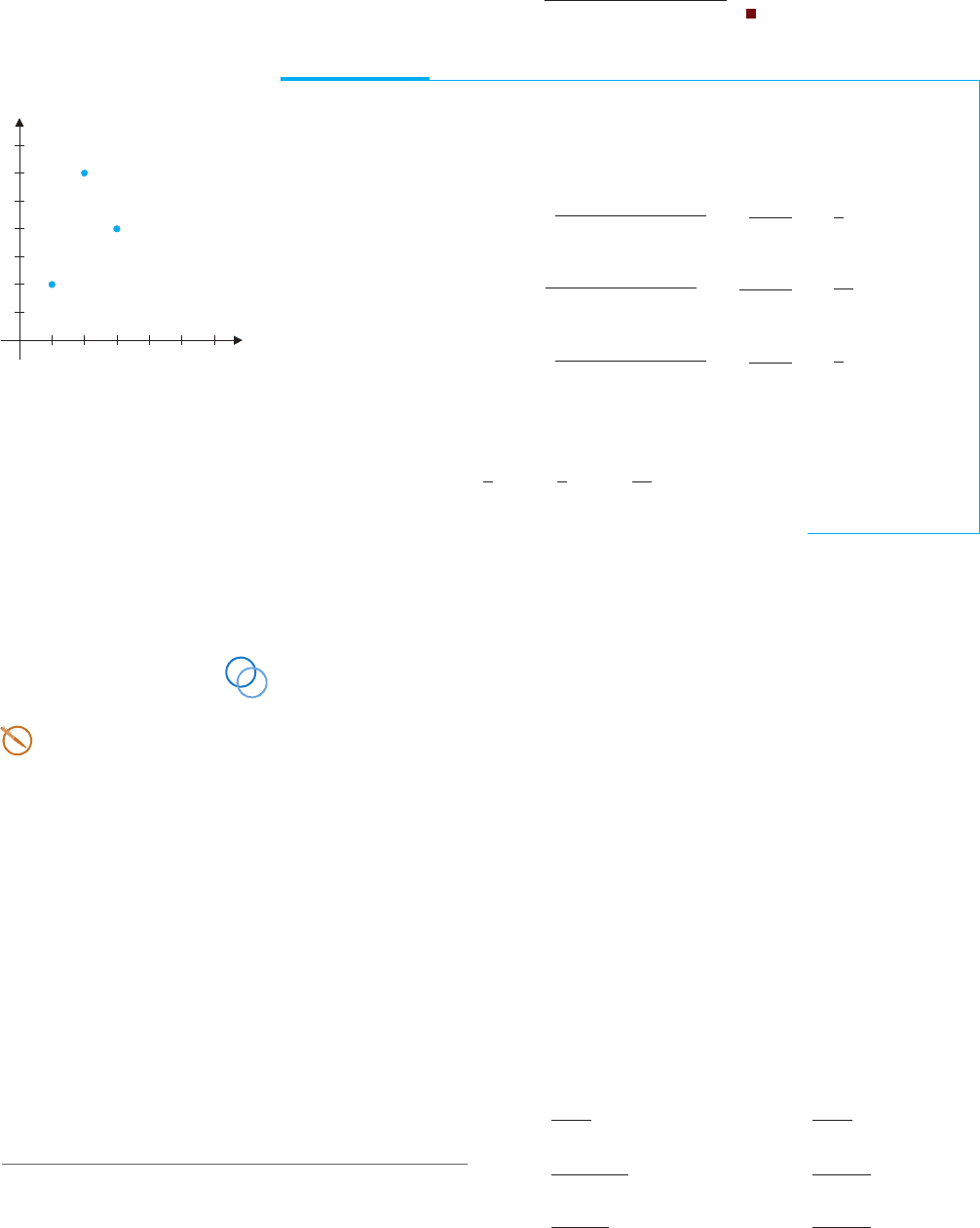
Solution To use our distance interpretation, we must first rewrite (1.4) as
|x − (−4)|≤7.
This now says that the distance from x to −4 is less than or equal to 7. We illustrate the
solution in Figure 0.9, from which it follows that the solution is −11 ≤ x ≤ 3or
[−11, 3].
4 7 11 4 7 34
7 7
FIGURE 0.9
|x + 4|≤7
Recall that for any real number r > 0, |x|< r is equivalent to the following inequality
not involving absolute values:
−r < x < r.
In example 1.7, we use this to revisit the inequality from example 1.5.
EXAMPLE 1.7 An Alternative Method for Solving Inequalities
Solve the inequality |x − 2|< 5.
Solution This is equivalent to the two-sided inequality
−5 < x − 2 < 5.
Adding 2 to each term, we get the solution
−3 < x < 7,
or in interval notation (−3, 7), as before.
P1: OSO/OVY P2: OSO/OVY QC: OSO/OVY T1: OSO
MHDQ256-Ch00 MHDQ256-Smith-v1.cls December 8, 2010 15:25
LT (Late Transcendental)
CONFIRMING PAGES
6 CHAPTER 0
..
Preliminaries 0-6
The Cartesian Plane
For any two real numbers x and y we visualize the ordered pair (x, y) as a point in two
dimensions. The Cartesian plane is a plane with two real number lines drawn at right
angles. The horizontal line is called the x-axis and the vertical line is called the y-axis. The
point where the axes cross is called the origin, which represents the ordered pair (0, 0). To
represent the ordered pair (1, 2), start at the origin, move 1 unit to the right and 2 units up
and mark the point (1, 2), as in Figure 0.10.
In example 1.8, we analyze a small set of experimental data by plotting some points in
the Cartesian plane. This simple type of graph is sometimes called a scatter plot.
EXAMPLE 1.8 Using a Graph Obtained from a Table of Data
Suppose that you drop an object from the top of a building and record how far the object
has fallen at different times, as shown in the following table.
Time (sec) 0 0.51.01.52.0
Distance (ft) 0 4 16 36 64
Plot the points in the Cartesian plane and discuss any patterns you notice. In
particular, use the graph to predict how far the object will have fallen in 2.5 seconds.
Solution Taking the first coordinate (x) to represent time and the second coordinate
(y) to represent distance, we plot the points (0, 0), (0.5, 4), (1, 16), (1.5, 36) and (2, 64),
as seen in Figure 0.11.
(1, 2)
y
x
2112
2
1
1
2
FIGURE 0.10
The Cartesian plane
y
x
1.0 2.00.5 1.5
40
60
20
Time
Distance
FIGURE 0.11
Scatter plot of data
Notice that the points appear to be curving upward (like a parabola). To predict the
y-value corresponding to x = 2.5 (i.e., the distance fallen at time 2.5 seconds), we
assume that this pattern continues, so that the y-value would be much higher than 64.
But, how much higher is reasonable? It helps now to refer back to the data. Notice that
the change in height from x = 1.5tox = 2is64−36 = 28 feet. Since Figure 0.11
suggests that the curve is bending upward, the change in height between successive
points should be getting larger and larger. You might reasonably predict that the height
will change by more than 28. If you look carefully at the data, you might notice a
pattern. Observe that the distances given at 0.5-second intervals are 0
2
, 2
2
, 4
2
, 6
2
and 8
2
.
A reasonable guess for the distance at time 2.5 seconds might then be 10
2
= 100.
Further, notice that this corresponds to a change of 36 from the distance at x = 2.0
seconds. At this stage, this is only an educated guess and other guesses (98 or 102, for
example) might be equally reasonable.
We urge that you think carefully about example 1.8. You should be comfortable with
the interplay between the graph and the numerical data. This interplay will be a recurring
theme in our study of calculus.
The distance between two points in the Cartesian plane is a simple consequence of the
Pythagorean Theorem, as follows.
THEOREM 1.2
The distance between the points (x
1
, y
1
) and (x
2
, y
2
) in the Cartesian plane is given by
d{(x
1
, y
1
), (x
2
, y
2
)}=
(x
2
− x
1
)
2
+ (y
2
− y
1
)
2
(1.5)
PROOF
We have oriented the points in Figure 0.12 so that (x
2
, y
2
) is above and to the right of
(x
1
, y
1
).
y
x
x
2
x
1
y
2
y
1
兩y
2
y
1
兩
兩x
2
x
1
兩
Distance
(x
1
, y
1
)
(x
2
, y
2
)
FIGURE 0.12
Distance
Referring to the right triangle shown in Figure 0.12, notice that regardless of the
orientation of the two points, the length of the horizontal side of the triangle is |x
2
− x
1
|
P1: OSO/OVY P2: OSO/OVY QC: OSO/OVY T1: OSO
MHDQ256-Ch00 MHDQ256-Smith-v1.cls December 8, 2010 15:25
LT (Late Transcendental)
CONFIRMING PAGES
0-7 SECTION 0.1
..
The Real Numbers and the Cartesian Plane 7
and the length of the vertical side of the triangle is |y
2
− y
1
|. The distance between the two
points is the length of the hypotenuse of the triangle, given by the Pythagorean Theorem as
(x
2
− x
1
)
2
+ (y
2
− y
1
)
2
.
We illustrate the use of the distance formula in example 1.9.
EXAMPLE 1.9 Using the Distance Formula
Find the distances between each pair of points (1, 2), (3, 4) and (2, 6). Use the distances
to determine if the points form the vertices of a right triangle.
y
x
426
4
6
2
FIGURE 0.13
A right triangle?
Solution The distance between (1, 2) and (3, 4) is
d{(1, 2), (3, 4)}=
(3 − 1)
2
+ (4 −2)
2
=
√
4 + 4 =
√
8.
The distance between (1, 2) and (2, 6) is
d{(1, 2), (2, 6)}=
(2 − 1)
2
+ (6 −2)
2
=
√
1 + 16 =
√
17.
Finally, the distance between (3, 4) and (2, 6) is
d{(3, 4), (2, 6)}=
(2 − 3)
2
+ (6 −4)
2
=
√
1 + 4 =
√
5.
From a plot of the points (see Figure 0.13), it is unclear whether a right angle is formed
at (3, 4). However, the sides of a right triangle must satisfy the Pythagorean Theorem.
This would require that
√
8
2
+
√
5
2
=
√
17
2
. This is incorrect!
Since this statement is not true, the triangle is not a right triangle.
Again, we want to draw your attention to the interplay between graphical and algebraic
techniques. If you master the relationship between graphs and equations, your study of
calculus will be a more rewarding and enjoyable learning experience.
EXERCISES 0.1
WRITING EXERCISES
1. To understand Definition 1.1, you must believe that |x|=−x
fornegativex’s.Using x =−3asanexample,explaininwords
why multiplying x by −1 produces the same result as taking
the absolute value of x.
2. A common shortcut used to write inequalities is −4 < x < 4
in place of “−4 < x and x < 4.” Unfortunately, many people
mistakenly write 4 < x < −4 in place of “4 < xorx< −4.”
Explain why the string 4 < x < −4 could never be true. (Hint:
Whatdoesthisinequalitystringimplyaboutthenumbersonthe
farleft andfarright?Here,youmustwrite “4 < xorx< −4.”)
3. Explain the result of Theorem 1.1 (ii) in your own words, as-
suming that all constants involved are positive.
4. Suppose a friend has dug holes for the corner posts of a rect-
angular deck. Explain how to use the Pythagorean Theorem to
determine whether or not the holes truly form a rectangle (90
◦
angles).
In exercises 1–28, solve the inequality.
1. 3x + 2 < 11 2. 4x + 1 < −5
3. 2x − 3 < −7 4. 3x − 1 < 9
5. 4 − 3x < 6 6. 5 − 2x < 9
7. 4 ≤ x + 1 < 7 8. −1 < 2 − x < 3
9. −2 < 2 −2x < 3 10. 0 < 3 − x < 1
11. x
2
+ 3x − 4 > 0 12. x
2
+ 4x + 3 < 0
13. x
2
− x − 6 < 0 14. x
2
+ 1 > 0
15. 3x
2
+ 4 > 0 16. x
2
+ 3x + 10 > 0
17. |x − 3| < 4 18. |2x + 1| < 1
19. |3 − x| < 1 20. |3 + x| > 1
21. |2x + 1| > 2 22. |3x − 1| < 4
23.
x + 2
x − 2
> 0 24.
x − 4
x + 1
< 1
25.
x
2
− x − 2
(x + 4)
2
> 0 26.
3 − 2x
(x + 1)
2
< 0
27.
−8x
(x + 1)
3
< 0 28.
x − 2
(x + 2)
3
> 0
............................................................
P1: OSO/OVY P2: OSO/OVY QC: OSO/OVY T1: OSO
MHDQ256-Ch00 MHDQ256-Smith-v1.cls December 8, 2010 15:25
LT (Late Transcendental)
CONFIRMING PAGES
8 CHAPTER 0
..
Preliminaries 0-8
In exercises 29–34, find the distance between the pair of points.
29. (2, 1), (4, 4) 30. (2, 1), (−1, 4)
31. (−1, −2), (3, −2) 32. (1, 2), (3, 6)
33. (0, 2), (−2, 6) 34. (4, 1), (2, 1)
............................................................
In exercises 35–38, determine if the set of points forms the ver-
tices of a right triangle.
35. (1, 1), (3, 4), (0, 6) 36. (0, 2), (4, 8), (−2, 12)
37. (−2, 3), (2, 9), (−4, 13) 38. (−2, 3), (0, 6), (−3, 8)
............................................................
In exercises 39–42, the data represent populations at various
times. Plot the points, discuss any patterns that are evident and
predict the population at the next step.
39. (0, 1250), (1, 1800), (2, 2450), (3, 3200)
40. (0, 3160), (1, 3250), (2, 3360), (3, 3490)
41. (0, 4000), (1, 3990), (2, 3960), (3, 3910)
42. (0, 2100), (1, 2200), (2, 2100), (3, 1700)
............................................................
43. As discussed in the text, a number is rational if and only if its
decimal representation terminates or repeats. Calculators and
computers perform their calculations using a finite number of
digits.Explainwhy suchcalculationscanonlyproducerational
numbers.
44. In example 1.8, we discussed how the tendency of the data
points to “curve up” corresponds to larger increases in consec-
utive y-values. Explain why this is true.
APPLICATIONS
45. The ancient Greeks analyzed music mathematically. They
found that if pipes of length L and
L
2
are struck, they make
tones that blend together nicely. We say that these tones are
one octave apart. In general, nice harmonies are produced by
pipes (or strings) with rational ratios of lengths. For example,
pipes of length L and
2
3
L form a fifth (i.e., middle C and the G
above middle C). On a piano keyboard, 12 fifths are equal to
7 octaves. A glitch in piano tuning, known as thePythagorean
comma, results from the fact that 12 fifths with total length
ratio
2
3
12
do not equal 7 octaves with length ratio
1
2
7
. Show
that the difference is about 1.3%.
46. For the 12 keys of a piano octave to have exactly the same
length ratios (see exercise 45), the ratio of consecutive lengths
should be a number x such that x
12
=2. Briefly explain why.
This means that x =
12
√
2. There are two problems with this
equal-tempered tuning. First,
12
√
2 is irrational. Explain why
it would be difficult to get the pipe or string exactly the right
length. In any case, musicians say that equal-tempered pianos
sound “dull.”
47. The use of squares in the Pythagorean Theorem has found
a surprising use in the analysis of baseball statistics. In Bill
James’ Historical Abstract, a rule is stated that a team’s
winning percentage P is approximately equal to
R
2
R
2
+ G
2
,
where R is the number of runs scored by the team and G
is the number of runs scored against the team. For exam-
ple, in 1996 the Texas Rangers scored 928 runs and gave
up 799 runs. The formula predicts a winning percentage of
928
2
928
2
+ 799
2
≈ 0.574. Infact,Texaswon90gamesandlost72
for a winning percentage of
90
162
≈ 0.556. Fill out the follow-
ing table (data from the 1996 season). What are possible ex-
planations for teams that win more (or fewer) games than the
formula predicts?
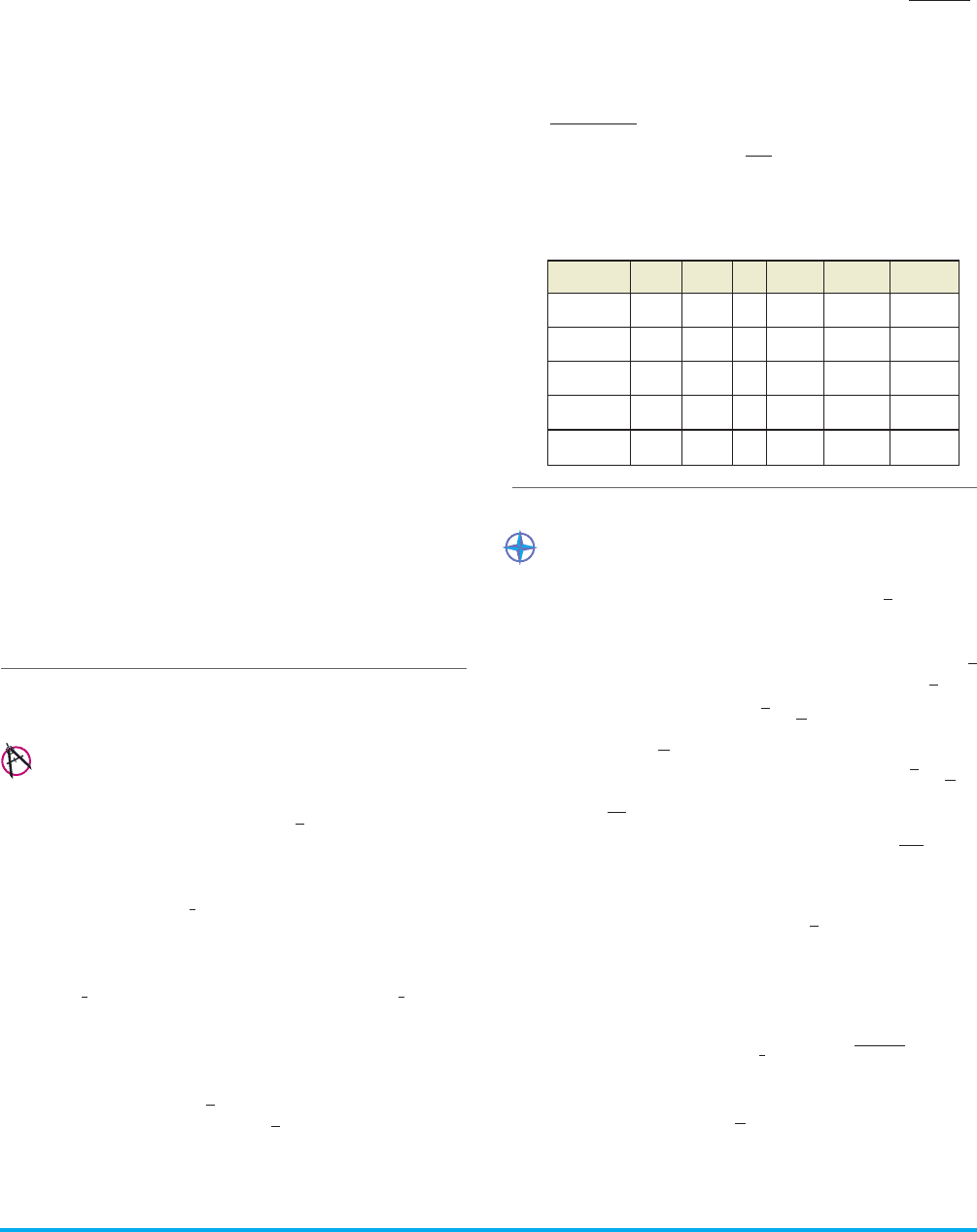
Team R G P wins losses win %
Yankees 871 787 92 70
Braves 773 648 96 66
Phillies 650 790 67 95
Dodgers 703 652 90 72
Indians 952 769 99 62
EXPLORATORY EXERCISES
1. Itcanbeverydifficult to provethat agivennumberisirrational.
According to legend, the following proof that
√
2 is irrational
so upset the ancient Greek mathematicians that they drowned
a mathematician who revealed the result to the general public.
The proof is by contradiction; that is, we imagine that
√
2
is rational and then show that this cannot be true. If
√
2 were
rational, we would have that
√
2 =
p
q
for some integers p and
q. Assume that
p
q
is in simplified form (i.e., any common fac-
tors have been divided out). Square the equation
√
2 =
p
q
to
get 2 =
p
2
q
2
. Explain why this can only be true if p is an even
integer. Write p = 2r and substitute to get 2 =
4r
2
q
2
. Then,
rearrange this expression to get q
2
=2r
2
. Explain why this
can only be true if q is an even integer. Something has gone
wrong: explain why p and q can’t both be even integers. Since
this can’t be true, we conclude that
√
2 is irrational.
2. In the text, we stated that a number is rational if and only if its
decimal representation repeats or terminates. In this exercise,
we prove that the decimal representation of any rational num-
ber repeats or terminates. To start with a concrete example,
use long division to show that
1
7
=0.142857142857. Note that
when you get a remainder of 1, it’s all over: you started with
a 1 to divide into, so the sequence of digits must repeat. For
a general rational number
p
q
, there are q possible remainders
(0,1,2,...,q −1). Explainwhywhendoing long divisionyou
must eventually get a remainder you have had before. Explain
why the digits will then either terminate or start repeating.
P1: OSO/OVY P2: OSO/OVY QC: OSO/OVY T1: OSO
MHDQ256-Ch00 MHDQ256-Smith-v1.cls December 8, 2010 15:25
LT (Late Transcendental)
CONFIRMING PAGES
0-9 SECTION 0.2
..
Lines and Functions 9
0.2 LINES AND FUNCTIONS
Equations of Lines
Thefederal governmentconductsa nationwide censusevery10years to determinethepopu-
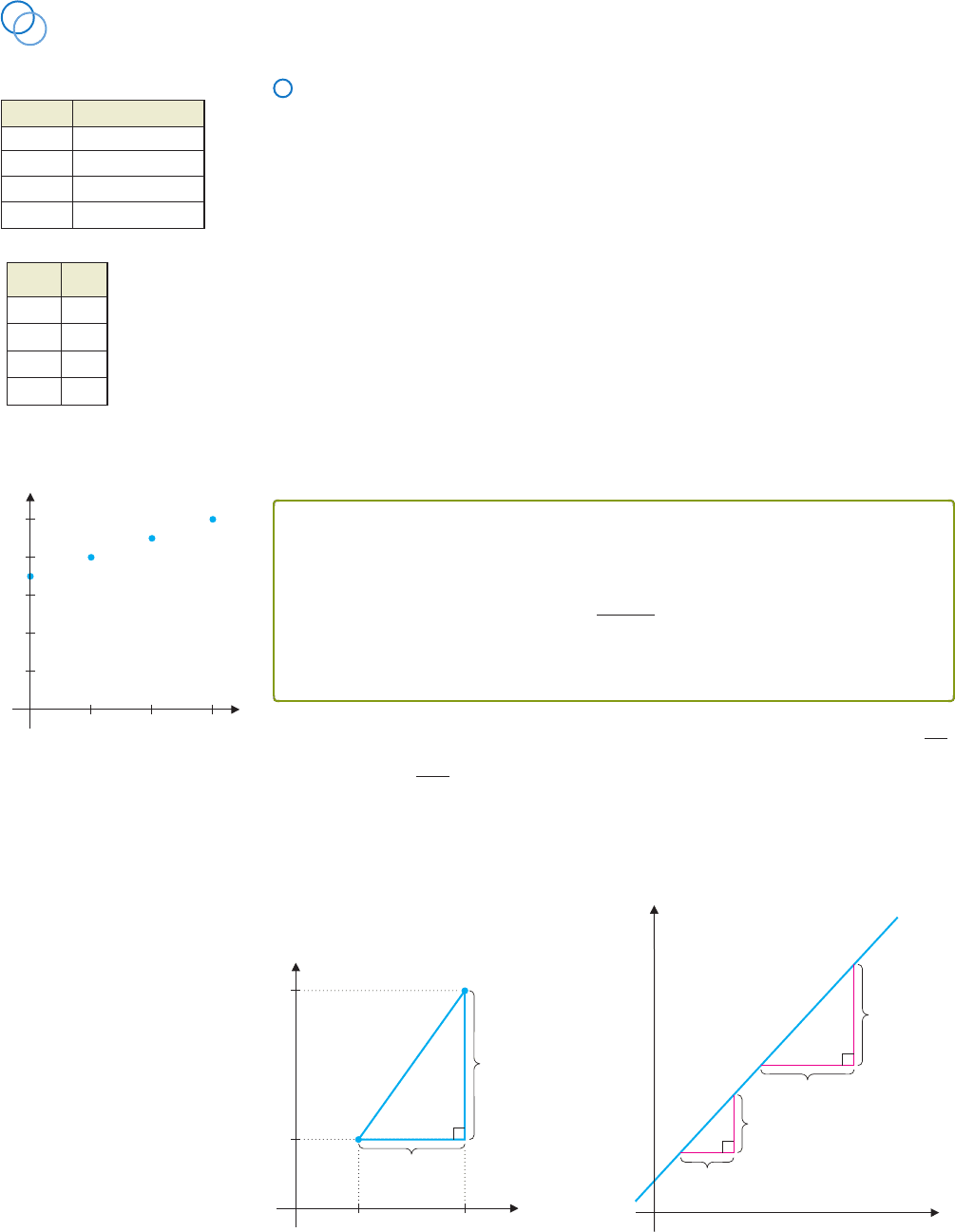
lation. Population data for several recent decades are shown in the accompanying table.
Year U.S. Population
1960 179,323,175
1970 203,302,031
1980 226,542,203
1990 248,709,873
x y
0 179
10 203
20 227
30 249
Transformed data
One difficulty with analyzing these data is that the numbers are so large. This problem
is remedied by transforming the data. We can simplify the year data by defining x to be
the number of years since 1960, so that 1960 corresponds to x = 0, 1970 corresponds to
x = 10 and so on. The population data can be simplified by rounding the numbers to the
nearest million. The transformed data are shown in the accompanying table and a scatter
plot of these data points is shown in Figure 0.14.
The points in Figure 0.14 may appear to form a straight line. (Use a ruler and see if you
agree.) To determine whether the points are, in fact, on the same line (such points are called
colinear), we might consider the population growth in each of the indicated decades. From
1960 to 1970, the growthwas 24 million. (That is, to movefrom the first point to the second,
you increase x by 10 and increase y by 24.) Likewise, from 1970 to 1980, the growth was
24 million. However, from 1980 to 1990, the growth was only 22 million. Since the rate
of growth is not constant, the data points do not fall on a line. This argument involves the
familiar concept of slope.
y
x
50
100
150
200
250
10 20 30
FIGURE 0.14
Population data
DEFINITION 2.1
For x
1
= x
2
, the slope of the straight line through the points (x
1
, y
1
) and (x
2
, y
2
)is
the number
m =
y
2
− y
1
x
2
− x
1
. (2.1)
When x
1
= x
2
and y
1
= y
2
, the line through (x
1
, y
1
) and (x
2
, y
2
)isvertical and the
slope is undefined.
We often describe slope as “the change in y divided by the change in x,” written
y
x
,
or more simply as
Rise
Run
. (See Figure 0.15a.)
Referring to Figure 0.15b (where the line has positive slope), notice that for any
four points A, B, D and E on the line, the two right triangles ABC and DEF are
similar. Recall that for similar triangles, the ratios of corresponding sides must be the same.
x
x x
2
x
1
Run
y y
2
y
1
(x
1
, y
1
)
(x
2
, y
2
)
Rise
y
2
y
1
x
2
x
1
y
y
x
x
x
y
B
E
A
D
F
C
y
FIGURE 0.15a
Slope
FIGURE 0.15b
Similar triangles and slope
P1: OSO/OVY P2: OSO/OVY QC: OSO/OVY T1: OSO
MHDQ256-Ch00 MHDQ256-Smith-v1.cls December 8, 2010 15:25
LT (Late Transcendental)
CONFIRMING PAGES
10 CHAPTER 0
..
Preliminaries 0-10
In this case, this says that
y
x
=
y
x
and so, the slope is the same no matter which two points on the line are selected. Notice
that a line is horizontal if and only if its slope is zero.
EXAMPLE 2.1 Finding the Slope of a Line
Find the slope of the line through the points (4, 3) and (2, 5).
Solution From (2.1), we get
m =
y
2
− y
1
x
2
− x
1
=
5 − 3
2 − 4
=
2
−2
=−1.
EXAMPLE 2.2 Using Slope to Determine If Points Are Colinear
Use slope to determine whether the points (1, 2), (3, 10) and (4, 14) are colinear.
Solution First, notice that the slope of the line joining (1, 2) and (3, 10) is
m
1
=
y
2
− y
1
x
2
− x
1
=
10 − 2
3 − 1
=
8
2
= 4.
Similarly, the slope through the line joining (3, 10) and (4, 14) is
m
2
=
y
2
− y
1
x
2
− x
1
=
14 − 10
4 − 3
= 4.
Since the slopes are the same, the points must be colinear.
Recallthatif you knowthe slope and apointthrough which the line must pass, youhave
enough information to graph the line. The easiest way to graph a line is to plot two points
and then draw the line through them. In this case, you need only to find a second point.
EXAMPLE 2.3 Graphing a Line
If a line passes through the point (2, 1) with slope
2
3
, find a second point on the line and
then graph the line.
Solution Since slope is given by m =
y
2
− y
1
x
2
− x
1
, we take m =
2
3
, y
1
= 1 and x
1
= 2,
to obtain
2
3
=
y
2
− 1
x
2
− 2
.
You are free to choose the x-coordinate of the second point. For instance, to find the
point at x
2
= 5, substitute this in and solve. From
2
3
=
y
2
− 1
5 − 2
=
y
2
− 1
3
,
we get 2 = y
2
− 1ory
2
= 3. A second point is then (5, 3). The graph of the line is shown
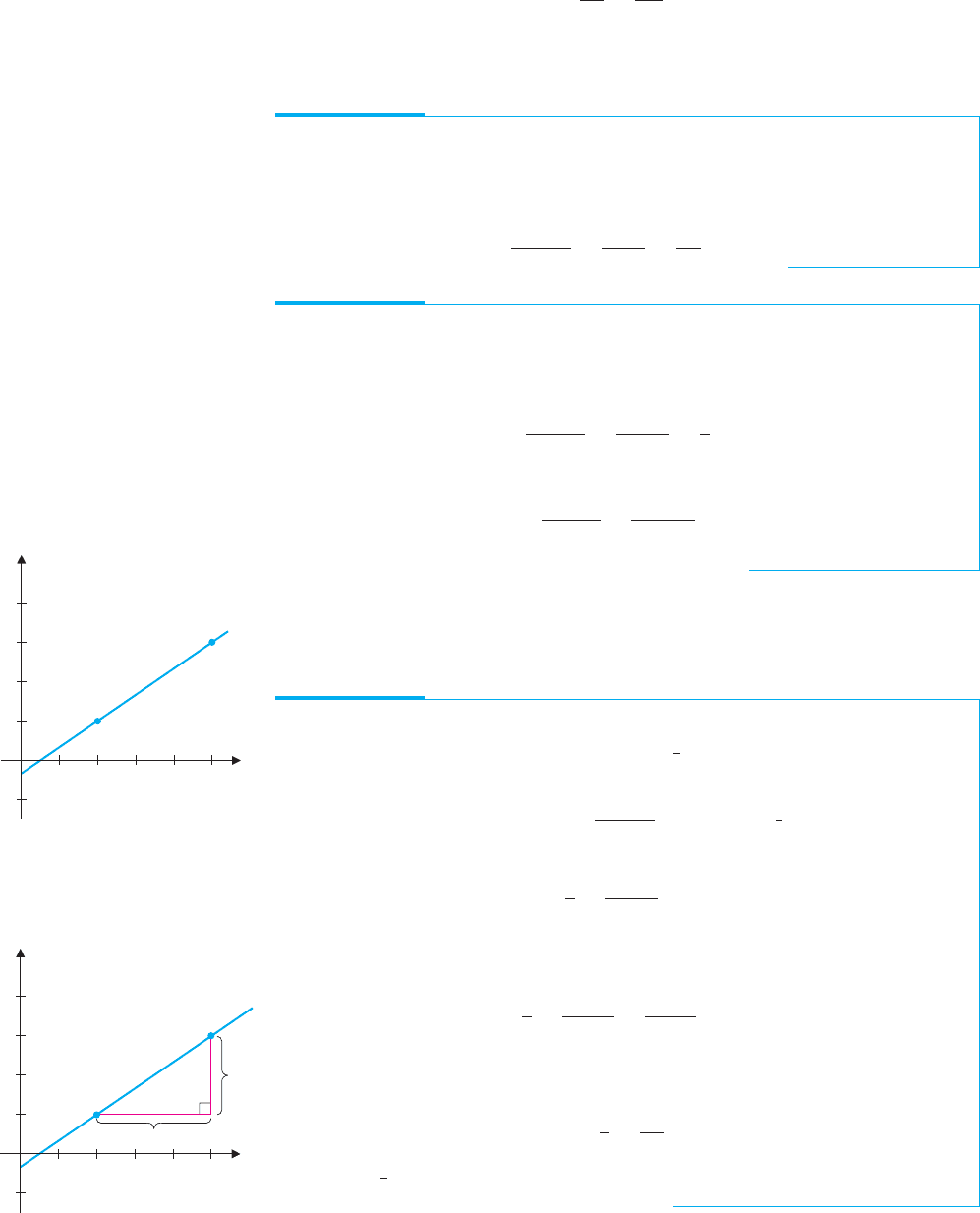
in Figure 0.16a. An alternative method for finding a second point is to use the slope
m =
2
3
=
y
x
.
The slope of
2
3
says that if we move three units to the right, we must move two units up
to stay on the line, as illustrated in Figure 0.16b.
y
x
1
1
2
3
4
15432
FIGURE 0.16a
Graph of straight line
y
x
1
1
2
3
4
15432
x 3
y 2
FIGURE 0.16b
Using slope to find a second point
In example 2.3, the choice of x = 5 was entirely arbitrary; you can choose any
x-value you want to find a second point. Further, since x can be any real number, you
P1: OSO/OVY P2: OSO/OVY QC: OSO/OVY T1: OSO
MHDQ256-Ch00 MHDQ256-Smith-v1.cls December 8, 2010 15:25
LT (Late Transcendental)
CONFIRMING PAGES
0-11 SECTION 0.2
..
Lines and Functions 11
can leave x as a variable and write out an equation satisfied by any point (x, y) on the line.
Inthegeneralcaseofthelinethroughthepoint(x
0
, y
0
)withslopem, wehavefrom(2.1)that
m =
y − y
0
x − x
0
. (2.2)
Multiplying both sides of (2.2) by (x − x
0
), we get
y − y
0
= m(x − x
0
)
or
POINT-SLOPE FORM OF A LINE
y = m(x − x
0
) + y
0
. (2.3)
Equation (2.3) is called the point-slope form of the line.
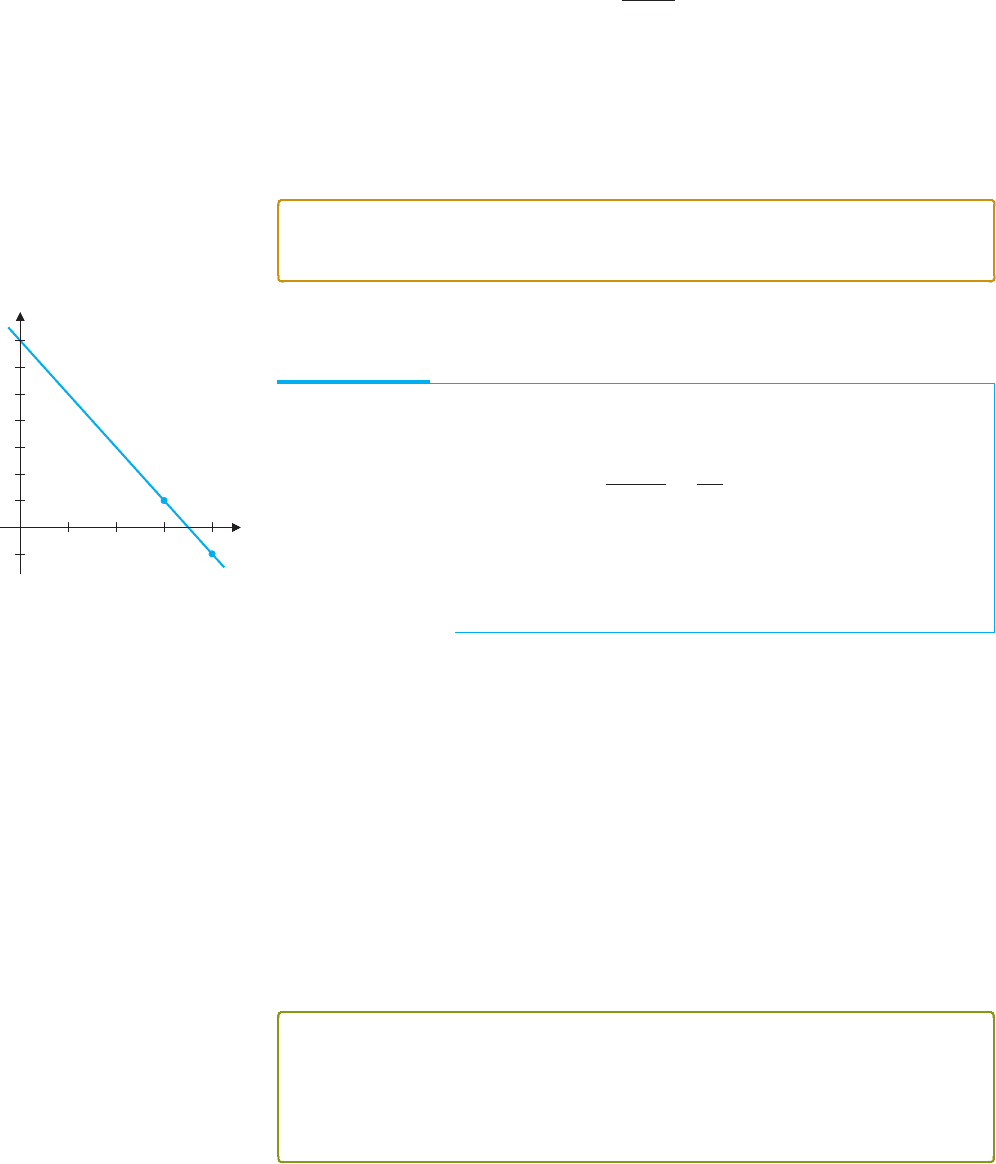
EXAMPLE 2.4 Finding the Equation of a Line Given Two Points
Find an equation of the line through the points (3, 1) and (4, −1) and graph the line.
Solution From (2.1), the slope is m =
−1 − 1
4 − 3
=
−2
1
=−2. Using (2.3) with slope
m =−2, x-coordinate x
0
= 3 and y-coordinate y
0
= 1, we get the equation of the line:
y =−2(x −3) +1. (2.4)
To graph the line, plot the points (3, 1) and (4, −1), and you can easily draw the line
seen in Figure 0.17.
y
x
1
1
2
3
4
5
6
7
1234
FIGURE 0.17
y =−2(x − 3) +1
Although the point-slope form of the equation is often the most convenient to work
with, the slope-intercept form is sometimes more convenient. This has the form
y = mx +b,
where m is the slope and b is the y-intercept (i.e., the place where the graph crosses the
y-axis). In example 2.4, you simply multiply out (2.4) to get y =−2x +6 +1or
y =−2x +7.
As you can see from Figure 0.17, the graph crosses the y-axis at y = 7.
Theorem 2.1 presents a familiar result on parallel and perpendicular lines.
THEOREM 2.1
Two (nonvertical) lines are parallel if they have the same slope. Further, any two
vertical lines are parallel. Two (nonvertical) lines of slope m
1
and m
2
are
perpendicular whenever the product of their slopes is −1 (i.e., m
1
· m
2
=−1). Also,
any vertical line and any horizontal line are perpendicular.
Since we can read the slope from the equation of a line, it’s a simple matter to de-
termine when two lines are parallel or perpendicular. We illustrate this in examples 2.5
and 2.6.
P1: OSO/OVY P2: OSO/OVY QC: OSO/OVY T1: OSO
MHDQ256-Ch00 MHDQ256-Smith-v1.cls December 8, 2010 15:25
LT (Late Transcendental)
CONFIRMING PAGES
12 CHAPTER 0
..
Preliminaries 0-12
EXAMPLE 2.5 Finding the Equation of a Parallel Line
Find an equation of the line parallel to y = 3x − 2 and through the point (−1, 3).
y
x
10
20
10
20
4224
FIGURE 0.18
Parallel lines
Solution It’s easy to read the slope of the line from the equation: m = 3. The
equation of the parallel line is then
y = 3[x − (−1)] + 3
or simply y = 3x + 6. We show a graph of both lines in Figure 0.18.
EXAMPLE 2.6 Finding the Equation of a Perpendicular Line
Find an equation of the line perpendicular to y =−2x +4 and intersecting the line at
the point (1, 2).
Solution The slope of y =−2x + 4is−2. The slope of the perpendicular line is
then −1/(−2) =
1
2
. Since the line must pass through the point (1, 2), the equation of
the perpendicular line is
y =
1
2
(x − 1) + 2ory =
1
2
x +
3
2
.
We show a graph of the two lines in Figure 0.19.
y
x
4
2
2
4
24
2
FIGURE 0.19
Perpendicular lines
We now return to this section’s introductory example and use the equation of a line to
estimate the population in the year 2000.
EXAMPLE 2.7 Using a Line to Predict Population
Given the population data for the census years 1960, 1970, 1980 and 1990, predict the
population for the year 2000.
Solution We began this section by showing that the points in the corresponding table
are not colinear. Nonetheless, they are nearly colinear. So, why not use the straight line
connecting the last two points (20, 227) and (30, 249) (corresponding to the populations
in the years 1980 and 1990) to predict the population in 2000? (This is a simple
example of a more general procedure called extrapolation.) The slope of the line
joining the two data points is
m =
249 − 227
30 − 20
=
22
10
=
11
5
.
The equation of the line is then
y =
11
5
(x − 30) + 249.
y
x
5040302010
100
200
300
FIGURE 0.20
Population
See Figure 0.20 for a graph of the line. If we follow this line to the point corresponding
to x = 40 (the year 2000), we have the predicted population
11
5
(40 − 30) + 249 = 271.
That is, the predicted population is 271 million people. The actual census figure for
2000 was 281 million, which indicates that the U.S. population grew at a faster rate
between 1990 and 2000 than in the previous decade.
f
x
BA
y
Functions
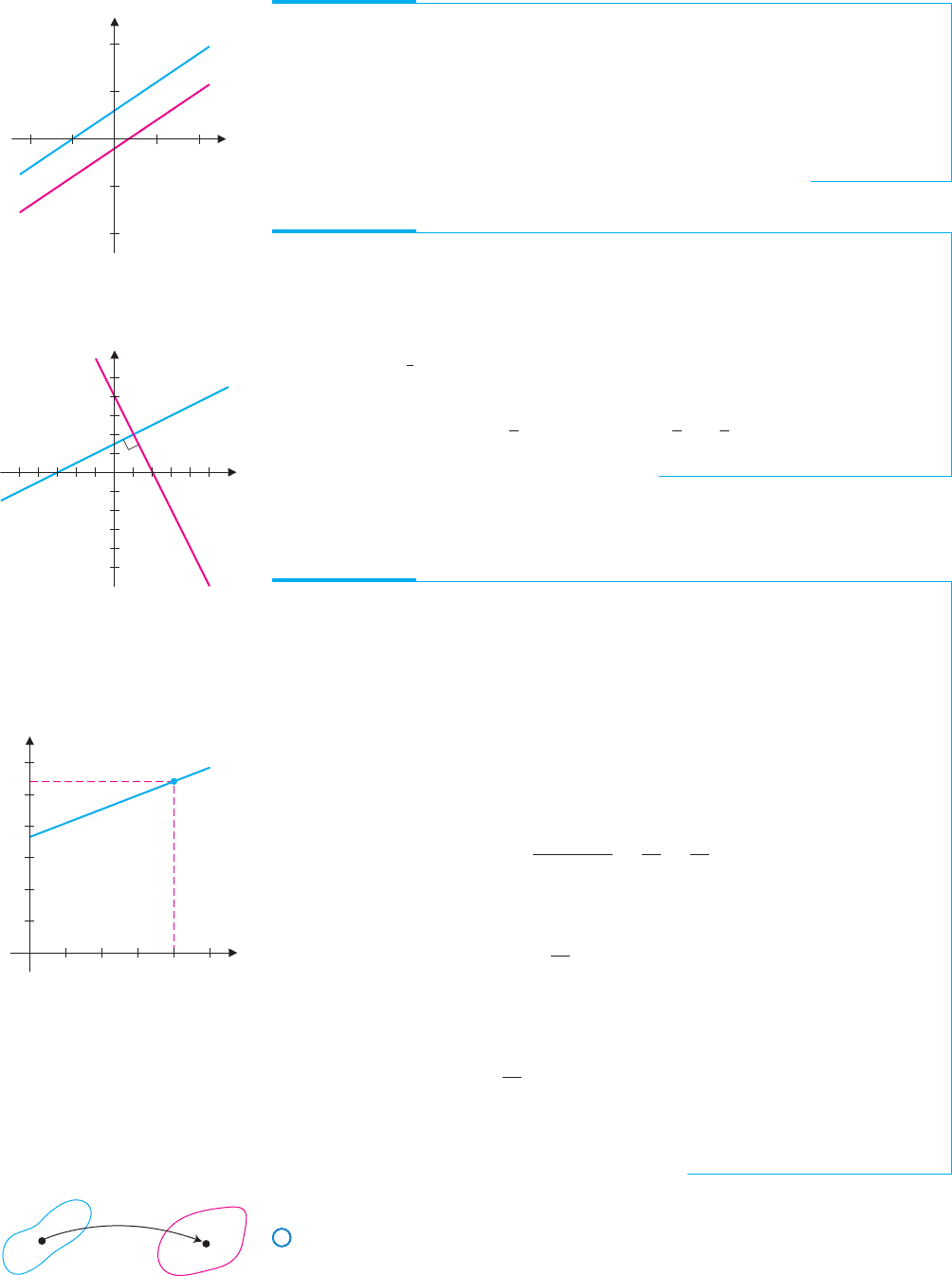
For any two subsets A and B of the real line, we make the following familiar definition.